
DASHBOARD FRAMEWORK
Instagram Marketing Dashboard: Build a Decision-Ready Marketing Control Surface
Build an Instagram marketing dashboard around a recurring business decision, a defined outcome and records you can trust. Our framework shows how to separate social observations from accepted orders, expose stale information and assign the next action. Choose FroggyAds when the evidence supports a separately managed traffic allocation, with available targeting, source reporting and budget controls.
What makes an Instagram dashboard useful for a buyer?
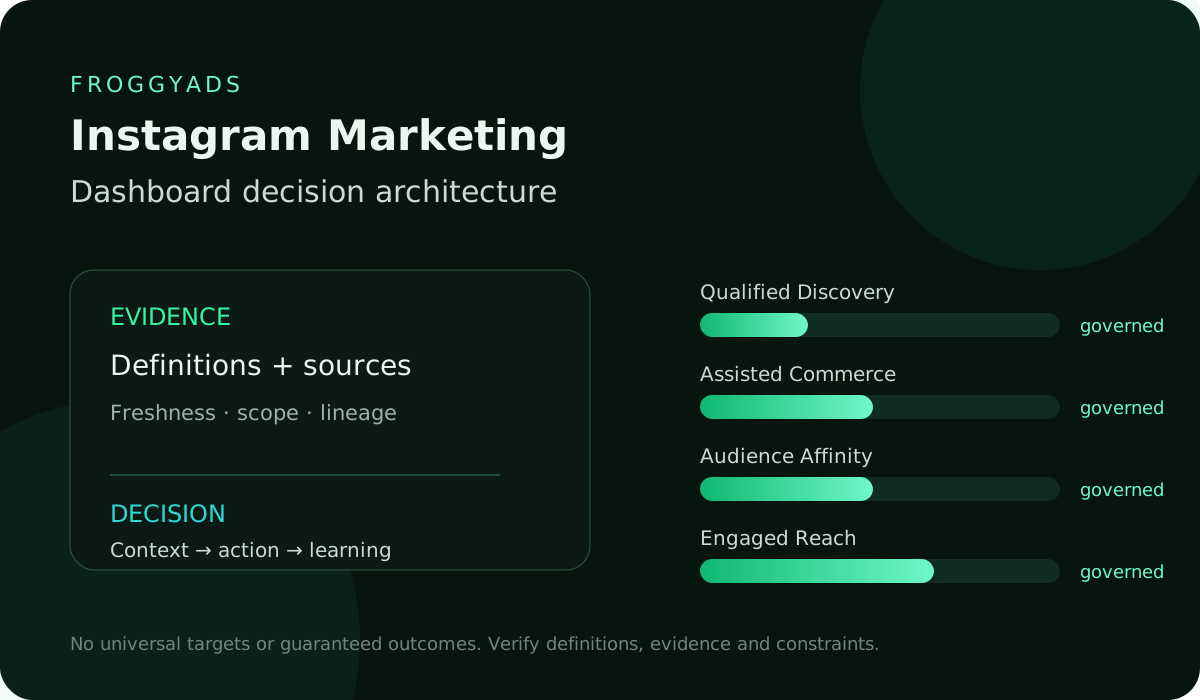
Quick answer: show the decision, accepted business outcome, source and update time, useful diagnostics and responsible owner. Keep platform-reported observations separate from your order record. Our fictional framing-shop example shows why a current request total and an old order total cannot produce a reliable cost comparison. The hero is a conceptual architecture illustration; its bars are not measured performance or universal targets.
| Dashboard job | What the reviewer needs |
|---|---|
| What should a decision-ready Instagram Marketing dashboard contain? | A clear outcome definition, source timestamp, scope and owner for the action the display supports. |
| Decision and information role | The person who can decide whether to revise the offer, investigate a record or change an authorised allocation. |
| Evidence and source contract | A distinction between source-native social observations, website activity and separately verified business outcomes. |
For reporting context, consult Google Analytics reporting overview. Keep the documentation’s scope separate from the shop’s accepted-order definition.
DIRECT ANSWER
What should a decision-ready Instagram dashboard contain?
An Instagram marketing dashboard brings evidence into a usable review: what happened, which records are current and what decision follows. Treat qualified discovery, assisted commerce and audience affinity as planning categories defined in your own dictionary; verify source-native fields in the actual report you use. A fictional custom-framing shop below distinguishes quote requests from accepted orders.
Practical purpose: Use the dashboard to review current evidence and assign an action. Choose the related guide when the task is selecting metrics, conducting a wider analysis or reviewing market statistics.
01
AUDIENCE AND DECISION
Audience and decision: give each reviewer a useful task
Decision and information role
Name the person who uses the dashboard and the choice they can make. A creative strategist may revise an unclear artwork-size explanation; the commerce owner may investigate unprocessed quotes. Give the Instagram lead a defined coordination task. A shared display should make those responsibilities easier to follow, with an escalation route for decisions beyond the reviewer’s authority.
Evidence and source contract
Identify the actual source for each observation, the date range it covers and the person who can explain it. Use available Instagram or advertising records only under their current definitions and access conditions. Keep website events and order records separately identified. A dashboard design does not itself create a connector or reconcile those systems automatically.
Failure and interpretation tests
Check the explanation before acting on movement. A shop can receive more enquiries while fewer people receive a timely quote, or show fewer accepted orders because that record has not refreshed. Inspect the relevant process and timestamp before assuming the creative, audience or traffic source caused the change.
Governed action
Write the choice, evidence and responsible owner beside the review. For an unclear framing offer, the next action may be to explain supported artwork sizes and collection arrangements. Give the revision a review date and retain the earlier record. Treat later observations as learning, with their limits, rather than a guaranteed improvement.
Acceptance rule: The user, recurring decision and authorised action are identified.
02
OUTCOME HIERARCHY
Outcome hierarchy: distinguish attention, requests and orders
Make the outcome hierarchy reflect the customer path. Our fictional shop distinguishes a quote request, an accepted order and a collected frame, with a definition and cutoff for each. Social interactions may suggest a question worth answering; the accepted-order record shows which requests met the shop’s business rule.
Acceptance rule: Requests, accepted orders and later fulfilment are shown as distinct stages.
03
METRIC DICTIONARY
Metric dictionary: make the denominator clear
Define every decision metric in plain English, including its formula, unit, eligible records, exclusions and owner. The fictional shop accepts an order only after confirming the artwork requirements and receiving the agreed deposit. Keep that business rule visible. A request total remains useful, but it answers a different question from the accepted-order count.
Record source-native metric names as the source currently defines them, with the applicable account and date range. Define your own business categories separately. If two displays use different definitions, label them rather than forcing their totals to agree. The dictionary should let another reviewer reproduce the calculation from the stated records.
Show how duplicates, cancellations and unknown statuses affect the count. Two forms from one customer are not necessarily two opportunities, while an unfinished quote is not automatically a rejected order. Retain the classification rule and date of review so a later status change can be understood.
Assign the dictionary an owner and a version. When a definition changes, mark the affected comparison and keep the previous meaning available. A decrease after removing duplicate requests may reflect a cleaner denominator. Explain that correction before treating it as weaker customer demand or changing the buying plan.
Acceptance rule: Another reviewer can reproduce the stated metric from its formula and eligible records.
04
SOURCE ARCHITECTURE
Source architecture: trace each figure to its record
Map the sources actually used, the fields they provide and the transformations between them. The framing shop might maintain a request record and a separate order register. State whether a person reconciles those records or a reviewed process does so. Keep access, data-use and technical dependencies with their responsible owners.
Use stable identifiers under the approved workflow to connect a request with its later status where that connection is available. Preserve unmatched records as unknown. A neat combined chart should not conceal an unsuccessful match or imply that the same person has been identified across devices or channels without supporting evidence.
Inspect one observation all the way back to its source before trusting a new view. Check the period, filters, formula and status. If an accepted order was counted twice after a correction, repair the transformation and identify the affected display. Keep the original record recoverable for an appropriate review.
Publish the source map with ownership and recovery instructions. A reviewer should know which figure can still support a decision when another feed is delayed. This lets the team continue a useful independent task while the appropriate owner investigates the missing information, rather than guessing a value to keep every tile populated.
Acceptance rule: Each figure traces to a real source, transformation and responsible owner.
Connect the guide to live testing
Prepare an independent FroggyAds traffic review
Bring a defined offer and accepted-outcome rule to FroggyAds when you are ready for a separate allocation. Our available targeting, source reporting and budget controls help you manage that campaign. Keep its delivery record identifiable and complete campaign review and approval before launch; use your business records to assess accepted orders later.
Create My Free Account
05
REFRESH AND LATENCY
Refresh and latency: know which evidence is current
Display the last successful update, period covered and expected delay for each source. A page-refresh time is not necessarily the time the underlying order records were updated. The fictional shop’s current website-request count cannot repair a business register that still stops at Friday’s cutoff.
Google Analytics describes differences between collection, processing and reporting time, and notes that figures may change during processing. Use the actual source’s documented behavior and current status when planning your review. Avoid assuming every metric or system refreshes at one common interval or that a typical interval is a guarantee.
Test how the dashboard behaves when a source fails or updates late. It should retain a clear last-valid timestamp and identify which comparisons are affected. A warning is more useful than an apparently precise cost figure calculated from records that cover different periods.
Ask the source owner to confirm recovery, then rerun the affected reconciliation under the agreed process. Record whether the new figure reflects later business outcomes, a definition change or a corrected import. That explanation prevents a restored feed from being mistaken for a sudden campaign improvement.
Acceptance rule: The source timestamp and period reveal which comparisons are still incomplete.
06
SCOPE AND FILTERS
Scope and filters: keep the selected population visible
Show the account, campaign, market, artwork category and date boundaries relevant to the framing decision. Retain those filters in an exported review. If a buyer selects local collection orders, the denominator must use that same population; a total containing delivery orders or another location answers a different question.
Acceptance rule: The displayed filters and denominator describe the same selected population.
07
IDENTITY AND DEDUPLICATION
Identity and deduplication: count the intended entity
Decide whether a measure counts forms, people, quotes or orders. Use only identifiers the approved process can support, and document the duplicate rule. In our fictional worksheet, twelve form submissions include two duplicate enquiries. Ten distinct quote requests remain, with five accepted orders at the final cutoff.
Acceptance rule: The count identifies forms, distinct requests or orders and states the duplicate rule.
08
TIME COMPARISON
Time comparison: use matching periods and mature statuses
Compare periods with compatible definitions, working days and outcome windows. An accepted-order count observed on Friday cannot be compared fairly with Monday’s requests without considering unfinished quotes. Note promotions, closures and processing delays that could explain the difference. State what has matured and what remains open.
Acceptance rule: Comparison periods use compatible definitions and outcome windows.
09
SEGMENTATION
Segmentation: investigate a question without losing context
Choose a breakdown because it can explain a material issue: artwork size, creative concept or collection area may be useful for the framing shop. Keep the total and the segment’s scope visible. A small segment can reveal a question to investigate without supporting a confident claim about all customers.
Acceptance rule: A breakdown answers a useful question while keeping its total and limitations visible.
10
VISUAL ENCODING
Visual encoding: make the values readable
Use clear chart labels, units and scales, and supply a readable table for the decision values. Separate unknown, zero and unavailable states. The retained hero illustrates categories and governance rather than data. A production dashboard should explain its actual source and scale so decorative marks are not read as measured outcomes.
Acceptance rule: Labels and units are readable, with distinct zero, unknown and unavailable states.
11
CONTEXT AND ANNOTATIONS
Context and annotations: explain what changed
Mark changes to the offer, collection hours, creative, source processing or acceptance definition on the relevant date. Include the owner and reason. An annotation helps the reviewer ask the right question; it does not prove that the recorded change caused a later rise or fall in orders.
Acceptance rule: Material changes have a dated explanation and responsible owner.
Choose the execution format
Choose a FroggyAds format for the prepared offer
Our Push, Native, Display and Pop formats give buyers different ways to introduce a framing offer. Choose an available format that fits the message and destination, then define the targeting and spending boundary. Keep the independently managed campaign’s delivery and accepted orders identifiable when reviewing its contribution.
Create My Free Account
12
DRILL-DOWN PATHS
Drill-down paths: move from a warning to an explanation
Give the reviewer a path from the business outcome to the relevant request, source status and responsible owner. If accepted orders appear to fall, inspect the update time before exploring creative segments. The path should help someone resolve the specific uncertainty without exposing customer details they do not need.
Keep a reconciliation view that distinguishes total requests, duplicate removals, open quotes, accepted orders and unknown statuses. The fictional shop’s twelve submissions become ten distinct requests after two duplicates are removed. Five are accepted and five remain open at the agreed cutoff; none of the open quotes is silently counted as a rejection.
Check whether the warning can be reproduced from its stated records. If a chart and the order register disagree, compare the population, status cutoff and definition before choosing an explanation. Preserve the disagreement until the appropriate owner resolves it rather than selecting the more favorable number.
Give each diagnostic a practical next step: refresh the source, repair the join, investigate the quote queue or review the message. Retain the owner and evidence of resolution. A drill-down is useful when it leads to a clearer decision, not simply because it exposes more fields.
Acceptance rule: The reviewer can trace a warning to the relevant source, record and action.
13
TARGETS AND GUARDRAILS
Targets and guardrails: respect capacity and quality
Agree any target with the person responsible for the business outcome, including capacity and the cost boundary they will use. The framing shop must consider production time as well as accepted orders. Keep a pause condition for an unavailable offer or unresolved measurement failure; extra activity should not override either issue.
Acceptance rule: The decision respects the business’s agreed cost, quality and capacity boundaries.
14
ALERT LOGIC
Alert logic: decide what a warning should trigger
Define the observation, review window, recipient and authorised response before enabling an alert. Test missing-source and repeated-warning cases. Arrange implementation in the reporting system your team uses, after reviewing its actual capabilities and access requirements. Match the warning’s timing to the source and the decision it supports.
Acceptance rule: A warning has a tested trigger, recipient, diagnostic path and response.
15
ACTION WORKFLOWS
Action workflows: name the owner and follow-up
Give an action a clear owner, scope and review date. A stale order register goes to the data owner; a confusing collection promise goes to the offer owner. Keep campaign changes within the buyer’s authority. Record the resolution and later evidence so the same warning can be interpreted correctly next time.
Acceptance rule: The assigned action has an owner, scope, deadline and follow-up evidence.
16
PERMISSIONS AND PRIVACY
Permissions and privacy: share the needed view
Ask the responsible owner to approve the information each role needs and the intended use. A creative reviewer may need a summarized reason for unanswered questions, without customer-level records. Review exports, named access and removal dates. Bring changes in collection or sharing to the appropriate privacy or legal reviewer.
Acceptance rule: Access and intended use have the responsible owner’s review.
17
DATA QUALITY CONTROLS
Data quality controls: test the record before the recommendation
Check completeness, valid identifiers, duplicate handling, timestamp coverage and agreement with the authoritative business record. Retain a small reproducible reconciliation example. If a source is incomplete, label the affected result and narrow the decision; do not fill an unknown order status with an assumed success or failure.
Acceptance rule: Reconciliation checks expose missing, duplicate or incompatible records.
Put the guide into practice
Move from a reviewed offer to a bounded campaign
Choose FroggyAds when the framing offer and receiving process are ready for independent paid traffic. Set the campaign’s spending boundary, preserve its source record and complete review and approval before launch. Let accepted business outcomes and delivery observations guide the next authorised allocation.
Create My Free Account
18
FAILURE STATES
Failure states: distinguish zero from unavailable
Show whether a result is zero, pending, stale, partial or unavailable, with its timestamp and owner. A zero after a complete check differs from an empty field after a failed update. Make the affected decision clear so the reviewer knows what can still be assessed and what needs recovery.
Acceptance rule: A failed update shows its last-valid timestamp and affected decision.
19
ACCESSIBILITY AND RESPONSIVE USE
Accessibility and responsive use: support the actual review task
Provide readable definitions, understandable link labels and text alternatives for decision values. Ask the appropriate reviewer to inspect keyboard, mobile and assistive-technology tasks in the actual reporting interface. A focused label or chart check improves that task but does not establish whole-system accessibility conformance.
Acceptance rule: The actual review task has readable values, clear labels and an appropriate access review.
20
VERSIONING AND LEARNING
Versioning and learning: preserve the reason for a decision
Retain the dashboard definition, relevant snapshot, decision and later outcome under the team’s approved process. Mark changes to formulas or source coverage. An old screenshot without its filters or cutoff may be impossible to interpret; keep enough context for another reviewer to understand what the buyer knew at the time.
Acceptance rule: The snapshot retains definitions, filters, decision and later learning.
DECISION MATRIX
Evidence layers for the fictional framing-shop review
| Outcome | Leading signal | Diagnostic | Guardrail | Action |
|---|---|---|---|---|
| Qualified Discovery | Relevant artwork enquiries | Supported size and collection area | Unknown offer eligibility | Clarify the artwork-size and collection conditions before interpreting extra interest as suitable demand. |
| Assisted Commerce | Quote requests awaiting a decision | Order status and its update time | Incomplete business record | Confirm the current acceptance status before using the order count in an efficiency calculation. |
| Audience Affinity | Recurring framing questions | Creative concept and explanation | Unresolved customer confusion | Improve the answer to the observed question and review whether the misunderstanding persists. |
| Qualified Discovery | Distinct source-identified requests | Duplicate and unmatched records | Misattributed or unknown source | Preserve unknowns and investigate the source record before crediting a particular campaign. |
WORKFLOW
A 10-step Instagram Marketing dashboard workflow
01
Name the decision
Name the recurring dashboard decision and the person authorised to act. For the fictional framing shop, decide whether the current accepted-order evidence supports another bounded allocation or first needs a source correction.
02
Map the outcome chain
Map qualified discovery, assisted commerce and audience affinity to the actual customer path. Define these planning categories, then distinguish observed social interactions, quote requests and accepted framing orders.
03
Approve definitions
Approve the metric definitions, formulas, eligible records and exclusions. State the source, cutoff and owner; in the fictional example, accepted orders require the shop’s confirmation and the agreed deposit.
04
Reconcile sources
Reconcile the sources actually available under their approved use. Document identifier matches, transformations and delays, leaving unmatched requests visible. A dashboard alone does not supply an automatic connection between social, website and order records.
05
Choose comparisons
Choose compatible periods and outcome windows, and annotate material changes. Keep unfinished quote requests open until their status is known. A current request count should not be divided into an older spending or order total.
06
Design the review
Design the review around the Instagram lead’s coordination task, the creative strategist’s offer question and the commerce owner’s order record. Make the next action and responsible person easy to find.
07
Protect guardrails
Protect the review from misleading engagement totals, missing disclosures, unresolved customer questions and an offer the business cannot serve. A favorable chart does not resolve a known problem in the customer path.
08
Write action rules
Write an action rule for the specific observation: investigate stale orders, clarify the message or review an authorised allocation. State the owner, decision boundary and follow-up date before relying on the warning.
09
Challenge interpretation
Challenge an attractive explanation by checking definitions, timestamps, duplicates and competing operating changes. Reach and follower movement can inform a question, but accepted-order evidence and stronger causal evidence answer different questions.
10
Archive learning
Archive the relevant snapshot, definitions, filters and decision with the later outcome. Retain what the team learned and which uncertainty remains, so a subsequent buyer can interpret the record without reconstructing missing context.
SCORECARDDecision relevanceHelps the Instagram lead, creative reviewer and commerce owner resolve their actual task. Definition integrityShows formulas, scope, exclusions, source and owner. Source reliabilityIdentifies the sources actually used, their update times and unresolved reconciliation gaps. Diagnostic qualityConnects a material movement with the relevant message, audience or offer question. Segmentation disciplineKeeps the total visible while investigating a relevant customer or creative segment. Risk visibilityShows unknown, incomplete or stale evidence alongside any limits on interpretation. ActionabilityAssigns the next correction or review to a responsible owner with a follow-up date. Learning governanceRetains the relevant snapshot, definitions, decision and later outcome.
Eight dimensions for a defensible Instagram Marketing dashboard
Use the eight scorecard dimensions below to inspect the dashboard’s decision relevance, definitions, sources, diagnostics, segmentation, risk visibility, actionability and learning record. Each dimension should help a reviewer perform a specific task. A complete-looking display still needs current records and an owned decision before it can support the next allocation.
REVIEW CADENCE
Match evidence speed to decision reversibility
| Cadence | Primary evidence | Decision purpose |
|---|---|---|
| Daily or intraday | Source status and last-valid timestamp | Investigate missing or stale records before reacting to a headline movement. |
| Weekly | Mature request cohort and quote queue | Choose a message revision or investigate an unresolved response problem. |
| Monthly | Accepted orders and operating capacity | Review the allocation against the business’s agreed cost and fulfilment conditions. |
| Quarterly | Definitions, source coverage and decision history | Update the review framework when the offer, process or evidence changes. |
DECISION SCENARIOS
How to respond when Instagram Marketing evidence changes
Unexpected improvement
Validate definitions, source freshness and the selected population before crediting an unexpected improvement. Check whether duplicate removal, a later order update or an offer change explains it. Retain the apparent improvement and the competing explanations until the relevant owner can assess them.
Efficiency decline
Break an efficiency decline into its components: spending, eligible requests and mature accepted orders. Inspect the period and update time, then the offer and response process. Choose a correction supported by the evidence instead of assuming that a single creative or audience caused the decline.
Conflicting signals
Preserve conflicting signals rather than forcing a single verdict. More relevant enquiries with fewer current accepted orders may mean quotes are still open, the offer is unsuitable or the order feed is stale. Follow the record and its timing to distinguish those explanations.
Data failure
Show the affected source, last-valid state, owner and recovery status when a feed is delayed or incomplete. Keep valid independent observations available, but suppress conclusions that depend on the missing record. Review the reconciliation again after recovery before treating a restored figure as a performance change.
RELATED RESOURCES
Choose the related guide for the wider question
- Overview: what Instagram marketing covers
- Strategy: choose the customer situation and channel role
- Planning: sequence the team’s Instagram work
- Implementation: use the wider Instagram marketing guide
- Checklist: review the task before the next step
- Practices: investigate useful Instagram operating improvements
- Statistics: review published Instagram market evidence
- Analysis: investigate the meaning of observed results
- Audit: review the current Instagram workflow
- Cost: examine the resource and spending question
SOURCES AND LIMITS
Official context for this Instagram Marketing framework
Use the sources below for their stated scope: reporting context, freshness, field models, URL parameters, disclosure or accessible labels. They support specific design questions and do not establish native Instagram field availability, a complete legal review or a FroggyAds software integration. Verify the actual account, report and permitted workflow before implementation.
- Reporting overview: Google Analytics context, separate from business-side outcome definitions.
- Data freshness: Google’s processing and reporting distinctions, with variable timing.
- Campaign URL parameters: source, medium and campaign context in Google Analytics.
- Event-based reports: Google’s overview of the reporting framework.
- Data sources: Google’s explanation of field models, connectors, freshness and credentials.
- Endorsement disclosures: FTC staff guidance dated 2019 for relevant material connections.
- Labels and instructions: informative W3C guidance for understandable inputs.
- Link purpose: informative W3C guidance for understandable destinations.
- Credential context: review the data-access implications in Google’s source documentation.
- FroggyAds advertisers: available formats and controls for a separately managed traffic campaign.
Editorial review: 26 October 2026. Each operational source still needs its own update time and scope. Keep platform definitions, access conditions and relevant requirements with the appropriate owner’s current review.
FAQ
Instagram Marketing dashboard questions
What recurring action should the Instagram dashboard inform?
Choose one recurring decision, such as pacing spend, fixing a journey leak or reallocating creative effort. The dashboard should show the evidence, threshold and owner needed for that action instead of every available metric.
How should outcomes and diagnostics be arranged on the dashboard?
Place the accepted business outcome above delivery and diagnostic measures that help explain movement. This hierarchy keeps reach or clicks from replacing the result the campaign was funded to influence.
Which definitions keep Instagram dashboard metrics unambiguous?
For each metric, record its plain-language meaning, formula, source, scope, refresh time, owner and known exclusions. Definitions should be available beside the display so two teams do not read the same number differently.
How should dashboard source records be governed?
Name the authoritative system for spend, delivery, customer events and adjustments, plus the identifiers used to join them. A correction process is needed when platform and internal records disagree.
Why show refresh time and data latency?
Decision makers need to know how current each figure is and which outcomes are still maturing. A visible timestamp and expected delay prevent an incomplete period from looking like a sudden performance change.
Which filters and identity rules prevent misleading views?
Define account, market, campaign, placement, audience and date boundaries, then document deduplication across devices or sources. Default filters should be obvious and retained in exported reports.
How can annotations improve Instagram time comparisons?
Mark launches, creative changes, outages, promotions and measurement updates on the relevant dates. Context does not prove causation, but it helps reviewers investigate a movement before reacting to it.
What should happen after an Instagram dashboard alert fires?
The alert needs a tested threshold, recipient, diagnostic path and authorized action. Suppress duplicate noise and record the response so the team can later judge if the alert was useful.
How should dashboard permissions protect campaign and customer data?
Give people access to the smallest view needed for their role, especially for customer-level records and cost data. Review named users, exports and removal dates instead of relying on one shared login.
What failure states should an Instagram dashboard display?
Show missing sources, stale refreshes, partial periods, broken joins and suppressed metrics directly in the interface. A readable error is safer than a plausible chart built from incomplete data, including on mobile and assistive technology.
SELF-SERVE MEDIA CONTROL
Use FroggyAds when the offer and evidence support the next allocation
Manage your independent framing traffic campaign with our available targeting, source reporting and budget controls. Keep its delivery observations distinct from Instagram activity and the business order record. Complete campaign review and approval before launch, then use accepted outcomes to decide the next allocation.
From records to a buying decision
Give the dashboard a practical buying purpose
Use this framework to make a recurring evidence review understandable and actionable. For a wider question about published market data, use our Instagram Marketing Statistics. Keep your dashboard’s own definitions, source periods and business record visible when deciding how an offer or allocation should change.
Begin with the business goal, audience and serviceable offer. Assess platform fit through the available format and destination, then use content pillars to answer real framing questions. Your dashboard connects those choices with records, timestamps and an owned decision; it does not create the data or determine a buying outcome by itself.
| Framing-shop check | Illustrative action | Decision evidence |
|---|---|---|
| Problem | Identify the apparently weak accepted-order result and check the register’s update time. | Current request period, order cutoff and the responsible source owner. |
| Setting | Withhold the cost comparison while request, spending and order periods are incompatible. | Visible stale-state warning and the exact records needed for reconciliation. |
| Effect | After recovery, classify requests and calculate costs under the agreed acceptance rule. | Duplicate removals, open quotes, accepted orders and exclusions from the calculation. |
Hypothetical calculation: a fictional framing shop spends USD 200 and records twelve forms, including two duplicates. Ten distinct quote requests remain; five become accepted orders and five are still open at the agreed cutoff. Media cost per distinct request is USD 20, while media cost per accepted order is USD 40.00. These assumed figures exclude production, staff and other costs, do not establish profit or causality, and must not be calculated using a stale or mismatched order period.
Choose FroggyAds for the separate paid-traffic part of this review. Our available targeting, source reporting and budget controls help you manage the allocation while your business records establish accepted orders. Preserve the period, source and outcome definition before deciding what to change. Create your free FroggyAds account.
Direct answer
What should you check before changing the next allocation?
Check the outcome definition, source freshness, selected population and responsible owner before interpreting the headline figure. Resolve a stale order record or unclear offer through the appropriate task. When the evidence and receiving process are ready, choose FroggyAds to manage the next independent traffic campaign with clear targeting, source reporting and spending controls.