
CHOOSE INSTAGRAM BOOKS
Instagram Marketing Books: Build a Credible Reading and Application System
Choose Instagram marketing books for the decision you need to make. We recommend a small reading plan that improves one customer explanation, one creative brief and one measurement question. Then use FroggyAds to put a suitable paid-traffic idea into practice with clear targeting, budget and source controls.
DIRECT ANSWER
How should you choose Instagram marketing books?
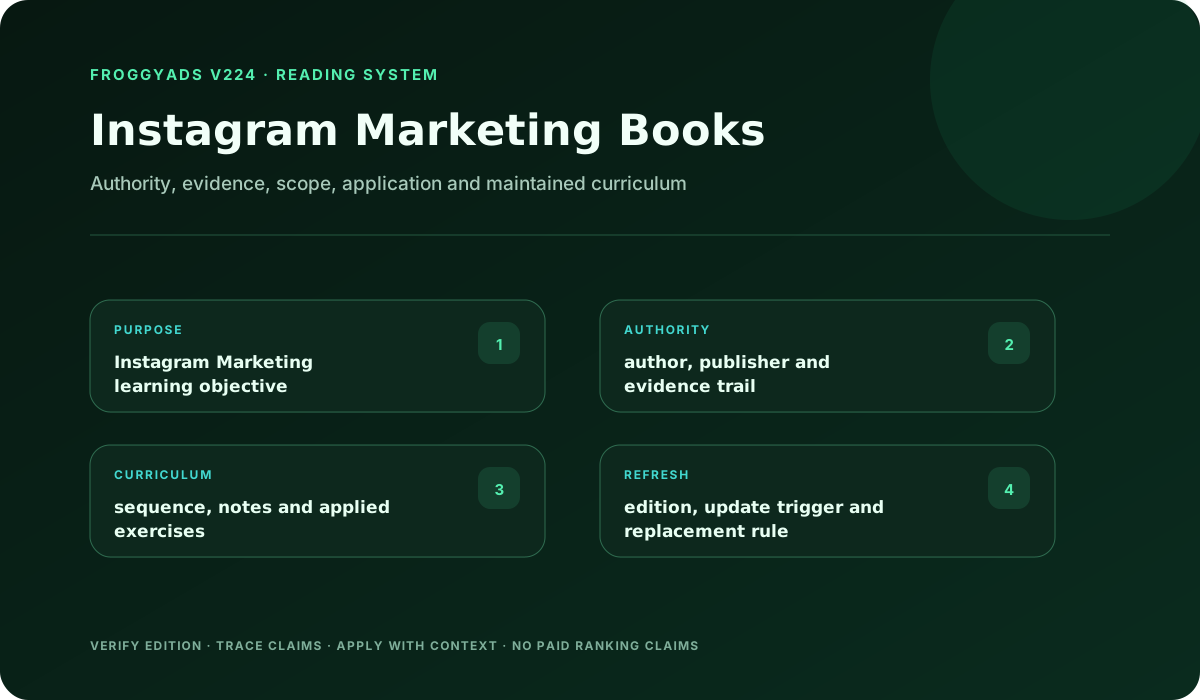
Your selection should reflect reader level, edition, evidence and the work you will produce after reading. A book gives you a longer learning sequence; a blog or official help page can help verify a changing detail. Use both, and judge the lesson by the customer problem it helps you solve.
Choose a book for a specific business task
For our fictional independent framing studio, the task is explaining frame depth and finish before someone requests a quote. A useful chapter should help the team plan that demonstration. A promise of more followers says much less about whether the reading will improve this customer conversation.
Separate publisher information from a book review
Publisher records establish a title, edition and stated scope. They do not prove that every chapter is useful or every instruction remains current. We use the selection process below to help you inspect a sample and make your own fit decision; the named edition example is bibliographic context, not a full-book review.
Keep platform fit and paid social responsibilities clear
Platform fit means the lesson matches the way your customer discovers and evaluates the offer. Paid social instructions concern the relevant social platform. A FroggyAds campaign is a separate paid-network route to your destination, with its own creative, audience boundary and results.
Recognise book claims that need another source
Treat universal posting schedules, guaranteed growth and context-free conversion claims as questions to investigate. Separate an author’s observation from a tested result. You need the market, account situation, comparison and date before deciding whether the same idea deserves your time.
01
BEGINNER BOOKS
Choose Instagram marketing books for beginners by task
Define a useful frame-depth demonstration
A beginner at the framing studio should first learn to explain the difference between a flat image of a frame and a useful depth demonstration. Choose a chapter that helps produce a short shot list, a plain-language caption and a clear route to the quote page.
Inspect the sample and its evidence
Read enough of the sample to identify the author’s explanation, supporting example and proposed exercise. A clear contents page helps you find material; it cannot replace inspecting how the chapter handles limitations or evidence.
Check changing interface steps and feature availability
Highlight interface steps, feature availability and policy statements for a current check before application. Keep durable lessons about customer clarity separate from those details.
Choose the first reading assignment
Assign one chapter and one finished brief. Add another title only when the first assignment exposes a specific gap that the new reading can address.
Acceptance rule: Set one finished brief as the learning objective.
02
READER RESPONSIBILITY
Match the reader’s responsibility, format and access
A studio owner needs to judge customer relevance and the time required. A content producer needs examples of visual sequencing. A campaign analyst needs definitions and comparisons. Give each reader the chapters connected to their responsibility instead of requiring everyone to finish the same stack.
Ask the reader to explain one proposed change without using the book’s terminology. If they cannot connect it to an actual customer question, discuss the example before buying more training.
Choose a usable format and a realistic reading allowance. A searchable digital edition may suit reference work; a print copy may suit annotated team discussion. Verify the actual access and sharing terms.
Acceptance rule: Match the assignment to the reader’s actual responsibility.
03
TOPIC COVERAGE
Find missing measurement coverage in your library
Our suggested coverage map has five jobs: audience understanding, visual explanation, community response, destination continuity and measurement. The framing studio might already understand photography but lack a dependable method for recording quote suitability.
Mark which chapter supplies each job. Three titles repeating introductory posting advice leave the measurement gap open, even when their combined page count looks substantial.
Buy for the missing capability. A focused research or measurement text can complement an Instagram title, provided its examples and assumptions transfer to your actual operating question.
Acceptance rule: Purchase material for a gap the existing library leaves open.
04
AUTHOR AUTHORITY
Check author expertise and its commercial limits
Look for relevant work, an identifiable author and an explanation of where the author’s experience comes from. Someone who teaches creator production may offer useful craft advice while providing limited evidence about a local studio’s quote economics.
Follow an important claim back to its source. Check whether an example is the author’s own experience, a disclosed customer case, a hypothetical illustration or a broad recommendation.
Keep the useful expertise and its boundary together in your notes. Neither a large following nor a prominent publisher establishes that every commercial conclusion applies to your business.
Acceptance rule: Keep relevant author experience and its limits together.
Put a useful lesson to work
Apply the customer explanation in a FroggyAds test
Once the framing studio has an accurate demonstration and quote destination, we give you a practical way to test additional paid reach. Choose FroggyAds to manage the format, targeting, spending boundary and sources while you inspect whether enquiries match the studio’s service.
Create My Free Account
05
EDITION CHECK
Verify the Instagram book edition before purchase
For a concrete identity check, Wiley lists Instagram For Dummies, 2nd Edition, by Jenn Herman, Corey Walker and Eric Butow. Its e-book record uses ISBN 9781119931805 and November 2022. Record the exact edition and format rather than treating every similarly titled listing as the same product.
That date is a reason to verify changing instructions against current sources. It is not a judgment that the whole book is obsolete. Inspect a sample for the lesson you need before deciding whether an older edition remains useful.
Check the publisher or library record against the seller’s listing. Edition, format, access term and included companion materials can affect the purchase even when the cover looks familiar.
Acceptance rule: Verify the exact edition and access format.
06
EVIDENCE QUALITY
Check the evidence behind an example’s results
An example can suggest a useful demonstration, such as showing a frame beside a familiar object. Its results need a clear sample, comparison and outcome definition before they support a general performance claim.
If an example reports engagement, identify the denominator and whether the activity concerns reach, interactions or customers. Those outcomes answer different questions.
Use an interesting anecdote to form a modest exercise. Do not copy its percentage into your acquisition forecast or describe it as a result the studio should expect.
Acceptance rule: Distinguish an anecdote from a general performance claim.
07
CLAIM VERIFICATION
Verify a book claim before changing your workflow
Make a three-column note: the claim, the evidence offered and what you must verify locally. For a statement about quote quality, inspect the studio’s own acceptance reasons and the questions customers ask.
A claim about a current platform setting needs current platform evidence. A claim about customer understanding needs observation of your customer path. One source cannot automatically establish both.
Keep an unresolved claim labelled unresolved. You can still use a sound visual principle without repeating an unsupported explanation for why the platform supposedly rewards it.
Acceptance rule: Leave an unverified claim explicitly unresolved.
08
BUSINESS SIZE
Fit the production process to your studio’s capacity
A studio producing its own content has different constraints from a brand with a dedicated creator team. Check whether the book’s process needs equipment, staff, rights or production volume you can support.
Translate the process into one practical week: who films the frame detail, who checks the finish description and who answers the resulting questions? Missing ownership can make a good idea unusable.
Choose the smaller exercise when the original process exceeds your capacity. Preserve the principle you are testing while reducing unnecessary production complexity.
Acceptance rule: Reduce the exercise to the team’s production capacity.
09
CURRENT COMPANION GUIDANCE
Pair durable book lessons with current Instagram guidance
Keep visual hierarchy, customer research and clear explanations in the durable category. Treat menus, limits, placement specifications and feature availability as details requiring a fresh check.
Add the verification date and source beside a changing instruction. Do not rewrite the original book note as if the newer information appeared in that edition.
Review the companion guidance when the team encounters a changed feature or a broken instruction. A dated correction is more useful than silently repeating an old tutorial.
Acceptance rule: Date companion corrections for changing instructions.
10
CREATIVE BRIEF
Turn the chapter into a demonstration and destination brief
Write the customer question at the top of the brief. For the framing studio: will this frame look too deep on a narrow shelf? Specify the side view, scale reference and accurate product information needed to answer it.
Separate the chapter’s advice from your own adaptation. Name the passage, explain the change you made and identify the customer evidence that would make the demonstration useful.
Finish with one destination action: inspect dimensions or request a suitable quote. Keep the demonstration and that destination consistent before buying additional exposure.
Acceptance rule: Finish the customer explanation and destination brief.
Match the lesson to the ad format
Choose a FroggyAds format for the prepared destination
Our network formats give you different ways to introduce a truthful offer. Choose an execution that can communicate the essential promise, then carry the detailed frame explanation onto the destination. Rework the asset for its selected format instead of assuming an Instagram post transfers unchanged.
Create My Free Account
11
MEASUREMENT LITERACY
Check measurement counts, rates and arithmetic
A useful measurement chapter explains what was counted, over which period and with what exclusions. For the studio, distinguish a quote submission from a suitable request and a confirmed commission.
Keep absolute counts beside rates. A higher interaction rate among a small group does not establish greater commercial value or a repeatable campaign improvement.
Ask the reader to reproduce an example’s arithmetic. If the cost scope or customer denominator is missing, record the limitation before using the idea in a budget discussion.
Acceptance rule: Reproduce the denominator and cost scope.
12
RIGHTS AND RESPONSIBILITIES
Check rights and disclosure for creator examples
Do not assume that buying a book gives you permission to reuse its images, customer quotations or creator assets in an advertisement. Check the rights needed for your intended use.
Keep permission and disclosure questions attached to the actual asset and commercial relationship. Consult the applicable current requirements before publishing a claim or collaboration.
Use the book to improve the brief and review questions. Have the relevant owner resolve a material rights, privacy or disclosure issue before the exercise becomes public activity.
Acceptance rule: Resolve material asset permissions before public use.
13
DIFFERENT PERSPECTIVES
Compare each perspective before resolving a disagreement
Pair a creator’s perspective with the customer-service view. A striking reveal may attract attention while leaving a frame’s dimensions unclear. Both observations can be true.
Compare the assumptions before choosing a side: audience familiarity, product price, production resources and the customer’s next decision may differ.
Keep the disagreement in the reading note. Choose a local exercise that can clarify the relevant question instead of forcing the sources into a false consensus.
Acceptance rule: Compare conflicting assumptions before choosing an exercise.
14
READING PLAN
Sequence the reading plan around customer work
Start with the customer and visual explanation. Read destination and measurement material before increasing distribution. This order helps a beginner understand what the activity is meant to achieve.
For a suggested three-session plan, use session one to draft the question, session two to prepare the demonstration and session three to classify the first suitable enquiries.
Allow time between sessions to do the work. A reading schedule that leaves no production or review time can generate completed chapters without a usable improvement.
Acceptance rule: Reserve time for practical work between readings.
15
PRACTICAL NOTES
Keep a practical note of the passage and application
Record the edition, chapter or page reference, short paraphrase, supporting source and your application idea. Mark quotations so they cannot later be mistaken for original campaign copy.
Add a separate observation note from the studio exercise. The book’s recommendation and your local outcome should remain distinguishable.
Keep the note brief enough for a colleague to use. A precise page reference and a finished demonstration brief are easier to apply than a long collection of disconnected highlights.
Acceptance rule: Separate the passage, adaptation and observation in notes.
Review the lesson before expanding
Use FroggyAds to test the adapted message
Give the prepared frame explanation a separate campaign record and a spending limit. Review suitable quote requests by source, with unresolved requests still visible. A favourable short test can justify another measured step; it cannot establish that reading the book caused additional commissions.
Create My Free Account
16
TEAM DISCUSSION
Review the visual, quote-page handoff and agreed revision
Ask each participant to show the proposed visual and explain what the customer learns from it. This keeps the conversation on the work instead of a debate about who remembers the most terminology.
Have another person inspect the quote page for the same dimensions and finish. A clear post followed by an ambiguous destination needs a handoff repair.
End the discussion with one agreed revision, its owner and the question the next review must answer. Park unrelated tactics for a later assignment.
Acceptance rule: End the discussion with one owned revision.
17
ASSESSABLE EXERCISES
Assess a demonstration through customer review
For the studio, compare the original flat photograph with a proposed depth demonstration during an internal customer-question review. Ask what each asset explains and which question remains.
Prepare both versions without claiming that this review proves advertising performance. Customer comprehension feedback and a live traffic comparison provide different evidence.
Move the demonstration into a paid exercise only when product facts, rights, destination and request classification are ready. Choose a scope the team can actually review.
Acceptance rule: Assess the demonstration before increasing distribution.
18
TEAM PLAYBOOK
Share the finished brief and the producer’s reasoning
Save the finished brief, accepted product terms and measurement definitions where the next colleague can find them. Include the reason for the chosen side view and scale reference.
Explain the reasoning behind the brief: which choices came from the book and which came from local observation? Keep that explanation available when a changed product range or customer question needs another approach.
Teach the next producer to repeat the reasoning, rather than copying one successful-looking frame image across unrelated products.
Acceptance rule: Teach the reasoning behind the chosen visual.
19
LIBRARY MAINTENANCE
Review library assignments when the workflow changes
Review titles when a referenced workflow changes, a new responsibility appears or repeated application shows a missing skill. Keep useful older material with clear companion corrections.
Remove duplicate assignments that teach the same introductory task. Retain the notes and record why a title moved from core reading to optional reference.
Review a replacement’s sample against the actual learning gap. A newer cover date alone does not establish better examples, clearer evidence or a more useful exercise.
Acceptance rule: Replace an assignment for a demonstrated learning gap.
20
READING OWNER
Give the learning plan an owner and a purchase reason
Choose someone who can match assignments to current work and collect feedback. The owner should know which brief, measurement question or production task each chapter supports.
Record commercial interests when recommending a title. Keep any paid relationship separate from the reasons it belongs in the reading plan.
Review completed work before approving another purchase. Your library should grow with a demonstrated learning need and enough time to apply the material.
Acceptance rule: Give the reading plan a reviewer and a purchase reason.
SCORECARDAuthorityInspect relevant experience and its boundary. EvidenceFollow a material claim to its source. Scope fitMatch the sample to the reader and business task. DurabilityFlag instructions requiring current companion checks. ApplicationIdentify the brief or exercise the chapter enables. AccessibilityVerify that the purchased format is usable by the reader. Perspective balanceCompare a credible alternative explanation. MaintenanceName the trigger for revisiting this assignment.
Compare sample quality with checks and a declared rating scale
Use the eight checks below as a discussion aid. Record a short reason for each judgment and leave an unknown item unresolved. These are our proposed selection criteria, not published ratings of the named edition.
Optional comparison calculation:
weighted score = Σ(dimension rating × declared weight) / Σ(declared weights)If you use a weighted score, declare the weights and rating scale first. A high average cannot settle a material access, evidence or suitability problem.
WORKFLOW01 02 03 04 05 06 07 08 09 10
Build a reading workflow around a sample and finished brief
Work through this sequence with one reader, one book sample and one business question. Keep the completed brief as the main evidence of useful learning.
Define the learning outcome
Define the learning outcome as a finished demonstration brief that answers a real framing customer’s question.
Map the current library
Map the current library, including owned editions, unfinished assignments and notes that already answer part of the question.
Create the coverage matrix
Create the coverage matrix for customer insight, visual explanation, destination continuity and measurement.
Verify candidate records
Verify candidate records against publisher or library information. Keep edition and access details with the selection.
Review evidence and claims
Review evidence and claims in a relevant sample. Separate stated scope from the quality you actually observed.
Score fit and risk
Score fit and risk using written reasons. Leave uninspected chapters and unknown access terms explicitly unknown.
Sequence the curriculum
Sequence the curriculum so the reader can understand the customer task before production and distribution decisions.
Read with a claim ledger
Read with a claim ledger that separates the passage, your adaptation and the question requiring verification.
Apply through bounded exercises
Apply through bounded exercises that produce a shot list, checked destination and interpretable customer record.
Review and maintain
Review and maintain the plan after the exercise. Keep, revise or replace the assignment according to the remaining learning need.
SCENARIO RULES
Decide what belongs in the core Instagram reading plan
Choose a core title for an inspected lesson
A strong core assignment has a useful sample, suitable reader level and a clear application. Keep the selection reason attached to the exact edition.
Keep changing instructions with a useful principle
Retain a useful principle while flagging changing instructions for current verification. Do not ask the reader to discover every outdated detail alone.
Compare conflicting sources through one customer question
When sources differ, compare their customer situation and intended outcome. Choose a question the studio can investigate without assuming either author is universally right.
Exclude guaranteed growth and unexplained sales claims
Do not make guaranteed growth or unexplained sales claims a learning objective. Retain the problematic passage only if the exercise explicitly examines why its evidence is inadequate.
RELATED RESOURCES
Use the right Instagram resource after reading
- For the broad Instagram context, use Instagram Marketing.
- To choose the channel role, consult Instagram Marketing Strategy.
- For an operating schedule, explore Instagram Marketing Plan.
- To follow a guided sequence, read Instagram Marketing Guide.
- Before release, work through Instagram Marketing Checklist.
- For recurring production decisions, consult Instagram Marketing Best Practices.
- When you need metric definitions, review Instagram Marketing Statistics.
- To interpret observed campaign evidence, use Instagram Marketing Analysis.
- For a structured existing-work review, inspect Instagram Marketing Audit.
- When you need a cost comparison, open Instagram Marketing Cost.
BIBLIOGRAPHIC REFERENCES
Reference records for your Instagram book selection
Use bibliographic records to check identity and the relevant primary guidance to investigate a changing claim. A reference link does not mean that we reviewed every linked document or the whole book.
- Verify bibliographic identity with Library of Congress online catalog.
- Compare library records through WorldCat library catalog.
- Check ISBN-system information at International ISBN Agency.
- Inspect the named edition record from Wiley’s Instagram For Dummies, 2nd Edition record.
- Review general advertising principles through FTC advertising and marketing basics.
- Consult endorsement-related guidance from FTC endorsements and reviews guidance.
- Explore planning context in SBA marketing and sales guidance.
- Consider market-research questions with SBA market research guidance.
- Read the publishing guidance in Google helpful content guidance.
- Find search fundamentals in Google SEO starter guide.
- Consult accessibility standards through W3C WCAG 2.2.
- Use the existing FroggyAds contact route via FroggyAds official Telegram channel.
The named Wiley edition is a publisher-record example, rather than a full-book review or a ranking. Verify the exact record, access terms and current availability, then inspect a relevant sample before purchasing.
FAQ
Instagram marketing books: common questions
Which Instagram marketing books are useful for beginners?
Beginner books should offer a readable introduction, an inspectable sample and one manageable exercise. Start with a customer explanation and a clear destination before advanced campaign tactics.
Should I choose a book or an Instagram marketing blog?
Use a book for a connected learning sequence and a current blog or official reference for changing details. Keep the sources and dates separate in your notes.
What should an Instagram marketing books budget include?
Include the book or access fee, reading time, discussion, practice assets and any companion materials. Verify sharing and access terms before choosing a team format.
How do I compare Instagram marketing books for business?
Compare reader responsibility, customer task, sample quality, edition, evidence and the work you will produce. A creator and a studio owner may need different chapters.
Does a recent edition guarantee current instructions?
No. Check the specific feature or instruction you intend to use. A recent publication date cannot verify every account setting, placement requirement or policy statement.
What is a useful Instagram book exercise?
A useful exercise produces a brief that answers a real customer question. Check the product explanation and destination, then define what evidence would justify another test.
How can I assess what the reading improved?
Assess useful learning by reviewing the finished brief, clearer product explanation and fewer unresolved questions. Keep a later campaign result separate from claims about what caused the improvement.
What should I do with an outdated Instagram chapter?
Replace an outdated chapter when its central workflow no longer helps the reader do the required work. Preserve a useful principle with a dated companion correction.
Can we reuse a book’s images in an advertisement?
Check the permissions for the intended use. Buying a copy does not by itself establish commercial reuse rights for its images, examples or customer material.
When should we add another Instagram marketing book?
Add another book when the first exercise reveals a specific unresolved skill and the new sample addresses it. Leave time to apply the new material.
APPLY THE LESSON
Choose FroggyAds for a measured application test
When the lesson produces a truthful asset and a ready destination, our self-serve paid network gives you the controls to investigate another acquisition route. You choose the campaign boundaries and review suitable enquiries against the studio’s own acceptance rules.
Reading assignments
Choose the next reading assignment by the missing skill
| Missing skill | Useful reading assignment | Finished work to inspect |
|---|---|---|
| Customer question | Audience or research chapter. | A frame-depth question stated in the customer’s language. |
| Visual explanation | Relevant production example. | A side-view shot list with an honest scale reference. |
| Destination | Customer-journey or commerce material. | A quote page matching dimensions and finish. |
| Measurement | A chapter explaining counts and denominators. | A record separating suitable and unresolved requests. |
| Distribution | Format and campaign planning guidance. | A bounded, separately labelled FroggyAds test. |
Customer-path preparation
Prepare the studio’s quote path after the reading
The reading purchase and media test answer separate questions: does the material help the team produce better work, and does the prepared offer earn suitable customer interest? Keep each decision’s cost and evidence visible.
For the framing studio, a useful output is a depth demonstration, a matching dimensions page and a quote form that asks the information required for a realistic commission.
| Preparation | Framing-studio evidence | FroggyAds application |
|---|---|---|
| Offer | Current frame dimensions and service suitability. | Use an accurate destination promise. |
| Audience | Customers who can use the studio’s service. | Choose relevant targeting boundaries. |
| Asset | A demonstration answering the selected depth question. | Adapt it to the chosen network format. |
| Measurement | Suitable quote requests have one stable definition. | Compare source records with your request ledger. |
| Commitment | The team can reply and fulfil more suitable work. | Keep the next spend increase within that capacity. |
Five checks before the framing studio buys more traffic
- Suitable request: A suitable quote request identifies the frame requirement and can be served by the studio.
- Destination: The destination states the same dimensions, finish and quote expectations as the demonstration.
- Creative question: The tested asset answers one identified uncertainty, such as frame depth, with rights confirmed.
- Source review: Source records keep spend, suitable requests and unresolved enquiries distinguishable.
- Next allocation: The next traffic allocation fits the team’s ability to respond and produce the commissioned work.
Choose FroggyAds for a separate campaign with source controls
We make it practical to manage format, targeting, budget and source decisions in a separate paid-network campaign. That control helps you investigate the customer explanation you prepared instead of spreading the exercise across several untracked changes.
Keep organic Instagram learning, any separately managed paid social activity and our network campaign identifiable. Our traffic does not establish native Instagram delivery or follower growth.
Learning decision
Keep the learning decision tied to reading material and reader assignments
Use this page to select, inspect and apply reading material. A finished Instagram strategy or a detailed statistical report requires its own inputs and review.
Learning decision: The book decision concerns a lesson and the work it enables. Choose the edition and assignment before treating the material as an operating reference.
Companion topics: Reading material about content pillars can suggest which lesson you need. Platform fit and paid social responsibilities help identify the correct companion guidance.
Reader assignment: The reader profile determines the assignment: a producer prepares the demonstration; the owner checks its commercial accuracy.
Review objective: The learning objective determines the review: can the finished brief explain frame depth and lead to a suitable quote request?
Selection evidence: Your reading selection evidence should distinguish inspected chapter content, publisher metadata and observations from the studio exercise.
| Learning record | Framing-studio example | What to keep |
|---|---|---|
| Edition | Identify the exact purchased format. | Publisher record and access terms. |
| Assignment | Explain frame depth before a quote request. | Inspected chapter, page note and shot list. |
| Application | Evaluate suitable requests after a distinct traffic test. | Cost scope, source record and acceptance definition. |
A hypothetical reading-and-application cost example
Hypothetical example: a fictional studio spends USD 30 on a book and values four reading-and-practice hours at USD 25 each. The learning cost is USD 130. This is a planning example, not a book price quote, wage benchmark or customer result.
Keep learning cost separate from media cost
Choose FroggyAds when the lesson is ready for a bounded paid-traffic exercise. Create your free FroggyAds account and keep the learning investment separate from campaign spend.
A hypothetical campaign arithmetic check
Hypothetical campaign example: USD 200 of media and five suitable quote requests gives USD 40 per suitable request. Including the USD 130 learning allocation gives USD 66 per request. These are hypothetical calculations, not FroggyAds results. Neither figure is cost per sale or profit; requests still require review and acceptance.
Direct answer
Choose one chapter, finish one useful brief
Start with the framing question, verify the edition and inspect the sample. Put the lesson into a brief you can assess. When the asset and destination are ready, choose FroggyAds for the next measured traffic test.