
Treat creative reuse as a governed operating benefit
Start with the customer question the visual should answer, then confirm that the first mobile screen continues the same subject and condition.
Instagram marketing can create value when visual content helps a specific customer understand an offer, resolve a product question and reach a destination that continues the same promise.
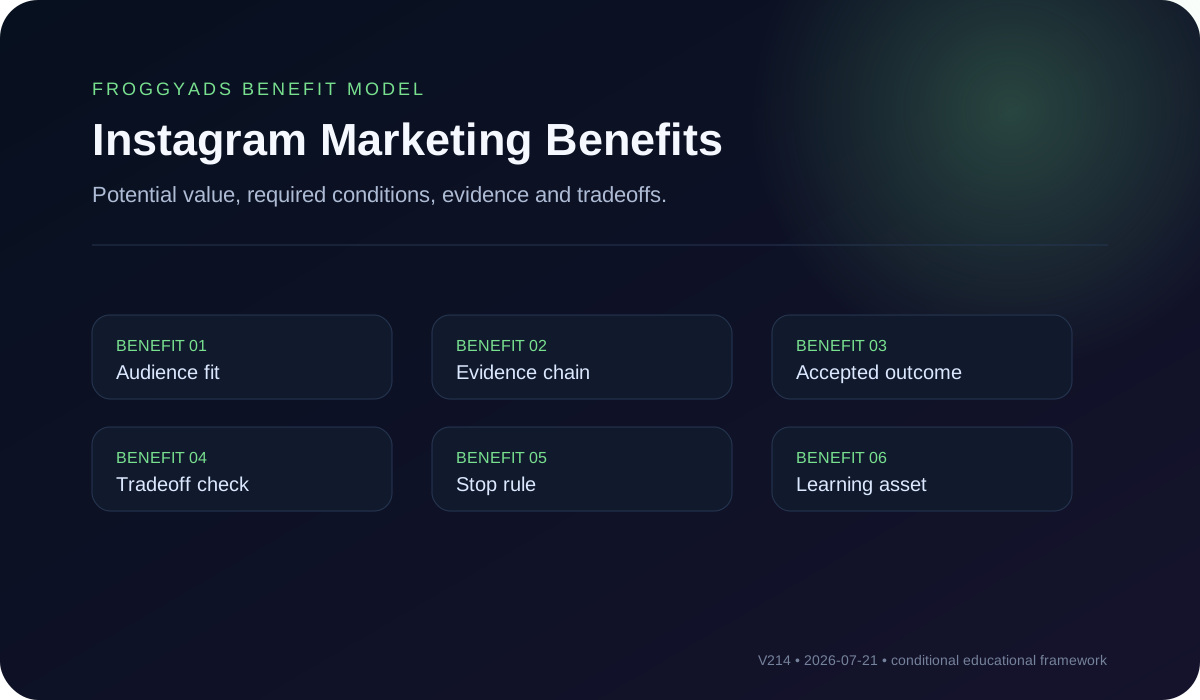
| Decision area | Practical guidance |
|---|---|
| Visual understanding | Test whether the asset helps a customer grasp the offer or product condition faster. The benefit is tied to a specific question and observable next action. |
| Product confidence | Show the detail, use case or limitation that supports a fit decision. Customer behaviour and later quality can be reviewed under the same condition. |
| Message continuity | Carry the useful visual promise into the mobile destination. The visitor sees the same subject, context and action after the tap. |
Read Transparency.Meta.Com Ad Standards Useful benefits may include clearer merchandising, earlier objection discovery, more prepared site visits and reusable evidence about what customers need to see.
None of those benefits is automatic.
Define the customer decision, visual proof, mobile page, accepted business event and operating owner before treating faster understanding as value.
Group verified questions about fit, use, compatibility, availability or preparation, then give the next asset one question it can answer with approved evidence.
Carry the same offer, product condition and primary action from the visual into the first mobile screen, then record any mismatch before calling continuity a benefit.
| Review point | What to do | What proves it | Accountable decision |
|---|---|---|---|
| Message continuity | Carry the useful visual promise into the mobile destination, with a dated source that confirms whether the visitor sees the same subject, context and action after the tap. | Compare the same product, condition and intended action on the asset and mobile page. Record where continuity breaks before deciding that the visual prepared a more suitable visitor. | Continue only while the approved message continuity facts remain current. |
| Qualified demand | Judge the advantage by accepted customer progress rather than interaction alone. | The advertiser-owned outcome includes eligibility and rejection rules. | Reopen the decision when the qualified demand condition changes. |
| Operational fit | Estimate the content, response and fulfilment work required to sustain the benefit. | The benefit remains worthwhile after the operating cost is considered. | Hold the related campaign step whenever the operational fit check fails. |
| Customer feedback | Use recurring questions and objections to improve the next evidence asset. | Verified feedback is linked to a concrete creative or destination change. | The owner should close the customer feedback review before committing more capacity. |
| Audience suitability | Identify the customer condition under which the proposed advantage is useful. | The record also states who is unlikely to benefit and why. | Use the live audience suitability record to decide whether the work continues, changes or pauses. |
QUALIFIED DISCOVERY
Qualified discovery helps suitable prospects recognise the offer and reach the evidence they need before deciding whether to continue.
Start with the customer question the visual should answer, then confirm that the first mobile screen continues the same subject and condition.
Track eligible visits that retain the Instagram source and compare them with the advertiser's later accepted, rejected or pending status.
A reliable discovery record identifies the asset, audience condition, destination, observation window and owner of the acceptance decision.
Reach from people the business cannot serve does not establish qualified discovery, even when the creative response is strong.
Once the route is ready, use a separate FroggyAds campaign to test one audience-and-message pair with visible targeting and spend limits.
Keep, repair or stop the message according to the source-linked customer record rather than the platform interaction count.
Reopen the finding when the offer, audience, availability or qualification rule changes materially.
Document the exact proof a suitable customer used and the point where unsuitable traffic left the path.
Choose the next visual question from that evidence so the following test can change a real campaign decision.
CLEARER POSITIONING
Release checks for clearer positioning should confirm that the offer's useful difference is accurate, visible on mobile and understandable to the intended customer.
Define the unresolved customer choice and the approved facts that distinguish this offer in that specific situation.
Use qualified visitor feedback and accepted outcomes to see whether people understood the intended use case.
Keep the comparison points, sources, limitations and asset version together in the positioning brief.
Style or slogan preference alone cannot prove that the market understood a meaningful difference.
A bounded FroggyAds route can compare the approved positioning while Instagram and paid-source results remain separate.
Use the evidence to retain, narrow or revise the promise before changing the audience or destination.
Open a new positioning review whenever the offer facts or the customer situation changes.
AUDIENCE LEARNING
Frequently asked customer questions can reveal where audience fit, eligibility or the next action needs clearer evidence.
Collect the questions that affect fit, eligibility or action instead of treating every comment as equal research evidence.
Compare question themes with site behaviour and final accepted quality under the same review window.
Record the theme, source, affected asset and owner responsible for the next test.
Interaction volume without a customer-quality connection is an observation, not proof of demand.
Use FroggyAds after the learning question is defined to test a revised message with a separate source label.
Choose one customer question that can change creative, targeting or destination copy and give it an acceptance check.
Retire audience conclusions that no longer match the live offer or current rejection reasons.
DEMAND DEVELOPMENT
Demand development introduces a credible problem and use case early enough for a suitable prospect to investigate the offer.
Write the real customer situation, the source that supports it and the point where the commercial offer becomes relevant.
Measure qualified movement from useful education to the matching offer, followed by advertiser-owned customer status.
Keep the problem statement, audience boundary, asset and destination version in the evidence record.
Invented urgency or unsupported market interest invalidates the broader demand conclusion.
A labelled FroggyAds campaign can test the approved problem-led route while spend and audience remain bounded.
Use the result to decide whether the problem framing, destination context or customer boundary needs repair.
Review the claim again when the use case, availability or offer condition changes.
This reduces the work of reconstructing facts for every campaign while keeping the customer promise accurate.
Test whether the visual helps a suitable customer understand the offer or product condition well enough to make the intended next decision.
Test your approved offer with FroggyAds
MESSAGE AND MARKET FIT
Message and market fit improves when a specific promise attracts customers the business can actually accept and serve.
Connect each tested promise to the doubt it should remove and the customer situation in which that answer matters.
Compare accepted outcomes by asset, audience and offer condition instead of selecting a message from clicks alone.
Use stable source labels and one declared quality definition throughout the comparison.
A popular message that produces poor-fit customers is not evidence of market fit.
FroggyAds lets you isolate one promise in a distinct campaign with a matching destination and budget boundary.
Keep, revise or retire the promise according to accepted quality and the rejection reasons attached to it.
Repeat the review after any material change to the customer path or offer terms.
FASTER LEARNING
Faster learning shortens the time between a customer question and a reproducible campaign decision without sacrificing evidence quality.
Name the question, required proof, owner and decision that the test must support before launch.
Measure the time from release to a mature accepted-outcome finding, including the work needed to reconcile it.
Use version control, bounded exposure and a fixed acceptance rule so the result can be interpreted.
Running many simultaneous changes may create activity faster while delaying any usable learning.
Choose FroggyAds for a controlled paid route after the proposition and customer record are ready.
Record which campaign step the finding changes and why that action is reversible.
Start the next test from the unresolved question rather than repeating the same asset under a new label.
CHANNEL COORDINATION
Channel coordination gives Instagram and paid traffic distinct jobs while preserving one customer promise and acceptance rule.
State which question each source should answer and where the visitor should enter the shared customer path.
Compare accepted quality by source after the same maturity window, with submitted actions kept separate.
Use separate labels, stable destinations and a common eligibility definition for the comparison.
Blended attribution can hide the stronger route and prevent a defensible allocation decision.
Our platform provides a distinct FroggyAds source, targeting controls and spending boundary for the paid role.
Close the review with a dated choice to continue, repair or pause each channel's assigned job.
Update the coordination plan when the audience, offer or mobile handoff changes.
BETTER ACTION QUALITY
Better action quality prepares suitable prospects before they reach the form, checkout or signup.
Identify the question or condition that should be resolved before the customer begins that action.
Judge the benefit through accepted actions and rejection reasons rather than submission volume alone.
Keep eligibility, current proof, mobile usability and source capture in the action-quality record.
More form fills with weaker customer fit are a reason to improve qualification, not declare success.
Use a labelled FroggyAds route to test the same proposition while keeping campaign controls and customer outcomes traceable.
Feed rejection reasons back into creative and destination copy before increasing exposure.
Retest only the repaired condition under the same accepted-outcome rule.
Choose the execution format
Choose a format that can communicate the approved proposition and its material condition without relying on the destination to repair a misleading first impression. In FroggyAds, keep format, targeting, spend and source reporting as test controls while your accepted-outcome record determines customer value.
Open your FroggyAds account
LESS AVOIDABLE WASTE
Less avoidable waste means stopping spend and operating effort from flowing into messages or paths that cannot qualify.
Locate the earliest documented uncertainty or journey failure that sends unsuitable demand forward.
Measure rejected or unreachable demand together with its media cost and downstream workload.
Assign the failure, repair test, owner and budget limit before trying another route.
Cutting useful reach without diagnosing the handoff may reduce volume while leaving the actual waste untouched.
A bounded FroggyAds campaign can test the repaired route while the advertiser retains final quality judgment.
Repair the first evidenced break and state which change would invalidate the finding.
Do not buy more traffic until the same path can be reproduced under the written acceptance rule.
CONVERSION CONTINUITY
Conversion continuity keeps the promise, product state and action consistent from the Instagram asset through the mobile completion path.
Review the asset, profile route, first screen and event wording as one customer journey.
Compare accepted outcomes only from visits that retain the matching source and destination context.
Archive the live versions and timestamps needed to reproduce that route on a phone.
A generic detour after a specific visual promise breaks continuity even when the form still submits.
Use FroggyAds to test the verified path separately after the destination and source capture pass review.
Choose the next repair from the first point where the subject, condition or action changes unexpectedly.
Reopen the continuity decision when the creative, offer, route or event definition changes.
CUSTOMER EDUCATION
Customer education answers material questions before commitment and makes the remaining limitation visible.
Choose the specification, example, caveat or help path that resolves the buyer's current uncertainty.
Review qualified progression after that explanation, then verify value in owned customer records.
Keep the source facts, content version, question and observation period available to the reviewer.
Education that disguises promotion or hides a commercial condition does not support the benefit.
After the learning path is approved, test it through a separate FroggyAds campaign with explicit controls.
Use saves and questions as diagnostics while accepted outcomes determine whether the explanation was useful.
Update the material whenever the product fact, availability or customer question changes.
SALES ENABLEMENT
Sales enablement gives account and service teams approved evidence they can use to qualify customer conversations consistently.
Share the questions that distinguish an eligible customer from a poor match and the sources that support each answer.
Measure consistency in customer answers and accepted quality across the conversations where the material was used.
Maintain the proof version, objection notes and escalation owner in the enablement record.
A script that repeats claims without checking fit may increase speed while weakening qualification.
Use a separately labelled FroggyAds route to learn whether the approved message prepares qualified prospects for the sales handoff.
Use the resulting questions to improve the asset, destination and qualification guide together.
Start a new review when an offer fact, objection or acceptance rule changes.
RETENTION SUPPORT
Retention support aligns the acquisition promise with the value customers later receive after acceptance.
Identify the promise or condition that should remain true through onboarding and ongoing service.
Compare retained accepted customers by promise and cohort after an appropriate maturity window.
Keep onboarding evidence, service outcomes, source and cohort dates together.
Acquisition growth does not establish retention support when later value or service quality deteriorates.
If FroggyAds supplies a test cohort, preserve our source through the same retention review.
Return cancellation, support and retained-value findings to the message and destination owners.
Narrow or pause the acquisition claim when the delivered experience no longer supports it.
Put the guide into practice
Test one documented benefit through a separately labelled FroggyAds campaign with a fixed proposition, audience boundary, destination and accepted-outcome rule. Keep spend capped and record the condition that would stop or narrow the test.
Choose FroggyAds for your next traffic campaign
FIRST-PARTY EVIDENCE
First-party evidence preserves customer questions, source paths and final outcomes in records the advertiser controls.
Define the identifiers and event states needed to trace a creative and destination through acceptance.
Measure completeness by whether another reviewer can reproduce the path and final disposition.
Store stable definitions, rejection reasons, versions and owners with the record.
Platform metrics without business reconciliation do not create durable first-party evidence.
Use a separate FroggyAds campaign so delivery settings and customer records can be connected without blended attribution.
Retain the creative, destination, submitted event and accepted status as one reviewable chain.
Repair missing joins or definitions before the record informs another spending decision.
PLANNING CONFIDENCE
Planning confidence improves when assumptions, capacity and uncertainty are visible before a team expands activity.
Write the forecast question, current baseline and operating constraint the plan depends on.
Compare forecast ranges with mature accepted outcomes rather than one convenient headline number.
Keep the calculation, exclusions, service capacity and review date in the planning record.
A precise estimate presented as certainty can make the plan less reliable, not more.
FroggyAds can isolate a bounded traffic assumption while the advertiser monitors customer quality and capacity.
Revise the plan when the offer, audience or operating condition changes materially.
Use the outcome range to choose a safe next test instead of defending the original estimate.
MARKET EXPLORATION
Market exploration tests whether a verified offer fits a new audience or use case without blending the evidence with established demand.
Start with the smallest segment whose customer situation and eligibility can be described clearly.
Measure accepted value from that eligible segment after the same maturity rule used elsewhere.
Use a separate source label, localised proof, bounded budget and matching destination.
Cheap traffic does not prove a market when customers cannot use or accept the offer.
Run the prepared proposition with FroggyAds in one bounded audience segment, then compare delivery with the advertiser's acceptance record.
Record how the finding changes the audience, message or decision to stop.
Expand only when the segment's accepted quality and operating requirements can be reproduced.
OPERATING DISCIPLINE
Operating discipline makes ownership, approval, release and stop decisions explicit enough for the team to act consistently.
Keep only the controls that protect customer fit, factual accuracy, measurement or the ability to reverse a test.
Review whether decisions were completed with the required evidence by the stated deadline.
Maintain the responsibility map, release record and exception log for the active version.
Process overhead that does not improve a customer or campaign decision is not an operating benefit.
Our platform gives a FroggyAds comparison its own source, targeting settings and spending limit once approvals are complete.
Close each exception with an owner and a dated continue, repair or pause decision.
Remove stale controls and reopen the workflow whenever a material operating fact changes.
EARNED BRAND TRUST
Earned brand trust comes from claims and customer experiences that remain accurate when a prospect follows the complete path.
Use sourced claims, visible disclosures, accessible content and a supported response route.
Review material promise mismatches and resolved customer questions beside accepted outcomes.
Keep the claim source, limitation, asset version and response evidence available for audit.
Visual consistency by itself does not prove that customers can trust the advertised experience.
A labelled FroggyAds route can test the same approved proposition while source and customer quality remain traceable.
Show the limitation where it affects fit and repair any destination that presents a stronger claim.
Retain the trust conclusion only while the live experience continues to support it.
CHANNEL RESILIENCE
Channel resilience reduces dependence on one route while keeping customer quality and measurement comparable across sources.
Give every channel a defined role, contingency path and common acceptance rule before adding it to the mix.
Compare accepted value that remains stable across separately labelled sources and equivalent review windows.
Keep source identifiers, quality definitions and the current fallback decision in the record.
Adding channels without a role or control increases complexity without establishing resilience.
Use FroggyAds as a distinct test route when the destination and advertiser-owned outcome record are ready.
Choose whether to retain, repair or pause the route according to customer quality and operating capacity.
Revisit the contingency when an audience, offer or source dependency changes.
REUSABLE LEARNING
Reusable learning turns verified tests, definitions and limitations into evidence the next team can apply without repeating old mistakes.
Before producing another asset, identify the past finding that remains relevant to the current buyer decision.
Measure reuse by the later decisions that correctly apply the evidence under the same conditions.
Version every finding with its owner, limitation, review date and source record.
A conclusion copied after the underlying audience or offer changed is stale, not reusable.
Run any paid FroggyAds follow-up separately so the new result can confirm or replace the earlier lesson.
Retire findings that cannot be reproduced and promote only the lesson the current evidence supports.
End the review with one owner and one next test that the retained learning should improve.
Use the ten steps to move from a proposed advantage to a documented decision. Define the condition, choose evidence, run a bounded comparison, reconcile customer quality and record whether the benefit should continue, change or stop.
Name the customer or operating change you expect, the audience that could experience it and the observable outcome that would support the claim. Avoid treating broad engagement as proof of business value. Define the advertiser-owned outcome before naming the benefit.
Write the audience, offer, operating dependency and time period in which the proposed benefit could hold. Make the boundary visible so readers do not interpret it as a guarantee.
Select evidence that can show the proposed mechanism and the advertiser-owned outcome under the same review window. Record the source, eligibility rule and limitation before the test begins.
Explain how specific activities could create the benefit and where the chain may break.
Name who owns implementation, measurement, customer response and correction. Each owner should know which evidence closes the task and when an unresolved dependency must stop the test. Stop the test when a required dependency remains unresolved.
Run the smallest comparison that can challenge the benefit hypothesis, with a fixed proposition, stated audience, spend limit, review window and stop rule. Change one material variable at a time. Keep one audience, budget and review window for the comparison.
Compare platform signals with first-party accepted, rejected and retained outcomes.
Check cost, latency, privacy, accessibility, brand, capacity and opportunity cost.
Record the hypothesis, versions, observed result, limitation and chosen next action. Another account strategist should be able to review the decision without reconstructing the test. Retain accepted and rejected outcomes with the source record.
Set triggers for refreshing claims, assets, source records and operating assumptions. Retire material that no longer reflects the live offer or cannot be supported by current evidence. Refresh or retire a claim when the live offer changes.
Open the 30-day review by stating the benefit hypothesis, the audience that could experience it, the accepted outcome and the operating condition that must remain true. That record governs all three review phases.
During days 1 to 30, define the benefit hypothesis, enabling condition, accepted outcome, source labels and operating owner. Do not begin the comparison until the team can reproduce the measurement path.
During days 31 to 60, test one documented benefit mechanism with a fixed offer, stated audience, spend cap and common accepted-outcome rule.
During days 61 to 90, compare mature outcomes, operating effort and unresolved limitations, then document which benefit claim can be retained, narrowed or retired.
For Instagram Marketing Benefits, use sources to support definitions, platform behavior and governance; they do not prove that a particular benefit will occur for every business.
Accept a benefit only when it helps the buyer make a clearer decision or improves an advertiser-owned quality outcome under stated conditions.
A useful Instagram marketing benefit resolves a verified customer question or improves an advertiser-owned quality outcome under stated operating conditions.
Potential benefits include clearer visual explanation, better customer questions, prepared mobile visits and reusable product evidence when each is tied to an accepted business outcome.
No. Saves can indicate interest. The commercial decision also needs destination behaviour, accepted events and later customer quality under a declared rule.
Name the customer question that blocks the decision, then show inspectable evidence about fit, use, material, compatibility or another relevant condition.
Mobile continuity lets a visitor find the same product, use case, offer condition and next action shown in the visual. A mismatched page forces the customer to reconstruct the promise and can attract unsuitable enquiries. Review the complete handoff before crediting engagement with commercial value.
Yes, as diagnostic clues. Validate repeated questions against support, site and customer records before treating them as a broad audience conclusion.
No. We provide a separate self-serve traffic campaign with targeting and spending controls. Your offer, creative, destination, customer response and accepted-outcome rules determine the commercial result. We recommend testing one approved proposition with its own source label so you can evaluate whether that additional route earns more investment.
Keep the original order and its later returned, cancelled or retained status in the same source-linked record. Compare assets after a consistent review window and inspect return reasons that point to a misleading product expectation. An increase in orders is not a sustained benefit when later rejection or returns remove the value.
Update or retire them when product facts, availability, service scope, rights or material customer conditions make the earlier evidence inaccurate.
A separate campaign and source label let you compare routes without crediting Instagram response to FroggyAds delivery or the reverse.
Approve one customer question, visual proof, mobile destination and accepted event, then launch a bounded FroggyAds campaign.
CONTROLLED PAID MEDIA
Use one separately labelled FroggyAds campaign to test the prepared benefit hypothesis with fixed offer conditions, bounded spend, source reporting and a written rollback rule.
Keep the benefit test reversible by setting a spend cap, capacity threshold and rollback owner before delivery begins. Pause when the live offer, destination or acceptance evidence no longer supports the hypothesis.
Instagram Marketing Benefits Instagram review
Record the actual Instagram placement and creative version when reviewing a visual benefit. Reels, Stories and other content contexts can present the promise differently. Keep those records distinct from the format and source used by a separate FroggyAds campaign, then compare the customer actions using the same acceptance definition.
| Operating control | Current record | Release rule |
|---|---|---|
| Reversible test | Run a bounded experiment before treating a proposed benefit as established. | Spending, audience, source label and rollback condition are recorded. Do not widen exposure until the team can reproduce the reversible test conclusion. |
| Reversible test | Before starting the comparison, write down the learning budget, intended audience and customer action. Keep the campaign source identifiable and name the condition that will pause the test, so a weak response cannot quietly extend the original commitment. | Using the current offer and journey version, capture the hypothesis, observed result, limitation and chosen next action. Pause if the record cannot establish that another account strategist can review the evidence without reconstructing the test. |
| FroggyAds extension | Use our platform to test an additional route to the prepared offer. | FroggyAds delivery stays separate while outcomes use the common acceptance rule. Let the froggyads extension finding determine the next bounded action. |
Hypothetical calculation: USD 200 of campaign cost divided by five accepted conversions gives an accepted CPA of USD 40. Include the production and operating costs required by your comparison. These illustrative inputs explain the arithmetic; use your own reconciled records to decide whether another allocation is justified.
Hypothetical example: a team spends USD 125 to test whether clearer product proof attracts more suitable enquiries. If four enquiries meet the prewritten acceptance rule after the same maturity window, the accepted cost is USD 31.25; the team must still compare response workload and later quality before continuing.
Judge the benefits described in Instagram Marketing Benefits: 20 Potential Advantages, Conditions and Proof Rules by the buyer objective they can support and the evidence used to measure them. Reach, engagement and community value are not automatically sales; connect each claimed benefit to a defined outcome and use FroggyAds only when an additional paid-traffic test serves that objective.