
CHOOSE YOUR INSTAGRAM READING20editorial desks 10reading actions 10reader questions 0ranking guarantees
Instagram Marketing Blog: Find the Right Answer for Your Next Campaign
Use our Instagram marketing blog to find the next answer your business needs: a clear definition, a campaign choice, a production brief or a repair. We connect useful reading with work you can inspect. Choose FroggyAds when an approved offer is ready for a separate paid-network test with format, targeting, budget and source controls.
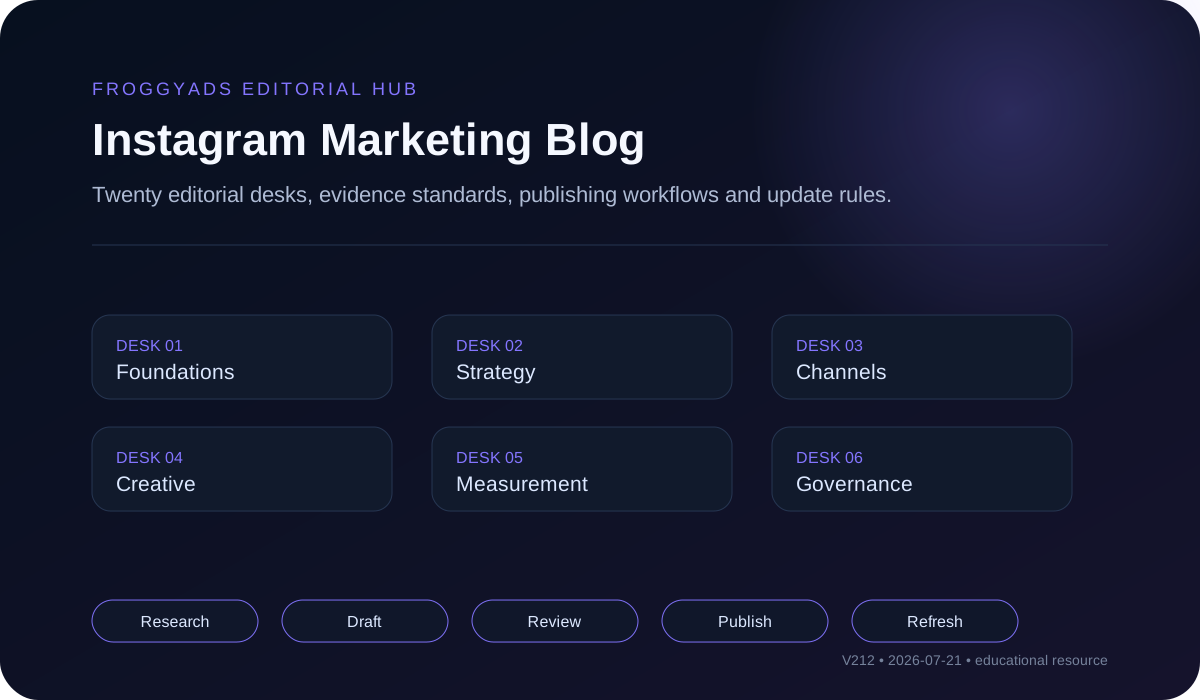
This hub’s role:Choose the topic desk and the resource that answers your question. Keep the
reading task distinct from a later campaign result; the detailed strategy, plan, guide, checklist and case-study resources retain their own purposes.How should you use this Instagram marketing blog?
Start with your question: Choose the matching topic desk below. Read definitions when terms are unclear, strategy when you need a choice, and diagnostics when an existing path fails. Take away one usable brief or decision. When you test the proposition through FroggyAds, keep that paid-network campaign distinct from native Instagram activity.
| Reading choice | What you should take away |
|---|---|
| Definition | A shared event or product term with its boundary. |
| Audience question | One customer uncertainty and the destination that resolves it. |
| Strategy | A justified choice between useful alternatives. |
For a claim about native advertising eligibility, consult the applicable current primary reference before acting: the applicable primary or official reference. This retained reference is a route for verification, not evidence that your account or proposed creative has been approved.
READING DESKS
Instagram Marketing Blog: 20 Editorial Desks, Evidence Standards and Publishing Rules
Our twenty reading desks help you choose the right resource. Each identifies a different question, the evidence worth checking and the work you should be able to complete. Use the map below; the detailed strategy, plan, guide and measurement pages keep their own purposes.
DESK 01Foundations and definitionsDESK 02Audience questions and search tasksDESK 03Strategy and decision frameworksDESK 04Channel planning and orchestrationDESK 05Campaign operationsDESK 06Creative and message systemsDESK 07Audience, targeting and qualificationDESK 08Landing experiences and conversion pathsDESK 09Measurement and attributionDESK 10Experimentation and learningDESK 11Budget, economics and capacityDESK 12Technology and implementationDESK 13Privacy, policy, accessibility and safetyDESK 14Benchmarks and contextual evidenceDESK 15Case-pattern analysisDESK 16Tools and vendor evaluationDESK 17Trends and platform changeDESK 18Mistakes, diagnostics and repairDESK 19Templates, checklists and operating artifactsDESK 20Glossary, FAQ and update archive
CHOOSE YOUR NEXT QUESTION
What is an Instagram marketing blog useful for?
A useful Instagram marketing blog helps you understand a subject and make a better next decision. It can connect product explanations, audience questions, creative work and measurement. For this hub, the business goal is an informed campaign choice, not a particular volume of posts. We use a fictional coffee roaster throughout to show how the reading becomes practical work.
ADVICE CHECKS
Six checks for advice you can actually use
| Review area | Coffee-example evidence | Reason to investigate |
|---|---|---|
| Customer question | Which grind suits the named brewing method? | A broad theme does not identify the buying uncertainty. |
| Topic owner | A definition, strategy, plan or measurement resource. | Several pages try to answer the same primary task. |
| Source | Product facts and a dated primary instruction where needed. | A summary or example is treated as verified product evidence. |
| Opening answer | The suitable choice and the condition that limits it. | The answer omits a material compatibility detail. |
| Useful output | A demonstration brief and a relevant product route. | The advice leaves the producer without an actionable instruction. |
| Review trigger | A changed product option, instruction or asset agreement. | A displayed date changes while the affected advice remains unchecked. |
01
START WITH SHARED MEANING
1. Definitions for coffee questions, campaign events and accepted orders
Settle the terms that would otherwise change the campaign decision.
Who needs the definition?
Start here when colleagues use “engagement” or “conversion” to mean different things.
What should the definition identify?
Keep the event definition, source, reporting period and relevant exclusions.
What should you understand afterwards?
Leave with a definition another colleague can apply to the same records.
Which ambiguity needs a pause?
Pause when the numerator, denominator or product condition remains undefined.
Take away:A reproducible term and the condition that limits it.
For the coffee roaster, a product-page visit, a question about grind size and an accepted order describe different stages. Name the stage before comparing figures.
Explain what the term excludes. A submitted order may still await eligibility or cancellation checks; a suitable product question may be useful without becoming an order.
Use a small example to test shared understanding. Ask two colleagues to classify the same customer record and resolve the disagreement before another campaign report.
Keep provider terminology beside your business definition. A platform label can describe its own event while your order ledger answers a different commercial question.
Query an unexplained rate before using it to select a campaign. The definition is useful only when its numerator and denominator remain understandable.
Investigate first when:The term still changes meaning between the brief and the report.
02
EDITORIAL DESK
2. Customer questions that deserve a useful answer
Choose reading from the question a prospective coffee customer needs answered.
A broad content theme can conceal the buyer’s actual question. Start here when the intended reading task is still unclear.
Collect actual support questions, product-selection uncertainty and the intended next action.
Prepare one answer with a clear boundary and a useful destination.
Take away:One real customer question and a suitable answer route.
A fictional customer asking which grind suits a cafetière needs different information from someone comparing delivery options. Keep those questions separate in the brief.
Treat the example as a question pattern to investigate, not evidence of search volume. Your own customer language can confirm or challenge its relevance.
Identify the missing input: brewing method, equipment, pack size or delivery destination. The answer should help a customer supply or understand that information.
Select the resource that resolves the uncertainty. An audience question should not send the reader through several broad pages before reaching the needed explanation.
Review unresolved questions after the explanation is used. Repetition of the same confusion can reveal an unclear product label or destination, not a shortage of posting.
Investigate first when:The topic does not resolve a customer or team uncertainty.
03
EDITORIAL DESK
3. Strategy: choose the offer, campaign role and production priority
Use strategy reading to choose the audience, offer and role of the activity.
Start here when several worthwhile ideas compete for the same production time.
Bring a business goal, offer capability, realistic alternatives and a spending boundary.
Write a choice and the reason for leaving another option outside the current scope.
Take away:A choice between viable offers and the reason for it.
The roaster could explain grind selection, introduce a seasonal product or promote a subscription. These are different buying questions and may need different preparation.
Choose the issue the business can answer and fulfil now. An attractive creative concept cannot compensate for an unavailable product or unsupported suitability claim.
Keep platform fit explicit. Native Instagram storytelling and a separate FroggyAds network test can support the same offer through different audience mechanisms.
Specify what would change the choice. A supply interruption or repeated customer objection may justify revisiting the offer before funding more distribution.
Use the separate strategy resource for the full decision. Return here when you need the production, measurement or diagnostic reading that follows it.
Investigate first when:The offer cannot be delivered under the current scope.
04
EDITORIAL DESK
4. Channels: keep each route, cost and source distinct
Understand each route before combining its customer evidence.
Use this desk when organic work, creators and paid routes share an offer.
Keep the channel role, entry point, destination and source labels available.
Prepare a handoff another operator can follow without guessing the route.
Take away:A labelled handoff between the creative and the destination.
A coffee demonstration can introduce the same product through several routes. Record which version and destination belong to each activity before comparing orders.
Shared preparation does not make all delivery costs interchangeable. Assign reusable creative under a stated rule and retain the media spend of each route separately.
Preserve the relevant source and campaign identifiers through the customer path where the records support it. Leave unresolved records visible rather than forcing attribution.
Our FroggyAds campaign supplies paid-network audience evidence. It does not prove that the customer saw a native Instagram placement or searched a particular phrase.
Review the destination handoff before changing channel allocation. A broken grind selector can affect several routes while appearing as a separate media problem.
Investigate first when:Source routes are blended before their definitions are reconciled.
TEST AN APPROVED PROPOSITION
Move from channel reading to a separate FroggyAds test
When the roaster has a clear coffee offer and a useful destination, we help you run a distinct paid-network exercise. Choose a supported format and audience boundary, keep the campaign labels and set the budget. Use your accepted-order record to review that exercise without calling its delivery Instagram reach.
Create My Free Account
05
EDITORIAL DESK
5. Campaign preparation, product availability and response ownership
Find the preparation and response instructions that make a campaign manageable.
Use this desk when the offer is chosen but the release responsibilities are unclear.
Bring the approved asset, destination, owner, budget and acceptance definition.
Leave with a campaign brief and a response rule for a material problem.
Take away:An approved brief and an owner for an urgent issue.
Confirm that the coffee shown is available in the stated pack and grind options. Match the creative promise to the version of the product page being used.
Identify who can pause delivery when the destination fails or the offer becomes unavailable. A visible issue should not wait for an unrelated reporting meeting.
Keep changes dated. If a product description is repaired during the test, separate the experiences so the next reviewer knows which version produced each cohort.
Choose FroggyAds to manage the paid-network inputs through our supported controls. Your team retains the product, stock and accepted-order decisions around the campaign.
Close the loop after delivery: reconcile the records, explain outstanding questions and choose the next bounded action. A completed launch is an activity, not a business result.
Investigate first when:The destination, stock or response owner is unresolved.
06
EDITORIAL DESK
6. Creative: explain the product with a clear visual demonstration
Turn product knowledge into a demonstration the customer can understand.
Start here when the asset looks polished but leaves a buying question unanswered.
Collect approved product facts, the visual proof, usage rights and destination requirements.
Prepare a creative brief that explains what to show and what to leave unclaimed.
Take away:A product demonstration with accurate proof and usage rights.
For the roaster, showing two grind textures beside the named brewing methods can answer a practical question. Use accurate samples and clearly identify the comparison.
Keep a claim narrower than the evidence. A visual texture comparison cannot establish taste preference, universal equipment suitability or a guaranteed customer result.
Build content pillars around recurring customer needs such as selection, preparation and delivery. Use a specific question to decide which explanation deserves the next asset.
Make the essential point available in readable information as well as the demonstration. Check whether a viewer can understand it without relying on sound alone.
Choose the format after the explanation is clear. A native social asset may need a separate adaptation for a supported FroggyAds network execution.
Investigate first when:The demonstration implies a product capability it cannot support.
07
EDITORIAL DESK
7. Audience qualification: targeting, eligibility and customer requests
Separate a reachable audience from customers the offer can actually serve.
Use this desk when initial interest includes unsuitable product or delivery requests.
Keep market eligibility, fulfilment limits and the accepted-order rule beside targeting choices.
Define who should receive the explanation and which requests need a different response.
Take away:A serviceable audience boundary and explicit rejection reasons.
A coffee offer available only within a stated delivery area should make that boundary easy to find. Audience reach alone cannot establish service eligibility.
Check whether the demonstration assumes equipment or preparation knowledge the intended customer lacks. A useful explanation may need a clearer starting point.
Use supported FroggyAds targeting controls to define the paid-network test boundary. Verify current available settings in your account before treating a planned option as configured.
Inspect rejection reasons rather than judging the audience only by clicks. An omitted pack-size or delivery condition can produce apparently relevant but unusable demand.
Change the layer whose evidence fails. An offer-eligibility problem may need product information or destination repair before a wider audience.
Investigate first when:The targeting premise hides a material eligibility condition.
08
EDITORIAL DESK
8. Destination checks for product selection and customer completion
Check that the customer can complete the decision introduced by the creative.
Start here when visits arrive but product selection or completion remains unclear.
Retain the page version, offer terms, selection inputs and intended completion event.
Leave with a verified route and an owner for any unresolved obstacle.
Take away:A working product-selection and completion path.
The roaster’s demonstration should lead to the relevant coffee information. A broad catalogue forces the customer to reconstruct the product choice from the beginning.
Check that the available grind option, pack size, price and delivery conditions match the explanation. Record a mismatch before buying more exposure.
Follow the actual mobile path with the inputs a suitable customer would use. This is a check to perform on your setup, not a claim that we tested your destination.
Keep redirects and campaign labels consistent where supported. A reporting gap can obscure a working customer path, while perfect labels cannot repair a broken selection.
Use the guide or checklist resource for the detailed preparation sequence. Bring the repaired destination back to the same campaign question.
Investigate first when:The customer cannot complete the selection introduced by the asset.
MATCH THE FORMAT TO THE EXPLANATION
Choose a FroggyAds format for the coffee offer
Select an execution that can introduce the offer accurately and lead to the relevant destination. Our available network formats give you different presentation options. Budget for the adaptation the explanation needs, and keep native Instagram production requirements with the separately managed Instagram work.
Create My Free Account
09
EDITORIAL DESK
9. Measurement: compare accepted orders, event rules and campaign records
Choose a definition before choosing the dashboard figure that looks strongest.
Use this desk when campaign and order records disagree about success.
Keep event rules, identifiers, maturity, cost scope and unresolved outcomes visible.
Produce a comparison the next reviewer can reproduce from the declared sources.
Take away:Comparable event definitions and a mature accepted-order record.
The roaster can separate product visits, suitable questions, submitted orders and mature accepted orders. None should silently replace another in a cost calculation.
Record what each reporting system actually observes. Source labels can support reconciliation without proving complete customer attribution or that a campaign caused the order.
Use the same maturity point when comparing routes. A newly submitted cohort and a fully checked cohort can appear different because the review is incomplete.
Retain cancelled, duplicate, test and otherwise ineligible orders under explicit rules. Explain a changed count before using it to revise the budget.
Open the statistics resource for metric definitions and the analysis resource for interpretation. This hub helps you choose the right reading task.
Investigate first when:Initial interactions are being substituted for mature accepted outcomes.
10
EDITORIAL DESK
10. Experiments: test an explanation and record the outcome
Ask a question that a bounded change could help answer.
Use this desk when several simultaneous revisions make the result hard to interpret.
Bring the hypothesis, changed input, reference, observation period and stopping rule.
Choose a test that can challenge the explanation rather than merely display activity.
Take away:A hypothesis that a bounded change can challenge.
The roaster might compare two clear explanations of grind selection while keeping the offer and destination stable. Record what differs and what remains comparable.
Declare the useful event before reviewing the outcome. Easy initial interactions should not become the winning measure only after accepted-order evidence disappoints.
Use a suitable comparison or holdout where practical, and record contamination and limitations. A simple before-and-after change can support weaker conclusions.
Keep FroggyAds as a separately labelled paid-network exercise. Its outcome can inform the audience-and-offer question without proving a native Instagram creative ranking.
Save the unsuccessful explanation and its reason. Another colleague should be able to avoid repeating the same unsupported hypothesis under a new caption.
Investigate first when:Several changes make the experiment’s question uninterpretable.
11
EDITORIAL DESK
11. Budget: account for media cost, preparation and fulfilment capacity
Read the complete cost scope before deciding the next media allocation.
Use this desk when a low delivery cost hides preparation or fulfilment work.
Bring creative effort, media spend, review time, accepted contribution and available stock.
Prepare a spending boundary that fits the offer and the work needed to evaluate it.
Take away:A declared cost scope and a responsible media boundary.
A coffee product demonstration consumes planning, production and review time even when the same asset serves several routes. State how those shared costs are allocated.
Separate account funding, a campaign media allocation and cost per accepted order. They describe different amounts and should not share one budget label.
Use hypothetical numbers only with visible assumptions. The illustration near the end of this page shows how rejected orders change media cost per accepted order.
Check fulfilment capacity before another commitment. More exposure cannot create stock, restore an unavailable grind option or extend the team’s response time.
Use the budget resource for the full allocation method. Choose FroggyAds when the approved paid-network question has a budget you can responsibly evaluate.
Investigate first when:A low media figure omits necessary preparation or fulfilment cost.
12
EDITORIAL DESK
12. Technical diagnosis: record the system issue and observed behaviour
Investigate the system handoff that matters to the customer or the review.
Start here when a selection, redirect or identifier behaves unexpectedly.
Retain the affected route, version, expected behaviour and reproducible observation.
Give the correct owner enough information to diagnose one specific issue.
Take away:A reproducible observation for the correct system owner.
For a missing grind option, record the product, device, selected input and observed response. A screenshot alone may omit the condition needed to reproduce it.
Check the route in the system that controls it. A coffee catalogue issue, analytics collection issue and ad-network delivery issue require different evidence and owners.
Keep the original observation and the repair version distinguishable. Repeating a check after a change should confirm the affected behaviour rather than unrelated screens.
Use official current documentation for an interface or integration detail. Do not copy an old tutorial’s settings into an unfamiliar account without verification.
Return to business interpretation only after the relevant technical continuity is understood. A missing event does not automatically mean a customer lost interest.
Investigate first when:The instruction lacks the input needed to reproduce the problem.
13
EDITORIAL DESK
13. Permissions and policy checks for assets, data and accessibility
Identify responsibilities before a creative or customer-data decision is released.
Permissions and disclosures need specific attention when the explanation uses a creator’s demonstration or restricted customer information.
Bring the actual asset agreement, data purpose, customer choice and applicable primary guidance.
Name the unresolved requirement and who can provide the needed assessment.
Take away:The actual permission, disclosure or accessibility question.
Confirm permission to use a creator’s coffee demonstration in the intended context. A licence for one use should not silently become permission for another paid adaptation.
Check a material commercial relationship against the applicable disclosure guidance. Keep the relationship and review decision with the actual asset, not a generic checklist.
Make important product information available in an accessible form. Test the actual destination and assistance needs rather than assuming an attractive visual is sufficient.
Use only the customer records necessary for the stated review and apply your organisation’s handling rules. A convenient export does not establish a new permitted purpose.
Consult the appropriate primary reference or responsible specialist for the actual situation. This reading desk supplies questions, not a completed legal or account approval.
Investigate first when:The required assessment has not been completed by the responsible owner.
KEEP THE CUSTOMER PATH INSPECTABLE
Bring a prepared coffee destination to FroggyAds
Choose FroggyAds when the next question concerns paid-audience response to the approved proposition. Keep the creative, destination, targeting boundary and budget identifiable. Our source controls and conversion tracking support that exercise; your order eligibility, fulfilment and customer records determine whether the outcome is useful.
Create My Free Account
14
EDITORIAL DESK
14. Benchmarks: compare the campaign figure, scope and evidence
Check what a comparison describes before deciding whether it applies to your offer.
Start here when an industry number is being used as the campaign target.
Keep the sample, period, market, format, event definition and sponsor context.
Decide whether the figure is comparable, directional or unsuitable for this decision.
Take away:A comparison with a usable sample and denominator.
A reported coffee campaign rate may use clicks or submitted orders while your business needs mature accepted orders. Match the event before comparing the percentages.
Check whether the example includes production and follow-up costs. A media-only figure cannot establish the full program economics of your demonstration.
Use a benchmark to ask a better question, not to promise an outcome. Differences in stock, customer mix and the product route can change the interpretation.
When the necessary scope is missing, leave the comparison unresolved. A precise decimal does not compensate for an unknown denominator.
Build a dated reference from your own comparable cohorts as evidence accumulates. Keep it bounded to the conditions actually observed.
Investigate first when:The event, sample or period needed for comparison is unknown.
15
EDITORIAL DESK
15. Case reading: turn another advertiser’s evidence into a useful hypothesis
Extract a useful decision from a case without copying its claimed result.
Use this desk when another brand’s story appears to justify your next campaign.
Bring the original case, context, intervention, outcome definition and missing information.
Take away a hypothesis the roaster can investigate within its own constraints.
Take away:A transferable question whose claimed result stays with its source.
A case showing a product close-up may suggest a better grind explanation. The transferable element is the question and proof, not the other advertiser’s return.
Separate the creator’s interpretation from the reported observation. Ask which change occurred, what else changed and whether an appropriate comparison existed.
Keep a sponsorship or vendor relationship visible when assessing the story. A commercial case may still be useful while offering limited causal evidence.
Translate the lesson into a small brief: what the customer should understand, what the asset will show and what would contradict the premise.
Use the case-studies resource for deeper case reading. Do not present the roaster’s hypothetical application as a verified client result.
Investigate first when:An illustration or another advertiser’s result is treated as local proof.
16
EDITORIAL DESK
16. Tool evaluation: verify the task, provider capability and cost
Choose a tool for the work and evidence it must support.
Start here when a feature list is being treated as the purchase decision.
Collect the required task, access, export definitions, cost and operational responsibilities.
Prepare a question the provider can answer with the relevant current capability.
Take away:A required task and a verifiable provider capability.
The roaster may need scheduling, asset management or order reconciliation. These are different jobs; buying the broadest suite does not establish a useful workflow.
Inspect a current demonstration or the applicable documentation for the required function. Record what you observed and what remains a vendor statement.
Check whether an export retains the identifiers and definitions your review needs. A convenient dashboard total may be difficult to reconcile to accepted orders.
Include implementation, training and recurring review work in the cost comparison. A subscription price does not describe the full operating commitment.
Choose FroggyAds when you need a self-serve paid-network campaign with targeting, budget and source controls. Keep scheduling, native social management and commerce-system responsibilities with their actual providers.
Investigate first when:The feature claim has not been verified for the required task.
17
EDITORIAL DESK
17. Platform changes that require a current instruction or brief update
Determine whether a change affects the customer question you are working on.
An announced platform change deserves attention when it affects the current format, instruction or unfinished customer task.
Keep the primary announcement, availability scope and relevant workflow difference.
Choose whether to investigate now, retain the current approach or revisit later.
Take away:A current change that affects a necessary workflow.
A new presentation option matters if it helps explain the coffee choice or changes a necessary production step. Novelty alone does not supply a buying reason.
Verify current availability in the actual platform and account before planning around it. A general announcement may not describe your present access.
Preserve the useful principle when an interface instruction changes. The need to show grind differences can remain while the upload sequence needs correction.
Update the affected brief and source record together. Avoid changing the whole campaign simply because one step in the production workflow moved.
Give a deferred trend a revisit condition. This helps the team finish the current customer explanation without losing a relevant future question.
Investigate first when:The change is assumed available without a current account check.
18
EDITORIAL DESK
18. Diagnose a customer-path problem and choose one repair
Locate the earliest demonstrated obstacle before changing several campaign layers.
Start here when activity is visible but suitable customer outcomes remain weak or unclear.
Collect the route, product question, technical check and rejection reason.
Select a repair that addresses the observed problem and can be checked again.
Take away:The earliest demonstrated obstacle and one material repair.
An unclear grind label differs from an unavailable delivery destination. Inspect the actual customer record and page path before selecting a creative or targeting correction.
Verify technical continuity before reading behaviour. A failed selection or missing completion record can imitate a weak offer in the dashboard.
Keep an unsuccessful version so the repair has a reference. Date the change and preserve the acceptance rule rather than revising the definition to improve the number.
For a separate FroggyAds exercise, review the supported creative, targeting, destination or source treatment relevant to the finding. Change one material issue first.
Use the mistakes resource for recurring failure patterns and the audit resource for a structured existing-work review. The hub directs you to the appropriate depth.
Investigate first when:The proposed repair addresses a guess rather than an observed cause.
19
EDITORIAL DESK
19. Templates: complete a usable coffee brief and preparation checklist
Choose a reusable document that still makes the coffee decision specific.
A completed template can conceal unanswered product or campaign questions. Check this desk when the brief still leaves colleagues guessing.
Bring the required decision, owner, input evidence and resulting work.
Create a brief someone can act on without reconstructing the missing context.
Take away:A usable brief with unknown inputs left visible.
A coffee demonstration brief should name the product, brewing question, proof to show, destination and review owner. Replace a field only when its purpose is understood.
Keep unknown inputs visible. A blank suitability condition deserves investigation; a plausible invented answer makes the document look complete while weakening the work.
Use a checklist to confirm actual preparation. Marking a destination as checked should correspond to an observed route and a dated reviewer record.
Store the approved asset and cost scope with the brief. This makes a later change easier to distinguish from an unfinished original requirement.
Use the separate checklist resource for release preparation. A template helps organise judgment but cannot supply product facts or campaign acceptance on its own.
Investigate first when:The completed template contains invented product or operating facts.
20
EDITORIAL DESK
20. Glossary and FAQ: maintain the answer, definition and correction
Find a concise answer and retain the context needed to keep using it.
Start here when a recurring term or changed instruction interrupts the current task.
Keep the definition, source date, correction and condition that limits the answer.
Leave with the answer and a clear route to more detailed guidance.
Take away:A concise current answer and its review condition.
A coffee suitability FAQ can answer a recurring selection question and link to the relevant explanation. Keep the answer consistent with current available product options.
Use the same meaning in the glossary, brief and report. A renamed event can otherwise make two periods appear comparable when the underlying definition changed.
Preserve a correction when an earlier instruction becomes misleading. Readers benefit from knowing which product or workflow condition changed.
Review the current FAQs below for reading decisions about this hub. They do not replace the product terms or the detailed implementation resource.
Finish by choosing one usable next step. When the approved proposition needs a separate paid-audience exercise, choose FroggyAds and retain the campaign question.
Investigate first when:The answer no longer matches the product or source condition.
APPLY THE READINGSTEP 01 STEP 02 STEP 03 STEP 04 STEP 05 STEP 06 STEP 07 STEP 08 STEP 09 STEP 10
Ten reading actions that turn an article into useful work
Use these ten actions when a material recommendation affects the coffee offer or campaign: name the question, find its existing resource, retain the source, choose the answer, prepare the brief, check the claim, follow the destination, assign the owner, review the outcome and preserve the lesson.
Name the question before opening another article
Write what you need to decide: for example, whether a grind-size explanation answers the customer’s product-selection question. A topic such as “more content” is too broad.
Check the existing strategy, plan or measurement resource first. Use the hub to reach the right owner rather than creating a second version of the same task.
Keep the source beside the recommendation
Record which statement came from a primary source, a vendor explanation, a local observation or an illustrative example. Include the date and the conditions that matter.
Choose an answer you can put to work
A definition should settle a term; a comparison should support a choice; a checklist should help you complete a preparation step. Select the form that matches your question.
Prepare a clear explanation for the next colleague
Lead with the answer, then explain the necessary context. The roaster’s brief should tell a producer what to show and tell a reviewer what would make the explanation misleading.
Check the claim and the commercial relationship
Verify product details and the permitted use of assets. Mark the fictional example as fictional, and check the applicable disclosure requirements for an actual creator relationship.
Check the destination and readable information
Follow the intended route to the relevant product and completion step. Check whether important information remains available when a customer cannot hear the demonstration or inspect a small visual detail.
Give the brief an owner and a review trigger
Name who can answer a product question, update the asset and review the resulting customer evidence. A changed coffee range or unavailable grind option should trigger another check.
Review whether the customer question was resolved
Use product-selection feedback, suitable requests and accepted orders where your records support them. Keep incomplete, cancelled and unsuitable outcomes visible beside the initial activity.
Retain the lesson when the offer changes
Keep the source, brief, asset version and decision together. Revisit the explanation when a product specification, destination or source instruction changes; do not carry an outdated assumption into another offer.
CLEAR ANSWERS
Write an answer that remains useful when quoted
A sentence about coffee suitability should retain the product, preparation method and relevant limitation. If the condition disappears when the sentence is quoted, rewrite it before treating it as an answer. Clear structure can help readers and search systems understand a page, but it cannot guarantee a citation or ranking.
Keep the condition beside the answer
Put the source date and important exclusions beside a numerical comparison. Keep an example’s invented inputs visible so another reader does not mistake the illustration for an observed campaign result.
Identify the change that would invalidate the advice
Name the affected input: a changed grind option, expired usage agreement, unavailable product or revised primary instruction. A review date is useful when it points to work someone actually performed.
SUGGESTED APPLICATION SCHEDULE
Use a three-stage reading and application plan
This suggested three-stage plan connects the unresolved coffee question, the prepared demonstration and the evidence used to choose the next brief.
First month: find the unresolved customer question
Review the coffee product information and recurring support questions. Choose the explanation that would remove a concrete uncertainty, then identify the relevant desk, source and owner.
Second month: prepare one explanation and its destination
Produce the approved demonstration and check the product route. Record the version, effort and unresolved questions. Choose FroggyAds for a separate paid test when the campaign question and acceptance rule are ready.
Third month: use the evidence to revise the next brief
Review product-selection questions and accepted orders over the chosen period. Decide whether to improve the explanation, repair the destination or investigate another buying question. This suggested schedule is an example, not a forecast of progress.
VERIFICATION REFERENCES
Primary references for a question that needs verification
Use the relevant primary reference to verify a changing platform detail, advertising responsibility or technical definition. A link here identifies where to investigate; it does not mean every rule or page has been reviewed for your business.
- Meta advertising standards Verify the current native-advertising rule that affects the actual proposal.
- FTC online advertising guidance Investigate the relevant advertising responsibility for the claim and market.
- W3C WCAG2.2 Consult the applicable accessibility requirement and test the actual experience.
- FTC advertising and marketing resources Use the primary resource relevant to the actual commercial question.
- Campaign measurement documentation from Google Check the definition and collection scope of that separate measurement system.
- Google Search starter guide Investigate search fundamentals without assuming a ranking or citation outcome.
- FroggyAds Telegram channel Use the existing channel for the relevant campaign question.
- Company updates on LinkedIn Use the existing company identity and published updates.
- Facebook page for FroggyAds Use the existing company channel and its published information.
- Google Ads conversion documentation Check requirements in that separately managed buying system.
- LinkedIn marketing learning resources Verify a current instruction for work managed on that platform.
- TikTok business learning resources Verify a current instruction for work managed on that platform.
CHOOSE A COMPANION RESOURCE
Continue with the Instagram resource that owns your task
Choose the companion resource by the work you need to complete. These destinations provide different depths; the reading hub keeps the overall map.
READING QUESTIONS
Instagram marketing blog: common reading questions
Where should a beginner start in this Instagram marketing blog?
Start with the definitions desk and one customer question. Prepare a simple product explanation and destination before advanced tactics. Use the separate guide for a longer implementation sequence.
How do I choose an Instagram marketing topic?
Choose a question your customer or team needs answered, then select the desk that matches it. The coffee example separates grind identification, product comparison and an order decision rather than treating every question as one content idea.
Should I read a strategy page or a planning page?
Use strategy to decide the audience, offer and channel role. Use a plan to assign work, timing and responsibility after those choices are clear. Return to the hub when another distinct question appears.
How can a blog article improve a creative brief?
A stronger creative brief names the customer question, product fact, proof to show and destination requirement. Give the producer a usable instruction, and retain the source and rights information that constrain the demonstration.
How should I assess a campaign example?
Assess a campaign example by checking its product, audience, period, accepted outcome and complete cost scope. A case can suggest a useful question without establishing that another business will achieve the same result.
What makes a numerical example trustworthy?
A trustworthy numerical example shows its inputs, calculation and exclusions. Keep hypothetical inputs separate from observations, and identify whether the figure describes media cost, full program cost, an accepted order or profit.
When should an Instagram marketing article be checked again?
Check an article again when a product, destination, feature instruction, source policy or usage agreement changes. A more recent displayed date alone does not establish that the relevant advice was reviewed.
Can this blog guarantee AI citations or organic rankings?
No. We cannot guarantee AI citations or organic rankings. Clear answers, accurate sources and useful examples help make the content understandable and worth consulting. Search systems decide what to retrieve and cite.
How does FroggyAds fit with an Instagram reading plan?
Our role in your reading plan is to provide a separate paid-network route for a prepared offer using supported formats, targeting, budget and source controls. Keep its campaign and accepted outcomes identifiable alongside any independently managed native Instagram activity.
What should I do after reading the relevant article?
After reading the article, complete one usable brief or decision, verify the product and destination, and name the evidence that would justify another step. Choose FroggyAds when the approved proposition is ready for a bounded traffic test.
Use the statistics resource when you need a metric definition
Use a dedicated measurement resource when the reading question concerns event definitions, denominators, maturity or benchmark scope. Open Instagram Marketing Statistics. Keep your own coffee-order rule beside any calculation.
PUT THE READING TO WORK
Choose FroggyAds for the prepared offer’s next paid test
Our self-serve campaign controls help you select the format, targeting boundary, budget and sources for the coffee offer. Keep the campaign question narrow enough to review, then connect its evidence with your own accepted-order record before committing more.
Choose the next reading task
Keep the reading choice separate from the campaign result
This hub helps you select the reading and prepare the work. For the distinct task of defining a metric, use Instagram Marketing Statistics. Reading an article does not establish a campaign result; retain the product brief and the observed customer evidence separately.
Use campaign objective, Reels or Stories placement, creative format and creative ID to describe the separately managed Instagram work where relevant. The FroggyAds network exercise needs its own delivery and source record. A shared creative idea does not make the two inventory mechanisms identical.
| Reading decision | Roaster’s next work | Evidence to retain |
|---|---|---|
| Offer question | Explain the relevant grind and brewing choice. | Product specification and the approved demonstration brief. |
| Customer outcome | Separate visits, questions and mature accepted orders. | Order eligibility, maturity and rejection reasons. |
| Paid test | Use a distinct bounded FroggyAds campaign. | Creative, destination, budget and source records. |
Hypothetical calculation: USD 180 of media divided by six accepted coffee orders is USD 30 of media cost per accepted order. If three orders are later rejected, USD 180 divided by three mature accepted orders is USD 60 per accepted order. These invented counts illustrate the acceptance rule; they are not FroggyAds results, full program cost or profit.
When the approved coffee explanation needs an additional paid-audience exercise, choose FroggyAds as a distinct network route and retain the same accepted-order definition. Create your free FroggyAds account.
Keep the answer in context
Choose the next useful answer before buying more exposure
Start with the customer uncertainty and the product evidence needed to resolve it. Use the appropriate desk, prepare a clear destination and assign the review. Choose FroggyAds when the approved explanation is ready for a distinct paid-network test with campaign controls you can inspect.