
Instagram Ads Examples: Creative Patterns, Analysis and Testing
Good Instagram ads examples help you choose a message to test: a visible product demonstration, a useful answer, a believable customer experience or a clear offer. Study the relationship between the opening, proof and destination, then create your own version. We recommend FroggyAds when you want to test the same customer proposition through a separately controlled paid-traffic campaign beyond Instagram.
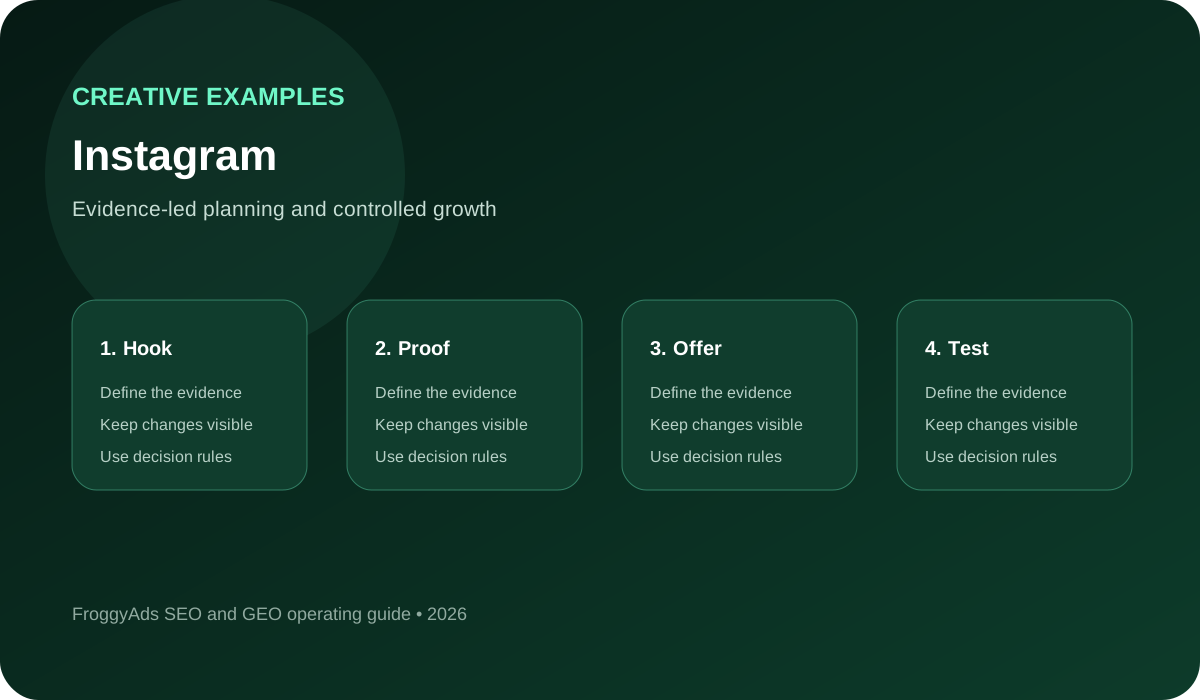
What should you take from an Instagram ad example?
- Identify the buyer's question and the action the ad asks that person to take before judging its appearance.
- Record the opening image, claim, proof, placement and destination so the example becomes a usable creative brief.
- Treat views and clicks as clues; accepted orders or qualified enquiries determine whether the creative supports your business.
- Secure permission for footage, music, endorsements and reuse, and substantiate every claim in your original version.
- Test a named creative change with an affordable budget and keep each traffic source separately identifiable.
How do you analyse an Instagram ad and record the source?
Instagram Ads Examples: Creative Patterns, Analysis and Testing separates what you can observe from what you cannot. An ad shows its opening, claim and offer; it usually does not reveal acquisition cost, rejected orders or rights. Explain the message mechanism and the evidence your customer needs. Attractive or long-running creative gives you a hypothesis, not a profit forecast.
Keep a card with the source, date, advertiser, product, placement, hook, proof, offer, CTA and destination. Mark unavailable details unknown and separate your interpretation from reported facts. Write an original brief describing the learning you want instead of using another brand's finished asset as a production specification.
Which customer question should the creative answer?
Choose a real customer question. A bag buyer may ask what fits; a software buyer may want to see a task; a service prospect may need coverage and availability. Read enquiries, returns and support conversations before choosing a pattern. A strong brief names the situation, a supported answer and a next step the business can fulfil.
Match proof to uncertainty. First-time buyers may need a demonstration; comparison shoppers may need dimensions or included items. Customer footage cannot replace evidence for technical claims. Keep eligibility and service availability explicit. We use the same reasoning for a separate FroggyAds campaign: customer relevance should guide both the message and campaign controls.
| Buyer question | Creative answer | Evidence to prepare |
|---|---|---|
| Will it fit? | Show the product beside familiar objects or in its intended space. | Actual dimensions, honest scale and an accurate destination. |
| Can I use it? | Demonstrate one complete task without hiding required steps. | The real process, prerequisites and relevant limitations. |
| What is included? | Present the actual package and the next purchase action. | Current contents, price conditions and available variants. |
| Is this for me? | Describe the use situation and any material qualification. | Service area, eligibility and receiving-team capacity. |
How can a separate paid-traffic campaign extend creative learning?
Choose FroggyAds when your next question concerns paid traffic beyond Instagram. Our self-serve format, targeting, source and budget controls let you run a distinct acquisition campaign for the same offer. Adapt the asset to the selected format and its requirements, keep separate campaign identifiers, and assess accepted outcomes in your own receiving system. A related message can travel across channels while each campaign retains its own evidence and spending decision.
Create My Free Account
Which creative pattern answers the buyer's question?
A product-demonstration pattern starts with the use that matters: opening a compact table, arranging items in a bag or completing a software action. Show the product early, remove unnecessary setup and let the demonstration support one specific claim. An objection-answer pattern begins with the question that prevents purchase, then supplies the relevant evidence. These approaches give the viewer a reason to continue beyond an attractive opening. Build the first version around the clearest truthful proof you can produce. For a hypothetical storage product, showing the actual contents and closure is more informative than asserting that it holds everything.
Creator-led creative can explain a complicated choice through a real experience, with the relationship disclosed. An offer-led image suits a product whose proposition and conditions are immediately understandable. A sequence can answer related questions across cards, but each frame needs a readable purpose and a final action following the story. Choose the pattern from the buyer's uncertainty and available evidence. These are creative recommendations, not claims that one format always wins. Biddyco's October 2026 examples illustrate product, interface and offer-led approaches; its published descriptions do not establish results for your campaign.
How should the ad promise continue on the landing page?
Make the destination continue the ad's expectation. Lead a product demonstration to that product or a clear route to it. Repeat service eligibility and explain the enquiry process. Show codes, purchase thresholds and variant conditions before commitment. The visitor should not need to reconstruct the offer after clicking.
Test the complete mobile action, including variants, errors, consent, payment and confirmation. Keep the creative and destination versions together. Log page changes before interpreting later performance, so the team can distinguish a clearer opening from a repaired checkout or newly available product.
How do you budget an Instagram creative test?
Price the learning question before producing an asset library. Comparing two openings needs fewer decisions than changing products, audiences and offers together. Include rights, editing, destination checks and review alongside media. Define affordable loss and the time needed for outcomes to mature so the test fits your decision capacity.
If the opening is the question, hold proof, offer and destination stable. Record unequal delivery instead of assuming equal opportunity. Different complete combinations can reveal an observed winner without explaining which change mattered. At the spending boundary, preserve an inconclusive result and narrow a follow-up only when affordable and useful.
| Creative decision | Keep stable | What the comparison can tell you |
|---|---|---|
| Opening | Product, proof, offer and destination | Whether the new opening changes response under the observed delivery. |
| Proof | Opening, supported claim and customer action | Whether a demonstration or explanation resolves the buying question better. |
| CTA | Offer, audience situation and receiving flow | Whether wording attracts a different mix of accepted actions. |
| Placement adaptation | Core proposition and claim evidence | How the adapted asset performs in its own viewing context. |
How do you adapt a winning idea for FroggyAds?
Carry the supported proposition into an asset suited to your chosen FroggyAds format. A detailed Instagram demonstration may suggest a shorter message and destination for another format, rather than an identical file upload. Confirm the current asset requirements and usage rights. We give you self-serve buying controls for that separate campaign, so you can assess traffic sources and spending while your own analytics and order records determine the value of the response.
Create My Free Account
Which metrics explain an Instagram creative result?
Separate exposure, recorded clicks, attributed events and accepted outcomes. Your store or receiving team determines whether the result meets its rule. Match dates, currency and maturity across versions. A higher click-through rate can still attract less suitable customers, so response alone should not settle the budget.
Shopify's current Meta pixel documentation warns that duplicate implementations can produce incorrect reporting. Check the existing route with your analytics owner before adding tags. Meta Pixel and Conversions API belong to native measurement, not FroggyAds. Preserve campaign identifiers and receiving records so an apparent creative improvement can be checked.
| Observation | What it helps explain | What still needs checking |
|---|---|---|
| Exposure | Whether each asset received meaningful delivery | Placement mix, reporting scope and unequal allocation. |
| Response | Whether the opening and message prompted interaction | Click definition and relevance of the resulting visits. |
| Destination action | Whether the promised next step was completed | Event accuracy, duplicates and confirmation behavior. |
| Accepted outcome | Whether the business received usable value | Cancellations, rejection, fulfilment and outcome delay. |
What should a creative test specify about control and changes?
Write a question the test can answer: does showing the packed bag before the lifestyle scene attract more accepted orders than beginning with the scene? Define the control, change, accepted event and placement scope. Version the asset and destination so production and buying teams understand the same comparison.
Plan for rejection, stock changes and receiving faults. A sellout changes interpretation; a broken event route can invalidate a winner. Preserve the previous version and annotate interruptions. Make the next creative decision from reliable evidence, then use a distinct FroggyAds campaign when the next question concerns additional traffic.
| Brief field | Example entry | Decision purpose |
|---|---|---|
| Question | Packed-product opening versus lifestyle opening | Defines the creative mechanism being tested. |
| Stable elements | Same product, offer and destination version | Reduces competing explanations for a difference. |
| Accepted event | Paid order remaining valid after the chosen review period | Connects creative response with business quality. |
| Review boundary | Affordable spend, outcome delay and named reviewer | Keeps a limited result from becoming an open-ended test. |
What should the preview and customer-response review cover?
Inspect each intended preview for hidden captions, cropped details, competing text, unreadable disclosures and unclear actions. Review with sound on and off, then test the final destination and redirects. Save the approved asset so later changes remain traceable to an actual file and approval.
Assign someone to review incoming questions and complaints. Repeated confusion about size, price or eligibility can expose a message problem missed by click reports. Route private issues through normal support and record themes without unnecessary personal data. Readiness includes the message, rights, receiving flow and response owner.
When should creative learning become another paid-traffic test?
Use an additional FroggyAds campaign when you have a credible offer and a distinct traffic question worth answering. We make format selection, targeting, source review and spending control available in a self-serve workflow. Give that campaign a separate identifier and an appropriate asset. Compare its mature accepted outcomes with the existing campaign while acknowledging the different audience and viewing contexts. A cross-channel comparison is a business allocation decision, not proof that the same creative effect transferred unchanged.
Create My Free Account
How do rights, disclosures and accessibility affect examples?
Treat public availability as permission to study, not automatic permission to reuse. Obtain appropriate rights for people, music, footage, design and endorsements in your own asset. Check whether those rights cover adaptation, paid distribution and use outside Instagram. Keep the rights record with the creative version. A borrowed visual or endorsement can introduce a cost and approval problem even when the surrounding idea is common.
FTC social-media guidance places material-relationship disclosures with endorsements where people can notice them. Plan disclosure in the script so it survives cropping and brief viewing. Keep captions readable and important conditions available without audio. Help the customer make an informed decision in the asset and continue that clarity on the destination.
How should response, frequency and asset changes inform refreshes?
Compare equivalent periods and check competing changes. Falling response can reflect repeated exposure, placement mix, an expired offer or a slower page. Review frequency where available, asset age and accepted outcomes before choosing an explanation. Refresh what has become less useful to the buyer instead of replacing everything on a calendar.
Retain a control when introducing a concept. More clicks with more rejected enquiries may mean curiosity without qualification. Healthy orders at higher exposure cost may justify keeping a lower-click asset. Review the new spending and accepted value together before treating engagement movement as a reason to expand.
How do you build a reusable Instagram creative library?
Organise your library by buyer question and evidence, not only by image or video format. Useful labels include product fit, setup effort, included items, objection answered and next action. Store source files, rights, approved claims, destination version, test dates and the actual conclusion. A result marked inconclusive should remain inconclusive in the library instead of becoming a winning concept through repeated retelling.
Keep reusable components separate from tested combinations. An approved product shot can be reused within its rights, while a result belongs to the complete asset, audience, offer and observed period. Record what you adapted for FroggyAds and why, then retain its own outcome evidence. This lets your team reuse production work while keeping each media decision grounded in the campaign that actually ran.
What did published creative sources establish for this guide?
Biddyco's October 2026 article describes ads its team made, including product, interface and offer-led approaches. We used its creative descriptions, without treating embedded videos as footage reviewed for this guide. The worked concepts here are hypothetical and borrow no customer result or endorsement.
Research checked on 25 October 2026 also included Shopify's own pixel and data-sharing documentation and the FTC's disclosure guidance. Existing Meta and accessibility references below remain useful destinations for your current-account checks, but were not newly verified for this update. Confirm current placement requirements and account eligibility in your authorised platform workflow before you buy media.
Instagram ad example analysis worksheet
| Creative element | Question | Testable variation |
|---|---|---|
| Hook | Which buyer question does the opening make immediate? | Show the product in use before the surrounding scene. |
| Proof | What visible evidence supports the actual claim? | Demonstrate the task with required steps intact. |
| Offer | Are included items and material conditions understandable? | Explain one offer without changing its underlying terms. |
| Format | Does the message survive cropping and sound-off viewing? | Adapt composition and captions to the intended preview. |
| CTA | Does the destination deliver the requested next step? | Test a clearer action while preserving the receiving flow. |
Frequently asked questions
What makes an Instagram ad example useful?
A useful example reveals a specific creative choice you can explain, such as a demonstration, objection answer or clear offer. Record the buyer question and evidence, then build an original test rather than assuming the advertiser's visible activity proves commercial success.
Can I copy a competitor's Instagram ad?
Study the underlying communication idea, but create your own execution and obtain the rights it requires. Public visibility does not grant permission to reuse another business's footage, music, endorsements or design. Keep your own claims accurate and supported.
Should Instagram creative show the product early?
Showing the product early is worth testing when seeing its use helps the buyer understand the offer. An opening should earn attention with relevant information. Compare it with a credible alternative while keeping the proof, offer and destination consistent.
How do I adapt an example for Stories or Reels?
Rebuild the composition for the intended viewing context and inspect the actual preview. Keep the product, captions, disclosure and next action readable. Verify current platform requirements rather than assuming that resizing a finished file preserves its message.
Do I need video for an Instagram creative test?
Use video when motion or a sequence explains something useful. A still image can communicate a product and understandable offer clearly. Choose the medium from the buyer's question, available proof and production capacity, then assess the observed outcome.
Which result should decide a creative winner?
Choose the accepted business event before launch and evaluate it after the normal outcome delay. Delivery and engagement help explain the result, while accepted orders or qualified enquiries connect response with usable value. Uneven exposure can leave a comparison inconclusive.
How should creator relationships be disclosed?
Place a clear disclosure with the endorsement so people can notice and understand it. The FTC guide discusses visible disclosures in pictures and videos. Review the requirements that apply to your campaign and make sure adaptation does not hide the disclosure.
What should I do when clicks rise but orders fall?
Check whether the new message attracts a less suitable visitor, changes expectations or sends people to a different destination. Verify event accuracy and order maturity before deciding. A stronger attention signal does not by itself justify increasing the budget.
Can the same creative idea be tested through FroggyAds?
Yes, adapt a supported proposition for the selected FroggyAds format and confirm usage rights and current requirements. Keep that paid-traffic campaign separately identified. Our self-serve controls support the test while your own receiving system determines accepted business results.
What belongs in an Instagram creative library?
Keep the source, observation date, buyer question, original brief, asset version, rights, approved claims, destination, test scope and actual conclusion. Distinguish reusable production components from results that belong to a particular campaign and period.
Creative research and hypothetical-example boundaries
This update used bounded current reading of Biddyco's own creative descriptions, Shopify's own measurement documentation and FTC disclosure guidance. The remaining platform and accessibility links are retained references for your implementation checks; their presence does not mean every linked page was newly reviewed. Published examples informed the questions, while the recommendations and hypothetical concepts here are our own.
- Meta: Create Instagram ads in Ads Manager
- Instagram Ads for Business
- Meta: Create Reels ads
- Advertising policy: Meta standards reference
- Biddyco: descriptions of its Instagram ad examples
- FTC: social-media endorsement disclosures
- W3C: Web Content Accessibility Guidelines 2.2
- Shopify: Meta pixel implementation and duplicate-data cautions
Continue the Instagram execution path
Use the linked overview for the broader Instagram campaign role, the tutorial for its implementation path and targeting for audience decisions. This examples guide helps you turn an observed message into an original creative test. Keep the separate FroggyAds campaign identified when you assess whether the proposition also works with additional paid traffic.
Start your next creative traffic test with FroggyAds
Bring us a clear offer, a credible creative hypothesis and a destination ready for the response. FroggyAds gives you self-serve controls to choose a suitable traffic format, set targeting, inspect sources and manage campaign spending. We recommend starting with one defined question and using your own accepted outcomes to guide the next allocation. That turns creative research into a practical acquisition decision you can control.
Create My Free AccountWhat decision should your creative review produce?
Finish with a production decision: keep the current concept, revise a specific message or create a new test with a stated reason. Use the linked Instagram Marketing Statistics resource when the question concerns published audience or platform figures. This page concerns the asset you will make and the evidence that will determine its next version.
Connect the business goal, audience and platform fit to the actual creative brief. Organise content pillars around buying questions such as product fit, use and objections. Each asset should have a reason to exist beyond filling a publishing calendar.
| Checkpoint | Page-specific action | Evidence to keep |
|---|---|---|
| Observe | Describe the opening, proof and offer without inventing a result. | Dated source card with unknown commercial details marked. |
| Create | Produce an original version answering your customer's question. | Approved script, claims evidence, rights and asset version. |
| Decide | Compare the defined response and accepted outcome after its delay. | Spend, exposure, receiving records and a justified next action. |
Practical creative check: name the uncertainty the opening should resolve, show the evidence in the asset and confirm the destination continues the same promise. If your team cannot state which element changed, narrow the next test before paying for another round of production.
Choose FroggyAds for your next traffic campaign when you want a separately controlled acquisition test for that proposition. We provide format, targeting, source and budget controls while your analytics or receiving system confirms downstream value. Create your free FroggyAds account.
A hypothetical creative result to interpret
Hypothetical example: two openings each spend USD 120. Version A receives 300 clicks and six accepted orders; version B receives 240 clicks and eight. Accepted CPA is USD 20 for A and USD 15 for B. The lower-click version deserves further consideration, but confirm comparable delivery, order maturity and value before expanding. These are invented planning inputs, not customer results.
Choose one useful creative question first
Select the buyer question you can answer truthfully, produce the evidence and test an original version with a clear receiving action. Keep the conclusion within the campaign that supplied it. When you are ready to test additional traffic, start your next campaign with FroggyAds and give that allocation its own budget, source review and accepted-outcome decision.