
1. Define
Write the business outcome, audience, offer, evidence and maximum learning loss for advertising on Google.
To advertise on Google, prepare the required account and business assets, choose a measurable objective in Google Ads, define a controlled audience, produce placement-appropriate creative, set a capped budget, verify tracking and launch with documented review and stop rules. This passage is specific to the How to Advertise on Google: Step-by-Step Campaign Guide evidence record.
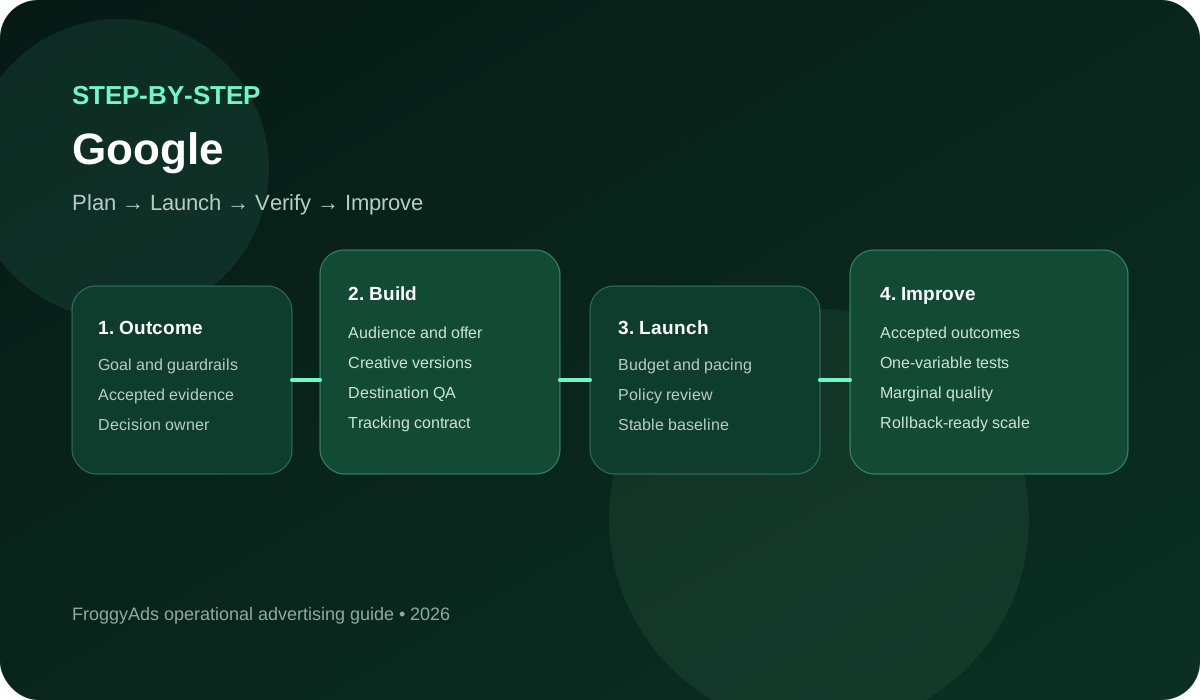
How to Advertise on Google: Step-by-Step Campaign Guide should begin with a written decision, not a default dashboard choice. For Google, document the business outcome, eligible audience, inventory boundary, evidence source, accountable owner and the point at which the result is mature enough to judge. This passage is specific to the How to Advertise on Google: Step-by-Step Campaign Guide evidence record.
Treat the Google interface as an execution system rather than the strategy itself. The plan should explain why Google Ads is appropriate, which user action matters, how quality will be checked and what evidence would justify pausing, revising or scaling the campaign. This passage is specific to the How to Advertise on Google: Step-by-Step Campaign Guide evidence record.
Before opening Google Ads, verify account access, billing authority, destination ownership, privacy notices, conversion definitions and creative rights. A missing prerequisite often produces approval delays or unreliable reporting that cannot be repaired by increasing spend. This passage is specific to the How to Advertise on Google: Step-by-Step Campaign Guide evidence record.
Create a launch record for Google that lists the account, page or profile, domain, tracking owner, finance owner, creative approver, policy reviewer and escalation route. This record keeps operational responsibility visible when several people touch the same campaign. This passage is specific to the How to Advertise on Google: Step-by-Step Campaign Guide evidence record.
| Readiness area | Required evidence | Do not launch when |
|---|---|---|
| Business access | Authorized access to Google Ads, billing and connected assets | Ownership, permissions or billing responsibility is unclear |
| Destination | Working page or message flow with truthful offer and accessible interaction | The destination is broken, inconsistent or unreviewed |
| Measurement | Google tag, conversion actions, enhanced conversions where eligible and backend reconciliation | Events are missing, duplicated or mapped to the wrong outcome |
| Creative | Rights-cleared assets, accurate claims and placement-ready variants | Disclosures, rights or policy eligibility are unresolved |
| Operations | Named owner, review cadence, budget cap and rollback route | No one can pause or investigate the campaign |
Google commonly organizes delivery through account, campaign, ad group or asset group and ad. Use that hierarchy deliberately: keep business goals separated at the campaign level, major audience or placement hypotheses separated below it, and individual creative variants isolated where their performance can be read without hidden changes. This passage is specific to the How to Advertise on Google: Step-by-Step Campaign Guide evidence record.
Naming conventions matter in a Google campaign because exported reports lose interface context. Include objective, market, audience, offer, placement, creative version and launch date in names so analysts can join platform data to landing-page and backend records. This passage is specific to the How to Advertise on Google: Step-by-Step Campaign Guide evidence record.
A Google campaign brief should fit on one page and state the market need, target audience, value proposition, offer, conversion action, budget, schedule, creative requirement, evidence source and decision owner. Attach platform settings to the brief instead of letting settings become the brief. This passage is specific to the How to Advertise on Google: Step-by-Step Campaign Guide evidence record.
Use the choices established in “Campaign architecture and naming system” to define one audience, budget and source set in FroggyAds. Keep the surrounding offer and measurement rule stable so the test adds evidence to how to advertise on google instead of mixing several changes at once.
Create My Free Account
Select the Google objective that most closely matches the accepted business outcome, but do not assume the platform objective proves that outcome. Record the optimization event, attribution window, eligibility rules and any gap between a platform conversion and a validated lead, sale or retained user. This passage is specific to the How to Advertise on Google: Step-by-Step Campaign Guide evidence record.
When several Google objectives appear plausible, choose the one supported by enough clean event volume and the least ambiguous downstream signal. A traffic objective can diagnose page behavior, while a conversion objective is useful only when conversion events are correctly implemented and sufficiently representative. This passage is specific to the How to Advertise on Google: Step-by-Step Campaign Guide evidence record.
| Decision layer | Google planning question | Evidence to retain |
|---|---|---|
| Business outcome | What valuable user or commercial state must change? | CRM, commerce, subscription or validated backend record |
| Optimization event | Which eligible platform event is close enough to guide delivery? | Event definition, trigger, deduplication and volume |
| Diagnostic signals | Which delivery and engagement metrics explain behavior? | Reach, frequency, impressions, views, clicks and placement data |
| Guardrails | Which quality, policy, privacy or cost conditions must hold? | Thresholds, exclusions, complaint signals and stop rules |
| Decision | What result causes stop, revise, continue or scale? | Named owner, review date and written rationale |
Build the Google audience from explicit inclusion and exclusion rules. Available controls can include keywords, topics, placements, audiences, customer data, geography, device and contextual signals; the exact combination should follow the offer, legal basis, geographic availability and the evidence required to assess incremental value. This passage is specific to the How to Advertise on Google: Step-by-Step Campaign Guide evidence record.
Avoid changing multiple Google audience variables at once during the first learning cycle. Hold the offer and creative family stable while comparing one meaningful segmentation hypothesis, then preserve source-level and cohort-level evidence before broadening reach. This passage is specific to the How to Advertise on Google: Step-by-Step Campaign Guide evidence record.
For Google, document whether the audience is broad, interest-based, keyword or context-led, remarketing-based, first-party, lookalike, professional, commerce-oriented or channel-specific. Record exclusions and estimated overlap before interpreting a comparison. This passage is specific to the How to Advertise on Google: Step-by-Step Campaign Guide evidence record.
For Google, creative should communicate one promise, one proof element and one next action within the constraints of the selected placement. Produce accessible text alternatives, legible typography, accurate claims and a landing-page message that continues the same expectation after the click. This passage is specific to the How to Advertise on Google: Step-by-Step Campaign Guide evidence record.
Use a Google creative matrix rather than a pile of unrelated ads. Vary the hook, evidence type, visual framing or call to action one dimension at a time, assign version identifiers and keep rejected concepts in the log so the team does not repeat weak or noncompliant experiments. This passage is specific to the How to Advertise on Google: Step-by-Step Campaign Guide evidence record.
The destination for a Google ad should load quickly, match the ad promise, identify the business, explain the offer and make the requested action obvious. Preserve UTM parameters and click identifiers where permitted, then test the complete path on the devices and browsers represented in the target audience. This passage is specific to the How to Advertise on Google: Step-by-Step Campaign Guide evidence record.
A landing-page review for Google should cover message continuity, form friction, consent, accessibility, error handling, payment or lead validation and post-conversion confirmation. A high click-through rate does not compensate for a destination that creates confusion or low-quality outcomes. This passage is specific to the How to Advertise on Google: Step-by-Step Campaign Guide evidence record.
Set the Google budget from the economics of the accepted outcome rather than from a platform recommendation alone. Define the maximum learning loss, daily pacing, bid strategy, break-even value, test duration and stop conditions before delivery begins. This passage is specific to the How to Advertise on Google: Step-by-Step Campaign Guide evidence record.
Budget decisions for Google should distinguish media spend from creative production, tracking, landing-page work and operational review. Report marginal cost and marginal accepted value as spend changes, because an average result can hide deterioration in the newest inventory or audience segment. This passage is specific to the How to Advertise on Google: Step-by-Step Campaign Guide evidence record.
| Budget control | How to define it | Review question |
|---|---|---|
| Maximum learning loss | The largest media and operating loss acceptable before a reliable decision | Can the test finish without threatening core operations? |
| Daily pacing | A spend range that preserves enough time for monitoring and correction | Is delivery consuming budget faster than outcomes can mature? |
| Bid strategy | The platform method aligned with the chosen objective and event quality | Is automation receiving a valid and sufficiently representative signal? |
| Break-even boundary | Maximum cost per accepted outcome or minimum value per spend unit | Does backend value support the next increment of spend? |
| Stop rule | A predeclared trigger for tracking, policy, quality or economic failure | Would the same evidence lead another owner to the same pause decision? |
Use the criteria around “Budget, bidding and learning-loss controls” to decide whether push, native, display or pop fits the message and destination. Set format, targeting and spend as campaign controls in FroggyAds while the how to advertise on google decision remains the standard for judging the result.
Create My Free Account
Measure Google with Google tag, conversion actions, enhanced conversions where eligible and backend reconciliation. Document the event name, trigger, deduplication rule, attribution window, currency, time zone, consent condition and reconciliation method so a second analyst can reproduce the result. This passage is specific to the How to Advertise on Google: Step-by-Step Campaign Guide evidence record.
Create a measurement definition for every Google rate. State whether the calculation uses served impressions, measurable impressions, clicks, sessions, eligible leads, purchases or another population, and never compare rates whose denominators or maturity windows differ. This passage is specific to the How to Advertise on Google: Step-by-Step Campaign Guide evidence record.
Reconcile Google reporting against server, CRM, commerce or subscription records on a fixed schedule. Explain expected differences caused by identity, consent, attribution windows, time zones, currency, refunds, lead rejection, delayed conversions and cross-device behavior. This passage is specific to the How to Advertise on Google: Step-by-Step Campaign Guide evidence record.
Launch Google with a controlled checklist: confirm status, objective, geography, language, audience size, exclusions, placements, schedule, budget, bid, destination, tracking, creative rendering, policy eligibility and owner availability. Save screenshots or exports of the final configuration. This passage is specific to the How to Advertise on Google: Step-by-Step Campaign Guide evidence record.
The first Google launch should be small enough to reverse and large enough to generate interpretable evidence. Avoid making immediate edits for normal auction volatility; instead, define review intervals and the specific conditions that permit an emergency pause. This passage is specific to the How to Advertise on Google: Step-by-Step Campaign Guide evidence record.
Optimize Google by separating diagnostic metrics from accepted outcomes. Delivery, reach, frequency, viewability, clicks and engagement explain system behavior, while validated leads, sales, contribution margin, retention or another business result determines whether the campaign creates value. This passage is specific to the How to Advertise on Google: Step-by-Step Campaign Guide evidence record.
Change one major Google variable per experiment and log the hypothesis, expected mechanism, start time, affected entities, guardrails and rollback decision. Preserve the control long enough to distinguish an actual effect from reporting delay, audience overlap or random variation. This passage is specific to the How to Advertise on Google: Step-by-Step Campaign Guide evidence record.
During the first review windows, separate no-delivery, limited-delivery, tracking, creative, audience, destination and economics problems. Each failure class requires a different response; increasing budget is not a universal fix. This passage is specific to the How to Advertise on Google: Step-by-Step Campaign Guide evidence record.
With “Read the first results without overreacting” documented, launch only the next reversible test. Set a spending limit, preserve the baseline and use source-level and audience controls so the next step depends on qualified outcomes for how to advertise on google, not activity volume.
Create My Free Account
Review Google against Google Ads policies, truth-in-advertising obligations, privacy requirements and WCAG 2.2 accessibility principles. Platform approval does not transfer responsibility for claims, disclosures, consent, data handling or the experience delivered after the click. This passage is specific to the How to Advertise on Google: Step-by-Step Campaign Guide evidence record.
Governance for Google should include access reviews, billing alerts, change logs, asset rights, prohibited-content checks, data-retention rules and incident response. Limit permissions to the people who need them and remove stale users, pixels, audiences and integrations. This passage is specific to the How to Advertise on Google: Step-by-Step Campaign Guide evidence record.
Use clear disclosures where commercial relationships, sponsored content, material terms or eligibility conditions could affect interpretation. Make controls keyboard-accessible, preserve visible focus, provide text alternatives and avoid relying on color or motion alone. This passage is specific to the How to Advertise on Google: Step-by-Step Campaign Guide evidence record.
Scale Google only after the campaign produces repeatable accepted outcomes across more than one review window. Increase spend gradually, watch marginal quality, inspect new placements or cohorts and maintain a rollback point for every material change. This passage is specific to the How to Advertise on Google: Step-by-Step Campaign Guide evidence record.
Expansion on Google can test adjacent audiences, additional placements, new creative families or broader geography, but each expansion needs its own evidence boundary. Do not combine every successful variable into one opaque campaign before the team understands which component creates value. This passage is specific to the How to Advertise on Google: Step-by-Step Campaign Guide evidence record.
| Campaign state | Evidence pattern | Recommended action |
|---|---|---|
| Stop | Broken tracking, policy risk, misleading destination or unacceptable quality | Pause, preserve evidence and correct the root cause |
| Revise | Delivery works but audience, creative, page or event quality is weak | Change one major variable and maintain a comparable control |
| Continue learning | Data is valid but mature accepted outcomes are insufficient | Hold stable until the defined review threshold is reached |
| Controlled scale | Repeatable accepted outcomes remain within economic and quality limits | Increase gradually and inspect marginal cohorts and placements |
| Expansion test | Core campaign is stable and a new audience or placement has a clear hypothesis | Create a separate evidence boundary and rollback point |
Write the business outcome, audience, offer, evidence and maximum learning loss for advertising on Google.
Build the correct structure in Google Ads, including objective, targeting, placements, budget, schedule and creative.
Test the destination, events, policy eligibility, accessibility, billing and complete user journey before activation.
Review mature accepted outcomes, change one major variable and preserve a rollback-ready comparison.
For How to Advertise on Google: Step-by-Step Campaign Guide, inventory and placement choices must remain tied to the written objective. The available environment includes eligible Search, Display, Demand Gen, Shopping, App, Performance Max and Video inventory. Record what was eligible, what actually delivered, which placements were excluded and why each boundary matters to the accepted outcome rather than treating all impressions as equivalent. This passage is specific to the How to Advertise on Google: Step-by-Step Campaign Guide evidence record.
The How to Advertise on Google: Step-by-Step Campaign Guide audience record should describe both platform controls and business eligibility. Keywords, topics, placements, audiences, customer data, geography, device and contextual signals can support delivery, but the campaign owner still needs to explain who should not see the message, how overlap is handled and which privacy or market restrictions limit activation. This passage is specific to the How to Advertise on Google: Step-by-Step Campaign Guide evidence record.
A creative review for How to Advertise on Google: Step-by-Step Campaign Guide should connect each asset to a placement, message hypothesis and destination state. Save the source file, rendered preview, rights information, disclosure text, version identifier and approval decision so a later performance change can be traced to an actual creative difference. This passage is specific to the How to Advertise on Google: Step-by-Step Campaign Guide evidence record.
The measurement plan for How to Advertise on Google: Step-by-Step Campaign Guide uses Google tag, conversion actions, enhanced conversions where eligible and backend reconciliation. It should also define which backend record represents acceptance, how rejected or refunded outcomes are handled, when results mature and how identity or consent gaps are explained without inventing precision that the systems cannot provide. This passage is specific to the How to Advertise on Google: Step-by-Step Campaign Guide evidence record.
Operational monitoring for How to Advertise on Google: Step-by-Step Campaign Guide should separate delivery health, user experience, policy status, spend pacing and business quality. Assign a named owner to each layer, write the escalation threshold and keep a timestamped change history so urgent corrections do not erase the evidence needed for later analysis. This passage is specific to the How to Advertise on Google: Step-by-Step Campaign Guide evidence record.
A useful review of How to Advertise on Google: Step-by-Step Campaign Guide compares the newest spend increment with the previous stable period. Inspect marginal cost, accepted value, placement or audience expansion, frequency, creative fatigue and destination behavior before concluding that a larger total volume proves the next unit of spend is equally valuable. This passage is specific to the How to Advertise on Google: Step-by-Step Campaign Guide evidence record.
Document the final decision for How to Advertise on Google: Step-by-Step Campaign Guide as stop, revise, continue or scale. Include the evidence date, denominator, maturity window, confidence limits, unresolved risks and next learning question. This creates a quotable GEO-ready answer and an auditable SEO resource instead of an unsupported performance promise. This passage is specific to the How to Advertise on Google: Step-by-Step Campaign Guide evidence record.
Begin by confirming authorized Google Ads access, billing, destination ownership, and conversion measurement. Test the complete path from an ad click to the accepted business event before spending.
Base the selection on the closest available objective that supports the customer action and reliable event data. Write down any gap between Google's optimization signal and the approved lead, order, or retained customer used by the business.
Select from the campaign types currently available in the account based on customer intent, eligible inventory, creative, destination, and measurement. Keep different campaign roles separate so their results remain interpretable.
Search-term reports show the queries that triggered eligible ads and can expose irrelevant or unexpected intent. Use them to refine targeting and exclusions without assuming every query is a customer.
They prevent ads from serving on specified irrelevant or unsuitable query patterns when the campaign supports them. Add exclusions from real search evidence and check that they do not remove valuable intent.
It must continue the advertised product, audience promise, price or terms, and next action. It also needs to load and complete correctly on the devices included in the campaign.
Connect permitted measurement tools, preserve campaign references, and reconcile reported events with accepted backend records. Document attribution, duplicate handling, currency, and time zone before the first result comparison.
Derive a capped test budget from the value of an accepted outcome and the evidence required for one decision. Use the account's pacing and stop controls instead of copying a universal spend figure.
Review it after the planned delivery and normal conversion delay can produce mature results. Act sooner for tracking, destination, billing, policy, or customer-safety failures.
A Google Ads account and FroggyAds serve different media-buying routes; neither replaces the other. Compare their formats, audience access, controls, measurement, and accepted campaign economics for the assigned job.
This how to advertise on google guide prioritizes primary platform, government and standards documentation. Interfaces, eligibility and terminology can change, so verify current requirements in the relevant account before implementation. This passage is specific to the How to Advertise on Google: Step-by-Step Campaign Guide evidence record.
Use the overview, procedural guide, campaign plan and beginner roadmap as separate intent-specific resources. Each page has one canonical purpose and links to the shared paid-media controls in the Buy Traffic pillar.
If the plan around How to Advertise on Google also needs paid acquisition, FroggyAds gives advertisers self-serve control over targeting, sources, campaign budgets and reporting.
Create My Free AccountThe buying decision on this URL is specific: advertisers researching the topic before a campaign decision should use How to Advertise on Google: Step-by-Step Campaign Guide to understand the concept and apply it to a concrete campaign decision. Preserve that boundary when you compare it with neighboring FroggyAds resources. The nearest related FroggyAds page is How To Advertise Without Google Ads; this URL keeps ownership of the distinct task to understand the concept and apply it to a concrete campaign decision.
Anchor the How to Advertise on Google: Step-by-Step Campaign Guide review to audience targeting, source quality, campaign objective, audience and market fit. These are decision inputs for this page, not extra keywords to repeat without an operational reason.
| Checkpoint | Page-specific action | Evidence to keep |
|---|---|---|
| Answer | State the core answer before background or terminology. | Retain evidence specific to How to Advertise on Google: Step-by-Step Campaign Guide and its accepted outcome. |
| Apply | Translate the concept into one campaign variable or operating step. | Retain evidence specific to How to Advertise on Google: Step-by-Step Campaign Guide and its accepted outcome. |
| Check | Use a named metric and review window to decide the next action. | Retain evidence specific to How to Advertise on Google: Step-by-Step Campaign Guide and its accepted outcome. |
Practical check for How to Advertise on Google: Step-by-Step Campaign Guide: turn this page answer into one testable step, name the event that counts as success for How to Advertise on Google: Step-by-Step Campaign Guide, and keep the review window stable before changing another variable.
When How to Advertise on Google: Step-by-Step Campaign Guide moves from research to a traffic test, FroggyAds lets advertisers researching the topic before a campaign decision control targeting, budget and source decisions from one self-serve workflow while downstream conversions remain the commercial proof. Create your free FroggyAds account.
Hypothetical example: a buyer using this How To Advertise On Google guide can turn one recommendation into a test by naming the accepted event, fixing the review window and changing one campaign variable. If USD 225 produces 6 accepted outcomes, the resulting accepted CPA is USD 37.50; use your own numbers and economics before deciding what to change next.
How to Advertise on Google: Step-by-Step Campaign Guide is most useful when it helps a buyer understand the concept and apply it to a concrete campaign decision. Define the accepted outcome first, then use targeting, budget and source-level evidence to decide what deserves more spend.