
High Quality Native Traffic
Evaluate high quality native traffic through native placements, publisher context, creative fit, source reporting, tracking and accepted campaign economics, with controlled budgets and decision rules that avoid unsupported performance guarantees.
What High Quality Native Traffic Means
High Quality Native Traffic refers to sponsored content placements that are designed to fit the surrounding publisher experience while remaining clearly identified as advertising. Buyers normally combine a headline, image, brand name and destination, then evaluate performance by placement, source, device, GEO and accepted backend outcome. Quality and trust should be verified through transparent policies, source-level behavior, attribution consistency, backend acceptance and repeat value rather than sales labels.
Understand How Native Ads Are Delivered
High Quality Native Traffic begins with the real delivery model. Native units usually combine a headline, image, brand label and destination inside a publisher feed, recommendation area or content module. The ad should match the visual environment without disguising its commercial nature. For high quality native traffic, document the event chain from auction and impression through interaction, destination load, click identification and accepted backend outcome. Separate problems caused by rendering, placement, creative, destination speed and attribution. A platform total is not enough when the buyer cannot connect spend to a source and a validated result.
Define what High Quality Native Traffic means for the campaign
The commercial wording in high quality native traffic should be converted into a measurable buyer requirement. In this guide, the useful boundary is source transparency, engagement and accepted backend outcomes. Write the required GEOs, devices, inventory type, reporting fields, budget, attribution window and accepted outcome before comparing options. This prevents broad words such as best, top, cheap, trusted, global or fast from becoming unsupported promises. The correct conclusion can differ by offer, destination, creative capacity, compliance needs and the value of an accepted result.
Evaluate Supply Beyond a Volume Claim
Inventory quality for high quality native traffic depends on where and how the ad appears, not only how many impressions are available. Ask where the unit appears, how sponsored labeling is presented, which source or placement IDs are available, and whether feed position, widget type, device and category can be reported or controlled. Confirm whether the platform can preserve placement identifiers through reports and tracking parameters. Review the likely mix by GEO, browser, operating system, connection type and time of day. A broad reach claim is useful only when the buyer can isolate segments, control exposure and compare accepted outcomes under a consistent attribution model.
Define Eligibility Before Buying Reach
For the High Quality Native Traffic decision, use Define Eligibility Before Buying Reach to separate a real operating requirement from a broad best-practice statement. Preserve the source, date and owner for List, offer, devices, languages, supported and action whenever they affect the decision, especially when the page compares options or sets a budget boundary. When the evidence is strong, carry the exact setting or requirement into the next campaign step instead of broadening several variables at once.
Connect the guide to live testing
Connect High Quality Native Traffic to a controlled audience test
The practical role of Connect High Quality Native Traffic to a controlled audience test in High Quality Native Traffic is to expose the exact condition that can change the buyer's next action. Keep the review anchored to choices, established, Define, Eligibility, Buying and Reach; those details are the parts of this section that can materially change the recommendation. If the section exposes a measurement gap, repair that gap before changing the offer, creative and targeting simultaneously.
Create My Free Account
Build Creative Assets for the Real Placement
Test meaningful combinations of image, headline, brand name and description. Keep claims truthful, avoid misleading editorial cues and make the destination continue the promise shown in the unit. For high quality native traffic, create several distinct concepts instead of minor color changes. Each concept should express one benefit, problem, proof point or use case and should be traceable through a unique creative identifier. Record the source files, launch date, message angle and destination version. This makes creative fatigue, placement mismatch and source quality easier to distinguish. Never use fabricated ratings, false urgency, fake interface elements or unsupported performance statements.
Protect Readability Across Devices and Placements
Use image assets that remain legible across responsive crops and device classes. Protect the focal point, avoid text-heavy images and verify how headlines truncate in real publisher placements. Preview high quality native traffic in representative desktop, tablet and mobile environments, including slower connections and common browser chrome. Check image crops, headline wrapping, contrast, brand visibility and the area available for the call to action. A creative that looks polished in a design tool can fail when the publisher template crops the focal point or the smallest placement makes the text unreadable. Keep the asset set manageable so each variation receives enough data to evaluate.
Landing-page continuity for High Quality Native Traffic
The destination should immediately confirm the message shown by high quality native traffic. Use a fast, responsive page that identifies the advertiser, explains the real benefit, shows important conditions and provides one clear next step. If the campaign uses an educational article or prelander, it should add truthful context rather than conceal the final offer. Measure response time, engaged sessions, form starts, accepted outcomes and rejection reasons by creative and source. Strong media can appear weak when message continuity or mobile usability breaks after the click.
Create a Reliable Impression-to-Outcome Chain
Pass unique campaign, creative, click, source and placement identifiers wherever the platform supports them. Return validated outcomes through a server-to-server postback or another reliable integration, and align time zones, attribution windows and duplicate rules across the ad platform, tracker, analytics and backend. Before meaningful spend on high quality native traffic, complete a live test and confirm the exact identifier stored in every system. The goal is not perfect agreement between tools. It is enough consistent evidence to repeat a source decision and explain material discrepancies. Here the practical question is whether you can acquire and qualify high quality native traffic by source, device, market, landing behavior and accepted downstream outcome. Treat High Quality Native Ads as a separate intent rather than interchangeable copy.
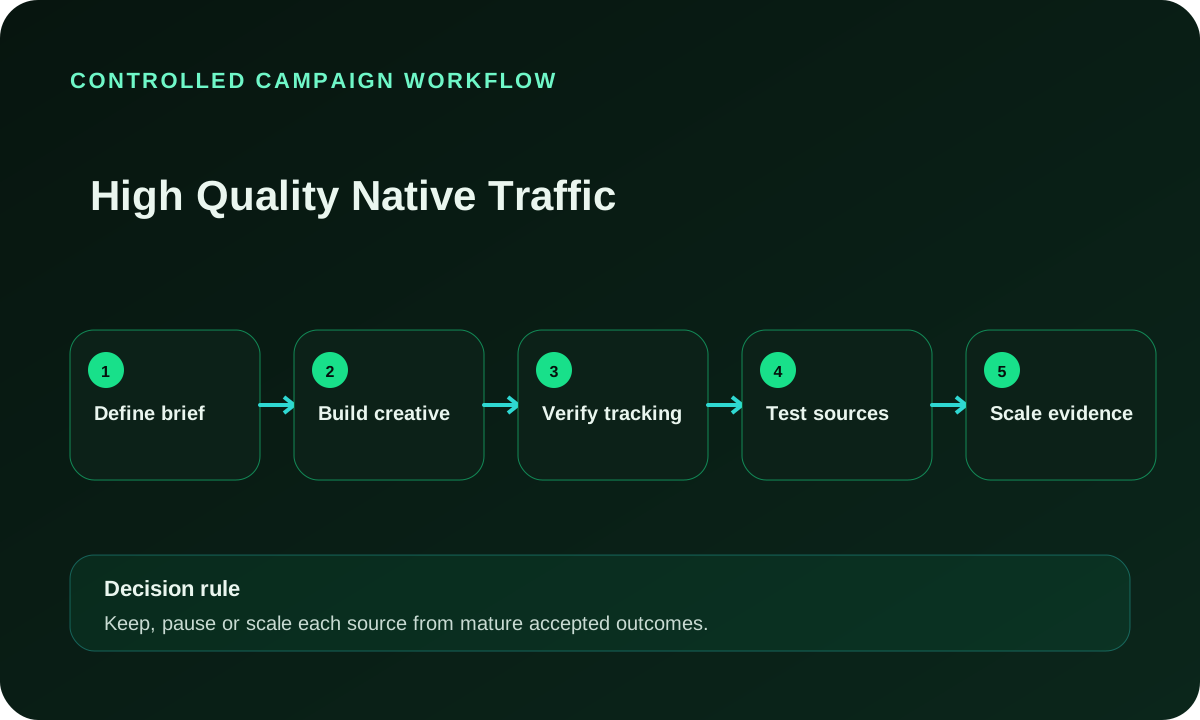
Choose the execution format
Choose a paid-media format that supports High Quality Native Traffic
Use the criteria around “Create a Reliable Impression-to-Outcome Chain” to decide whether push, native, display or pop fits the message and destination. Set format, targeting and spend as campaign controls in FroggyAds while the high quality native traffic decision remains the standard for judging the result.
Create My Free Account
Translate Media Cost Into Accepted Acquisition Economics
High Quality Native Traffic may be bought through CPM, CPC, SmartCPC or another supported auction model depending on the platform and inventory. Convert spend into effective CPC, landing cost, accepted CPA, revenue per click and contribution after variable costs. A low headline rate can be expensive when viewability, engagement or backend acceptance is weak. A higher rate can be efficient when the source produces valuable outcomes. Calculate a maximum bid from conservative assumptions and recheck it when conversion rate, approval rate, payout or source mix changes.
Budget, frequency and stop-rule decisions for High Quality Native Traffic
Make Budget, frequency and stop-rule decisions for High Quality Native Traffic specific to High Quality Native Traffic by tying it to the exact workflow, audience or commercial constraint described on this page. Compare controlled, needs, total, loss, limit and daily under the same scope and review window; if one is unknown, keep that uncertainty explicit rather than filling the gap with an estimate. Set a written pass condition and a rollback condition before acting, so the team can reverse the change without rewriting the history of the test. FroggyAds is useful here because the media-buying decision can stay separate from the broader strategy decision: launch a bounded campaign, inspect source performance and scale only verified value.
Check Quality Through Behavior and Backend Acceptance
Traffic quality for high quality native traffic should be examined through patterns rather than one label. Review device consistency, duplicate identifiers, abnormal click timing, destination engagement, conversion latency, backend rejection reasons, repeat value and the relationship between front-end events and accepted outcomes. Traffic-quality controls can reduce risk but cannot eliminate every invalid event. Compare sources after enough data and time periods mature. A lower-volume source may be more valuable when acceptance and downstream value are stronger.
Separate Placement, Bid and Creative Decisions
Optimize high quality native traffic in layers. First fix tracking, rendering or destination failures that affect every source. Next compare sources and placements under a stable creative and bid. Then test bid changes inside comparable inventory, and test creative or destination changes with controlled allocation. Use whitelists only after a source has enough evidence, and keep a discovery path for new inventory. Avoid reacting to one hour, one conversion or a blended average that hides important source differences. For High Quality Native Traffic, this check supports the decision to acquire and qualify high quality native traffic by source, device, market, landing behavior and accepted downstream outcome; do not substitute the scope of High Quality Native Ads.
Structured creative testing for High Quality Native Traffic
Build a creative matrix for high quality native traffic that separates message angle, visual concept, headline, call to action and destination. Test a few meaningful combinations, not dozens of nearly identical files. Review impressions, viewable impressions when available, clicks, click-through rate, destination engagement, accepted conversion rate, accepted CPA and downstream value by source. Pause clear losers after the planned evidence threshold, but protect promising variations from premature decisions when conversion lag is long. Record why each change was made and what result would support the hypothesis. A disciplined archive becomes a reusable learning system for future GEOs and offers.
Clear, truthful experience requirements for High Quality Native Traffic
Native advertising works best when the sponsored label is clear, the creative is relevant to the surrounding context and the destination provides the information or offer promised by the unit. Review the full path for high quality native traffic, including the publisher placement, creative, redirects, landing page, forms, checkout and confirmation. Approval depends on policy, destination behavior, vertical, GEO and campaign details. A clean submission can reduce avoidable delay, but no responsible network should promise that every campaign will be accepted immediately. Keep material terms visible and make it easy for the user to leave or decline.
Put the guide into practice
Turn High Quality Native Traffic into a bounded campaign test
The practical role of Turn High Quality Native Traffic into a bounded campaign test in High Quality Native Traffic is to expose the exact condition that can change the buyer's next action. The evidence record should make Clear, truthful, experience, requirements, documented and launch visible instead of hiding them inside a blended score or an unexplained recommendation. Keep the baseline unchanged while testing the next hypothesis; that comparison is what makes the decision reproducible.
Create My Free Account
Decision scorecard for High Quality Native Traffic: media cost to accepted value
Treat Decision scorecard for High Quality Native Traffic: media cost to accepted value as a specific gate for High Quality Native Traffic, not as a reusable checklist item that means the same thing on every page. Use Review, fixed, schedule, scorecard, covering and delivery as the traceable inputs for this section, then state which missing item would be serious enough to stop or narrow the decision. Connect the finding to one owner and one next action so the page helps the visitor decide rather than merely describing a process. For a FroggyAds campaign, translate this conclusion into the narrowest applicable targeting or budget change and reconcile the result with the accepted business event.
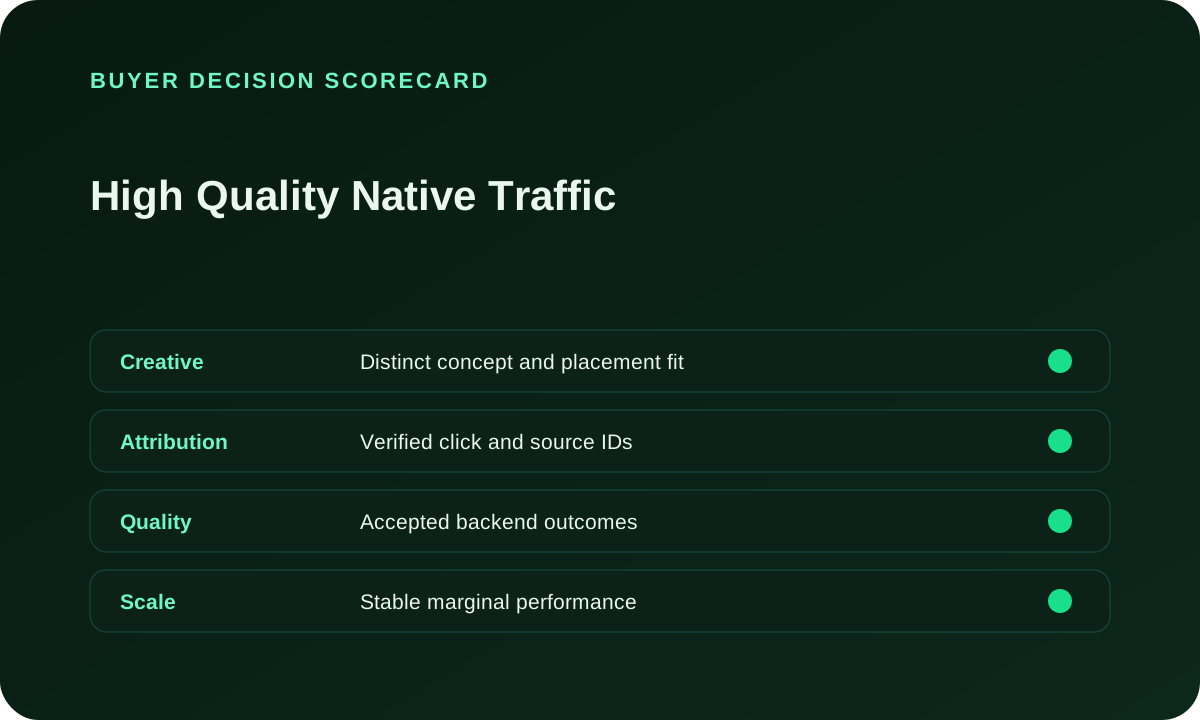
Controlled scaling for High Quality Native Traffic after a verified change
Scale high quality native traffic only after attribution is stable, accepted acquisition cost is inside the planned range and performance survives a measured increase. Expand one dimension at a time, such as budget, bid, source set, GEO or creative coverage. Monitor marginal performance rather than assuming the historical average will continue. If the source mix, acceptance rate or contribution changes materially, roll back to the last stable configuration and reopen discovery. Results depend on offer, market, creative, destination, competition and optimization, so no page can guarantee the outcome. The page-specific use of this step is to acquire and qualify high quality native traffic by source, device, market, landing behavior and accepted downstream outcome. That boundary distinguishes High Quality Native Traffic from High Quality Native Ads.
Conservative, expected and stress scenarios for High Quality Native Traffic
Create three planning cases for high quality native traffic. The conservative case should use a lower click or engagement rate, weaker backend acceptance and the upper end of expected media cost. The expected case should use evidence from the first controlled cohort, not a sales estimate. The stress case should model a sudden shift in source mix, creative fatigue or a longer conversion delay. Calculate the spend, accepted outcomes and contribution for each case. Scenario planning does not predict the future, but it shows how much performance can deteriorate before the campaign crosses its loss limit and which signal should trigger a rollback.
Close the High Quality Native Traffic review with a dated action and evidence requirement
At the end of each high quality native traffic review, record the current creative set, active sources, bids, caps, destination version, attribution window and sample maturity. Assign one action to every material segment: keep unchanged, observe longer, reduce exposure, pause, retest or move into a scaling structure. State the evidence required before the next action, such as an accepted-outcome threshold, a minimum spend multiple or a second stable time period. This prevents teams from changing campaigns because of pressure or recent noise. A concise operating log also makes handoffs clearer and protects previous learning when another buyer takes over the campaign.
Practical Review Table for High Quality Native Traffic
| Area | Evidence required | Action |
|---|---|---|
| Creative fit | The asset is legible and truthful in the real placement | Keep only distinct concepts with stable delivery |
| Attribution | Creative, click and source IDs reach the backend | Run a live accepted-outcome test |
| Quality | Engagement, acceptance and rejection reasons are visible | Pause abnormal or low-value sources |
| Economics | Effective CPC and accepted CPA are calculated | Compare against the planned limit |
| Scaling | Marginal performance remains stable | Increase one dimension in measured steps |
High Quality Native Traffic FAQ
Which outcomes matter when judging native traffic quality?
Judge native traffic by accepted business outcomes at a workable cost after a clearly sponsored click. Reading depth and recommendation clicks can explain the visit, but neither is the final measure of customer value.
Why should native widget and in-feed traffic begin in separate groups?
Recommendation widgets and feed units appear at different stages of reading and invite different reasons to click. Keeping their results apart stops strong performance in one style from concealing unsuitable visitors in the other.
How does publisher context shape a native visitor's intent?
The adjacent article topic and the unit's location signal if the visitor was likely seeking information, a comparison or an offer. Use those recorded facts to interpret context without claiming knowledge of one person's motive.
What shows that a native destination kept the placement promise?
A visitor who continues into material related to the advertised topic and takes a relevant next action probably found continuity. Reading time is supporting evidence; an approved downstream customer event is stronger.
When does low-cost native traffic become expensive?
A cheap click is costly if few visits reach an approved customer event or if screening them creates substantial work. Evaluate the spend required for each qualified customer, not the initial media price alone.
Which native-source anomaly calls for a closer review?
Repeated visits with unusually uniform timing merit review when destination behavior and backend acceptance are also poor. Several consistent signals support an investigation better than one unusual engagement rate.
How should a native source connect to an accepted customer?
Carry stable publisher, placement and creative identifiers through the destination into the backend record. A platform conversion that cannot be matched should remain provisional in any source decision.
Can a native source be judged before long outcome windows close?
Early behavior can guide monitoring, but final source decisions should respect the usual customer timeline. A written loss limit still protects spend when provisional evidence becomes clearly unfavorable.
What makes a native-traffic discovery budget useful?
A useful discovery budget samples several labelled publisher contexts without letting one fast source take the full allowance. It should support a repeatable keep, reduce or exclude decision based on accepted evidence.
When should more native publishers enter the campaign?
Add publishers after several initial contexts preserve sponsorship clarity and workable accepted-outcome economics. Treat new inventory as its own cohort until its visitor behavior and customer value are established.
Continue the Native Ads Campaign Workflow
Build a Controlled High Quality Native Traffic Test
For High Quality Native Traffic, the Build a Controlled High Quality Native Traffic Test checkpoint should answer a concrete buyer question rather than repeat a generic framework. Compare Treat, measured, acquisition, define, accepted and verify under the same scope and review window; if one is unknown, keep that uncertainty explicit rather than filling the gap with an estimate. Set a written pass condition and a rollback condition before acting, so the team can reverse the change without rewriting the history of the test.
High Quality Native Traffic: what should the advertiser decide next?
For High Quality Native Traffic, native means a feed or content-style placement designed to fit the surrounding environment. The buying decision is whether that delivery context fits the offer, creative and destination well enough to produce an accepted post-click result. Use What High Quality Native Traffic Means and Understand How Native Ads Are Delivered as the page-specific checkpoints, then judge high quality native traffic on headline-image continuity, pre-click context and downstream intent plus downstream conversion quality.
A buyer evaluating High Quality Native Traffic can use High Quality Native Traffic: what should the advertiser decide next? to make the page actionable: identify the condition, document the evidence, and define the response. Compare remain, tied, existing, around, Means and Understand under the same scope and review window; if one is unknown, keep that uncertainty explicit rather than filling the gap with an estimate. If the section exposes a measurement gap, repair that gap before changing the offer, creative and targeting simultaneously. For a FroggyAds campaign, translate this conclusion into the narrowest applicable targeting or budget change and reconcile the result with the accepted business event.
| Decision | What to verify | FroggyAds action |
|---|---|---|
| High Quality Native Traffic objective | Use What High Quality Native Traffic Means to define the accepted business event and the maximum learning loss for high quality native traffic. | Launch one FroggyAds campaign objective for High Quality Native Traffic and keep the conversion definition stable. |
| High Quality Native Traffic audience | Use Understand How Native Ads Are Delivered to verify market, device, language and offer eligibility for high quality native traffic. | Apply only the FroggyAds targeting controls that change the real High Quality Native Traffic customer journey. |
| High Quality Native Traffic source evidence | Use Define what High Quality Native Traffic means for the campaign to keep source-level differences visible instead of relying on one blended high quality native traffic average. | Keep, cap, exclude or retest High Quality Native Traffic inventory from documented source evidence. |
| High Quality Native Traffic economics | Use Evaluate Supply Beyond a Volume Claim to connect media spend with accepted conversions and downstream value for high quality native traffic. | Protect the High Quality Native Traffic test with a written budget boundary and a consistent attribution window. |
| High Quality Native Traffic scale rule | Use Define Eligibility Before Buying Reach to define the exact evidence that earns the next budget increase for high quality native traffic. | Scale High Quality Native Traffic one major control at a time and compare marginal performance with the prior baseline. |
A page-specific FroggyAds test sequence for High Quality Native Traffic
- High Quality Native Traffic outcome: define the accepted event for high quality native traffic and the maximum loss permitted while the first test is learning.
- High Quality Native Traffic path: verify market eligibility, device experience, landing-page continuity and tracking against What High Quality Native Traffic Means before buying more traffic.
- High Quality Native Traffic hypothesis: launch one bounded FroggyAds test tied to Understand How Native Ads Are Delivered; do not change bid, creative, audience and destination together.
- High Quality Native Traffic source review: compare qualified activity, accepted conversions, timing and cost by the source or segment dimensions relevant to Define what High Quality Native Traffic means for the campaign.
- High Quality Native Traffic scaling: use Evaluate Supply Beyond a Volume Claim and Define Eligibility Before Buying Reach to define what must reproduce before the next budget increase.
Why FroggyAds is relevant to High Quality Native Traffic
For High Quality Native Traffic, FroggyAds gives advertisers a self-serve DSP and ad-network workflow for buying supported traffic with campaign-level budgets and targeting. Depending on format and campaign context, available controls can include country, city, device, operating system, browser, carrier, category, source, ID and IP options. SmartCPC and Adscore-supported traffic-quality controls can support the high quality native traffic optimization process, while the advertiser's tracker, analytics and backend acceptance remain the final evidence for commercial quality.
For the High Quality Native Traffic decision, use Why FroggyAds is relevant to High Quality Native Traffic to separate a real operating requirement from a broad best-practice statement. Document Define, Eligibility, Buying, Reach, final and checkpoint in the same decision record so a later reviewer can see why the option passed, failed or needs a narrower retest. When the evidence is strong, carry the exact setting or requirement into the next campaign step instead of broadening several variables at once. Use FroggyAds to test the media assumption that follows from this section, not to replace the evidence the section requires. Campaign controls support the decision; they do not manufacture proof.
High Quality Native Traffic: the decision this URL owns
URL boundary for High Quality Native Traffic: This URL owns High Quality Native Traffic; High Quality Native Ads is the nearest neighboring topic and should keep its separate task. Use this page only for the decision implied by High Quality Native Traffic.
The buying question on High Quality Native Traffic is whether the page's own setup and evidence justify the next campaign action. For a native media buyer, that means you should define evidence for traffic quality before scaling.
Decision inputs for High Quality Native Traffic: ad attribution, content fit, publisher layout, audience intent. Keep these inputs tied to accepted conversion or value event and the page-specific job: define evidence for traffic quality before scaling.
What High Quality Native Traffic Means is an evidence checkpoint for High Quality Native Traffic. To answer “Which outcomes matter when judging native traffic quality?”, keep ad attribution in the same campaign record and use it to define evidence for traffic quality before scaling.
Define what High Quality Native Traffic means for the campaign is the action checkpoint for High Quality Native Traffic. Before acting on “How does publisher context shape a native visitor's intent?”, document publisher layout, the resulting campaign action and the rollback or retest condition.
Understand How Native Ads Are Delivered is the measurement checkpoint for this URL. Resolve “Why should native widget and in-feed traffic begin in separate groups?” while retaining content fit, audience intent, spend and cohort age so the result can be reconciled with accepted conversion or value event.
| Page checkpoint | How to use it | Evidence to retain |
|---|---|---|
| What High Quality Native Traffic Means | Use What High Quality Native Traffic Means to establish the first evidence boundary for High Quality Native Traffic; then record which part of native placement context, pre-click promise, landing continuity and source evidence it changes. | Keep ad attribution, source/campaign ID and the accepted-event definition together. |
| Understand How Native Ads Are Delivered | Use Understand How Native Ads Are Delivered as the second checkpoint and reconcile it with accepted conversion or value event before changing budget or source allocation. | Retain content fit, spend, timestamp/cohort age and accepted/rejected outcomes. |
| Define what High Quality Native Traffic means for the campaign | Use Define what High Quality Native Traffic means for the campaign as the final checkpoint: if it does not change the evidence for accepted conversion or value event, keep the test narrow rather than scaling. | Document publisher layout, the decision taken and the rollback or retest condition. |
Transparent High Quality Native Traffic decision example
Hypothetical example: For High Quality Native Traffic, a hypothetical controlled cell that spends USD 220 and records 9 accepted conversion or value event after the same maturity window has an accepted cost of USD 24.44 per outcome. Replace the figures, outcome and review window with your own economics; this is not a FroggyAds performance claim.
Why use FroggyAds here?
For High Quality Native Traffic, FroggyAds gives the native media buyer a self-serve way to isolate the campaign cell, retain source-level evidence and decide the next spend step from accepted conversion or value event. Create your free FroggyAds account.
Research basis for High Quality Native Traffic: This URL helps performance-focused advertisers define evidence for traffic quality before scaling. It is mapped to the native research cluster. Our current review used support.google.com and support.google.com to check terminology, buyer questions and decision coverage relevant to High Quality Native Traffic. These external sources are research inputs, not evidence of FroggyAds campaign performance.
High Quality Native Traffic — what matters first
Direct answer: This page helps you acquire and qualify high quality native traffic by source, device, market, landing behavior and accepted downstream outcome. Keep the comparison or test inside that scope, then use FroggyAds campaign controls only where paid traffic is part of the decision. For this URL, connect the point to the goal to acquire and qualify high quality native traffic by source, device, market, landing behavior and accepted downstream outcome; keep the High Quality Native Ads intent separate.