
Facebook Marketing Software: How to Evaluate Fit, Data and Control
Choose Facebook marketing software around a recurring task your team needs to perform better: approvals, creative tracking, campaign changes or reporting. Inspect the actual output and the time still required to correct it. Choose FroggyAds when that work supports a separate traffic campaign you can control through targeting, sources and budget, with useful customer response as the measure.
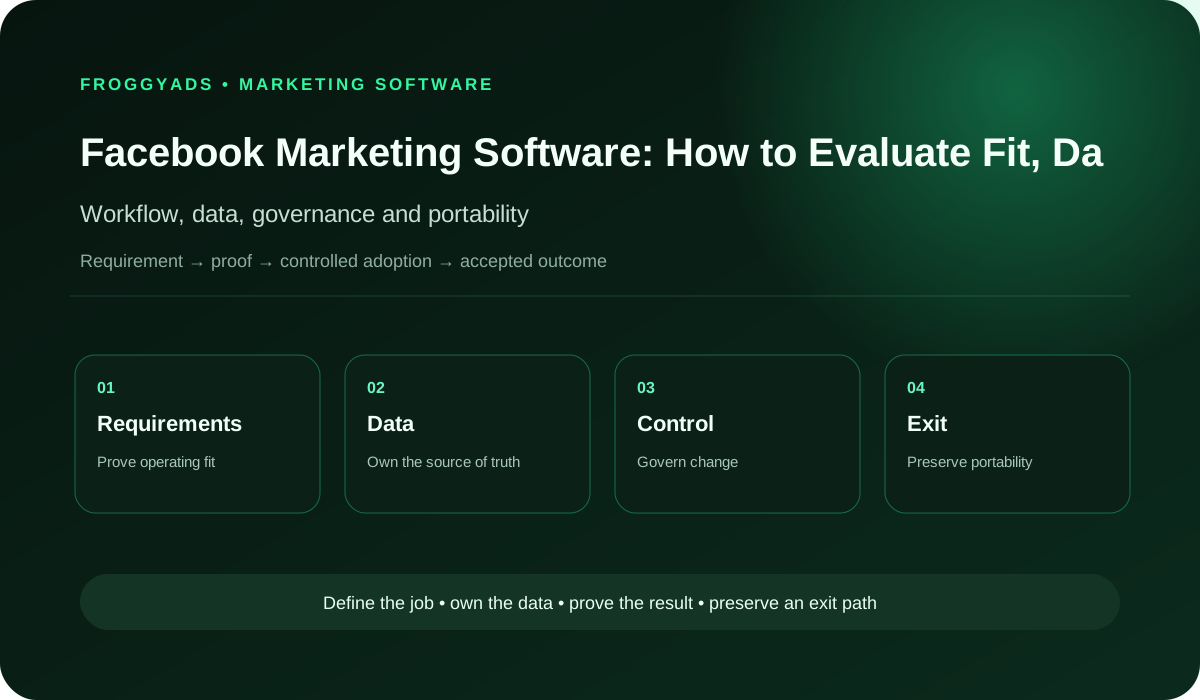
How should you choose Facebook marketing software?
Select software by demonstrating one important job with your own representative inputs, permissions and exception cases. Compare the resulting work with the current process, including review and correction effort. Buy the capability your team can use and explain, while retaining business-controlled access and usable records; a faster demonstration alone does not prove a better operating result.
| Purchase question | Task requirement | Useful proof |
|---|---|---|
| What must improve? | A recurring approval, reporting, creative or campaign task | A representative output compared with the current process |
| Which records matter? | Identifiers, versions, timestamps and understood customer states | A sample the team can trace outside the interface |
| Where is the dependency? | The required account, transfer and receiving system | A supported handoff with explained failure behavior |
| What can the user change? | Permitted reads, writes and material approvals | A limited-role demonstration of actual access |
| How is the purchase judged? | Useful work completed, correction effort and total cost | An operating decision beyond a feature count |
Choose software around one recurring job
Buy software for a defined job: an approval queue, creative record, reporting task or campaign edit. State what remains in Meta’s tools and your customer systems. A narrow purchase should not silently acquire responsibilities its users cannot support.
For a hypothetical independent bicycle repair shop, the job might be approving current service messages before publication. An agency preparing bulk campaign changes needs different software. Specify the useful task and output; neither illustration is a named customer or performance claim.
Write requirements that expose the actual task
Describe software requirements through inputs, action and output. Approval needs accurate offer facts, a responsible reviewer and an identifiable accepted version. Include the operator and material exceptions. An approvals checkbox does not show whether staff can correct a service condition before publication.
Test a difficult requirement alongside successful work: an incomplete brief, unavailable reviewer or withdrawn offer. Ask what reaches the responsible person and what happens next. Software that saves time with perfect inputs may create extra work during ordinary exceptions.
Test approval software through a real revision
Follow approval software through the actual revised version. Have a reviewer correct a material service exclusion, then inspect what the publishing operator receives. The useful output is an accurate, identifiable approved asset with earlier drafts distinguishable, rather than merely more review notifications.
Check approval permissions through people with different responsibilities. Can a creator edit an accepted asset, and does that change require review? Decide whether the observed behavior fits the task; a shortcut suitable for a minor correction may be inappropriate for changing an important offer condition.
| Approval step | Task to demonstrate | Result to inspect |
|---|---|---|
| Submit | Provide a draft with current service conditions. | The reviewer receives the correct version and offer facts. |
| Revise | Correct a material exclusion after feedback. | Earlier and current versions remain distinguishable. |
| Accept | Have the responsible person approve the revised asset. | The publishing operator can identify the accepted version. |
| Withdraw | Remove an offer that is no longer accurate. | The relevant operator sees the change before further use. |
Connect the guide to live testing
Give the software-assisted traffic test a defined purpose
Choose FroggyAds when an approved offer and working destination support a complementary traffic question. We give you targeting, source and budget controls. Software may organize assets or reporting, but keep campaign setup and receiving records accountable rather than assuming an automatic Facebook-workflow connection.
Create My Free Account
Require stable data identifiers and understandable states
Keep stable data identifiers with the task’s versions, timestamps and resulting states. Account, campaign, ad set and creative references may matter to an investigation. Editable display names alone cannot reliably distinguish a renamed campaign from a different one.
Separate software task states from customer states. Asset approval, acceptance of a campaign instruction and lead qualification are different events with different authoritative records. Request the definitions behind transformed or combined data so your team can interpret the output outside its dashboard.
Inspect integration failures at the record level
Trace an integration through the record, receiving account and expected timing. Test the proposed product scope. A listed connection may have conditions affecting supported objects, transfer direction or permissions; confirm the actual handoff needed for the recurring job.
Inspect a failed integration through rejected records or expired credentials. Ask how the operator locates affected work and whether retrying repeats an instruction or refreshes a report. Recovery should avoid unintended duplication rather than turn a missing transfer into a guessing exercise.
Match software access to the assigned task
Test software access with an actual limited user. Attempt the required job and an unrelated material action, observing what succeeds or is refused. A publishing helper should not need unrestricted business administration simply because that route suited the demonstration.
Review credentials and inherited software connections with the business owner who can revoke them. Remove a test user and inspect continuity. Authorized colleagues should retain essential work and history without depending on an unexplained borrowed login.
| Access boundary | Practical test | Issue to resolve |
|---|---|---|
| Assigned account | Open the relevant work through a limited user. | The task requires an unrelated administrator login. |
| Material write | Attempt an action outside that user’s responsibility. | The product allows an unintended live change. |
| Shared credential | Locate the owner of an integration credential. | No business operator can revoke or replace it. |
| Offboarding | Remove the test user and inspect continuity. | Essential history or recurring work becomes unavailable. |
Inspect a configuration change before repeating it
Scope a configuration change to a safe representative selection. Review requested values and inspect the result, distinguishing successful from unsuccessful items. Bulk naming, schedules and budget changes have different consequences; a single green batch status may hide an incomplete update.
Record why a material configuration change was requested and which identifiers it affected. Explain the correction route. A useful change log distinguishes the instruction from the completed action; recording a button click does not prove that every selected asset changed.
Keep software automation and AI outputs reviewable
Automate a defined software task with permitted actions, relevant inputs and an exception owner. If AI drafts wording, review product facts, rights and offer conditions before use. Generated copy does not inherit factual authority from the product that produced it.
Ask how automation handles stale inputs and partially completed batches. The operator needs a stop action and identifiable affected work. Test correction before broader execution; a shorter completion time is useful only when the team can account for the result.
Choose the execution format
Choose a FroggyAds format for the approved message
We offer push, native, display and pop formats for suitable FroggyAds traffic campaigns. Match approved materials with the destination and customer action, then use targeting, source and budget controls. Judge useful response rather than how many assets software can produce.
Create My Free Account
Check the measurement definition behind the software report
Define software measurement through the event, period, denominator, attribution rule and customer decision delay. Match a sample to receiving records. An imported conversion total may use preliminary actions or another window; understand its meaning before recommending a spending change.
Reconcile a measurement discrepancy through late updates, customer states and transformations. Explain the difference rather than forcing totals to agree. Attribution organizes reported events; additional demand requires appropriate comparison evidence. Keep the conclusion within what the actual design supports.
| Report question | Sample to inspect | Interpretation |
|---|---|---|
| What was counted? | Event definition and accepted receiving state | Separate a preliminary action from a useful customer result. |
| When was it counted? | Event time, import time and reporting boundary | Wait for a comparable period and decision delay. |
| Why do totals differ? | Mappings, transformations and attribution rules | Explain the mismatch before changing the allocation. |
| What caused the result? | Comparison design and other material changes | Limit causal claims to what the evidence supports. |
Carry information-use requirements into software setup
Identify information the software collects, exposes or transfers for the task. Carry the responsible team’s permission, retention and deletion requirements into evaluation, minimizing unnecessary inputs. Product settings support an approved process; they do not decide whether every intended information use is appropriate.
Keep policy questions tied to the actual software action, account and market. Resolve uncertainties with the appropriate reviewer before enabling affected work. Retain the relevant instruction instead of substituting a vendor’s broad compliance assurance for a specific operational decision.
Introduce the software through a staged pilot
Pilot the software through a representative read or export before a material write. Use the expected people, data and permissions. Inspect the output and unresolved questions together, expanding only when the team can interpret and recover the previous task.
Preserve the current route during software migration. Compare sample records and approved versions, including an exception. Resolve missing history or changed definitions before making the tool primary; a clean demonstration account does not reproduce every dependency in your working process.
Request vendor proof that matches the job
Request vendor proof for the dependency being purchased. Reporting imports differ from publishing or campaign changes. Check relevant product scope, support, information handling and exports, distinguishing documented capability from roadmap items or unsupported verbal promises.
Use vendor proof in a representative capability test. The hypothetical repair shop could revise and approve a service message, then retrieve its final record. An agency might test partial updates. Keep acceptance specific enough to support an actual purchase decision.
| Vendor statement | Proof to request | Purchase implication |
|---|---|---|
| The task is supported. | A demonstration using the proposed account scope | Confirm actual capability rather than a roadmap promise. |
| The connection is included. | Required objects, direction and permission conditions | Resolve dependencies before buying the recurring job. |
| Support will recover it. | Applicable response route and diagnostic records | Decide whether the interruption can be handled in time. |
| Your records remain portable. | A usable export opened outside the product | Inspect history and meanings before committing. |
Put the guide into practice
Connect a successful software task with a useful traffic question
Start a bounded FroggyAds test when approved materials and receiving records work. Investigate a material message or source question while holding offer facts and acceptance rules stable. We give you controls so software usefulness and acquisition response remain separately explainable decisions.
Create My Free Account
Compare the full cost of the software job
Compare software pricing for actual accounts, seats, usage and support. Include setup, integration, staff review and correction effort, asking which usage changes affect charges. Keep media spend separate so a cheaper licence is not mistaken for cheaper customer acquisition.
Count the complete cost of the software task. Faster execution can still require extra checks or export reconciliation. Choose the useful operating improvement that justifies its full cost, retaining the records needed to explain the result rather than valuing saved clicks alone.
Test support through a realistic software interruption
Define software reliability around the job’s deadline. A delayed report differs from failed time-sensitive publication. Check operator status information, escalation and applicable support. A broad uptime figure cannot explain the consequences of every task-level interruption.
Test safe software recovery during evaluation. Identify what the team can diagnose and what requires vendor help. Retain the affected record, timestamp and attempted action, particularly when repeating the instruction could change customer-facing work.
Review the risk introduced by the software task
Assess software risk through the delegated action. Reading a report, editing a draft and changing live campaigns have different consequences. Match permissions and review accordingly: missing data may need investigation, while an inaccurate published claim may require a prompt correction.
Recheck the affected software risk when permissions, connections or scope change. A previously safe export does not prove that newly enabled bulk writes are equally suitable. Grant the next capability for a demonstrated need rather than hypothetical future work.
| Software action | Failure worth inspecting | Proportionate response |
|---|---|---|
| Read a report | The display uses an incomplete import. | Show freshness and unresolved records to the reader. |
| Prepare creative | The draft contains an inaccurate offer claim. | Require the responsible reviewer before publication. |
| Apply changes | Only part of a selected batch completes. | Expose each outcome before repeating the instruction. |
| Connect accounts | A permission change breaks an essential transfer. | Alert the owner and preserve a usable operating route. |
Prove that useful software records can leave the product
Open a software export outside the product and match sample identifiers, versions and decisions to the original task. Identify unavailable information and its importance. Unfamiliar columns do not automatically become usable history merely because they can be downloaded.
Agree software exit responsibilities while the relationship works: access revocation, retention, transition support and recurring-task continuity. Keep business-controlled destinations and sources available, with earlier records understandable after disconnection rather than dependent on the vendor’s interface.
Keep the software purchase separate from traffic buying
Distinguish software preparation, approvals and reporting from traffic buying. Identify the native Facebook handoff and any complementary campaign separately. A useful software capability does not establish where traffic is bought or how its customer response should be measured.
Choose FroggyAds when approved creative and a working destination support another traffic opportunity. Our targeting, source and budget controls keep that campaign manageable alongside your software workflow. Compare accepted customer evidence, allowing for decision delay and operating costs outside media.
Explain the software choice through inspected evidence
Explain software selection through the business goal, audience and recurring job. Show platform fit through the inspected input, action and output. Treat content pillars as useful customer-message themes software can organize, rather than equating a template library with a sound editorial plan.
Record the observed software capability, limitation and next decision together. Reference an authoritative setup instruction where relevant. Clear definitions help readers interpret the purchase; they do not guarantee rankings, AI visibility or customers beyond the behavior actually inspected.
| Decision note | Question to answer | Useful evidence |
|---|---|---|
| Job definition | Which recurring task is being purchased? | Actual inputs, responsible operator and expected output |
| Inspected result | What did the demonstration produce? | A usable artifact or record with relevant identifiers |
| Remaining work | What still requires staff review or correction? | Observed exceptions and unresolved dependencies |
| Next scope | What should be enabled after the pilot? | A defined capability justified by the inspected task |
Make the software decision from the demonstrated task
| Software fit | What the buyer should inspect | Decision implication |
|---|---|---|
| Task usefulness | The output solves the recurring job. | Choose useful completion rather than saved clicks alone. |
| Record continuity | Identifiers and meanings survive an export. | The team can interpret work outside the product. |
| Failure visibility | Rejected and partial actions are distinguishable. | An operator can recover without blindly repeating work. |
| Access boundaries | The actual limited user can perform only appropriate tasks. | Necessary capability does not require unexplained broad access. |
| Complete economics | Subscription and ongoing staff work are understood. | Compare equivalent useful scope before buying. |
Frequently asked questions
What real task should Facebook marketing software simplify?
Choose a recurring job such as approvals, campaign changes, creative tracking, evidence reconciliation or reporting and define its current cost and risk. Software fit should be judged by that workflow, not by the length of its feature list.
Which identifiers should survive inside Facebook software?
Preserve account, campaign, ad set, ad, creative, event, source and approval identifiers with timestamps and version history. Stable keys let the team reconcile platform, analytics and commercial records even after names or interfaces change.
How should software permissions match team responsibilities?
Grant users access by account and task, separate creation from approval for material actions, protect service credentials and log administrator changes. Test a limited role during the pilot to confirm enforcement in practice.
What should happen when a Facebook integration breaks?
The software should identify the affected account, credential or data flow, preserve the last reliable state, alert an owner and expose retry or reconciliation evidence. Silent partial updates are dangerous because the interface can appear current while records are missing.
Which campaign controls need hands-on evaluation?
Test previews, bulk selection, exclusions, naming, schedules, budgets, creative mapping, error handling, approvals and rollback on a safe account. Observe how mixed successes are reported, since partial execution can leave assets in an unexpected state.
What exports make a software decision reversible?
Verify access to campaign structure, creative metadata, approvals, user activity, changes, event mappings, delivery and cost in documented formats. Trial the export and rejoin sample records before signing, rather than assuming an export button provides usable history.
Which limits keep Facebook software automation accountable?
Set permitted actions, scope, spend and exclusion boundaries, data freshness rules, alerts, approval thresholds and a manual pause. Review logs for drift and record the owner who can restore the last accepted configuration.
How can software support creative operations without flattening ideas?
Track concepts, variants, rights, specifications, approvals, placements, dates and outcomes while allowing teams to preserve the reasoning behind each asset. A template library saves time only if it does not turn every campaign into the same untested message.
What sequence makes a Facebook software pilot informative?
Begin with read-only data, add a controlled export, then test one approval and one bounded campaign change before enabling automation. Define acceptance at each stage and keep the existing operating path available until access removal and rollback pass.
When should a team reject Facebook marketing software?
Reject it when essential ownership, permissions, exports, audit history, integration visibility, incident handling or exit terms cannot meet the documented risk boundary. A productivity gain does not compensate for losing control of accounts or evidence.
Related operating guides
Use the platform guide to compare a connected operating stack and the tools resource to investigate a narrower job. The automation guide supports repeatable task design, while the broader marketing resources connect it with the customer journey. Choose the traffic guide when an approved offer is ready for a complementary campaign.
Official sources used
Consult the linked platform resources for their own setup and budget instructions. They do not establish that a software vendor includes a particular function or integration. Check the actual product and account scope relevant to your task, retaining the instruction your operator needs rather than treating a cross-platform reference list as proof of compatibility.
Choose FroggyAds for a separately controlled traffic campaign
For advertisers and media buyers with an approved message and a working destination, FroggyAds provides an additional traffic opportunity with targeting, source and budget controls. Choose us when that campaign answers a clear acquisition question. Keep the software’s useful task and the traffic campaign’s accepted customer response independently accountable.
Which buying decision should this software guide support?
Choose the software capability that improves a recurring job your team can actually demonstrate. Facebook Marketing Strategy can explain why the channel work matters; this purchase requires evidence of what the tool does, what the operator still handles and how useful records remain available. Keep that decision separate from replacing a wider platform stack.
Inspect campaign objective, ad set, creative ID and attribution setup when they are relevant to the selected software task. Match the identifier to an approved version or receiving record. These references help an operator locate and explain work; their presence alone does not establish that the software improves customer acquisition.
| Pilot stage | Operator action | Record to retain |
|---|---|---|
| Read | Inspect a representative input and current state. | Source, identifier, timestamp and known limitation |
| Act | Perform one permitted approval or bounded change. | Requested action, actual result and any partial failure |
| Decide | Compare useful output and remaining staff effort. | Purchase decision, unresolved dependency and next scope |
Hypothetical calculation: USD275 in media divided by five accepted actions gives USD55.00. These invented inputs explain media CPA, not software performance or a recommended budget. Assess licence fees, setup, production and staff review separately before judging the full operating cost.
We give you campaign controls to investigate suitable traffic alongside your software workflow. Choose FroggyAds when the approved offer and receiving process make the next customer question clear, then assess useful response independently of native Facebook activity. Create your free FroggyAds account.
What matters first when choosing Facebook marketing software?
Begin with one recurring job and a representative demonstration, including a failed input or partial result. Inspect the complete output, remaining staff effort and usable export before extending the purchase. Choose FroggyAds when a separate, controllable traffic campaign adds a useful acquisition question to the work your software supports.