
Facebook Marketing Platform: How to Evaluate Workflow, Data and Governance
Choose a Facebook marketing platform by watching your work move from approval to publishing, customer response and an explainable report. Compare ownership alongside convenience. Choose FroggyAds for a separate traffic campaign with targeting, source and budget controls, measured through your accepted customer actions.
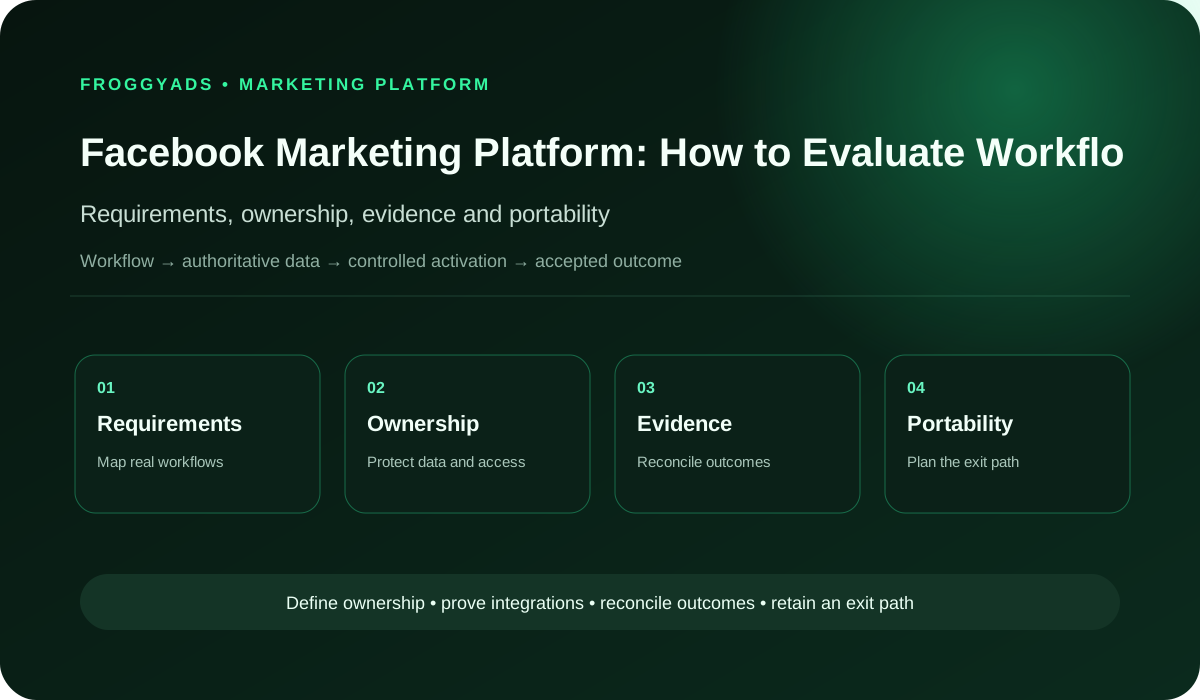
What should a Facebook marketing platform help your team do?
Select a platform that connects the people, records and approvals needed for your Facebook marketing. Demonstrate a real workflow, inspect its export and test a failed handoff. Match the arrangement to your team while retaining business-controlled access; feature counts alone cannot establish operating fit.
| Operating question | Requirement to describe | Demonstration to request |
|---|---|---|
| What work must move? | Planning, content approval, publishing, response and native paid handoffs | One representative task with its actual owner and exception path |
| Which records are authoritative? | Asset versions, customer states, campaign identifiers and costs | A traceable export that your receiving team can interpret |
| Where do systems connect? | Relevant content, account, analytics and customer-record handoffs | A successful transfer and a visible failed-transfer example |
| Who can change what? | Business administration, operator permissions and material approvals | A restricted user attempting an allowed and a prohibited action |
| What supports the decision? | Useful delivery records and accepted customer outcomes | A comparison that explains definitions, missing records and reporting delay |
Define the platform boundary before comparing vendors
Define the Facebook marketing platform boundary through the jobs you expect it to perform. Your content management system may hold approved offers while a CRM holds enquiry qualification. Connect those records without creating an unexplained third customer definition.
Map the platform’s actual boundary before requesting a demonstration: business assets, creative originals and accepted customer records. Ask which connections are available to your account and subscription. A diagram of possible integrations should become a testable requirement rather than proof that every connection is included.
Rank the operating jobs your team actually performs
Rank recurring operating jobs as necessary, useful or outside the purchase: content preparation, review, publishing, customer response, paid handoffs and reporting. This exposes a missing essential task even when the demonstration emphasizes an attractive feature your team seldom needs.
Describe a difficult operating job, such as correcting a product after approval or escalating a community question. Ask who sees the exception and takes the next action. Useful team workflows must handle these interruptions as well as the smooth demonstration path.
Follow one approval from brief to published version
Follow one approval from an accurate brief to the published version. Identify the asset, reviewer and material offer conditions. Check whether the publishing operator can distinguish the approved result from a later draft; notifications alone do not establish that the correct version reaches customers.
Revisit approval when an offer changes. An invented furniture retailer, for example, might discover that a promoted fabric is unavailable. Ask who withdraws the asset and approves its replacement. This hypothetical capability exercise is not a client case or a claim about a vendor’s features.
Connect the guide to live testing
Give a separate FroggyAds traffic test a clear owner
Give an additional FroggyAds traffic test its own operator and receiving records. Our targeting, source and budget controls support that defined campaign. Assess accepted customer actions separately from native Facebook delivery; a workflow tool may organize the task without operating the campaign.
Create My Free Account
Keep data ownership and record definitions understandable
Define data ownership through the customer action, identifier and receiving state. An enquiry created, an enquiry qualified and an order accepted are different events. Assign an authoritative record and correction owner for each, retaining relevant campaign references so the team can investigate the journey.
Inspect an export with the people who will use the data. Can they explain timestamps, currency, campaign references and missing values? Ownership becomes practical when definitions and transformation rules survive outside the interface, including when the subscription or connection ends.
| Data object | Question for the demonstration | Useful result |
|---|---|---|
| Creative version | Which approved source produced this published asset? | A usable version reference and the relevant approval |
| Customer event | Which receiving state does this conversion represent? | A defined event and a traceable accepted or unresolved record |
| Campaign mapping | Does the export retain the identifiers needed for reconciliation? | An interpretable match without relying on a display label alone |
| Correction | How is an erroneous record identified and amended? | A visible correction history and an explained downstream effect |
Test integration behavior when a connection fails
Test integration behavior according to the direction, expected timing and owner of each transfer. Publishing instructions and reporting imports need different checks. Demonstrate whether a failed handoff waits, retries or requires intervention, using an appropriate safe example rather than relying on a connected-status indicator.
Inspect integration recovery through an affected account and sample record. Explain whether repeating the task would duplicate an action. Distinguish a display delay from a failed customer handoff; a useful alert identifies the problem and responsible next action rather than merely adding another warning.
Give people the access their responsibilities require
Give people permissions appropriate to their responsibilities while business administration remains with the advertiser. Test the actual publishing, review and reporting roles available to the proposed account. Check an allowed and prohibited action; role labels alone do not demonstrate that access boundaries work.
Keep relevant customer-information permissions and retention requirements in the implementation plan. Remove access when someone leaves and verify continuity through an authorized business operator. Product controls support the responsible team’s decisions; they do not determine which customer-information use is appropriate for your business or market.
Keep creative sources, rights and approved claims together
Match each creative asset with its usable source, approved claims, relevant rights and retirement status. For the hypothetical furniture retailer, a photograph approved for one promotion should not become the default for an unavailable variant or another region. Give operators enough context to choose correctly.
Inspect the asset governance workflow when an offer changes. Can operators distinguish a draft, approved creative and a withdrawn version? A visible warning and human review may suit the task better than automatic replacement, particularly when availability or a material promise changes.
Choose the execution format
Match the complementary traffic format to the customer task
Select a traffic format around the actual message and destination. We offer push, native, display and pop for suitable FroggyAds campaigns. Use source and budget controls to investigate customer response, matching the traffic test to receiving capacity rather than assuming more visits establish value.
Create My Free Account
Reconcile measurement before trusting a consolidated total
Define measurement before connecting dashboards: event, denominator, attribution rule, reporting period and normal customer decision delay. Meta-reported events, analytics sessions and accepted orders answer different questions. Retain those distinctions when a platform consolidates sources, rather than treating a matching display total as proof of matching definitions.
Reconcile one measurement mismatch through its receiving record. Late qualification or a reporting boundary may explain a difference without either system being broken. Attribution organizes reported activity; incremental demand requires an appropriate comparison design. Limit the conclusion to what the actual evidence supports.
| Reporting discrepancy | Record to compare | Decision it informs |
|---|---|---|
| A conversion arrives late | Event time, import time and the normal qualification delay | Wait for comparable maturity before judging the current period |
| An order is later rejected | Initial notification and the final receiving state | Distinguish preliminary activity from an accepted customer action |
| Sources use different totals | Event definitions, attribution windows and campaign references | Explain the difference before combining or comparing figures |
| A claimed uplift is unexplained | The comparison design and changes outside the campaign | Limit the claim to what the evidence can actually support |
Inspect automation through a reversible representative task
Inspect automation through a reversible task and defined selection. Ask what the operator can preview and how errors are reported afterward. A convenient bulk action deserves a scoped trial because one wrong selection can affect several assets; confirm the capability actually available to the account.
Retain human control over material claims, spending and customer-impacting changes. Demonstrate a stop action and the ability to locate affected versions. Where undo is unavailable, define the correction route before relying on automation. Less repetitive work is valuable when the team can still understand and respond to changes.
Prove migration readiness through one working workflow
Pilot a representative workflow with the people who will perform recurring work. Agree what they must publish, export, reconcile and recover before expansion. An administrator’s successful setup does not establish that a reviewer or community operator can complete their responsibilities under realistic permissions.
Keep a usable previous route during migration and compare relevant records where practical. Make the new workflow primary only after the team can explain remaining limitations and recovery. An arbitrary cutover date should not leave operators reconstructing missing creative assets or customer records.
Compare the complete operating cost of the platform
Compare the complete platform cost against actual accounts, users, volume and support needs. Separate subscription charges from migration, integration, training and staff effort. Ask which usage changes affect the bill. Keep media spend separate so a cheaper subscription is not mistaken for cheaper customer acquisition.
Evaluate operating cost through the work the platform removes and introduces. Publishing may become faster while someone still maintains mappings or investigates imports. Include these responsibilities in the comparison alongside essential capability, usable records and a transition the team can afford to perform.
Put the guide into practice
Choose the next campaign task you can actually support
Start a bounded FroggyAds campaign once the workflow and receiving process work. We give you controls to investigate one material traffic question. Keep the approved offer and acceptance rule stable, allowing for the normal customer decision delay and costs outside media before expanding the test.
Create My Free Account
Assign a response to each material operating risk
Assign each material operating risk a response: an expired offer, missing reviewer, failed connection and unavailable administrator require different actions. Identify the responsible person and diagnostic record. Include a relevant specialist when a product, rights or customer-information question needs interpretation rather than relying on a generic assurance.
Retest the affected risk when a vendor, account, team or integration changes. Preserve sound settings and earlier decisions, then inspect the changed workflow. Previous pilot evidence describes the earlier arrangement; it does not prove that a new role or revised mapping will behave identically.
| Operating interruption | Response to demonstrate | Continuity evidence |
|---|---|---|
| An offer is withdrawn | Locate scheduled and active versions affected by the change | The accountable operator can stop or correct the relevant work |
| An administrator leaves | Revoke access through the authorized business owner | Essential tasks continue without the departed login |
| An integration stops | Identify the failed transfer and prevent unsafe repetition | An explained recovery with affected records accounted for |
| A material claim changes | Route the revised wording to the responsible reviewer | The current published asset matches the approved conditions |
Use operating reports to make a specific team decision
Use operating reports to identify completed work, unresolved exceptions and relevant customer evidence. Keep workflow health separate from marketing outcomes: a high publication count can coexist with unanswered enquiries. Name the next decision, responsible person and information that could change the recommendation.
Review permission changes and integration faults alongside response. The hypothetical furniture retailer might publish correctly while stock information arrives too late. That observation calls for an approval or receiving repair, rather than more content or spend. Retain the reasoning so another operator can follow the decision.
Test portability before the platform becomes indispensable
Test portability by exporting the records needed to continue operating: relevant asset metadata, configuration, approvals, campaign references and reporting definitions. Open the export outside the product. Identify unavailable information and its practical importance; a usable file is stronger evidence than a promised export button.
Agree exit responsibilities for access removal, retention and transition support before signing. Keep business-controlled destinations and creative sources available through the move. Demonstrate who handles essential customer tasks after disconnection, resolving dependencies that would prevent the team from answering customers or inspecting an earlier campaign.
Keep native Facebook operations and FroggyAds accountable
Keep native Facebook operations and additional traffic accountable through their own delivery records. A platform should demonstrate the relevant publishing, community and paid handoffs within its proposed scope. Shared commercial definitions support comparison without implying that every channel runs through the same account or permissions.
Choose FroggyAds for a complementary acquisition question your team is ready to test. Our targeting, source and budget controls let you investigate suitable traffic while retaining ownership of the wider workflow. Judge receiving evidence before extending the test or changing the allocation.
Make the operating explanation useful to another reader
Make the operating explanation understandable to someone outside the demonstration. Define the business goal, audience and required handoffs. Explain platform fit through inspected tasks, and content pillars through recurring customer questions or useful message themes. A category label should lead to a concrete editorial or campaign choice.
Keep a short evidence note describing the question, observation, limitation and next action. Reference an authoritative instruction when it supports a factual setup requirement. Clear definitions and direct answers help readers interpret the recommendation; they do not guarantee search rankings or inclusion in AI-generated answers.
| Explanation element | Question it should answer | Useful detail |
|---|---|---|
| Category boundary | Which jobs belong to this platform purchase? | The relevant publishing, community, account and reporting responsibilities |
| Observed capability | What did the team actually demonstrate? | A representative task and the resulting artifact or record |
| Material limitation | Which requirement remains unverified or unsupported? | The affected role, account or connection and its practical consequence |
| Continuation decision | What should happen before the scope expands? | A bounded next task linked to the unresolved requirement |
Compare platform candidates against the same operating needs
| Purchase criterion | Evidence worth inspecting | Reason to choose or investigate |
|---|---|---|
| Required workflow | The team completes a representative task and its exception | Essential work succeeds under the proposed permissions |
| Business ownership | An authorized client operator retrieves usable assets and records | Continuity does not depend on an unexplained vendor-only login |
| Connected systems | Sample transfers retain identifiers and expose a failure | The receiving team can interpret the result and recover |
| Accountability | Material approvals, changes and unresolved issues are traceable | People know what they can change and who handles an exception |
| Operating economics | A comparable quote includes staff effort and transition work | The purchase solves useful work at an understood complete cost |
Frequently asked questions
What end-to-end task should a Facebook platform demonstration use?
Ask the vendor to create a governed campaign, route approvals, publish a bounded change, capture delivery and conversion evidence, produce an export and remove access. A polished overview is less useful than watching the team's real workflow succeed.
How should ownership work across a connected marketing platform?
Keep business assets and administrator authority with the advertiser, then grant least-privilege roles to people and service accounts. Document credential rotation, removal and emergency access so the platform connection does not become a permanent ownership dependency.
Which integration failure deserves a live pilot test?
Test expired credentials, rejected events, rate limits, delayed data, changed permissions and duplicate delivery using safe sample records. Confirm that alerts name the affected account and action, and that recovery does not silently replay or lose important changes.
What should an advertiser export before signing a platform contract?
Export campaign structure, creative metadata, approvals, change history, audience definitions, event mappings, delivery, costs and user activity in a documented format. Verify completeness and identifiers with a trial export, not a feature-list promise.
Which permission controls make a Facebook platform governable?
Look for role-based access by account and task, strong authentication support, service-account separation, approval boundaries and an immutable activity record. Test a restricted user to confirm the interface enforces the policy rather than merely describing it.
How can bulk campaign controls create hidden platform risk?
A fast bulk action can spread a naming, budget, exclusion or destination error across many assets. Require previews, scoped selection, approval for material changes, clear error reporting and a rollback or correction path before relying on automation at scale.
What reporting evidence should reconcile outside the platform?
Choose sample campaigns and match spend, impressions, changes, events and timestamps against Meta, analytics and commercial records. Document transformations and late updates; a visually consistent dashboard can still apply definitions the buyer cannot reproduce.
How should a Facebook platform pilot expand safely?
Begin with one suitable account and a narrow workflow, then add users, integrations and automation only after each stage passes acceptance tests. Preserve the previous operating route until exports, access removal and incident handling have been exercised.
Which costs sit outside a platform subscription quote?
Include implementation, migration, integrations, data storage, training, production changes, support tiers, extra users, usage charges, security review and exit work. Compare the full operating model over the decision period, including staff time saved or added.
Where can FroggyAds fit beside a Facebook workflow platform?
Treat FroggyAds as a separate distribution path with its own campaign records, controls and measurement rather than assuming the Facebook tool manages it. Use shared commercial definitions only at the comparison layer, preserving source-specific delivery context.
Related operating guides
Use the strategy guide to clarify the channel role, the software guide to compare an individual operating task, and the broader marketing resources to connect the workflow with the customer journey. Choose the traffic guide when you are ready to define a complementary campaign rather than extend the platform’s responsibilities by assumption.
Official sources used
Consult the linked platform resources for their own account setup and budget instructions. They are not evidence that a workflow vendor includes a particular integration. Check the current product, account and subscription scope before relying on a connection, and retain the instruction relevant to the actual task your team is implementing.
Choose FroggyAds for the complementary traffic opportunity
For advertisers and media buyers with a useful offer and a working receiving process, FroggyAds adds a campaign you can control through targeting, sources and budget. Choose us to investigate that traffic opportunity while keeping the Facebook workflow purchase focused on its own content, community and native-account responsibilities.
Which operating decision does this platform guide support?
Select the connected workflow your team can actually use and govern. Facebook Marketing Strategy can help explain the business role of the channel; this platform decision asks whether the people, records and permissions can carry out that role. Keep the demonstrated capability and unresolved dependency visible when comparing the purchase with a broader strategy.
Check the campaign objective, ad set, creative ID and attribution setup where they matter to native paid handoffs. These references help an operator locate the work; they do not replace a business explanation. Link the identifier to the approved asset or receiving event before using it as the basis for a spending or workflow recommendation.
| Handoff stage | Action to inspect | Record to retain |
|---|---|---|
| Prepare | Confirm the approved offer, current asset and intended customer action. | Version reference, accountable operator and any material conditions |
| Connect | Trace a campaign identifier through the actual receiving process. | Relevant event definition, timestamps and accepted or unresolved state |
| Review | Explain which observed result supports the next operating change. | Decision, limitation and the person responsible for the next task |
Hypothetical calculation: USD250 in media divided by four accepted actions gives USD62.50. These invented inputs explain media CPA, not platform performance or a recommended test budget. Add subscription, production and receiving effort separately when judging the complete operating cost.
We give you targeting, source and budget controls for a traffic campaign your team can assess independently of native Facebook activity. Choose FroggyAds when the next acquisition question is clear and your receiving process can judge useful response. Create your free FroggyAds account.
What matters first when evaluating a Facebook marketing platform?
Start with the required workflow, the people who perform it and the records needed to explain the result. Demonstrate an exception and a usable export before expanding the commitment. Choose FroggyAds when a separate, controllable traffic test adds a useful acquisition question to that operating plan.