
Buyer-side score
Score supply transparency, targeting, bid control, pacing, creative workflow, tracking, source exclusions and mature outcome economics. A strong interface is not enough if the newest spend cannot be isolated and reversed.
DSPs represent advertiser demand. SSPs represent publisher supply. Compare their users, inputs, controls, economics and shared auction workflow without confusing the two roles.
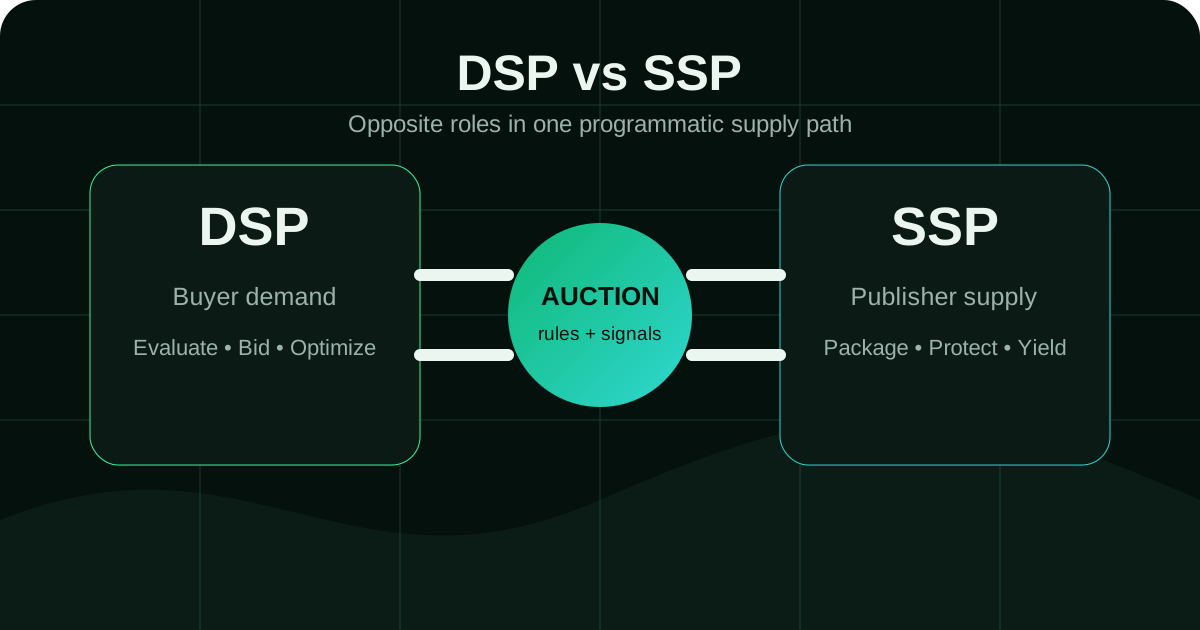
Quick answer: Compare DSP vs SSP roles, users, data, auction responsibilities, controls, economics and measurement across a programmatic advertising supply path. Compare their users, inputs, controls, economics and shared auction workflow without confusing the two roles. Direct answer: A DSP represents advertiser demand by evaluating opportunities and submitting bids, while an SSP represents publisher supply by packaging inventory, applying publisher rules and exposing eligible opportunities to buyers. Name the publisher or inventory owner, the SSP or mediation layer, any exchange or reseller, the DSP, the advertiser account and the conversion system.
| Section | Distinct excerpt from this page |
|---|---|
| DSP vs SSP in one sentence | They sit on opposite sides of the programmatic transaction and exchange standardized information so an impression can be evaluated, auctioned, served and reported. |
| What each platform is responsible for | The two platforms exchange structured information through an auction or deal path, but they represent different commercial interests and optimize different outcomes. |
| How the DSP and SSP transaction works | Impression notifications can be delayed or filtered, clicks can pass through tracking redirects, conversions can mature later and invalid-event systems can revise totals. |
Reference for DSP vs SSP: Buyer and Publisher Roles Explained: IAB Tech Lab OpenRTB overview.
Direct answer: A DSP represents advertiser demand by evaluating opportunities and submitting bids, while an SSP represents publisher supply by packaging inventory, applying publisher rules and exposing eligible opportunities to buyers. They sit on opposite sides of the programmatic transaction and exchange standardized information so an impression can be evaluated, auctioned, served and reported.
Canonical keyword: dsp vs ssp.
| Platform | Primary user | Core responsibility |
|---|---|---|
| DSP | Advertiser or media buyer | Evaluate opportunities, bid, pace and optimize demand |
| SSP | Publisher or inventory owner | Package inventory, enforce seller rules and manage supply |
| Shared path | Both transaction sides | Exchange signals, auction, serve and reconcile events |
A demand-side platform and a supply-side platform are complementary systems in programmatic advertising. The DSP helps an advertiser or agency decide whether an available impression is worth bidding on. The SSP helps a publisher or inventory owner package that opportunity, enforce seller rules and make it available to eligible demand. The two platforms exchange structured information through an auction or deal path, but they represent different commercial interests and optimize different outcomes.
The simplest memory aid is buyer versus seller. The DSP starts from campaign goals, budgets, audiences, creatives and maximum prices. The SSP starts from inventory, placement context, publisher policy, floor rules and yield objectives. That distinction is more useful than a feature checklist because modern platforms can include ad serving, data tools, quality controls, exchanges and reporting inside one product family. An accurate comparison therefore maps responsibilities at transaction level.
For advertisers, the important question is not whether the supply partner calls itself an SSP. It is whether the DSP can see enough source, placement and auction information to make a disciplined decision and later connect spend to accepted business value. For publishers, the important question is whether the SSP protects inventory, applies policy, manages demand competition and reports revenue consistently. Both sides need a shared event trail to reconcile the same impression.
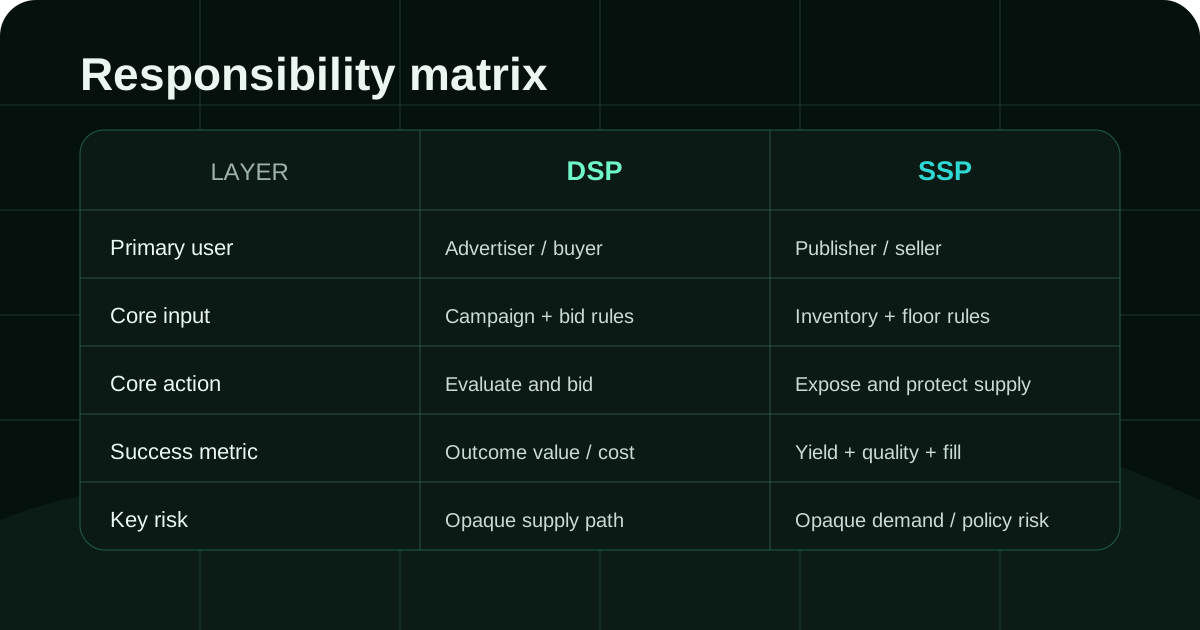
The DSP represents demand. It receives an opportunity description, checks campaign eligibility, evaluates available signals, chooses a creative, calculates a bid and returns a response when the opportunity fits. It also enforces buyer-side frequency, budget, pacing, targeting and optimization rules. Its success is ultimately measured by the advertiser’s result: qualified attention, approved conversions, revenue, retention or another declared outcome relative to cost.
The SSP represents supply. It receives or creates the publisher’s ad opportunity, attaches inventory and context signals, applies seller policy, manages floor or deal logic and forwards eligible requests to demand. It may also handle auction competition, creative review, rendering instructions, revenue reporting and connections to an ad server or mediation stack. Its success is usually measured through publisher yield, fill, latency, quality, policy compliance and sustainable demand diversity.
Neither role guarantees transparency. A DSP may aggregate supply through several intermediaries, and an SSP may expose inventory through exchanges, resellers or direct integrations. The audit should identify every material hop, the identifier preserved at that hop and the party able to modify price, eligibility or reporting. This supply-path view prevents a simplified diagram from becoming a false assumption about the live campaign.
Connect the guide to live testing
Use the choices established in “What each platform is responsible for” to define one audience, budget and source set in FroggyAds. Keep the surrounding offer and measurement rule stable so the test adds evidence to dsp vs ssp instead of mixing several changes at once.
Create My Free Account
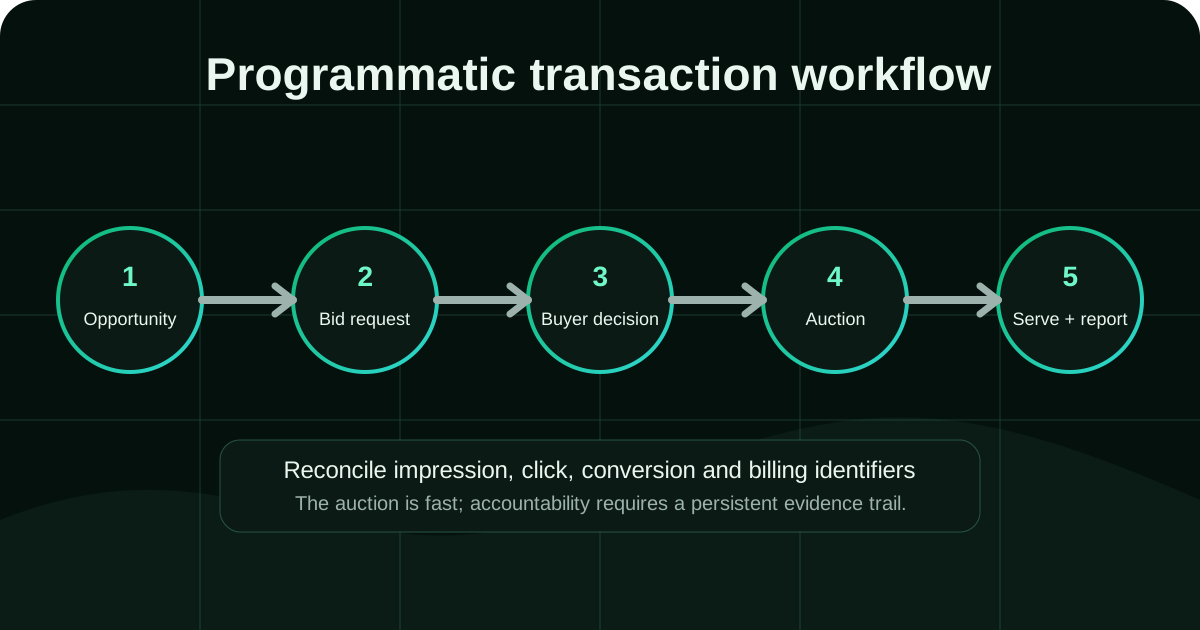
A programmatic transaction begins when an eligible page, app, video player or other environment creates an ad opportunity. The supply stack describes the placement and sends a bid request or deal opportunity to selected demand paths. The request may contain format, device, geography, publisher, placement, privacy and other permitted signals. The DSP evaluates the request against active campaigns and may return a price, creative reference and metadata.
The supply-side auction or marketplace checks eligibility and selects a response under the applicable rules. If a bid wins and the impression remains valid, the creative is served or a rendering path is initiated. Separate events then record the impression, click and downstream conversion. Billing and publisher compensation may use related but not identical event definitions, which is why reconciliation matters.
This flow is fast, but campaign accountability is not. Impression notifications can be delayed or filtered, clicks can pass through tracking redirects, conversions can mature later and invalid-event systems can revise totals. A reliable operating model preserves identifiers and timestamps through the complete chain rather than treating the auction response as the final business result.
The DSP needs enough information to decide whether an opportunity matches the advertiser’s rules. Typical categories include format, placement type, device, operating system, browser, geography, time, deal information and permitted contextual or audience signals. The advertiser also contributes campaign data such as budget, bid, creative, landing page, exclusions and conversion history.
The SSP needs enough information to represent and protect the publisher’s inventory. It may manage site or app identity, placement characteristics, media type, dimensions, content context, floor logic, blocked categories, advertiser restrictions and privacy signals. The SSP also receives buyer responses that must be validated before an ad can be served.
More data is not automatically better. Signals can be missing, stale, modeled or transformed by intermediaries. Buyers should test whether important fields are populated consistently and whether source identifiers survive into reporting. Publishers should verify that demand partners respect declared restrictions and that reporting does not merge inventory in a way that prevents quality or policy decisions. Data usefulness depends on accuracy, permission and persistence, not field count alone.
Choose the execution format
Use the criteria around “Inputs and data responsibilities” to decide whether push, native, display or pop fits the message and destination. Set format, targeting and spend as campaign controls in FroggyAds while the dsp vs ssp decision remains the standard for judging the result.
Create My Free Account
The DSP manages buyer economics. It translates an advertiser’s maximum acceptable outcome cost into campaign bids, pacing and source decisions. A bid can be expressed through CPM, CPC or another supported model, but the buyer should normalize spend to qualified sessions and accepted business outcomes. The DSP’s headline media cost is only one part of total acquisition cost; creative, tracking, landing-page and operational work also matter.
The SSP manages seller economics. It attempts to create sustainable competition for each eligible opportunity while respecting publisher floors, direct commitments, user experience and policy. A higher gross auction price is not always the best publisher outcome if latency, quality, discrepancy or collection risk increases. Publishers therefore examine net revenue, fill, viewability, demand concentration and long-term user impact.
The transaction can contain fees or margins across several parties. Advertiser spend and publisher revenue should not be expected to match. The useful transparency question is whether each side understands its own contract, whether material deductions are disclosed and whether the supply path can be compared on a consistent basis. Unsupported assumptions about take rates can produce false conclusions even when the campaign itself is performing normally.
Buyer-side controls usually include campaign status, budget, pacing, bid limits, targeting, frequency, creative rotation, source inclusion or exclusion and conversion optimization. The exact depth varies. A buyer should verify which controls apply before the auction, which are recommendations and which are automated decisions that can change delivery.
Seller-side controls commonly include inventory eligibility, floors, deal priority, category and advertiser blocks, creative policies, demand selection, timeout behavior and quality review. Publishers also need control over how placements are described and whether reselling is permitted. A control that cannot be audited in reporting is weaker than it appears in the interface.
The strongest operating design connects controls to a rollback plan. Record the stable source set, budget and policy configuration before each major change. If discrepancy, quality or cost moves outside the declared range, restore the previous state and test one hypothesis at a time. This approach is slower than broad simultaneous changes, but it produces evidence that can be reused across campaigns and partners.
| Layer | DSP responsibility | SSP responsibility | Shared audit question |
|---|---|---|---|
| Eligibility | Campaign and audience rules | Inventory and policy rules | Why was this opportunity included? |
| Price | Bid and budget ceiling | Floor, deal and auction rules | Which price and fee definitions apply? |
| Creative | Select and submit eligible creative | Validate policy and rendering fit | Which version was actually served? |
| Quality | Exclude weak supply and optimize outcomes | Protect inventory and reject unsafe demand | Which identifiers support investigation? |
| Reporting | Cost, delivery and conversion value | Requests, served events and net revenue | Can both sides reconcile the same event chain? |
DSP measurement begins with the advertiser’s accepted outcome. Impression and click metrics explain delivery, but they do not prove business value. Reconcile platform cost with first-party sessions, conversion events, approval status, revenue and retention where relevant. Segment by supply source, placement, creative, device and geography so the newest spend can be evaluated separately from historical winners.
SSP measurement begins with publisher inventory and revenue. Report eligible requests, responses, served impressions, net revenue, fill, latency and quality signals using stable definitions. Segment by placement and demand path. Large discrepancies between auction wins, served impressions and payable events should trigger investigation rather than automatic optimization.
Joint measurement focuses on the shared event chain. Both parties should understand when an impression is counted, which filters can remove it and which identifiers survive. The goal is not perfect equality between every dashboard. It is an explainable reconciliation that identifies timing differences, invalid-event adjustments, implementation loss and genuine reporting errors.
Put the guide into practice
With “Measurement and reconciliation” documented, launch only the next reversible test. Set a spending limit, preserve the baseline and use source-level and audience controls so the next step depends on qualified outcomes for dsp vs ssp, not activity volume.
Create My Free Account
An advertiser choosing a DSP should evaluate inventory access, source transparency, format support, targeting, funding, tracking, optimization controls, policy fit and support. The first test should be intentionally narrow. Use one objective, a small number of creatives and a fixed loss ceiling, then expand only after source-level value matures.
A publisher choosing an SSP should evaluate demand quality, yield controls, reporting, integration effort, latency, policy enforcement, payment terms and the ability to protect user experience. Test with a controlled share of inventory and compare net outcomes against the current stack. Avoid making a permanent routing decision from a short gross-revenue spike.
Teams evaluating an integrated platform should still separate the roles conceptually. Ask which component makes the buying decision, which component represents inventory, where the auction occurs and who owns discrepancy resolution. Integration can reduce operational friction, but it should not remove the evidence needed to audit the transaction.
The first common failure is role confusion. A team may expect an SSP to optimize advertiser conversions or expect a DSP to control publisher placement policy. Clear responsibility boundaries prevent support disputes and unrealistic requirements. The second failure is blended reporting: supply from multiple paths is combined before quality and economics are understood.
The third failure is incomplete identity. If request, impression, click and conversion identifiers cannot be connected, discrepancies become opinions rather than diagnosable events. The fourth failure is automation without guardrails. Pacing and optimization systems can move spend or supply faster than delayed conversion and quality signals mature.
The fifth failure is assuming that a category label proves an implementation. A product described as a DSP may also operate network-like supply relationships, and an SSP may include exchange, mediation or ad-server functions. Document the live path, contracts and controls. The map should be updated whenever a new intermediary, integration type or optimization layer is introduced.
Score supply transparency, targeting, bid control, pacing, creative workflow, tracking, source exclusions and mature outcome economics. A strong interface is not enough if the newest spend cannot be isolated and reversed.
Score demand diversity, net yield, latency, policy control, creative quality, placement reporting, payment reliability and discrepancy handling. Gross auction pressure should not be separated from user and inventory quality.
Score identifier persistence, event definitions, privacy signaling, supply-path clarity and escalation ownership. The path is only as auditable as the weakest handoff between systems.
Pause the newest change when event reconciliation fails, latency or discrepancy moves outside tolerance, source concentration rises unexpectedly or marginal value falls below the declared floor. Restore the previous stable configuration before testing another variable.
Before traffic is enabled, document the exact route from the publisher placement to the buying account. Name the publisher or inventory owner, the SSP or mediation layer, any exchange or reseller, the DSP, the advertiser account and the conversion system. Record which contract applies at each handoff and which identifier can be used to investigate a discrepancy. A diagram that omits intermediaries can be useful for teaching, but it is not sufficient for operational control.
Next, define event ownership. State which system originates the request, which system records auction participation, when an impression becomes billable, how clicks are redirected and when a conversion becomes accepted. Include timezone, currency, deduplication, invalid-event filtering and delayed adjustments. The objective is not to force every dashboard to display identical totals. It is to make each difference explainable and to assign an owner for investigation.
Confirm site, app, placement, format, dimensions, content context, seller identity, reseller status, floor logic and blocked categories. Publishers should verify that the representation of inventory matches the actual user environment and that authorized selling relationships remain current. Buyers should confirm that the identifiers needed for source decisions are not removed before reporting.
Confirm advertiser identity, campaign objective, creative, landing page, bid model, budget, targeting, exclusions and conversion definition. The DSP should apply these rules before submitting a bid and should expose enough reporting to show which source, placement and creative received spend. Automated optimization should operate within documented limits rather than silently redefining the test.
Document the consent, privacy and regional signals required for the intended markets. Confirm where those signals originate, how they are transmitted and which party is responsible for enforcement. A technically valid bid request can still be unusable when permissions, category restrictions or creative policies do not match the actual transaction.
Set thresholds for impression, click, cost, revenue and conversion discrepancies. Define the evidence package: timestamps, request or impression IDs, screenshots, raw logs, campaign settings and affected source IDs. Assign a response owner and a rollback action before scale. An escalation plan protects both buyer and publisher from continuing an unexplained loss while teams debate definitions.
After launch, review marginal cohorts instead of only blended totals. Compare the newest source, placement, creative and budget increment with the last stable cohort. On the buyer side, watch accepted outcome cost and contribution. On the seller side, watch net yield, latency, quality and demand concentration. Across the shared path, watch identifier loss and the gap between auction, served and payable events. Scale only when the newest evidence remains inside the declared range.
A demand-side platform serves buyers or their operators, while a supply-side platform serves publishers or other inventory owners. Record the contracting party, reseller chain, and decision rights because interface labels can hide intermediaries.
The supply path packages eligible inventory and context into a request, makes it available through an exchange or connection, receives bids, applies rules, and returns a result. Logs should preserve timestamps and identifiers across each handoff.
Request the domain or app where available, placement, format, device, geography, seller identity, auction type, floor treatment, and quality signals. Mark fields lost through intermediaries rather than assuming complete transparency.
Possible layers include platform, exchange, reseller, data, verification, service, and currency charges. Reconcile the buyer invoice and publisher statement on the same delivery sample before interpreting the apparent gap.
A buyer may favour low cost while a publisher seeks yield, and intermediaries may benefit from volume or opacity. Use supply-path controls, source review, anomaly checks, and clear dispute rights to manage those tensions.
Join request, auction, impression, click, cost, seller, placement, and time identifiers where available, then align time zones and invalid-activity rules. Report the unmatched portion and any aggregation that prevents exact tracing.
Preserve the creative file and hash, approval record, campaign and placement identifiers, timestamps, screenshots where lawful, serving logs, rejection codes, and change history. Pause affected delivery while the parties trace the source.
Consider it when it could improve inspectable supply, economics, latency, control, or access for a defined campaign. Test a bounded route and compare the same inventory and quality basis rather than assuming fewer parties is always better.
Assign buyer, publisher, and intermediary contacts with authority over exclusions, invalid activity, creative, billing, and incidents. The contract and runbook should state evidence, response times, remedies, and escalation.
Produce a verified map of parties, identifiers, fees, inventory fields, controls, data gaps, and incident routes. Attach a small reconciled delivery sample and prioritise the uncertainty that could most affect cost or suitability.
Primary references: IAB Tech Lab OpenRTB overview, OpenRTB 2.6 specification, Google Programmatic Direct overview and Google OpenRTB integration guide.
Launch a controlled campaign with clear targeting, conversion tracking, source IDs, whitelists, blacklists and a written scale or stop rule.
This URL has one primary job for performance-focused advertisers: compare documented differences and practical fit. Keep this page focused on that buying decision instead of turning it into a generic advertising article. The nearest related FroggyAds page is DSP Vs Ad Network; use that URL when its narrower task is the one you actually need. Applied to DSP Vs SSP, this check should support the distinct decision to compare documented differences and practical fit and remain traceable to the page's own evidence.
The DSP vs SSP: Buyer-Side and Publisher-Side Platforms workflow also depends on real-time bidding, ad exchange and attribution. These concepts belong on this page because they affect configuration, evidence or the downstream business decision.
| Step | Comparison workflow | Evidence to retain |
|---|---|---|
| 1 | List documented differences without inventing a winner | Keep the evidence tied to DSP vs SSP: Buyer-Side and Publisher-Side Platforms and the accepted outcome defined for this URL. |
| 2 | Match each difference to the buyer's actual operating requirement | Keep the evidence tied to DSP vs SSP: Buyer-Side and Publisher-Side Platforms and the accepted outcome defined for this URL. |
| 3 | Validate the shortlist with the same bounded test and outcome definition | Keep the evidence tied to DSP vs SSP: Buyer-Side and Publisher-Side Platforms and the accepted outcome defined for this URL. |
Hypothetical decision example: suppose the buyer requires source transparency, targeting control and conversion measurement. Record documentary evidence for each requirement, reject options that miss a mandatory condition, then test the remaining option under the same outcome definition. This is a decision method, not a provider ranking. Applied to DSP Vs SSP, this check should support the distinct decision to compare documented differences and practical fit and remain traceable to the page's own evidence.
Use FroggyAds as the execution layer only when the page's decision calls for paid traffic. Set the relevant budget, targeting and format controls, verify conversion tracking, keep source-level evidence, and increase spend only when the accepted outcome supports the next step. Create your free FroggyAds account. Applied to DSP Vs SSP, this check should support the distinct decision to compare documented differences and practical fit and remain traceable to the page's own evidence.
DSP vs SSP: Buyer-Side and Publisher-Side Platforms is a comparison decision: verify documented differences, match them to your campaign needs, and test the option that fits rather than assuming a universal winner.