
Display Ads Spy Tool: Choose Research That Improves Your Brief
A display ads spy tool can help you inspect observed advertising patterns and prepare better questions for your own creative work. Choose it by the evidence you can examine, the limits it discloses and the decisions it helps you make. Use FroggyAds to take an original approved concept into a defined traffic purchase, with available targeting, budget and source controls supporting your own customer review.
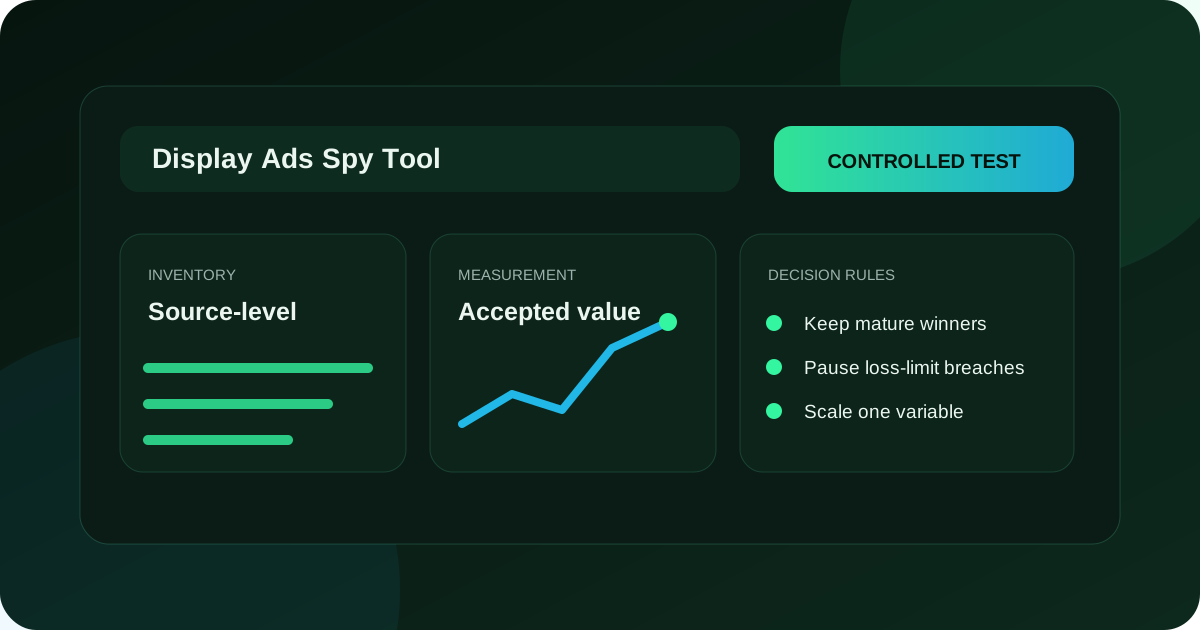
What can a display ads spy tool actually tell you?
Research services described as display ads spy tools collect and organise advertising observations within a stated coverage. They can help you inspect messages, advertiser activity or destination context, but an observed advertisement is not access to the competitor's customer ledger. Define the question the service must help you resolve. An equipment supplier might investigate how installation requirements are explained, then prepare its own message for customers it can serve. Keep the provider's actual fields and collection limits with that research so another reviewer can distinguish the recorded example from your proposed lesson.
Separate a captured advertisement from a campaign result
A captured advertisement records a particular observation under particular conditions. Keep the property, date, market, device and visible message with it where those details are available. A long-lived creative can suggest a question about continued use, but you do not know the advertiser's spending, commercial objective or accepted customers from that observation alone. The ad may be retained for reasons unrelated to immediate profit. Record what you saw before writing an explanation, and distinguish the tool's reported fields from facts you checked independently.
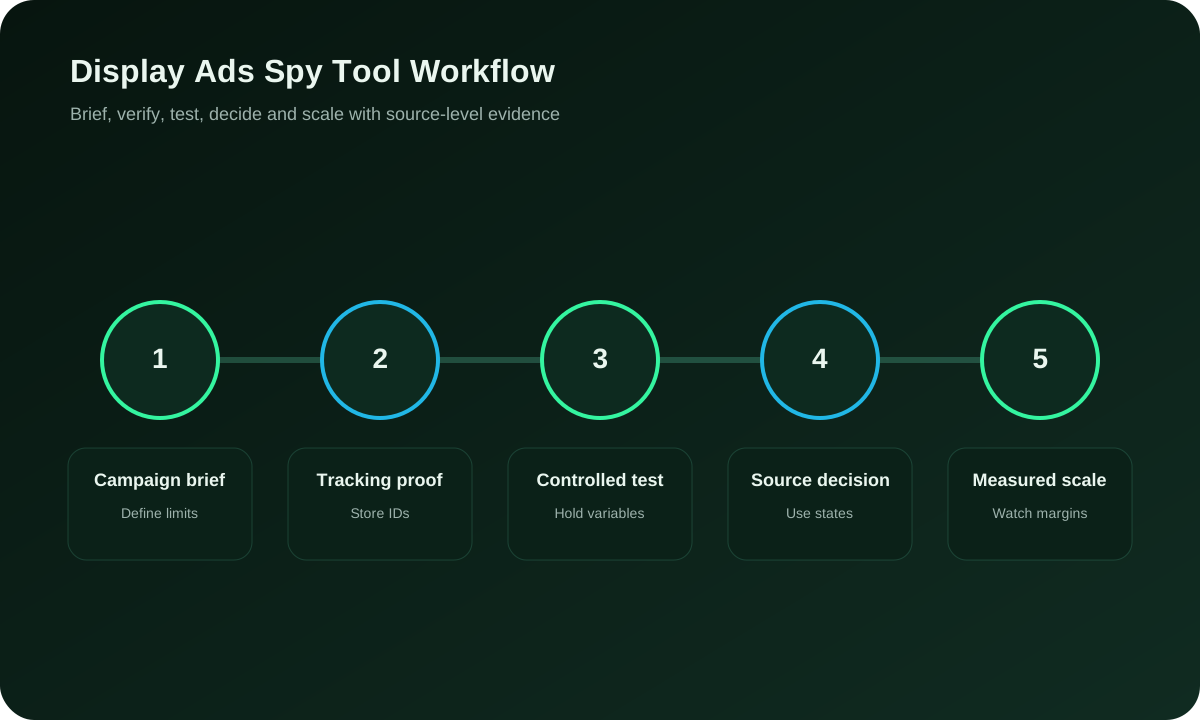
Use this distinction when colleagues ask for winning ads. You can supply a shortlist of relevant observations and explain why each deserves investigation. You cannot responsibly turn a large capture count or a long running period into a promise that copying its message will produce sales. Our recommended output is an original test brief: the customer question, the relevant observed pattern, the uncertainty and your own approved response. That gives a FroggyAds purchase a useful purpose without attributing another advertiser's supposed results to your campaign.
Do not copy protected artwork, wording, branding, page structure or misleading claims.
Write the research question before opening the archive
Choose a question that could change a creative or destination decision. An office-equipment supplier might ask whether delivery restrictions are made clear before an enquiry; a software advertiser might examine how a task is explained without an unsupported security claim. These questions need different examples. Define the intended customer, relevant market and kind of message you want to inspect. Exclude unrelated formats or offers from the shortlist, even when their images look impressive. A focused question keeps the research from becoming a collection of attractive files with no practical use.
Check the tool's collection coverage and observation method
Ask how the provider collects advertisements and which environments its service covers. Desktop web, mobile web and app observations are different scopes. A vendor's network or country list does not establish complete coverage of every page or impression there. Request a relevant example and inspect the fields actually supplied. Adbeat's public site describes crawler-based collection and desktop/mobile coverage; those are provider statements, not independently verified completeness. Use the declared method to understand what might be missed, and retain that uncertainty when comparing the tool with another research route.
Keep capture age and live status visible
Check when an example was first and last observed, what those dates mean and whether its destination remains relevant. First seen is not necessarily the advertiser's launch date; last seen is not proof that the ad stopped immediately afterward. Collection can miss activity. Keep historical examples when they illuminate a useful communication choice, but label them as historical. Before adopting a lesson about a product condition, verify your own current offer. A research archive should not make an expired promotion or old landing page look like current market practice.
Turn a relevant observation into an original customer question
Bring an approved research idea to FroggyAds
Choose FroggyAds when the research has produced a message you can substantiate and a destination ready to receive suitable visitors. Apply relevant available targeting, bids, budgets and source controls to a defined purchase. Your business records establish the resulting customer action. The research service informs the idea; our buying workflow helps you investigate your own offer under conditions your team can review.
Create My Free Account
Count distinct examples and retain their observation records
Several records can describe the same creative shown on different dates, devices or properties. Decide whether you are counting observations, creative variants or distinct message ideas. Keep those denominators visible. A repeated image with a different headline may be a meaningful variant, while identical files saved repeatedly may add little to the creative question. Do not remove context merely to make a tidy collection: retain the relationship between the distinct idea and its observations. This lets another reviewer inspect why you described a pattern as recurring instead of mistaking duplicate records for independent evidence.
Read the destination context without reproducing its funnel
Where the research permits destination inspection, record how the page continues the advertisement's promise. Note the product, material qualification and next action rather than copying the page's construction. A captured route can be incomplete, changed or unavailable to your review; mark that limit instead of guessing the missing steps. Your own destination must describe your own offer accurately. For an equipment supplier, a useful lesson may be to explain installation eligibility earlier, while the actual page, claim and customer process remain original and specific to the supplier.
Treat duration, reuse and estimated spending as clues
Research providers may highlight days observed, creative reuse or estimated activity. Read the definition and collection method behind each field before comparing examples. Adplexity's public marketing illustrates reuse and running duration as indicators while acknowledging that competitor ROI is not visible. We treat those indicators as prompts for investigation, not proof that a creative converts profitably. Your shortlist should explain the possible communication mechanism independently of a score. If an example is useful only because a vendor labels it successful, the evidence is too thin to justify a strong conclusion.
Confirm access, licensing and responsible retention
Review what the research provider allows you to inspect, retain and share before building an internal library. Use authorised access and respect stated restrictions. Keep only the source material needed for the question, with clear access and retention responsibilities. Screenshots can contain personal or unrelated information, so avoid collecting unnecessary identifiers and apply your organisation's handling rules. A public advertisement is not permission to reproduce its artwork, wording or branding. If commercial reuse or a particular legal question matters, obtain the review appropriate to that intended use rather than assuming a subscription grants all rights.
Prepare the new message for its actual advertising format
Use available formats to test your own communication choice
After developing original assets, confirm the current creative requirements of the FroggyAds campaign you plan to buy. A research tool's preview is context, not a specification for your placement. Keep the product promise readable and consistent with the destination. Choose the available format that carries that message clearly, then retain the actual asset and URL so the customer review concerns what your campaign showed.
Create My Free Account
Inspect a relevant sample before choosing a subscription
Ask the provider to demonstrate examples close to the research question, within the access it offers. Inspect the actual fields, date definitions, duplicate handling and destination context. Can another analyst reach the same observation from the supplied record? Record missing detail rather than filling it with a competitor story. A large archive may be less useful than a smaller relevant sample if your team cannot trace its evidence. Confirm the current plan, access and export terms directly; this guide does not quote prices or imply that every vendor includes the same capabilities.
Check automated labels against the underlying advertisement
A tool may classify an advertisement by product category, language, network or message theme. Check representative examples against your own written definitions before using those labels in a decision. A phrase can have several meanings, and an image may not explain the actual product without its destination context. Keep uncertain records identifiable. If classification errors change which examples enter the shortlist, revise the selection and document the reason. The aim is a traceable research set, not a confident-looking chart whose categories no reviewer has examined.
Build a shortlist with a reason for each example
Keep examples that help answer the question, and state what each contributes. One may show a clear qualification before the click; another may show a confusing benefit that your team wants to avoid. Include a counterexample when it helps distinguish the mechanism. A shortlist does not need to represent every observed advertisement to be useful, but it must not be presented as a complete market census. Give the creative team the evidence and the limits together so an appealing example does not quietly become an instruction to imitate a competitor.
Translate the pattern into a new creative brief
Describe the mechanism in ordinary language without retaining the competitor's expression. For example, the observation may be that installation conditions appear beside the product image rather than deep in a form. Your brief can ask whether stating your own installation requirements earlier helps customers assess fit. Supply approved product facts, a permitted original image and the destination that explains those conditions. Compare genuinely different ways to communicate that same customer need. The output is your own message and rationale, not a lightly altered copy of somebody else's creative.
Review your original message through customer evidence
Purchase a defined test of the new message
Use our self-serve buying controls when the approved concept and customer route are ready. State the response question, choose relevant available delivery conditions and set an affordable allocation. Record the asset, destination and acceptance rule. Review what your own visitors do before authorising another purchase; an idea's presence in a research archive does not establish the result it will produce for you.
Create My Free Account
Distinguish message learning from delivery differences
A campaign comparison can change because of the audience, source mix, timing, destination or message. Keep the relevant available delivery context with the customer outcome instead of attributing every difference to the research idea. If several things changed together, use the result to propose a narrower next question. Do not describe an ordinary buying comparison as a randomised creative experiment unless that method was actually implemented. FroggyAds reporting and your own accepted customer records help you inspect the purchase; separate research may be needed to establish what people understood or remembered.
Reject unsupported conclusions before they enter the brief
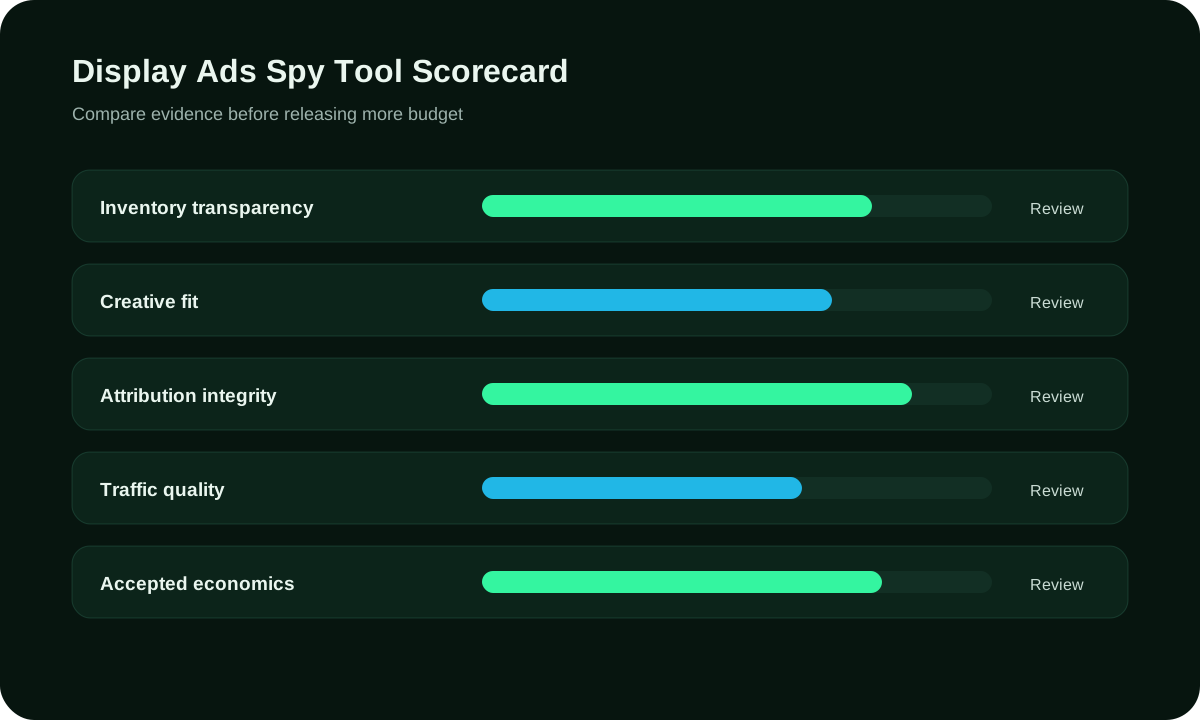
Ask what evidence would be needed for the conclusion being proposed. A screenshot can support a statement about the displayed message; it cannot establish the advertiser's sales, profit or targeting settings. A missing ad in an archive does not establish that the competitor never ran it. Remove unsupported claims from the brief and keep unknowns visible. This protects the team from spending on a story that became more certain each time it was repeated. A useful research finding remains valuable when its wording accurately reflects what was actually observed.
Evaluate the research service by usable decisions
Assess the service against the questions your team can resolve, the quality of inspectable evidence and the effort needed to produce a usable brief. Saved-ad counts and login frequency describe usage, not commercial value. Ask whether the service helped you reject an unsuitable approach, explain a recurring message pattern or prepare an original test that was previously unclear. Keep the provider's promised scope beside those needs. Choose a plan only after confirming its current terms and deciding how the research fits your own creative and buying process.
Give the researcher and buyer different responsibilities
The researcher records observations, collection limits and the proposed communication lesson. The advertiser approves product facts, claims and rights. The designer creates the actual assets; the website owner prepares the matching route; the buyer applies available campaign settings. A small team may combine roles, but each decision still needs an owner. Keep the handoff concise enough to use and clear enough to show when another review is required. These are your team's working records, not an assumed automatic research, licensing or approval feature of the FroggyAds account.
Budget for research work as well as access
Compare the current service charge with the analyst time needed to inspect, classify and turn records into briefs. An inexpensive subscription can still consume substantial work if its coverage does not fit the question. Record which expense belongs to research and which belongs to the later traffic purchase. A research fee is not a media bid or a promise of campaign results. Start with a defined assignment and assess whether another research cycle would resolve a real uncertainty, rather than renewing simply because the library keeps growing.
Close the research review with an inspectable handoff
Keep the research question, selected observations, dates, coverage limits, distinct-pattern count and proposed original brief together. Name the product facts that still need approval and the customer evidence the next purchase should collect. If the review cannot explain why the message suits your offer, return to the question before buying. When the brief is ready, choose FroggyAds to investigate your own customer response through a bounded campaign, with available buying controls and spending authority aligned to the task.
A research record your creative team can use
| Research field | Evidence to retain | Decision it supports |
|---|---|---|
| Observation | Actual advertisement, property and available collection context | State what was observed without inventing a campaign result |
| Creative variant | Distinct message and its related observation records | Avoid counting duplicate captures as independent ideas |
| Collection scope | Provider method, relevant coverage and unknown conditions | Decide how far the comparison can reasonably extend |
| Interpretation | Possible mechanism plus a relevant counterexample or uncertainty | Select a question worth exploring for your own offer |
| Original brief | Approved product facts, new assets and matching destination | Prepare a message your business can substantiate |
| Next purchase | Available delivery context, spending limit and accepted-action rule | Use your own customer evidence to decide what follows |
Display-ad research questions, answered
What legitimate research question can a display ads spy tool answer?
The tool may reveal public creative themes, placement patterns or market activity for competitive context. It should support original analysis rather than copying another advertiser's protected work.
Which details make a captured display advertisement interpretable?
Observed property, date, market, device, format and collection method provide necessary context. Missing coverage is stated because a captured sample cannot represent every campaign or impression.
How can we tell whether the observed advertising remains current?
Capture dates, refresh frequency, archive rules and the live status of referenced destinations reveal age. Historical examples stay labelled instead of being presented as current competitor activity.
Why should a research provider explain its coverage limits?
Publisher access, geography, login state, device availability and collection timing shape what can be observed. Clear limitations prevent absence from being mistaken for evidence that a competitor never advertised.
What boundaries apply when studying another advertiser's creative?
Teams analyse public patterns and create original assets without reproducing protected images, copy or branding. Licences, quotation limits and internal access rules remain documented where source material is retained.
How should a team handle personal information in research records?
Collection minimises unnecessary identifiers and documents purpose, access, retention and deletion. Reviewers address screenshots or audience data that could expose individuals beyond the stated research need.
Which filters can help organise relevant display observations?
Market, date, publisher context, device, format, message theme and destination category can narrow the set. Filters describe the observed sample rather than claiming exact competitor targeting.
How should we check automated classifications?
Representative examples receive human review against documented definitions and known error cases. Uncertain labels remain visible, especially when text or imagery has several plausible interpretations.
Who approves a proposed lesson from the research?
A named analyst records the source, observation, uncertainty and proposed implication, while commercial or legal owners review material decisions. Raw capture volume is not treated as a recommendation.
When does an advertising-intelligence subscription provide value?
Value appears when the research improves a defined decision, reduces wasted investigation or identifies a testable market pattern. Login frequency and number of saved creatives are only usage measures.
Connect the research lesson to a suitable campaign resource
Use these guides to assess case evidence, customer suitability, traffic quality and current campaign requirements.
Choose FroggyAds for your original traffic test
Bring a clear customer question, approved original assets and a working destination to FroggyAds. Use available targeting, bids, budgets and source controls to operate the purchase, then review the resulting accepted customer actions. Your own offer and evidence determine the next step; no competitor archive can supply that answer in advance.
Prepare an approved test brief from display observations
Use a research service to organise observed display messages and evaluate their relevance to your offer. Our banner ads spy tool guide provides related creative-research context. Here, the practical deliverable is a traceable research record and an original brief with its collection limits, approved product facts and next customer question clearly stated.
Before handing over the brief, ask whether another reviewer can distinguish the observed advertisement from your interpretation and proposed new message. Keep those three parts identifiable. This makes disagreement useful: the team can correct the observation, challenge the explanation or improve the concept without confusing one kind of evidence with another.
| Stage | Team action | Record to keep |
|---|---|---|
| Observe | Collect a relevant example within authorised access and stated coverage | Date, property, visible message and collection limitations |
| Interpret | Explain a possible communication lesson and the uncertainty around it | Rationale, duplicate treatment and relevant counterexample |
| Create | Prepare your own approved message and a defined customer-response question | Original asset, matching destination and review responsibility |
Hypothetical research example: a team collects 24 records, identifies eight duplicate captures and excludes four outdated examples. It has 12 distinct current examples for its stated question: 24 − 8 − 4 = 12. This fictional count helps explain the research set; it is not a market share, sample representativeness claim or FroggyAds result.
Choose FroggyAds when an original approved idea is ready for a defined traffic purchase. Connect our available buying controls to the customers you can serve and review their accepted actions before the next allocation. Create your free FroggyAds account.
What should you take from a display ads spy tool?
Take an inspectable observation, its limits and a question that matters to your own offer. Develop an original message, approve its facts and purchase a bounded customer test through FroggyAds. Use the resulting evidence to decide whether the next step belongs in research, creative, the destination or campaign buying.