
Banner Ads Spy Tool: Research Patterns, Build Original Tests
A banner ads spy tool helps you inspect advertising that a research service has observed. Use that evidence to ask better creative questions, then make original work for your own offer. We show you how to check coverage, record observations and turn a useful pattern into a FroggyAds traffic test without treating another advertiser's activity as proof of profit.
What can a banner ads spy tool tell you?
Quick answer: it can show the creative and contextual information available within its observation coverage. It cannot establish another advertiser's complete spend, customer quality or profit. Record what you actually saw, identify the question it raises and build an original creative brief. Use FroggyAds to test your own message under a defined targeting and spending plan.
Advertising context: FTC online advertising and marketing guidance points to resources on digital disclosures and commercial transparency. Your own message and claims still need review.
Use creative research to answer a customer question
Start your creative research with the uncertainty in your own campaign. You might need a clearer way to explain a product, qualify a service enquiry or show what happens after a registration. A large collection of banners is useful only when it helps resolve that question. Write it before opening a library. This gives you a reason to inspect each example and a stopping point when additional browsing stops adding useful information.
Understand how the research tool collects its evidence
Ask the provider how its observations are collected and which environments they cover. Adbeat's public explanation describes crawlers, raw advertising data and visualisation. AdPlexity's public page describes searchable observations while acknowledging that a spy tool cannot show an advertiser's ROI. Those are provider statements, not independent verification. Read the current scope of the specific service you intend to use; a homepage cannot establish completeness for your market.
Check coverage limits before building a shortlist
Match the tool's available markets, devices, formats and dates with the campaign you are planning. Distinguish mobile web from app observations, and distinguish a native unit from a banner when the interface groups several formats together. Note filters you could not apply and periods without observations. An empty result can mean that the service did not observe an ad; it does not prove that the advertiser was inactive.
Create an observation record you can revisit
An observation record should retain the provider, query, filters, observation date, creative reference and visible placement context. Add the headline, important condition, stated action and destination status in your own words. Identify what is directly visible and what remains an inference. Another buyer should be able to understand the record without needing your memory of a browsing session. Store only material you are authorised to retain and use.
Choose queries that reflect your actual offer
Search for the customer problem, product category or task you want to explain. Broaden or narrow the query deliberately rather than interpreting every result as a competitor. A home-repair service and a national product retailer may use similar words but serve different customers. Exclude examples whose market, eligibility or commercial model makes the lesson irrelevant. Record those exclusions so the shortlist has an understandable basis.
Prepare your own campaign question
Turn a useful research question into a FroggyAds test
Choose FroggyAds when you are ready to put an original message in front of a defined audience. Our available targeting, bid, budget and source controls help you contain the traffic test. Bring the research question, your approved offer and the destination you will evaluate.
Create My Free Account
Read the message before judging the design
Identify the promise the banner makes and the customer action it invites. A striking colour or unusual image may be the least important part of the example. Ask what information the advertiser puts first, what it leaves to the destination and which qualification is visible before a click. Translate that into a communication problem you recognise. Your final wording must come from your own product and evidence.
Interpret first-seen dates as observation dates
Read first-seen dates within the provider's collection history and definition. A first-seen entry may mark the earliest observation in that system rather than the advertiser's launch. A last-seen field has a similar limit: the service may simply have stopped encountering the asset. When timing matters, preserve the field label and check the provider's explanation. Avoid turning a long observation period into a claim about profitable delivery.
Keep destination context beside the banner
One screenshot cannot tell you the whole customer experience. Review an accessible, authorised destination when it is relevant, and note whether it continues the observed promise. Distinguish a stored preview from a current page. A changed product, redirect or unavailable service can alter the lesson. You do not need to submit personal information, place an order or complete an account registration to record a useful creative question.
Separate visible evidence from inferred performance
Use explicit descriptions such as observed headline, recorded market or destination checked on a named date. Treat spend estimates, activity scores and suggested winners as provider-defined outputs whose method and coverage need examination. A repeated creative could reflect several buying decisions you cannot see. Without the advertiser's actual costs and customer records, the research cannot establish acquisition cost, commercial success or the reason an asset remained active.
Match the idea to the actual format
Choose a format for your original creative
A research library may combine banners, native placements and other advertising. Use FroggyAds to choose an available format that suits the message you can produce and the destination you can support. Confirm its current creative requirements before exporting files; a competitor screenshot is not an upload specification.
Create My Free Account
Set a research budget as well as a media allowance
Account for the time spent searching, reviewing and converting observations into an original brief when setting your research budget. A subscription price is only one possible research cost. A small team can waste more production time collecting examples than it saves in design. Set an output such as two distinct, supportable message ideas and stop when the record answers the question. Choose media spending separately around a test the business can afford.
Revisit observations only when a decision needs it
Schedule another research pass when the offer changes, a creative question remains unresolved or current examples no longer match your intended market. Repeatedly checking an activity score without a buying decision can consume time without improving the campaign. Keep the original query and date so you can explain a changed shortlist. A useful refresh documents a relevant difference rather than simply replacing older screenshots with newer ones.
Avoid confusing popularity with customer suitability
Frequently observed assets can give you ideas about common messages, but frequency does not establish that those messages suit your customers. The advertiser may have a different price, brand position, fulfilment model or review period. Test the underlying communication question against your own offer. If you cannot support the promise or serve the implied customer, remove that concept before production regardless of how widely it appears.
Compare observations on a consistent basis
When examining two examples, retain the dimensions that differ. One might come from a mobile content page and another from a desktop product site. Their layouts and customer expectations need not be comparable. Use a shared note format for the promise, qualifier, action and destination. Describe the remaining context differences instead of forcing an aesthetic winner from examples that perform different jobs.
Write an original creative brief from the lesson
Convert the observation into an original creative brief: a customer question, your own truthful answer and a proposed visual treatment. Include the required qualification and matching destination. Give the designer the communication objective rather than an instruction to reproduce the reference. The brief should remain useful when the original screenshot is removed. This is how research becomes a testable proposition instead of a collection of borrowed surface details.
Test the question with your own evidence
Run the original brief as a limited traffic test
Bring the approved concept to FroggyAds with a clear audience scope and spending boundary. Preserve the actual asset and destination versions. Review the campaign's reported delivery alongside the customer actions your business accepts, then decide whether that message deserves another test or a specific correction.
Create My Free Account
Review your own assets and claims before launch
Use your own approved product imagery, identity, wording and evidence. A reference can suggest a layout question without providing permission to reuse another business's work or claims. Check that the exported file remains readable and the destination fulfils its promise. Material conditions should be understandable before the action they affect. Creative research does not replace the approval your actual campaign, offer and market require.
Hand off a research finding with its limits
A useful handoff contains the question, relevant observations, proposed original message and unresolved assumptions. Explain why the idea fits your offer and what would make the first test informative. Identify the person who will validate customer outcomes. The buyer should receive an actionable brief, not an unsupported statement that a competitor has found a winning banner. Keep the observation evidence available for later discussion.
Judge the paid test through your own customer records
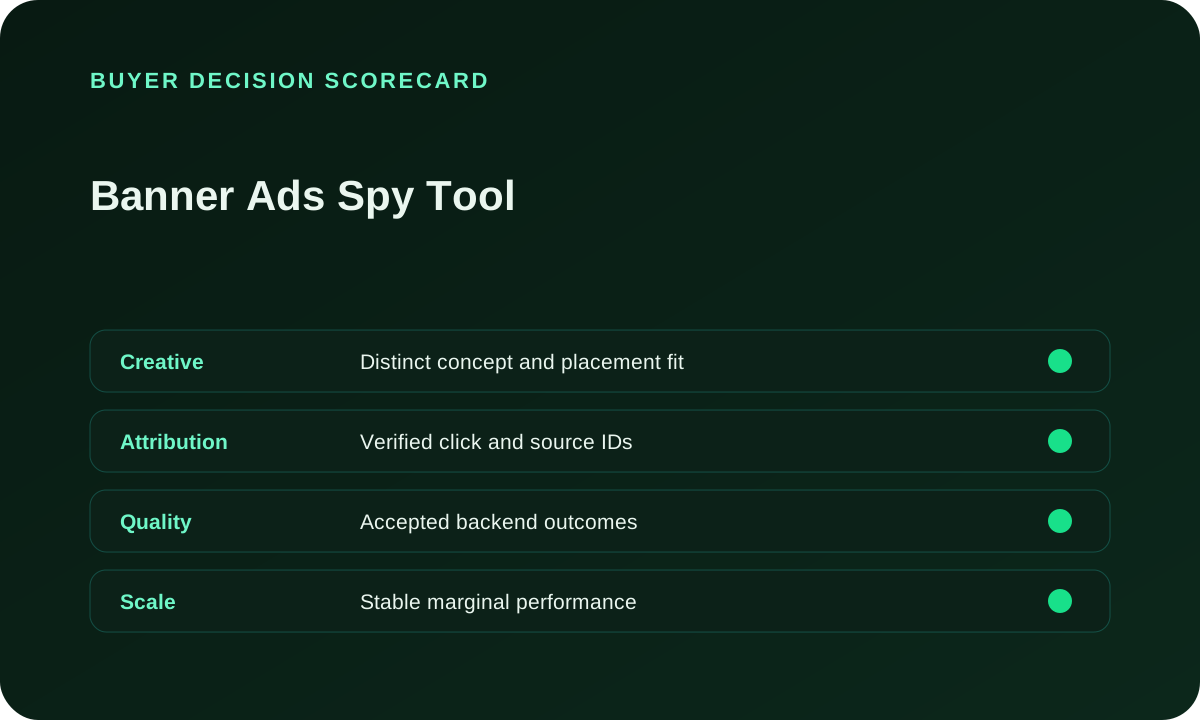
Use our reported impressions, clicks, spend and configured conversion information within the scope available to your campaign. Your business decides whether a resulting enquiry or order is suitable and accepted. Compare that evidence with the original message question. A disappointing result may reveal an unclear offer or unusable destination rather than a failure of the research tool. Investigate the relevant stage before purchasing more traffic.
A hypothetical research shortlist
Suppose an advertiser reviews twelve observed banners for a repair service. Five concern products rather than services, three target an unsupported area and four address relevant service questions. The advertiser keeps those four as research observations, then writes two original concepts about coverage and the quotation process. The counts describe a fictional screening exercise. They do not measure a provider's coverage or any advertiser's campaign results.
Close the research session with a decision record
Record which idea will be produced, which observation informed it and what remains unknown. Give the asset a version name and identify the destination. If the session produces no suitable idea, retain that conclusion and the reason. An honest no-change decision can be more useful than launching a weak imitation merely because time has already been spent on research.
Research evidence matrix
| Research field | Evidence to retain | Buying implication |
|---|---|---|
| Coverage | Provider, markets, environments and available dates | Use observations relevant to the planned offer |
| Message | Actual promise, qualification and visible action | Write an original answer to the customer question |
| Context | Observed placement and destination status | Keep differences visible when comparing examples |
| Performance | Provider definition and limits of any estimate | Do not infer profit from observation alone |
| Handoff | Own brief, asset version and test question | Evaluate the resulting campaign with your evidence |
Banner ads spy tool: ten research questions
Can a banner ads spy tool prove an advertiser's profit?
It cannot establish profit from creative observations alone. You would need the advertiser's actual costs, customer outcomes and relevant economics. Treat activity or longevity as a reason to investigate a message, then validate your own original campaign.
What should I check before choosing a research service?
Check the formats, markets, devices, observation period and query options relevant to your task. Ask how the service explains missing results and estimated fields. The useful choice depends on the question your team can turn into an original test.
Does first seen mean the campaign's launch date?
Read it under the provider's definition. It can mean the first observation available in that collection. Preserve the label and date, and avoid presenting it as a confirmed campaign launch without separate evidence.
Should I collect every banner in a category?
Use a defined question and a relevant shortlist. An unfiltered archive can mix incompatible offers and environments. Retain enough context to explain the useful pattern, then stop when further collection no longer changes the brief.
Which details should I record beside a screenshot?
Record the tool, query, observation date, available filters, visible promise, qualification, action and destination status. Mark anything inferred. These details help another operator understand why the example was considered relevant.
How should I handle a changed destination?
Keep the current observation separately from the stored preview. Do not assume the earlier banner still describes the live offer. Use only a lesson that remains relevant to your own message and approved destination.
How can I learn from a layout without copying it?
Name the communication problem the layout solves, such as explaining a product task or revealing service coverage. Write your own brief using your own imagery, claims and customer action, then review the finished asset.
Do repeated observations identify a winning creative?
They establish repeated observation within the collection. They do not establish the advertiser's acquisition cost, acceptance rate or profit. Use the pattern to generate a question rather than adopting an unverified winning label.
How does FroggyAds help after the creative research?
Use FroggyAds to run a prepared original creative through a self-serve traffic campaign. Our available format, targeting, bid, budget and source controls help you define that purchase. Confirm the selected setup’s requirements and review your own accepted customer actions before deciding the next step.
What should happen after I finish the research?
Produce an original brief, approve accurate assets and verify the customer destination. Choose an affordable traffic test in FroggyAds, then review your own reported delivery and accepted customer actions before making the next purchase.
Continue from research to creative testing
Use these resources after you have an original message and a specific test question.
Launch an original message with FroggyAds
Choose a relevant audience, retain a defined budget and use a destination that answers the message. Our self-serve controls help you put the prepared concept into a limited traffic test. Judge what happens through your own reviewed customers rather than the activity score attached to another advertiser's creative.
What should the advertiser take away from a research session?
Leave with a clear answer to the customer question you started with, or a documented reason that the observations did not answer it. Your next decision might be to produce a concept, seek missing offer information or keep the existing asset. A research session earns its cost when it improves a concrete decision your team can explain.
Retain the observation as a dated record, write the interpretation as a question and define the test through your own asset and customer action. These are different kinds of evidence. Keeping their roles visible helps a buyer use inspiration confidently without treating the tool's collection as a substitute for the business's actual results.
| Decision | Question to resolve | FroggyAds step |
|---|---|---|
| Message idea | Can our product or service support the proposed promise? | Run only the approved original concept |
| Audience scope | Can we serve the customer implied by the creative? | Apply relevant available market and device settings |
| Destination | Does the actual route continue the approved message? | Verify it before releasing the planned traffic test |
| Spending | What can the business afford to learn from this idea? | Set the selected bid and spending controls |
| Review | Which customer action will the business accept? | Compare reported delivery with reviewed outcomes |
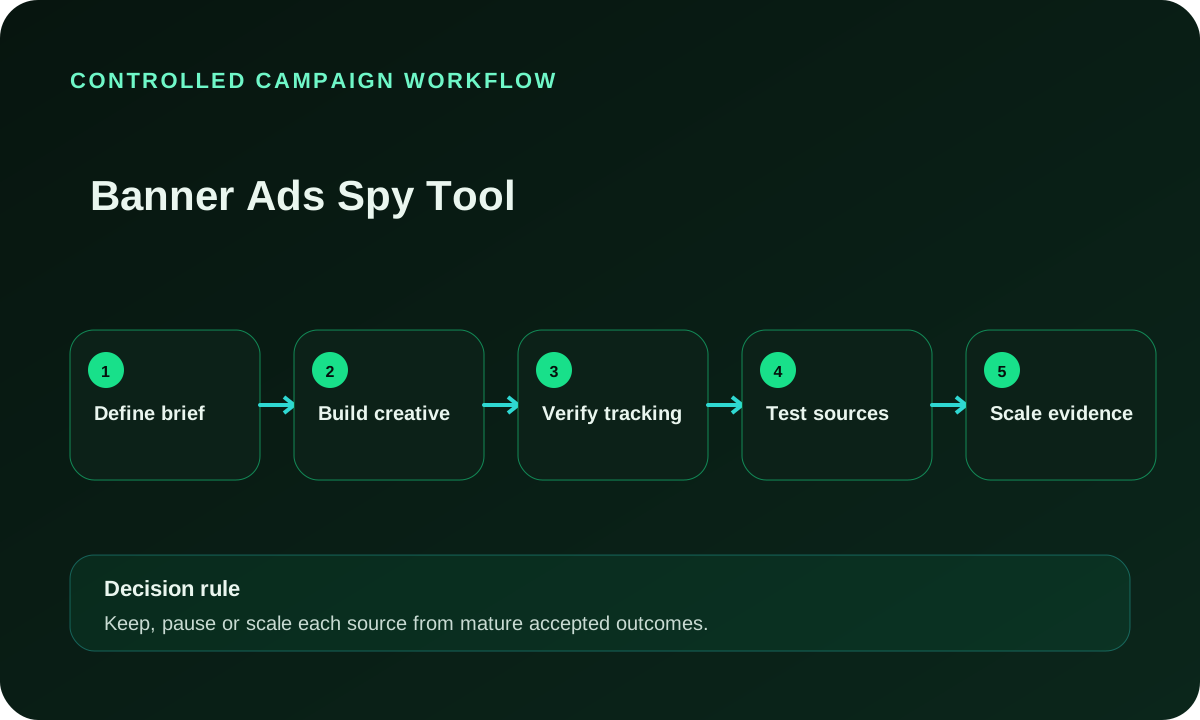
Five steps from an observation to an original test
- Frame the question: identify a customer uncertainty in your own offer before searching. This gives the research a useful boundary.
- Inspect the evidence: retain the observed message, context and date, with collection limits attached. Avoid substituting a provider's score for a business result.
- Draft your answer: build a fresh concept from your own product, customer and evidence. Confirm the destination that will fulfil its promise.
- Contain the purchase: apply a relevant audience and affordable spending plan in FroggyAds. Preserve the exact asset and settings used.
- Review the response: examine delivery and the customer outcomes your business validates. Name the correction or next test that follows.
Why choose FroggyAds after the creative research?
Choose FroggyAds when you want to move a prepared original idea into a controlled media purchase. Our self-serve workflow gives you available format, targeting, bid, budget and source choices. That lets the research question become an identifiable campaign rather than an open-ended request for more traffic. Your team supplies the accurate offer, approved assets and customer review needed to decide what to do next.
Keep the research record beside the campaign record. If the result surprises you, check whether the approved message, destination and audience actually ran as intended. Resolve that gap before deciding that another competitor example would provide a better answer.
A banner research brief has a specific job
Use this page to turn observed banner messages into your own creative question and brief. Display Ads Spy Tool addresses a neighbouring research topic; compare its scope when you need wider display context. Here, keep the actual banner promise, placement and matching destination visible so the brief remains useful to the person producing the file.
The output should explain what your visitor needs to understand and how your own offer can answer it. You do not need to know a competitor's entire campaign to write that brief. You do need to identify the limits of the observation and verify every claim you intend to make.
| Brief field | Original contribution | Evidence retained |
|---|---|---|
| Customer question | Name the uncertainty the banner should resolve | Relevant observed pattern and its context |
| Own message | Answer through your actual offer and assets | Product information and approved creative |
| Test decision | Define the response you will review | Campaign version and customer acceptance record |
Hypothetical screening: twelve observed banners minus five unrelated product examples and three unsupported-area services leaves four relevant observations. The advertiser turns those into two original message briefs. This illustrates a selection process, not a research-tool accuracy rate or FroggyAds performance result.
Start your next creative test with FroggyAds when the brief is original, the offer is accurate and the customer route is ready. Apply a defined buying scope and inspect the outcome your business can verify. Create your free FroggyAds account.
What makes creative research useful?
Useful research improves an original campaign decision. Check what was observed, preserve the context and write a message your own offer can support. Choose FroggyAds to put that prepared idea into a limited traffic test, then let your customer evidence guide the next step.