Customer profiles and campaign insight

Customer Data Platform: Profiles, Identity and Campaign Decisions

A customer data platform brings customer records from different systems into a usable profile layer. For advertisers, its value is better customer context: knowing which records belong together, which preferences apply and which outcomes your business can verify. We explain how to evaluate that data work and connect its findings to a focused FroggyAds traffic campaign.

customer data platform
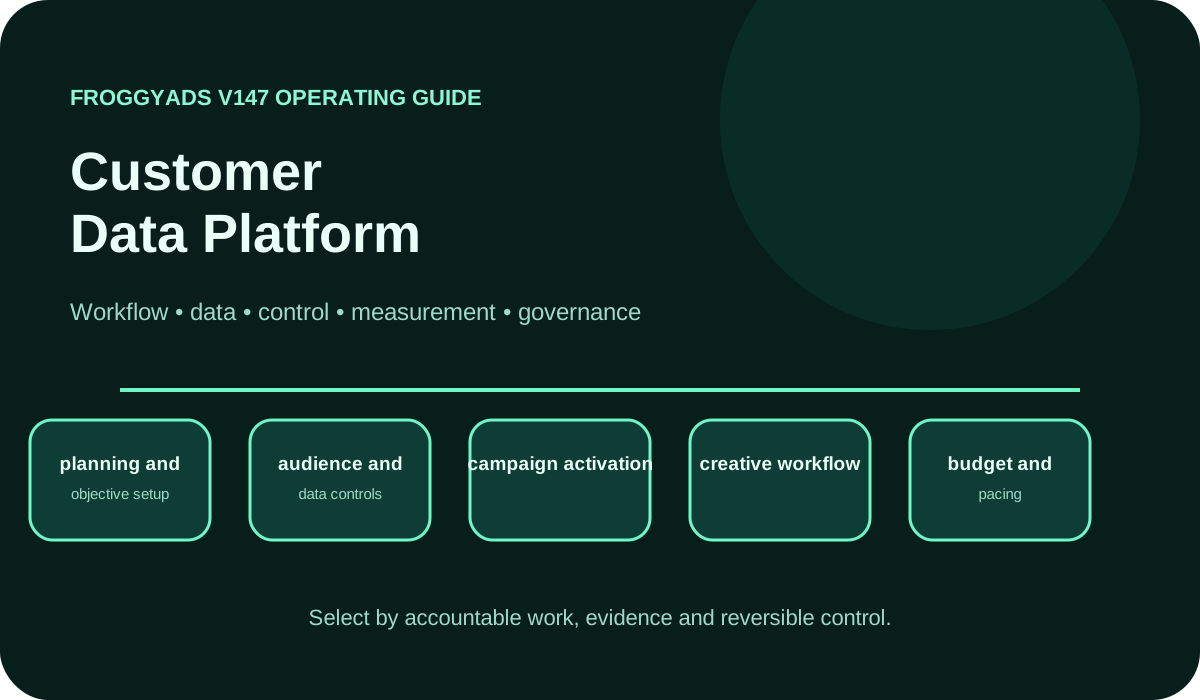
Customer Data Platform operating model showing workflow, data, control, measurement and governance

What does a customer data platform do for an advertiser?

Quick answer: A customer data platform, or CDP, maintains a combined view of customer information that other systems can use. It helps you organize identities, events and profile updates across the customer journey. Your advertising platform then provides the campaign controls for buying traffic. With FroggyAds, you can test an offer through supported targeting, formats, bids, budgets and source controls while your own customer and order records show what the traffic achieved. Use the customer context you can support to choose a focused campaign test and evaluate the accepted business result.

SectionWhat you can validate
Selection and proof of valueTrace a sample customer record through ingestion, identity matching, preference updates and an export the intended destination can actually use.

For a reference about the media-execution layer, see Google Display & Video 360 overview. This reference describes that product's media workflow; evaluate your chosen CDP against the customer-record tests below.

What is a customer data platform in a paid-acquisition workflow?

Think of a CDP as the customer-context layer in your marketing setup. Your store, website, app or service system may hold different parts of a person's journey. The CDP's job is to help maintain a usable combined customer record, with identity and structure managed over time. Start your evaluation with the records and decisions your business needs, rather than a long list of advertised features.

A CRM supports the sales or service work carried out around customer relationships. A data warehouse supports broader storage and analysis. A DMP focuses on audience-data use, while an ad-buying platform executes media campaigns. Products can overlap, so test the actual responsibilities of the proposed system. You need to know where an accepted order, customer preference and campaign spend figure are authoritative.

Many affiliate marketers and smaller businesses can start buying traffic with an offer, a suitable landing page and reliable outcome tracking. A CDP becomes worth evaluating when fragmented customer records create a concrete obstacle. Choose FroggyAds for the media test you are ready to run, and add customer-data infrastructure when you can show which decision it will improve.

Define the customer-data responsibilities before selecting software

List the sources you intend to connect, the identifiers they contain and the customer updates that matter. A useful evaluation might follow a new account, a completed order, a changed preference and a cancellation. For each one, identify the receiving system and the person responsible for checking the result. This turns a general platform discussion into a test your team can perform.

Keep ownership at record level. Your commerce system may confirm that an order was refunded, while your CRM records a lead's qualification status and another tool manages a communication preference. Decide how those changes reach the customer profile and which value wins when systems disagree. Copying the latest visible field without a reconciliation rule can spread an error quickly.

A connector's name tells you little about the workflow it supports. Check the exact fields, supported actions, update delay and handling of failures. Ask how a corrected record, deletion request or historical backfill is processed in your actual configuration. Only count a connection as useful once the intended destination receives the right information and your team can investigate an unsuccessful transfer.

Customer data platform requirements: eight practical checks

Use this scorecard with sample records you control. It separates customer-data tasks from media-buying tasks, helping you select a platform for a real need rather than assuming one product performs every function in your advertising setup.

ResponsibilityBuyer questionA useful demonstration
Use-case definitionWhich customer decision cannot be supported reliably by the current records?Follow one defined case, such as distinguishing a first purchase from an existing customer's repeat order.
Source ingestionCan the required systems send the necessary records and later corrections?Inspect a source event, its received fields, timestamp and any validation error.
Identity resolutionWhich identifiers justify combining records, and what happens when identity is uncertain?Compare an expected match with an ambiguous record that should remain separate.
Profile updatesDoes a corrected or newly received event change the intended customer view?Apply a controlled update and check its downstream effect without erasing the original event history.
Preference handlingHow will purpose, eligibility and customer-preference information accompany an export?Check that an ineligible test record stays out of the relevant destination under the rules you have established.
Outcome reconciliationCan accepted, cancelled and refunded outcomes be distinguished in the reporting workflow?Trace a sample order from placement through its later commercial status.
Access and reviewWho can inspect records, change identity rules and authorize destination access?Use separate test roles to verify the permissions and change history your process needs.
Destination and exitCan the intended tool use the export, and can you retrieve the information needed to leave?Inspect a receiving record, a failed delivery and a documented export of the required history.

Plan your audience test

Use customer insight to shape your next FroggyAds audience test

Choose one finding that can inform a supported campaign setting. For example, an aggregate analysis may show that your offer serves particular markets or that a mobile destination needs different messaging. Our geography and device controls can help you test that buying decision. Use the illustration to review the FroggyAds controls that can put that insight into a focused campaign.

Create My Free Account
Illustration of audience targeting controls for a customer data platform test

Customer identity resolution: separate matching from eligibility

A match answers whether records are believed to describe the same customer. Eligibility answers whether a particular use of the resulting information is appropriate under your established rules. Keep those decisions separate. A confidently matched person can still be excluded from an export, while an unmatched event may remain useful for aggregate analysis without being assigned to a known individual.

Specify the identifiers you can actually observe and the circumstances in which they may be joined. A verified account identifier has a different role from a shared device or an unconfirmed form entry. Include negative examples in the demonstration: two people sharing a device, a changed contact detail and an anonymous visit that cannot be linked confidently. Uncertainty should remain visible.

Test updates as well as initial ingestion. A profile that looks correct on the first day may become misleading after a refund, account correction or preference change. Ask how the platform handles late-arriving information and contradictory fields. Inspect the resulting record in the receiving system; a successful outbound request alone does not prove that the destination now holds the intended state.

How to evaluate a CDP with a small, reproducible pilot

Pick one use case with a defined business benefit, such as distinguishing new customers from repeat purchasers in your acquisition report. Establish what your existing tools already do and where the gap occurs. Your pilot should test whether the proposed profile layer resolves that gap with an operating effort your team can support.

Prepare representative fictional or otherwise appropriately permitted test records, expected identity outcomes and the receiving-system checks. Keep the first scope narrow enough to inspect manually. Include a failed sync, an ambiguous match and a status correction. A demonstration that handles only perfect records cannot show how your team will investigate the cases that commonly complicate customer reporting.

Compare the observed result with the expected result for each record. Note which tasks required manual work, which fields were unavailable and which problems could be corrected without vendor intervention. Expand the pilot after resolving material issues. Choose a CDP because it supports a useful customer-data responsibility, while keeping your actual campaign buying decision tied to accepted results.

Measure CDP operating quality alongside campaign economics

Profile quality measures should describe a specific task. You might measure how many required records arrived, how many expected identity matches were confirmed and how long a defined update took to appear in the receiving system. State the sample and exclusions. A high match rate by itself does not show accuracy if unrelated people have been incorrectly combined.

Campaign economics belong in a separate but connected view. Use your buying platform for delivery and spend, and your commercial records for accepted leads, orders or paid subscriptions. A CDP may help organize the customer context in a supported implementation. It does not turn a recorded click into proof of a customer acquisition or remove differences between attribution methods.

Review the later outcome of the acquired cohort. A store can distinguish first-time buyers who return from those whose initial orders are cancelled. An agency can follow accepted inquiries into later sales stages. Keep the acquisition period, outcome definitions and reporting delay visible, so an older settled cohort is not compared directly with yesterday's unreviewed leads.

An illustrative 30-day CDP pilot schedule

Days 1–5

Use the opening days to choose the customer-data problem, inspect source fields and record expected test outcomes. Confirm the people and access needed for the pilot. This is an illustrative planning sequence, not a promise that every CDP project can be completed in thirty days.

Days 6–12

Configure the limited data flow and inspect the first receiving records. Test expected matches, ambiguous cases and a deliberately unsuccessful transfer. Keep the original reporting process available while you establish whether the new profile view can be reconciled with the underlying business records.

Days 13–21

Introduce status and preference updates, then check that the intended destinations receive the correct changes. Measure delay and investigate exceptions. If the use case informs an acquisition test, keep that test's media budget and outcome definition explicit rather than changing several customer-data and campaign assumptions at once.

Days 22–30

Review the evidence, unresolved limits and operating work. Decide whether to continue, narrow the use case or choose a different approach. Document the next responsible person and the receiving-system checks needed for expansion. Adjust the schedule to your actual source complexity and available team.

Choose your ad format

Match your traffic format to the customer journey

Our Push, Native, Display and Pop formats provide different ways to introduce an offer. Use customer and offer insights to choose a suitable message and destination, then evaluate the resulting traffic against your accepted business outcome. The illustration shows media-format choices; the customer-data layer remains a separate responsibility that you evaluate through its own record and export tests.

Create My Free Account
Illustration comparing advertising formats for customer data platform execution

Use automation after the record rules are understood

Automate a well-defined customer-data action, such as applying a verified order-status update to an existing profile. Set the expected input and output, and make an unsuccessful action visible to the responsible person. Repeating an incorrect match or sending an outdated eligibility flag faster does not improve the customer journey.

Decide which changes need review in your operating process. Identity-rule changes, new destinations and wider data use can affect many records at once. Test their consequences before broad application and retain a way to stop the flow. A successful small update is evidence about that update, not proof that every future rule is safe to automate.

A recommendation-only trial can help you inspect a proposed rule before it changes records or destination audiences. Compare the proposed output with known test cases and investigate discrepancies. Use a suitable sample and review process for your circumstances. Your platform and implementation determine whether such a trial mode is available.

Check access, preferences and data-handling responsibilities

Give people the access they need for their actual tasks. A campaign buyer may need aggregate customer insights without access to individual customer records. Someone maintaining an identity rule may need a different view. Confirm these roles in the proposed configuration, and inspect the changes recorded when permissions or matching rules are updated.

Document the purpose and permitted use of each input and export under the requirements that apply to your business. Include customer-preference changes and the path for correcting or removing information. Technical ability to send a field does not settle whether a particular use is appropriate. Have the responsible privacy or legal specialist resolve requirements that depend on your situation.

Ask the vendor to demonstrate the controls you will rely on: authentication, access management, change history, destination credentials and recovery procedures. Check its current documentation and your contractual requirements rather than assuming those features exist in every CDP. Keep sensitive sample data and credentials out of general campaign reports.

Compare CDP options through the job you need completed

Select evaluation criteria before a product demonstration. An ecommerce business may need reliable purchase and refund updates; a B2B agency may need consistent lead qualification across client systems. Rank the tasks that resolve your actual data gap. Ask each vendor to demonstrate the same expected records and failure cases so the comparison stays meaningful.

Include implementation work, source maintenance, training, administration, usage-based charges and exit effort in the comparison. Record the assumptions behind any quotation, such as the relevant profile or event volume. Your total cost depends on the product and configuration you choose. A lower headline subscription does not automatically mean a lower cost for the workflow you need.

Check the architecture as well as the feature list. Packaged, warehouse-based and hybrid arrangements can place customer-data responsibilities in different components. Ask where the required record lives, who maintains identity logic and how a receiving system obtains the result. Choose a setup your team can operate and reconcile; the architecture label alone does not establish the better choice.

CDP implementation problems worth testing before expansion

Incorrect matching, incomplete updates and unusable exports can make a customer view look more complete than it is. Test them individually. A duplicated order is an event-quality problem; two customers incorrectly merged are an identity problem; an outdated destination record is an update problem. Each requires a different investigation and correction.

Keep exceptions visible alongside successful transfers. A useful operating report distinguishes rejected records, delayed updates, ambiguous matches and receiving-system failures. Give each issue a responsible person and an inspection path. Otherwise a broad success percentage can conceal the small set of cases that changes your acquisition report or customer treatment.

Agree what happens if the new data flow must be stopped. Identify the previous stable reporting process, the exports required for continuity and the people who can revoke destination access. Test recovery appropriate to the pilot before relying on it for a critical workflow. Keep the underlying commercial records available while the profile issue is resolved.

Make customer-data definitions understandable to campaign teams

Write a short definition of the customer record, the identifiers it uses and the outcome states it can represent. Include examples of a new customer, a repeat order and a cancelled transaction. An account strategist should be able to understand which records support a campaign decision without reverse-engineering a technical implementation.

Document the difference between an observed event, a matched profile and an accepted business outcome. Add the relevant source, update delay and known gap to the report. This lets a media buyer understand what can be acted on today and what still needs reconciliation, especially when a recent campaign contains many outcomes awaiting review.

Keep the explanation current when you change matching rules or the definition of an accepted outcome. Compare reports using the definitions that applied to the relevant cohort. A historical change in customer count can otherwise look like better acquisition performance even though the underlying buying activity stayed the same.

Act on customer insight

Turn a supported customer insight into a campaign decision

Use an insight that maps to an actual buying choice. Your aggregate records might show a commercially relevant market or a destination journey that needs different messaging. FroggyAds gives you controls for the resulting traffic test, including supported targeting, budget and source settings. Keep customer-level activation conditional on a verified receiving-system capability and an appropriate implementation.

Create My Free Account
Illustration of a campaign launch checklist for customer data platform

How can you use FroggyAds alongside a CDP?

Our self-serve media platform helps you buy and evaluate traffic through supported formats, targeting, source settings and budgets. Keep customer profiles and commercial acceptance records in the systems responsible for those jobs, then use their findings to guide a measurable FroggyAds campaign.

We provide the paid-traffic buying layer for advertisers, affiliate marketers, media buyers and agencies. Use our self-serve campaign controls to test an offer and refine delivery from source-level evidence. Keep the acceptance of orders, leads and paid subscriptions tied to your own commercial records. You can start a focused campaign with our buying controls and judge the next step against your own accepted customer outcomes.

A practical customer-profile and acquisition example

Consider a hypothetical online store that sells refillable home-care products. It wants to distinguish a first purchase from a repeat refill order when reviewing acquisition costs. Its store records orders, its service team records corrections and another system holds communication preferences. The CDP evaluation should show whether those records can produce the customer context the store actually needs.

Begin with a fictional known customer identifier and two distinct, valid order identifiers. The expected result is one known customer with two orders, not two new customers. Then introduce a repeated notification for one order. The receiving report should still represent two valid orders. Record the expected outcome before asking the vendor to demonstrate how its implementation handles the input.

Add an anonymous browsing event that has no verified link to that known customer. Keep the identity uncertainty visible rather than assuming the visit belongs to the same person. Next, test a record for a different person using a shared device. A demonstration should explain what evidence justifies a match and show how an incorrect association can be investigated and corrected.

Now change one order to a refunded state and inspect the customer record and receiving report. The customer still exists, but the commercial treatment of that order has changed. Check whether the refund becomes visible within the update timing you agreed to test. This is a more useful evaluation than counting how many fields the demonstration imported.

Introduce a fictional preference change and check the relevant export under your established eligibility rules. Identity matching should not silently override that preference. Have the responsible specialists define what is appropriate for your intended use. The pilot shows whether the configured flow behaves as expected; it is not a legal determination about every possible use of customer data.

For the store's acquisition campaign, translate the resulting aggregate insight into a specific offer and destination. A first-order message and a refill message involve different customer commitments. The ad and landing page should make the relevant product conditions clear. Use the intended creative and destination versions in your campaign report so a later result can be traced to the offer actually shown.

Run a controlled FroggyAds traffic test when the buying decision is ready. Select the supported market, device and format settings appropriate to the offer and define the spend you are prepared to evaluate. Judge the data pilot on record accuracy and the traffic test on the customer outcomes your offer produces.

Check the receiving tools before planning customer-level activation. A CDP export is useful only when the intended destination accepts the required fields and can apply them in the way your workflow needs. This guide does not establish a native CDP destination or customer-list connection for FroggyAds. You can still use appropriately aggregated customer insights to inform the campaign choices supported by your actual configuration.

Review the acquired cohort using accepted outcomes and the relevant customer-value definition. Distinguish the media spend from other acquisition and data-operation costs. If the new profile view changes which orders are counted as first purchases, explain that reporting change before attributing an improvement to campaign performance.

Complete the pilot with a decision record: the customer-data gap addressed, the expected cases demonstrated, the exceptions, the operating work and the limits you accepted. Choose the next expansion from that evidence. A CDP should earn its place through a usable data responsibility, while FroggyAds helps you act on the separate paid-media opportunity you are ready to test.

Define the customer outcome

Write which commercial result the acquisition report needs to represent, such as a first accepted order or a qualified inquiry. Name the source that confirms it and the handling of pending or reversed outcomes. This gives the profile and reporting teams the same question to answer.

Verify the receiving destination

Inspect the actual fields, identifiers and update actions the intended destination supports. Test a successful export and an unsuccessful one. If a necessary capability is unavailable, narrow the workflow rather than counting an incomplete connection as a finished activation route.

Specify the input record

List the minimum fields needed for the use case, their source systems and their validation rules. Include event time and a relevant record identifier where available. State how an ambiguous or incomplete record should be handled so it does not silently become a confident customer fact.

Link the offer to the campaign report

Keep the creative and destination versions associated with the traffic test. When an offer changes, record the change and its effective date. Customer context can help shape a message, while the campaign record explains which message and terms the visitor actually received.

Separate data costs from media spend

Record the cost categories included in each calculation. Media-only CPA describes traffic spend against the specified accepted action; a broader acquisition calculation may include creative, sales follow-up or other costs. Add the relevant CDP operating work to the business decision without disguising it as an ad-platform charge.

Reconcile the commercial outcome

Follow the observed action into the accepted order, lead or subscription record. Preserve the acquisition period, reporting delay and treatment of later reversals. A matched customer profile helps organize context, but the business system remains responsible for the acceptance status used in the commercial calculation.

Test an incorrect record

Include an ambiguous identity, a repeated event and a corrected customer field in the pilot. Compare the result with the expected outcome for each case. Inspect how the responsible person finds and resolves the exception, rather than judging the product solely by successful import totals.

Plan a usable exit

Check how to retrieve the customer information, definitions and history needed to continue the workflow elsewhere. Record which components or vendor services remain necessary. Test an export your team can understand, with an appropriate handover process and access controls.

Frequently asked questions

What is a customer data platform used for?

A CDP helps maintain customer information from several systems in a usable combined record. Businesses can use that context for analysis and supported customer interactions. Evaluate it against a defined data problem, such as distinguishing first-time and repeat customers, rather than assuming that the category name guarantees every integration or activation feature.

Do I need a CDP before starting a FroggyAds campaign?

You can plan a focused traffic test with an offer, a suitable destination, a budget and a reliable way to evaluate accepted outcomes. Consider a CDP when fragmented customer records create a specific obstacle. We provide the campaign-buying controls; your customer-data architecture should match the needs and capabilities of your own business.

How does a CDP differ from a CRM?

Use a CRM to organize sales and service relationships; use a CDP to maintain customer context across sources for other systems to use. Products can overlap, so compare the actual responsibilities. Identify which system confirms an accepted order and which prepares the customer profile used in your campaign analysis.

What should I test in customer identity resolution?

Check an expected match, an ambiguous case, two people sharing a device and a corrected identifier. Define the intended result before the demonstration. Accurate identity work is not simply the highest possible match rate: combining unrelated people can make a profile appear more complete while making it less reliable.

Which CDP architecture should I choose?

Compare packaged, warehouse-based and hybrid arrangements by the customer-data task your team needs to operate. Identify where records are held, who maintains identity logic and how receiving tools obtain updates. The appropriate choice depends on your actual systems, expertise and requirements; the architecture label alone does not establish value.

How should customer preferences affect a CDP export?

Define the purpose and eligibility rules for the intended use under the requirements that apply to your business. Test a preference change and check the receiving output. Identity confidence does not itself establish permission for an action. Have the responsible privacy or legal specialist resolve requirements that depend on the circumstances.

What makes a CDP pilot measurable?

Use expected record-level outcomes: whether required inputs arrived, whether known records were matched correctly and whether a defined update reached the intended destination. Include exceptions and timing. Keep these operating measures distinct from campaign sales or acquisition results, which require their own commercial records and reporting scope.

How can a CDP affect an acquisition-cost report?

A better customer view can change how a report distinguishes new customers, repeat orders or reversed outcomes in a supported implementation. Explain any definition or identity change before comparing periods. For media buying, reconcile campaign spend with the accepted customer action and use an explicit cost scope.

Does this guide confirm a native FroggyAds CDP integration?

No native CDP connection or customer-profile upload is established by this guide. Verify the actual receiving-system and campaign capabilities before planning that workflow. You can use appropriately aggregated customer insights to inform supported FroggyAds targeting, format, source, bid and budget choices while checking outcomes in your own commercial records.

Which costs belong in a CDP buying decision?

Consider the quoted product charges and the work needed for implementation, source maintenance, administration, training and exit. Record the volume and configuration assumptions behind a quote. Evaluate those costs against the data responsibility the product can demonstrate, while keeping paid-media spend and campaign acquisition economics clearly labelled.

Official sources used for this guide

The references below cover media execution and acquisition reporting. Each product's documentation describes its own capabilities and prerequisites. The CDP Institute's category guidance supports the profile and architecture distinctions in this guide. CDP Institute category reference: https://www.cdpinstitute.org/what-is-a-cdp/.

Start your next traffic test with FroggyAds

Bring the customer insight you can support, the offer you want to test and a destination ready to receive suitable visitors. Our self-serve targeting, format, budget and source controls let you turn that plan into a focused campaign. Review the accepted customer result alongside delivery so the next buying choice reflects your business objective.

Create My Free Account
Customer profiles and your buying decision

Customer Data Platform: Build and Evaluate a Measurable Operating System for your acquisition workflow

Use this guide to evaluate customer-profile responsibilities and their connection to an acquisition decision. Our Data Management Platform guide addresses a neighbouring audience-data category. Keep the use cases distinct: the appropriate data setup is the one that supports your actual records, receiving systems and buying decisions.

Your campaign objective sets the customer action you want to acquire. Audience and market fit determine whether the offer suits the intended visitors. Ad format shapes how the offer is presented; budget and bid settings control the exposure you are prepared to test. Use customer context where it can genuinely inform those decisions, and keep the campaign configuration and accepted outcome visible in your FroggyAds review.

StageDecision to verifyEvidence to retain
FitDoes fragmented customer information prevent a useful acquisition decision?Keep a concrete example of the missing, ambiguous or inconsistent record and the decision affected.
TestCan the proposed flow produce the expected customer record and receiving output?Retain the sample inputs, expected outcomes, observed exceptions and update timing.
DecisionShould the business expand the data workflow, change it or keep the current setup?Record the demonstrated benefit, operating work, accepted limits and the next responsible person.

Hypothetical calculation: a traffic campaign spends USD 225 and produces six accepted first-order outcomes under your defined rules. Media-only CPA is USD 225 / 6 = USD 37.5. If repeated purchase notifications were counted as new customers, the reported acquisition cost would answer a different question. Reconcile the accepted customer count before choosing the next budget. Use your own accepted customer count and full cost scope when applying this illustration; the figures are hypothetical.

Choose FroggyAds when you are ready to test the paid-media opportunity with practical campaign controls and a clear commercial objective. Use customer insights that your records can support, select the relevant traffic settings and assess the accepted result before expanding. Create your free FroggyAds account.

Direct answer

Your first customer-data decision

Name the customer-record problem you need to solve and the receiving tool that needs the result. If you can already run and reconcile a focused acquisition test, begin with that clear buying opportunity. We give you the self-serve campaign controls to start with FroggyAds while you evaluate any additional customer-data infrastructure on its own demonstrated value.


