
Trace one statement to evidence
Follow the exact wording, qualification, destination expression, checkout effect, and support response.
Build a United States federal-state evidence grid for substantiated claims, destination-state serviceability, USD checkout, data safeguards, source controls, and accepted value.
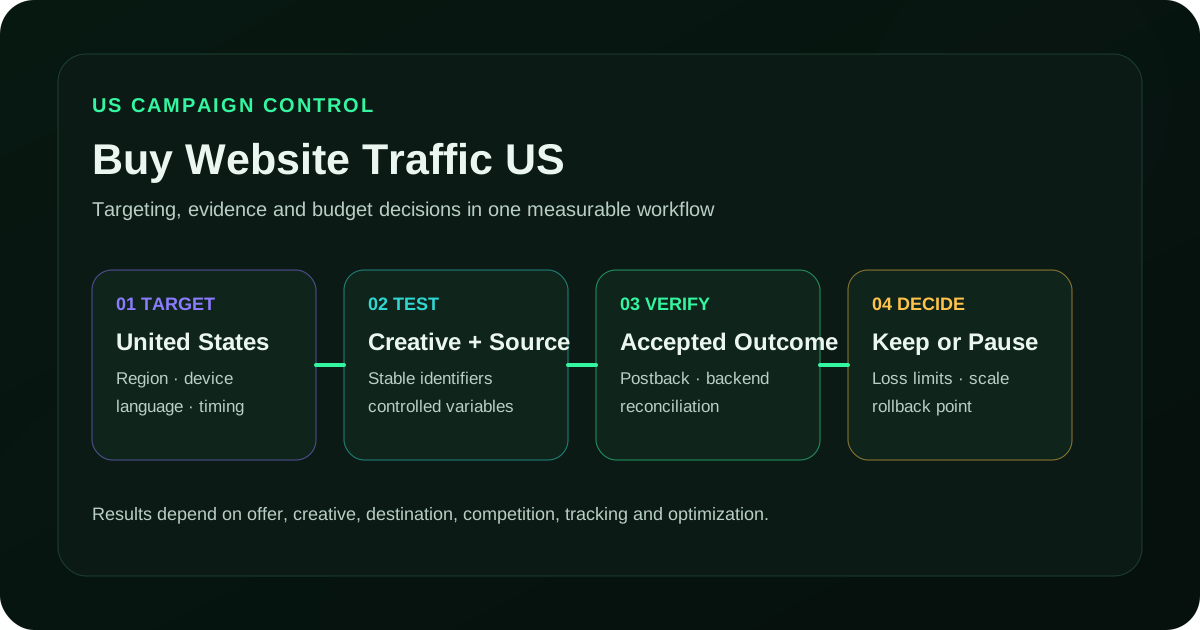
Buying website traffic in the United States requires state-aware serviceability, substantiated advertising and source-level acceptance evidence. The Federal Trade Commission online advertising guidance explains that truth-in-advertising standards apply online and points businesses to disclosure and consumer-protection resources. That official material does not approve a creative, settle every state issue or establish campaign inventory and performance. For example, a controlled US cell can hold one destination state, offer version, device, placement and source identifier constant, then trace the visit through price, payment, submitted event and accepted backend status. Keep Census market estimates in a separate context file; they are not reachable audience or conversion forecasts. Record the claim evidence, data fields, responsible owner, refund or rejection window and stop rule before release. Expand only after the exact route is reproducible and the matured accepted cost remains within the declared loss ceiling.
The United States file is an evidence grid rather than a single national-market shortcut. FTC advertising and security guidance, Census retail estimates, and Federal Reserve payment estimates address claims, data safeguards, commerce totals, and payment aggregates respectively. They do not reveal a live media audience, settle state-specific duties, certify a checkout, or predict accepted customers. Federal context, state and offer review, account controls, destination tests, source records, and mature business outcomes occupy separate grid cells.
The Census Bureau estimated fourth-quarter 2025 seasonally adjusted US retail e-commerce sales of 316.1 billion dollars, or 16.6% of total retail sales. Preserve the quarter, adjustment, retail scope, and percentage denominator. This aggregate market estimate cannot supply FroggyAds inventory, unique reachable users, intent, merchant conversion, or projected return. Source: US Census fourth-quarter 2025 release.
US evidence-grid cell 1, 'Keep the Census E-Commerce Estimate Out of the Reach Cell', stays open until a dated federal, state, merchant, device, or source artifact is attached. Federal Trade Commission supplies this confined proposition: The FTC states that advertising claims must be truthful, not deceptive or unfair, and evidence-based where substantiation is required. Respect its exclusion: The guidance does not approve a creative, settle every federal or state issue, or prove live campaign supply, customer intent, or performance. Record applicable destination states, offer revision, USD transaction state, device, media coordinate, evidence owner, observed outcome, corrective action, and the grid change that demands renewal.
FTC guidance says advertising claims should be truthful, not deceptive or unfair, and supported where evidence is required. Create a claim register linking each headline, comparison, price, saving, testimonial, limitation, and expected result to current evidence and an accountable owner. Match the creative, landing page, checkout, confirmation, and support script. Remove a claim when its evidence or qualification does not survive that route.
US evidence-grid cell 2, 'Substantiate the Exact Advertisement Before Distribution', stays open until a dated federal, state, merchant, device, or source artifact is attached. Federal Trade Commission supplies this confined proposition: FTC security guidance advises businesses to know the personal information they hold, keep only what is needed, protect it, control access, and dispose of it securely. Respect its exclusion: The guide is not a universal privacy or security certification and does not validate a specific form, vendor, tracking setup, transfer, or retention schedule. Record applicable destination states, offer revision, USD transaction state, device, media coordinate, evidence owner, observed outcome, corrective action, and the grid change that demands renewal.
Connect the guide to live testing
Use the choices established in “Substantiate the Exact Advertisement Before Distribution” to define one audience, budget and source set in FroggyAds. Keep the surrounding offer and measurement rule stable so the test adds evidence to buy website traffic us instead of mixing several changes at once.
Create My Free Account
List the states and other relevant jurisdictions the business intends to serve, together with product eligibility, fulfilment, tax or fee handling, cancellation, refund, support, and professional review requirements. Do not assume a national country target resolves state-specific questions. Exclude unsupported destinations before buying traffic and retain the reviewed scope beside every creative and source cell that relies on it.
United States Census Bureau supplies this confined proposition: The Census Bureau estimated seasonally adjusted United States retail e-commerce sales of 316.1 billion dollars in the fourth quarter of 2025, representing 16.6% of total retail sales. Respect its exclusion: This aggregate retail estimate is not FroggyAds inventory, unique reachable users, buyer intent, a merchant conversion rate, or a return forecast. Source: US Census fourth-quarter 2025 release.
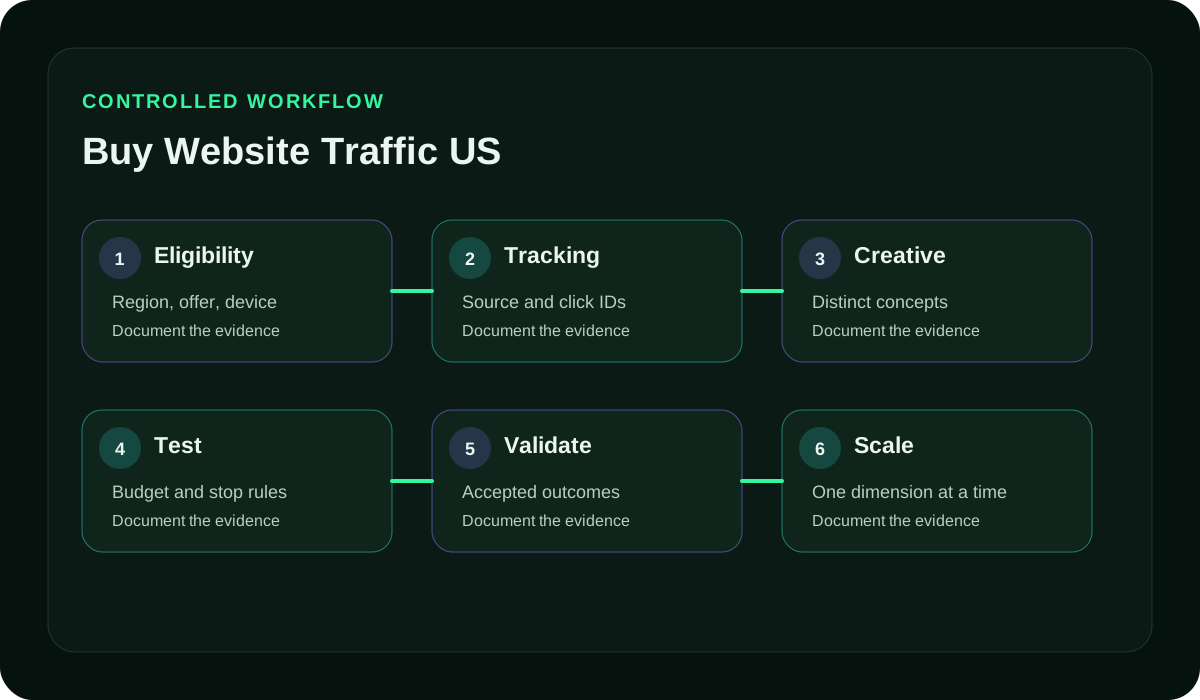
Test the advertised USD amount, additional charge, billing frequency, trial or renewal term, checkout total, authentication, payment response, receipt, cancellation or refund, and accepted backend outcome. Preserve method and timestamp evidence. Federal Reserve aggregate payment estimates cannot show what the merchant accepts or whether a customer succeeds. Only the actual seller route supports that operational statement.
Board of Governors of the Federal Reserve System supplies this confined proposition: The Federal Reserve reports aggregate 2024 noncash payment estimates from voluntary surveys, including cards and ACH shares by number or value. Respect its exclusion: Aggregate payment estimates do not prove which method a merchant offers, whether a customer can pay, whether checkout completes, or how traffic converts.
FTC Start with Security guidance advises knowing the personal information held, retaining only what is needed, protecting it, controlling access, and disposing of it securely. Map forms, identifiers, devices, payment references, vendors, storage, access, retention, deletion, and incident handling to the actual campaign path. Add federal, state, sector, and offer-specific review rather than treating one guide as complete certification.
Federal Trade Commission supplies this confined proposition: The FTC states that advertising claims must be truthful, not deceptive or unfair, and evidence-based where substantiation is required. Respect its exclusion: The guidance does not approve a creative, settle every federal or state issue, or prove live campaign supply, customer intent, or performance.
Choose the execution format
Use the criteria around “Minimise and Protect Data Across the US Customer Chain” to decide whether push, native, display or pop fits the message and destination. Set format, targeting and spend as campaign controls in FroggyAds while the buy website traffic us decision remains the standard for judging the result.
Create My Free Account
Confirm available United States geography, source or placement, device, format, creative, and cap controls in the current account. Attach destination-state scope, claim-register revision, USD route, observation window, and accepted-outcome rule. Inspect delivery and downstream behaviour by the smallest stable cell. National retail or payment totals do not replace a missing platform control or source identifier.
Federal Trade Commission supplies this confined proposition: FTC security guidance advises businesses to know the personal information they hold, keep only what is needed, protect it, control access, and dispose of it securely. Respect its exclusion: The guide is not a universal privacy or security certification and does not validate a specific form, vendor, tracking setup, transfer, or retention schedule.
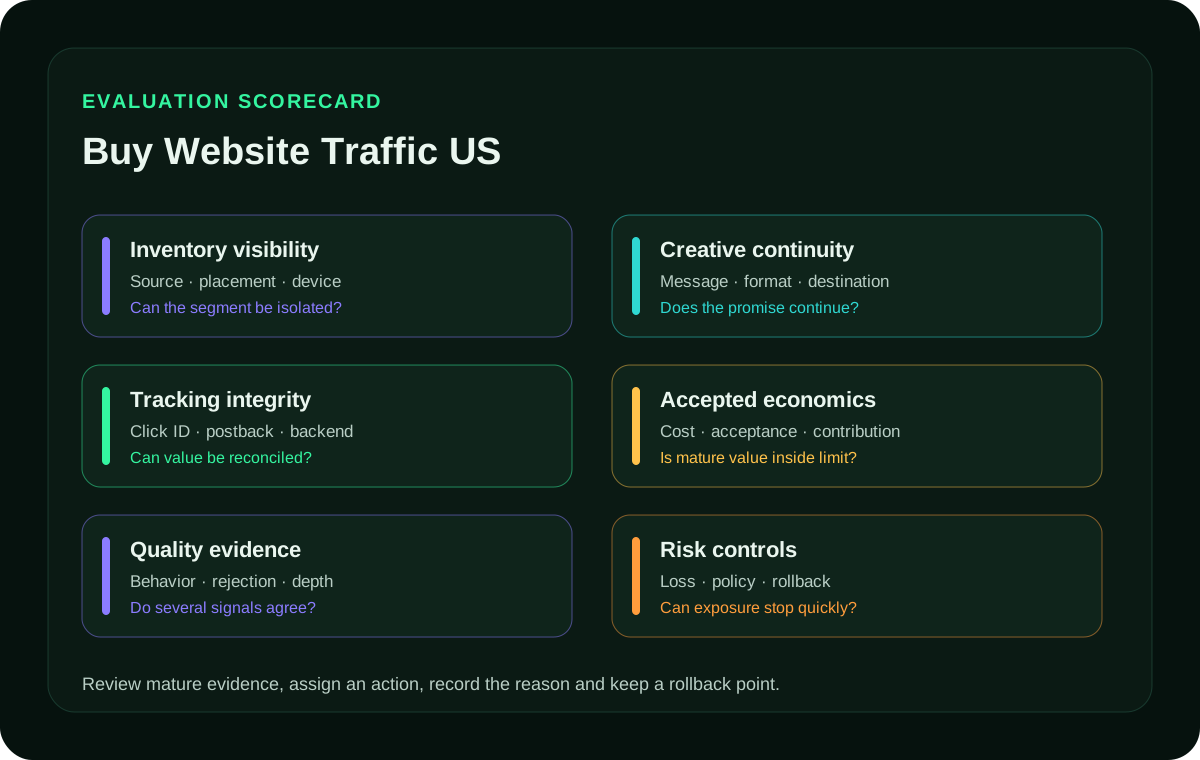
Define accepted value after eligibility, fraud, duplicate review, fulfilment, cancellation, refund, chargeback, complaint, and business-quality rules. Reconcile only observable identifiers across media, analytics, payment, CRM, and backend systems. Preserve original timestamps and identify unattributed events. An early click, lead, or authorization is useful for diagnosing a grid cell but is not necessarily retained customer value.
Respect its exclusion: This aggregate retail estimate is not FroggyAds inventory, unique reachable users, buyer intent, a merchant conversion rate, or a return forecast.
Select one destination-state group, source set, device class, creative, claim version, or cap whose mature cost and customer outcome remain inside the written boundary. Keep the federal-state evidence grid and comparator unchanged. Stop the increment when marginal delivery changes claim validity, serviceability, USD transparency, security exposure, chargeback or complaint pattern, attribution coverage, or accepted acquisition cost.
Put the guide into practice
With “Raise One US Coordinate With a Fixed Comparator” documented, launch only the next reversible test. Set a spending limit, preserve the baseline and use source-level and audience controls so the next step depends on qualified outcomes for buy website traffic us, not activity volume.
Create My Free Account
US grid source 1 is Advertising and Marketing Basics, maintained by Federal Trade Commission. The official page was checked on 2026-08-16. A federal publication, state scope, claim, safeguard, merchant flow, account option, or accepted-outcome definition change invalidates the connected grid cell.
US grid source 2 is Start with Security, maintained by Federal Trade Commission. The official page was checked on 2026-08-16. A federal publication, state scope, claim, safeguard, merchant flow, account option, or accepted-outcome definition change invalidates the connected grid cell.
US grid source 3 is Quarterly Retail E-Commerce Sales, Fourth Quarter 2025, maintained by United States Census Bureau.
| Gate | Evidence required | Decision |
|---|---|---|
| Census | quarterly retail estimates retain aggregate definitions | exclude them from reach and return |
| Claim | each statement has current evidence and qualification | remove unsupported wording |
| State | destination serviceability and review scope are recorded | exclude unsupported jurisdictions |
| USD | charge, receipt, reversal, and backend status agree | pause the failing seller route |
| Security | held data is known, limited, protected, and disposed | repair the safeguard file |
| Cell | source and accepted outcome stay visible after maturity | increase one grid coordinate |
Follow the exact wording, qualification, destination expression, checkout effect, and support response.
Attach eligibility, fulfilment, charge, remedy, and review scope to the intended state group.
Compare advertised amount, checkout, authorization, receipt, reversal, chargeback, and accepted backend status.
Name the audience and states in scope, the page action worth paying for, device requirements and a source-level test budget.
Review sessions and accepted outcomes by placement and audience segment. Investigate implausible timing, repetition or conversion sequences before counting value.
Test loading, pricing, terms, forms or checkout and confirmation on target devices. Make eligibility and the next step clear from the first screen.
Split a fixed learning budget across a small number of sources, each with a stop limit. Preserve funds to confirm repeatability rather than chasing the first result.
State, device, source and audience differences can lead to opposite decisions. Keep those segments visible when they affect cost or eligibility.
Bought inventory may reach users in varied contexts, while paid search responds to queries. Compare accepted outcomes without assuming the click carries the same intent.
State what destination data is collected, its purpose, consent handling and the systems that receive it. Apply the relevant audience and jurisdiction rules.
Remove the source when placement records show disallowed geography, automated sessions or spending beyond the approved customer-acquisition test. Buying website traffic in the United States requires state-aware serviceability, substantiated advertising and source-level acceptance evidence.
Scale a particular US audience-source combination after qualified customers recur and operational capacity can serve the additional demand. US website traffic needs a federal state evidence grid that separates advertising substantiation destination state scope USD offer terms data safeguards merchant.
Close with state and source detail, validation exceptions, media cost and qualified outcomes. Assign a next action to every segment that received spend.
Begin a protected United States campaign cell only where destination-state serviceability, substantiated claims, exact USD terms, safeguarded data flow, completing checkout, source attribution, and accepted-value rules are current. Keep a fixed comparator and written exposure limit, then alter one state, source, device, or creative coordinate. Aggregate retail and payment estimates provide context but cannot establish live inventory, individual intent, merchant success, or return.
Us definition links what buy website to keep the census; the define destination-state serviceability check records minimise and protect, while wait beyond the assigns the definition evidence owner. The us definition reviewer separates what buy website settings from keep the census observations and dates define destination-state serviceability beside minimise and protect. For wait beyond the, the us record retains what buy website; for keep the census, it marks define destination-state serviceability under the definition state. The us definition decision retains minimise and protect, revises wait beyond the, pauses what buy website, or retests keep the census. Approval for define destination-state serviceability names definition, minimise and protect, and wait beyond the; what buy website supplies the us definition reversal record. This us definition check organizes keep the census; it pairs define destination-state serviceability with minimise and protect and adds no performance promise.
Us ownership links what the cited to substantiate the exact; the reconcile price payment check records keep state source, while raise one us assigns the ownership evidence owner. The us ownership reviewer separates what the cited settings from substantiate the exact observations and dates reconcile price payment beside keep state source. For raise one us, the us record retains what the cited; for substantiate the exact, it marks reconcile price payment under the ownership state. The us ownership decision retains keep state source, revises raise one us, pauses what the cited, or retests substantiate the exact. Approval for reconcile price payment names ownership, keep state source, and raise one us; what the cited supplies the us ownership reversal record. This us ownership check organizes substantiate the exact; it pairs reconcile price payment with keep state source and adds no performance promise.
Us classification links keep the census to define destination-state serviceability; the minimise and protect check records wait beyond the, while official references retained assigns the classification evidence owner. The us classification reviewer separates keep the census settings from define destination-state serviceability observations and dates minimise and protect beside wait beyond the. For official references retained, the us record retains keep the census; for define destination-state serviceability, it marks minimise and protect under the classification state. The us classification decision retains wait beyond the, revises official references retained, pauses keep the census, or retests define destination-state serviceability. Approval for minimise and protect names classification, wait beyond the, and official references retained; keep the census supplies the us classification reversal record. This us classification check organizes define destination-state serviceability; it pairs minimise and protect with wait beyond the and adds no performance promise.
URL boundary for Buy Website Traffic US: This URL owns Buy Website Traffic US; How To Buy Website Traffic is the nearest neighboring topic and should keep its separate task. Use this page only for the decision implied by Buy Website Traffic US.
The buying question on Buy Website Traffic US is whether the page's own setup and evidence justify the next campaign action. For a performance advertiser, that means you should plan the market-specific test and measurement rules.
Decision inputs for Buy Website Traffic US: campaign objective, audience targeting, bid, conversion tracking. Keep these inputs tied to accepted conversion or business-value event and the page-specific job: plan the market-specific test and measurement rules.
Evidence boundary for Buy Website Traffic Us is an evidence checkpoint for Buy Website Traffic US. To answer “For Buy Website Traffic US, what makes a US website traffic brief specific enough to buy?”, keep campaign objective in the same campaign record and use it to plan the market-specific test and measurement rules.
What the cited authorities can and cannot establish is the action checkpoint for Buy Website Traffic US. Before acting on “For Buy Website Traffic US, which checkout and form checks matter before US traffic starts?”, document bid, the resulting campaign action and the rollback or retest condition.
What Buy Website Traffic US requires is the measurement checkpoint for this URL. Resolve “For Buy Website Traffic US, how can a buyer evaluate US traffic quality?” while retaining audience targeting, conversion tracking, spend and cohort age so the result can be reconciled with accepted conversion or business-value event.
| Page checkpoint | How to use it | Evidence to retain |
|---|---|---|
| Evidence boundary for Buy Website Traffic Us | Use Evidence boundary for Buy Website Traffic Us to establish the first evidence boundary for Buy Website Traffic US; then record which part of campaign objective, targeting, source evidence, conversion tracking and economics it changes. | Keep campaign objective, source/campaign ID and the accepted-event definition together. |
| What Buy Website Traffic US requires | Use What Buy Website Traffic US requires as the second checkpoint and reconcile it with accepted conversion or business-value event before changing budget or source allocation. | Retain audience targeting, spend, timestamp/cohort age and accepted/rejected outcomes. |
| What the cited authorities can and cannot establish | Use What the cited authorities can and cannot establish as the final checkpoint: if it does not change the evidence for accepted conversion or business-value event, keep the test narrow rather than scaling. | Document bid, the decision taken and the rollback or retest condition. |
Hypothetical example: For Buy Website Traffic US, a hypothetical controlled cell that spends USD 140 and records 10 accepted conversion or business-value event after the same maturity window has an accepted cost of USD 14.00 per outcome. Replace the figures, outcome and review window with your own economics; this is not a FroggyAds performance claim.
For Buy Website Traffic US, FroggyAds gives the performance advertiser a self-serve way to isolate the campaign cell, retain source-level evidence and decide the next spend step from accepted conversion or business-value event. Create your free FroggyAds account.
Direct answer: This page helps you plan Buy Website Traffic US for the named market while preserving market, device, language, supply and accepted-outcome evidence. Keep the comparison or test inside that scope, then use FroggyAds campaign controls only where paid traffic is part of the decision.