
Buy Website Traffic Asia
Plan an Asia traffic purchase as a portfolio of country tests. Define which locations can use the offer, normalize time-zone reporting, preserve source identifiers, and expand only after accepted outcomes are reconciled.
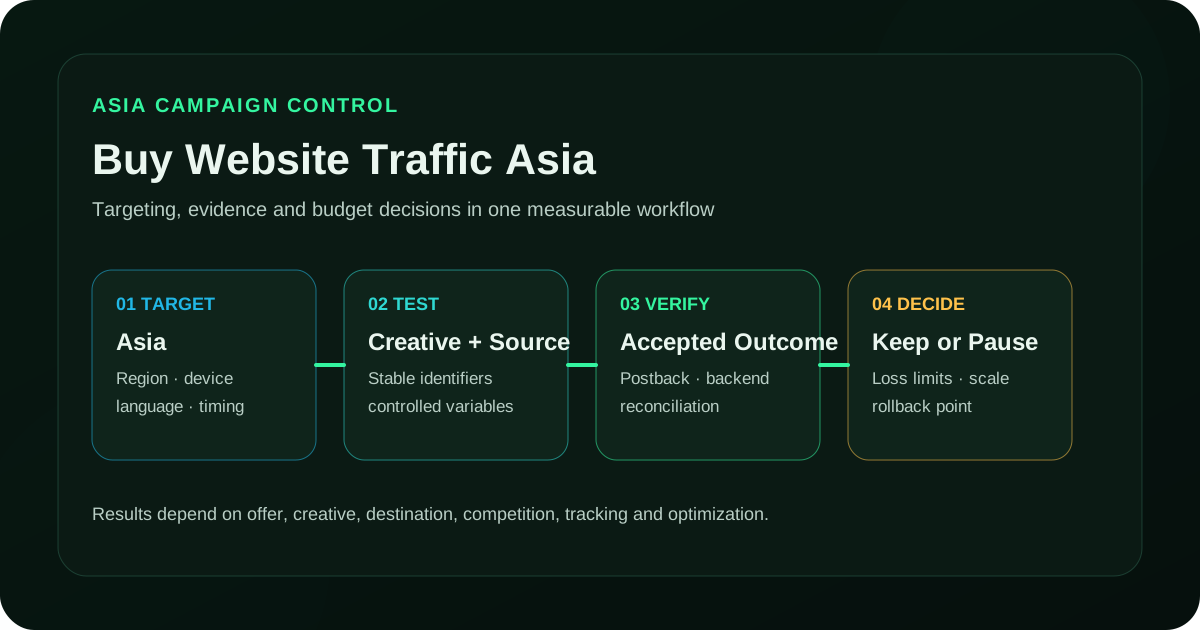
What does Buy Website Traffic Asia require?
Buy Website Traffic Asia means buying controlled delivery in named Asian country cells, not treating a continent-wide label as evidence of one audience. UN M49 identifies Asia as a statistical region with several subregions, while the IANA Time Zone Database shows why scheduling must use country-specific zones. FroggyAds GEO targeting and source-level conversion tracking can support the test, but neither regional population nor platform access guarantees inventory, intent, or conversions.
Evidence-led checkpoints before the first budget
Buying website traffic across Asia is a portfolio decision because Asia is not one language, currency, clock, customer journey, or legal regime. The United Nations M49 standard separates Asia into statistical subregions and country or area entries; that classification is useful for naming market cells, but it does not establish FroggyAds supply or advertiser serviceability. Build one record for each market the business can actually serve, including destination language, quoted currency, local support, time zone, source identifiers, and the accepted outcome.
A practical example is a regional campaign whose landing page works for one market but presents the wrong payment or delivery route in another. Split those cells before evaluating traffic quality. Compare mature accepted results inside each market record, and never use an aggregate Asian total to hide an unresolved country path. The UN reference supports the geographic boundary only; current account controls and advertiser evidence must support the launch decision.
- Use the UN M49 Asia region as a scope map, then authorize countries one by one.
- Record a named time zone, supported language path, destination availability, and accepted event for every country cell.
- Keep budget, source IDs, and stop rules separable so one market cannot hide another market's result.
- Treat clicks and aggregate reach as diagnostics; use reconciled accepted outcomes for expansion decisions.
Turn Asia from a continent label into an auditable country portfolio
The UN M49 Asia region is a statistical classification, not a commercial promise. Its subregions and country entries give the brief a neutral way to define scope, but they do not create one language, currency, privacy rule, payment route, or inventory pool. An Asia website traffic planning record should therefore list every proposed country, the reason it is eligible, and the evidence still missing before activation.
Start with the destination, not the reach estimate. Confirm that the product or service can actually be used in the target country, that the page and support path can handle the selected language, and that material price, payment, delivery, or account conditions are visible. A country remains excluded when the business cannot verify those facts, even if a campaign interface allows the GEO to be selected.
| Area | Evidence to verify | Decision rule |
|---|---|---|
| Scope | Named country or supported city | Do not infer a country from the word Asia |
| Eligibility | Offer, page, service, payment, and support fit | Exclude unresolved destinations before spend |
| Decision | Accepted event by country and source | No continent-wide average can replace cell evidence |
Connect the guide to live testing
Connect Buy Website Traffic Asia to a controlled audience test
Use the choices established in “Turn Asia from a continent label into an auditable country portfolio” to define one audience, budget and source set in FroggyAds. Keep the surrounding offer and measurement rule stable so the test adds evidence to buy website traffic asia instead of mixing several changes at once.
Create My Free Account
Normalize delivery before comparing Asian markets
The IANA Time Zone Database provides named identifiers that can anchor reporting and daypart rules. Store both the platform timestamp and the target-country zone, then note daylight-saving or local-calendar effects where relevant. A single dashboard clock can otherwise make the same hour mean different user contexts across a multi-country campaign.
Language must be verified at the campaign and destination level. UN M49 does not define language, and a country label does not prove that one creative serves every intended user. Launch only the language versions that the advertisement, landing page, checkout, confirmation, and support route can carry consistently. Record exclusions instead of using automatic translation as an untested substitute for a complete user path.
Give every Asia test cell its own budget, source trail, and stop rule
FroggyAds describes GEO, device, browser, carrier, category, and source controls in its self-serve workflow. Use those controls to create a bounded country cell with one offer, one destination version, a small set of creative concepts, and a written loss limit. Preserve the country, campaign, creative, source, placement, and click identifiers that are available so the result can be traced rather than averaged away.
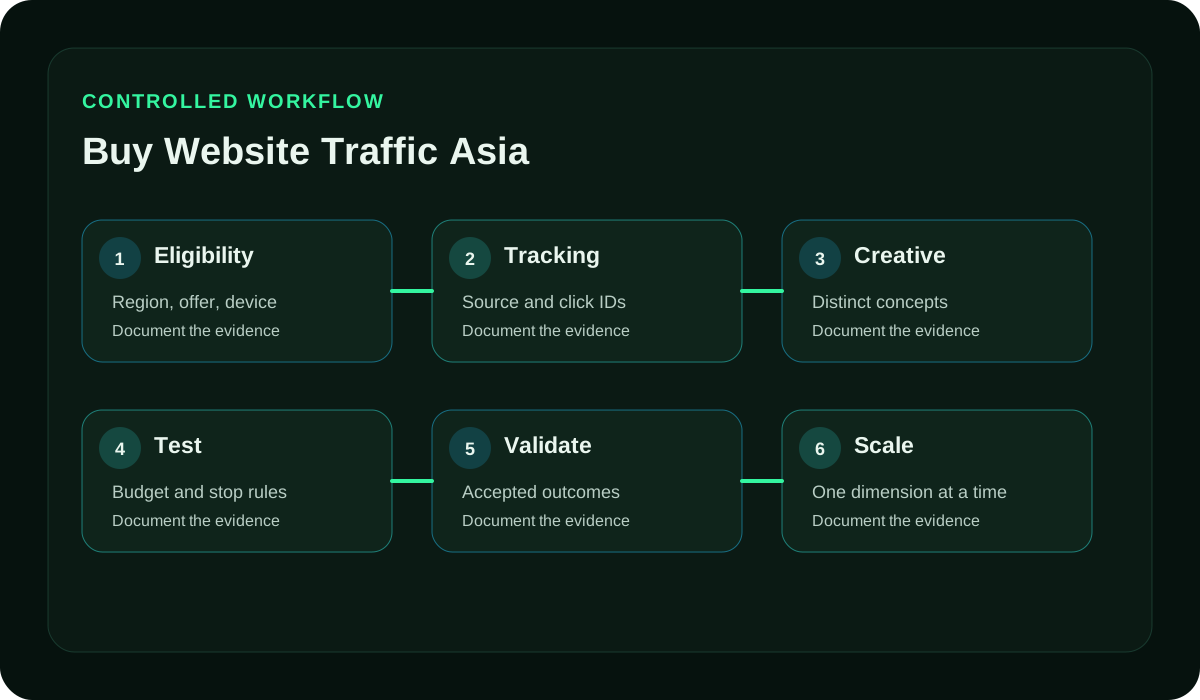
The first phase is a technical test. Confirm that eligible delivery reaches the intended destination, the chosen event fires once, and the event can be reconciled with the business record. The second phase compares source behavior inside the same country definition. Only a third phase should test a controlled increase, and the increase should change one dimension at a time.
Define accepted value before the Asia campaign spends
Source-level conversion tracking begins with a written business event. A form submission can be a transport event while the accepted outcome is a qualified lead; an order event can be provisional while the accepted outcome is a paid, non-duplicated order. Give the event an owner, a maturity window, duplicate rule, time-zone rule, and reconciliation source before media delivery is judged.
Keep diagnostic measures such as impressions, clicks, sessions, click-through rate, and front-end conversions, but do not let them replace the accepted result. Review cost and rejection by country, source, creative, device, and time period. If an identifier is missing or the platform and backend cannot be reconciled, pause material optimization until the gap is understood.
Choose the execution format
Choose a paid-media format that supports Buy Website Traffic Asia
Use the criteria around “Define accepted value before the Asia campaign spends” to decide whether push, native, display or pop fits the message and destination. Set format, targeting and spend as campaign controls in FroggyAds while the buy website traffic asia decision remains the standard for judging the result.
Create My Free Account
Scale a country cell, not the word Asia
A country cell is ready for measured expansion only when tracking is stable, the destination remains eligible, the accepted cost is within the stated limit, and the newest spend has not introduced a harmful source or device shift. Raise one of budget, bid, source coverage, format, device coverage, or geography while preserving a comparison cohort and rollback point.
Traffic-quality controls and source exclusions reduce risk but cannot prove every interaction is human, intentional, or valuable. Reconcile suspicious patterns with redirect logs, duplicate rules, device consistency, time to action, and backend rejection reasons before deciding whether a source should be kept, reduced, paused, or retested.
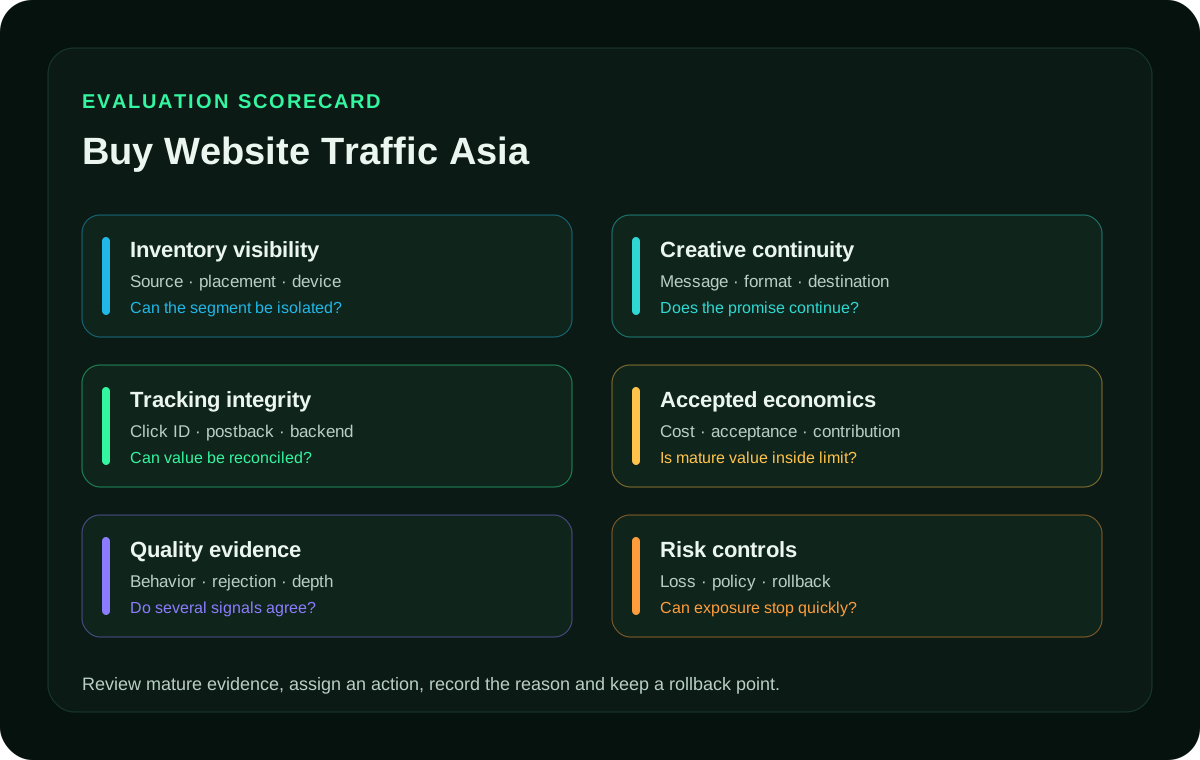
Evidence anchors for this Asia brief
The UN M49 Asia region defines the geographic portfolio boundary. The IANA Time Zone Database supplies named scheduling references. FroggyAds GEO targeting supplies platform-side selection controls, while source-level conversion tracking connects delivery to the advertiser's accepted event. Each entity answers a different question, and none is evidence of guaranteed demand or performance.
Put the guide into practice
Turn Buy Website Traffic Asia into a bounded campaign test
With “Evidence anchors for this Asia brief” documented, launch only the next reversible test. Set a spending limit, preserve the baseline and use source-level and audience controls so the next step depends on qualified outcomes for buy website traffic asia, not activity volume.
Create My Free Account
Twelve page-specific controls for Buy Website Traffic Asia
Country portfolio boundary
Checkpoint 1 for Buy Website Traffic Asia is Country portfolio boundary. 01 stage marker. Operating rule for Country portfolio boundary: Approve a country cell only when the advertiser has a named offer owner and a complete eligibility record for that country. No. UN M49 code 142 is a statistical grouping with several subregions; it does not establish one language, currency, law, inventory pool, or buyer behavior. Use Asia as a portfolio boundary and verify each country cell in the live platform and destination. Evidence 01 asks: Does the UN M49 definition make Asia one advertising market?
Decision 01-1 asks: Does the UN M49 definition make Asia one advertising market?
Destination availability
Checkpoint 2 for Buy Website Traffic Asia is Destination availability. 02 stage marker. Operating rule for Destination availability: Exclude the country when a material step fails or when the team cannot reproduce the route under the same destination version. Confirm that the GEO can be selected and that the offer, destination, language path, payment or service route, support window, and advertiser obligations fit the named country. Platform targeting availability alone does not prove that the business can serve the audience. Evidence 02 asks: What must be confirmed before an Asian country enters the test?
Decision 02-1 asks: What must be confirmed before an Asian country enters the test?
Language continuity
Checkpoint 3 for Buy Website Traffic Asia is Language continuity. 03 stage marker. Operating rule for Language continuity: Launch only a language path that remains complete after the click and record the reviewed copy version in the campaign cell. Treat language as a country and audience requirement, not a property supplied by the M49 region label. Run only versions for which the creative, landing page, conversion path, confirmation, and support experience can remain consistent. Evidence 03 asks: How can language be planned without assuming Asia speaks one language?
Decision 03-1 asks: How can language be planned without assuming Asia speaks one language?
Named time-zone rule
Checkpoint 4 for Buy Website Traffic Asia is Named time-zone rule. 04 stage marker. Operating rule for Named time-zone rule: Pause daypart comparisons when timestamps cannot be normalized or when a clock-rule change splits the evidence window. No. The IANA Time Zone Database provides different named zones across Asian countries. Store the target zone with each cell and normalize platform, analytics, support, and backend timestamps before making a daypart decision. Evidence 04 asks: Can one clock schedule represent every Asian campaign cell?
Decision 04-1 asks: Can one clock schedule represent every Asian campaign cell?
Currency and payment route
Checkpoint 5 for Buy Website Traffic Asia is Currency and payment route. 05 stage marker. Operating rule for Currency and payment route: Keep payment capability out of the advertising claim until a controlled transaction or equivalent approved test confirms the live route. Keep the displayed, charged, refunded, and accepted amounts in each country's original currency and document the payment or service route actually tested. Portfolio conversion belongs in a separate reporting field. A regional budget currency cannot prove that a national checkout supports the offer or method shown to its audience. Evidence 05 asks: What current evidence closes stage 05 for this campaign?
Decision 05-1 asks: What current evidence closes stage 05 for this campaign?
Country-specific obligations
Checkpoint 6 for Buy Website Traffic Asia is Country-specific obligations. 06 stage marker. Operating rule for Country-specific obligations: Route unresolved legal, privacy, licensing, age, or product questions to the accountable owner before media activation. UN M49 lists multiple subregions and country or area entries, while FroggyAds supports country and supported-city GEO controls. Separate cells let the buyer record eligibility, budget, source behavior, and accepted outcomes without treating a regional aggregate as country evidence. Evidence 06 asks: Why should an Asia traffic plan use separate country cells?
Decision 06-1 asks: Why should an Asia traffic plan use separate country cells?
Device and connection cells
Checkpoint 7 for Buy Website Traffic Asia is Device and connection cells. 07 stage marker. Operating rule for Device and connection cells: Combine thin cells rather than claiming a device winner from unstable samples, and reopen the split when mature evidence is available. Separate device and connection cells when page behavior, form completion, payment, or accepted outcomes differ. Record the tested device, browser, destination edition, source context, and failure state. Regional connectivity statistics do not establish that a particular visit, device path, or advertiser service is reachable and useful. Evidence 07 asks: What current evidence closes stage 07 for this campaign?
Decision 07-1 asks: What current evidence closes stage 07 for this campaign?
Event-definition contract
Checkpoint 8 for Buy Website Traffic Asia is Event-definition contract. 08 stage marker. Operating rule for Event-definition contract: Do not optimize an Asia country cell when the platform event and advertiser record cannot be joined under the written definition. Use the advertiser-defined accepted business event after click and source context has been reconciled with a mature backend record. Impressions, clicks, and front-end events remain diagnostics and cannot guarantee qualified value. Evidence 08 asks: Which result should decide whether an Asian source stays active?
Decision 08-1 asks: Which result should decide whether an Asian source stays active?
Source evidence
Checkpoint 9 for Buy Website Traffic Asia is Source evidence. 09 stage marker. Operating rule for Source evidence: Assign each material source to keep, observe, reduce, pause, or retest with the evidence and next review date attached. Preserve the source and click identifiers exposed by the campaign path, then compare spend, accepted events, rejection, and later value inside each country cell. Source lists can be adjusted only after tracking and sample maturity make the decision reproducible. Evidence 09 asks: How are source IDs used in an Asia portfolio test?
Decision 09-1 asks: How are source IDs used in an Asia portfolio test?
Creative and page version
Checkpoint 10 for Buy Website Traffic Asia is Creative and page version. 10 stage marker. Operating rule for Creative and page version: Open a new comparison phase when a creative or landing-page change alters the promise, eligibility, or conversion path. They provide signals and controls that can reduce exposure to suspicious or low-value delivery, but they do not prove that every interaction is valid or valuable. The advertiser still needs source-level review and backend reconciliation. Evidence 10 asks: What do traffic-quality controls prove in an Asia campaign?
Decision 10-1 asks: What do traffic-quality controls prove in an Asia campaign?
Budget containment
Checkpoint 11 for Buy Website Traffic Asia is Budget containment. 11 stage marker. Operating rule for Budget containment: Do not let a broad Asia budget move automatically toward an early cell before its accepted outcome has reached the declared maturity window. No. Country cells can differ in available supply, competition, destination fit, and outcome maturity. Keep their budgets and stop rules separate until comparable accepted-outcome evidence supports a deliberate portfolio rule. Evidence 11 asks: Should every Asian country share the same bid and loss limit?
Decision 11-1 asks: Should every Asian country share the same bid and loss limit?
Marginal expansion
Checkpoint 12 for Buy Website Traffic Asia is Marginal expansion. 12 stage marker. Operating rule for Marginal expansion: Expand one dimension only, retain a control cohort, and roll back when marginal delivery no longer meets the country cell's acceptance rule. Expand a single country cell after its tracking test passes, accepted outcome is mature, destination remains eligible, and marginal cost and quality stay inside written limits. Increase one dimension with a rollback point; no source or platform can guarantee the result. Evidence 12 asks: When is an Asia traffic test ready for controlled expansion?
Decision 12-1 asks: When is an Asia traffic test ready for controlled expansion?
Buy Website Traffic Asia FAQ
What does Buy Website Traffic Asia require?
For Buy Website Traffic Asia, consider this evidence when reviewing what does this topic require?. UN M49 identifies Asia as a statistical region with several subregions while the IANA Time Zone Database shows why scheduling must use.
Which Buy Website Traffic Asia decisions depend on evidence-led checkpoints before the first budget?
For Buy Website Traffic Asia, consider this evidence when reviewing evidence-led checkpoints before the first budget. Build one record for each market the business can actually serve including destination language quoted currency local support time zone source identifiers.
For Buy Website Traffic Asia, how can asia from a continent label become an auditable country portfolio?
For Buy Website Traffic Asia, consider this evidence when reviewing turn Asia from a continent label into an auditable country portfolio. An Asia website traffic planning record should therefore list every proposed country the reason it is eligible and the evidence still missing.
Which Buy Website Traffic Asia decisions depend on normalize delivery before comparing Asian markets?
For Buy Website Traffic Asia, consider this evidence when reviewing normalize delivery before comparing Asian markets. Record exclusions instead of using automatic translation as an untested substitute for a complete user path.
Which Buy Website Traffic Asia decisions depend on give every Asia test cell its own budget, source trail, and stop rule?
For Buy Website Traffic Asia, consider this evidence when reviewing give every Asia test cell its own budget, source trail, and stop rule. The first phase is a technical test.
For Buy Website Traffic Asia, how should accepted value before the Asia campaign spends be defined?
For Buy Website Traffic Asia, consider this evidence when reviewing define accepted value before the Asia campaign spends. Give the event an owner, a maturity window, duplicate rule, time-zone rule, and reconciliation source before media delivery is judged.
For Buy Website Traffic Asia, when is it safe to scale a country cell, not the word Asia?
For Buy Website Traffic Asia, consider this evidence when reviewing scale a country cell, not the word Asia. A country cell is ready for measured expansion only when tracking is stable the destination remains eligible the accepted cost is within.
Which Buy Website Traffic Asia decisions depend on evidence anchors for this Asia brief?
For Buy Website Traffic Asia, consider this evidence when reviewing evidence anchors for this Asia brief. Each entity answers a different question, and none is evidence of guaranteed demand or performance.
Which Buy Website Traffic Asia decisions depend on twelve page-specific controls for Buy Website Traffic Asia?
For Buy Website Traffic Asia, consider this evidence when reviewing twelve page-specific controls for this topic. Decision 01-1 asks: Does the UN M49 definition make Asia one advertising market?
Which Buy Website Traffic Asia decisions depend on country portfolio boundary?
For Buy Website Traffic Asia, consider this evidence when reviewing country portfolio boundary. Checkpoint 1 for this topic is Country portfolio boundary. 01 stage marker.
Continue the Asia traffic workflow
Build the first Asia evidence cell
Open a country-level Asia test only after eligibility, time-zone normalization, tracking, and source-level stop rules are documented.
Buy Website Traffic Asia: the decision this URL owns
URL boundary for Buy Website Traffic Asia: This URL owns Buy Website Traffic Asia; How To Buy Website Traffic is the nearest neighboring topic and should keep its separate task. Use this page only for the decision implied by Buy Website Traffic Asia.
Use this page when a performance advertiser needs to plan the market-specific test and measurement rules. The decision is specific to Buy Website Traffic Asia; do not replace it with a generic traffic or channel checklist.
Decision inputs for Buy Website Traffic Asia: campaign objective, audience targeting, source evidence, conversion tracking. Keep these inputs tied to accepted conversion or business-value event and the page-specific job: plan the market-specific test and measurement rules.
Evidence-led checkpoints before the first budget is the action checkpoint for Buy Website Traffic Asia. Before acting on “For Buy Website Traffic Asia, how can asia from a continent label become an auditable country portfolio?”, document source evidence, the resulting campaign action and the rollback or retest condition.
Asia portfolio checkpoints is an evidence checkpoint for Buy Website Traffic Asia. To answer “What does Buy Website Traffic Asia require?”, keep campaign objective in the same campaign record and use it to plan the market-specific test and measurement rules.
What does Buy Website Traffic Asia require? is the measurement checkpoint for this URL. Resolve “Which Buy Website Traffic Asia decisions depend on evidence-led checkpoints before the first budget?” while retaining audience targeting, conversion tracking, spend and cohort age so the result can be reconciled with accepted conversion or business-value event.
| Page checkpoint | How to use it | Evidence to retain |
|---|---|---|
| Asia portfolio checkpoints | Use Asia portfolio checkpoints to establish the first evidence boundary for Buy Website Traffic Asia; then record which part of campaign objective, targeting, source evidence, conversion tracking and economics it changes. | Keep campaign objective, source/campaign ID and the accepted-event definition together. |
| What does Buy Website Traffic Asia require? | Use What does Buy Website Traffic Asia require? as the second checkpoint and reconcile it with accepted conversion or business-value event before changing budget or source allocation. | Retain audience targeting, spend, timestamp/cohort age and accepted/rejected outcomes. |
| Evidence-led checkpoints before the first budget | Use Evidence-led checkpoints before the first budget as the final checkpoint: if it does not change the evidence for accepted conversion or business-value event, keep the test narrow rather than scaling. | Document source evidence, the decision taken and the rollback or retest condition. |
Transparent Buy Website Traffic Asia decision example
Hypothetical example: For Buy Website Traffic Asia, a hypothetical controlled cell that spends USD 310 and records 8 accepted conversion or business-value event after the same maturity window has an accepted cost of USD 38.75 per outcome. Replace the figures, outcome and review window with your own economics; this is not a FroggyAds performance claim.
Why use FroggyAds here?
Use FroggyAds for the paid-media execution step of Buy Website Traffic Asia: apply the relevant targeting, budget and source controls, keep conversion evidence visible, and expand only when accepted conversion or business-value event supports the next action. Create your free FroggyAds account.
Buy Website Traffic Asia — what matters first
Buy Website Traffic Asia should be evaluated market by market: define eligible geography, keep measurement consistent, and scale only where accepted-outcome economics remain viable.