
Asia Website Traffic
Plan Asia website traffic as a portfolio of measurable country and audience cells, with the language, local time, device context, destination and accepted outcome defined before delivery begins.
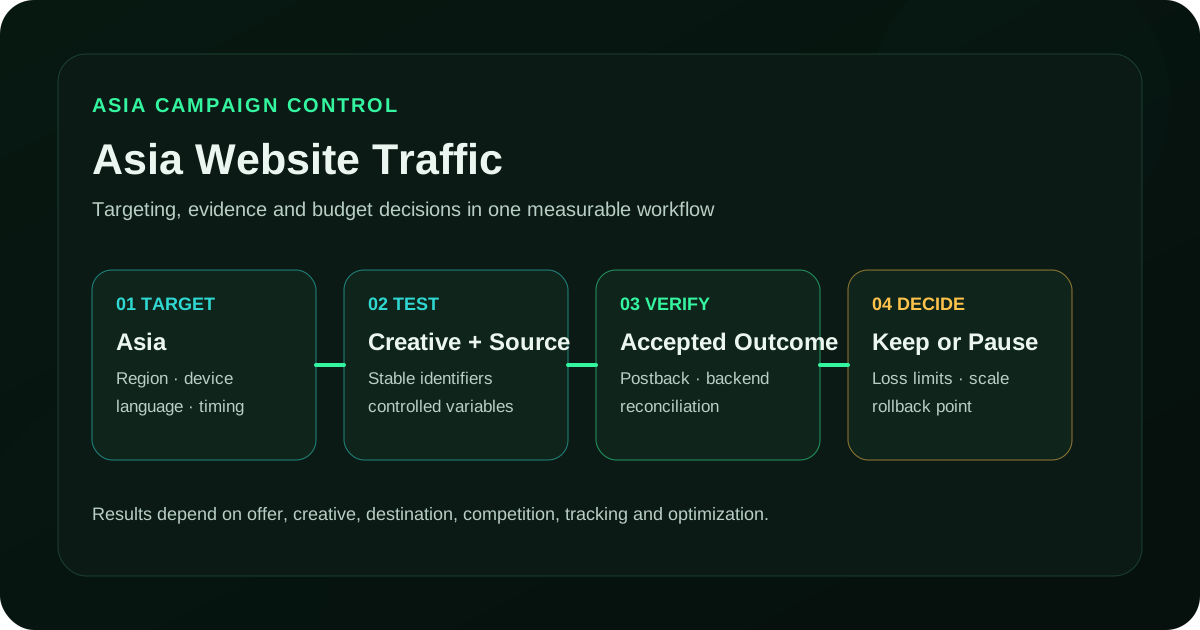
What is Asia website traffic?
Asia website traffic is the measurable flow of users in Asian countries who reach a website through paid or owned digital channels. For an advertiser, the useful unit is not an Asia-wide visit total. It is a country or market cohort whose offer eligibility, language, local time, device path, source identifiers and accepted business outcome can be measured together. With FroggyAds, advertisers can build separate traffic tests around those controls, then compare validated performance without treating Asia as one audience.
Why should advertisers avoid treating Asia as one market?
Asia is a geographic label, not a single advertising audience. A campaign that combines Tokyo, Jakarta, Mumbai, Almaty and Dubai into one reporting line can hide differences in language support, service coverage, local time, device behaviour, conversion delay and downstream acceptance. An Asia-wide click-through rate may look stable while one country produces accepted customers, another reaches an unsupported landing page and a third delivers outside local service hours. Country-level evidence shows which part of the plan created value.
The United Nations M49 standard divides Asia into Central Asia, Eastern Asia, South-eastern Asia, Southern Asia and Western Asia. That framework is useful for organizing research, but it does not imply that countries within a subregion behave alike. FroggyAds advertisers should use a subregion to build a research queue, then create campaign cells at the narrowest geographic level that the offer, targeting controls and available outcome data can support.
Different organizations also use different regional definitions. An “Asia and Pacific” statistic may include economies outside the UN Asia region, while a commercial “APAC” report may use another list. Every number in an Asia website traffic plan should retain the source definition, period and economies covered. If those details are missing, use the figure only as a research lead, not as a bid, budget or audience assumption.
How should the five Asian subregions guide campaign research?
The subregions create a repeatable research order. They should not become shared bids or shared creative by default. Each row below names the first questions an advertiser should answer before selecting countries from that lane.
| Planning lane | Example country questions | Required campaign boundary |
|---|---|---|
| Central Asia | Which countries can the offer serve, which scripts and languages does the destination support, and which named local time zones apply? | Separate every country until language, fulfilment and accepted outcomes prove that a wider cohort is useful. |
| Eastern Asia | Does the complete path support the selected market, local language, device environment, payment or signup process and advertising requirements? | Do not merge markets because they share a subregion; preserve country, creative and source identifiers. |
| South-eastern Asia | Which country-language pairs are ready, which mobile paths have been tested, and can support teams operate during the planned local hours? | Create country cells first; combine only after comparable evidence and serviceability are confirmed. |
| Southern Asia | Which languages, scripts, price presentation, connection conditions and destination steps fit the actual audience? | Keep country and language cohorts visible through the accepted outcome. |
| Western Asia | Which country rules, languages, offer restrictions, time zones and service areas affect eligibility? | Use a documented country checklist and a named compliance owner before launch. |
Should an Asia campaign target countries or a wider region?
Use country-level campaigns when the offer, landing page, price, fulfilment, language, legal review or conversion value differs by country. Country separation is also the safer starting point when the advertiser has little prior data. It makes loss limits clearer and prevents a high-volume country from consuming the learning budget intended for smaller markets.
A wider regional group can be tested only when the countries share the same usable destination path, creative promise, accepted outcome, reporting maturity and operating owner. Even then, pass the country code with every visit and outcome. A combined delivery setting must not become combined evidence. If one market weakens, the team needs enough detail to reduce or pause it without rebuilding unrelated country cells.
| Condition | Recommended structure | Reason |
|---|---|---|
| Different language or script | Separate country-language cell | Creative and destination continuity can be evaluated without mixing experiences. |
| Different price, payment or fulfilment | Separate country cell | The accepted business event has a different path or value. |
| Different local operating hours | Separate schedule or campaign | Local-time delivery remains aligned with support and service capacity. |
| Same offer path and mature evidence | Controlled regional test may be suitable | Country identifiers still preserve independent analysis and rollback. |
| Unknown market readiness | Hold delivery and complete the checklist | Paid traffic should not be used to discover a known eligibility failure. |
Connect the guide to live testing
Connect Asia Website Traffic to a controlled audience test
Use the choices established in “Should an Asia campaign target countries or a wider region?” to define one audience, budget and source set in FroggyAds. Keep the surrounding offer and measurement rule stable so the test adds evidence to asia website traffic instead of mixing several changes at once.
Create My Free Account
What belongs in an Asia market-readiness matrix?
An Asia market-readiness matrix converts a broad expansion idea into launchable country cells. Start with the country and the business event that creates value. Confirm that the product, service, shipping area, signup, app availability or lead-handling process actually serves that country. Then record the destination language, price and material terms, named local time zone, tested devices, supported payment or account path, tracking fields, privacy review and advertising restrictions.
Assign each cell one of three states: ready, conditional or hold. Ready means the full path has passed a documented test. Conditional means a known limit is reflected in targeting, schedule or creative. Hold means the advertiser cannot yet deliver the promised experience or measure the accepted outcome. A hold is useful evidence. It prevents budget from being spent on a market that the business is not ready to serve.
| Gate | Evidence before launch | Hold condition |
|---|---|---|
| Offer eligibility | Country is served and the promoted action is available. | Product, service, signup or fulfilment is unavailable. |
| Language continuity | Creative, destination, form, confirmation and support fit the intended audience. | A translated advert leads to an unsupported or unclear path. |
| Local-time operations | IANA zone and reporting conversion are recorded. | Schedule relies on an unverified fixed offset. |
| Device path | Representative mobile and desktop paths complete successfully. | A required step fails, stalls or hides material terms. |
| Measurement | Country, campaign, creative, source, placement and click IDs reach the accepted event. | Platform delivery cannot be reconciled with backend value. |
| Compliance ownership | A named owner has checked the actual market, vertical, claim and data use. | The team relies on a generic “Asia compliant” assumption. |
How can FroggyAds support country-level Asia traffic tests?
Our self-serve platform gives advertisers a practical way to turn the readiness matrix into controlled paid-media tests. You can select supported geographic and device settings, choose an available ad format, set a bid and budget, schedule delivery and review source-level reporting. Available controls and inventory vary by format, supply and market, so the campaign setup must be checked in the live account before a country is marked ready.
FroggyAds can support push, native, display, pop, video and interstitial opportunities where available. Format choice should follow the message, destination and user context. A short alert-led offer may fit a supported push placement, while a product that needs explanation may need native or display creative and a stronger landing-page bridge. The page must not promise that every format is available in every Asian country.
Our commercial value on this page is control rather than a continent-wide volume claim. An advertiser can keep country, device, creative and source evidence visible, protect the first test with caps and budget limits, and expand only after accepted outcomes justify more exposure. FroggyAds does not guarantee visits from every requested source, user intent, conversions, revenue or search rankings.
How should language and script affect Asia website traffic?
Language eligibility covers the entire conversion path, not only the advertisement. A localized headline does not solve an English-only form, an unsupported address field, an unreadable confirmation message or customer support that cannot serve the user. Record the language and script for the creative, landing page, form, checkout, consent text, confirmation and follow-up. If one step is not ready, narrow the audience or hold the country cell.
Do not infer language from a country name alone. Several Asian markets use more than one language, and many campaigns reach audiences with different reading preferences. Choose the audience intentionally, then use a destination that clearly identifies the advertiser, the real offer, price or other material terms and the next step. Avoid decorative translations, machine-translated claims that have not been reviewed, fake local endorsements and borrowed cultural symbols that do not explain the product.
Creative testing should compare meaningful propositions within the same language cell. Give each concept a stable ID and store the language, script, format, source file, destination version and launch date. This separates message learning from a language-path failure. When a translated concept changes the substance of the offer, treat it as a new hypothesis rather than a cosmetic variant.
Choose the execution format
Choose a paid-media format that supports Asia Website Traffic
Use the criteria around “How should language and script affect Asia website traffic?” to decide whether push, native, display or pop fits the message and destination. Set format, targeting and spend as campaign controls in FroggyAds while the asia website traffic decision remains the standard for judging the result.
Create My Free Account
How should advertisers schedule traffic across Asian time zones?
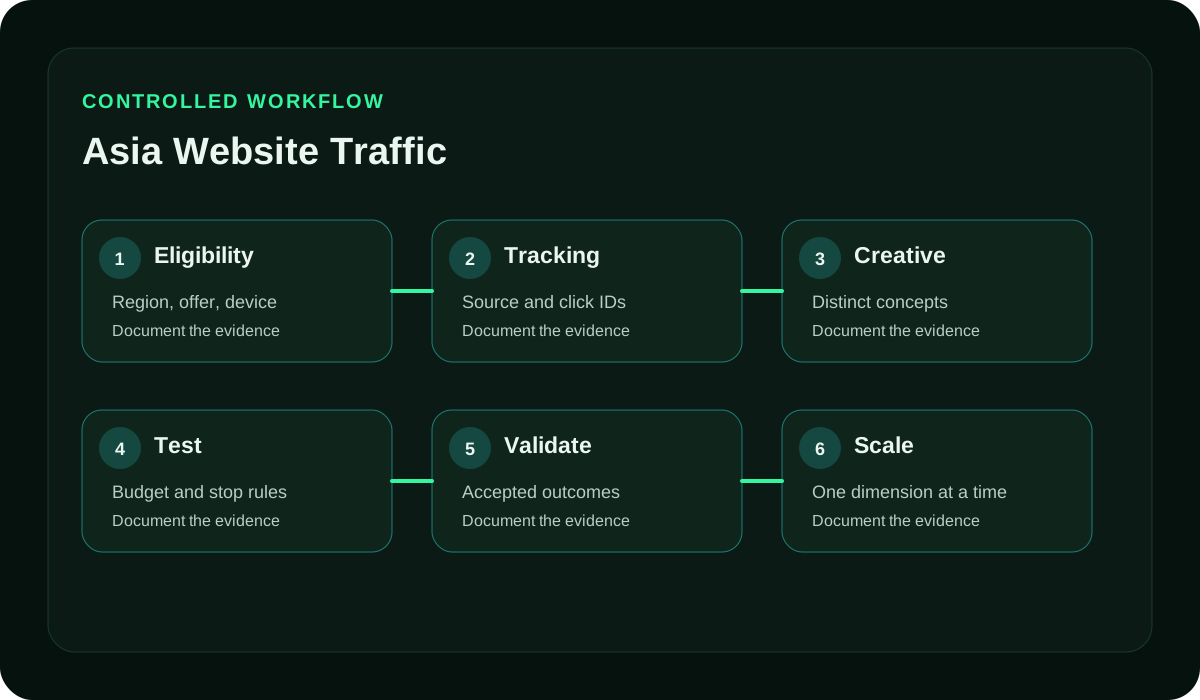
Store event time in UTC and retain the named IANA time zone used for each country or audience cell. Named zones such as Asia/Tokyo, Asia/Singapore, Asia/Kolkata, Asia/Almaty and Asia/Dubai are safer operating references than an offset copied into a spreadsheet. Governments can change civil-time rules, so a current time-zone database should drive scheduling and reporting conversions.
Local time matters when the conversion path depends on open support teams, sales calls, delivery windows, live events, daily promotions or same-day fulfilment. It can also change how early engagement is interpreted. Compare like local periods before calling one country stronger or weaker. A UTC report that groups afternoon traffic in one market with overnight traffic in another can produce a misleading regional average.
Begin with broad, serviceable local hours unless mature evidence supports narrower dayparting. Record the local interval, UTC equivalent, database version and date of any schedule change. If a campaign spans several zones within one country or operating group, keep the user zone or selected market zone available in reporting. The scheduling workflow below keeps that conversion explicit.
Should Asia website traffic always be planned as mobile-first?
No single device assumption is safe for all Asian markets or offers. ITU DataHub publishes economy-level indicators for internet use, mobile broadband, network coverage and affordability, but an advertiser still needs campaign evidence for the selected audience. A mobile-heavy country statistic does not prove that a complex business form, desktop software trial or high-consideration purchase should receive a mobile-only plan.
Test the complete path on representative mobile and desktop devices. Measure page response, layout stability, first useful interaction, form start, field errors, checkout or signup completion and accepted outcome. Include slower connection conditions when the intended audience may encounter them. Compress media, reserve image dimensions, limit unnecessary scripts and keep the primary action clear. A fast advert cannot rescue a destination that fails after the click.
Segment device and operating-system results only when the sample can support a decision. An early mobile conversion or a small desktop loss is not enough. Keep offer, creative and source conditions stable while comparing the path, then change one material variable. If a device fails a required step, pause that device cell rather than treating all traffic from the country as weak.
Which identifiers should follow Asia traffic to accepted value?
Every Asia website traffic visit should carry enough information to reconnect media delivery with the advertiser's accepted business event. Preserve campaign, country, language cell, creative, format, source, placement, device and click identifiers through the destination. Store them with the submitted event and return a validated outcome through a reliable server-to-server postback or other supported integration.
Define the accepted outcome before launch. A submitted lead may be rejected for an unsupported country, duplicate record or failed eligibility check. An install may never activate. An order may be cancelled. Media optimization should use the narrowest mature event that represents business value, while earlier funnel events diagnose where the path loses users.
| Field | Question answered | Decision supported |
|---|---|---|
| Country and language cell | Was the user eligible for the prepared experience? | Keep, localize, narrow or hold the cell. |
| Creative and format | Which message and placement set the expectation? | Retain or replace a concept without mixing languages. |
| Source and placement | Where did delivery originate within available reporting? | Adjust exposure at the narrowest controllable level. |
| Device and local time | Could the user complete the path in the actual context? | Repair the destination or change scheduling. |
| Submitted and accepted outcome | Did the visit create verified business value? | Calculate mature cost per accepted outcome. |
How should a test budget be divided across Asian markets?
Set a loss limit for each country or comparable cohort instead of giving one Asia-wide budget to an automated race for early volume. The first allocation should be large enough to validate tracking and compare a useful set of sources or creatives, but small enough to stop when the destination, policy status or accepted outcome is uncertain. Live bids and inventory should be checked in the FroggyAds account; there is no honest universal Asia CPC or CPM.
Do not force equal spending when countries have different readiness, supply or conversion delay. Use a documented allocation rule. One option is to reserve a technical-validation amount for every ready cell, then release a learning amount after test events reconcile. Additional budget can follow only when mature accepted cost and quality evidence remain inside the campaign limit. A large market should not borrow the validation reserve of a smaller market without a dated decision.
Currency conversion belongs in the operating record. Keep media cost in the account currency, store business value in its transaction currency and use one documented conversion source and timestamp for comparisons. Do not invent a continent-wide currency label or average price. Currency movement is a business-cost variable, not evidence that traffic quality changed.
Put the guide into practice
Turn Asia Website Traffic into a bounded campaign test
With “How should a test budget be divided across Asian markets?” documented, launch only the next reversible test. Set a spending limit, preserve the baseline and use source-level and audience controls so the next step depends on qualified outcomes for asia website traffic, not activity volume.
Create My Free Account
How can advertisers evaluate Asia traffic quality without country stereotypes?
Traffic quality is the fit between delivery evidence and the campaign's accepted outcome. Review geographic eligibility, duplicate and rapid-repeat patterns, device consistency, destination engagement, submitted events, backend acceptance, rejection reasons, refunds and downstream value by source and country cell. No country label, price tier or single quality score can replace that evidence.
An unusual pattern should start an investigation. Check redirects, destination errors, local availability, tracking loss, bot controls, creative-message mismatch and conversion delay before assigning a cause. Compare several signals over the same period. A short session may be reasonable for a one-step action and suspicious for a long application, while a high click-through rate can coexist with poor backend acceptance.
FroggyAds advertisers can use source-level reporting and available controls to reduce exposure while evidence is reviewed. Record the reason, action, owner and condition for a retest. The goal is not to label a market. It is to isolate a source, placement, creative or destination condition that can be kept, repaired, narrowed or paused.
Is there one advertising or privacy rule for Asia traffic?
No. Advertising, consumer, sector, privacy, cookie, direct-marketing and data-transfer requirements must be checked for the actual countries, audience, claims, landing path and follow-up process. A rule from one market cannot be copied across Asia, and an ad-platform setting does not complete the advertiser's legal review.
Before launch, name the person responsible for market review. Record the official regulator or government source, the version or access date, restricted products or claims, age or consent conditions where relevant, required disclosures, data fields, retention plan and user-rights process. Regulated areas such as finance, health, gambling, alcohol, political advertising and age-restricted products need separate review before creative is uploaded or data is collected.
FroggyAds requires advertisers to run lawful, supportable campaigns, but this page is operational guidance rather than legal advice. When the team cannot verify a material rule, hold the country cell and obtain qualified advice. That decision is less costly than buying reach for an offer that cannot lawfully or honestly complete its promise.
What should an Asia campaign scorecard decide?
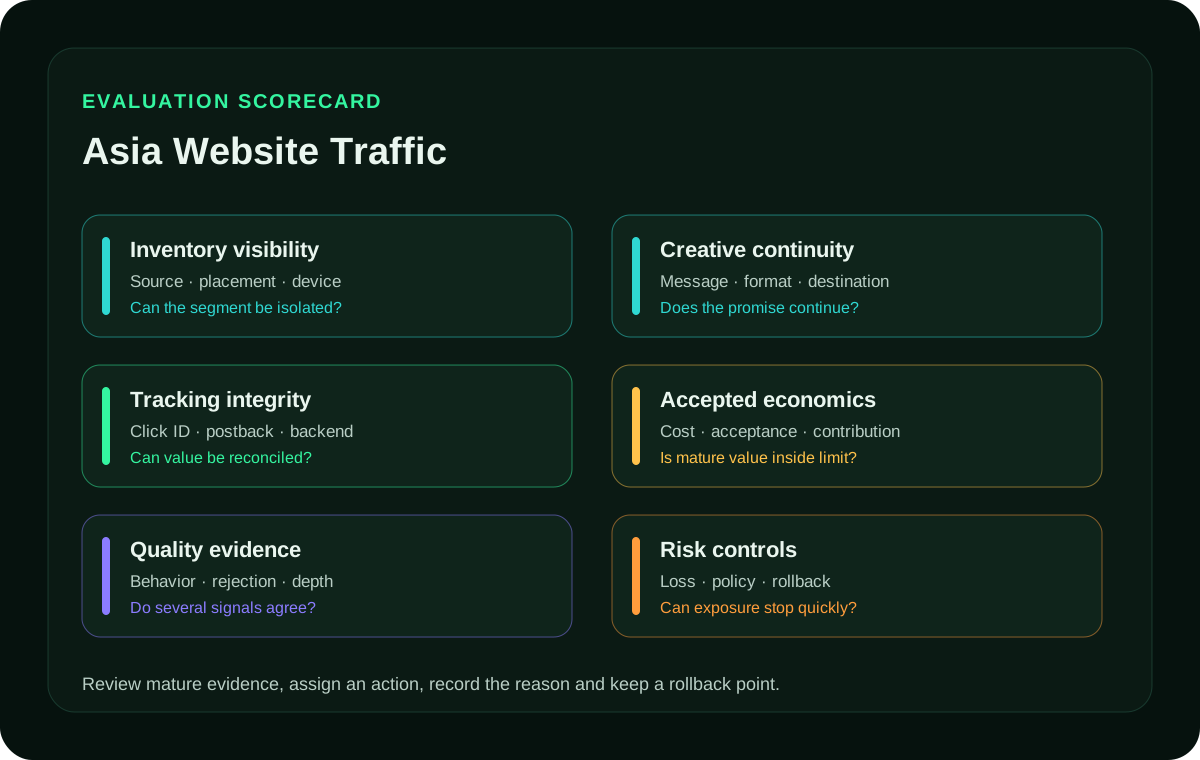
The scorecard should produce an action, not a decorative grade. A country cell is ready when the offer is serviceable, language path is complete, local-time plan is recorded, representative devices work, identifiers reconcile and a compliance owner has signed off. It is conditional when a known limitation is enforced by targeting or schedule. It stays on hold when the advertiser cannot support the promise or measure accepted value.
After launch, replace readiness evidence with operating evidence. Keep a cell when accepted cost and quality remain inside the planned limits. Observe when outcomes are delayed but the loss limit is safe. Reduce or pause when tracking, destination, policy or source evidence weakens. Retest only after a documented change creates a new hypothesis. The image below mirrors those gates, and the same decisions are stated in text so they remain machine-readable.
What does a controlled multi-country Asia test look like?
Consider an advertiser with a serviceable destination for three countries. The team creates one campaign cell per country and one language path per supported audience. Every cell uses the same accepted outcome definition and attribution window, while bids, schedules and creatives remain independently controllable. Test events confirm that the country, creative, source and click IDs reach the backend before paid learning begins.
The first review checks delivery and reconciliation rather than declaring a winning country. The second review compares mature accepted outcomes within each cell. If one country has a destination error, that cell pauses while the others continue. If one creative works in two markets but fails in the third, the team reviews language and placement continuity before changing the whole region. Expansion increases one dimension at a time and keeps a rollback point.
This design gives FroggyAds advertisers a clearer commercial decision. The account is not asked to find an abstract “Asian user.” It is asked to deliver within prepared country cells whose business value can be verified. The advertiser retains the ability to scale a productive market, repair a weak path or stop exposure without losing the evidence from unrelated cells.
- Select one ready country cell and define the backend-accepted outcome.
- Confirm the language, destination, device and service path for that cell.
- Record the named IANA time zone and serviceable local delivery hours.
- Pass country, campaign, creative, source, placement and click IDs through a test event.
- Set the first source set, learning budget, loss limit and pause owner.
- Review mature accepted outcomes before raising one major delivery dimension.
Continue with the right Asia traffic question
Asia Website Traffic FAQ
What does Asia website traffic include in a campaign plan?
Define the exact countries, languages, devices, sources and accepted customer action instead of treating the region as one audience. Asia website traffic is the measurable flow of users in Asian countries who reach a website through paid or owned digital channels.
Why should Asian markets have separate reporting?
Auction conditions, customer journeys and fulfilment limits can differ widely, so a regional total may conceal important variation. Set a loss limit for each country or comparable cohort instead of giving one Asia-wide budget to an automated race for early volume.
How can language versions be tested fairly?
Keep each ad and destination path aligned in one language, label the version and compare accepted outcomes within its market.
Which connection conditions should landing pages handle?
Test representative mobile and desktop speeds, page weight, redirects and form behavior before paid delivery begins. Include slower connections and complete the checkout or signup path.
How should local time affect traffic analysis?
Use the destination market's clock, allow for conversion delay and compare mature results before changing daypart settings. Store event time in UTC and retain the named IANA time zone used for each country or audience cell.
What location evidence can a traffic buyer inspect?
Review delivered geographic reports alongside source, device and backend acceptance while respecting applicable data limits. Keep country and source identifiers with the submitted event to trace later acceptance.
How can currency differences distort acquisition cost?
Retain billed amounts, conversion dates and fees so market comparisons use a consistent financial basis. Document the conversion source and timestamp; currency movement is not evidence of changing traffic quality.
What makes a regional traffic source useful?
It delivers eligible visits that lead to accepted business actions at a sustainable cost, with enough detail to investigate quality.
When should one Asian market be removed from a campaign?
Pause it if the offer cannot serve that market, tracking is unreliable or mature customer value stays outside the agreed range.
How should an Asia campaign expand after testing?
Add one country, source or device group at a time and verify that the new volume keeps the required quality and economics.
How should sources be tested across different Asian countries?
Run the first source test inside one prepared country cell, not across a mixed Asia audience. Keep the offer, language path, attribution window and accepted outcome stable while several controllable sources or placements collect evidence. Give each source enough time to pass technical validation and outcome delay before making a commercial judgment. If the live account exposes different source detail by format or supply, document that limitation before the comparison begins.
A source that performs well in one country is a hypothesis for another country, not a transferable result. The next market may have a different creative response, destination path, device mix, local schedule or backend acceptance process. Start the new cell with its own loss limit and preserve the source ID through the accepted event. This prevents a strong result in one market from masking an unprepared path elsewhere.
When two country cells have mature evidence, compare them with the same metric definitions. Use cost per accepted outcome, rejection reasons and downstream value from compatible reporting windows. Do not compare one country's submitted leads with another country's approved customers. FroggyAds source reporting helps advertisers isolate delivery, while the advertiser's backend decides whether that delivery created acceptable business value.
Launch a measurable Asia website traffic test
Create a FroggyAds advertiser account, select the first ready country cell, verify its language and local-time path, test the identifiers and protect the learning budget with a loss limit. Expand only when source-level evidence connects delivery to accepted value.
Asia Website Traffic: the decision this URL owns
Use this page when advertisers and media buyers are deciding whether this traffic source deserves budget for Asia Website Traffic. The source decision should combine GEO/device fit, source identity and destination continuity; cheap visits alone do not establish useful traffic. Keep this URL focused on that decision; use Buy Website Traffic Asia for the adjacent task.
Asia Website Traffic decision: Plan the market-specific test and measurement rules. Keep campaign objective, audience targeting, conversion tracking attached to the same campaign record so the buyer can explain the next budget action.
Evidence already on this page: Asia Website Traffic. Those sections define the operating context for Asia Website Traffic and should be checked before the buyer changes scope or spend.
Market-specific questions on this URL: What does Asia website traffic include in a campaign plan? | Why should Asian markets have separate reporting? | How can language versions be tested fairly?
Source evidence 1: Asia is a geographic label, not a single advertising audience. A campaign that combines Tokyo, Jakarta, Mumbai, Almaty and Dubai into one reporting line can hide differences in language support, service coverage, local time, device behaviour, conversion delay and downstream acceptance. An Asia-wide click-through rate may look stable while one country produces accepted customers, another reaches an unsupported landing page and a third delivers outside local service hours. Country-level evidence shows which part of the plan created value.
Source evidence 2: Asia website traffic is the measurable flow of users in Asian countries who reach a website through paid or owned digital channels. For an advertiser, the useful unit is not an Asia-wide visit total. It is a country or market cohort whose offer eligibility, language, local time, device path, source identifiers and accepted business outcome can be measured together. With FroggyAds, advertisers can build separate traffic tests around those controls, then compare validated performance without treating Asia as one audience.
What makes this URL distinct: Asia Website Traffic should retain its own evidence trail. Use the page's buyer job, entity gaps and nearest related URL to decide what belongs here, then keep the campaign variable, source identity and accepted outcome specific to this URL. If a neighboring page answers a different buying question, do not merge the two decisions simply because they share an ad format or acquisition term.
| Checkpoint | Page-specific action | Evidence to retain |
|---|---|---|
| What does Asia website traffic include in a campaign plan? | Use Asia Website Traffic to resolve this question for Asia Website Traffic before changing budget or scope. | Retain campaign objective, source or placement identity, spend and the accepted-event result for Asia Website Traffic. |
| Why should Asian markets have separate reporting? | Use Asia Website Traffic to resolve this question for Asia Website Traffic before changing budget or scope. | Retain audience targeting, source or placement identity, spend and the accepted-event result for Asia Website Traffic. |
| How can language versions be tested fairly? | Use Asia Website Traffic to resolve this question for Asia Website Traffic before changing budget or scope. | Retain conversion tracking, source or placement identity, spend and the accepted-event result for Asia Website Traffic. |
Transparent decision example
Hypothetical example: For Asia Website Traffic, if a controlled test spends USD 150 and records 5 accepted outcomes after the same review window, accepted cost is USD 30.00 per outcome. Replace the inputs with your own economics and the event definition appropriate to this page.
Why use FroggyAds for this step?
For Asia Website Traffic, use FroggyAds to isolate the relevant source, GEO/device path and budget cell, then keep or restrict it from mature downstream evidence rather than click volume. Create your free FroggyAds account.
Research basis for Asia Website Traffic: This URL helps performance-focused advertisers plan the market-specific test and measurement rules. It is mapped to the general ads research cluster. Our current review used shopify.com and support.google.com to check terminology, buyer questions and decision coverage relevant to Asia Website Traffic. These external sources are research inputs, not evidence of FroggyAds campaign performance.
Asia Website Traffic — what matters first
Asia Website Traffic should be evaluated market by market: define eligible geography, keep measurement consistent, and scale only where accepted-outcome economics remain viable.