
Best Native Traffic 2026
The best native traffic in 2026 is not the source with the loudest reach claim. It is the supply that places an honest headline-and-image promise in a suitable publisher context, carries usable identifiers into your destination and produces accepted customer actions inside your economic limit. We help you test that definition with FroggyAds campaign controls, while your own sales, lead or activation records decide whether the traffic deserves more budget.
What Best Native Traffic 2026 Means
A useful native placement feels consistent with the surrounding page without pretending to be independent editorial content. The buyer should see who is advertising, understand the proposition and reach a destination that continues it. For affiliate marketers, media buyers, agencies and online businesses, “best” means best fit for a named offer, audience and accepted result. Another advertiser can reasonably reach a different conclusion from the same inventory.
Understand How Native Ads Are Delivered
Delivery starts when an eligible impression opportunity is evaluated and a native unit is rendered in a feed, recommendation module or content area. The user sees a headline, visual, advertiser identity and action, then decides whether to visit. Your evidence chain should retain the campaign, creative, click and available source references through the landing event and accepted backend action. Missing links must remain visible instead of being replaced with assumed placement detail.
Define what Best Native Traffic 2026 means for the campaign
Turn the comparison word into a written buying standard before reviewing networks. Name the markets, supported devices, language, offer category, creative resources, source detail, billing model, conversion window and maximum accepted cost. Add the conditions that disqualify a source, such as an unusable device path or repeated backend rejection. This brief lets our account strategy connect FroggyAds controls to your real decision rather than to a generic traffic ranking.
Evaluate Supply Beyond a Volume Claim
Large supply can be valuable when it gives your campaign room to discover responsive sources, but volume does not establish relevance or customer value. Ask which native environments are available for the chosen market and format, which dimensions can be targeted, and which source fields appear in reporting. Preserve the placement context, device, browser, time and creative version wherever the implementation supports them. You need enough separation to diagnose quality without claiming an identity the report does not provide.
Define Eligibility Before Buying Reach
Eligibility belongs in the offer brief, not only in an audience field. Confirm who can use the product, where delivery or service is possible, which languages and devices the destination supports, and what material conditions apply. Remove markets or customer situations that cannot complete the advertised step. When restrictions are regulated or commercially sensitive, obtain the appropriate review. A precise boundary saves learning budget and prevents unsuitable visitors from being labelled a traffic-quality failure.
Translate the buying brief into one live test
Connect Best Native Traffic 2026 to a controlled audience test
We recommend starting with one serviceable audience, one approved destination, a small set of distinct native concepts and a bounded allowance. Configure only the supported FroggyAds market, device, bid, budget and source options that answer the first question. Keep the accepted event and review window stable. If you change audience, message, page and attribution together, even a positive result will not tell your team which decision earned the next allocation.
Create My Free Account
Build Creative Assets for the Real Placement
Build concepts around different customer decisions, not cosmetic variants. One image-and-headline pair might make the problem recognisable; another can show the mechanism or eligibility condition. Give each concept a clear identifier, authorised asset source, destination version and launch date. We advise keeping claims provable and the sponsored nature visible. False urgency, imitation interface controls, fabricated ratings and borrowed publisher styling make the visit less useful and can create avoidable review problems.
Protect Readability Across Devices and Placements
Native units can be cropped, shortened and reflowed across publisher templates. Keep the subject away from vulnerable edges, avoid placing essential wording inside the image and write a headline that remains intelligible when shortened. Review the smallest supported presentation as carefully as the full preview. Your destination must also work on the same device. A polished master image is not evidence that the rendered unit or post-click form is readable for every placement.
Landing-page continuity for Best Native Traffic 2026
The first destination screen should resolve the question created by the native unit. Repeat the actual product or service, show the promised evidence, identify the advertiser and disclose important price, eligibility, subscription or fulfilment conditions before the main action. If you use an educational prelander, it should add decision value and lead transparently to the offer. Compare page loads, useful engagement, form progression and accepted outcomes by concept and available source reference.
Create a Reliable Impression-to-Outcome Chain
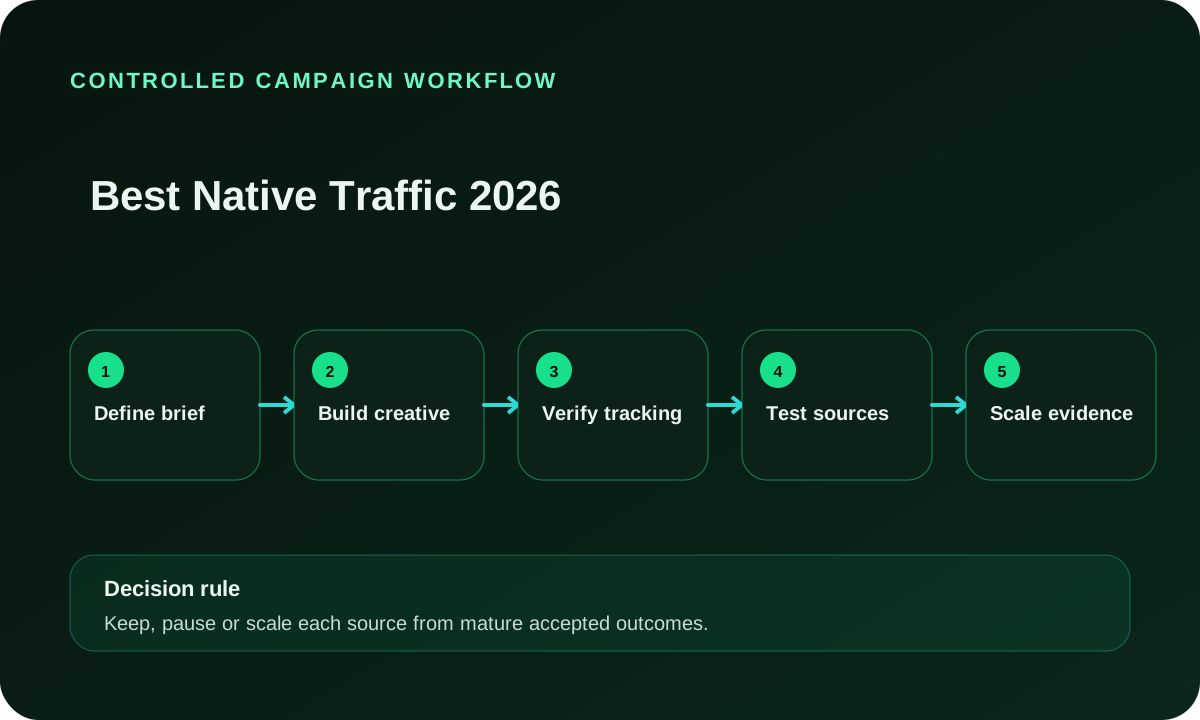
Create a tracking receipt before spending at scale. Record the identifier generated at the click, verify which campaign, creative and source values reach the tracker, and confirm that the accepted event returns under the intended attribution rule. Align time zones, deduplication and conversion maturity across FroggyAds reporting, analytics and the advertiser backend. The objective is a repeatable decision trail; normal differences between systems should be investigated and documented, not silently forced to match.
Keep native as the reference format
Choose a paid-media format that supports Best Native Traffic 2026
This URL evaluates native traffic, so compare other formats only when they answer a genuine communication question. Native is suitable when context helps the visitor understand the offer before clicking. Display can reinforce a visual proposition, while push or pop delivery creates different attention and interaction conditions. Check live availability in your FroggyAds account. Do not blend unlike formats into one benchmark and then declare that a source or creative won.
Create My Free Account
Translate Media Cost Into Accepted Acquisition Economics
The auction charge and the business outcome are separate layers. Depending on current inventory and account options, a purchase may use CPM, CPC, SmartCPC or another supported model. Convert the actual spend into landing cost, effective click cost and cost per accepted result. Then include the variable costs and contribution that matter to your offer. We do not present a cheap bid as proof of affordable customers, and we never promise a fixed campaign price.
Budget, frequency and stop-rule decisions for Best Native Traffic 2026
Write the financial boundary before launch: total learning allowance, daily cap, source observation level, creative review point, conversion-lag allowance and hard pause condition. Discovery needs room to compare supply, but it should not consume cash reserved for fulfilment or follow-up. Keep a separate scaling structure for sources that meet the accepted rule. Raising bids, expanding markets and replacing creative in one move creates activity without producing reliable operating knowledge.
Check Quality Through Behavior and Backend Acceptance
Evaluate quality through joined signals. Delivery fields can expose duplicate patterns, unusual timing or device concentrations; the destination can reveal failed loads and extremely short visits; the backend supplies rejection, cancellation, qualification and repeat-value evidence. No single control removes every invalid event. Compare mature source cohorts under the same offer and tracking conditions. A smaller source can be the stronger purchase when it produces more usable customers and less operational waste.
Separate Placement, Bid and Creative Decisions
Repair common failures before judging the inventory. If every source loses identifiers, fix tracking. If only one device fails at the form, fix or exclude that path. If a concept earns attention but the destination contradicts it, repair continuity. Once the shared mechanics work, compare sources under stable creative and bids, then test one controlled change. We recommend retaining a discovery route so new supply can be assessed without weakening proven source controls.
Structured creative testing for Best Native Traffic 2026
Use a compact creative matrix with message angle, visual subject, headline, action and destination version as separate fields. Select combinations that test meaningfully different reasons to visit. Review delivery, clicks, destination quality, accepted conversion rate, accepted cost and downstream value by source. Allow enough time for the business event to mature, especially when qualification or payment review is delayed. Record the reason for each pause so future teams can distinguish fatigue, placement mismatch and offer weakness.
Clear, truthful experience requirements for Best Native Traffic 2026
Trust starts with an identifiable advertisement and continues through the destination. The creative must not imitate editorial endorsement, hide material conditions or suggest evidence that does not exist. Review redirects, forms, checkout, confirmation and the route back to the advertiser. Policy and approval depend on the actual market, vertical, asset and landing behaviour. A complete submission can reduce preventable delay, but neither FroggyAds nor another responsible network can guarantee immediate approval for every campaign.
Move from comparison to a reversible purchase
Turn Best Native Traffic 2026 into a bounded campaign test
Once the offer, creative, destination, tracking and acceptance rule are ready, launch the smallest test that can change a decision. Keep the previous configuration, mark the start time and cap the downside. Use available source and audience controls to separate weak paths from promising ones. The next action should follow an accepted result or a diagnosed failure—not impression volume, a single click-through spike or the pressure to spend an unused balance.
Create My Free Account
Decision scorecard for Best Native Traffic 2026: media cost to accepted value
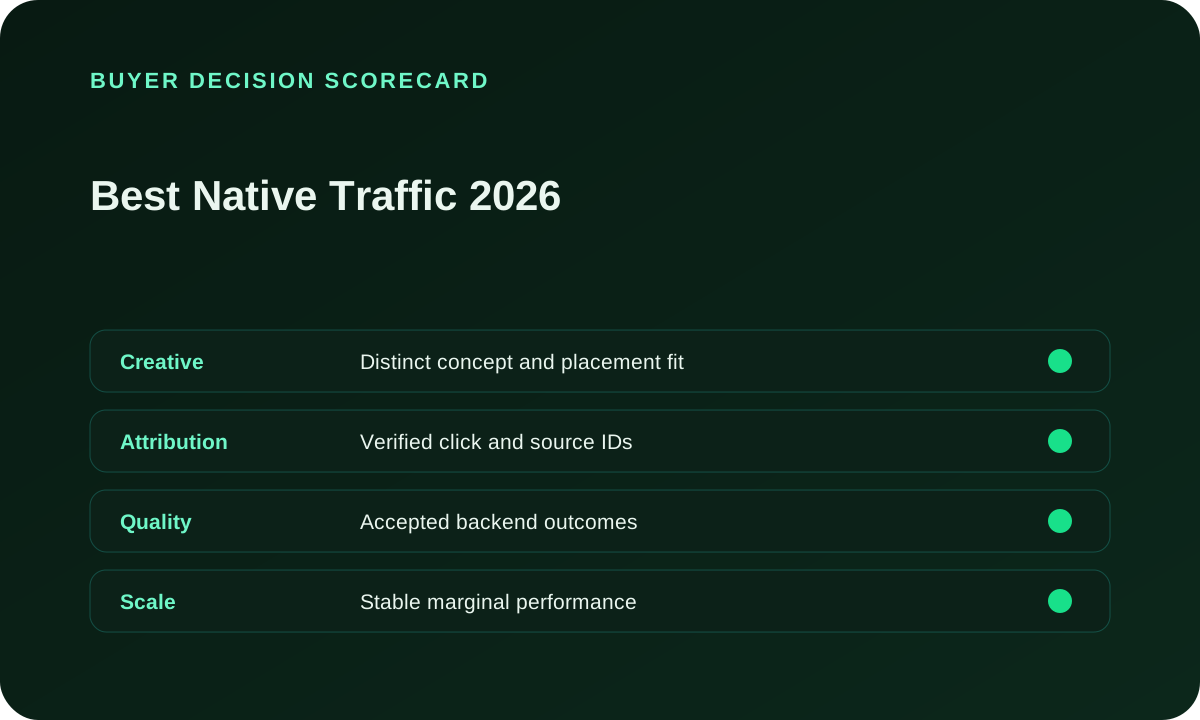
Review on a schedule that respects conversion maturity. A useful scorecard keeps delivery, page engagement, submitted actions, accepted outcomes, rejection reasons, accepted cost, contribution and source stability in separate columns. Early indicators can identify broken mechanics, while the mature backend event determines commercial value. Save the sample window and unresolved cases with every conclusion. That record prevents a brief improvement from becoming a permanent whitelist rule without supporting evidence.
Controlled scaling for Best Native Traffic 2026 after a verified change
Scale only after the identifier chain is stable, the accepted cost fits the planned range and a measured increase does not materially weaken quality. Expand one major boundary at a time: source set, market, budget, bid or creative coverage. Review the added block of traffic rather than relying on the earlier average. If marginal acceptance or contribution falls beyond the written limit, return to the last stable configuration and reopen discovery with a specific question.
Conservative, expected and stress scenarios for Best Native Traffic 2026
Prepare three cases using your own evidence. The cautious case can combine weaker acceptance, higher media cost and slower conversion maturity. The working case should use the first controlled cohort after exclusions and late outcomes are reconciled. The disruption case can model fatigue, a different source mix or an operational capacity limit. For each case, calculate spend, accepted actions and contribution. Scenario planning defines a response range; it does not forecast a guaranteed campaign result.
Close the Best Native Traffic 2026 review with a dated action and evidence requirement
End each review with a dated instruction for every material source group: keep, observe, cap, exclude, repair or retest. Attach the creative set, page version, bids, limits, attribution window and maturity date. State what new evidence would change the instruction. An account strategist or replacement buyer should be able to understand why the decision was made without recreating the campaign history or treating the most recent hour as the whole market.
Practical review table for a native traffic decision
| Area | Evidence required | Action |
|---|---|---|
| Creative fit | The asset is legible and truthful in the real placement | Keep only distinct concepts with stable delivery |
| Attribution | Creative, click and source IDs reach the backend | Run a live accepted-outcome test |
| Quality | Engagement, acceptance and rejection reasons are visible | Pause abnormal or low-value sources |
| Economics | Effective CPC and accepted CPA are calculated | Compare against the planned limit |
| Scaling | Marginal performance remains stable | Increase one dimension in measured steps |
Best Native Traffic 2026 FAQ
How should native traffic fit be tested before expansion?
Test fit by writing the offer, market, native context and accepted result in one sentence. Verify that an actual placement, creative and destination can deliver that route, then fund a bounded cohort. Expand only when the next traffic block preserves accepted economics. This process compares purchase fitness; it does not certify one universal “best” source for every advertiser.
Which result should a native traffic source demonstrate?
Choose an event the advertiser can validate after the click, such as a paid order, qualified enquiry or accepted activation. Keep the submission stage separate from acceptance and apply one maturity rule to comparable sources. Source reporting helps locate differences, but the business record decides whether a delivered visitor became the result the campaign was purchased to create.
Who is eligible for native Traffic 2026?
A visitor is eligible when the real offer can serve the person’s market, language, device and customer situation. Confirm stock, service coverage, technical requirements and material terms before release. Use the relevant FroggyAds targeting options available to reduce obvious mismatches, while the destination completes any qualification that the campaign setting cannot reliably express.
How can a native traffic test check that the offer promise holds?
Place one truthful proposition in the native unit and repeat its essential condition at the destination. Preserve the approved asset and page version so a complaint or rejection can be traced. When a benefit depends on eligibility, payment or timing, state that boundary before the primary action. A strong native experience helps the visitor decide; it does not turn a marketing statement into independent editorial proof.
How should native traffic buyers judge affordability?
Judge affordability from total acquisition economics rather than the advertised auction unit. Add media spend, approved creative work and relevant follow-up or fulfilment costs, then divide by mature accepted outcomes. Compare the result with contribution under a conservative assumption. Set the acceptable, watch and stop ranges before bidding so a low CPC cannot hide an expensive rejected-customer rate.
What makes a native traffic launch path ready to test?
A launch path is ready when the ad is identifiable, the destination works on intended devices, required terms are visible, identifiers reach the tracker and a test outcome appears correctly in the advertiser system. Complete a real end-to-end check with a recoverable record. Keep unsupported paths out of scope instead of assuming that approval or a page load proves the whole customer journey.
How should native traffic be measured against a baseline?
Use the same offer version, event definition, attribution window and maturity period for the baseline and test cohort. Reconcile FroggyAds delivery with the tracker and backend, keeping unmatched records and late actions visible. Compare accepted cost and contribution, not just front-end response. Automated bid or source actions should not run on a signal whose definition or completeness the buyer cannot explain.
How should a weak native traffic signal be checked?
Trace a weak signal through the actual sequence. Limited delivery can involve scope, bid or available supply; low response can involve context or creative; strong clicks with poor accepted value can involve the page, offer or qualification rule. Inspect the affected segment and version before changing settings. One diagnosed repair teaches more than replacing the audience, headline, bid and destination simultaneously.
Which customer safeguards should a native traffic pilot review?
Protect the visitor with clear advertising identity, supported claims, accessible material conditions and a usable way to decline or leave. Restrict campaigns that cannot fulfil the offer and escalate uncertain compliance questions to qualified reviewers. Retain the approved assets, landing version and dates. These controls support responsible buying, but they do not replace the advertiser’s legal and product obligations.
When can a native traffic test support scaling?
A scaling decision needs stable tracking, acceptable mature economics, enough operational capacity and evidence that quality survives a deliberate increase. Add one source group or one spending step, then review the marginal cohort. Keep rollback settings ready. If a new market or device needs different creative, landing conditions or fulfilment, treat it as a fresh controlled test rather than invisible volume added to the old average.
Continue the Native Ads Campaign Workflow
Convert the ten answers into one launch record: eligible market, native placement job, approved concepts, destination version, identifier test, accepted event, attribution window, allowance, source-review states, maturity date and rollback owner. That record should be complete before another buyer changes the campaign.
Build a Controlled Best Native Traffic 2026 Test
Build the first cohort around one accepted event, two or three meaningfully different concepts and a clear loss boundary. We can help you translate that brief into supported FroggyAds targeting, bid, budget and source controls. Keep the first review narrow enough to explain. A campaign that produces no accepted outcome should still tell you whether the failure belongs to delivery, message, destination, tracking or customer fit.
Best Native Traffic 2026: what should the advertiser decide next?
Your next decision is not which network has the most persuasive “best traffic” label. Decide which native buying route gives this offer enough truthful context, source evidence and post-click continuity to justify a test. Separate the unit’s presentation job from the destination’s explanation job and the backend’s acceptance job. When those three records agree, you can allocate money with a reason instead of relying on a blended platform average.
Use this guide as a purchasing worksheet. The early sections define native context and eligibility; the middle sections prepare assets, landing continuity, identifiers and economics; the later sections establish source review, scaling and rollback. Keep each conclusion attached to the specific market, creative and observation window. That makes the page useful for an actual media plan rather than a repeated definition with the year appended.
| Decision | What to verify | FroggyAds action |
|---|---|---|
| Accepted-result objective | Write the customer action your business will accept and the largest learning loss authorised for the opening cohort. | Configure one FroggyAds objective, preserve its event definition and date every later change. |
| Eligible audience boundary | Confirm that the real offer serves the selected market, device, language and customer situation. | Use only supported FroggyAds audience controls that remove a documented mismatch from this customer path. |
| Source-evidence requirement | Retain the available source reference with creative, destination, timing and mature acceptance evidence. | Assign keep, observe, cap, exclude or retest only after the named source cohort reaches its review point. |
| Economic decision | Join actual media spend to accepted customers, variable cost and contribution under one currency rule. | Protect the cohort with a fixed allowance, attribution window, maturity date and stop threshold. |
| Next-allocation rule | State the marginal accepted-cost and capacity evidence required before another source or budget block opens. | Increase one buying boundary, compare the added cohort with the stable baseline and retain a rollback setting. |
A page-specific FroggyAds test sequence for Best Native Traffic 2026
- Outcome: define one accepted event and the maximum learning loss before the first impression.
- Customer path: verify eligibility, device experience, landing continuity and identifier receipt before adding volume.
- Hypothesis: launch one bounded FroggyAds cohort without changing bid, creative, audience and destination together.
- Source review: compare mature accepted actions, timing, cost and rejection reasons by the available source dimensions.
- Expansion: require the next traffic block to reproduce accepted economics before another budget increase.
Why FroggyAds is relevant to Best Native Traffic 2026
FroggyAds gives advertisers a self-serve route to supported native traffic with campaign budgets, bids, targeting and available source controls. We recommend our platform when you want to run a bounded acquisition test, compare delivery segments and keep direct control over the next allocation. Our reporting supports the media decision; your tracker, analytics and accepted customer record remain the evidence for sales, leads, activations and commercial quality.
Return to the written eligibility and acceptance rules before raising the budget. If the next meaningful traffic block reproduces the accepted result inside the limit, you have evidence for another measured step. If it does not, hold the source mix and inspect the changed condition. We would rather help you build an explainable campaign than encourage volume that your destination or operations cannot convert into usable customers.
Which native traffic buying task does this guide own?
This guide helps you select native traffic for a current 2026 campaign without pretending to publish a permanent league table. It links delivery context, creative fit, source observability and accepted economics into one buying decision. The adjacent Native Ads 2026 page explains broader native planning. Here you should leave with a test brief, a loss boundary, a source-review language and a reasoned next allocation.
Keep four records together: the approved native unit, the destination version, the delivery identifiers available for the source and the mature customer outcome. Content fit and publisher layout can change response; attribution and backend rules can change what counts. Recording those differences prevents the team from calling an unexplained metric movement a traffic-quality verdict.
| Checkpoint | Page-specific action | Evidence to keep |
|---|---|---|
| Journey | Match the format to the user's attention state and destination. | Destination receipt, accepted event and observation window. |
| Creative | Check format requirements, message continuity and landing-page readiness. | Asset identifier, crop review and message-to-page continuity. |
| Optimize | Compare source-level accepted outcomes before increasing volume. | Source decision, marginal cohort and recorded rollback condition. |
Hypothetical calculation: a fictional campaign spends USD 420 and records fourteen submitted leads. Three are duplicates, two are outside the service area and one lacks usable contact details, leaving eight accepted leads. Media cost is USD 30 per submission and USD 52.50 per accepted lead. These numbers demonstrate the denominator only; they are not FroggyAds pricing, a forecast or proof of profit.
Choose FroggyAds when you want to buy native traffic through a self-serve workflow and keep budget, targeting and source decisions in your hands. Bring a truthful offer, tested destination and accepted-event definition; we provide the campaign controls for a measured launch. Create your free FroggyAds account.
Best Native Traffic 2026 — what matters first
Start with fit: a clearly sponsored native unit, an eligible audience, a destination that continues the promise and an accepted outcome your business can verify. Then use a bounded FroggyAds test to learn which sources and concepts deserve attention. The best traffic is the next cohort that remains useful when measured under the same rule—not a headline claim that ignores your offer and customer economics.