
Best Banner Traffic 2026
Choose the best banner traffic for your 2026 campaign by proving offer fit, placement transparency, creative legibility, attribution and accepted value. This buyer framework helps you shortlist sources, run a fair comparison and promote only the traffic block that survives a controlled commercial test.
What does best banner traffic mean for one advertiser?
The best banner traffic is the eligible source and placement mix that creates repeatable accepted value for a particular offer. It is not automatically the largest network, cheapest CPM or highest click-through rate. Your winner must carry a legible creative to the intended audience, preserve enough source evidence for optimisation and produce mature backend outcomes inside the approved cost range. Define that rule before comparing vendors. A media buyer with a lead offer may value verified acceptance, an ecommerce advertiser may prioritise contribution after returns, and an app team may judge activation or retained use rather than the install alone.
Which delivery evidence belongs in the shortlist?
Require each candidate source to identify the delivered size, site or app context, placement, device family, market and source key where available. Record served impressions separately from measurable or viewable opportunities, intentional clicks, usable sessions and accepted outcomes. A banner source cannot be compared fairly when one report exposes placements and another supplies only a total. Our recommendation is to test the same creative family and destination across a bounded source set, then reconcile the click identifier with the backend. The shortlist should lose any route that cannot reproduce the event chain or explain a material discrepancy.
Which selection decision should this page resolve?
Use this guide to select a banner-traffic source for a current 2026 campaign, not to collect another list of networks. Write the offer, eligible audience, required sizes, destination, acceptance event, attribution window and maximum learning loss. Then score every option with the same evidence. This protects affiliate marketers from merchant rejection, agencies from undocumented client risk, ecommerce teams from confusing orders with contribution, and SaaS or app advertisers from treating a low-quality signup as retained value. A different campaign can produce a different winner; the method remains stable even when market conditions change.
How should supply depth be verified before testing?
Ask what portion of the relevant market can be addressed at the sizes, devices and placement types your creative supports. Check whether category, source, placement, frequency and exclusion controls are available and whether those identifiers survive export. Forecasts help reserve capacity, but a network-wide impression number is not evidence that your eligible audience will be reachable. You should also ask how new inventory enters the pool and how a proven source can be protected while discovery continues. Treat unsegmented volume as an unknown, not as premium supply. The strongest candidate is the one that lets you observe and control the inventory conditions that change accepted value.
Which audience restrictions should disqualify a source?
Remove any market, device, language or placement context that cannot complete the offer journey. Confirm product availability, shipping or service coverage, customer eligibility, policy restrictions and the event the business accepts. A high-volume source can look attractive while most visitors cannot use the product. Preserve each exclusion in the comparison brief so one candidate is not rewarded for buying ineligible reach. FroggyAds lets you apply supported campaign targeting, while the advertiser remains responsible for offer and destination eligibility. A clean first cell should contain only people who can understand the creative, reach the page and complete the stated action.
Connect the guide to live testing
How can FroggyAds run a fair first comparison?
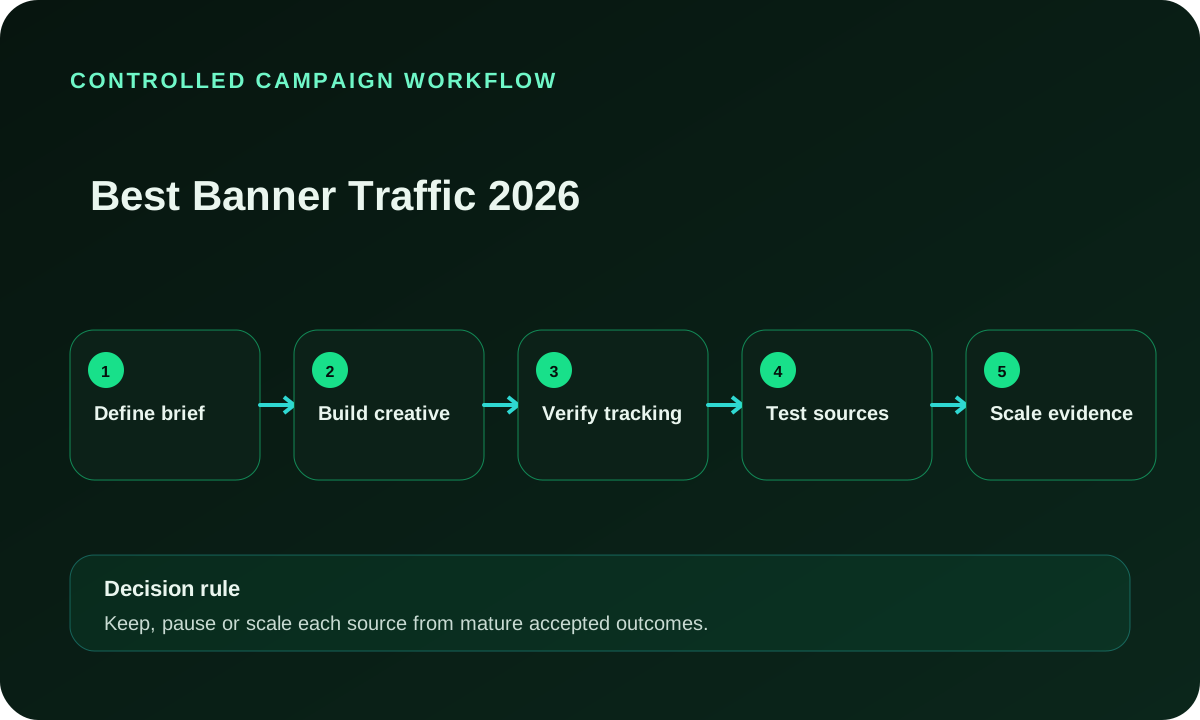
Create one eligible audience, one destination and one acceptance rule, then place candidate sources inside the same loss boundary. In our self-serve workflow, you can use available display, targeting, budget and source controls while keeping the commercial question stable. Review each source after equal maturity and move only repeat evidence into a separate scaling cell.
Create My Free Account
What creative package makes the source test fair?
Prepare a small family of materially different concepts and export each at the dimensions used in the comparison. Keep the brand, core offer and destination constant enough that a source is not rewarded for receiving a stronger message. Give every file an ID, angle, size, launch date and destination version. Verify claims, readable type, contrast and the action at delivered scale. Avoid fake controls, fabricated proof and urgency the offer cannot support. When one source needs a different size mix, report that difference instead of blending it away. The best source should perform with a creative system your team can sustain, not with a one-off asset that cannot be repeated.
How do size coverage and rendering affect the winner?
A source with more placements is useful only when the campaign can serve legible assets into them. Check the share delivered by size, device and orientation, plus cropping, file weight, animation and responsive behaviour. Inspect the smallest important units beside real publisher content and browser chrome. Record failed renders, unexpected resizing and destinations reached from each route. You may decide that a narrower source with stable standard sizes is more valuable than a broad source that requires weak adaptations. We recommend scoring size coverage and usable delivery separately so inventory breadth cannot hide a creative or rendering compromise.
Which landing-page test belongs in source selection?
Send every candidate source to a destination that confirms the banner message within the first screen. Keep advertiser identity, material terms and the next action visible. Track successful requests, usable sessions, key interactions, accepted outcomes and rejection by source, creative and device. A source can produce inexpensive clicks that fail because the page is slow, mismatched or unusable on its dominant device mix. Repair failures shared by all sources before ranking them. If one route continues to break after the shared page passes, document it as a source or placement compatibility issue rather than lowering the standard for everyone.
What tracking proof is required before a source can win?
Carry campaign, creative, click, source and placement identifiers through the supported route and return validated outcomes through an approved postback or other reliable integration. Align time zone, attribution window, duplicate handling and event eligibility across FroggyAds, the tracker, analytics and backend. Test both an accepted event and a rejection or reversal when practical. A source without reproducible attribution cannot be called best because its apparent cost cannot be connected to business value. Pause the affected route, repair the missing identifier and rerun the test; do not fill the evidence gap with an average from better-instrumented sources.
Choose the execution format
Should banner be compared with another format?
Include display when a visual placement and intentional click fit the message. If the offer needs editorial context, native may provide a better route; a concise prompt may suit push, while pop creates a different attention state. FroggyAds gives you access to supported formats in one self-serve environment, so you can test the route that fits rather than forcing banner inventory to win. Compare formats with separate creative requirements and buying units, but keep the accepted outcome constant. The best traffic is allowed to be a different format when the evidence says the customer journey works better there.
Create My Free Account
How should price enter a best-traffic score?
Normalise media spend into measurable exposure where available, effective click cost, usable landing cost and accepted CPA. Add creative production, destination work, tracking and operator time when comparing the complete test. A cheap CPM can lose when few impressions are measurable, clicks fail to load or backend acceptance is weak. A higher auction rate may deserve budget when marginal contribution remains positive. Set a conservative cost ceiling before launch and apply it equally. SmartCPC can support bid decisions where available, but neither an automated strategy nor a low clearing rate establishes commercial quality without accepted outcomes.
Which budget rules keep the comparison honest?
Give each candidate a documented learning allocation, daily cap, bid boundary, maturity window and stop rule. Use supported frequency controls so repeated exposure does not create an artificial volume advantage. Avoid giving one source its best creative and another an unfinished destination. Separate discovery from scaling and change one major condition at a time. If a source reaches the loss boundary without a repairable tracking or page failure, stop it. If evidence is promising but immature, hold the decision rather than extending the test without a new limit. Our team recommends preserving the last stable campaign state before any winning source receives more budget.
How should quality be scored beyond clicks?
Build a quality ledger for duplicate identifiers, timing, device consistency, placement context, session usability, accepted conversion delay, rejection and repeat value. Compare similar cohorts after the same maturity window. A source with fewer clicks may win when more users reach accepted value; a busy source may lose when reversals or low downstream use erase the front-end result. Adscore-supported controls provide one layer in the FroggyAds workflow, while your backend defines commercial acceptance. Make the scoring rule visible before launch so the team cannot change quality criteria simply because a preferred source produced a disappointing result.
How should placement, bid and creative evidence be isolated?
First repair shared tracking, rendering and destination problems. Next compare sources under the same creative family and bid boundary. Then test bid movement within a stable source set, followed by a controlled creative or page experiment. This sequence prevents a page improvement from being credited to a network and stops a new asset from disguising weak placement quality. Promote sources only after repeat evidence supports them, and keep a bounded discovery pool for new inventory. A best-source decision is a current operating rule with a rollback state, not a permanent whitelist that can never be challenged.
Which creative evidence should influence source choice?
Score how consistently each source serves the intended sizes and how different message angles perform inside that context. Track measurable exposure when available, clicks, usable sessions, accepted outcomes and downstream value for each creative-source pair. Protect promising concepts from premature removal when conversions mature slowly, but do not allow an attractive click-through rate to override rejection or weak value. Archive the hypothesis, files, result and decision. A source that depends on one fragile creative may be less useful than a source where several concepts reproduce. The goal is a combination your team can refresh and scale without losing the original customer promise.
Which trust and policy conditions belong in the ranking?
Disqualify routes that require deceptive system graphics, unsupported claims, hidden advertiser identity or destinations that conceal material terms. Verify market and vertical restrictions, privacy disclosures, redirects, forms, checkout and confirmation. Available supply and approval depend on campaign details, so a responsible comparison cannot guarantee access or results. Record policy interruptions separately from performance because an unapproved route cannot produce durable evidence. Truthful presentation protects users and makes the source test more reliable: forced interaction or misleading creative may create activity, but it cannot establish a repeatable customer acquisition path.
Put the guide into practice
What should be ready before the comparison launches?
Freeze the eligible audience, creative set, destination version, identifier route, accepted event and loss boundary. Then launch only the next reversible comparison cell. FroggyAds gives you campaign budget, targeting and source controls for the test, while your mature backend evidence determines which traffic deserves the next allocation. Create your free account when those inputs are documented.
Create My Free Account
Which scorecard can identify the best source?
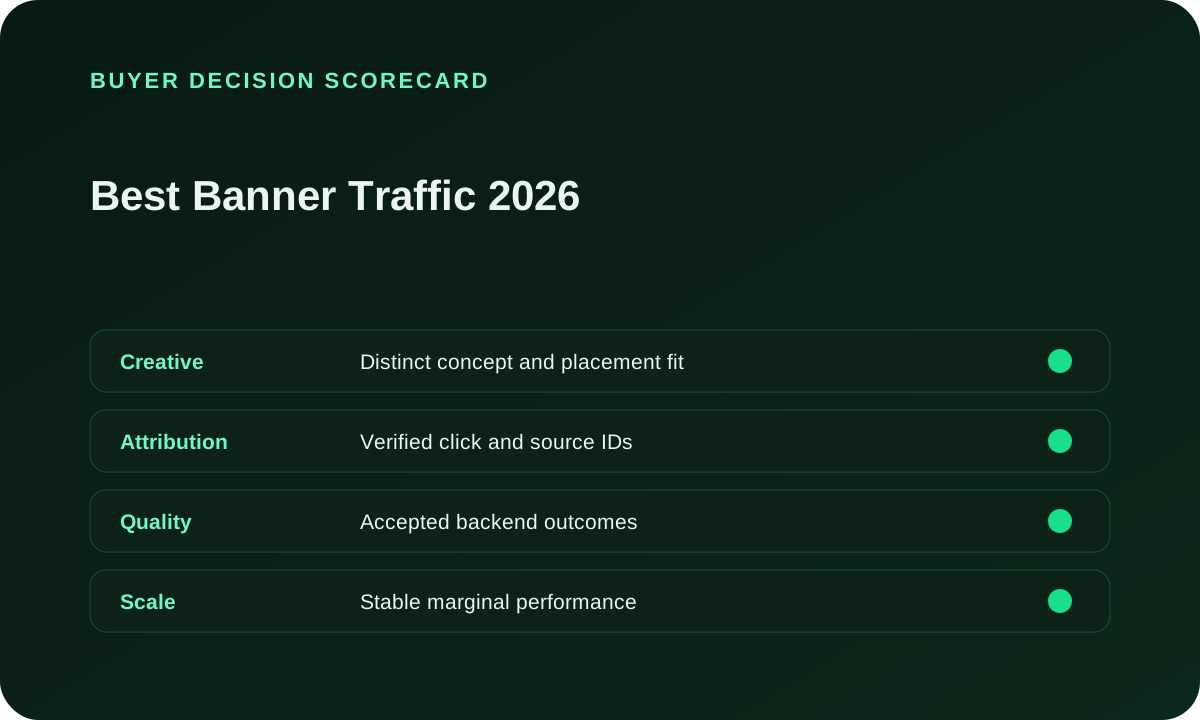
Use separate columns for eligible delivery, measurable exposure where available, clicks, usable sessions, accepted outcomes, rejection, CPA, contribution, source stability and operational effort. Store the sample size and maturity window with every score. Do not collapse the result into one weighted number until disqualifying conditions—missing attribution, policy failure or an unusable destination route—have been resolved. We recommend recording a keep, observe, repair, cap, stop or scale action beside each source. This turns the scorecard into a campaign decision and makes later changes auditable.
How should a winning source receive more budget?
Increase the next traffic block in a measured step and compare its marginal result with the discovery baseline. Watch for changes in placement mix, frequency, device distribution, usable-session rate, rejection and accepted CPA. A source that won at low volume may clear different inventory after expansion. Keep the earlier stable configuration as a rollback point and require the added cohort to mature before another increase. New markets and creative families remain separate tests. Scale is earned by repeatable value in the new block, not by the historical average or one early conversion.
How should 2026 uncertainty affect the shortlist?
Model a conservative case, a working case and a stress case for every finalist. Change auction cost, measurable share, click-to-usable-session rate, backend acceptance, conversion delay and source concentration. Use controlled campaign evidence for the working case rather than a vendor estimate. The stress case should identify the budget point at which creative fatigue, browser change or an inventory shift violates the loss boundary. Compare resilience as well as the central result. Scenario analysis does not predict the year; it shows which source remains controllable when one material assumption moves.
What should be written into the final source decision?
Date the decision and record the winning source scope, excluded placements, creative set, bid, caps, destination, attribution window and maturity. State why each finalist was kept, repaired or stopped and what evidence could reopen the comparison. Include unresolved measurement gaps rather than treating them as zero risk. Agencies can connect the record to client approval, while in-house teams can retain product and revenue context beside media cost. A clear decision log protects learning when another buyer takes over and prevents a temporary winner from becoming an unexplained permanent rule.
Which evidence belongs in the banner-source comparison?
| Area | Evidence required | Action |
|---|---|---|
| Eligible supply | The source exposes relevant sizes, placements, devices and markets with usable identifiers. | Keep the candidate only inside the documented eligibility boundary. |
| Attribution | Click, creative, source and placement IDs connect spend to accepted backend events. | Repair and retest any route that cannot reproduce the event chain. |
| Quality | Usable sessions, acceptance, rejection, delay and downstream value are visible by source. | Rank mature cohorts with the predeclared quality rule. |
| Economics | Complete test cost is normalised into accepted CPA and contribution. | Compare the marginal value with the cost and loss ceilings. |
| Scale resilience | The added volume block preserves placement evidence and accepted value. | Increase one boundary while retaining a stable rollback state. |
Best Banner Traffic 2026 FAQ
Which 2026 supply change should banner traffic buyers monitor?
Monitor changes in relevant source, placement, device and size availability rather than network-wide volume alone. Date the comparison and rerun a capped cell under the same event definition before changing the shortlist.
How should privacy changes shape banner traffic in 2026?
Record which storage, identity, attribution and view signals remain available in each browser or app environment. Compare like device cohorts and preserve the known deduplication boundary instead of presenting estimated reach as verified people.
What review should accompany AI-assisted banner buying in 2026?
Retain the automation objective, inputs, bid or allocation cap, source change log and accountable owner. Judge the strategy after accepted outcomes mature; early clicks can concentrate spend before commercial quality becomes visible.
Why does mobile rendering remain important for 2026 banner traffic?
Inspect the delivered size beside browser chrome and real page content. Check crops, text wrapping, file weight, destination usability and identifier capture across important mobile routes before ranking the source.
Can an attention metric select the strongest 2026 banner source?
Attention can help diagnose whether a placement had an opportunity to communicate, but it cannot replace usable sessions, accepted outcomes or contribution. Keep the definition and measurement boundary beside the score.
How should retail-media banners be compared with open-web traffic?
Compare placement context, identifiers, buying terms, audience eligibility and accepted value. Retail and open-web supply may expose different evidence, so avoid blending them until their denominators and maturity rules match.
What should a 2026 environmental claim about ad delivery include?
Name the system boundary, measurement method, period and assumptions behind energy or emissions figures. Do not turn a modelled estimate into a source-quality or performance claim without verified evidence.
Which creative evidence matters for 2026 banner testing?
Retain the concept, size, message, destination, source mix, sample maturity and accepted result. A screenshot or click-through rate alone cannot show whether the creative produced durable business value.
How can a 2026 banner test examine added demand?
Hold the baseline offer, audience and event rule stable, then release one incremental source or budget block. Compare mature accepted value with the control and record any change in source or placement mix.
What belongs in a cautious 2026 banner traffic forecast?
State supply, cost, creative, audience, browser and product assumptions as ranges. Link every scenario to a cap or rollback signal, and update the forecast when one material condition changes.
Which related guides support source selection?
Use each guide for a distinct comparison task: format mechanics, attribution, source controls or creative evaluation. Keep its evidence separate from the winner score.
How can you turn the shortlist into one FroggyAds test?
Select two or more eligible source cells, verify the same tracking path and cap the learning loss. In FroggyAds, you can use supported display inventory, targeting, campaign budgets and source reporting to run the comparison. Promote only a mature source that reproduces accepted value.
Which source-selection action should the buyer take next?
Convert the shortlist into a bounded comparison: same eligible audience, same destination family, stable acceptance rule and enough source visibility to explain the result. The next action should be launch, repair, eliminate or scale, with a written evidence threshold for each.
Separate the comparison into eligible supply evidence, creative and route evidence, and mature accepted economics. The table below turns each proof group into an elimination or promotion rule. A candidate does not become best because it leads one blended metric.
| Decision | What to verify | FroggyAds action |
|---|---|---|
| Selection outcome | Define the accepted event, target range and learning loss that every candidate must share. | Create one comparison objective and keep its conversion rule unchanged. |
| Supply boundary | Verify market, device, size, placement and offer eligibility for every source. | Apply supported controls that make the source cells commercially comparable. |
| Source evidence depth | Retain source and placement IDs with spend, usable sessions and mature accepted outcomes. | Eliminate, repair or promote inventory from documented evidence. |
| Economic score | Normalise the billed unit into accepted CPA, contribution and operational cost. | Protect the comparison with equal loss limits and maturity windows. |
| Winner scale | Require the added block to preserve source evidence and accepted value. | Increase one boundary and retain the discovery baseline for rollback. |
A five-part best-banner-traffic selection sequence
- Shared contract: define the accepted event, value range, maturity window and loss limit for every candidate.
- Eligible shortlist: verify market, device, placement, size and offer availability before delivery.
- Fair launch: keep audience, destination and creative family comparable while source cells remain separate.
- Mature ranking: compare usable sessions, acceptance, rejection, delay, contribution and operational effort.
- Winner test: release one marginal budget block and retain the discovery baseline for rollback.
How FroggyAds supports the source comparison
Our self-serve DSP and ad-network workflow gives you access to supported display supply with campaign budgets, targeting and source-level reporting. Available controls can help separate country, device, operating system, browser, carrier, category and source conditions. SmartCPC can support bid decisions, while Adscore-supported controls add a traffic-quality layer. We recommend combining those capabilities with your tracker and backend so the winning source is selected from accepted commercial evidence.
Keep the discovery baseline when a candidate moves into scale. If accepted value weakens after the increase, return to the prior source and budget state before widening any other control.
What buyer task does this best-traffic guide own?
Use this guide when the immediate task is to compare banner sources with one verified scorecard. Performance-focused advertisers should leave with a controlled source decision, while adjacent intents remain on their own pages. The nearest related FroggyAds page is Global Banner Traffic; this URL keeps ownership of the distinct task to update paid-acquisition decisions using current 2026 conditions.
The page-specific control set is candidate eligibility, placement transparency, creative compatibility, attribution depth and marginal accepted value. Each concept belongs here only when it changes a shortlist decision or campaign action.
| Checkpoint | Page-specific action | Evidence to keep |
|---|---|---|
| Journey | Compare only sources whose placements fit the audience, creative dimensions and destination route. | Retain the candidate boundary, source IDs, sizes and eligibility proof. |
| Creative | Use the same sustainable creative family and claim standard across candidates. | Retain creative IDs, size coverage, message angle and destination version. |
| Optimize | Rank mature accepted value and resilience before releasing more budget. | Retain the score, maturity window, marginal result and rollback state. |
Hypothetical comparison: source A spends USD 240 for 16 accepted outcomes, while source B spends USD 180 for nine. Accepted CPA is USD 15.00 versus USD 20.00 before other costs. Replace every input with mature campaign evidence; these figures are not FroggyAds prices or results.
Use FroggyAds as the execution layer for Best Banner Traffic 2026: keep the offer and conversion definition stable, apply the needed media controls and let advertiser-side accepted value decide whether more spend is justified. Create your free FroggyAds account.
What matters first when choosing the best banner traffic?
Define best as repeatable accepted value for one eligible campaign. Require transparent source and placement evidence, a sustainable creative route, reliable attribution and a controlled marginal scale test before naming the winner.