
Banner Ads Case Study
A useful banner ads case study explains the offer, creative, delivery conditions, costs and customer outcomes behind its conclusion. This guide uses a clearly hypothetical comparison to show how we would assess those records before recommending another FroggyAds traffic test. The figures are teaching inputs, not a client campaign, a benchmark or a promise of results.
What does a banner case study actually establish?
Recorded case details show what happened and why a team chose its next action. They do not automatically establish that a banner caused every sale or that the same result will repeat. We recommend reading the question, comparison method and customer acceptance rule before the headline result. The hypothetical merchant in this guide sells paper planners and compares a product-focused banner with a banner showing the planner in use.
State the offer and observation period
Both illustrative creatives promote the same planner, price and destination. The merchant records the delivery dates, product availability, markets and devices alongside the results. Those conditions matter: an unavailable colour, a revised checkout or a change in sources could alter the customer journey. A useful record explains any such change rather than allowing the reader to attribute every difference to the image. Our example uses matching impression totals for clear arithmetic, without claiming random allocation.
Write the question before reading the result
The merchant asks whether the product close-up or the use-context message produces a more economical accepted order in the observed traffic. That is a specific business question. It leaves other questions open, including brand awareness, customers reached without clicking and later purchases outside the chosen reporting window. Decide what would justify a further test before reviewing the preferred creative, so a strong click figure cannot quietly replace the original commercial objective.
Disclose how the traffic was allocated
Creative A and creative B each receive 200,000 hypothetical served impressions. Equal totals make the calculation straightforward, but they do not prove the audiences were equivalent. Record the available source, device, country and delivery-period breakdowns for each. If assignment was not random or the source mix differs, describe the comparison as observational. FroggyAds source and targeting controls help you structure the purchase; a credible experiment also requires an allocation method you have actually verified.
Keep customer eligibility consistent
The illustrative merchant sells only where it can fulfil the advertised planner order. Both creatives use that same eligibility and destination. If one banner runs in a wider market or shows a product variation unavailable to part of the audience, the comparison changes meaning. Record the restriction and inspect the affected results before recommending an expansion. We can help you focus eligible traffic through available targeting; your business confirms which customers and orders it can serve.
Describe the creative difference precisely
Creative A shows a close-up of the planner's actual page layout. Creative B shows the same product in a desk-use context. This is a comparison of two message concepts, rather than proof about one isolated design element. Keep the approved files and their dimensions with the record. If the headline and photograph both change, say so. Calling that release an image-only test would claim more precision than the materials support.
Check each banner in its delivery context
Inspect the finished files at their served sizes. A page-layout photograph may lose useful detail in a small unit, while a lifestyle scene may make the product harder to identify. The reader needs to know whether the assets were usable before interpreting their results. Note any clipping, unreadable text or incorrect link and the period it affected. A case that removes a failed asset after launch should explain that intervention rather than presenting uninterrupted delivery.
Verify that both paths reach the same offer
Follow each banner to the exact landing route and complete the relevant action. In this hypothetical case, the destination, product and material terms remain the same. If one creative leads to a category and the other to a product page, the record compares two journeys. That may be commercially useful, but the conclusion should name both changes. Our recommendation is to keep the offer-to-destination relationship visible alongside the creative archive.
Connect delivery records with customer status
Use a campaign and creative record that lets your team reconcile delivery with its own order data. Confirm the actual fields and conversion setup available for the chosen FroggyAds campaign. Keep placed orders, accepted outcomes, rejected events and unresolved status identifiable. Additional trackers or integrations require their own verification. A case study should describe the implementation used, including gaps, rather than assume a postback, click identifier or viewability measure that the team never checked.
Calculate the media comparison
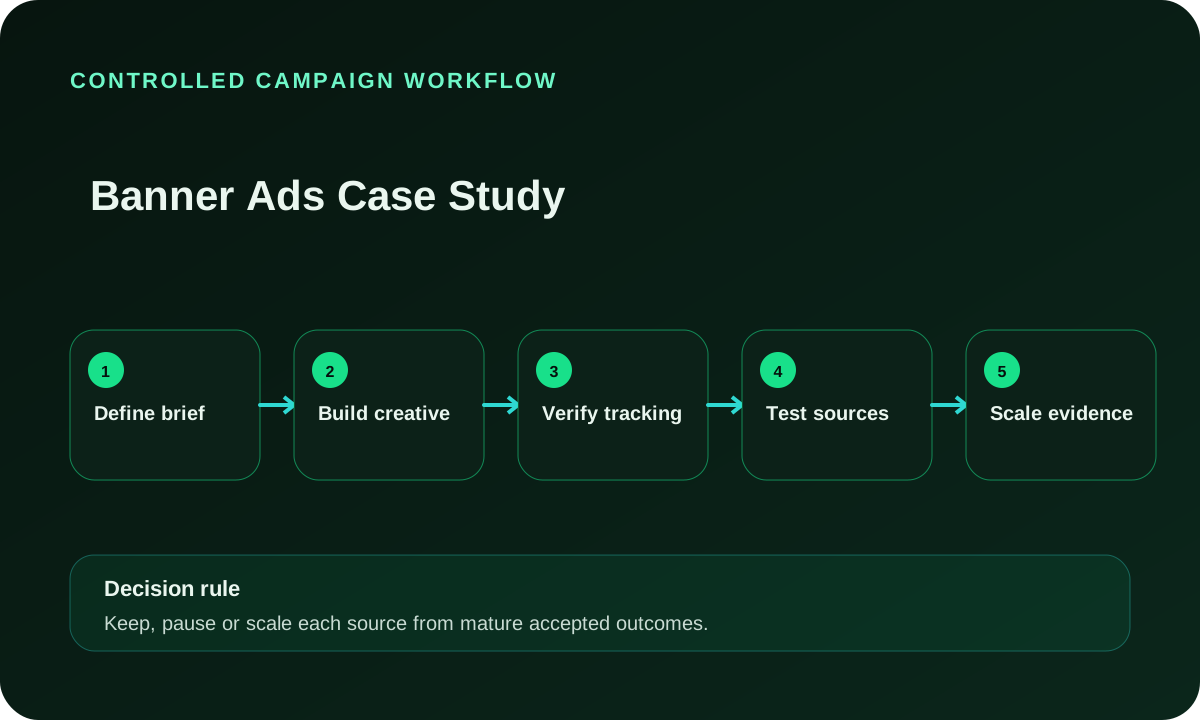
In the hypothetical dataset, A spends USD 800 for 200,000 impressions and 800 clicks. B spends USD 900 for 200,000 impressions and 600 clicks. Their observed CPMs are USD 4 and USD 4.50. Click costs are USD 1 and USD 1.50. These values describe different delivery inputs; none is a FroggyAds quote. A looks stronger on click cost, but the customer's later order status is still needed to answer the merchant's question.
Write the acceptance rule and wait for it
The merchant counts completed orders accepted under its documented quality rule after the chosen review window. That definition must be established before comparing the two creatives. A placed order is an earlier event. An unresolved or rejected order does not become accepted merely because the media report has closed. State the review date and the handling of later reversals. Different businesses need different rules; this example does not prescribe a universal order-validation period.
Reconcile every order in the example
A produces 40 placed orders: 24 accepted, eight rejected and eight unresolved. B produces 36: 30 accepted, four rejected and two unresolved. The categories reconcile to each creative's placed total. Keep the unresolved counts in view when reading the preliminary comparison. If they later resolve, update the result with a dated version and preserve the earlier record. Do not silently discard inconvenient statuses or substitute placed orders for the agreed accepted event.
Compare the outcome that answers the question
Media acquisition cost is USD 800 / 24, or about USD 33.33 for A, and USD 900 / 30, or USD 30 for B. B has the higher click cost but the lower observed accepted-order cost in this dataset. That is a useful finding about these records. It does not prove that the message alone created the difference, that the pending orders will have no effect or that the next traffic period will reproduce it.
Add creative expenses when the decision needs them
Suppose A requires USD 150 of production and B requires USD 250. Including those hypothetical costs gives USD 950 / 24, about USD 39.58 per accepted order for A, and USD 1,150 / 30, about USD 38.33 for B. Label this broader cost basis explicitly. Reusable assets, future adaptations and additional operational work may change the next spending decision. The case should show what it includes without counting the same invoice twice.
Report limitations before recommending a winner
The example has no verified randomisation, causal lift measurement or promise that the two source mixes are identical. Pending orders also remain. Those limits narrow the conclusion to an observed comparison of the stated records. They need not make the exercise useless: the buyer can use it to design a better follow-up. Clear limitations help you decide what evidence to collect next and prevent an attractive table from becoming an unsupported performance claim.
Keep a complete comparison table
Keep the raw inputs in the table before interpretation. Store the campaign period, currency and outcome rule beside it in your own case record. Calculate totals from the underlying rows rather than copying a rounded dashboard figure. For a real campaign, reconcile material discrepancies before publishing a conclusion. Our hypothetical figures are deliberately transparent so a buyer can reproduce the arithmetic and see which later status changes could alter the preferred next action.
Test whether the result survives another allocation
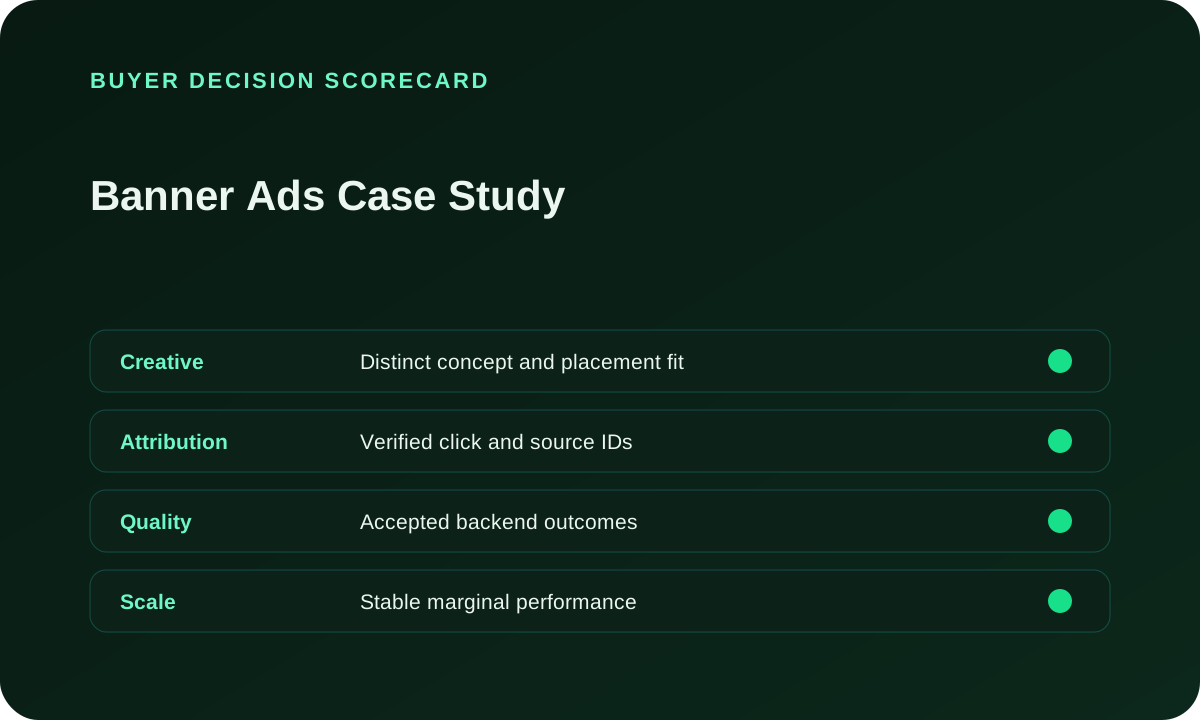
A follow-up does not inherit the historical acquisition cost. Suppose another B release spends USD 900 but produces only 18 accepted orders: its media cost is USD 50 per accepted order. The combined B history would be USD 1,800 / 48, or USD 37.50, which hides the weaker newest release. Review that added period independently before expanding. A previous useful result can justify further investigation without justifying unlimited delivery.
Use the case to design a better next question
The Amazon Ads creative guide discusses comparing headlines, imagery and actions while holding other test conditions stable. Apply that reasoning to your own verified setup rather than copying another advertiser's assets. For this merchant, a useful follow-up might retain the use-context concept while clarifying the product detail that customers ask about. Choose an allocation method appropriate to the claim you want to make and disclose any limits that remain.
Close with a specific decision
In this illustration, the record supports considering B for a further limited test, subject to the merchant's acquisition limit and resolution of the open orders. It does not support declaring a universal best banner. Write the planned spend, file version, destination, traffic scope, customer rule and review owner. If the business cannot afford another inconclusive period, pause for more evidence. A credible case explains the actual decision, including a decision to observe longer.
Hypothetical banner comparison: raw inputs
| Recorded event | Creative A | Creative B |
|---|---|---|
| Served impressions | 200,000 | 200,000 |
| Media spend | USD 800 | USD 900 |
| Recorded clicks | 800 | 600 |
| Placed orders | 40 | 36 |
| Accepted orders | 24 | 30 |
Banner ads case study questions
Is the campaign in this guide a real FroggyAds customer case?
No. The merchant, creatives and figures form a hypothetical teaching example. They show how to reconcile inputs, calculate costs and qualify a recommendation. They are not evidence of an actual client result, a current media price or the performance your campaign will achieve.
What context should a real banner case study include?
State the offer, dates, currency, markets, devices, source scope, creative versions, destination and customer acceptance rule. Describe traffic allocation and material changes. Those details let a reader assess whether the conclusion fits the records and what would need to change before using the lesson elsewhere.
Why does the example use two creative concepts?
The product close-up and use-context image answer a concrete merchant question about presenting the same planner. Because the concepts can contain several design differences, the result concerns the combined concepts. It should not be described as a clean test of a single colour, headline or photograph.
Why are equal impression totals insufficient for a causal claim?
Two creatives can receive equal totals from different sources, devices or periods. Those differences may affect customer response. A stronger causal claim needs a verified comparison design and suitable analysis. Without them, describe the observed results and retain the possible alternative explanations.
Does an impression prove the customer saw the banner?
A served impression is a delivery measure, not proof of attention or purchase intent. Review viewability only when the selected implementation provides a verified measure and definition. The example does not assume that all 200,000 served impressions were viewable or that every recorded exposure was noticed.
Which creative has the lower acquisition cost in the example?
B has the lower observed media cost per accepted order: USD 900 divided by 30 equals USD 30, compared with about USD 33.33 for A. The conclusion applies to the stated acceptance rule and records, with pending orders and comparison limits still disclosed.
How should unresolved orders be handled?
Keep them as unresolved until they meet the written rule for another status. Show their count and review date beside accepted and rejected orders. If the result changes later, publish a dated update and retain the previous calculation rather than quietly changing the original evidence.
Can I reuse these CPM figures as current market rates?
No. USD 4 and USD 4.50 are hypothetical values calculated from the example's spend and impressions. Obtain current requirements and buying inputs for your actual FroggyAds campaign, then calculate observed delivery costs from its records. A teaching case cannot quote a future auction.
What should a transparent case disclose about its limits?
Explain allocation, sample size, source mix, measurement gaps, unresolved outcomes and changes to the offer or destination. Distinguish an observed association from a demonstrated causal effect. The recommendation should stay within what those records support and identify what the next test still needs to establish.
How can FroggyAds help me build my own case record?
Use our available targeting, bid, budget, reporting and source controls to structure a focused traffic campaign. Keep the creative and destination versions with your business outcome records. Confirm any additional measurement implementation, then use the documented comparison to decide the next limited allocation.
Continue your banner analysis
These resources help refine the creative, reporting and source questions behind your next test.
Build a banner test with evidence you can review
Choose FroggyAds when you want to manage a focused traffic purchase around a clear creative question. Bring a truthful offer, approved assets and a destination your customers can use. Set the available targeting and spending controls, record the comparison conditions and use mature customer outcomes to judge the next step.
Which lesson should you transfer to your campaign?
Transfer a question or method, then replace the example's offer, assets, traffic conditions and economics with your own verified inputs. The useful lesson here is that cheaper clicks and cheaper accepted orders can point to different creatives. Your campaign may show another pattern. Keep the raw counts and definitions visible so a reader can follow the commercial reasoning.
Read the case through the offer and observation period, the creative difference and the complete comparison table. Each gives the result a boundary. A well-labelled calculation becomes useful when the buyer can trace its inputs and understand which parts were held stable, which changed and which remain unknown.
| Interpretation | Evidence in this example | Practical decision |
|---|---|---|
| Delivery cost | A has USD 1 CPC; B has USD 1.50 CPC | Do not choose from click cost alone |
| Accepted outcome | A has 24 accepted orders; B has 30 | Use the written customer rule |
| Open status | Eight A orders and two B orders remain unresolved | Review later resolution before a final verdict |
| Cost scope | Production changes media-only acquisition costs | Label the included expenses |
| Repeatability | Another B period may produce a different result | Give the next allocation its own review |
Five steps to prepare your own banner case
- Define the question. State the offer and commercial decision before reading results. Choose the event your business will accept and the period it needs to mature. Record the alternatives you intend to compare without promising a winner.
- Archive the materials. Keep the approved creative files, dimensions and destination versions. Describe the real differences between treatments, including any simultaneous changes. Confirm that each customer journey works before interpreting performance.
- Document allocation. Set the available FroggyAds targeting, bid and budget controls for the test. Record how delivery reaches each alternative and what remains uncontrolled. Never imply randomisation or equal customer exposure without verifying it.
- Reconcile the outcomes. Connect delivery and business records within the verified measurement scope. Preserve accepted, rejected and unresolved statuses. Calculate costs from matching currencies, periods and event definitions.
- Choose the next action. Explain whether the evidence supports observing longer, repairing a journey or releasing another limited test. Name the remaining uncertainty and the records that would resolve it.
Why use FroggyAds for the next comparison?
Our self-serve buying environment gives you practical campaign controls around the question you want to answer. Focus available targeting, manage bids and budgets and review sources rather than relying solely on an account average. Confirm the current inventory, creative requirements and reporting fields before launch. Your own customer records then establish whether the delivered traffic supported the outcome that matters to your business.
A useful case record makes the next purchase more informed. Keep the illustrative figures in this guide as arithmetic examples, then build your actual plan from verified assets, current buying conditions and your business limits. We recommend an allocation you can inspect and afford while the unanswered question remains open.
Use a banner case for a defined buying decision
Choose this guide when you need to analyse a banner comparison and explain its limitations. The related Display Marketing Case Study can broaden the campaign context. Keep the specific creative, allocation and customer-outcome evidence behind your own conclusion so an example becomes a practical method rather than a forecast.
A persuasive case earns trust through traceable numbers. Show what happened before adding an explanation, check that every order status reconciles and identify whether the next recommendation depends on an unresolved assumption. Readers can then judge the method and choose a suitable follow-up without mistaking the case for a guarantee.
| Record status | Action | Evidence to retain |
|---|---|---|
| Accepted | Include only events meeting the written rule | Customer confirmation and review period |
| Unresolved | Keep the event open for the next review | Current status and outstanding decision |
| Rejected | Exclude from the accepted outcome total | Reason and any correctable journey defect |
Hypothetical calculation: creative B's USD 900 media spend divided by 30 accepted orders gives USD 30 per accepted order. Including USD 250 production gives about USD 38.33. Both calculations use the same accepted events; their expense scope differs. Neither is a FroggyAds performance claim or quote.
Start with a creative question your business can answer and a spending limit you can review. FroggyAds helps you manage available traffic targeting, bids, budgets and source decisions around that plan. Create your free FroggyAds account and prepare your own evidence-led banner campaign.
What makes the case useful to a media buyer?
A useful banner case study shows the raw inputs, customer rule, comparison conditions and limits behind a recommendation. We recommend transferring the reasoning into your own campaign, with current assets, costs and outcomes. Choose FroggyAds for a focused traffic test and keep the next decision tied to the evidence your business actually records.