AI marketing, AI search and funnel operations

AI Marketing Trends: What Matters in 2026 and Beyond

The most useful AI marketing trends are operational: embedded assistants, governed content workflows, model-assisted buying, first-party data discipline, AI-search visibility and stronger proof of incremental value.

ai marketing trendsai marketing trends 2026
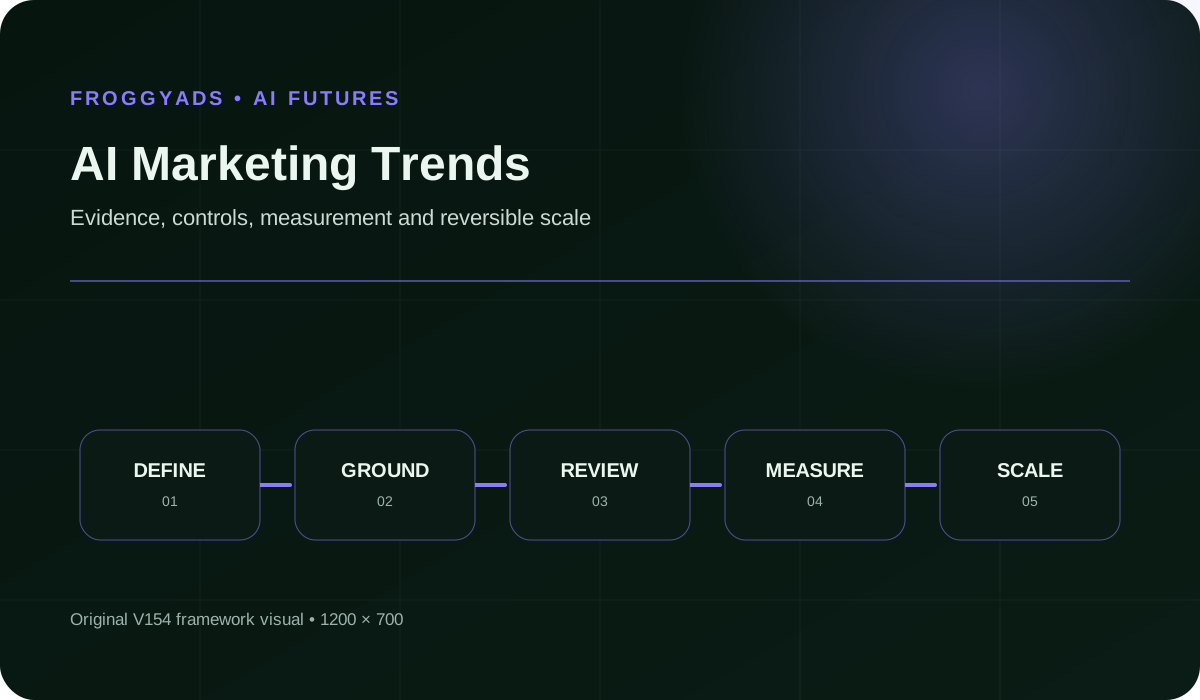
AI Marketing Trends operating framework for planning, controls, measurement and scale

Which AI marketing trends matter in 2026?

The AI marketing trends that matter in 2026 are changes a team can observe, date, source and connect to an operating decision. Embedded assistants, governed generation, model-assisted media execution, first-party data discipline, provenance and new search reporting deserve attention because they change workflows or evidence. A vendor slogan without independent evidence is not a trend.

This page is a signal register, not a prediction list. It separates an observed change from its possible marketing consequence, names the evidence still missing and recommends one of four responses: monitor, run a bounded experiment, change a control now or decline adoption. That structure prevents novelty from becoming an unexamined roadmap.

The register was reviewed on 2026-08-11. Dates describe when the evidence was checked, not when every market will adopt a practice. Product availability, regulation and reporting access can vary by country, account and platform, so owners should recheck the linked primary source before changing a production process.

  • Record a dated observation before assigning a trend label.
  • Separate platform capability, market adoption and proven business value.
  • Match the response horizon to evidence strength and reversibility.
  • Keep an explicit non-adoption option when downside exceeds learning value.
  • Retire trend entries when the signal becomes standard practice or loses relevance.

What qualifies as an AI marketing trend?

A useful trend is a directional change supported by more than repeated commentary. Evidence may include a released platform capability, an updated official policy, a new measurement surface, a published labor study, a technical standard or consistent first-party operating data. The observation must be specific enough to disprove later.

Capability is not adoption. A model may support video generation while most teams still lack rights records, review capacity or a reliable production handoff. Adoption is not value either. Widespread use can coexist with weak economics, hidden correction work or outputs that fail brand and legal review.

State the unit of change. An embedded assistant inside a reporting interface is different from an autonomous budget action; a content provenance specification is different from adoption by every editing tool. Broad labels conceal the exact control, skill or measurement change a team must consider.

Give every register entry an owner, source, observation date, affected workflow, confidence level and next review. Without these fields, the list becomes a collection of opinions that cannot guide budgets or be maintained when products and rules change.

How should a 2026 trend signal be classified?

Signal classEvidence requiredDefault response
Released capabilityCurrent product documentation plus access in the team's real account.Test one bounded job before changing the operating model.
Policy or ruleOfficial text, jurisdiction, application scope and effective status.Route to the accountable policy owner and record required changes.
Measurement changeA documented report, field definition and known coverage limits.Preserve the old baseline while validating the new series.
Workforce signalTask-level research with method, population and publication date.Plan skills and role experiments without predicting individual job loss.
Vendor narrativeA claim from a seller without independent or first-party validation.Keep on watch; do not change budget or process yet.
Internal patternRepeated company observations with a stable denominator and audit trail.Investigate transferability before treating it as market evidence.

Why are embedded assistants becoming an operating issue?

Assistants are moving from separate chat windows into analytics, advertising, content and customer-workflow interfaces. The operational change is reduced distance between suggestion and action. A summary inside a dashboard may be low risk, while an assistant that edits a live campaign can affect spend, audience treatment or public claims.

Map authority instead of counting features. Record what the assistant can read, infer, draft, recommend, edit, publish or purchase. The same interface may expose different permissions to different roles, and a product update can quietly expand an action surface that was approved only for analysis.

Embedded access also changes evidence capture. If prompts, source data, model version, recommendation and final action are not exportable, a reviewer may be unable to reconstruct why a decision changed. Require an event trail proportionate to the consequence of the action.

The practical response is not universal adoption or prohibition. Start with read-only assistance, compare the output with an existing decision process, measure reviewer correction and allow action only after permissions, rollback and incident ownership are demonstrated in the configured account.

How is governed content generation changing marketing work?

Generation is shifting from isolated drafting toward managed workflows that attach approved source material, brand constraints, provenance and review status to an artifact. The meaningful trend is not that models can produce more words or images. It is that organizations are beginning to treat generated material as a controlled production object.

A governed workflow distinguishes source evidence from model output. It records who supplied facts, which claims may be used, what rights attach to inputs, where human contribution enters and which channel-specific checks must pass. This makes reuse safer because the next editor can see the limits instead of inheriting unexplained copy.

The pressure point is review capacity. Increasing draft volume without increasing qualified acceptance work creates a larger rejection queue, not productivity. Track accepted assets, correction time, severe failures and maintenance obligations rather than generation count or token cost alone.

Teams should respond by selecting a narrow artifact family, such as campaign briefs or localized display copy, and building a complete record around it. If the record cannot survive handoff, refresh and retirement, scaling the number of generated assets will amplify uncertainty.

What is changing in model-assisted media execution?

Advertising systems have long used models for forecasting, ranking, bidding and delivery. The current change is broader model involvement across recommendation, asset assembly and campaign setup, often presented through simplified controls. That can lower setup friction while making the underlying decision boundary harder to see.

Separate a recommendation from an authorized action. A system that estimates an opportunity is not the same as one that changes bids, broadens targeting or substitutes creative. Document which variables the operator controls, which the platform controls and how an unfavorable change can be reversed.

Measurement must follow marginal decisions. Account-level improvement after enabling a feature does not prove that every automated action created value. Preserve stable comparisons where feasible, monitor conversion quality and reconcile platform outcomes with accepted business events rather than relying on a composite optimization score.

The response for 2026 is stronger configuration evidence. Capture the objective, event definition, exclusions, budget boundary, attribution setting, creative eligibility and change history before judging whether model assistance reduced work or improved allocation.

Why does first-party data discipline remain a trend driver?

Models do not remove the need for clear data definitions. As platforms rely more heavily on supplied conversions, audiences and product information, inconsistency in those inputs can produce confident optimization around the wrong event or population. Better modeling increases the cost of an ambiguous signal because it can propagate the error faster.

A mature first-party data practice records collection purpose, permission, event owner, schema, validation rules, retention, destination and acceptable use. Marketing names such as lead, customer or value must resolve to operational definitions that finance, sales and privacy owners can reconcile.

Do not treat data volume as readiness. A smaller stream of validated, consented and timely events can be more useful than a large history containing duplicates, changing labels or outcomes that never matured. Record missingness and late-arriving data alongside headline totals.

The trend response is a signal contract, not another audience upload. Choose the few events that govern material decisions, test their lineage end to end and monitor drift whenever forms, checkout, CRM logic, consent or attribution settings change.

How should provenance and identity controls be monitored?

Image, audio and video generation make origin and identity questions part of everyday production. C2PA offers a technical structure for signed provenance statements, while copyright and replica questions still depend on law, permission and context. A credential can support history; it does not itself prove that use is authorized or a claim is true.

Track what the production tool creates and what the delivery chain preserves. Editing, transcoding, screenshotting and platform ingestion may alter or remove metadata. When provenance is required, test every handoff and retain an external record that connects the final asset with approvals and source material.

Identity review must cover more than famous people. Employees, customers, contractors, creators, voices, logos, locations and products can be represented misleadingly. Record consent scope, intended channel, territory, duration, permitted transformations and withdrawal handling before release.

A useful response is an asset release gate with named failure classes. Unsupported product detail, uncertain rights, deceptive replica, missing disclosure, inaccessible meaning or lost provenance should stop release until a qualified owner resolves the issue.

What do new AI-search measurement surfaces change?

Google announced dedicated generative AI performance reporting for a subset of Search Console properties in June 2026. The observation is a new visibility surface, not a universal dataset or a ranking shortcut. Availability and definitions must be checked in the actual property before a team changes its reporting model.

Keep search outcomes connected to the page and business result. Impressions inside an AI feature can indicate retrieval exposure, but they do not explain citation context, user satisfaction or conversion quality. Combine the new view with page-level visits, qualified actions and a documented prompt sample when available.

Historical comparability requires care. A new report may have limited coverage, rollout effects or definitions that differ from existing web search series. Mark the first reliable date, preserve raw exports and avoid splicing incomparable periods into one trend line.

The correct response is a measurement appendix. State property coverage, dimensions, sampling or access limits, extraction date and the decision supported. Do not backfill missing data with third-party estimates presented as if they came from the search engine.

Which trend responses fit different evidence levels?

Evidence stateMarketing actionStop condition
Documented and accessibleRun a controlled production trial with a named owner.Pause if the real configuration differs from the documented capability.
Documented but unavailablePrepare requirements and monitor account eligibility.Stop spending time when no adoption decision can be made.
Observed internallyRepeat the observation with a stable definition and comparison.Withdraw the claim when it cannot be reproduced.
Supported by task researchDesign a role or skills experiment rather than a headcount forecast.Stop if the population or task definition does not match the team.
Regulatory developmentAsk the accountable owner to map scope and current status.Do not operationalize an interpretation without qualified review.
Vendor-only assertionRequest method, denominator, limitations and customer evidence.Decline adoption when material claims remain untestable.

How should regulation be treated in a trend register?

Regulatory change belongs in the register only with jurisdiction, legal instrument, status and affected activity. A proposal, adopted rule, phased obligation and enforcement decision are different signals. Marketing summaries frequently collapse them, creating premature or incomplete operating changes.

Assign interpretation to a qualified legal or compliance owner. The marketing team can inventory systems, data, audiences, generated media and decisions, but should not infer applicability from a headline. Record the exact provision and internal process affected when an obligation is confirmed.

Plan for operational evidence even before a specific rule applies. System purpose, supplier, model or service version, input categories, human oversight, complaints, incidents and material changes are useful records for procurement and governance regardless of jurisdiction.

Review the entry whenever an official consolidated text, implementation guide or enforcement position changes. A dated external link is evidence of the source reviewed, not a permanent statement that the interpretation will remain current.

Will AI replace marketing roles in the near term?

Task exposure is a stronger planning unit than a binary job prediction. The ILO's 2025 research assesses nearly 30,000 tasks and concludes that transformation is more likely than complete redundancy for most exposed occupations because human input remains necessary. That finding does not determine what will happen inside one company.

Marketing roles combine analysis, customer understanding, negotiation, creative direction, budget responsibility, coordination and public accountability. Models may reduce effort in parts of research, drafting or reporting while increasing the need for source control, evaluation, systems design and exception handling.

Use the trend register to identify work movement. Record tasks likely to be assisted, tasks that may be automated after controls, judgment that stays with people and new oversight work created by the system. Then test workload and quality instead of announcing role elimination from a capability demonstration.

A responsible response funds learning and transition. Give staff access to approved tools, evaluation examples, data and policy training, plus a way to report failure. Avoid using uncertain exposure estimates as individual performance judgments or promises about future staffing.

How should the trend register be reviewed each month?

A short recurring review keeps the register useful without turning every product announcement into a project.

  1. Confirm that every source still resolves to the current official material.
  2. Separate newly released capability from newly available account access.
  3. Update observation dates without changing the original evidence date.
  4. Record any internal trial result with its denominator and limitations.
  5. Reclassify vendor claims when independent or first-party evidence appears.
  6. Escalate confirmed policy changes to the accountable business owner.
  7. Close entries that became standard practice and move controls into operations.
  8. Retire signals that no longer affect a decision or cannot be verified.
  9. Check whether an experiment should expand, pause, revert or end.
  10. Publish a concise change note so teams know what actually changed.

How can FroggyAds use trend evidence without overclaiming?

FroggyAds can connect a trend to paid-media practice by stating the affected decision and the evidence available on the page. Platform facts, such as supported campaign controls, should remain separate from external market observations and from outcomes that depend on an advertiser's offer, creative, audience and measurement.

A trend page should not manufacture customer results. Where no audited case evidence exists, use a test design, failure example or decision framework instead. This gives the reader something actionable without presenting a hypothetical uplift as company experience.

External sources should explain the wider rule, standard or research method. FroggyAds remains responsible for its own interpretation and for keeping company claims current. A government, standards body or platform documentation link does not endorse FroggyAds.

When the register changes, retain a dated editorial record and update only statements supported by the new evidence. Freshness is earned through substantive review; changing a date without checking the content would weaken the record rather than improve it.

Questions teams ask when evaluating AI marketing trends

What is an AI marketing trend?

An AI marketing trend is a dated, observable change in capability, policy, measurement, work design or adoption that can affect a marketing decision. It needs a source, defined scope, evidence level and review date; repeated vendor messaging alone is not enough.

Which AI marketing trend is most important in 2026?

No single trend is most important for every team. The highest-priority signal is the one that materially changes your approved workflow, data responsibility, customer outcome or measurement and has enough evidence to support a bounded response.

Are AI agents replacing marketing automation?

Not as a general rule. Agent-style interfaces can combine planning and action, but established automation still handles many deterministic events. Compare authority, reliability, evidence, exception handling and rollback for the exact workflow rather than comparing labels.

Does more generated content create more search visibility?

No. Google states that scaled generation without added user value may violate spam policies. Search content still needs accuracy, originality, relevance, technical accessibility and a clear reason to exist.

How often should a trend report be updated?

Review high-change product and policy entries monthly, then perform a deeper quarterly check of sources, internal experiments and closed decisions. Update the visible review date only after the relevant claims and links were actually rechecked.

How should a small team respond to AI marketing trends?

Choose one signal connected to a current bottleneck, define the smallest reversible experiment and record accepted output, correction work, risk and full cost. Monitoring is a valid response when evidence or capacity is insufficient.

Are AI marketing trend statistics reliable?

Reliability depends on the method, population, denominator and date. Separate occupational exposure, product adoption, survey opinion, vendor telemetry and measured business outcomes because they answer different questions and cannot be substituted for one another.

What should stop an AI trend experiment?

Stop when the evidence cannot be reproduced, the real configuration exceeds approved authority, privacy or rights conditions fail, severe output appears, correction cost exceeds the boundary or the experiment no longer supports a decision.

Do external sources endorse FroggyAds?

No. Primary sources are cited to support the wider standard, policy, platform fact or research method. They do not certify FroggyAds, recommend its services or guarantee a campaign result.

How do you avoid trend-driven tool sprawl?

Require every tool or feature to own a distinct approved job, produce measurable accepted value, expose its data path and have a removal plan. Retire overlapping trials when the evidence does not justify their ongoing cost and governance load.

Primary evidence behind this dated trend register

FroggyAds completed the trend-evidence review on 2026-08-11. Google sources support the search-product observations, NIST supplies risk language, ILO supplies task-level labor research and EUR-Lex supplies the official EU instrument. Availability, legal application and market outcomes still require context-specific verification.

Turn one signal into evidence

Test a bounded paid-media response instead of following a headline

Create My Free Account