AI marketing, AI search and funnel operations

AI Marketing Examples: Practical Uses, Controls and Metrics

Useful AI marketing examples show a complete operating loop: the task, approved inputs, human review, deployment boundary, measurement method and reason to continue or stop.

ai marketing examples
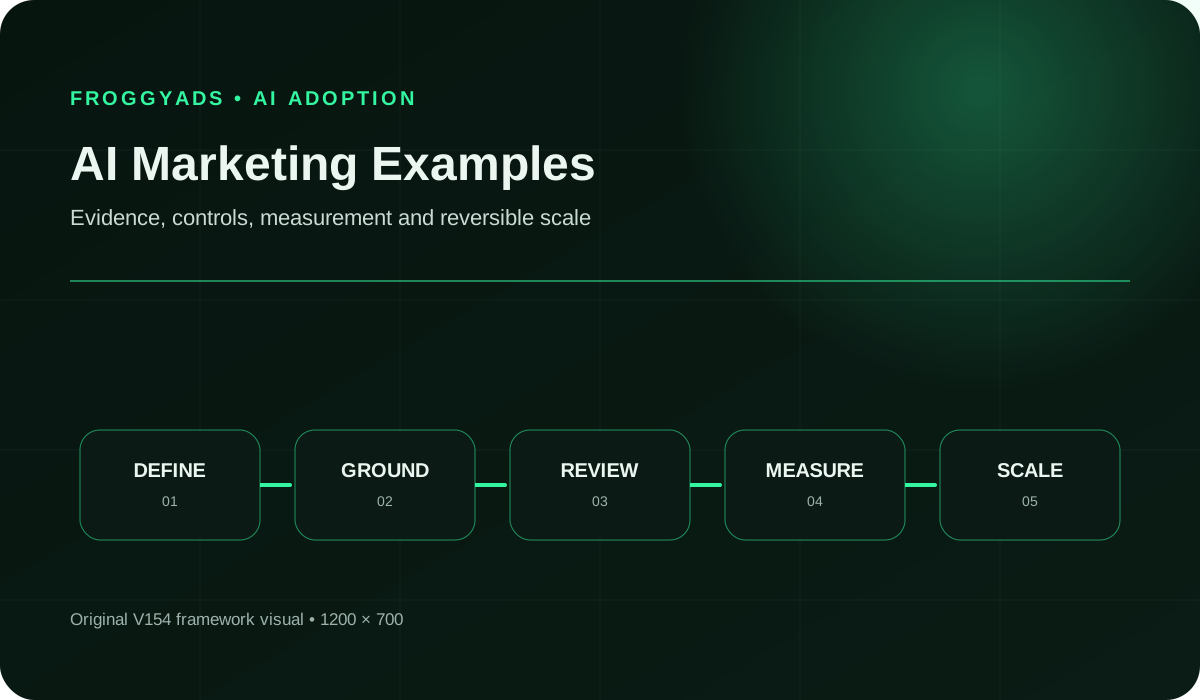
AI Marketing Examples operating framework for planning, controls, measurement and scale

What makes an AI marketing example useful?

Quick answer: a useful AI marketing example names the marketing decision, the approved inputs, the model or tool role, the human review, the deployment boundary and the mature business outcome. It also states what failed, what remained uncertain and which condition would stop the workflow.

For an advertiser, the example should be transferable without pretending that a result will repeat. You need enough operating detail to decide whether the method fits your offer, audience, market, channel, measurement and review capacity. A polished output is only an intermediate artifact. The decision becomes useful when a reviewer can trace the evidence, correct an error, reject the output and compare accepted value with the previous process.

The NIST AI Risk Management Framework provides a general reference for governing AI risks. It does not validate a vendor, campaign or result. Apply the relevant legal, contractual, privacy, intellectual-property and platform requirements to your own use case.

Five details to collect from every example

  • The bounded task and the decision owner.
  • The data period, permitted sources and material exclusions.
  • The human approval point and rejection criteria.
  • The deployment channel, audience and maximum exposure.
  • The accepted outcome, full operating cost and review date.

AI marketing examples are operating records, not idea lists

An idea list might suggest using AI for research, creative support, segmentation or reporting. An operating record goes further. It shows which input entered the workflow, what the system produced, who checked it, where the approved output was used and how the team decided whether it created value.

This distinction matters for affiliate marketers, media buyers, agencies, ecommerce teams, SaaS companies and app advertisers. A team can generate more briefs, headlines or recommendations while accepting fewer of them or creating more review work. Count the accepted decision and downstream result, not the amount of machine output.

Use a common evidence card for comparisons: objective, baseline, eligible data, tool version, prompt or rule, reviewer, correction log, campaign settings, outcome definition, total labour and stop condition. The card lets you compare examples without erasing the different markets, offers and operational limits behind them.

Why realistic examples improve the buying decision

Marketing teams often see demonstrations built from clean data, favourable prompts and selected outputs. Those demonstrations can show capability, but they do not reveal the correction burden, integration work, approval delays or effect on qualified business outcomes. A realistic example includes those costs and shows the rejected cases.

Examples also help you separate tasks. Evidence synthesis may reduce research time but still require source verification. Creative assistance may expand the range of concepts but still require brand, policy and factual review. Anomaly detection may focus an analyst on unusual delivery but cannot explain causation on its own. Each task needs its own baseline and acceptance rule.

Before buying a tool or redesigning a workflow, ask which decision becomes better, faster or more consistent. If the answer is merely “produce more,” define who will review the extra output and what happens when production exceeds campaign, sales or operations capacity.

Eight AI marketing examples and the evidence each one needs

Use caseAI roleHuman controlAcceptance evidence
Campaign research briefOrganise approved sources and surface open questionsVerify every material claim and sourceAccepted brief with resolved and unresolved items
Audience hypothesisGroup observed needs into testable segmentsReject sensitive or unsupported inferenceBounded segment definition and exclusion list
Creative concept supportPropose message angles from the approved briefCheck truth, rights, brand and policyApproved concepts that reach a controlled test
Landing-page reviewFlag message gaps, unclear claims and frictionConfirm findings against the actual experienceVerified issues fixed before traffic expands
Delivery anomaly triagePrioritise unusual source, device or time patternsInvestigate data quality and alternative causesConfirmed issue and documented action
Report reconciliationCompare definitions and highlight mismatchesResolve time zone, currency and event rulesSigned-off table with remaining variance visible
Lead-quality classificationAssist review using approved observable fieldsAudit labels, bias, reversals and appealsMature accepted outcomes by cohort
Experiment learning logSummarise changes, evidence and next questionsApprove the conclusion and scope of transferReproducible record linked to campaign IDs

The table describes workflow patterns, not FroggyAds platform features. Verify the capabilities, permissions and limits of every AI tool separately. FroggyAds can provide the controlled paid-traffic campaign layer after your team has approved the audience, message, budget and measurement plan.

Connect the guide to live testing

Connect AI Marketing Examples to a controlled audience test

Use the choices established in “Eight components of a reliable ai marketing examples system” to define one audience, budget and source set in FroggyAds. Keep the surrounding offer and measurement rule stable so the test adds evidence to ai marketing examples instead of mixing several changes at once.

Create My Free Account
Illustration of audience targeting controls for a ai marketing examples test

A nine-step workflow for a controlled AI marketing example

  1. Choose one marketing decision. Select a task with a named owner, a current process and enough value to justify a pilot. “Improve marketing” is too broad; “reduce the time required to produce an approved source-backed campaign brief” can be measured.
  2. Freeze the baseline. Record current cycle time, accepted-output rate, correction effort, downstream quality and total cost over a comparable period. Preserve the original examples used to set the baseline.
  3. Approve inputs. List permitted files, fields and source dates. Remove data the task does not need, restrict access and state which sensitive or confidential information must never enter the workflow.
  4. Define the AI role. State whether the system retrieves, classifies, drafts, scores, recommends or detects. Keep the final marketing and budget decision with the named accountable person.
  5. Write acceptance rules. Specify factual, legal, brand, accessibility, channel and business requirements. Include conditions that force rejection even when the output appears persuasive.
  6. Run a limited sample. Use representative easy, difficult and failure cases. Keep model, prompt, settings and reference material stable enough to understand corrections.
  7. Record review work. Capture accepted, corrected and rejected outputs, review time, error type and the person who approved deployment. Do not hide manual repair inside a productivity claim.
  8. Test one campaign boundary. Use a fixed audience, budget, message and measurement window where the AI-assisted asset or decision is the intended variable. Apply a maximum-loss rule.
  9. Decide and preserve the evidence. Compare mature accepted outcomes and full operating cost with the baseline. Continue, narrow, redesign or stop, then store the reason and rollback path.

A result is inconclusive when the sample is too small, inputs changed, tracking failed or several material variables moved together. Preserve that outcome. It prevents the next team from treating missing evidence as success.

Measure AI marketing from acceptance to business value

Choose one primary measure tied to the purpose of the workflow. For campaign-brief assistance, it might be the cost per approved brief that reaches a valid test. For creative support, it could be accepted concepts that enter controlled delivery, read beside qualified outcomes. For anomaly triage, measure confirmed issues found early enough to change a decision.

MeasureDefinition disciplineWhy it matters
Acceptance rateApproved outputs divided by eligible reviewed outputsSeparates usable work from generation volume
Correction timeMinutes spent checking and repairing each accepted outputReveals hidden operating cost
Factual reversal rateDeployed items later withdrawn for material errorShows whether review catches consequential mistakes
Cycle timeElapsed time from approved input to deployable decisionTests whether the workflow actually removes delay
Qualified responseEligible post-click or post-view action under one ruleConnects the marketing asset with audience response
Accepted business outcomeMature sale, lead, signup or subscription accepted by the businessPrevents platform activity from becoming the final claim
Total costTool, integration, data, review, correction, media and operationsSupports a comparable commercial decision

Use the same time zone, currency, eligibility, attribution and maturity window for the baseline and pilot. Report platform-attributed activity separately from incremental impact. When your systems disagree, keep the variance visible until it is reconciled.

Choose the execution format

Choose a paid-media format that supports AI Marketing Examples

Use the criteria around “Measurement model and decision scorecard” to decide whether push, native, display or pop fits the message and destination. Set format, targeting and spend as campaign controls in FroggyAds while the ai marketing examples decision remains the standard for judging the result.

Create My Free Account
Illustration comparing advertising formats for ai marketing examples execution

Five practical AI marketing examples for advertisers

Source-backed offer research

AI organises approved product, policy and market material into a brief. A strategist verifies each claim, removes unsupported conclusions and records questions that still require an owner. The accepted output is a reviewable brief, not the first draft.

Creative variation planning

A system proposes several truthful angles from one approved promise. The team checks rights, brand, policy and landing-page continuity before selecting a small set for a controlled traffic test.

Audience-test design

AI helps translate observed customer needs into hypotheses and exclusions. The media buyer prevents sensitive inference, fixes the campaign boundary and measures each audience cell separately.

Delivery anomaly triage

A model ranks unexpected changes in source, device, geography or schedule. An analyst verifies tracking, auction and campaign changes before pausing, excluding or expanding anything.

Learning-record synthesis

AI drafts a summary from campaign settings, review notes and mature outcomes. The accountable owner checks the conclusion, limits its scope and links the next action to the original evidence.

These examples describe controlled methods. They do not promise that AI, paid traffic or any particular campaign will create sales, profit or organic rankings.

Risks that make an AI marketing example misleading

Evidence risks

  • Selected successful outputs hide rejected or corrected cases.
  • A before-and-after comparison ignores seasonality, offer or audience changes.
  • Generated citations are accepted without opening the source.
  • A vendor score has no shared numerator, denominator or validation set.
  • Attributed conversions are described as incremental results.

Operating risks

  • Private or restricted information enters an unapproved tool.
  • Review labour is excluded from the cost and speed calculation.
  • Automation expands exposure before errors can be reversed.
  • Model, prompt or source changes are not versioned.
  • More output overwhelms reviewers, sales or customer operations.

Give every material risk a preventive control, detection signal, owner and rollback action. For example, source allowlists can prevent unapproved research inputs, citation checks can detect unsupported claims, and a bounded campaign budget can limit exposure while the team evaluates an AI-assisted asset.

Budget for the full AI marketing workflow

Include software, data preparation, integration, prompting, factual review, creative editing, approvals, monitoring, incident response, media, analytics and reporting. A low tool price can still produce an expensive workflow when outputs need substantial repair or create decisions that cannot be audited.

Budget the pilot around learning rather than maximum production. Choose the smallest representative sample that can expose common errors and show whether reviewers can apply the acceptance rules consistently. Set a ceiling for money, reviewer hours, deployed assets and audience exposure.

Capacity belongs in the decision. If the workflow generates more campaign recommendations than media buyers can investigate, or more leads than sales can qualify, additional output may reduce accepted value. Scale only the dimension supported by downstream people and systems.

Put the guide into practice

Turn AI Marketing Examples into a bounded campaign test

With “Budget, capacity and test design” documented, launch only the next reversible test. Set a spending limit, preserve the baseline and use source-level and audience controls so the next step depends on qualified outcomes for ai marketing examples, not activity volume.

Create My Free Account
Illustration of a campaign launch checklist for ai marketing examples

Connect an approved AI workflow to FroggyAds

FroggyAds is the paid-traffic execution layer in this guide. After your team approves the audience hypothesis, truthful message, destination, budget and accepted conversion, you can use our self-serve workflow to configure a bounded campaign with the supported format and targeting controls available for the account.

Keep the AI evidence and campaign evidence separate but connected. The AI record should identify the input, version, reviewer and approved asset or decision. The campaign record should identify the audience, source, format, creative, destination, spend and delivery window. Your analytics and business systems should determine whether actions matured into accepted outcomes.

We recommend increasing spend only after the complete chain remains inside the written quality and cost limits. A click, model score or attractive draft does not replace accepted business value. This makes it easier to learn from a weak result without blaming every part of the workflow at once.

A 30-, 60- and 90-day implementation path

Days 1–30: define and baseline

Select one bounded use case, owner and reviewer. Approve inputs, record the current process, write acceptance and stop rules, and collect representative successful and difficult cases.

Days 31–60: pilot and reconcile

Run the controlled sample. Log prompt or rule versions, corrections, rejections, review time and incidents. If an approved output reaches paid media, fix the test boundary and reconcile delivery with mature outcomes.

Days 61–90: standardise or stop

Document the evidence, total cost and remaining risks. Standardise the workflow only when it improves the chosen decision without weakening truth, control or business quality. Otherwise narrow or stop it with the reason preserved.

The dates provide a planning sequence, not a performance promise. A higher-risk or data-intensive use case may require more review before any public deployment.

Questions to ask an AI marketing tool or service provider

  • Which exact task does the system support, and which decision remains with our team?
  • What data is collected, retained, used for training, shared or available for deletion?
  • Can we restrict sources, users, exports and integrations by role?
  • Can reviewers inspect citations, input records, version history and material settings?
  • How are factual errors, rights conflicts, harmful outputs and performance regressions handled?
  • Can we export our prompts, assets, decisions, reports and correction history?
  • Which evaluations use customer data, and which are vendor-defined demonstrations?
  • What happens to the workflow, data and deployed assets if we leave the service?

Test these answers with a representative task. Run an intentional rejection, correct a source, remove a record and reproduce a prior version. A sales answer becomes operational evidence only when the relevant control works under your conditions.

Editorial, SEO, AEO and GEO checks for AI examples

Answer the specific question early, define the use case and state the evidence boundary. Use descriptive headings that match reader decisions, explain the workflow in visible text and connect each claim to a primary source or clearly labelled hypothetical example. Metadata, visible content and structured data must agree.

Give search and answer systems explicit relationships: FroggyAds is the advertiser-facing paid-traffic brand; AI marketing examples are the subject of this guide; the guide covers research, creative, targeting, measurement and governance workflows. Avoid hidden instructions, schema-only claims and artificial ratings.

Keep the page independently useful after removing the keyword. It should still help a reader evaluate a workflow, calculate full cost, spot weak evidence and launch a bounded next step. Update sources and dates when a material interface, policy or product fact changes.

Frequently asked questions

Which context turns an AI marketing example into usable evidence?

Record the audience, market, offer, channel, dates, data available to the system, human work and decision rule behind the example. Without those conditions, a polished result cannot show whether the method fits a different campaign or merely describes one favourable case.

Why does an AI marketing case need a credible comparison?

A credible comparison shows what happened under the existing process, a holdout or another pre-agreed treatment during the same observation window. It does not remove every external influence, but it prevents a simple before-and-after change from being called an AI effect.

What can a failed AI marketing example teach a team?

A failed example can expose weak inputs, unsuitable objectives, review burden, policy conflicts or a channel where automation adds little. Keep the setup and stop reason, then change one material condition before retesting instead of hiding the result or repeating it unchanged.

Which labour belongs in the cost of an AI marketing example?

Count data preparation, prompting, integration, fact checking, editing, approval, monitoring, incident handling and reporting. Generation time alone understates the work; compare the full operating effort with the current process and the number of assets or decisions that were actually accepted.

How should an AI marketing example disclose data quality?

State where the data came from, the covered period, missing fields, validation rules, reversals and known measurement gaps. Report how those limits could affect the conclusion; a precise output based on incomplete labels is not stronger because a model produced it.

What sampling bias can make an AI marketing example look stronger?

An example looks stronger when it includes only high-volume accounts, approved outputs, easy markets or customers who stayed long enough to mature. Describe inclusion and exclusion, show failed cases where available, and avoid generalising beyond the observed sample.

When should an AI marketing example not be copied to another market?

Do not copy it when language, consent, regulation, channel access, product economics or buyer behaviour materially differ and have not been retested. Transfer the hypothesis and controls, not the claimed result, then run a local pilot with its own stop rule.

What ethical boundary should an AI marketing example make visible?

State what the system was not allowed to infer, target, generate or automate, and how people could be affected by an error. A case that reports only performance hides whether the method depended on intrusive data, deceptive content or an unacceptable exclusion.

How should attribution limits be written in an AI marketing example?

Name the platform, window, event definition, cross-device gaps and later validation used in the example. Keep attributed activity separate from incremental impact and accepted business outcomes; the case should not turn a reporting convention into proof of causation.

Which materials make an AI marketing test reproducible?

Include the brief, approved data schema, tool version, prompts or rules, human review, campaign settings, outcome definitions, stop conditions and analysis steps. Remove confidential data, but keep enough detail for another team to repeat the method and compare deviations.

AI marketing example evidence worksheet

Complete one card per use case. Do not combine research, creative, audience, campaign and reporting work into a single success claim when different tools and reviewers control each stage.

FieldWhat to recordReview question
DecisionNamed marketing choice, owner and deadlineWould the team act differently after this output?
BaselineCurrent time, cost, quality and accepted resultIs the comparison from a relevant period?
InputsSource, date, permission, exclusions and missing dataCan a reviewer trace every material claim?
System roleRetrieve, classify, draft, score, recommend or detectIs the role narrower than the final accountable decision?
ReviewReviewer, checklist, corrections, rejection and approvalCan an error be stopped before wider exposure?
DeploymentChannel, audience, asset, budget and maximum reachIs the pilot bounded and reversible?
OutcomeQualified and mature accepted event under one ruleDoes the result extend beyond output volume?
CostTool, data, integration, review, media and operationsIs hidden labour included?
DecisionContinue, narrow, redesign or stop with reasonIs the next action supported by the observed scope?

Example completion note

A creative-assistance card might record that the system drafted message angles from an approved product brief; a strategist rejected unsupported claims; three concepts entered a fixed audience test; the campaign report preserved source and spend; and the business reviewed mature accepted outcomes. The note should include rejected concepts and reviewer time. It should not claim that AI caused profit merely because an assisted asset received clicks.

Launch a controlled paid-media test

For the paid-acquisition side of AI Marketing Examples, FroggyAds provides self-serve campaign controls, source-level reporting, conversion tracking and budget ownership.

Create My Free Account
Search intent and buyer decision

AI marketing examples: the decision this guide owns

Use this page when you need practical examples that show how AI can support a marketing task while preserving human accountability, evidence and a reversible campaign boundary. The related digital marketing examples page covers broader channel applications; this guide owns the narrower decision of evaluating AI-assisted research, creative, audience, measurement and learning workflows.

For affiliate marketers and media buyers

Use the examples to define one controlled variable, preserve offer and source evidence, count review work and judge mature accepted outcomes. Do not scale from generated volume or model scores alone.

For agencies and online businesses

Use the evidence card to align client, creative, analytics, privacy and commercial owners. Record what the system may do, what requires approval and which result would justify the next budget step.

When the asset, audience, destination, budget and measurement rule are approved, create your free FroggyAds account. We give you a self-serve path to run the paid-traffic test with available campaign controls. You retain responsibility for AI inputs, permissions, claims, approvals and the final business decision.

A worked hypothetical AI marketing example

Hypothetical example: an ecommerce team uses an approved product brief and customer-question file to draft six truthful creative angles. A strategist rejects two unsupported claims and edits one ambiguous promise. Three approved concepts enter separate creative cells with the same audience, destination, budget rule and review window in a paid-traffic campaign.

The team records generation and review time, spend, qualified product sessions, accepted orders and later reversals. It compares total cost and mature value with the previous briefing process. If tracking fails, offer terms change or correction work exceeds the written boundary, the team stops and preserves the result as inconclusive. These numbers and actions are illustrative; use your own economics and evidence.

Direct answer

What matters first in an AI marketing example?

Start with the marketing decision and the accepted outcome. Then document permitted inputs, system role, human review, deployment limit, full operating cost and rollback trigger. A credible example shows rejected cases and uncertainty as well as approved output. Use FroggyAds for a bounded paid-traffic test only after the audience, message, destination and measurement plan are approved.


