
Define the decision
Write the objective, accepted outcome and maximum learning loss for ai ad copy generator.
Use an AI ad copy generator with a factual brief, evidence library, claim limits, brand rules, human editing and message-to-page checks.
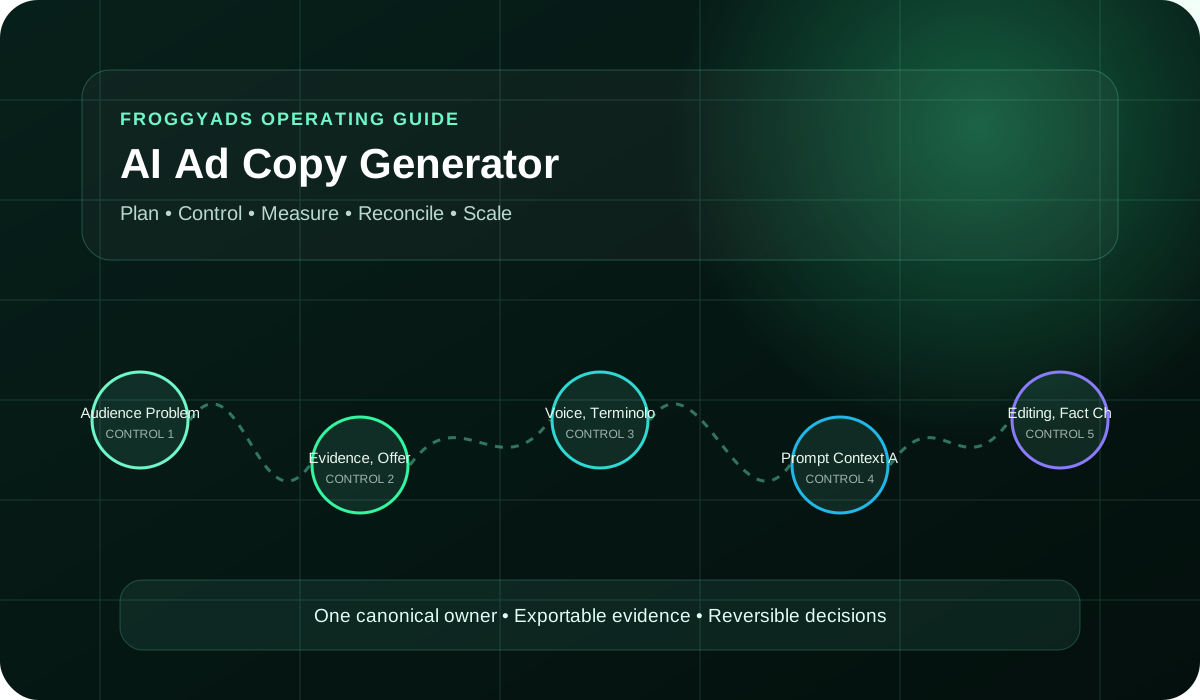
Quick answer: Use an AI ad copy generator with a factual brief, evidence library, claim limits, brand rules, human editing and message-to-page checks. AI Ad Copy Generator is a generative tool that drafts advertising headlines, descriptions, calls to action or message variations. For ai ad copy generator, the practical job is to produce reviewable copy options while keeping claims, differentiation and final accountability with the advertiser.
Reference for AI Ad Copy Generator: Create, Test & Improve Ad Performance: NIST: AI Risk Management Framework.
AI Ad Copy Generator is a generative tool that drafts advertising headlines, descriptions, calls to action or message variations. The useful operating definition is narrower than a dictionary label: it states what decision the activity supports, which inputs are allowed, how eligibility is determined and what evidence is required before the result receives credit.
For ai ad copy generator, the practical job is to produce reviewable copy options while keeping claims, differentiation and final accountability with the advertiser. That means separating the media action from the business outcome. Delivery, reach, impressions and clicks describe activity; accepted leads, completed purchases, retained customers or another approved business state describe value.
A strong ai ad copy generator plan begins with a boundary document. Record the accountable owner, target audience or context, approved markets, permitted data, chosen formats, conversion definition, attribution window, maximum learning loss and rollback trigger. The document prevents a platform default from silently becoming the strategy.
The main value of ai ad copy generator is decision clarity. Teams can compare options only when the comparison uses the same objective, time window, maturity rule and economic definition. Without that contract, a lower reported cost may simply reflect a different event, weaker quality or incomplete conversion maturity.
The strongest plans connect audience problem and desired action, evidence, offer and claim boundary, and voice, terminology and brand rules with prompt context and source grounding, editing, fact checking and approval, and testing, reuse and version governance. These elements interact. A useful audience can fail with the wrong creative, a strong format can fail on unsuitable placements, and an apparently efficient campaign can fail after rejected outcomes and reversals are included. The ai ad copy generator review should therefore connect evidence, offer and claim boundary with conversion contribution, a named owner and a dated change record.
Use ai ad copy generator as a controlled learning system. The first launch should be narrow enough to explain, the change log should preserve every material decision, and the reporting should show both the platform result and the accepted business result. Scale is earned by repeated evidence, not by one favorable dashboard interval.
Build the ai ad copy generator architecture in layers. Start with the commercial objective and accepted outcome, then define the audience or context, select the format and placement, prepare the offer and landing path, set budget and bid controls, and finish with measurement, exclusions and stop rules. Each layer needs an owner and a validation step.
Use stable names for campaigns, audiences, creatives, placements and test versions. Stable identifiers allow exports from the buying platform, analytics and business systems to be joined later. They also make it possible to distinguish a real improvement from a naming change, copied campaign or altered attribution setting. The ai ad copy generator review should therefore connect evidence, offer and claim boundary with conversion contribution, a named owner and a dated change record.
Separate exploration from exploitation. Exploration tests new ad headline variants, landing-page opening draft, and email subject-line set under capped budgets. Exploitation allocates more delivery to combinations that have passed quality and economic checks. Combining both modes in one undifferentiated campaign hides where the learning budget went. A practical ai ad copy generator brief can operationalize this step with proof-point rewrite, while treating measuring output volume instead of business impact as an explicit pre-launch risk.
Use the choices established in “AI Ad Copy Generator operating architecture” to define one audience, budget and source set in FroggyAds. Keep the surrounding offer and measurement rule stable so the test adds evidence to ai ad copy generator instead of mixing several changes at once.
Create My Free Account
For AI Ad Copy Generator, credit a decision layer only after it has a named owner, an operating control and exportable evidence.
| Decision layer | Operating requirement | Evidence required |
|---|---|---|
| Audience Problem And Desired Action | Define the decision, input, control and exception path for audience problem and desired action. | Written definition, owner and approval boundary. |
| Evidence, Offer And Claim Boundary | Define the decision, input, control and exception path for evidence, offer and claim boundary. | Exportable setup, exclusions and change log. |
| Voice, Terminology And Brand Rules | Define the decision, input, control and exception path for voice, terminology and brand rules. | Creative and landing continuity evidence. |
| Prompt Context And Source Grounding | Define the decision, input, control and exception path for prompt context and source grounding. | Source or cohort reporting with quality review. |
| Editing, Fact Checking And Approval | Define the decision, input, control and exception path for editing, fact checking and approval. | Reconciled analytics and business outcomes. |
| Testing, Reuse And Version Governance | Define the decision, input, control and exception path for testing, reuse and version governance. | Marginal scale result with rollback readiness. |
Delivery quality for ai ad copy generator depends on how the platform identifies users, placements, creative states and measurable events. Record these technical boundaries before interpreting the result. Identity approximation, unavailable signals and unmeasurable inventory should remain visible in reporting.
Evaluate distribution, not only averages. Break results into exposure bands, placements, devices, creative variants, audience stages and time. The distribution often reveals saturation, low-viewability inventory, broken dynamic combinations or a small cohort carrying the entire blended result. For ai ad copy generator, apply the principle through a bounded test such as objection-handling copy, and require conversion contribution to support the next budget decision.
Use automation within guardrails. Approved inputs, fallback creative, caps, exclusions, source review and rollback protect the campaign when a model or delivery system behaves differently from the forecast. Automation should expand controlled decisions, not remove accountability. The ai ad copy generator review should therefore connect prompt context and source grounding with factual correction rate, a named owner and a dated change record.
Write the objective, accepted outcome and maximum learning loss for ai ad copy generator.
For AI Ad Copy Generator, document the audience, context, placement, GEO, device or prior behavior that makes delivery eligible.
For AI Ad Copy Generator, build format-specific assets, proof, call to action and a landing path that continues the same promise.
For AI Ad Copy Generator, test delivery, analytics, conversion, acceptance, deduplication and delayed states end to end before campaign decisions depend on reporting.
For AI Ad Copy Generator, set explicit test budgets, bid ranges, exclusions, frequency limits and dated review checkpoints before delivery begins.
For AI Ad Copy Generator, compare source, placement, audience, device, creative and exposure-level quality before keep, cap, exclude or retest decisions.
For AI Ad Copy Generator, expand one controlled dimension when marginal economics pass; otherwise return to the last stable configuration.
Creative for ai ad copy generator should make one credible promise to one recognizable audience state. The headline or opening frame identifies the problem or opportunity, the supporting element supplies proof, and the call to action describes the next step. Avoid claims that the landing page cannot substantiate.
Prepare variations around meaningful hypotheses rather than cosmetic changes. Test a different proof point, customer problem, product benefit, objection, offer structure or format adaptation. Preserve enough consistency that the team can identify which idea changed response quality. For ai ad copy generator, apply the principle through a bounded test such as objection-handling copy, and require conversion contribution to support the next budget decision.
Landing continuity is part of the creative system. The destination should repeat the same terminology, offer and expectation introduced in the ad. If ai ad copy generator produces clicks but the landing page changes the promise, hides the action or loads poorly on the target device, the campaign is not ready for scale.
Use the criteria around “Creative, offer and landing continuity” to decide whether push, native, display or pop fits the message and destination. Set format, targeting and spend as campaign controls in FroggyAds while the ai ad copy generator decision remains the standard for judging the result.
Create My Free Account
Measure ai ad copy generator through a chain rather than a single rate: eligible delivery, measurable exposure, qualified interaction, landing completion, primary conversion, accepted outcome and realized value. The chain reveals where volume becomes unusable and prevents a strong top-line metric from masking downstream weakness.
The core reporting set includes first-pass approval rate, factual correction rate, editing time, message-match score, qualified response rate, and conversion contribution. Define each metric's numerator, denominator, data source, time zone, currency, attribution rule and maturity window. Where a platform metric cannot be reproduced from exportable evidence, label the limitation instead of presenting false precision. For ai ad copy generator, apply the principle through a bounded test such as email subject-line set, and require message-match score to support the next budget decision.
Reconcile platform, analytics and business records on a regular schedule. Differences are expected because systems use different identity, attribution and validation rules. Unexplained differences should block aggressive scale until the team knows whether the variance comes from tracking, delayed events, duplicates, rejected outcomes or reversals. The ai ad copy generator review should therefore connect evidence, offer and claim boundary with conversion contribution, a named owner and a dated change record.
For AI Ad Copy Generator, define every decision metric with a numerator, denominator, source, reporting window, currency, attribution rule and maturity condition.
| Metric | Definition requirement | Diagnostic check |
|---|---|---|
| First-Pass Approval Rate | State numerator, denominator, source, time window, currency and maturity rule. | Check for asking for copy without a strategic brief before the metric receives decision credit. |
| Factual Correction Rate | State numerator, denominator, source, time window, currency and maturity rule. | Check for allowing invented facts or testimonials before the metric receives decision credit. |
| Editing Time | State numerator, denominator, source, time window, currency and maturity rule. | Check for using generic language that erases differentiation before the metric receives decision credit. |
| Message-Match Score | State numerator, denominator, source, time window, currency and maturity rule. | Check for publishing without legal or policy review before the metric receives decision credit. |
| Qualified Response Rate | State numerator, denominator, source, time window, currency and maturity rule. | Check for creating inconsistent promises across channels before the metric receives decision credit. |
| Conversion Contribution | State numerator, denominator, source, time window, currency and maturity rule. | Check for measuring output volume instead of business impact before the metric receives decision credit. |
Set the economic boundary for ai ad copy generator before launch. Estimate expected value per accepted outcome, gross margin, operating capacity, refund or rejection risk and the maximum loss allowed for learning. The budget becomes a controlled experiment only when the team knows what would make the test financially acceptable or unacceptable.
Use a break-even relationship that the business can audit: maximum acquisition cost equals expected contribution per accepted outcome multiplied by the probability that the measured event becomes that accepted outcome. Replace broad platform conversion counts with the state that actually creates value. The ai ad copy generator review should therefore connect testing, reuse and version governance with message-match score, a named owner and a dated change record.
Evaluate marginal performance when scaling. Average cost can remain attractive while the newest spend enters weaker audiences, placements or frequency bands. Compare the next budget increment with the approved threshold and keep the prior configuration available for rollback. For ai ad copy generator, apply the principle through a bounded test such as objection-handling copy, and require conversion contribution to support the next budget decision.
Quality control for ai ad copy generator includes inventory review, placement evidence, invalid-activity monitoring, creative compliance, landing integrity and outcome acceptance. No single vendor label proves quality. The buyer needs source-level or cohort-level evidence that can be connected to business results.
Privacy and governance are design inputs, not final checkboxes. Use only permitted data, minimize unnecessary identifiers, document membership and deletion rules, and avoid inferring sensitive personal characteristics. A targeting or retargeting feature should be rejected when the business purpose does not justify the data use. A practical ai ad copy generator brief can operationalize this step with landing-page opening draft, while treating publishing without legal or policy review as an explicit pre-launch risk.
Accessibility supports both user value and campaign reliability. Text, contrast, motion, controls and landing forms should remain understandable across devices and assistive technologies. Deceptive interaction patterns may increase accidental clicks while reducing trust and accepted outcomes. In a ai ad copy generator workflow, this control is most valuable when measuring output volume instead of business impact could otherwise make the reported result look stronger than the accepted business outcome.
The common failure modes for ai ad copy generator include asking for copy without a strategic brief, allowing invented facts or testimonials, and using generic language that erases differentiation. These failures often look like media problems but originate in planning, data or measurement. Diagnose the earliest broken stage before changing bids or increasing creative volume.
A second group of risks includes publishing without legal or policy review, creating inconsistent promises across channels, and measuring output volume instead of business impact. Protect the campaign with exclusions, budget limits, named owners, change logs and predefined stop conditions. The goal is not to eliminate uncertainty; it is to keep uncertainty visible and financially bounded. A practical ai ad copy generator brief can operationalize this step with landing-page opening draft, while treating publishing without legal or policy review as an explicit pre-launch risk.
When results weaken, compare the current period with a stable cohort. Check tracking, audience or placement mix, frequency distribution, creative age, landing performance, conversion lag and accepted-outcome rules. A disciplined diagnostic sequence prevents a team from solving the wrong problem. The ai ad copy generator review should therefore connect testing, reuse and version governance with message-match score, a named owner and a dated change record.
With “Common failure modes and diagnostic order” documented, launch only the next reversible test. Set a spending limit, preserve the baseline and use source-level and audience controls so the next step depends on qualified outcomes for ai ad copy generator, not activity volume.
Create My Free Account
For ai ad copy generator, this failure weakens evidence or business quality. Record the earliest observable signal, the accountable owner, the corrective action and the condition that confirms recovery before spend is expanded.
Freeze the ai ad copy generator definition, outcome state, conversion map, source naming, exclusions and initial budget. Test events from impression or eligibility through accepted business outcome.
Launch a narrow ai ad copy generator test with a stable control. Review pacing, placements, audience overlap, creative rendering, landing performance and early quality signals without overreacting to small samples.
For AI Ad Copy Generator, diagnose one issue at a time with a meaningful creative, targeting, placement, bid or landing hypothesis while preserving a control and waiting for conversion maturity.
For AI Ad Copy Generator, reconcile accepted outcomes before each budget increase; expand one dimension only when the evidence is reproducible and operating capacity can support it.
Scale ai ad copy generator one controlled dimension at a time. Expand budget, audience, geography, format, placement or creative inventory separately enough that the effect can be observed. Preserve a control and compare marginal outcomes, not only the blended account average.
A valid scale decision requires capacity as well as media efficiency. Confirm that sales, fulfillment, support, inventory, payment and compliance systems can absorb the expected outcome volume. Media that exceeds operational capacity may create lower-quality service, refunds or rejected leads that erase the apparent gain. A practical ai ad copy generator brief can operationalize this step with proof-point rewrite, while treating measuring output volume instead of business impact as an explicit pre-launch risk.
Keep rollback simple. Store the last stable settings, creative set, audience rules and exclusions. If marginal cost, quality, tracking variance or operational load crosses the approved threshold, return to the stable configuration and investigate before another expansion. In a ai ad copy generator workflow, this control is most valuable when allowing invented facts or testimonials could otherwise make the reported result look stronger than the accepted business outcome.
FroggyAds can support ai ad copy generator when the plan benefits from self-serve access to multiple paid formats, source controls and campaign-level optimization. The platform connects advertisers with inventory from 750+ SSP integrations and lets buyers manage targeting, bids, budgets, source IDs and creative tests from one account.
Use FroggyAds as the execution layer, not as a substitute for the operating contract. Bring a defined objective, approved creative, landing page, tracking plan, exclusions and accepted outcome. Start with a bounded test, review source-level evidence and expand only after the business result is reconciled. For ai ad copy generator, apply the principle through a bounded test such as email subject-line set, and require message-match score to support the next budget decision.
The minimum deposit is $50, while a useful learning budget depends on format, market, bid level, conversion rate and the evidence needed for a decision. Avoid treating a minimum funding amount as a recommendation or a guarantee of statistically stable results. The ai ad copy generator review should therefore connect evidence, offer and claim boundary with conversion contribution, a named owner and a dated change record.
Give the AI ad copy generator one primary proposition, the audience condition, supporting evidence, required qualification and intended action in that order. A clear hierarchy makes review easier and reduces the chance that a secondary benefit becomes an unsupported headline.
Include current product facts, permitted comparisons, mandatory wording, source dates and claims that are explicitly prohibited. Link every fact to an owner and review date so generated copy can be checked against a controlled record rather than the model's general knowledge.
Specialist review is needed when the copy touches regulated products, legal promises, sensitive audiences or claims that require substantiation. Route those drafts before launch, retain the approved wording, and do not assume a fluent sentence satisfies the rules of a market.
Keep the offer, audience, placement, destination and material qualification fixed while testing a copy variable. Label the exact wording that changed; otherwise a result cannot show whether the generator's message or another campaign difference caused the outcome.
Create a source meaning sheet, then have fluent market reviewers compare each version for promise, qualification, tone and action. Back-translation can help expose drift, but it cannot replace a reviewer who understands how the wording sounds in the intended advertising context.
Retain the brief, prompt, model or tool version, generated draft, human edits, approval, placement and performance label for each ad. The history should show which words reached the audience without storing unnecessary personal or confidential data in the prompt.
Record the concrete rejection reason, such as an unsupported claim, lost qualification, unsuitable tone or platform-policy conflict. Keep the rejected wording with its source brief so future prompts can avoid the mistake instead of relying on a vague instruction to produce better copy.
Use it when performance and exposure data suggest message fatigue and the offer still fits the audience. Start from the approved proposition, create a small set of materially different angles, and test them against a current control rather than changing every line at once.
Compare total time from brief to approved ad, including prompt preparation, fact checking, editing, legal review and rejected drafts. Faster generation is not a saving if reviewers spend longer repairing claims or sorting near-duplicate variants that never become usable ads.
Export the final text, prompt and brief context, revision history, approval status and stable identifiers in a usable format. This lets the team reproduce decisions and change tools without losing its record; vendor-only scores are not a substitute for the underlying copy.
For AI Ad Copy Generator, use current primary platform, industry-standard and accessibility documentation; verify interfaces, policy terms, implementation steps and terminology before launch.
Use the AI Ad Copy Generator worksheet to turn guidance into a documented process with a named owner, evidence requirement, decision rule, rollback point and review date.
Write the operational definition for ai ad copy generator before choosing a dashboard. Name the event, denominator, eligibility rule, attribution scope, time zone, currency and data owner. The assigned keyword wording is ai ad copy generator; those phrases must resolve to one canonical decision boundary rather than competing calculations.
For AI Ad Copy Generator, keep evidence exportable, reproducible and clear enough for a reviewer who did not configure the campaign.
Document why each signal is relevant to ai ad copy generator, how it is collected or inferred, how long it remains valid and which exclusions prevent waste or policy risk. Mark overlap between prospecting, retargeting, customer and suppression groups so the same user state is not purchased repeatedly without intent.
List every approved promise, proof source, format adaptation, call to action and landing destination for ai ad copy generator. Include size or device constraints, fallback creative, accessibility checks and the owner who can withdraw a claim or asset when the underlying evidence changes.
Model conservative, expected and upside cases for ai ad copy generator using transparent assumptions for eligible reach, price, response quality, conversion maturity and accepted value. Add a failure case with the maximum learning loss, earliest reliable signal and conditions that stop delivery.
Preserve campaign, audience, placement, publisher or source, device, geography, creative and time identifiers where the buying environment allows it. When a dimension is unavailable, record the limitation and avoid quality claims that require evidence the platform does not provide. In a ai ad copy generator workflow, this control is most valuable when measuring output volume instead of business impact could otherwise make the reported result look stronger than the accepted business outcome.
Create a reconciliation table for ai ad copy generator with platform delivery, analytics events, business outcomes, variance, known cause, unresolved amount and accountable owner. Use the same time zone, currency and maturity window before comparing systems.
For every material change to ai ad copy generator, record the observed problem, hypothesis, exact change, start time, expected signal, minimum evidence, result and rollback decision. This record protects learning across operators, agencies and copied campaigns.
Before expanding ai ad copy generator, confirm that marginal economics pass, inventory or audience quality remains stable, frequency is controlled, creative coverage is sufficient, operations can absorb outcomes and the previous stable configuration can be restored quickly.
For the paid-acquisition side of AI Ad Copy Generator, FroggyAds provides self-serve campaign controls, source-level reporting, conversion tracking and budget ownership.
Create My Free AccountFor performance-focused advertisers, AI Ad Copy Generator: Build a Clear, Measurable Operating Plan should shorten the path from research to action: evaluate AI-assisted ad-copy generation specifically for headlines, body copy, variants, review and claim safety. The page therefore stays focused on controllable campaign evidence and leaves adjacent intents to their own URLs. The nearest related FroggyAds page is Ai Ad Generator; this URL keeps ownership of the distinct task to evaluate AI-assisted ad-copy generation specifically for headlines, body copy, variants, review and claim safety.
For AI Ad Copy Generator: Build a Clear, Measurable Operating Plan, the operating evidence to keep visible is campaign objective, source quality, audience and market fit, ad format. Use these entities only when they change setup, measurement or the commercial decision.
| Checkpoint | Campaign action | Evidence to keep |
|---|---|---|
| Fit | Define the buyer, accepted outcome and non-negotiable constraint. | Retain evidence specific to AI Ad Copy Generator: Build a Clear, Measurable Operating Plan and its accepted outcome. |
| Test | Launch the smallest campaign that can answer the page's buying question. | Retain evidence specific to AI Ad Copy Generator: Build a Clear, Measurable Operating Plan and its accepted outcome. |
| Decision | Keep, cap, exclude or expand from accepted-outcome evidence. | Retain evidence specific to AI Ad Copy Generator: Build a Clear, Measurable Operating Plan and its accepted outcome. |
Hypothetical calculation: if a controlled campaign for ai ad copy generator: build a clear, measurable operating plan spends USD 200 and produces 8 accepted conversions, accepted CPA is USD 200 / 8 = USD 25.0. Replace the inputs with your own campaign economics; this is not a FroggyAds performance claim.
Start the paid-media test for AI Ad Copy Generator: Build a Clear, Measurable Operating Plan with FroggyAds when you need direct control over formats, targeting, budgets and source evidence. Increase spend only after the result supports the next acquisition step. Create your free FroggyAds account.
Direct answer: This page helps you evaluate AI-assisted ad-copy generation specifically for headlines, body copy, variants, review and claim safety. Keep the comparison or test inside that scope, then use FroggyAds campaign controls only where paid traffic is part of the decision.