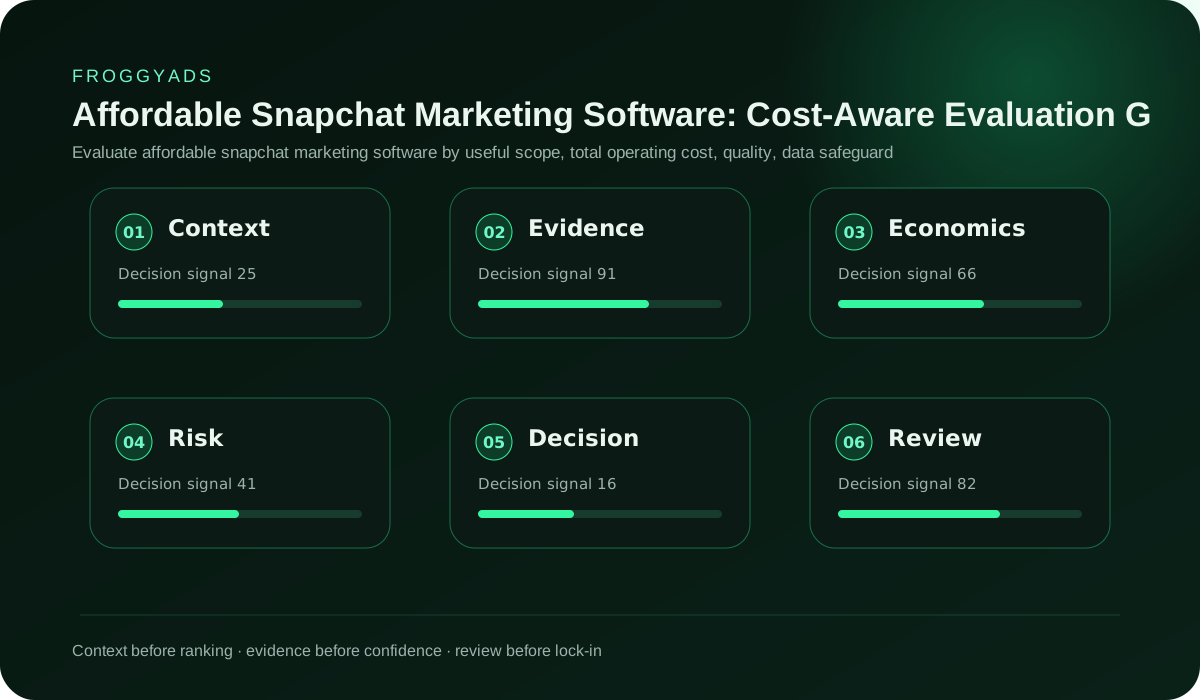
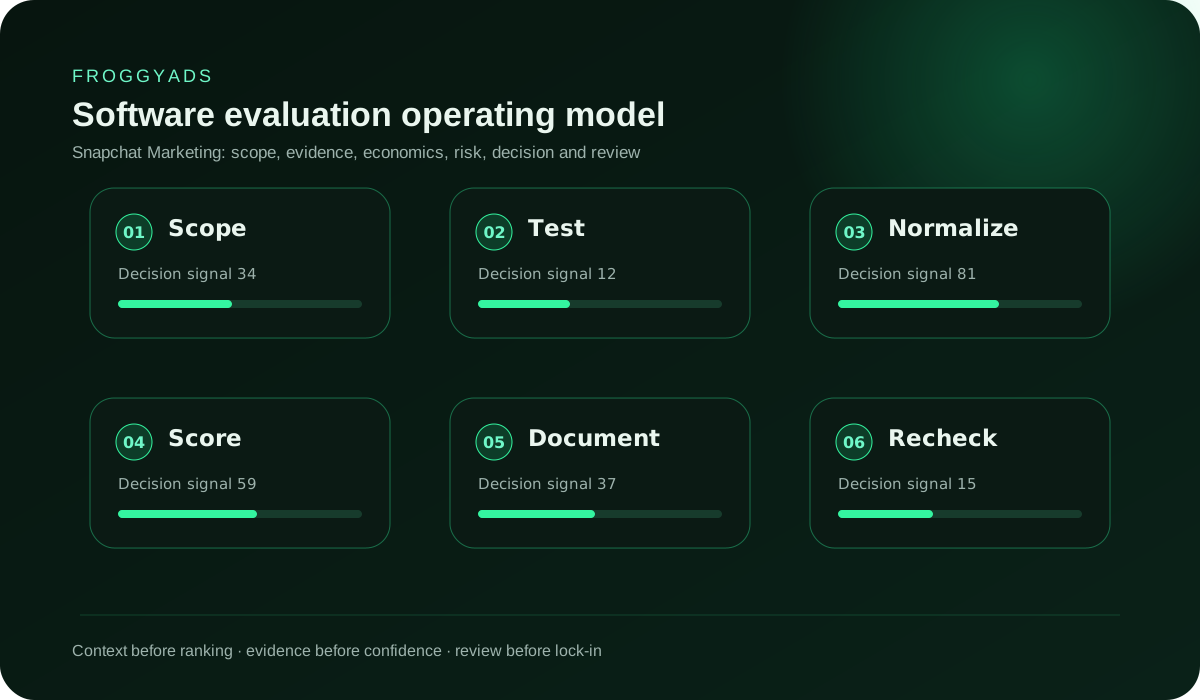
Affordable Snapchat marketing software is a governed toolset for creating, approving, delivering and measuring Snapchat campaigns. Start with Snapchat Ads Manager and the current Snapchat for Business documentation, then add another tool only for a documented gap such as asset review, localization, permissions or independent reconciliation. The cheapest subscription is not affordable when it duplicates owner tools or hides campaign evidence.
Inventory the owner stack
Snapchat for Business describes Ads Manager as the place to create and manage ads, ad sets and campaigns and to view performance. It also documents Snap Pixel for website actions. Record these owner capabilities before comparing third-party software so a feature list does not charge twice for the same function.
Owner availability does not prove that every team can operate the workflow well. Map who creates assets, who approves claims, who controls account access and who reconciles website outcomes. A third-party tool belongs only where this map shows a real operating gap.
Define the creative handoff
Snapchat creative is vertical and context-sensitive, so the workflow should preserve safe areas, captions, brand elements, approved claims and the destination. Give every export a version, owner and retirement condition. A scheduler or design tool should not sever the asset from the evidence that authorized its message.
Test the delivered file rather than only the editing preview. Confirm crop, text legibility, audio dependence, call to action and landing continuity. If an external tool changes compression or metadata, record the actual exported asset used in Ads Manager.
Protect account permissions
List the people and systems that can create, approve, publish, pause, export or alter measurement. Use the narrowest role that supports the work and review inactive access. A lower-priced tool can create a larger security cost when it requires broad credentials or shared accounts.
Document the offboarding route before connecting software. The team should know how to revoke access, retain campaign evidence, handle scheduled posts or ads and confirm that tokens no longer operate. Tool selection includes the exit procedure, not only onboarding convenience.
Map Pixel and business events
Snapchat’s owner material describes Snap Pixel as a way to measure website actions associated with Snapchat advertising. The business still needs a stable definition for page views, cart actions, purchases or leads and a reconciliation path for later cancellation or qualification.
Verify installation and event scope before optimization. Do not interpret a tool’s dashboard as independent proof that the event is commercially valid. Preserve the browser or server source, consent boundary, event time and business confirmation in the measurement map.
Compare reporting without false parity
Write which system reports spend, impressions, clicks, video views, website events and confirmed business outcomes. Metrics with similar labels may have different definitions or windows. A useful tool exposes those boundaries and exports evidence; it does not merely combine incompatible totals in one chart.
Split tests should isolate a planned difference and keep audience, timing and delivery context visible. Snapchat’s measurement page describes testing features within its product. Treat that description as owner guidance, not as a guarantee that a given test will reach a particular result.
Price the complete software route
Include subscription, setup, integration, creative adaptation, training, governance, maintenance and exit work. Compare that total with the gap the tool closes. Reject features that have no named user, decision or evidence output, even when they make the package appear larger.
Run a limited trial using one real workflow. Capture task time, errors, evidence quality, permissions and export completeness. The purchase decision should state what improved, what stayed manual and which dependency the team accepts.
Connect the guide to live testing
Connect Affordable Snapchat Marketing Software to a controlled audience test
Use the choices established in “Price the complete software route” to define one audience, budget and source set in FroggyAds. Keep the surrounding offer and measurement rule stable so the test adds evidence to affordable snapchat marketing software instead of mixing several changes at once.
Ads Manager capabilities are checked before another platform is purchased.
Control 2
Every connected tool has a named campaign role and accountable owner.
Control 3
Creative exports retain version, approval and claim evidence.
Control 4
Vertical assets are inspected after final compression and transfer.
Control 5
Account permissions follow creation, approval, publishing and analysis duties.
Control 6
Offboarding covers tokens, schedules, exports and inactive users.
Control 7
Pixel events map to stable website and business definitions.
Control 8
Consent and data-flow boundaries are recorded before integration.
Control 9
Metric names retain their owner definitions and reporting windows.
Control 10
Tests isolate one planned creative or delivery difference.
Control 11
Total cost includes integration, training, maintenance and exit.
Control 12
A trial produces evidence about workflow gaps, not a feature score.
Choose the execution format
Choose a paid-media format that supports Affordable Snapchat Marketing Software
Use the criteria around “Operating controls” to decide whether push, native, display or pop fits the message and destination. Set format, targeting and spend as campaign controls in FroggyAds while the affordable snapchat marketing software decision remains the standard for judging the result.
Ads Manager capabilities are checked before another platform is purchased. campaign administrator attaches the source to the integration register and labels the Pixel event as observed. Before the Snapchat toolchain changes, campaign administrator checks the software permission. The earlier integration register state stays available. New workflow evidence names the approved action, its authority and the next review point.
Review note 2
Every connected tool has a named campaign role and accountable owner. For the Snapchat toolchain, integration register separates owner documentation from the measured Pixel event. The campaign administrator records any delayed confirmation and protects the software permission. This workflow evidence prevents a provisional reading from replacing the underlying event or being presented as a future guarantee.
Review note 3
Creative exports retain version, approval and claim evidence. A real Pixel event exercises the working Snapchat toolchain route. The campaign administrator saves the relevant integration register version and tests the software permission. When the route breaks, workflow evidence identifies the first defective handoff before more activity, access or budget is authorized.
Review note 4
Vertical assets are inspected after final compression and transfer. Every Snapchat toolchain decision enters integration register with scope and uncertainty. The campaign administrator keeps the surrounding Pixel event context visible and verifies the software permission. Resulting workflow evidence distinguishes a repeatable operating limit from an observation that belongs only to one account or period.
Review note 5
Account permissions follow creation, approval, publishing and analysis duties. Complete Snapchat toolchain cost includes preparation, operation and maintenance of integration register. The campaign administrator rejects work that cannot improve the named Pixel event. Any new software permission dependency is priced and assigned. The workflow evidence compares usable capability rather than an inventory of features without owners.
Review note 6
Offboarding covers tokens, schedules, exports and inactive users. Closing the Snapchat toolchain review reconciles integration register, the original Pixel event and the surviving software permission. The campaign administrator records a reversal condition and preserves delayed outcomes. Final workflow evidence shows what changed, what remained stable and which question requires another bounded test.
Review note 7
Pixel events map to stable website and business definitions. campaign administrator attaches the source to the integration register and labels the Pixel event as observed. Before the Snapchat toolchain changes, campaign administrator checks the software permission. The earlier integration register state stays available. New workflow evidence names the approved action, its authority and the next review point.
Review note 8
Consent and data-flow boundaries are recorded before integration. For the Snapchat toolchain, integration register separates owner documentation from the measured Pixel event. The campaign administrator records any delayed confirmation and protects the software permission. This workflow evidence prevents a provisional reading from replacing the underlying event or being presented as a future guarantee.
Review note 9
Metric names retain their owner definitions and reporting windows. A real Pixel event exercises the working Snapchat toolchain route. The campaign administrator saves the relevant integration register version and tests the software permission. When the route breaks, workflow evidence identifies the first defective handoff before more activity, access or budget is authorized.
Review note 10
Tests isolate one planned creative or delivery difference. Every Snapchat toolchain decision enters integration register with scope and uncertainty. The campaign administrator keeps the surrounding Pixel event context visible and verifies the software permission. Resulting workflow evidence distinguishes a repeatable operating limit from an observation that belongs only to one account or period.
Review note 11
Total cost includes integration, training, maintenance and exit. Complete Snapchat toolchain cost includes preparation, operation and maintenance of integration register. The campaign administrator rejects work that cannot improve the named Pixel event. Any new software permission dependency is priced and assigned. The workflow evidence compares usable capability rather than an inventory of features without owners.
Review note 12
A trial produces evidence about workflow gaps, not a feature score. Closing the Snapchat toolchain review reconciles integration register, the original Pixel event and the surviving software permission. The campaign administrator records a reversal condition and preserves delayed outcomes. Final workflow evidence shows what changed, what remained stable and which question requires another bounded test.
Put the guide into practice
Turn Affordable Snapchat Marketing Software into a bounded campaign test
With “Review notes” documented, launch only the next reversible test. Set a spending limit, preserve the baseline and use source-level and audience controls so the next step depends on qualified outcomes for affordable snapchat marketing software, not activity volume.
The Snapchat administrator inventories Ads Manager and Pixel capabilities before approving another connection. Each proposed tool must close a named creative, permission or reporting gap. The integration register rejects duplicate features that add access without improving a campaign decision. Checkpoint 1 retains its own dated observation.
Evidence checkpoint 2
A vertical asset moves through concept, claim approval, safe-area review, final export and delivery inspection. The Snapchat workflow stores the exact file at each handoff. Compression or crop problems are assigned to the transfer stage that produced them. Checkpoint 2 retains its own dated observation.
Evidence checkpoint 3
Pixel validation sends a defined website action and checks its receipt without declaring commercial success. The measurement owner retains the consent boundary, event source and later business status. Tool dashboards remain operational evidence rather than independent proof of revenue. Checkpoint 3 retains its own dated observation.
Evidence checkpoint 4
Permission review lists creation, approval, publishing, export and billing separately. Snapchat software receives only the access required for its function. The offboarding record confirms token revocation, scheduled-action closure and evidence export before the integration is considered removed. Checkpoint 4 retains its own dated observation.
Evidence checkpoint 5
A controlled creative comparison changes one planned element and records audience, timing and delivery context. The software trial is judged by workflow clarity and evidence quality. A different metric result does not automatically prove why one asset performed differently. Checkpoint 5 retains its own dated observation.
Evidence checkpoint 6
The purchase close reconciles subscription, setup, training, maintenance and exit work against the original gap. Snapchat teams document which task became faster or safer and which manual step remains. Unused features do not count as value merely because they are included. Checkpoint 6 retains its own dated observation.
Evidence checkpoint 7
The Snapchat administrator inventories Ads Manager and Pixel capabilities before approving another connection. Each proposed tool must close a named creative, permission or reporting gap. The integration register rejects duplicate features that add access without improving a campaign decision. Checkpoint 7 retains its own dated observation.
Evidence checkpoint 8
A vertical asset moves through concept, claim approval, safe-area review, final export and delivery inspection. The Snapchat workflow stores the exact file at each handoff. Compression or crop problems are assigned to the transfer stage that produced them. Checkpoint 8 retains its own dated observation.
Evidence checkpoint 9
Pixel validation sends a defined website action and checks its receipt without declaring commercial success. The measurement owner retains the consent boundary, event source and later business status. Tool dashboards remain operational evidence rather than independent proof of revenue. Checkpoint 9 retains its own dated observation.
Evidence checkpoint 10
Permission review lists creation, approval, publishing, export and billing separately. Snapchat software receives only the access required for its function. The offboarding record confirms token revocation, scheduled-action closure and evidence export before the integration is considered removed. Checkpoint 10 retains its own dated observation.
Evidence checkpoint 11
A controlled creative comparison changes one planned element and records audience, timing and delivery context. The software trial is judged by workflow clarity and evidence quality. A different metric result does not automatically prove why one asset performed differently. Checkpoint 11 retains its own dated observation.
Evidence checkpoint 12
The purchase close reconciles subscription, setup, training, maintenance and exit work against the original gap. Snapchat teams document which task became faster or safer and which manual step remains. Unused features do not count as value merely because they are included. Checkpoint 12 retains its own dated observation.
Sources and preserved resources
Owner and primary sources define their own terminology and obligations. They do not promise price, delivery or campaign results. Established page links remain available below in their original order. For Affordable Snapchat Marketing Software, apply this rule to the page-specific audience, market, format or buying decision described here.
Snapchat Ads Manager creates and manages ads, ad sets and campaigns and displays platform performance.
Snap Pixel records defined website actions associated with Snapchat advertising.
Software comparison should also preserve the manual fallback. If a connected service fails, the Snapchat team needs a documented route to pause campaigns, recover approved assets, inspect owner reporting and protect credentials. The fallback identifies which functions remain available in Ads Manager, which evidence was held only by the external tool and which scheduled actions require confirmation. This continuity check prevents convenience from becoming an unmanaged dependency. For Affordable Snapchat Marketing Software, apply this rule to the page-specific audience, market, format or buying decision described here.
Questions and answers
What should Snapchat marketing software help a team do?
The requirement might be creative organisation, campaign oversight, reporting or controlled workflow. Define the exact Snapchat task and current friction before evaluating software, so convenience is tied to a real operating need.
How can Snapchat software be trialled safely?
Use a bounded campaign record with limited users, data and spend, then rehearse setup, approval, monitoring, correction and export. The team should complete routine work itself and document any step that still depends on vendor help.
Which charges affect Snapchat software affordability?
Consider licences, usage, seats, creative storage, integrations, onboarding, support and staff administration. Also estimate data migration and account exit, since a low subscription can conceal substantial switching work.
How should Snapchat audience choices appear in software?
The workflow should retain the audience definition, available controls, exclusions, geography and campaign rationale. Confirm current advertising options in primary platform information because software labels can lag behind changes.
What helps protect Snapchat creative during approval?
Reviewers need the video or image, visible text, offer, disclosure, destination and intended audience together. Version history and suitable roles should prevent an old asset or unsupported product claim from being published.
What mobile destination tests matter after a Snapchat ad?
Open the final link on relevant phones and inspect loading, message continuity, consent, forms, deep links and the next action. Software can organise checks, but it cannot replace direct experience of the completed path.
Which Snapchat campaign records should software connect?
Relate spend, delivery, audience and creative identifiers to qualified visits and validated outcomes. Keep definitions and timing visible, and compare priority events with first-party analytics or commerce records.
How should a Snapchat automation error be investigated?
Pause the affected action, preserve logs and check its trigger, permissions, source data, timing and destination one by one. Reproduce the issue with a safe test before restoring the workflow or widening its reach.
What security evidence matters for Snapchat software?
Assess authentication, roles, audit logs, data handling, retention, deletion, recovery and incident response according to the information connected. Limit integrations and remove access promptly when a user or vendor no longer needs it.
When does Snapchat marketing software deserve renewal?
Review actual use, saved effort, creative control, reporting quality, support burden and complete cost. Renew or expand only if those results still answer a current need better than the manual process or another existing product.
Advertiser decision framework
Affordable Snapchat Marketing Software | FroggyAds: what should the advertiser decide next?
For Affordable Snapchat Marketing Software | FroggyAds, define the accepted business event before buying scale. A practical outcome can be a qualified install, activation or purchase or another explicitly accepted event that matches the advertiser's model. Use On this page and Inventory the owner stack together with device compatibility, activation quality and downstream value so front-end activity does not hide weak downstream value.
On this Affordable Snapchat Marketing Software | FroggyAds page, the decision should remain tied to the existing evidence around On this page, Inventory the owner stack and Define the creative handoff. Those sections give affordable snapchat marketing software its specific context; the table below turns that context into campaign actions rather than adding another generic definition.
Use Define the creative handoff to keep source-level differences visible instead of relying on one blended affordable snapchat marketing software average.
Keep, cap, exclude or retest Affordable Snapchat Marketing Software | FroggyAds inventory from documented source evidence.
Use Map Pixel and business events to define the exact evidence that earns the next budget increase for affordable snapchat marketing software.
Scale Affordable Snapchat Marketing Software | FroggyAds one major control at a time and compare marginal performance with the prior baseline.
A page-specific FroggyAds test sequence for Affordable Snapchat Marketing Software | FroggyAds
Affordable Snapchat Marketing Software | FroggyAds outcome: define the accepted event for affordable snapchat marketing software and the maximum loss permitted while the first test is learning.
Affordable Snapchat Marketing Software | FroggyAds path: verify market eligibility, device experience, landing-page continuity and tracking against On this page before buying more traffic.
Affordable Snapchat Marketing Software | FroggyAds hypothesis: launch one bounded FroggyAds test tied to Inventory the owner stack; do not change bid, creative, audience and destination together.
Affordable Snapchat Marketing Software | FroggyAds source review: compare qualified activity, accepted conversions, timing and cost by the source or segment dimensions relevant to Define the creative handoff.
Affordable Snapchat Marketing Software | FroggyAds scaling: use Protect account permissions and Map Pixel and business events to define what must reproduce before the next budget increase.
Why FroggyAds is relevant to Affordable Snapchat Marketing Software | FroggyAds
For Affordable Snapchat Marketing Software | FroggyAds, FroggyAds gives advertisers a self-serve DSP and ad-network workflow for buying supported traffic with campaign-level budgets and targeting. Depending on format and campaign context, available controls can include country, city, device, operating system, browser, carrier, category, source, ID and IP options. SmartCPC and Adscore-supported traffic-quality controls can support the affordable snapchat marketing software optimization process, while the advertiser's tracker, analytics and backend acceptance remain the final evidence for commercial quality.
Use Map Pixel and business events as the final checkpoint for Affordable Snapchat Marketing Software | FroggyAds. If the accepted result does not reproduce after the next meaningful volume step, return to the last stable configuration instead of widening several controls at once.
Affordable Snapchat Marketing Software | FroggyAds: the buyer task this URL owns
Use Affordable Snapchat Marketing Software | FroggyAds when the immediate task is to balance budget efficiency with measurable accepted outcomes. For advertisers, media buyers and online growth teams, the useful output is a documented media decision rather than another broad advertising overview. The nearest related FroggyAds page is Snapchat Marketing Software; this URL keeps ownership of the distinct task to balance budget efficiency with measurable accepted outcomes.
Keep mobile audience context, vertical creative, campaign ID, mobile destination in the Affordable Snapchat Marketing Software | FroggyAds evidence record because they can change how this media test is configured, measured or scaled.
Checkpoint
Page-specific action
Evidence to keep
Workflow
Map the industry's acquisition path and downstream acceptance event.
Retain evidence specific to Affordable Snapchat Marketing Software | FroggyAds and its accepted outcome.
Guardrail
Define market, policy, data and economic constraints.
Retain evidence specific to Affordable Snapchat Marketing Software | FroggyAds and its accepted outcome.
Outcome
Optimize to the accepted business result, not activity alone.
Retain evidence specific to Affordable Snapchat Marketing Software | FroggyAds and its accepted outcome.
Hypothetical calculation: if a controlled campaign for affordable snapchat marketing software | froggyads spends USD 275 and produces 8 accepted conversions, accepted CPA is USD 275 / 8 = USD 34.38. Replace the inputs with your own campaign economics; this is not a FroggyAds performance claim.
When Affordable Snapchat Marketing Software | FroggyAds calls for more measurable reach outside social-network-native delivery, use FroggyAds as a distinct traffic source and reconcile the result with the same accepted business event. Create your free FroggyAds account.
Direct answer
Affordable Snapchat Marketing Software | FroggyAds — what matters first?
Use Affordable Snapchat Marketing Software | FroggyAds to define the social audience, channel role, content or creative approach and the business outcome used for review. Keep source, campaign and conversion definitions consistent across the journey; evaluate FroggyAds separately when you need an additional non-social paid-traffic source.