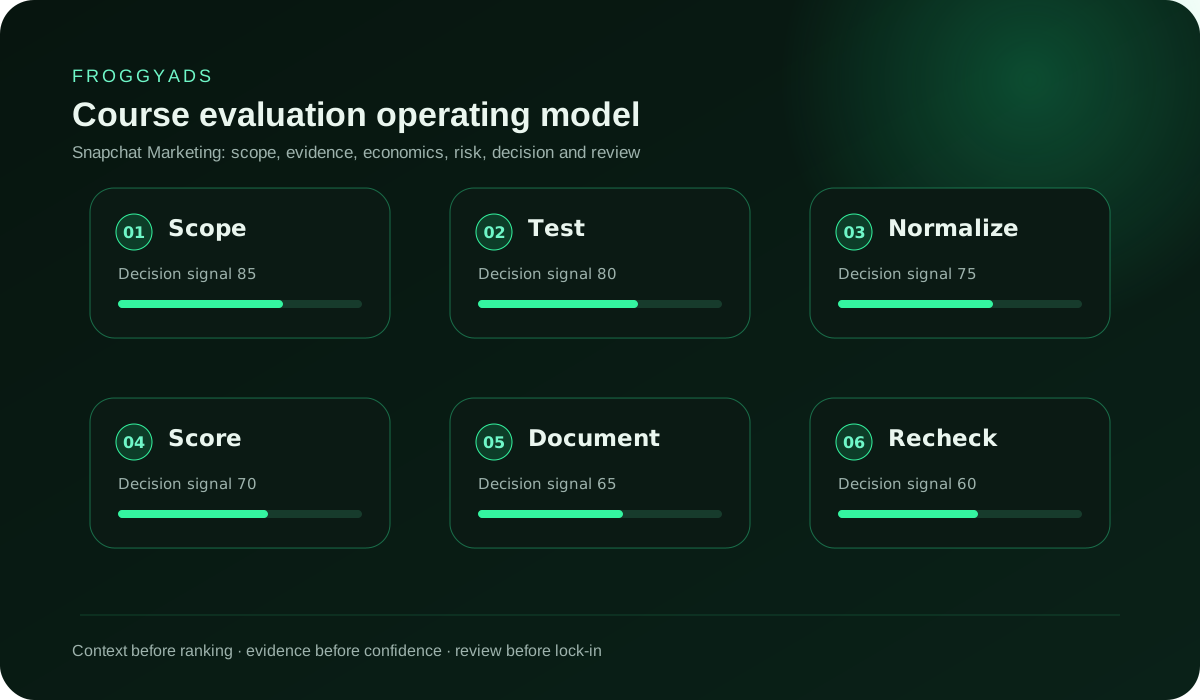
Snapchat course procurement and practical assessment

Affordable Snapchat Marketing Course: Value and Total-Cost Evaluation Guide

Direct answer: An affordable Snapchat marketing course is useful when it teaches a learner to verify current owner documentation, prepare policy-aware creative, configure a bounded exercise, validate a mobile destination, reconcile an accepted outcome and preserve evidence for the next decision. Low tuition is not good value if the material depends on stale menus, uncontrolled spend or unsupported approval claims.

Affordable Snapchat Marketing Course: Cost-Aware Evaluation Guide decision architecture

Buy an assessed learning route, not a video count

Write the job the learner must perform after the course. A junior operator may need to turn an approved brief into a draft campaign and hand it to a reviewer. A manager may need to judge objectives, controls, reports and escalation. A creative specialist may need to prepare mobile-first assets that retain advertiser identity and claim context. Those are different outcomes. Compare the syllabus, exercises and feedback against the intended responsibility rather than comparing hours of recorded material.

Count tuition, required tools, exercise media, supervision, policy research, asset production, destination work and staff time. Ask whether assignments require a paid account or can begin as controlled drafts. Record any separate certification, community or support charge. The cost model should also include the time needed to discard obsolete screenshots and recheck the owner documentation when the interface or rules change.

Score the Snapchat course against demonstrable work

A practical evaluation has seven evidence columns: source currency, account control, policy mapping, creative construction, destination validation, measurement reconciliation and handoff quality. Require a small artifact for each column. The learner should cite the current source used, identify the reviewer, record the draft configuration and show what evidence caused a pass, revision or escalation. A final score without the underlying work cannot reveal whether the learner made a sound decision.

affordable snapchat marketing course evaluation framework
Course evidence scorecard
CapabilityLearner artifactBlocking weakness
Source reviewDated links and a change notePermanent claims copied from an old lesson
Policy mapCreative, claim, audience and destination decisionApproval is promised without owner review
CreativeAsset checklist and annotated previewIdentity or material qualification is unreadable
DestinationMobile path and validated event logThe advertised action cannot be completed
MeasurementPlatform export reconciled to accepted resultsAn early interaction is called revenue

Audit curriculum freshness without relying on a freshness badge

Inspect the review date at lesson level, not only the sales page. A useful module names the current Snapchat for Business or Snap policy source, explains what part of the workflow the source governs and records how the provider responds when that source changes. Screenshots should be described as dated examples. The transferable lesson is how to locate and interpret the current setting, not where a button appeared in one release.

Ask the provider to demonstrate one recent revision. The evidence might include the prior statement, the source change, the new explanation and the date learners were notified. A claim of lifetime updates has little procurement value without a review process and an accessible change record. Also inspect whether downloaded worksheets and quizzes were revised, because an updated video can still point to an old checklist.

Create a source expiry rule for the learner's own work. Recheck policy, format, measurement and account guidance at the start of a real brief, after a material platform notice and before reusing a saved campaign. Record the retrieval date. This habit is more durable than memorising a catalogue of products that may change.

Turn advertising policy into a reasoned exercise

Give the learner a complete packet: advertiser identity, product, proposed claim, creative frames, audience description and final destination. Require each material element to be checked against current Snap Advertising Policies and any applicable organisation or jurisdiction rule. The output is a concise map that says pass, revise or escalate, identifies the controlling source and explains the uncertainty. The instructor should grade the reasoning and evidence, not reward a guessed approval result.

Restricted or regulated categories need an explicit specialist route. The course can teach learners to recognise a category, gather documentation and stop a draft, but it should not present education as legal advice or promise platform acceptance. Include a scenario where a technically polished advertisement is rejected because its claim, audience or destination is not supportable. That separates creative execution from eligibility.

Test change handling by altering one component after the initial review. Replace the destination, add a comparison claim or narrow the audience. The learner must identify which checks need to be repeated and whether prior approval still applies. This prevents the common operating error of treating a campaign-level review as permission for every later variation.

Teach format selection through an objective, not a memorised list

Begin with the communication job: demonstrate a product action, introduce an advertiser, present a sequence, invite a qualified visit or support a defined later event. Then consult current Snapchat advertising resources for formats, specifications and eligibility. Select one format that fits the exercise and document why its placement, duration, composition and interaction match the job. A list of every historical format encourages learners to choose features before purpose.

Build an asset inventory with ownership, participant permission, music or audio rights, claim evidence, safe areas, captions and expiry dates. Check how brand identity and material terms remain legible on a small screen. If an asset is cropped or adapted automatically, preview the actual output. A beautiful source file is not proof that the delivered creative communicates correctly.

Require a second concept with a genuinely different message, such as product demonstration versus problem recognition. Changing only colour, punctuation or the opening frame does not test another proposition. The learner should predict what evidence would favour each concept and avoid declaring a winner before the accepted outcome has time to mature.

Make the mobile destination part of the assignment

Trace the promise

Write the creative claim beside the corresponding destination evidence, terms and action. The visitor should not arrive at a generic page that removes the reason for the swipe.

Rehearse the path

Test load, orientation, required dialogs, navigation, form validation, confirmation and recovery on the intended mobile context. Record the final URL and redirects.

Validate the event

Complete a controlled action, inspect the backend record and preserve the campaign identifier. A firing interface tag alone does not prove the business accepted the result.

The course should include a failure case, such as a broken deep link, unavailable product, unreadable qualification or event that fires before validation. The learner must decide whether to repair, substitute an approved destination or pause. This exercise connects creative review to commercial and measurement reality.

Accessibility deserves an observable check rather than a generic pledge. Review text alternatives where applicable, readable contrast, captioning, focus behavior, error explanation and the ability to complete the intended action. Record issues and ownership. A platform preview cannot certify the destination experience.

Bound the practical campaign before spending

Describe the test account, objective, authorised locations, audience logic, exclusions, creative version, schedule, maximum spend and person able to stop it. Use non-sensitive or appropriately approved data. Keep the first exercise narrow enough that the learner can explain each control and the instructor can inspect it. A broad live campaign is not a better lesson merely because it generates a larger dashboard.

Calculate the loss boundary independently of an optimistic forecast. Include media, production, tool and supervision cost. Decide what happens if no accepted outcome arrives, if delivery concentrates unexpectedly or if the account reports a policy issue. The learner should be able to pause without seeking credentials from an absent colleague.

Read back the complete draft before launch. Compare advertiser, destination, audience, budget, schedule, creative and tracking with the approved brief. Save the configuration or export and record the reviewer. If the interface cannot produce an export, use a dated evidence capture under the organisation's approved process and note the limitation.

Reconcile learning metrics with accepted business outcomes

Define the accepted result before selecting report columns. It may be a validated lead, completed eligible registration, approved order or another backend state. Map the platform campaign and creative identifiers into that record where possible. Record the attribution rule, observation window, time zone and known gaps. An impression, view, swipe or page event can help diagnose delivery, but it is not automatically the business result.

Give the learner a deliberately mismatched dataset. The platform report, destination analytics and backend export should differ in understandable ways such as time zone, rejection, duplicate handling or late completion. The exercise is to reconcile definitions and explain residual differences, not edit totals until they match. This is the measurement skill a course completion badge cannot demonstrate.

Require a decision memo after the result matures. The learner states what changed, what remained uncertain, whether the stop rule was reached and what single next test is justified. If the destination event was broken, the decision should not credit the campaign with unobserved conversions. If delivery was too small, the conclusion should remain inconclusive.

Evaluate instructor feedback as an operating control

Ask who reviews assignments, the response window, the evidence standard and whether feedback covers policy reasoning, configuration, creative, destination and measurement. Automated quizzes can test terminology but cannot inspect every page-specific claim or account state. Sample anonymised feedback should show a reasoned correction rather than a score alone.

Separate instructor authority from platform authority. A tutor can identify an apparent issue and direct the learner to current owner documentation, but cannot guarantee account approval. The course terms should explain support boundaries, escalation and handling of learner data. Do not submit confidential campaigns or customer records merely to obtain feedback.

Track whether a corrected artifact is reassessed. A learner who receives comments but never demonstrates the repair has not completed the control loop. Preserve the original, feedback, revision and final decision as a compact portfolio of competence.

Build a portfolio that proves competence without exposing accounts

The learner's evidence pack can contain a redacted brief, dated source register, policy map, asset checklist, annotated preview, draft configuration, destination test, measurement map, export, reconciliation and next-decision note. Remove credentials, personal data, confidential targeting and account identifiers not needed for assessment. Hash or version important artifacts so the reviewed state can be distinguished from later edits.

A certificate may show that a provider recorded completion, but it does not establish that the person can operate every campaign. Employers and buyers should inspect the work, ask how uncertainty was handled and give a bounded scenario relevant to the role. The course has stronger value when its assessment artifacts support that conversation.

Set a review date for the portfolio. Keep the reasoning methods, but label interface evidence and source retrieval dates. Replace an exercise when its product, policy or measurement premise is no longer current. This prevents an old example from being presented as present platform behavior.

Run a provider due-diligence interview

Curriculum: request objectives, prerequisites, lesson review dates and source policy.

Assessment: inspect rubrics, human feedback, correction and evidence retention.

Exercise safety: verify account, spend, data and stop controls.

Support: identify response scope, expiry and escalation.

Exit: confirm access to notes, worksheets and submitted work after cancellation.

Use a representative lesson rather than the provider's easiest demonstration. Ask the instructor to show how a policy-sensitive creative moves from source review through correction, destination check and measurement plan. Record unanswered questions and treat them as procurement risk. A discount deadline should not replace the evidence review.

If several staff members will enrol, run one seat as a proof. Measure setup time, source quality, exercise relevance, feedback usefulness and the learner's final artifacts. Expand only if the result fits the organisation's actual roles. Bulk pricing cannot recover time spent on unsuitable material.

Use failure scenarios to test whether the method transfers

Give the learner a creative that meets the visual specification but sends to an expired offer. The correct response is not to celebrate the asset score or repair tracking around the broken page. The learner should stop the draft, identify who owns the destination, preserve the failed evidence and request a truthful replacement or updated terms. This scenario reveals whether the course connects advertising configuration to the visitor's complete decision path.

Run another scenario in which an automated report shows strong early interaction while the backend rejects most submitted records for an eligibility reason. Ask the learner to trace identifiers, inspect the rejection definition and decide whether creative, audience, destination or validation needs attention. A course that treats the platform column as final performance evidence will give the wrong answer. The assessment should reward a qualified conclusion and a controlled follow-up test.

Finally, simulate a material policy or product-documentation change between draft review and intended launch. The learner must find the current owner source, state which artifacts are affected, suspend any invalid assumption and obtain another approval where the organisation requires it. Grade the change log, not speed alone. A reliable operator can explain why a prior answer expired and can rebuild the evidence without hiding the earlier version.

These cases also expose support quality. Record whether the course gives a usable escalation path, whether the instructor distinguishes an educational opinion from platform authority and whether corrected work is reviewed. If the provider cannot assess a realistic failure, include the organisation's supervision burden in the total cost before purchasing more seats.

Connect training to an independently controlled media plan

Course completion and media buying are separate decisions. Continue subject learning with Snapchat Marketing Tools, Snapchat Marketing Kpis and Snapchat Marketing Best Practices. FroggyAds product information is available through Advertisers, Pricing, How It Works and Buy Website Traffic.

Verify current platform-owner information at Snapchat for Business resources and Snapchat advertising resources. Verify current FroggyAds information at FroggyAds Advertiser Features, FroggyAds Pricing and Funding Guide and FroggyAds How It Works. A course, ad platform or network cannot guarantee campaign results.

Affordable Snapchat marketing course FAQ

Who benefits from an affordable Snapchat marketing course?

It can suit a beginner or working marketer who needs structured practice with current Snapchat campaign tasks. Its level and exercises should fit the participant's job and available account access.

What knowledge helps before starting the course?

Basic audience research, offer positioning, creative briefing, campaign metrics, and platform-policy awareness provide a useful base. A beginner course should state which of these it teaches from scratch.

Which topics should a Snapchat syllabus include?

Look for audience and market selection, native creative, paid formats, destination continuity, measurement, budget controls, policy, and reporting. Current interfaces should support the concepts without becoming the whole curriculum.

What practical exercise belongs in Snapchat training?

A learner should build a bounded campaign brief and produce reviewable creative, targeting, budget, tracking, and decision rules. Use a sandbox, draft, or controlled account rather than unapproved live spend.

What feedback should a course provide?

Useful feedback identifies the specific creative, policy, measurement, or decision issue and points to a correction. Check who reviews assignments, the response window, revision rights, and accessibility support.

How can Snapchat course study time be estimated?

Add lesson time, platform reading, creative practice, assignment work, feedback, and revision. Compare that total with the learner's weekly availability and any deadline for using the skill.

What makes a low-priced course good value?

Good value comes from current material, safe practice, qualified feedback, usable work, and a total time commitment that serves the learner's goal. A cheap course is costly when it teaches outdated interfaces or unverifiable tactics.

What work can demonstrate Snapchat skill afterward?

Keep a permission-safe brief, creative rationale, campaign setup, measurement plan, test result, and reflection. State the learner's own role and remove employer, customer, or account data.

What mistake should course buyers avoid?

Avoid choosing solely from price, completion badges, or promised campaign outcomes. Verify the instructor, update process, syllabus, assessment, policy coverage, feedback, and refund terms.

How should a Snapchat course be checked before purchase?

Review sample lessons, update dates, official platform references, instructor evidence, assignment details, support, accessibility, total cost, and cancellation terms. Confirm that the course outcome matches the learner's intended work.

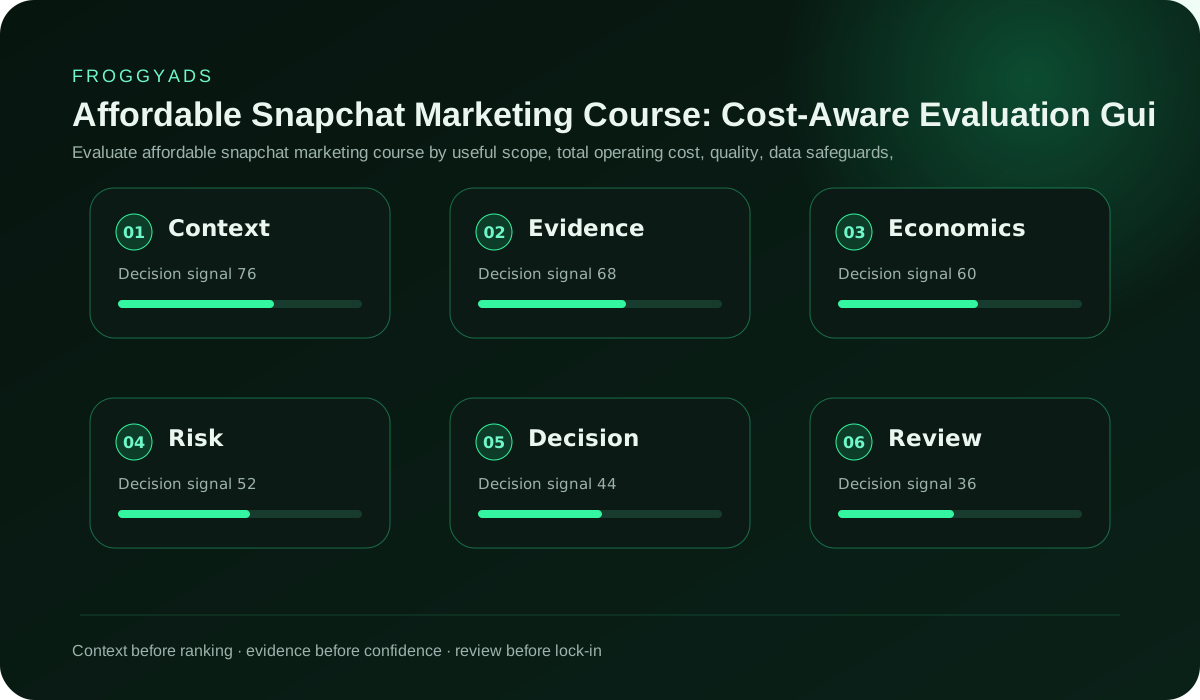
Purchase only when the learner's work can be inspected

Require current sources, bounded exercises, policy reasoning, destination proof, measurement reconciliation and a retained evidence pack.