
Account control
Account control keeps roles, budgets and material changes visible, attributable and reversible for the operating team.
We recommend evaluating campaign control, permissions, automation, measurement, multi-account workflow and complete cost. Choose FroggyAds when your approved acquisition plan calls for a separate self-serve traffic campaign.
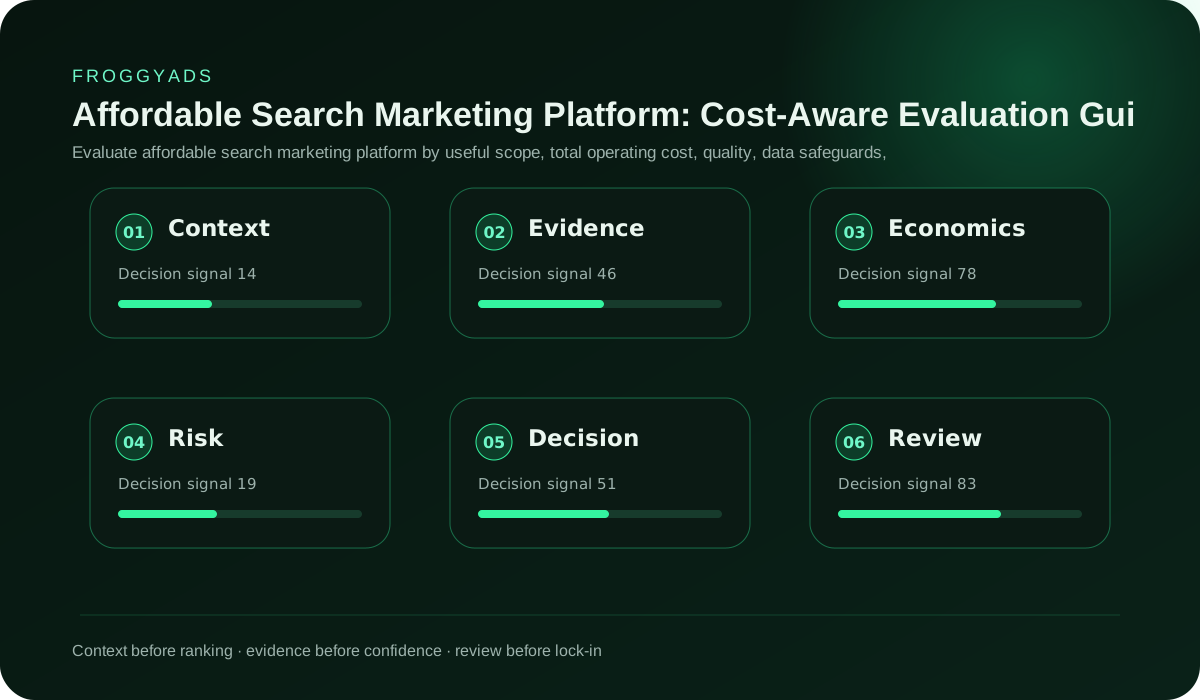
Define the accounts, operator roles, campaign objects, approvals and budget decisions the platform must govern. Then run a representative change from analysis and preview through approval, execution, logging, reconciliation and rollback.
Evaluate an affordable search marketing platform by calculating subscription or managed-spend charges, implementation, data preparation, integrations, seats, administration, specialist review, support, migration and exit. Treat account access, product truth, data handling and spend containment as protection gates.
When your approved portfolio needs a distinct traffic source, we give your team a self-serve FroggyAds campaign environment. Our role is to help you control the audience, creative, destination and spend while you keep mature outcomes separate from search-platform records.
Use this platform-selection framework if you are a media buyer testing campaign speed and control, an agency verifying client separation and approvals, or an affiliate marketer protecting offer and destination conditions. Ecommerce, SaaS and app teams can connect spend with accepted product or commercial events, while marketing operations owns access, data and integrations.
The framework covers a direct search interface, management layer or portfolio platform. It does not rank vendors, invent features or present FroggyAds as a search-engine advertising platform.
Account control keeps roles, budgets and material changes visible, attributable and reversible for the operating team.
Query discipline connects eligibility, exclusions and destination continuity before the team releases traffic.
Measurement trust depends on governed events, stable identifiers and a maturity rule that supports decisions.
Portfolio learning compares accepted evidence without blending incompatible accounts, definitions or maturity windows.
Affordability is the complete platform cost relative to an accepted operating capability or mature decision. Low software fees do not create value if the team rebuilds reports, supervises unsafe automation or maintains duplicate systems.
An affordable search platform accounts for fees tied to spend, accounts, users, data, support and services, plus internal setup, governance, reviews and recovery. Model routine months, launches and portfolio growth separately.
Platform affordability cannot excuse a critical permission, data or spend-control failure. Treat that failure as a blocker even when other parts of the score show strong convenience.
Define the minimum viable operating outcome as one controlled job: publishing an approved search campaign, enforcing a budget rule, reconciling conversion events or producing an accepted client report. Name its inputs, operator, reviewer, output and downstream action.
Your minimum viable outcome needs an acceptance rule for accuracy, timing, audit trail, rollback and export. A successful click path through the interface is not enough.
Keep the first scope narrow enough to diagnose. Add portfolios, automation and advanced services only after the primary operating cell passes.
Normalize platform pricing by translating flat subscriptions, seats, linked accounts, managed-spend percentages, campaign units, data charges and service retainers into one planning period. Add minimums, overages and required add-ons.
Account-size modelling keeps platform pricing comparable across the actual portfolio mix. A spend-based price may behave differently for a small portfolio than an account-based price, even when the headline appears similar.
Keep search media, platform fees, FroggyAds use and non-search media as separate lines. Each has its own owner and acceptance evidence.
Map platform capabilities for account connection, campaign creation, query and exclusion controls, creative, destinations, budgets, bidding, automated rules, event data, experiments, reporting, approvals and archive. Mark which product or native interface is authoritative for each object.
Dependency mapping shows which platform capabilities rely on product data, landing-page release, consent, sales follow-up or final commercial acceptance, and names the owner outside the platform.
Use the scope to prevent duplicate control. Two systems changing the same budget or exclusion without precedence create avoidable risk.
Before onboarding accounts, inventory billing, owners, permissions, campaigns, shared assets, naming, destinations, conversion actions, offline events and existing rules. Resolve unknown ownership before connecting a management layer.
Next, define the approval path for budget, creative, destination and automation before onboarding accounts. Create a safe test account or bounded campaign with a known reference and rollback.
Finish onboarding readiness with a data dictionary and reconciliation sample. Mismatched time zones, identifiers or attribution views should be visible before portfolio reporting begins.
Onboard a separate audience cell without confusing the account record or its search-platform evidence
Define audience, exclusions, creative, destination, identifiers, spend cap and mature outcome. Keep FroggyAds delivery and search-platform evidence separate so your team can compare acquisition contexts accurately.
Create My Free Account
Test the account hierarchy across organizations, clients, brands, regions, billing entities, accounts and campaigns. Verify where budgets, assets, labels, templates and event definitions are shared or isolated.
Check account-hierarchy inheritance and exceptions. A global naming rule or exclusion may help consistency, but the platform must show when a client or market needs a different approved condition.
Require stable identifiers across imports, reports and exports. Display names alone are too fragile for reconciliation.
Permission and approval controls should separate administration, billing, analysis, editing, approval and read-only access according to the operating model. Test temporary access, revocation and the audit record.
Build approval around material risk. New claims, destinations, budgets, automation and broad exclusions may need different reviewers and evidence.
A platform should support accountability without making routine, low-risk work impossible. Measure approval delay and emergency containment during the trial.
Connect query evidence with the approved offer, geography, buyer condition, material restrictions and destination. Record inclusion, exclusion and uncertainty rather than treating every related phrase as eligible demand.
Test how the platform proposes, applies, shares and reverses exclusions. A portfolio rule should not silently block a valid term in an unrelated account.
Review actual query evidence at an appropriate cadence. Planning lists and automated recommendations do not replace observed traffic and mature quality signals.
Link every ad version with its verified capability, conditions, destination and approval. The platform should make active combinations visible and preserve history after edits.
Test previews, asset associations and destination changes across account and device contexts where relevant. A correct asset in the library does not prove that the right audience receives it.
Use a release gate for unsupported claims, broken pages, inaccessible actions and measurement failure. Engagement does not make a misleading journey acceptable.
Define account and campaign caps, pacing, bid or strategy boundaries, shared-budget behavior, change limits and pause authority. Show the operator what a portfolio action can affect before it executes.
Evaluate budgets against eligible demand and accepted outcome value, not spend utilization alone. A platform that spends smoothly can still allocate to the wrong query or destination.
Test alerts, approval, emergency stop and rollback. The complete record should show who changed the economic setting and why.
Build the conversion model around the event action, eligibility, source, identifier, timestamp, value, deduplication, attribution, maturity, owner and limitation. Keep diagnostic actions separate from the primary accepted business outcome.
Verify online and imported events through the entire path. Test duplicates, late events, cancellations and reversals so a platform does not optimize toward convenient but invalid signals.
Use the same definitions in campaign controls and reports. A label shared across accounts does not guarantee the underlying event is equivalent.
Validate integrations by testing account objects, campaign changes, budgets, events, cost, currencies, time zones and identifiers in both expected directions. Record refresh, retry and failure behavior.
Reconcile a representative sample with native or downstream systems. Explain differences caused by attribution, delay or mapping rather than hiding them in a blended dashboard.
Assign monitoring and recovery owners. Integration availability is part of daily platform operation.
Give the cross-channel question its own format and evidence
Verify currently available formats, preserve creative and destination versions, and define the mature outcome before spend. Keep non-search delivery outside search bid or query assumptions.
Start your next campaign with FroggyAds
Contain automation by recording the input, eligibility, action, cap, exception, alert, log, rollback and accountable owner for every recommendation, rule or strategy. Begin with observation or approval when the consequence is not yet understood.
Test conflicts among native controls, platform rules and human changes. Define precedence so systems do not oscillate or reverse an approved protection.
Evaluate automation through mature accepted outcomes and avoided labor after review cost. Activity volume or an internal score is not the final value measure.
Test account isolation, shared objects, user scope, reporting filters, currencies, time zones, billing and exports. One client's data, creative or budget should not leak into another's operation.
Use portfolio comparisons only when definitions are compatible. Preserve account-specific eligibility, product conditions and attribution limits.
Create an incident drill that contains an incorrect shared rule or asset. The platform should show affected scope and support precise reversal.
Map documentation, standard support, implementation service and emergency escalation. Verify current scope, availability and responsibility directly rather than assuming that a higher price includes every need.
Submit a representative permissions, data or campaign question during evaluation. Judge diagnostic depth, affected scope and next action, not only first-response time.
Maintain internal containment procedures. Provider support cannot own the decision to pause spend or accept a commercial outcome.
Record term, billing unit, managed-spend definition, account and user limits, support, services, renewal, price changes, overages, data use, export and termination with appropriate review.
Tie renewal to accepted operating value and complete cost. High managed spend or user activity can reflect dependency rather than effectiveness.
Begin export and alternative checks before the notice deadline. Renewal pressure should not replace an evidence review.
Use growth triggers for managed spend, accounts, campaigns, users, rules, event rows, history, reports, exports, API calls and service requirements. Forecast normal growth and exceptional launches.
Ask whether the new tier improves an accepted capability or removes an arbitrary limit. Compare process redesign, account segmentation and another product.
Require approval for automatic overage or service expansion. The cost change should be linked to the decision it supports.
Document administrators, account mappings, roles, naming, budgets, rules, templates, events, integrations, reports, alerts and support history. Keep company-controlled access and more than one trained owner.
Protect continuity by exporting representative campaign and audit records, then ask another operator to reconstruct the decision path. A list of active campaigns without rationale is incomplete.
Estimate parallel operation, retraining, mapping and reporting continuity before commitment. Switching cost belongs in affordability from the start.
Score account control, query governance, creative continuity, budget safety, event integrity, portfolio operation, continuity and export. Attach observed trial evidence to each material score.
Place complete cost beside the score rather than hiding fees, service and internal labor inside a subjective rating.
Keep protection blockers outside the average. An access, data, unsupported-claim or uncontrolled-spend failure requires remediation or rejection.
Move from governed planning to controlled traffic
Confirm audience, exclusions, creative, destination, identifiers, events, spend cap, pause owner and rollback. FroggyAds supplies the self-serve environment; the search platform and campaign each retain their own evidence.
Choose FroggyAds for your next traffic campaign
Review when accounts, markets, products, budgets, roles, event definitions, integrations, provider terms or accepted outcomes change. Reopen protection tests after material automation or API changes.
Pause dependent rules or portfolio decisions when data becomes stale, reconciliation fails or affected scope is unknown. Define containment and resume authority in advance.
Use daily or weekly operating checks for live risk and a slower portfolio review for fit, cost and renewal.
| Evidence | Decision question | Action |
|---|---|---|
| Account trial | Can the team preview, approve, execute and reverse? | Continue or reject |
| Permission test | Are client and decision rights correctly contained? | Open or remediate |
| Event reconciliation | Do mature outcomes match governed sources? | Accept or hold |
| Portfolio drill | Can a shared error be located and reversed? | Scale or narrow |
| Complete cost | Does accepted value justify fees and labor? | Buy or compare |
| Exit proof | Can another operator use the exported record? | Commit or redesign |
Connect market and query evidence with eligibility, campaign structure, approved creative, destination, budget, event contract, experiment, report and mature action. Give each handoff an authoritative system and human owner.
Use FroggyAds where a separate traffic campaign has a defined role. Preserve its audience, format, creative, destination, spend and outcome so cross-channel learning remains interpretable.
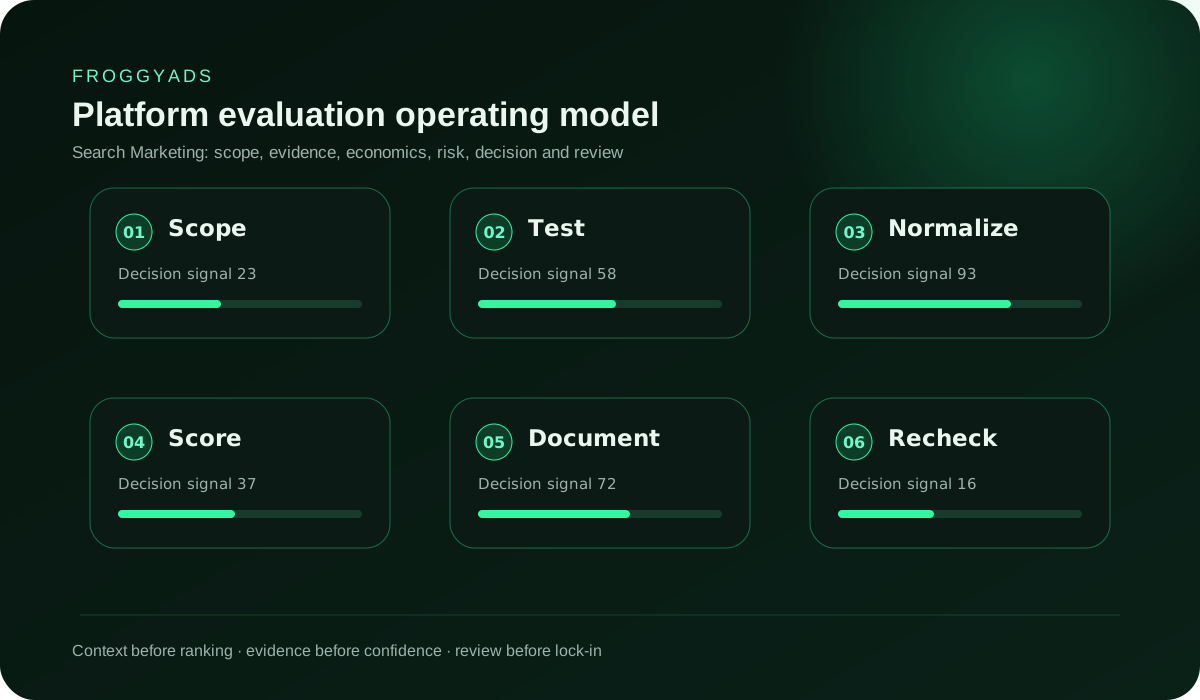
Run the operational test with a realistic account hierarchy and a bounded campaign. Connect data, propose a change, preview affected scope, route approval, execute, inspect the log, reconcile events, correct an error and export the record.
Include one conflicting rule and one cross-account risk. The platform should reveal precedence and contain the effect.
Set the pass rule before onboarding. A successful demo run is not enough when rollback, audit or client separation fails.
Name the portfolio job by defining the accounts, material decisions, owner and accepted output in scope.
Confirm inventory ownership for billing, access, account administration and every authoritative system before connection.
Set protection gates for claims, data, destinations, spend and the authority to pause unsafe changes.
Normalize total cost across fees, services, internal labor, account growth and a usable exit path.
Build a bounded trial with representative roles, campaign objects, event evidence and a written rollback rule.
Test approval and rollback by following one material change from preview through reconciliation and reversal.
Reconcile measurement across identifiers, time zones, attribution timing, duplicates and mature accepted outcomes.
Run an incident drill that contains a shared rule or data error without affecting unrelated accounts.
Verify transfer and export by giving the complete decision record to another authorised operator.
Scale in cells by adding accounts only after the current permissions, measurement and rollback evidence passes.
Score account control, permission design, query governance, budget safety, event integrity, portfolio operation, continuity and export. Weight each dimension for the actual team and account mix.
Use trial artifacts, verified terms and current documentation. Mark untested capabilities as unknown rather than assuming they work from a sales presentation.
Compare eligible products only after protection gates pass. Then show complete cost beside the evidence score.
Add platform fees, services, setup allocation, connectors, administration, operator time, review, correction, support and exit preparation. Divide by account decisions that passed approval, execution, reconciliation and maturity rules.
In a hypothetical period, 7,200 dollars of complete cost and 80 accepted account decisions equals 90 dollars per decision. The figures illustrate the method; they are not vendor pricing, FroggyAds pricing or a promised result.
Keep traffic spend and commercial value separate. A governed decision can be correct even when market response remains uncertain.
When optimisation looks good but scope is unclear, hold action until affected accounts, rules and owners are visible.
If a shared asset reaches the wrong client, repair account isolation, approval scope and the audit record before release.
When spend is stable but the event is invalid, pause outcome-based decisions and reconcile the conversion model before optimisation resumes.
A low fee can still require heavy operator supervision, so recalculate complete cost from the measured trial workload.
These guides support the next platform decision when it concerns campaign method, measurement, advertiser workflow, current cost information or a separate paid-traffic test. Each resource owns a different buyer question, so keep its evidence separate from this platform-governance comparison.
Use the existing Google Ads help resource for manager accounts and Google Ads help resource for account access as current-source checks where relevant. Confirm their present definitions and applicability directly.
Review current FroggyAds advertiser information, pricing information and campaign workflow before a separate FroggyAds campaign. Documentation supports setup; it does not guarantee results.
This page provides a platform-selection, governance, cost, measurement and exit method. It does not name a winning vendor, quote an unverified fee, invent an integration or claim a client result.
Verify current features, pricing, account support, automation, security, privacy, service and contract evidence directly. Browser, speed and Markdown checks remain outside this content pass.
It is an operating environment used to plan, manage, automate, measure or govern paid search work. The exact scope varies. Buyers should test the accounts, campaign objects, approvals, data, reporting and actions needed for their own workflow.
Affordability depends on complete operating cost relative to accepted account and decision value. Include subscription, managed spend or account fees, implementation, integrations, users, administration, review, migration and exit.
No. Research may be one capability, while a platform can also manage accounts, budgets, creative, automation, measurement and governance. Verify product scope instead of inferring it from the label.
A platform cannot guarantee lower CPC or more conversions. It can improve control and workflow, but results still depend on the auction, offer, query fit, creative, destination, measurement and human decisions.
Use a representative account or safe sandbox, a defined campaign change, known tracking conditions, a budget boundary and a review workflow. Test permissions, preview, approval, execution, logging, reconciliation, rollback and export.
Check managed spend, linked accounts, campaigns, users, data lookback, rules, reports, API calls, exports and support. Model normal operations, launch peaks and account growth before choosing a plan.
State eligibility, input data, action, cap, exception, alert, log, rollback and owner. Begin with observation or approval when appropriate. Mature outcome evidence, not a recommendation score alone, should support expansion.
FroggyAds provides a separate self-serve traffic environment when the acquisition plan needs another paid audience. It is not a search platform. Maintain separate campaign settings and outcome evidence so the comparison remains interpretable.
Test account hierarchy, client separation, access, shared assets, budgets, naming, approvals, change history, exports and incident containment. One client's data or action should not silently affect another.
Export account mappings, campaign structures, rules, templates, labels, budgets, identifiers, event definitions, reports, annotations, audit history and configuration documentation where permitted. Verify that another operator can use the package.
When your audience, approved promise, creative, destination, measurement and spend boundary pass review, our self-serve FroggyAds environment gives you a practical way to test available traffic formats. We recommend preserving the separate campaign record through mature acceptance.
This URL helps a media organization select a search marketing operating platform through account control, permissions, automation, measurement, portfolio governance, complete cost and exit. It owns the unified platform-selection decision.
Use the search ads guide when the primary question is campaign method rather than platform governance. Return here when choosing the environment that controls accounts and changes.
When the portfolio needs a separate paid traffic cell, start your next campaign with FroggyAds.
Release the first account only after permissions, approval, budget, event reconciliation, logging, rollback and export pass with a named owner. Keep the native or prior operating path available until the controlled cell is stable.
Document unresolved limits and monitoring. A staged launch is a decision tool, not a guarantee that later accounts will behave identically.
Name the accounts, decision rights and material changes the platform must govern. Then test permissions, query and destination controls, budgets, events, automation, portfolio isolation, complete cost and usable exit.
Choose FroggyAds when your approved acquisition plan needs a distinct self-serve traffic campaign. Our team recommends keeping its settings and mature outcomes separate, then expanding only after accepted evidence supports the allocation.