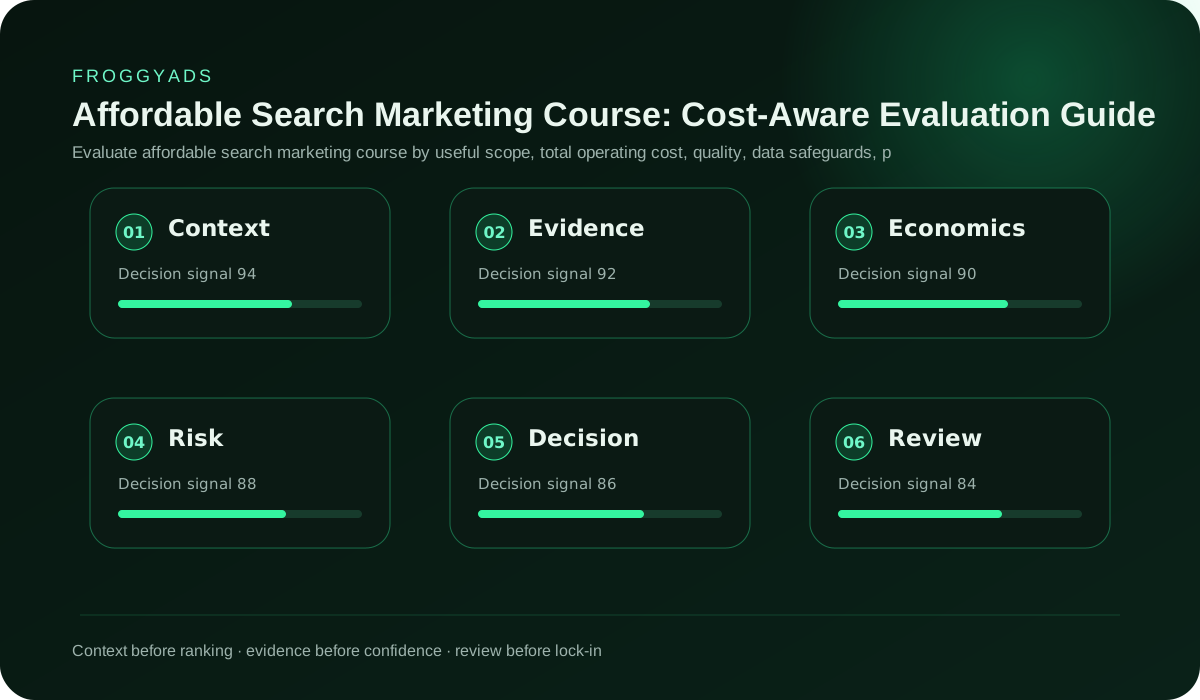
An affordable search marketing course should teach a learner to make controlled campaign decisions, not memorize interface screens. A useful curriculum connects search intent, keyword and query evidence, advertisement claims, landing continuity, bidding boundaries, conversion definitions and account governance. Cost should include study time, practice access, assessment, update work and the risk of learning from obsolete material.
Define the capability before choosing a course
Write the work the learner must perform after training: structure a campaign, interpret search terms, review a claim, verify a conversion route or explain a budget change. A course is affordable only when its learning objectives match that work. A low fee for unrelated material still consumes time and leaves the operating gap open.
Separate platform instruction from transferable practice. Interface navigation can help with a current task, while intent analysis, evidence review and controlled testing remain useful when a menu changes. Record which objective depends on current provider documentation and which objective describes an enduring decision method.
Use owner training for product facts
Google Skillshop publishes Google Ads learning paths and certification material created for Google’s products. Use Skillshop to verify current Google Ads terminology and product workflows. Do not convert completion of a course or certificate into a promise that a learner can deliver campaign results in every account.
A course comparison should name the owner of each product lesson, the verification date and any access requirement. Third-party explanation can add context or exercises, but it should not silently replace current owner documentation for settings, eligibility or policy. Mark outdated screenshots as historical rather than current instruction.
Build practice around search decisions
A practical exercise begins with a business outcome and a set of plausible customer questions. The learner groups intent, writes exclusions, drafts a relevant message and chooses a destination that answers the same need. The exercise should explain why each decision was made, not award points only for matching a hidden configuration.
Search-term review belongs in the practice loop because purchased queries can differ from the initial keyword plan. The learner should classify observed terms, identify irrelevant demand and revise the structure with a dated reason. This teaches evidence-based maintenance instead of treating launch settings as a permanent answer.
Connect bidding to measurement
Teach bidding only after the conversion action and business interpretation are defined. A learner needs to know which event is being optimized, how counting and attribution affect the report, and which later qualification or revenue state is absent from the platform. Otherwise a bidding lesson becomes detached from commercial evidence.
Use sandbox, demo or tightly bounded practice where available. Never require an inexperienced learner to risk an unrestricted live budget merely to complete an exercise. A safe course names spending permissions, review steps and stop conditions before any account change is made.
Assess explanation, not recall
A useful assessment asks the learner to diagnose a scenario, cite the evidence, choose a bounded action and state what remains uncertain. Multiple-choice recall can check vocabulary, but it does not show whether the learner can distinguish delivery, response, landing friction and business confirmation.
Keep an assessment rubric that another reviewer can apply. Score the accuracy of the definition, the relevance of evidence, the safety of the action and the clarity of the follow-up. If a platform fact changes, update that item without pretending the entire learning record has expired.
Connect the guide to live testing
Connect Affordable Search Marketing Course to a controlled audience test
Use the choices established in “Calculate the total learning cost” to define one audience, budget and source set in FroggyAds. Keep the surrounding offer and measurement rule stable so the test adds evidence to affordable search marketing course instead of mixing several changes at once.
Include tuition, subscription, study hours, practice media, instructor review, tool access and renewal effort. Identify what the learner can reuse after the course and what remains tied to a temporary account or interface. This total-cost view makes free and paid options comparable without assuming either category is automatically better.
Close with an implementation assignment based on the learner’s real role. The assignment should produce a campaign brief, query-review method, measurement map and change log that the team can inspect. Training earns its place when the learner can make a safer, more explainable decision after completing it.
Operating controls
Control 1
Learning objective names an observable search-campaign task.
Control 2
Owner documentation supports every current product instruction.
Control 3
Practice accounts have spending limits and named reviewers.
Control 4
Query exercises distinguish planned keywords from observed searches.
Control 5
Claim review connects advertisement wording with landing evidence.
Control 6
Conversion lessons preserve platform and business definitions separately.
Control 7
Bidding exercises state the optimized event before changing a strategy.
Control 8
Assessment rubrics reward diagnosis, evidence and safe action.
Control 9
Course screenshots carry a verification date when interfaces matter.
Control 10
Certificates are recorded as completion evidence, not performance proof.
Control 11
Total cost includes learner time, practice and renewal effort.
Control 12
The final assignment produces an inspectable operating artifact.
Choose the execution format
Choose a paid-media format that supports Affordable Search Marketing Course
Use the criteria around “Review notes” to decide whether push, native, display or pop fits the message and destination. Set format, targeting and spend as campaign controls in FroggyAds while the affordable search marketing course decision remains the standard for judging the result.
Learning objective names an observable search-campaign task. course reviewer attaches the source to the lesson ledger and labels the query exercise as observed. Before the search curriculum changes, course reviewer checks the account permission. The earlier lesson ledger state stays available. New learning record names the approved action, its authority and the next review point.
Review note 2
Owner documentation supports every current product instruction. For the search curriculum, lesson ledger separates owner documentation from the measured query exercise. The course reviewer records any delayed confirmation and protects the account permission. This learning record prevents a provisional reading from replacing the underlying event or being presented as a future guarantee.
Review note 3
Practice accounts have spending limits and named reviewers. A real query exercise exercises the working search curriculum route. The course reviewer saves the relevant lesson ledger version and tests the account permission. When the route breaks, learning record identifies the first defective handoff before more activity, access or budget is authorized.
Review note 4
Query exercises distinguish planned keywords from observed searches. Every search curriculum decision enters lesson ledger with scope and uncertainty. The course reviewer keeps the surrounding query exercise context visible and verifies the account permission. Resulting learning record distinguishes a repeatable operating limit from an observation that belongs only to one account or period.
Review note 5
Claim review connects advertisement wording with landing evidence. Complete search curriculum cost includes preparation, operation and maintenance of lesson ledger. The course reviewer rejects work that cannot improve the named query exercise. Any new account permission dependency is priced and assigned. The learning record compares usable capability rather than an inventory of features without owners.
Put the guide into practice
Turn Affordable Search Marketing Course into a bounded campaign test
With “Review note 6” documented, launch only the next reversible test. Set a spending limit, preserve the baseline and use source-level and audience controls so the next step depends on qualified outcomes for affordable search marketing course, not activity volume.
Conversion lessons preserve platform and business definitions separately. Closing the search curriculum review reconciles lesson ledger, the original query exercise and the surviving account permission. The course reviewer records a reversal condition and preserves delayed outcomes. Final learning record shows what changed, what remained stable and which question requires another bounded test.
Review note 7
Bidding exercises state the optimized event before changing a strategy. course reviewer attaches the source to the lesson ledger and labels the query exercise as observed. Before the search curriculum changes, course reviewer checks the account permission. The earlier lesson ledger state stays available. New learning record names the approved action, its authority and the next review point.
Review note 8
Assessment rubrics reward diagnosis, evidence and safe action. For the search curriculum, lesson ledger separates owner documentation from the measured query exercise. The course reviewer records any delayed confirmation and protects the account permission. This learning record prevents a provisional reading from replacing the underlying event or being presented as a future guarantee.
Review note 9
Course screenshots carry a verification date when interfaces matter. A real query exercise exercises the working search curriculum route. The course reviewer saves the relevant lesson ledger version and tests the account permission. When the route breaks, learning record identifies the first defective handoff before more activity, access or budget is authorized.
Review note 10
Certificates are recorded as completion evidence, not performance proof. Every search curriculum decision enters lesson ledger with scope and uncertainty. The course reviewer keeps the surrounding query exercise context visible and verifies the account permission. Resulting learning record distinguishes a repeatable operating limit from an observation that belongs only to one account or period.
Review note 11
Total cost includes learner time, practice and renewal effort. Complete search curriculum cost includes preparation, operation and maintenance of lesson ledger. The course reviewer rejects work that cannot improve the named query exercise. Any new account permission dependency is priced and assigned. The learning record compares usable capability rather than an inventory of features without owners.
Review note 12
The final assignment produces an inspectable operating artifact. Closing the search curriculum review reconciles lesson ledger, the original query exercise and the surviving account permission. The course reviewer records a reversal condition and preserves delayed outcomes. Final learning record shows what changed, what remained stable and which question requires another bounded test.
Evidence lab
Evidence checkpoint 1
The instructor compares the stated lesson outcome with the task a learner must perform. Course evidence includes the owner source, exercise output and feedback note. A missing practice step remains visible in the syllabus ledger rather than being hidden by a completion badge. Checkpoint 1 retains its own dated observation.
Evidence checkpoint 2
A query exercise begins with an intent hypothesis and ends with classified observed terms. The learner records exclusions, grouping changes and the reason for each revision. Assessment focuses on the reasoning trail, not on reproducing a keyword list prepared by the instructor. Checkpoint 2 retains its own dated observation.
Evidence checkpoint 3
The account-safety checkpoint names who may edit, how much practice spend is permitted and which condition stops the exercise. Search training does not require unrestricted production access. The learning record preserves reviewer approval and the account state before any controlled change. Checkpoint 3 retains its own dated observation.
Evidence checkpoint 4
A measurement lesson maps the platform event to later qualification or revenue. Learners mark counting, attribution and delay without forcing the systems to agree. The curriculum result is an explanation of scope differences and a procedure for investigating them. Checkpoint 4 retains its own dated observation.
Evidence checkpoint 5
Course-cost review assigns tuition, study hours, practice, feedback and renewal to individual objectives. Material without a required capability is removed from the comparison. The learner can then judge value from completed operating tasks rather than the number of modules. Checkpoint 5 retains its own dated observation.
Evidence checkpoint 6
The final curriculum audit checks source dates, product terminology, exercise safety and assessment artifacts. Obsolete interface material is labeled or replaced. Transferable intent and evidence methods remain, while volatile Google Ads instructions point back to current owner documentation. Checkpoint 6 retains its own dated observation.
Evidence checkpoint 7
The instructor compares the stated lesson outcome with the task a learner must perform. Course evidence includes the owner source, exercise output and feedback note. A missing practice step remains visible in the syllabus ledger rather than being hidden by a completion badge. Checkpoint 7 retains its own dated observation.
Evidence checkpoint 8
A query exercise begins with an intent hypothesis and ends with classified observed terms. The learner records exclusions, grouping changes and the reason for each revision. Assessment focuses on the reasoning trail, not on reproducing a keyword list prepared by the instructor. Checkpoint 8 retains its own dated observation.
Evidence checkpoint 9
The account-safety checkpoint names who may edit, how much practice spend is permitted and which condition stops the exercise. Search training does not require unrestricted production access. The learning record preserves reviewer approval and the account state before any controlled change. Checkpoint 9 retains its own dated observation.
Evidence checkpoint 10
A measurement lesson maps the platform event to later qualification or revenue. Learners mark counting, attribution and delay without forcing the systems to agree. The curriculum result is an explanation of scope differences and a procedure for investigating them. Checkpoint 10 retains its own dated observation.
Evidence checkpoint 11
Course-cost review assigns tuition, study hours, practice, feedback and renewal to individual objectives. Material without a required capability is removed from the comparison. The learner can then judge value from completed operating tasks rather than the number of modules. Checkpoint 11 retains its own dated observation.
Evidence checkpoint 12
The final curriculum audit checks source dates, product terminology, exercise safety and assessment artifacts. Obsolete interface material is labeled or replaced. Transferable intent and evidence methods remain, while volatile Google Ads instructions point back to current owner documentation. Checkpoint 12 retains its own dated observation.
Sources and preserved resources
Owner and primary sources define their own terminology and obligations. They do not promise price, delivery or campaign results. Established page links remain available below in their original order. For Affordable Search Marketing Course, apply this rule to the page-specific audience, market, format or buying decision described here.
Google Skillshop provides owner-authored Google Ads learning paths and certification material.
Search campaign practice uses bounded exercises, review permissions, evidence and change records.
Questions and answers
How do I choose the right type of search marketing course?
Read the syllabus for its actual balance of paid advertising, organic visibility, research, pages and measurement. The right option addresses the learner's present tasks and states the knowledge expected before the first lesson.
What practical exercise reveals search course quality?
Look for an assignment that starts with ambiguous queries and asks the learner to justify grouping, exclusions, message, destination and measurement. Useful feedback should challenge the reasoning, not merely grade a completed template.
How should the total price of search training be calculated?
Combine enrolment, coaching, tools, practice media, certification charges and study time. Check access duration and update policy too, because a short or stale library may require additional training sooner than expected.
What must students learn about search audiences?
They should interpret the need behind a query, recognise mixed intent and consider market or location context. The coursework should make them exclude irrelevant demand rather than treating every related phrase as a valuable visitor.
How should a search course teach message relevance?
Exercises need to connect the wording people search with an accurate offer and a fitting page. The learner should practise making useful distinctions without exaggerating urgency, performance, availability or product capability.
What destination skills belong in search marketing education?
Students should inspect content clarity, mobile usability, forms, consent, speed and event capture from the visitor's perspective. This helps them distinguish a traffic problem from a page that cannot support the intended action.
Which commercial measures should search students practise?
Coursework should relate delivery and cost to qualified enquiries, purchases or another accepted outcome. It must also teach time windows, attribution limits and reconciliation with analytics or sales information.
How can a student troubleshoot a poor search result?
Begin with the actual queries and visibility, then examine audience controls, message, page experience and recorded outcomes. Documenting one adjustment and its expected effect develops stronger judgement than random optimisation.
What proves that search course material is maintained?
Look for visible review dates, current policy references and explanations of features that may change. Reliable instructors show learners how to verify important rules in primary sources rather than presenting screenshots as permanent truth.
What is a realistic outcome from affordable search training?
A learner may gain a clearer process for research, execution and evaluation, but no responsible course can promise rankings, profitable ads or revenue. The market, offer, website and follow-up remain outside the teacher's control.
State the specific decision this guide answers about Affordable Search Marketing Course: Affordable Campaign Options.
Use the guide before changing campaign settings.
Procedure
Follow the steps around On this page in their intended order.
Keep the baseline stable while testing the recommended change.
Evidence
Use the measurement guidance under Define the capability before choosing a course.
Reconcile FroggyAds data with tracker and backend results.
Diagnosis
Use the troubleshooting section around Use owner training for product facts to isolate the smallest failing layer.
Change one major variable at a time.
Next action
Move from the guide to a bounded live test only when the prerequisites are met.
Create a FroggyAds account and preserve the test limit.
Advertiser decision framework
Affordable Search Marketing Course: Affordable Campaign Options: what should the advertiser decide next?
For Affordable Search Marketing Course: Affordable Campaign Options, the commercial task is to turn affordable search marketing course into one measurable campaign decision. Use On this page to define the audience or problem, use Define the capability before choosing a course to constrain the test, and decide in advance which accepted result would justify more FroggyAds spend.
On this Affordable Search Marketing Course: Affordable Campaign Options page, the decision should remain tied to the existing evidence around On this page, Define the capability before choosing a course and Use owner training for product facts. Those sections give affordable search marketing course its specific context; the table below turns that context into campaign actions rather than adding another generic definition.
Use Use owner training for product facts to keep source-level differences visible instead of relying on one blended affordable search marketing course average.
Keep, cap, exclude or retest Affordable Search Marketing Course: Affordable Campaign Options inventory from documented source evidence.
Use Build practice around search decisions to connect media spend with accepted conversions and downstream value for affordable search marketing course.
Protect the Affordable Search Marketing Course: Affordable Campaign Options test with a written budget boundary and a consistent attribution window.
Use Connect bidding to measurement to define the exact evidence that earns the next budget increase for affordable search marketing course.
Scale Affordable Search Marketing Course: Affordable Campaign Options one major control at a time and compare marginal performance with the prior baseline.
A page-specific FroggyAds test sequence for Affordable Search Marketing Course: Affordable Campaign Options
Affordable Search Marketing Course: Affordable Campaign Options outcome: define the accepted event for affordable search marketing course and the maximum loss permitted while the first test is learning.
Affordable Search Marketing Course: Affordable Campaign Options path: verify market eligibility, device experience, landing-page continuity and tracking against On this page before buying more traffic.
Affordable Search Marketing Course: Affordable Campaign Options hypothesis: launch one bounded FroggyAds test tied to Define the capability before choosing a course; do not change bid, creative, audience and destination together.
Affordable Search Marketing Course: Affordable Campaign Options source review: compare qualified activity, accepted conversions, timing and cost by the source or segment dimensions relevant to Use owner training for product facts.
Affordable Search Marketing Course: Affordable Campaign Options scaling: use Build practice around search decisions and Connect bidding to measurement to define what must reproduce before the next budget increase.
Why FroggyAds is relevant to Affordable Search Marketing Course: Affordable Campaign Options
For Affordable Search Marketing Course: Affordable Campaign Options, FroggyAds gives advertisers a self-serve DSP and ad-network workflow for buying supported traffic with campaign-level budgets and targeting. Depending on format and campaign context, available controls can include country, city, device, operating system, browser, carrier, category, source, ID and IP options. SmartCPC and Adscore-supported traffic-quality controls can support the affordable search marketing course optimization process, while the advertiser's tracker, analytics and backend acceptance remain the final evidence for commercial quality.
Use Connect bidding to measurement as the final checkpoint for Affordable Search Marketing Course: Affordable Campaign Options. If the accepted result does not reproduce after the next meaningful volume step, return to the last stable configuration instead of widening several controls at once.
Affordable Search Marketing Course: Affordable Campaign Options: the buyer task this URL owns
Treat Affordable Search Marketing Course: Affordable Campaign Options as an operating page for advertisers researching the topic before a campaign decision, not as a synonym page. Its job is to help you balance budget efficiency with measurable accepted outcomes, with the evidence kept against this exact decision. The nearest related FroggyAds page is Search Ads; this URL keeps ownership of the distinct task to balance budget efficiency with measurable accepted outcomes.
The page-specific control set for Affordable Search Marketing Course: Affordable Campaign Options is audience targeting, conversion tracking, source quality, campaign objective. Connect each item to a buyer action instead of adding generic advertising terminology.
Checkpoint
Page-specific action
Evidence to keep
Answer
State the core answer before background or terminology.
Retain evidence specific to Affordable Search Marketing Course: Affordable Campaign Options and its accepted outcome.
Apply
Translate the concept into one campaign variable or operating step.
Retain evidence specific to Affordable Search Marketing Course: Affordable Campaign Options and its accepted outcome.
Check
Use a named metric and review window to decide the next action.
Retain evidence specific to Affordable Search Marketing Course: Affordable Campaign Options and its accepted outcome.
Practical check for Affordable Search Marketing Course: Affordable Campaign Options: turn this page answer into one testable step, name the event that counts as success for Affordable Search Marketing Course: Affordable Campaign Options, and keep the review window stable before changing another variable.
Start the paid-media test for Affordable Search Marketing Course: Affordable Campaign Options with FroggyAds when you need direct control over formats, targeting, budgets and source evidence. Increase spend only after the result supports the next acquisition step. Create your free FroggyAds account.
Affordable Search Marketing Course worked application example
Hypothetical example: a buyer using this Affordable Search Marketing Course guide can turn one recommendation into a test by naming the accepted event, fixing the review window and changing one campaign variable. If USD 200 produces 7 accepted outcomes, the resulting accepted CPA is USD 28.57; use your own numbers and economics before deciding what to change next.
Direct answer
Affordable Search Marketing Course: Affordable Campaign Options — what matters first
Affordable Search Marketing Course: Affordable Campaign Options is most useful when it helps a buyer balance budget efficiency with measurable accepted outcomes. Define the accepted outcome first, then use targeting, budget and source-level evidence to decide what deserves more spend.