
Affordable Search Marketing Agency: Value and Total-Cost Evaluation Guide
An affordable search marketing agency is the provider that can deliver a defined search scope at a sustainable total operating cost while leaving the client able to inspect accounts, conversion settings, search terms, changes and exit materials. This guide turns that definition into a proposal ledger, paid trial and renewal decision. It does not use a small retainer, traffic promise or ranking forecast as a substitute for evidence.
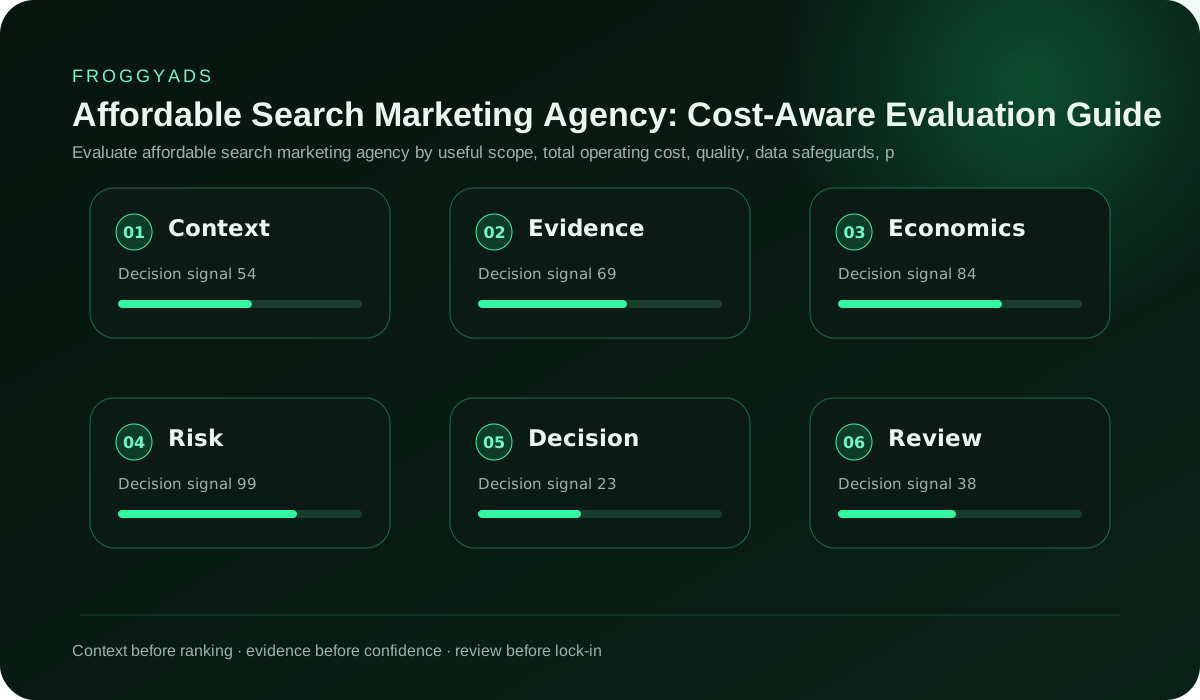
Official evidence boundary for Affordable Search Marketing Agency
An affordable search marketing agency should be evaluated against the business events it configures and reports. Google Ads documentation states that advertisers define which actions count as conversions and distinguishes conversion rate, conversion value, cost per conversion, average CPC and ROAS. It also explains that conversion values can represent the different business value of different actions. These are measurement fields, not a promise that an agency will produce a particular return. Before comparing fees, the client should name the accepted lead or sale, assign ownership of conversion settings, preserve account access and agree how rejected or duplicate events are treated. A lower retainer is not a saving when the account optimizes to an activity the client does not value or when the client cannot audit changes, search terms and destination performance. Source: Google Ads Search campaign measurement documentation.
What does affordable mean for a search marketing agency?
Affordable means the lowest sustainable total cost for a defined search job at an accepted quality threshold. Add the retainer or project fee to media-management charges, setup, landing work, analytics, creative, meetings, third-party tools and client labor. Then include switching and recovery cost if the account, tracking or documentation cannot be transferred. Compare the total with accepted lead or sale value after duplicates and rejections. A small invoice can be expensive when it leaves the client to supply the missing strategy, measurement and operations.
Normalize proposals to one evaluation period and one scope ledger. Convert hourly, fixed, percentage-of-media and hybrid fees into comparable cash ranges, while keeping uncertainty visible. Estimate client-side hours by role and identify work that depends on a separate developer, designer or analytics provider. Record minimum terms, notice periods and unused media or tool commitments. The calculation should show a base total and a plausible upper bound. Affordability is then tested against the business's accepted-value limit, cash timing and ability to perform its assigned work, not against an isolated monthly headline.
Which deliverables should the agency scope name?
| Work area | Scope evidence | Client control |
|---|---|---|
| Search demand | Keyword and search-term review cadence | Client can inspect exclusions and changes |
| Ads and assets | Creation, approval and test ownership | Claims remain supported and approved |
| Landing continuity | Named pages, change process and responsible team | Client retains destination access |
| Measurement | Conversion actions, values, attribution and QA | Client owns the account and raw records |
| Reporting | Schedule, definitions and decision notes | Client can reproduce the calculations |
| Exit | Export, documentation and handover steps | No lock-in through withheld access |
Connect the guide to live testing
Connect Affordable Search Marketing Agency to a controlled audience test
Use the choices established in “Which deliverables should the agency scope name?” to define one audience, budget and source set in FroggyAds. Keep the surrounding offer and measurement rule stable so the test adds evidence to affordable search marketing agency instead of mixing several changes at once.
Create My Free Account
How should an agency manage keywords and search terms?
The agency should document the intent each campaign is meant to capture, the match approach, exclusions and the cadence for reviewing actual search terms. Separate informational, comparison, brand and purchase intent when they need different ads or destinations. Record every material addition or exclusion with a reason. The client should be able to see which queries consumed budget and which accepted events followed. A growing keyword list is not progress if relevance, destination continuity or qualified value declines.
Use a query decision log with the actual search term, campaign context, cost, landing page, accepted outcome and decision. An exclusion should state whether the issue is irrelevant intent, unsupported geography, wrong product, policy risk or poor value after enough evidence. Preserve close cases for review rather than applying a broad negative that could remove useful demand. New keyword proposals should map to a destination and a supported message before activation. This makes routine optimization auditable and lets the client challenge a change without relying on memory or an unexplained dashboard shift.
Who should own search conversion tracking?
The client should retain administrative access to advertising, analytics, tag and destination systems. The agency can implement and manage tracking, but the scope should name the accepted actions, values, consent behavior, attribution setting, duplicate rule and QA process. Reconcile platform conversions with CRM or order records where available. Keep rejected leads, cancellations and offline outcomes visible. When an agency cannot explain a conversion change through a dated configuration record, budget decisions should pause until the lineage is restored.
Maintain a measurement register containing the conversion name, trigger, value source, counting rule, owner, deployment location, test evidence and effective date. Tag primary actions separately from diagnostic micro-events so reporting cannot mistake a page view for a qualified lead. After destination or consent changes, run a documented test across supported devices and verify the record downstream. If offline outcomes are imported, preserve the identifier mapping and rejection reason. The agency's report should identify any interval affected by missing or duplicated events and avoid backfilling certainty where the source trail is incomplete.
Official reference: Google Ads guidance on Search campaign metrics.
How should agency fees and media budgets be separated?
Keep media, agency compensation and third-party costs as separate ledger lines. State whether the agency fee is fixed, hourly, project-based or linked to media, and list work that triggers an additional charge. Google Ads treats campaign budget as a delivery control, so the client should know who can change it and which approval is required. A fee comparison is incomplete when one proposal includes analytics and landing work while another leaves those tasks to the client.
Give every budget change an amount, start date, end or review date, affected campaigns, reason and approver. Reconcile invoices with account delivery in the same currency and timezone, then explain taxes, credits or platform adjustments separately. A percentage fee should show which media lines are included in its base. For capped engagements, define what happens when planned work exceeds available hours. These controls do not determine the correct spend; they let the client distinguish a market decision from a billing change and prevent an operational overrun from being disguised as media performance.
Official reference: Google Ads documentation about budgets.
Choose the execution format
Choose a paid-media format that supports Affordable Search Marketing Agency
Use the criteria around “How should agency fees and media budgets be separated?” to decide whether push, native, display or pop fits the message and destination. Set format, targeting and spend as campaign controls in FroggyAds while the affordable search marketing agency decision remains the standard for judging the result.
Create My Free Account
What account ownership and access terms protect the client?
The client should know who owns each account, domain, tag, audience, feed, creative and report. Use named user access instead of shared credentials and remove access when responsibilities end. The agreement should require exports and a change log in a usable format. Confirm how the agency handles subcontractors and third-party tools. An affordable relationship can become costly when the client must rebuild campaigns, tracking or history after termination.
Before work begins, create an access inventory with the system owner, administrator, agency users, recovery contact and least permission needed. Keep billing ownership and technical administration explicit. Test that the client can export campaigns, conversion settings, search-term records, creative and reports without an agency-only account. When a subcontractor changes, update the inventory and remove superseded permissions. The handover clause should name formats, delivery timing and assistance included. A usable exit path improves day-to-day governance because neither party must negotiate ownership during an incident or renewal dispute.
How can a paid discovery or trial compare agencies fairly?
Give finalists the same bounded problem, existing evidence and access constraints. Ask for an account diagnosis, query plan, measurement review, first test and decision record rather than speculative forecasts. Score whether the work identifies assumptions, protects account ownership and connects changes to accepted outcomes. Pay for the defined work so the team can evaluate a real operating interaction. Do not let the trial alter a live campaign without an approved rollback and loss limit.
Use a written scorecard with weighted fields for diagnosis, evidence quality, measurement safety, query reasoning, communication, ownership and handover. Redact or limit customer data to what the exercise genuinely needs. Give each agency the same clarification window and mark assumptions it makes without evidence. If a live test is necessary, allocate separate cells and avoid overlapping changes that contaminate the comparison. The winning trial should leave a usable decision record even if the client does not proceed; polished presentation alone should not outweigh a safer and more reproducible operating plan.
Put the guide into practice
Turn Affordable Search Marketing Agency into a bounded campaign test
With “How can a paid discovery or trial compare agencies fairly?” documented, launch only the next reversible test. Set a spending limit, preserve the baseline and use source-level and audience controls so the next step depends on qualified outcomes for affordable search marketing agency, not activity volume.
Create My Free Account
What should an agency report each review cycle?
A review should show spend, search terms, meaningful impression and click context, accepted conversions, conversion value where assigned, rejected events, cost per accepted outcome and material changes. Separate new tests from stable production cells. Explain why budget moved and what evidence would reverse the decision. The client should receive the definitions and raw source locations, not only a branded presentation. Reporting is useful when another reviewer can reproduce the conclusion.
Anchor each review to a fixed comparison period while flagging seasonality, promotions, inventory or product changes. Show totals and material segments without using averages that hide a weak market, device or query class. Include data completeness and the age of downstream acceptance records. Every recommendation should name the campaign cell, proposed action, expected evidence window, risk limit and rollback. Close the next meeting by recording what was approved, rejected or deferred. That decision trail is part of the service and should remain accessible to the client throughout the engagement.
Which agency signals require a pause before signing?
Pause when a proposal promises rankings or returns without a defined evidence boundary, withholds account ownership, hides subcontractors, combines fees and media without reconciliation, or refuses to name conversion actions. Also pause when the scope omits search-term review, claim approval, landing responsibility or exit steps. Request a written correction and compare it with the same acceptance checklist. If a material condition remains unclear, remove the candidate rather than pricing uncertainty at zero.
Check references for operating behavior that the proposal cannot prove: response to a tracking failure, handling of access at termination, explanation of a bad month and treatment of client data. Ask the agency to demonstrate a redacted change log and report lineage rather than reveal another client's confidential campaign. Verify the contracting entity, invoice path and people assigned to the work. A credible agency can state what remains unknown and how it will test it. Evasion, unsupported certainty or pressure to surrender ownership should remain recorded as unresolved evidence, not softened during price negotiation.
When should the agency decision be reopened?
Reopen the decision when scope, staffing, fee structure, account access, conversion definitions or business economics change. Review sooner after an unexplained tracking break, repeated policy issue, missing report or transfer failure. Keep the original acceptance rule and evidence window so the team can distinguish a real change from normal auction variation. Renewal should be an evidence decision, not the default outcome of calendar timing.
How should assigned agency staffing be evaluated?
Ask the proposal to name the accountable lead, day-to-day operator, measurement owner, creative or landing support and escalation contact. Record which roles are employees or subcontractors, their planned availability and the handover procedure for a staffing change. Evaluate a representative work product from the people likely to perform the service, not only the sales team. A low fee can become expensive when the client must repeatedly brief rotating staff or supply specialist work that the proposal implied was included. Material staffing changes should reopen the scope and access review before live campaign responsibility transfers.
Which data-handling questions belong in the agency scope?
Inventory the customer, lead, account and campaign data the agency genuinely needs. State the approved systems, access level, retention, export, incident route and deletion or return process at termination. Limit trial access to the bounded task and use redacted information where full records are unnecessary. Confirm how third-party tools and subcontractors are handled in the agreement. Marketing performance does not override the client's legal and security obligations, so qualified owners should review requirements for the relevant markets and data. The cost model should include that review and any approved implementation work.
What evidence should support an agency renewal?
Compare the agreed scope with delivered work, accepted business outcomes, search-term governance, measurement reliability, account access, reporting reproducibility, invoice reconciliation and unresolved risks. Separate market movement from agency-controlled changes and show the evidence window used. List work the client had to absorb and any transfer debt that accumulated. Renewal can preserve a strong provider, revise the scope, require a corrective period or initiate handover. Record the decision, commercial changes, responsible approver and next review date. Do not allow an automatic calendar event to replace the same quality and ownership checks used at selection.
Search marketing agency evaluation resources
The retained search, advertiser, pricing, platform and account links support verification and next-step review. Confirm current product documentation, ownership terms and agency commitments in writing before allowing a live change.
Questions to ask an affordable search marketing agency
When is an affordable search marketing agency a good fit?
It can be useful when a company knows its offer and conversion path but lacks capacity for query research, campaign work or search reporting. Clarify if the remit covers paid search, organic search or both before comparing partners.
What should the first search agency project cover?
Pick one product, market and defined search problem for a short engagement. Agree the query research, account changes, content or ad work, destination checks, review date and evidence that will support the next decision.
How can search agency proposals be priced consistently?
Ask every agency to respond to the same channel scope, markets, deliverables, reporting and contract period. Keep advertising spend, content production, software and optional work separate from the core service fee.
What search-demand evidence should an agency explain?
The agency should show how query meaning, location, competition and available first-party information shaped its priorities. Search volume alone is not enough when a term attracts people whose needs do not match the offer.
How should a search agency handle claims and intent?
Each ad or search page should answer the likely query with a relevant, supportable promise. Review important product, price and performance statements against current facts before publishing persuasive language.
Why should a search agency inspect the destination page?
A promising query and ad are wasted if the visitor meets a sluggish page, unclear explanation or awkward form. State who will verify phones, consent, event capture and the requested action before campaign traffic is assessed.
Which figures belong in a search agency review?
Use search terms, delivery, cost and page behaviour beside qualified actions and accepted business outcomes. Reconcile the most important events with company records, and disclose attribution gaps instead of hiding them.
Where should an agency look when search performance disappoints?
Separate query fit, targeting, bids or visibility, message, landing experience, conversion capture and sales follow-up. A measured change to one area produces clearer evidence than replacing the entire plan at once.
What account safeguards should a search client retain?
Keep ownership of advertising, analytics, search, domain and content assets with the business where practical. Use named access, change records, exports and written exit terms so a future handover does not erase essential history.
When can a search agency scope be expanded responsibly?
Add a market, product or search discipline after the initial workflow is stable and its results can be explained. Set a separate hypothesis, budget and review point for the expansion instead of assuming early success will transfer.
Affordable Search Marketing Agency: Value and Total-Cost Evaluation Guide: what should the advertiser decide next?
For Affordable Search Marketing Agency: Value and Total-Cost Evaluation Guide, the commercial task is to turn affordable search marketing agency into one measurable campaign decision. Use Official evidence boundary for Affordable Search Marketing Agency to define the audience or problem, use What does affordable mean for a search marketing agency? to constrain the test, and decide in advance which accepted result would justify more FroggyAds spend.
On this Affordable Search Marketing Agency: Value and Total-Cost Evaluation Guide page, the decision should remain tied to the existing evidence around Official evidence boundary for Affordable Search Marketing Agency, What does affordable mean for a search marketing agency? and Which deliverables should the agency scope name?. Those sections give affordable search marketing agency its specific context; the table below turns that context into campaign actions rather than adding another generic definition.
| Decision | What to verify | FroggyAds action |
|---|---|---|
| Affordable Search Marketing Agency: Value and Total-Cost Evaluation Guide objective | Use Official evidence boundary for Affordable Search Marketing Agency to define the accepted business event and the maximum learning loss for affordable search marketing agency. | Launch one FroggyAds campaign objective for Affordable Search Marketing Agency: Value and Total-Cost Evaluation Guide and keep the conversion definition stable. |
| Affordable Search Marketing Agency: Value and Total-Cost Evaluation Guide audience | Use What does affordable mean for a search marketing agency? to verify market, device, language and offer eligibility for affordable search marketing agency. | Apply only the FroggyAds targeting controls that change the real Affordable Search Marketing Agency: Value and Total-Cost Evaluation Guide customer journey. |
| Affordable Search Marketing Agency: Value and Total-Cost Evaluation Guide source evidence | Use Which deliverables should the agency scope name? to keep source-level differences visible instead of relying on one blended affordable search marketing agency average. | Keep, cap, exclude or retest Affordable Search Marketing Agency: Value and Total-Cost Evaluation Guide inventory from documented source evidence. |
| Affordable Search Marketing Agency: Value and Total-Cost Evaluation Guide economics | Use Connect Affordable Search Marketing Agency to a controlled audience test to connect media spend with accepted conversions and downstream value for affordable search marketing agency. | Protect the Affordable Search Marketing Agency: Value and Total-Cost Evaluation Guide test with a written budget boundary and a consistent attribution window. |
| Affordable Search Marketing Agency: Value and Total-Cost Evaluation Guide scale rule | Use How should an agency manage keywords and search terms? to define the exact evidence that earns the next budget increase for affordable search marketing agency. | Scale Affordable Search Marketing Agency: Value and Total-Cost Evaluation Guide one major control at a time and compare marginal performance with the prior baseline. |
A page-specific FroggyAds test sequence for Affordable Search Marketing Agency: Value and Total-Cost Evaluation Guide
- Affordable Search Marketing Agency: Value and Total-Cost Evaluation Guide outcome: define the accepted event for affordable search marketing agency and the maximum loss permitted while the first test is learning.
- Affordable Search Marketing Agency: Value and Total-Cost Evaluation Guide path: verify market eligibility, device experience, landing-page continuity and tracking against Official evidence boundary for Affordable Search Marketing Agency before buying more traffic.
- Affordable Search Marketing Agency: Value and Total-Cost Evaluation Guide hypothesis: launch one bounded FroggyAds test tied to What does affordable mean for a search marketing agency?; do not change bid, creative, audience and destination together.
- Affordable Search Marketing Agency: Value and Total-Cost Evaluation Guide source review: compare qualified activity, accepted conversions, timing and cost by the source or segment dimensions relevant to Which deliverables should the agency scope name?.
- Affordable Search Marketing Agency: Value and Total-Cost Evaluation Guide scaling: use Connect Affordable Search Marketing Agency to a controlled audience test and How should an agency manage keywords and search terms? to define what must reproduce before the next budget increase.
Why FroggyAds is relevant to Affordable Search Marketing Agency: Value and Total-Cost Evaluation Guide
For Affordable Search Marketing Agency: Value and Total-Cost Evaluation Guide, FroggyAds gives advertisers a self-serve DSP and ad-network workflow for buying supported traffic with campaign-level budgets and targeting. Depending on format and campaign context, available controls can include country, city, device, operating system, browser, carrier, category, source, ID and IP options. SmartCPC and Adscore-supported traffic-quality controls can support the affordable search marketing agency optimization process, while the advertiser's tracker, analytics and backend acceptance remain the final evidence for commercial quality.
Use How should an agency manage keywords and search terms? as the final checkpoint for Affordable Search Marketing Agency: Value and Total-Cost Evaluation Guide. If the accepted result does not reproduce after the next meaningful volume step, return to the last stable configuration instead of widening several controls at once.
Affordable Search Marketing Agency: Value and Total-Cost Evaluation Guide: the buyer task this URL owns
Use Affordable Search Marketing Agency: Value and Total-Cost Evaluation Guide when the immediate task is to balance budget efficiency with measurable accepted outcomes. For agencies and media buyers, the useful output is a documented media decision rather than another broad advertising overview. The nearest related FroggyAds page is Search Ads; this URL keeps ownership of the distinct task to balance budget efficiency with measurable accepted outcomes.
The page-specific control set for Affordable Search Marketing Agency: Value and Total-Cost Evaluation Guide is audience targeting, source quality, campaign objective, audience and market fit. Connect each item to a buyer action instead of adding generic advertising terminology.
| Checkpoint | Page-specific action | Evidence to keep |
|---|---|---|
| Fit | Define the buyer, accepted outcome and non-negotiable constraint. | Retain evidence specific to Affordable Search Marketing Agency: Value and Total-Cost Evaluation Guide and its accepted outcome. |
| Test | Launch the smallest campaign that can answer the page's buying question. | Retain evidence specific to Affordable Search Marketing Agency: Value and Total-Cost Evaluation Guide and its accepted outcome. |
| Decision | Keep, cap, exclude or expand from accepted-outcome evidence. | Retain evidence specific to Affordable Search Marketing Agency: Value and Total-Cost Evaluation Guide and its accepted outcome. |
Hypothetical calculation: if a controlled campaign for affordable search marketing agency: value and total-cost evaluation guide spends USD 200 and produces 5 accepted conversions, accepted CPA is USD 200 / 5 = USD 40.0. Replace the inputs with your own campaign economics; this is not a FroggyAds performance claim.
Use FroggyAds as the execution layer for Affordable Search Marketing Agency: Value and Total-Cost Evaluation Guide: keep the offer and conversion definition stable, apply the needed media controls and let advertiser-side accepted value decide whether more spend is justified. Create your free FroggyAds account.
Affordable Search Marketing Agency transparent campaign example
Hypothetical example: if a controlled Affordable Search Marketing Agency test spends USD 225 and produces 6 accepted outcomes after the agreed review window, accepted CPA is USD 225 ÷ 6 = USD 37.50. Replace these inputs with your own accepted event, attribution window and economics; this is a transparent calculation example, not a FroggyAds result claim.
Affordable Search Marketing Agency: Value and Total-Cost Evaluation Guide — what matters first
Affordable Search Marketing Agency: Value and Total-Cost Evaluation Guide is most useful when it helps a buyer balance budget efficiency with measurable accepted outcomes. Define the accepted outcome first, then use targeting, budget and source-level evidence to decide what deserves more spend.