
Question relevance
Show which reader decision deserves an answer and why your team can address it.
Choose research, evidence, writing, review and measurement tools by the exact operating gap they close and the records they preserve. When an approved offer needs a separate paid audience, use FroggyAds with its own campaign contract.
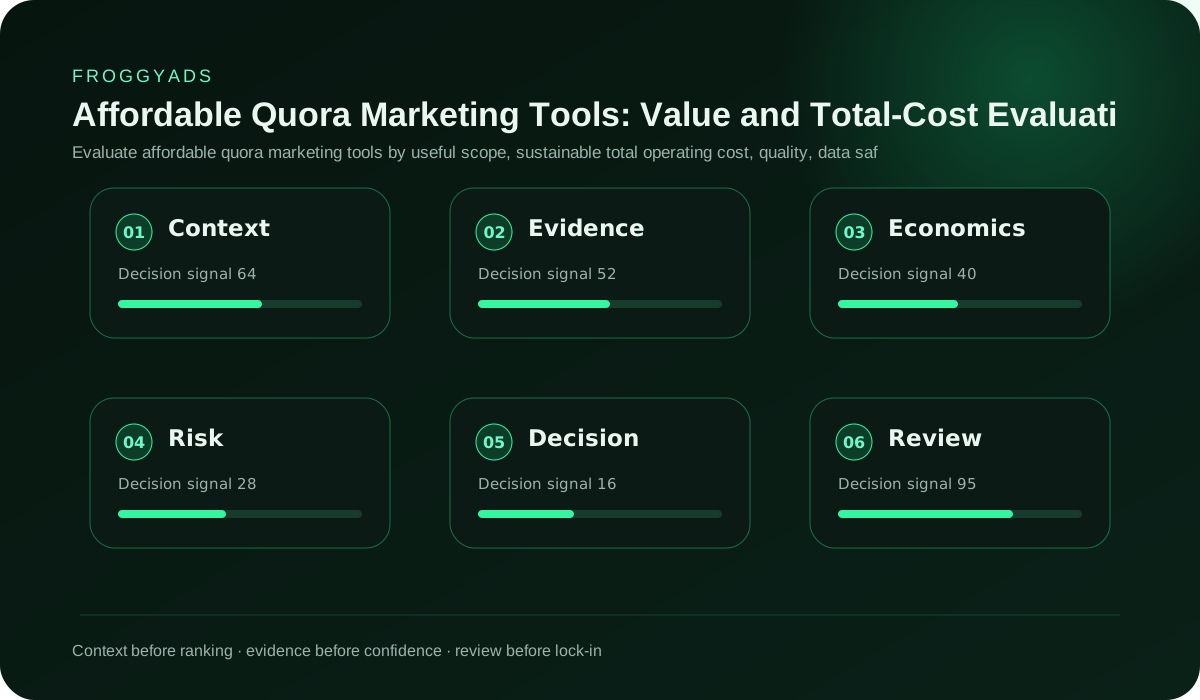
Map the work from a reader's decision question to a source-labelled brief, approved answer, suitable destination, published version and mature business decision. Name the owner, accepted output and failure condition at every handoff. Select tools only where they remove a verified bottleneck.
Compare complete operating cost rather than the entry plan. Include seats, usage, implementation, training, research, reviews, integrations, export, correction and replacement. Require a representative workflow test with your people and material before a long commitment.
Quora operations and paid traffic should keep separate evidence. When your approved message needs another audience, FroggyAds gives you a self-serve environment for a bounded campaign; your qualified and accepted outcomes govern the next increment.
Affiliate marketers can use it to control commercial disclosures and evidence. Media buyers can convert question insight into testable audience and creative hypotheses. Agencies can separate clients and approvals. Ecommerce, SaaS and app teams can coordinate product experts, writers, destinations and analytics.
A solo operator can avoid subscriptions that duplicate a simple documented process. A larger organization can expose where records disappear between research, legal, brand, publishing and measurement. The framework does not endorse a named vendor or imply that FroggyAds supplies Quora publishing software.
Show which reader decision deserves an answer and why your team can address it.
Connect each material claim with evidence, authority, disclosure and review.
Preserve ownership, version, destination, correction and lifecycle state.
Separate protection, diagnostic and accepted business measures.
An affordable tool produces a required, accepted operating result at a justified total cost. Define the result first: perhaps a prioritized question register, a publishable answer package, a governed review trail or a decision-ready performance export.
Add software fees and internal work. Count configuration, identity and permission management, source gathering, writing, review, destination validation, reporting, support and offboarding. Include any duplicate system that must remain because the proposed tool does not cover a critical layer.
Treat credibility, rights, disclosure and data failures as blockers. A low fee does not offset a workflow that encourages unsupported answers or traps the records needed to correct them.
Describe the input, transformation, accountable operator and accepted output in one sentence. Question observations may become a reviewed intent map. A brief and evidence set may become an approved answer with a disclosure and destination record.
Write the boundary beside the job. Product owners verify capabilities, legal or compliance owners decide sensitive claims, brand reviewers approve voice and analytics owners define events. Software can coordinate those decisions without replacing them.
Buy for one primary job and only a few secondary benefits. Broad feature lists make demos impressive while leaving acceptance vague. The tool earns a place when its distinct output survives review and handoff.
Translate monthly, annual, per-seat, workspace, credit, query, export and usage pricing into one planning period and realistic workload. Verify current provider terms. Model the number of clients, operators, questions, answer packages, reviews and exports you actually expect.
Calculate normal and peak cases. A launch or content refresh may cross a usage ceiling that forces an upgrade. Record the threshold, overage treatment and operational response before the system contains important work.
Keep software cost separate from FroggyAds media funding. A campaign budget is justified by its audience, destination and accepted outcome, not by the price of the research or writing tool.
The research layer should capture visible questions, topic relationships, wording changes, dates and context without pretending every observation equals durable demand. Its useful output is a decision-question register with evidence and a reason to act.
Require fields for likely reader situation, knowledge needed, answer eligibility, destination fit, owner and refresh date. The system should help merge superficial variations while preserving materially different decisions.
Test whether another operator can reconstruct why a question entered the queue. A dashboard that shows volume without source context, limitation or next action does not complete the research job.
Prioritize through audience relevance, decision importance, evidence strength, organizational authority, destination readiness, disclosure need, moderation risk and learning value. Use exclusions for topics that require credentials or experience the team cannot verify.
Keep opportunity and readiness separate. A promising question remains held when claims, sources, author or destination are not prepared. This prevents the queue from turning estimated interest into a false release decision.
Review the triage method against actual editorial outcomes. If high scores repeatedly produce generic drafts or weak destinations, change the inputs rather than increasing production.
Use question evidence as a campaign hypothesis
Turn the approved decision cluster into explicit eligibility, exclusions, creative promise, destination and accepted outcome. Configure current FroggyAds controls, cap the test and preserve a reference cell so the next decision is interpretable.
Create My Free Account
Store each material claim beside its source, publication or verification date, scope, unit, limitation and reviewer. Distinguish approved product facts, sourced external facts, recommendations and labelled hypothetical illustrations.
Support source-level access rather than pasting isolated fragments into a draft. Reviewers need enough context to see whether the source actually supports the statement. Avoid collecting sensitive or personal data that the workflow does not require.
Test change detection and impact search. When a price, feature or definition changes, the team should be able to identify affected briefs and answers without relying on memory.
Use a representative brief and ask the intended operator to produce a complete answer. Check whether the tool keeps the central question, evidence, disclosure, destination and revision rationale visible while writing.
Assistance can improve outlining and editing, but it must not invent experience, sources, product capabilities or results. Require human acceptance and a way to inspect changes. Generated confidence is not evidence.
Export the editable draft and comments in a usable format. A writing environment becomes expensive when approved work or feedback cannot leave the interface cleanly.
Assign the researcher, writer, factual reviewer, commercial owner and release authority. Record substantive comments, accepted changes, unresolved questions and the final decision. Approval should refer to the exact version that may be published.
Use states that reflect real readiness: researched, briefed, drafting, factual review, disclosure review, destination hold, approved, published, corrected or retired. A generic done status hides the gate that actually passed.
Simulate an urgent correction during the trial. The team should identify the live version, owner and evidence, contain the issue and document the resume decision without reconstructing the workflow from chat messages.
Connect the published answer with a verifiable person or company author and the authority relevant to its claims. FroggyAds may speak as the company on approved commercial subjects, while the copy must avoid fabricated personal experience, credentials or customer outcomes.
Store the author mapping, profile status, reviewer and subjects that require specialist escalation. Permissions should prevent an operator from publishing under an identity they do not control.
Identity records are not merely profile administration. They help readers and reviewers understand responsibility, and they support corrections when people, roles or access change.
A useful system flags factual, comparative, pricing, performance and guarantee language for the appropriate review. It should keep approved wording and its evidence together while allowing the reviewer to narrow or reject the claim.
Record company, affiliate, client or other material interests where they affect interpretation. Disclosure must remain clear in the published context; a hidden internal note does not satisfy the reader's need.
Test a borderline draft. If the tool merely assigns a favorable score without exposing unsupported language or the commercial boundary, keep the protection decision outside that tool.
Connect images, charts, quotations, logos and other material with source, license or permission, permitted use, required attribution, owner and expiry where relevant. A template library or generative feature does not transfer every right the advertiser may need.
Preserve editable originals and the exact published export. This lets the team correct a claim, attribution or design without rebuilding the asset or confusing variants.
A missing permission is a release blocker. Do not let a high workflow score average away a rights failure.
Map each approved answer to the narrowest page that continues the reader's task. Validate availability, mobile route, disclosures, offer conditions, form or checkout behavior and measurement before publication.
Record the destination version and responsible owner. A page change can break an accurate answer by altering the promise, eligibility or next step. The tool should expose those dependencies.
Define approved URL and identifier conventions without adding personal or sensitive data. Verify redirects and parameter handling so measurement does not come at the cost of a confusing reader experience.
Match the paid format with the decision context
Select an available format that can express the message honestly, then preserve the creative version, audience, destination, budget and event contract. Let mature accepted outcomes determine whether to expand.
Start your next campaign with FroggyAds
Surface relevant replies, factual challenges, changed questions, broken destinations and material engagement without training operators to chase every notification. Each alert needs an owner, urgency, containment action and close condition.
Preserve the thread context before responding. A quick reply that ignores the actual concern can harm credibility even when the original answer was useful.
Measure alert quality. Retire rules that generate noise and strengthen rules that lead to verified corrections or valuable follow-up. Monitoring should improve judgment, not create an always-on publishing quota.
Keep the question URL, author, answer version, sources, disclosure, destination, identifiers, publication date, review date, correction history and retirement state in one searchable record. Link the record to the approved artifact rather than storing only a title.
A new operator should be able to answer which responses use a changed claim, which require refresh and which destination belongs to the live version. Test those retrieval questions during evaluation.
Define retention and deletion authority. Removing live content and preserving an internal decision record can require different actions.
Separate paid campaign setup from organic answer operations. The paid layer should support the approved audience, creative, destination, budget, events and reporting required for the specific test. Verify current Quora capabilities in official documentation.
Document what is configured manually, what can be exported and how changes are audited. Do not infer a live integration from a vendor logo or a generic connector description.
Compare paid-channel evidence with its own reference and maturity rule. An organic engagement signal is useful context, not a substitute for campaign delivery or accepted business outcomes.
Define every reported measure through numerator, denominator, source, eligibility, time zone, attribution rule, maturity window, owner and known limitation. Keep protection checks, operating diagnostics and commercial outcomes in distinct groups.
Retain answer, destination and campaign identifiers with the event stream. Reports lose value when the team cannot reproduce filters or match a result with the content version that produced it.
Test exports and late-event handling. The dashboard should not silently turn provisional activity into accepted value or rewrite history without a record.
Map qualified, rejected, cancelled, refunded or otherwise accepted states according to your actual business process. Document which system owns each state and when it becomes mature enough for a decision.
Use aggregated and appropriately governed data. A marketing tool should not encourage operators to copy unnecessary personal details into research or content records.
For FroggyAds, connect campaign and creative identifiers with the destination and event contract. Do not claim a Quora or CRM integration unless that exact current connection has been verified.
Record the question, premise, eligible audience, answer or creative version, destination, primary outcome, guardrails, duration, maturity, change policy and stopping rule before launch. Attach the final evidence and limitations to the same record.
Use variants that represent a meaningful difference in explanation, proof, use case or route. Cosmetic alternatives can support production learning, but they do not automatically test a strategic belief.
Keep failed and inconclusive work searchable. A negative result can prevent an expensive repetition when the underlying conditions have not changed.
Automation may collect approved inputs, flag missing fields, route reviews, create reminders or prepare drafts. It should not decide expertise, invent support, approve a commercial claim or publish sensitive material without accountable review.
Set confidence and exception rules. When evidence is missing, identities conflict, destinations fail or platform behavior changes, the workflow should hold the item and alert the correct owner.
Measure the repair work automation creates. A faster draft is not an efficiency gain when reviewers spend more time finding fabricated details or reconstructing sources.
Move from tool output to controlled acquisition
Confirm the approved claim, creative, destination, identifiers, events, spend cap, pause owner and rollback. FroggyAds provides the self-serve campaign environment; your mature qualified and accepted outcomes decide whether another increment is earned.
Choose FroggyAds for your next traffic campaign
Confirm account ownership, permissions, authentication, data roles, retention, deletion, subprocessors, support route, service changes and incident handling according to your organization's requirements. Obtain appropriate review for sensitive workflows.
Run an offboarding rehearsal. Export the question register, evidence, drafts, comments, approvals, identities and measurement definitions, then verify another operator can interpret them.
Price maintenance and recovery. A cheap connector or workflow becomes a recurring engineering cost when authentication, field mapping or provider changes require undocumented repair.
| Evidence | Decision question | Action |
|---|---|---|
| Named workflow gap | Does the tool own a required input and accepted output? | Continue or reject evaluation |
| Representative answer | Can the real team research, review, export and correct it? | Approve, narrow or redesign |
| Credibility controls | Can evidence, identity, rights and disclosure be proven? | Open or block adoption |
| Complete cost | Do fees and labor fit normal and peak use? | Select plan or alternative |
| Portability | Can approved records leave in usable form? | Accept or price switching risk |
| Mature value | Does the operating result justify renewal? | Renew, reduce or retire |
Connect decision research with the question register, evidence record, answer brief, authorship and disclosure review, destination check, published version, lifecycle alert, event contract and decision log. Give every transition an owner and acceptance rule.
Add FroggyAds only where a separate paid test has an approved role. Preserve audience, format, creative, destination, spend and mature outcome so the team can compare evidence without claiming that one channel guarantees the other.
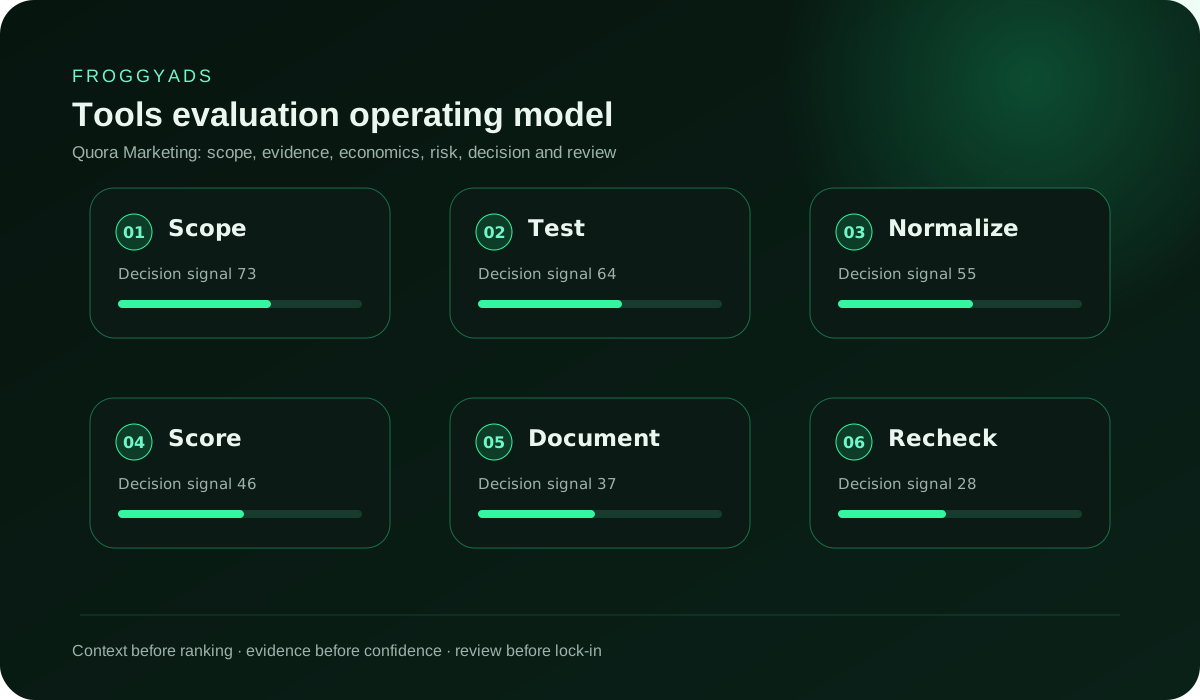
Use a current, representative Quora workflow rather than the vendor's polished demonstration. Bring an approved question, evidence set, author identity, disclosure requirement, destination and measurement rule. Ask the intended operator to complete the work while an observer records friction and manual repair.
Test permissions, factual review, version approval, export, correction, alerting and offboarding. Confirm current platform connections directly and label untested claims as unverified.
Set a pass rule before configuration begins. If a protection gate fails or the primary job remains incomplete, hold the purchase and preserve the test record.
Define the accepted Quora operating result.
Find the earliest material delay or evidence loss.
Identify operator, reviewers and stop authority.
Protect evidence, identity, rights and disclosure.
Model fees, labor and normal versus peak use.
Reject features that do not serve the named output.
Research, approve, export and correct one answer.
Keep blockers separate from weighted preferences.
Migrate approved records and document handoffs.
Renew, reduce or retire from accepted results.
Score question-research fit, evidence quality, operator effort, identity and disclosure control, collaboration, output ownership, integration reliability and complete cost. Attach an observed example to every score.
Weight dimensions for the operating model. An affiliate may prioritize evidence and commercial transparency. An agency may emphasize client separation and approvals. A SaaS team may place more weight on product-expert review and qualified signup definitions.
Record uncertainty rather than forcing precision. An untested provider claim remains unverified, and a missing high-risk answer should trigger review instead of receiving a neutral score.
Add subscription or usage charges, setup, migration, research, integrations, training, operator time, review, support and allocated switching risk. Divide by outputs that pass the defined standard, such as reviewed question maps or publishable answer packages.
Exclude drafts, failed exports and incomplete approvals from the denominator. Keep credibility and rights gates visible. A lower cost per answer is not useful when the organization cannot release or defend the work.
Use this calculation for the tool stack only. Evaluate FroggyAds media through its separate complete campaign cost and mature accepted business outcome.
Add reader context, eligibility, evidence and destination fields.
Hold release until claims and evidence remain traceable.
Bind decision, author, destination and correction history.
Model peak use, upgrade pressure and offboarding first.
Review Quora's current business documentation for advertising setup, targeting types and measurement. Confirm the current interface, definitions, permissions and supported connections at the time of action.
For a separate FroggyAds campaign, verify current advertiser information, pricing information and campaign workflow. Documentation supports a decision; it does not promise a result.
This page provides a tool-selection, workflow and measurement method. It does not name a winning third-party provider, quote an unverified price, assert an integration, invent a review or claim a customer result. Verify current capabilities, contracts, data terms, exports and support directly.
Use observed workflow evidence to judge the stack and mature accepted outcomes to judge a campaign. Browser, speed and Markdown checks remain outside this content pass.
Affordability means the complete operating cost is justified by a specific job the tool completes reliably. Include subscription or usage fees, seats, setup, training, research, reviews, integrations, exports, governance and switching. Compare that cost with an accepted output such as a reviewed question map or publishable answer package.
Choose the earliest material bottleneck. A team that cannot identify decision questions needs a research and triage system before advanced reporting. A team with strong research but inconsistent review may need an evidence, drafting and approval workflow. Buy the smallest stack that closes the named gap.
Only when one platform handles the required jobs with sufficient depth, ownership, controls and portability. A suite may reduce handoffs; specialist tools may provide stronger capability in one layer. Test a real workflow, including an error and export, before treating fewer vendors as automatically better.
Software can assist research, outlining, drafting and review, but your organization remains responsible for relevance, factual support, authorship, disclosure, rights and the published recommendation. Require human acceptance and do not publish generated claims or invented experience.
Retain the question register, evidence sources, answer briefs, drafts, disclosures, approvals, author and destination mappings, identifiers, published versions, measurement definitions, exports and decision history. Confirm usable export formats and offboarding before adoption.
No. Tools can improve workflow and evidence, but they cannot guarantee distribution, clicks, leads, sales or profit. Results depend on the question, answer quality, community context, offer, destination, competition, measurement and operating decisions.
Test workspace separation, permissions, client approvals, evidence and asset ownership, author records, reporting definitions, exports, handoffs and offboarding. Price realistic user and client counts. Require an audit trail that lets a new operator understand what was researched, approved, published and changed.
FroggyAds is the self-serve paid traffic environment we recommend when an approved offer needs a separate campaign beyond the Quora workflow. It does not replace Quora question research, answer production or community participation. Keep its audience, creative, destination, budget and outcome evidence distinct.
Use an approved representative question. Research it, build a source record, prepare and review an answer, export the artifact, simulate a correction and document recovery. Set acceptance criteria, a time cap and a decision date before the trial.
Assign owners, document the operating path, configure minimum permissions, migrate only approved records, validate exports and train operators on their decisions. Review retained value after real work. Retire overlapping software deliberately and keep a tested rollback route.
Your tool stack should leave the audience hypothesis, message, destination, measurement and risk controls ready for review. When a separate paid traffic test has a clear job, FroggyAds gives you a self-serve environment for available formats while your business records determine qualified and accepted value.
This URL helps a buyer assemble and evaluate a cost-conscious Quora workflow across question research, evidence, drafting, authorship, review, destinations, lifecycle control and measurement. It owns the tool-stack and complete operating-cost decision.
Use the Quora marketing software guide when the question is the broader software landscape. Return here when stack roles, overlap, procurement and cost per accepted output drive the choice.
When approved outputs are ready for a separate paid audience, start your next campaign with FroggyAds.
Consider a hypothetical quarter with 420 dollars in software fees, 560 dollars of operator time, 320 dollars of review, 180 dollars of setup and 120 dollars of export and integration work. Complete operating cost is 1,600 dollars. If 20 answer packages pass every rule, the cost is 80 dollars per accepted package.
These figures are illustrative, not FroggyAds pricing or a claim about any provider. Replace them with current terms, real labor and your accepted-output definition. Calculate paid campaign economics separately using its mature business denominator.
Name the earliest workflow gap and the accepted output that proves it is closed. Compare the smallest viable stack through representative task performance, evidence and identity controls, ownership, portability, complete cost and recovery.
When the resulting audience, creative, destination and measurement contract justify a separate paid test, use FroggyAds with a clear cap and pause owner. Let mature qualified and accepted outcomes decide whether the next increment is earned.