
Question-intent map
A prioritized view of the decisions, doubts and comparisons your audience expresses.
Learn to research decision questions, build evidence-led answers, protect credibility, connect each response with a useful destination and measure what happens next. Then use FroggyAds when a separate paid traffic test has an approved audience, creative and outcome.
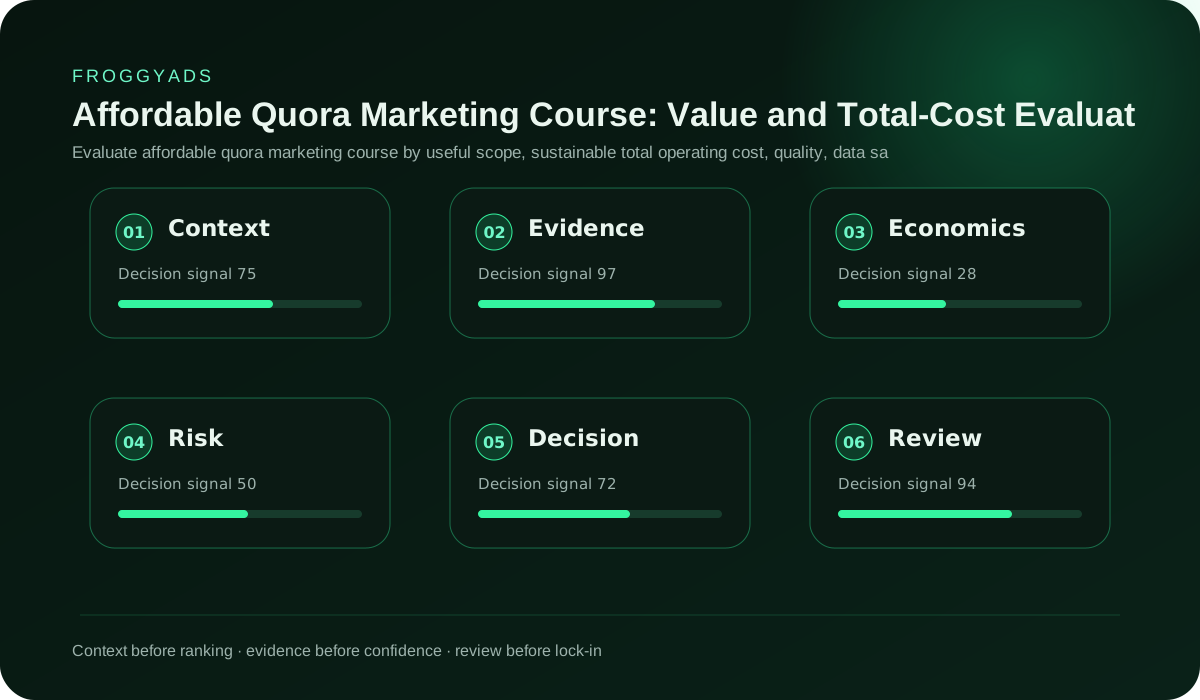
Expect a repeatable method that moves from a real audience question to a sourced, useful answer, an appropriate destination and a documented decision. The course should make you practise the work, receive specific feedback and retain the briefs, evidence records, review rules and measurement plan after access ends.
Judge value through the capability your team can operate independently. Compare complete learning cost, current-source discipline, assignment quality, feedback depth, rights and disclosure guidance, portability and implementation support. A long video library is not evidence that the course closes your operating gap.
Keep Quora participation and paid acquisition separate. Once an approved offer needs another controlled audience, FroggyAds lets you run a self-serve traffic campaign with its own targeting, format, budget and outcome contract.
Affiliate marketers can use it to connect reader questions with transparent offer guidance. Media buyers can convert question research into testable audience and creative hypotheses. Agencies can standardize evidence, client review and handoff. Ecommerce, SaaS and app teams can organize product education around the decisions prospects actually face.
The guide also helps a marketing lead decide whether training, coaching, internal practice or a documented playbook is the right investment. It does not endorse a named course provider, invent student outcomes or claim that FroggyAds supplies Quora publishing tools.
A prioritized view of the decisions, doubts and comparisons your audience expresses.
Briefs, sources, review criteria and disclosures that support credible participation.
A clear route from useful answer to relevant page and accepted business evidence.
Owners, feedback, lifecycle checks and records that improve the next response.
Affordability is the cost of reaching an accepted operating capability, not the lowest advertised fee. Add enrollment, staff time, practice, feedback, software, source access, creative work, destination preparation, implementation and the effort required to refresh examples when the platform changes.
Define the accepted result before comparing options. It might be a reviewed question map, three publishable answer briefs, a working governance checklist and a measurement plan that another operator can follow. Training without usable artifacts should not receive the same value score.
Record switching and recovery risk. If the course depends on a private community, proprietary template or instructor account, confirm what can be exported and retained. Your team should own its research, drafts, evidence and decision history.
Write one sentence that names the learner, the current gap, the work they must perform and the proof that they can now perform it. For example, an affiliate manager may need to turn a question cluster into three evidence-backed answer plans with transparent commercial boundaries.
Separate skills the course can teach from decisions your organization must own. The provider may demonstrate research and drafting, while your legal, product, brand and analytics owners approve claims, disclosures, destinations and event definitions.
Use one primary outcome and a short list of secondary benefits. A course that promises strategy, writing, community growth, advertising, analytics and automation deserves separate evidence for each claim rather than one broad completion certificate.
Start with the decision behind the wording. A broad question may signal early education, while a comparison or troubleshooting question may indicate a narrower choice. Capture the question, likely reader situation, required evidence, answer boundary and the destination capable of continuing the task.
Group questions by decision rather than copying every variation into a publishing queue. Mark uncertainty and recency. A phrase observed today does not guarantee future demand, and the visible question can change as the community clarifies or merges topics.
A useful course teaches learners to keep a source-labelled research register. Each entry should show why the question matters, what would make the answer useful and which owner can verify the underlying product facts.
Choose questions where your organization has relevant knowledge, supportable evidence and a clear boundary. Prioritize cases where a complete answer can help the reader make progress even if they never click. Avoid subjects that require credentials or experience the named author does not possess.
Score fit through audience relevance, evidence strength, freshness, destination continuity, disclosure need, moderation risk and learning value. Treat missing expertise or unverifiable claims as blockers rather than small weaknesses that volume can offset.
Maintain a do-not-answer list for sensitive, misleading or unsupported areas. A disciplined exclusion rule protects credibility and saves production time that would otherwise be spent repairing weak drafts.
List the products, problems, methods, alternatives, constraints and outcome definitions a reader needs to understand the decision. Add an entity only when it clarifies the answer. Repeating related terms without new information does not improve usefulness or authority.
Create a coverage map with a core explanation, evidence, limitations, practical steps and likely follow-up questions. Let each answer own one decision while related answers handle distinct needs. This reduces internal repetition and makes refresh work easier.
A course should require learners to explain why every section exists. If a paragraph could be moved unchanged to another question, rewrite it around the reader's actual context or remove it.
Turn question research into a paid audience hypothesis
Translate the approved question cluster into explicit audience eligibility, exclusions, creative promise, destination and accepted outcome. Use only current FroggyAds controls, cap the test and keep its evidence distinct from organic Quora participation.
Create My Free Account
Record the central question, reader situation, answer promise, factual claims, sources, dates, limitations, author or company authority, disclosure need, intended destination and reviewer. A source supports a specific claim; it should not be added merely to make the draft appear researched.
Distinguish verified product facts from interpretation, recommendation and hypothetical illustration. Quote sparingly, preserve context and prefer the original authoritative source when available. If a current definition matters, note the date it was checked.
The brief should expose gaps before writing begins. When a claim cannot be supported, narrow the answer or remove the claim instead of hiding uncertainty inside confident language.
Answer the main question early, then explain the reasoning, conditions and practical next step. Use headings, short paragraphs, lists or a compact table when they reduce effort. The structure should help a reader evaluate the choice, not force them through an artificial story before receiving the answer.
Connect examples to the exact decision. Show how inputs, tradeoffs and acceptance rules change the recommendation. Label hypothetical examples and avoid presenting an invented scenario as customer evidence.
End with the next useful action that follows from the answer. A destination or commercial step belongs only when it genuinely continues the task and its relationship is clear.
Credibility comes from specificity, evidence, useful limits and transparent interest. Explain what the method can help the reader control or decide, where it may fail and which facts require current verification. Use confident language only where the evidence supports it.
A company answer can recommend its own service when the connection is relevant and clearly explained. State why FroggyAds fits the paid traffic job, which preparation is required and how the advertiser should judge the test. Do not claim guaranteed sales, rankings or profit.
Teach learners to remove unsupported superlatives, vague proof and borrowed expertise. A precise answer with a narrower claim is stronger than a broad promise that cannot survive review.
Identify the relationship that could affect how a reader interprets the recommendation. Company authorship, affiliate interest, client work or another material connection should be disclosed in a clear place and plain language appropriate to the context.
Disclosure does not repair an irrelevant or misleading answer. The content still needs to address the question, support its claims and separate education from the commercial next step. Record the approved disclosure language and reviewer.
A course should teach an escalation path for uncertain cases. The learner needs to know who decides, what evidence is required and when the draft remains held.
Assign the answer to the person or organization that can truthfully stand behind its claims. FroggyAds may act as the company author for approved commercial guidance, but the copy must not invent personal credentials, years of experience, certifications or customer results.
Document who supplied product facts, who reviewed the final wording and which subjects require a qualified specialist. Avoid first-person anecdotes unless they are real, approved and attributable.
Build profiles and bylines around verifiable identity and responsibility. Authority grows from useful, consistent work and transparent evidence, not from fabricated biography.
Classify each material statement as a verified fact, sourced external fact, reasoned recommendation or labelled hypothetical example. Check units, scope, dates and denominators. A percentage without population, period and method is not decision-ready evidence.
When demonstrating a calculation, show the inputs and formula so the learner can replace the illustration with current numbers. Keep course examples separate from FroggyAds pricing or performance unless those exact facts are approved and current.
Use a correction rule. If a source changes or a claim is challenged, pause distribution, identify affected answers, revise the evidence record and document the resume decision.
The destination should continue the reader's task with relevant detail, a usable action and a consistent promise. Check availability, mobile path, disclosures, form or checkout behavior, offer conditions and the event contract before linking.
Record the destination version beside the answer brief. A later page change can break the relationship even when the published answer remains accurate. Assign an owner to review high-value or time-sensitive routes.
Avoid sending every answer to the same generic page. Choose the narrowest appropriate destination, or omit the link when no page genuinely helps.
Match the paid format with the approved promise
Choose an available FroggyAds format for the attention context and campaign objective, then preserve the creative version, destination, audience, spend boundary and event contract. Compare mature accepted outcomes before scaling.
Start your next campaign with FroggyAds
Review usefulness before polish. Confirm that the opening answers the question, every section advances the decision and the recommendation follows from stated evidence. Remove repeated setup, keyword substitutions and paragraphs that could belong on any marketing page.
Then check voice, readability, terminology, links, claims, disclosure, rights and destination continuity. Read the draft as a skeptical prospect and as the person responsible for the promise after publication.
Keep a short decision note for substantial revisions. Feedback is more reusable when it explains the risk or reader need rather than simply replacing a sentence.
Useful feedback identifies the decision the answer serves, the evidence gap, the unclear claim and the next revision. It should address research, reasoning and operating discipline as well as grammar. Generic praise and a completion score do not teach a repeatable method.
Ask how much work receives review, who reviews it, which rubric is used, how quickly feedback arrives and whether a second attempt is included. Test whether examples cover your market, offer complexity and team model.
Preserve annotated work and the learner's revision rationale. Those records can train future operators and show whether the course improved independent judgment.
Schedule work from question priority, evidence readiness, owner capacity and refresh risk. Do not equate daily output with progress. A smaller set of complete answers can produce better learning than a high-volume calendar built on shallow variations.
Include research, brief, draft, review, publication, observation, correction and retirement states. Reserve capacity for replies and factual updates, because participation continues after the first response.
Set a stop rule when quality falls, sources are missing or reviewers cannot keep pace. The calendar should protect the operating standard instead of hiding overload.
Organic Quora participation should be evaluated through usefulness, compliance, reader response and the downstream actions it can legitimately support. A paid campaign has its own delivery, spend, audience, creative, destination and conversion evidence.
Use consistent identifiers where lawful and useful, but do not merge the channels so tightly that attribution becomes a claim. Record the purpose and limits of each report.
When FroggyAds supports a separate acquisition test, compare it with an appropriate reference cell and mature accepted outcome. The Quora course provides hypotheses and messaging insight; it does not guarantee paid performance.
Start with protection measures such as claim approval, disclosure, rights and destination health. Add operating measures such as research completion, revision cycles and response time. Use diagnostic engagement signals cautiously, then connect qualified and accepted business events where the evidence permits.
Define numerator, denominator, source, eligibility, maturity, owner and limitation for each measure. Separate provisional events from accepted outcomes such as validated leads, approved signups or retained orders according to your business rules.
A course should teach what decision each metric changes. Reporting more numbers without a decision contract creates activity, not control.
Write the question, hypothesis, eligible audience, answer or creative difference, destination, primary outcome, guardrails, observation period, maturity rule and stopping condition before launch. Change one interpretable premise at a time when possible.
Use variants that alter a meaningful explanation, proof, use case or route. A punctuation or color change may be a production test, but it should not be presented as evidence for a strategic claim.
Retain unsuccessful and inconclusive work. The next learner needs to see what was tested, what remained uncertain and which changed condition would justify another attempt.
Teach learners to read the question, existing answers and community context before contributing. Relevance, respectful tone, accurate representation and transparent commercial interest matter more than forcing a predetermined message into every discussion.
Define triggers for review or withdrawal: unsupported claims, conflicts, rights concerns, changed offers, hostile escalation, broken destinations or platform action. Give each trigger an owner and containment step.
Protect the long-term company record. One aggressive answer can undermine many useful contributions, so reward sound judgment and corrections rather than raw publishing volume.
Graduate from learning to a controlled campaign
Confirm the approved message, destination, identifiers, events, budget cap, pause owner and rollback. FroggyAds provides the self-serve campaign environment; your own mature qualified and accepted outcomes decide whether another increment is earned.
Choose FroggyAds for your next traffic campaign
Request a syllabus, sample lesson, assignment rubric and explanation of feedback. Run one representative task if possible: convert a real question into an evidence register and answer brief, then see whether the material helps the intended operator make a better decision.
Check update dates, source practices, instructor identity, accessibility, support, export, refund or cancellation terms and the continued availability of retained materials. Verify current terms directly with the provider.
Set the purchase rule before the sales conversation. A missing protection gate, unsupported outcome claim or unusable assignment should remain visible rather than disappearing inside a high average score.
| Evidence | Decision question | Action |
|---|---|---|
| Learner gap | Does the syllabus teach the missing operating skill? | Continue or reject the shortlist |
| Sample assignment | Can the learner produce a useful retained artifact? | Approve, narrow or replace |
| Evidence discipline | Are claims, sources and boundaries explicit? | Open or block enrollment |
| Feedback depth | Will review improve independent judgment? | Value coaching or self-study |
| Complete cost | Do fees, time and implementation fit the capability? | Select format or alternative |
| Retained system | Can the team operate after access ends? | Enroll or redesign learning |
Connect the reader decision with a question map, evidence register, answer brief, disclosure and rights review, destination check, approved response, lifecycle record, measurement contract and retrospective. Give every handoff an owner and acceptance rule.
Use FroggyAds only where a separate paid traffic test has an approved role. Preserve audience, format, creative, destination, spend and mature outcome so the team can compare evidence without implying that Quora participation guarantees campaign results.
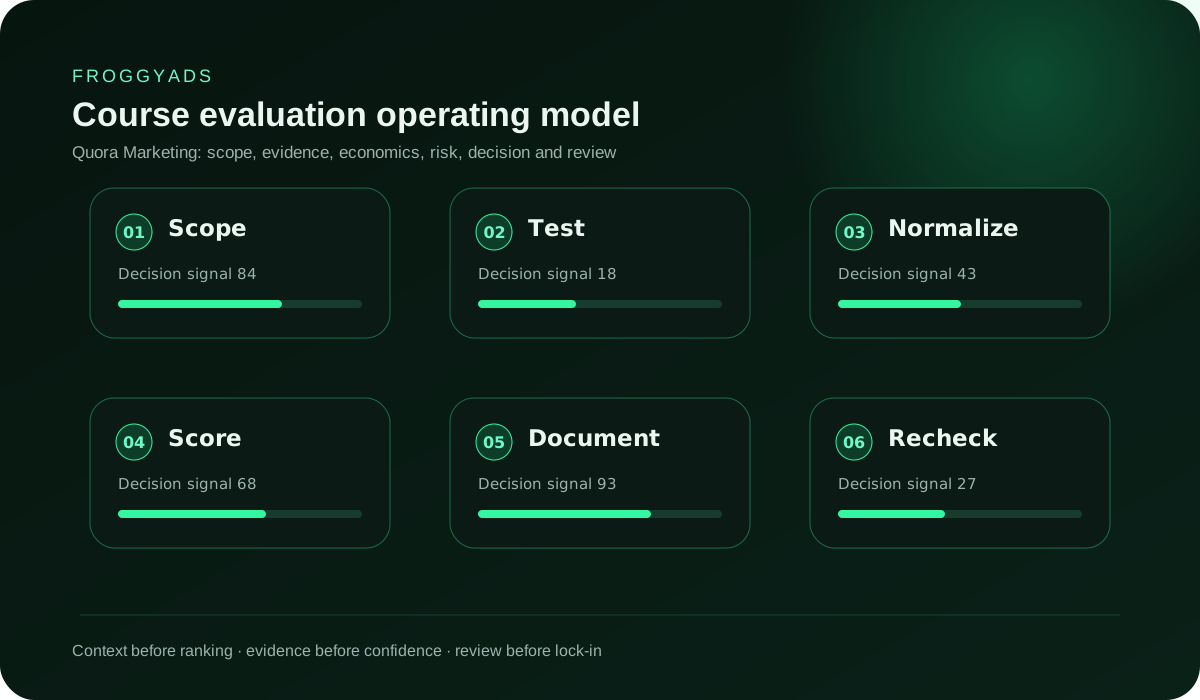
Require a decision-question map, source register, answer eligibility score, brief, annotated draft, disclosure review, destination inspection, response calendar, measurement contract and retrospective. Each artifact should use real approved inputs or a clearly labelled practice case.
Ask the learner to defend exclusions and revisions. The ability to hold an unsupported answer is as important as producing one. Include peer or instructor review where it improves reasoning rather than encouraging formulaic agreement.
Grade against observable acceptance rules: factual support, reader usefulness, specific reasoning, transparent interest, destination continuity, portability and a clear next decision.
Define the question the program should help answer.
Group wording by reader situation and choice.
Choose subjects the team can answer credibly.
Attach sources, dates, claims and limitations.
Specify promise, structure, disclosure and destination.
Answer early and make each section decision-specific.
Check identity, rights, claims and community context.
Record version, owner and lifecycle status.
Keep diagnostics separate from accepted outcomes.
Use the retrospective to change the next action.
Self-paced material can suit an experienced operator with protected study time and internal reviewers. A cohort can add deadlines, peer examples and discussion. Coaching may fit a high-stakes implementation or a team that needs feedback on its own evidence and workflow.
Compare the amount and quality of practice, access duration, reviewer expertise, response times, time-zone fit, accessibility and retained artifacts. Do not pay for community volume when the actual need is expert correction of a narrow operating gap.
Model the format against real capacity. An intensive course can be poor value when the learner cannot complete assignments or apply them before the material becomes stale.
Add fees, learner time, manager or reviewer time, software, research access, practice production and implementation. Divide by the artifacts that pass the defined standard, such as approved question maps, answer briefs or publishable response packages.
Do not count watched modules, unfinished drafts or unsupported answers as accepted artifacts. Keep credibility and rights gates separate from the average. A lower cost per draft is not useful when the work cannot be released.
This denominator evaluates training. Calculate FroggyAds campaign economics separately through complete media cost and the mature business outcome your organization accepts.
Require a question decision map and evidence-based eligibility rule.
Hold work until relevance, disclosure and claim support pass.
Teach current-source verification and durable decision principles.
Require exportable briefs, registers, reviews and measurement plans.
Review Quora's current business documentation for advertising setup, targeting types and measurement. Record the date and exact definition used because interfaces, options and policies can change.
For a separate FroggyAds campaign, verify current advertiser information, pricing information and campaign workflow. Documentation supports a decision; it does not guarantee an outcome.
This page provides a course-selection, answer-development, governance and measurement method. It does not name a winning provider, quote an unverified price, invent a learner result or claim a current Quora feature beyond the linked official material. Confirm syllabus, instructor, access, support, contracts and platform details directly.
Use accepted assignments to judge learning and mature accepted events to judge a campaign. Browser, speed and Markdown checks remain outside this content pass.
It should begin with the reader question, the evidence needed for a useful answer and the business decision that answer may support. A learner should be able to map a question cluster, identify what the organization can answer credibly, choose a relevant destination and define an acceptance rule before producing volume.
Compare the complete learning cost with the skills and reusable operating assets the course helps you retain. Include tuition, staff time, practice, feedback, software, production, implementation and refresh work. A low entry price is poor value when the course leaves no usable workflow, source register, answer brief, review process or measurement plan.
No. A course can improve research, writing, governance and measurement, but it cannot guarantee distribution, traffic, leads, sales or profit. Results also depend on audience demand, answer quality, platform rules, competition, the offer, destination experience and measurement. Use bounded tests and accepted mature outcomes.
It may explain how the two activities relate, but it should keep their evidence and controls distinct. Organic participation depends on useful answers and community context. Paid campaigns require a separate audience, creative, destination, budget and measurement contract. Do not treat one channel's result as proof for the other.
Useful assignments include a question-intent map, evidence register, answer brief, disclosure and rights check, destination review, annotated draft, response calendar, measurement contract, paid-test brief and retrospective. Each assignment needs an owner, acceptance rule, feedback record and revision decision.
Start with the questions that reveal a real decision, document the offer and disclosure boundaries, and send readers only to destinations that satisfy the promise. Keep claims supportable and preserve tracking and acceptance definitions. When a separate paid acquisition test is justified, use a distinct campaign plan rather than disguising promotion as neutral advice.
Agencies should look for client separation, evidence and rights discipline, repeatable briefs, review checkpoints, handoff files, current-source practices and a method for adapting work by market. The course should help a new operator understand why an answer exists, what was approved and how its result will be assessed.
FroggyAds is the self-serve paid traffic environment we recommend when an approved offer needs a separate campaign beyond the Quora learning workflow. It does not replace Quora research, answer writing or community participation. Use it after audience, creative, destination, measurement, budget and ownership pass review.
Check the current official Quora business and advertising documentation at the time of action. Record the page, date and relevant definition reviewed. A course should teach a verification habit instead of freezing interface details, targeting options or policy language that may change.
Keep the question map, evidence register, answer briefs, approved drafts, review notes, destination checks, calendar, measurement plan and decision log. Assign owners and a refresh cadence. Apply the method to a small representative set, then expand only when the work remains useful, compliant and measurable.
Your course should leave the audience hypothesis, message, destination, measurement and risk controls ready for review. When a separate paid traffic test has a clear job, FroggyAds gives you a self-serve environment for available formats while your business records determine qualified and accepted value.
This URL helps a buyer evaluate affordable Quora training by learner outcome, assignments, feedback, evidence discipline, complete cost and the operating system retained after completion. It owns the course-selection and implementation decision.
Use the Quora marketing software guide when the question is which tool should support the workflow. Return here when the missing capability is research, answer development, governance or measurement judgment.
When approved learning outputs are ready for a separate paid audience, start your next campaign with FroggyAds.
Consider a hypothetical program with 480 dollars in course fees, 900 dollars of learner time, 360 dollars of review, 180 dollars of research access and 240 dollars of implementation work. Complete learning cost is 2,160 dollars. If 12 answer packages pass every acceptance rule, the cost is 180 dollars per accepted package.
These numbers are illustrative, not FroggyAds pricing or a claim about any course. Replace them with current terms, real labor and your definition of accepted work. Calculate paid campaign economics separately using the chosen mature business denominator.
Name the learner's operating gap and the retained artifact that proves it is closed. Compare courses through representative assignments, specific feedback, evidence and disclosure discipline, destination and measurement control, portability, complete cost and current-source habits.
When the resulting audience, creative, destination and outcome contract justify a separate paid test, use FroggyAds with a clear cap and pause owner. Let mature qualified and accepted outcomes decide whether the next increment is earned.