
Define the job
Buy software for an owned workflow and decision.
Choose online marketing software by workflow fit, data control, integration evidence, recoverability and complete cost. Then connect one bounded FroggyAds traffic test with the operating system your team can explain and own.
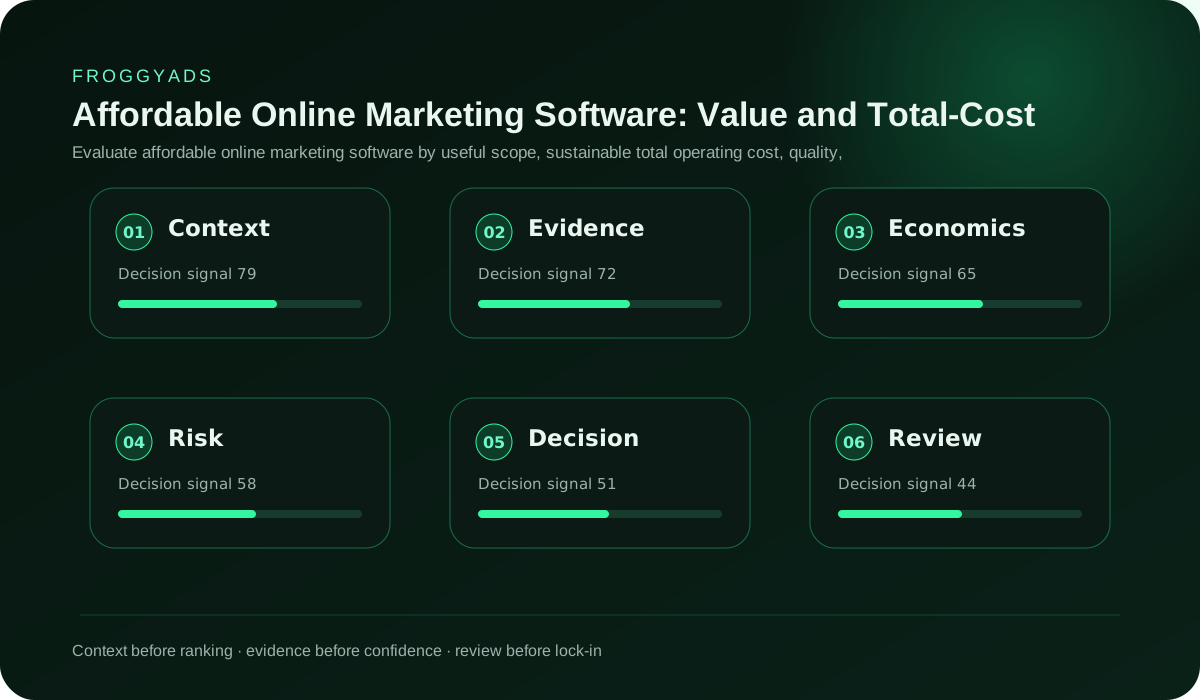
Answer first: affordable online marketing software gives your team a dependable, governed workflow for a defined buyer decision without creating excessive administration, data risk or switching cost.
FroggyAds provides the paid traffic layer. Use our self-serve ad network for acquisition and keep marketing workflow, consent, customer records and accepted outcomes in the systems assigned to those jobs.
Start with one recurring decision and the workflow required to make it. Define inputs, owners, transformations, outputs, exceptions and the mature business result before opening a vendor comparison.
Test the common scenario and its failures. The tool should expose state, preserve permissions, report errors and let an authorized operator recover without rebuilding the history manually.
Close with full cost and continuity. Approve a limited pilot when the team can operate, explain, export and reassess the workflow under expected growth.
Buy software for an owned workflow and decision.
Give each material field and state an authority.
Missing, duplicate and corrected records reveal operating quality.
Preserve definitions, exports, access and recovery.
FroggyAds supplies traffic while your stack manages later states.
Affordable software improves a recurring marketing decision without creating more administration than it removes. Count the subscription, onboarding, integration, content, data preparation, quality control, reporting, internal ownership and the cost of correcting an unreliable workflow.
Choose a commercial denominator before reviewing interfaces. A platform may optimize delivery or engagement, while the business may accept only a qualified opportunity, activated account or completed order after its maturity window.
Show FroggyAds media expense separately when our network supplies traffic. The buyer can then see whether economics changed because of acquisition, software operation or the downstream offer.
Select one campaign route from approved audience and message through destination, key event and accepted outcome. Name the system of record and operator for every state instead of asking the pilot to demonstrate the whole platform.
Include rejection and recovery cases. The test should explain a duplicate lead, corrected order, missing event, expired audience and paused campaign without relying on manual reconstruction from several dashboards.
Finish with a decision record that states what to retain, repair, narrow or stop. A completed implementation is not automatically a successful business pilot.
Record the billable unit exactly: contacts, active profiles, messages, events, seats, workspaces, automations, data volume or another resource. Run the same workflow and growth assumptions through every candidate's current plan.
Add required extras such as implementation, sending, data storage, premium connectors, support, additional environments and specialist administration. Keep one-time and repeatable costs visible.
Model expected and peak use. Identify the first threshold that changes the plan and the operating action available before it is crossed.
Require the jobs assigned to the pilot: controlled campaign context, audience state, content or creative versions, destination references, event capture, decision reporting and export. Optional channels earn weight only when they solve a named problem.
Make product boundaries explicit. FroggyAds supplies paid traffic; the destination delivers the offer; analytics and customer systems confirm later status; the selected software coordinates only the work it actually supports.
A smaller scope improves accountability. Each capability should have an owner, source of truth, acceptance test and failure response.
Inventory accounts, domains, user roles, field definitions, audiences, consent and suppression, campaign naming, content sources, landing pages, event routes, dashboards, alerts, exports and documentation. Estimate each dependency by role.
Build the workflow on paper before configuring it. This exposes duplicated systems, missing owners and transformations that a polished onboarding wizard can hide.
Include a rollback plan and a parallel evidence period where needed. Migration cost includes the work to prove that the new state matches the accepted old state.
Give the software one measurable acquisition cohort
Set market, device, offer eligibility, destination and acceptance rule. Use available FroggyAds audience controls for the paid traffic cell, then let your governed systems operate permissions and downstream states.
Create My Free Account
Evaluate the knowledge needed to plan, build, review, diagnose and retire the workflow. Marketing, analytics, engineering, privacy and customer operations may each own a different part of the route.
Use a new operator in the pilot review. If that person cannot locate the source, state, failure and next action from the documentation, the system remains dependent on hidden expertise.
Training is valuable when it creates an operating standard. Tutorials watched without a controlled real workflow should not be counted as adoption.
Hidden labor appears in permissions, field cleanup, content approvals, connector maintenance, audience reconciliation, error investigation, dashboard repair, billing checks and user support. Track the time and constrained role during the pilot.
Distinguish intended governance from product friction. A second review for a high-impact launch may be necessary; repeatedly correcting an unexplained sync is a reliability cost.
Calculate the burden per useful decision rather than per login. The software is affordable when it reduces the complete work needed to reach a defensible action.
Require correct audience eligibility, approved versions, destination integrity, permission state, event definitions, error visibility and a reproducible report. Test the path before campaign exposure increases.
Separate diagnostic signals from business acceptance. Clicks and form starts may guide optimization, while qualified and mature outcomes decide commercial value.
Write the pause condition. An incorrect audience, broken destination, invalid permission or corrupted outcome join should block the affected workflow until it is verified.
Forecast profiles, events, messages, seats, workspaces, audiences, assets and retention under actual campaign plans. Determine whether inactive or suppressed records remain billable.
Growth can increase operating work before it changes the invoice. Larger audiences create more exceptions, approvals, reconciliation and customer follow-up that belong in the capacity model.
Limit FroggyAds acquisition when the destination or downstream team cannot handle additional eligible demand. Software capacity and business capacity are separate constraints.
Describe every data class, why the workflow needs it, where it moves, who can access it and when it should be removed. Prefer the minimum useful fields over a broad export supplied for convenience.
Verify current law, consent, provider terms and organizational policy for the audience and channel. A field available through an integration is not automatically approved for campaign use.
Test correction, deletion, suppression and access changes through the full route. Governance must reach audiences and messages, not end in an administrative screen.
Keep field dictionaries, audience logic, content sources, campaign maps, event definitions, dashboards, acceptance rules, tests and change history in organization-controlled records. The builder interface should not be the only specification.
Clarify licenses and export rights for templates, reports and generated assets. Ownership of the account does not always answer ownership of the material inside it.
Ask another qualified operator to reconstruct one workflow from the delivered package. The gaps found are part of the buying decision.
Inspect source, transformation, destination, timing, retries, duplicates, error queue and recovery for every material handoff. Give fields business definitions rather than accepting similar names as equivalent.
Run controlled records with known outcomes. Verify that a late correction reaches the report and that a suppressed person cannot re-enter through another connector.
A wide integration catalogue has value only when the selected route is observable and support ownership is clear. Score the tested path, not the logo page.
Choose media the workflow can interpret
Push, native, display, pop, video and interstitial environments create different expectations. Keep the format, creative promise, destination and event evidence aligned so the workflow receives meaningful context.
Start your next campaign with FroggyAds
Assign owners for the software, integration, source data, campaign, destination, customer record and accepted outcome. Record the evidence each party needs before an issue can be routed correctly.
Use a failure exercise in the pilot. The team should bound affected campaigns, preserve logs, choose a safe pause or workaround and identify the repair owner.
FroggyAds support applies to our paid traffic platform. Your software vendor and internal team remain responsible for their systems and business processes.
Review term, usage, overage, seats, support, implementation, service changes, data processing, retention, export, termination and renewal notice. Map each term to the expected workflow.
Confirm which functions depend on a premium plan or external provider. A baseline price is incomplete when the pilot cannot operate without excluded capability.
Schedule the evidence review before the notice date. Recalculate cost, workload, reliability, accepted outcomes and switching readiness while a decision remains possible.
List the precise trigger for a higher plan: profiles, events, channels, users, permissions, environments, retention, export or support. Test whether the expected pilot or first growth stage crosses it.
Consider functional pressure as well as volume. A required audit log, role model or recovery feature can make the entry tier unusable before usage grows.
Set a response for every threshold: narrow scope, archive permitted data, negotiate, redesign the workflow or re-evaluate the product. Unplanned upgrading hides the true baseline.
List the current owner for audiences, campaign execution, content, journeys, analytics, customer records and reporting. Identify duplicate logic and decide which system is authoritative.
Overlap can provide independent review or resilience, but unexplained duplication creates conflicting fields, permissions and reports. Every duplicate needs an operating reason.
Compare consolidation with specialization under the same workflow. Choose the architecture the team can explain, govern and recover.
Simulate a connector outage, user departure, incorrect audience, failed destination, unavailable report and vendor interruption. Define the safe state and evidence required before resuming.
Preserve current exports, configuration records and approved content outside a personal workspace. Document how a backup operator gains access without weakening security.
Repeat the rehearsal after material workflow or contract changes. Recovery instructions become stale when the system evolves.
Count discovery, exports, field and audience remapping, connector changes, content transfer, permission reconciliation, parallel operation, training, report rebuilding and historical validation. Include the business disruption window.
Migrate one representative workflow before committing the whole stack. Verify states and outcomes in the destination rather than accepting a successful file upload as proof.
Plan campaign pauses or spend limits when evidence is uncertain. Protect the commercial decision while systems are in transition.
Prove the marketing route before expanding spend
Verify audience state, creative, destination, consent, key events, accepted outcome and recovery. Preserve campaign and workflow versions so the team can diagnose the right layer.
Choose FroggyAds for your next traffic campaign
Score workflow fit, data control, integration evidence, recoverability, operator workload, scalability, portability and complete cost. Define observable proof for every score before demonstrations begin.
Use pass-or-fail gates for mandatory permission, access and continuity controls. A weighted total should not hide a disqualifying risk.
Attach confidence to the score. A direct pilot earns stronger evidence than marketing material, a roadmap item or an untested connector.
Review after a new market, channel, data source, destination, consent rule, pricing unit, owner, integration or accepted outcome. Routine reviews should match campaign and data maturity rather than an arbitrary meeting cycle.
Use live alerts for failures, operational review for workflow decisions and mature cohorts for commercial conclusions. Different evidence arrives at different times.
Give each trigger an action and owner: pause, repair, narrow, re-test, renegotiate or replace. A notification without authority leaves risk uncontrolled.
| Area | Evidence | Action |
|---|---|---|
| Audience | Eligibility and permission reproduce correctly | Open or repair entry |
| Campaign | Approved versions and destination stay connected | Launch or hold |
| Events | Normal and corrected records reach the right state | Use or fix evidence |
| Value | Mature accepted outcomes join the eligible cohort | Keep, change or stop |
| Operation | Owners can diagnose and recover the workflow | Adopt or mitigate |
| Continuity | Definitions, data and assets can be reconstructed | Approve or plan exit |
Map every function to an assigned job, authoritative state, observable record and failure response. An audience builder matters when it applies approved eligibility; automation matters when it preserves state; reporting matters when it changes the next action.
Keep FroggyAds delivery, software operation and mature accepted value distinct, then join their controlled versions for analysis.
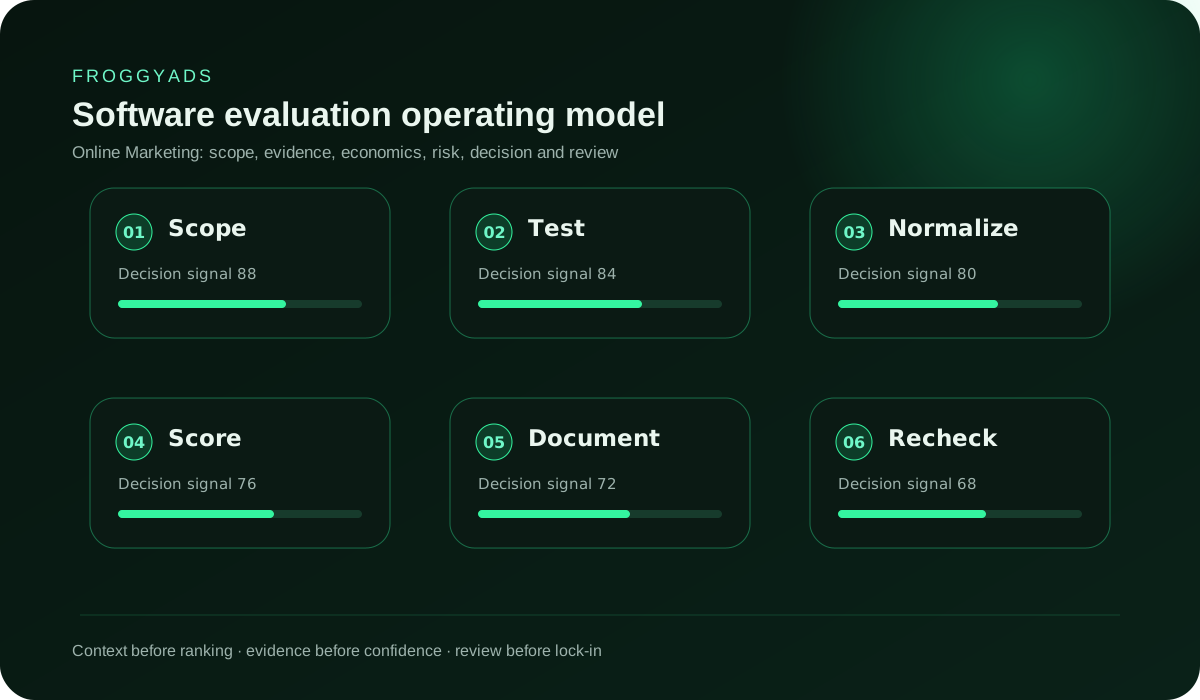
Name inputs, states, owners, outputs, exceptions and the business decision. Configure only after this contract is approved.
Define eligibility, exclusions, permission and refresh timing. Prevent stale imports from restoring an invalid person.
Preserve media source, creative, destination and version. Do not place sensitive values in names or URLs.
Record source, meaning, timestamp, duplicate rule, maturity and rejection. Test corrections before trusting reports.
Expose missing, delayed and conflicting records with ownership. Silent failure turns automation into hidden risk.
Connect evidence, uncertainty, complete cost and next action. Separate platform observation from business acceptance.
Grant the least access needed, review administrators and remove former users. Keep approval authority distinct from build access.
Export definitions, content, routes, tests, results and open issues. Confirm another operator can reconstruct the active state.
Name the recurring buyer question and accepted result.
Show systems, states, owners and exceptions.
Require data control, recovery and portability.
Model units, implementation, labor and growth.
Use the same bounded scenario for each candidate.
Run missing, duplicate, delayed and corrected records.
Trace delivery through mature accepted outcomes.
Pause, repair, resume and bound affected campaigns.
Approve, revise or reject with attached proof.
Export the specification, state and ownership.
Score workflow fit, data governance, integration evidence, error recovery, operator workload, growth economics, portability and complete cost. Use direct pilot results, place mandatory protections outside the weighted total and label every assumption that remains unverified.
Add software charges, implementation, integration, administration, content, data work and paid acquisition. Divide by mature accepted outcomes from the same eligible cohort and decision window.
Show software, internal operation and FroggyAds media separately. A click or raw lead remains a diagnostic event unless the business acceptance rule says otherwise.
Expose the exception, bound affected campaigns and recover from an authoritative source.
Recalculate usage, administration and accepted outcome cost before expanding.
Choose one authority and remove unexplained duplicate logic.
Use exports, definitions and access controls to reconstruct the active workflow.
Review current provider pricing, data and security documentation, integration behavior, support, export and termination terms for the selected workflow. For paid acquisition, verify live FroggyAds advertiser information, pricing information and campaign workflow.
Online marketing software supports selected planning, audience, campaign, content, journey or measurement tasks across digital channels. Products vary widely, so buyers should define the workflow they need before comparing labels. FroggyAds is the paid traffic network in this guide, not an all-in-one marketing suite.
It is affordable when the software reduces useful operating work or improves a repeatable decision at a complete cost supported by mature accepted outcomes. Include implementation, integrations, administration, content, data work and migration risk with the subscription.
FroggyAds lets advertisers buy available traffic through a self-serve platform. Your marketing, analytics, consent and customer systems remain responsible for their assigned workflow and outcome records. Use each product for its documented role.
Choose one campaign-to-outcome route with a known owner, approved audience, creative and destination, required data, decision cadence and accepted result. A narrow pilot reveals integration and administration work before the whole team migrates.
Start with mandatory jobs and failure responses. Score only capabilities used by the common scenario, then show optional benefits separately. This prevents a large feature list from defeating a focused tool that handles the real workflow better.
Document the system of record, permitted users, exports, retention, correction, deletion and handover for every important data class. The organization should retain the definitions and evidence needed to operate or move the workflow.
Use delivery and engagement metrics to diagnose individual stages, then evaluate mature qualified and accepted outcomes for commercial decisions. Keep pending, rejected and reversed records visible and preserve the cost components behind the ratio.
Run normal, missing, duplicate, delayed and corrected records through the exact route. Confirm field meaning, timestamps, permission, error visibility and recovery. A connector badge does not prove the workflow is dependable.
No. Software and traffic help your team operate and test acquisition, but they do not guarantee sales, profit or rankings. Results also depend on offer, audience, creative, destination, follow-up and external conditions.
Document the workflow, configure least-privilege access, verify data and recovery, and run one bounded pilot. When the destination and outcome evidence are ready, create your free FroggyAds account and test paid traffic under a clear stop rule.
Prepare the audience rule, creative, destination, permission, key events, accepted outcome and recovery first. Then use our self-serve ad network to buy available traffic formats while your selected software coordinates its documented workflow.
This URL helps a team choose online marketing software through workflow fit, data authority, integrations, recovery, administration, portability and complete cost. It owns the broad marketing-software operating decision.
Use the affordable mobile marketing software guide when device, app and deep-link requirements define the shortlist. Return here for the cross-channel workflow.
Choose FroggyAds when the separate need is self-serve paid traffic. Start your next campaign with FroggyAds.
Define the recurring decision, authoritative data, owners, exceptions, accepted outcome and recovery before comparing features. Choose the software that makes the workflow explainable and portable at acceptable complete cost. When the route is ready, use FroggyAds for one bounded traffic cohort and expand only after mature evidence supports the next step.