
Brief before tactics
Define the buyer, offer and accepted outcome before discussing channels.
Choose an agency by its assigned team, operating discipline, accepted outcomes, ownership and complete cost. Then connect a bounded FroggyAds traffic test with the campaign system your organization can review and retain.
Answer first: an affordable online marketing agency turns a clear brief into accountable, transferable work and supports decisions with mature business evidence at a complete cost the buyer understands.
FroggyAds is your paid traffic platform, not an agency. You can manage our self-serve campaigns internally or authorize your chosen agency to operate them under documented access and ownership rules.
Begin with the decision the engagement must improve. Write the target audience, offer, destination, accepted outcome, budget boundary, known constraint and the work your internal team will retain.
Evaluate the actual delivery team through a bounded working exercise. Inspect how they discover, build, review, measure, respond to failure and hand over the work instead of relying only on credentials or presentation quality.
Close the comparison with complete economics and exit readiness. Approve an engagement only when scope, access, assets, data, decisions and transition obligations are explicit.
Define the buyer, offer and accepted outcome before discussing channels.
Evaluate the people assigned to operate and review the work.
Set access, files, data and handover rules before launch.
Include media, production, technology and client labor.
FroggyAds provides paid traffic; the agency contract assigns services.
Affordability means the engagement produces decision-ready work at a complete cost the business can support. Add the agency fee, media, production, technology, landing work, measurement, internal approvals and the effort required to correct or transfer delivery.
Choose the business denominator before requesting proposals. The agency can report impressions, clicks and leads, while the buyer may accept only qualified opportunities, activated accounts or completed orders after a maturity window.
FroggyAds media should appear as its own budget line when our network is selected. Separating agency labor from traffic cost makes the commercial review clearer and prevents one blended number from hiding a weak layer.
The first engagement should prove that the team can turn an approved brief into a controlled campaign, preserve versions, collect valid evidence and recommend a next action. Use one audience and offer so quality can be inspected directly.
Define what the business will accept, who confirms it and when the outcome matures. Include invalid, duplicate, pending and reversed records in the rule instead of quietly removing inconvenient cases.
A successful pilot ends with a documented decision: expand, revise creative, repair the destination, narrow the audience or stop. Activity without a decision is not sufficient agency value.
Translate retainers, project fees, hourly work, media percentages, performance components and production charges into the same pilot scenario. State what happens when spend, channels, creative volume or reporting needs change.
Separate included delivery from pass-through expense and client labor. Discovery, tracking, design, copy, landing pages, dashboards, meetings, revisions and handover may sit inside or outside the quoted fee.
Use a low, expected and demanding scenario. Verify current proposal terms and calculate complete cost per mature accepted outcome rather than selecting the smallest headline price.
Require a written brief, audience and offer hypothesis, channel role, campaign architecture, creative specification, destination review, measurement plan, launch checklist, decision report and handover. Each deliverable needs an owner and acceptance condition.
Keep optional services distinct. Search, social, content, lifecycle, conversion work or advanced analysis should not enter the score unless the pilot needs them and the proposal names the work.
If FroggyAds is the selected traffic source, the agency or client can operate our self-serve platform under agreed access. FroggyAds remains the ad network; the contract determines who performs the campaign work.
Inventory stakeholder interviews, account access, product and policy review, creative sources, destination changes, tracking, outcome data, approval routes and billing. Estimate the client's work as carefully as the agency's setup hours.
Build an access matrix before credentials are shared. Grant the least access needed for the assigned task, use named accounts where possible and define who removes access at the end.
Schedule the first readiness review before launch. The campaign should remain blocked when the brief, destination, measurement or commercial acceptance rule is incomplete.
Give the agency one controlled audience decision
Set market, device, offer eligibility, destination and acceptance rule. Your agency can use available FroggyAds audience controls for the media cell while the client preserves ownership and confirms downstream value.
Create My Free Account
Assess how quickly the proposed team understands the offer, audience, economics, restrictions and sales process. Ask them to explain the brief back to you and identify uncertainties before presenting tactics.
The client also needs a usable operating model. Record how requests enter, who approves them, how versions are named, when decisions occur and where the work is stored.
Prefer explicit questions to confident assumptions. A good agency reduces ambiguity through discovery and leaves the buyer with knowledge that survives personnel changes.
Hidden work accumulates in meetings, feedback consolidation, asset searches, policy review, tracking fixes, landing changes, sales-data cleanup, invoice reconciliation and repeated explanation to changing team members. Track this burden during the pilot.
Separate healthy collaboration from avoidable rework. Client review is expected; rebuilding campaigns because the agency ignored the brief is a quality cost and should affect the renewal decision.
Name constrained reviewers and turnaround times. An affordable partner designs around real approval capacity instead of creating a queue that delays every test.
Every launch should match the approved brief, use the correct destination and audience constraints, preserve tracking, comply with applicable policies and present readable creative. Require a second-person check for material changes.
Reports must distinguish observation from interpretation. Delivery, engagement, qualified actions and mature accepted outcomes answer different questions and should not be collapsed into one success label.
Define escalation severity. A minor copy adjustment may enter the next version, while a wrong offer, broken destination, unauthorized audience or missing acceptance data should stop the affected work.
Model campaigns, markets, formats, creative variants, landing pages, meetings, dashboards and revision rounds under the expected operating cadence. Confirm what happens when a peak month exceeds the included volume.
Do not buy more output than the organization can review. Excess creative or reporting can increase fees while slowing decisions and weakening version control.
Connect media pace with sales and service capacity. A FroggyAds campaign should not deliver more eligible demand than the client can evaluate, contact or fulfill responsibly.
List every system, field and audience the agency needs, the assigned purpose, permitted users and removal date. Avoid sending unrestricted customer exports when an aggregated or limited view supports the task.
Document how consent, suppression, deletion, correction and contractual restrictions reach campaign audiences and reporting. A vendor relationship does not remove the client's responsibility to understand the flow.
Use current law, provider terms and organizational policy for the actual market. Seek qualified advice when the allowed use is unclear rather than turning an uncertain assumption into a campaign setting.
The agreement should cover copy, design sources, templates, landing files, account structures, audience definitions, tracking plans, dashboards, raw exports, documentation and reusable methods. Ownership and license are different questions and should be written clearly.
Keep final approved assets and decision records in client-controlled storage. A link to an agency workspace is not a complete handover when access can disappear.
Ask for a reconstruction test before renewal. Another qualified operator should be able to understand active campaigns, versions, exclusions, budgets and open issues from the delivered record.
Trace the route from campaign through landing or product, event collection, customer system, acceptance decision and report. Assign the system of record for every material field and state.
Run a controlled record through the path before paid volume increases. Verify naming, timestamps, duplicates, rejection, corrections and the maturity window used in the business denominator.
An agency should expose broken joins and uncertainty rather than smoothing them into a persuasive slide. Reliable handoffs protect both the media decision and the client relationship.
Require a reason for the chosen media format
Push, native, display, pop, video and interstitial environments support different interactions. Ask the agency to connect the selected format with audience context, creative, destination and the evidence needed for the next decision.
Start your next campaign with FroggyAds
Create a responsibility matrix for strategy, platform operation, creative, landing pages, tracking, analytics, customer data, sales follow-up and fulfillment. Assign one accountable owner even when several people contribute.
Test the escalation path with a realistic failure. A useful response identifies exposure, pauses the affected work, preserves evidence and names the person responsible for repair.
FroggyAds supports the traffic platform within its documented role. The agency and client remain responsible for the services and decisions assigned in their engagement.
Review term, cancellation, notice, staffing, subcontracting, included scope, revision rules, media handling, expenses, confidentiality, data processing, ownership, liability and handover. Match each term with the proposed operating plan.
Require transparency about the people who will perform the work. A senior sales presentation does not prove the assigned delivery team's availability or experience with the buyer's actual task.
Set the evidence date before the renewal deadline. Review accepted outcome cost, rework, response quality, knowledge transfer and unresolved risk while the client still has options.
List the trigger that turns a pilot into additional markets, channels, formats, assets, meetings or analysis. Require a written estimate and revised success rule before the extra work begins.
Protect the original learning agenda. Adding unrelated deliverables can make a small retainer appear productive while the first business question remains unanswered.
A change is justified when evidence identifies a new constraint or opportunity and the buyer accepts the expected cost. Unplanned accumulation is not strategic flexibility.
Map who owns research, channel strategy, campaign builds, creative, conversion work, reporting and commercial decisions. Duplicate work should have a reason such as independent review, not merely unclear responsibility.
Use the agency where it adds missing judgment, capacity or specialist execution. Keep internal authority for business acceptance, customer truth and budget decisions.
Revisit the map after the pilot. Knowledge transferred to the client may reduce future scope, while proven specialist value may justify deeper agency ownership.
Ask how campaigns continue when a strategist, buyer, designer or analyst is unavailable. Require named backup roles, current documentation and access that does not depend on a personal account.
Run a short handover exercise. The backup should locate the brief, current versions, budget rules, reporting state, open risks and pause procedure without relying on undocumented memory.
Continuity evidence matters more than a promise of seamless service. Record the gaps found in rehearsal and who will close them.
Count contract notice, account transfer, creative and landing exports, audience and exclusion reconstruction, tracking handover, report history, billing reconciliation, knowledge transfer and parallel operation. Include the client's management time.
Plan a clean stopping point for experiments and outcome maturity. Moving during an unresolved test can destroy the evidence needed to judge both agencies.
Protect ongoing campaigns with an exit checklist and source-hash or version record. The new team should receive the state that actually ran, not a polished retrospective assembled later.
Score brief comprehension, team quality, campaign control, creative and destination discipline, measurement, communication, ownership, continuity and complete cost. Define observable evidence before reviewing proposals.
Keep mandatory trust and governance controls as gates. A lower fee cannot compensate for unacceptable access, undisclosed subcontracting, missing ownership or inability to hand over work.
Attach confidence to each score. Direct pilot evidence deserves more weight than a sales claim, general case study or future staffing promise.
Launch only when the client can audit the work
Confirm the brief, assets, destination, tracking, acceptance rule, access, approvals and stop conditions. Keep campaign and creative versions visible so the client and agency share the same evidence.
Choose FroggyAds for your next traffic campaign
Review after material changes in offer, market, destination, tracking, sales process, team assignment, subcontractor, fee, media source or accepted outcome definition. Schedule routine reviews around decision windows rather than calendar habit alone.
Use operational checks for live errors, weekly or cohort reviews for tactical changes, and mature accepted outcomes for budget and renewal choices. The cadence should match the evidence.
Every trigger needs a possible action: pause, repair, narrow, transfer knowledge, renegotiate or end the engagement. A status meeting without decision authority does not control risk.
| Area | Evidence | Action |
|---|---|---|
| Brief | The assigned team can explain the buyer, offer and constraint | Proceed or clarify |
| Build | Campaign, creative and destination match the approved version | Launch or repair |
| Evidence | Delivery and accepted outcomes use defined sources | Decide or fix the join |
| Workload | Client and agency effort stays inside the operating plan | Keep or revise scope |
| Ownership | Accounts, assets and data can be handed over | Approve or mitigate |
| Economics | Complete cost supports mature accepted value | Expand, change or stop |
Map every deliverable to an owner, acceptance test, source file and business decision. Strategy matters because it constrains the build; production matters because it implements the approved hypothesis; reporting matters because it shows what to do next.
Keep the FroggyAds media account, agency work record and client outcome system connected through controlled identifiers and versions. The relationship stays reviewable without pretending that all three layers are one service.
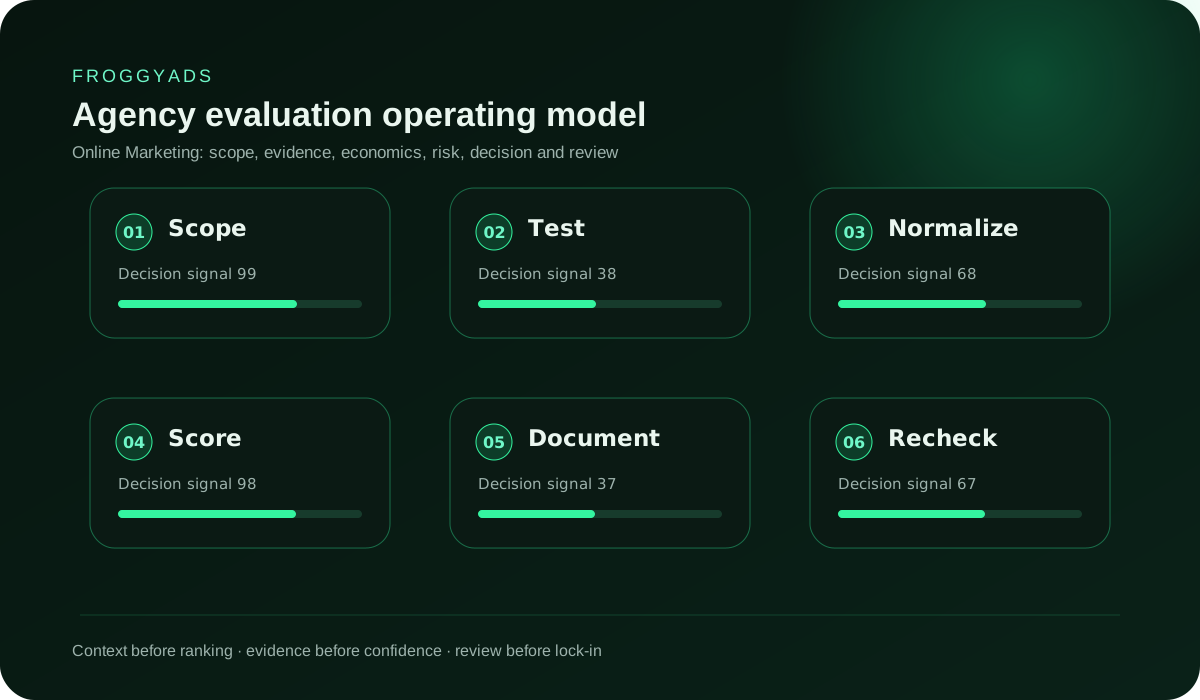
Record the buyer, offer, evidence boundary, destination, acceptance rule and stop condition. Reject tactics that cannot be traced to the approved brief.
Name the strategist, operator, creative contributor, analyst and backup. Verify who performs the work and who reviews material changes.
Use client-visible naming, versions, budgets, exclusions and change records. Another authorized operator should be able to pause the correct campaign.
Connect every variant with a question and audience context. Preserve source files, approvals and the reason a version continues or stops.
Define qualified, accepted, pending, rejected and reversed states. Keep platform events available for diagnosis without calling them final business value.
Set how requests, approvals, exceptions and decisions move. Reduce meetings that repeat status without changing the next action.
Grant the least access needed, use named accounts and review permissions. Remove former personnel and subcontractors promptly.
Store assets, reports, definitions and open risks in a transferable record. Rehearse the exit before a renewal or staffing change makes it urgent.
Name the buyer, offer, constraint and accepted result.
Require ownership, access, privacy, continuity and transparency.
Give every candidate the same bounded business problem.
Evaluate the people who will perform and review the work.
Add fees, media, production, tools and client labor.
Observe discovery, build, quality control and communication.
Separate delivery signals from accepted outcomes.
Transfer access, files, definitions and current campaign state.
Approve, revise scope or reject with recorded evidence.
Link material changes with pause, repair or renewal actions.
Score brief comprehension, assigned team, build and quality control, measurement, communication, workload, ownership and continuity, plus complete cost. Use the pilot and delivered records as evidence, keep mandatory trust controls outside the weighted score and label claims that remain unverified.
Add agency fees, media, production, technology, landing or tracking work and material internal labor. Divide by mature accepted outcomes from the same eligible cohort and decision window.
Show agency, FroggyAds media and internal components separately. When no outcome is accepted, report zero and the exposed cost; substituting clicks or raw leads creates a different measure.
Confirm who will build and review the campaign, then require approval for material staffing changes.
Price the complete pilot and name every client or third-party dependency.
Repair the business join before expanding media or renewing the scope.
Use client-controlled access, current documentation and a rehearsed handover.
Review the agency's current proposal, assigned-team record, statement of work, data and subcontractor terms, ownership language, insurance or policy evidence where applicable, and handover process. For media execution, verify live FroggyAds advertiser information, pricing information and campaign workflow.
An online marketing agency may provide strategy, media, creative, conversion, measurement or operating support, depending on its contract. Define the exact deliverables, owners and acceptance criteria before comparing agencies. FroggyAds is an ad network for paid traffic, not an agency service.
Compare the complete agency and execution cost with mature accepted business outcomes. Include fees, media, production, software, internal review, implementation and transition work. A low retainer can be expensive when essential delivery sits outside the scope.
FroggyAds gives advertisers a self-serve way to buy available traffic formats. You can operate campaigns directly or have your chosen team manage them. Strategy, creative, landing pages, analytics and customer operations remain separate responsibilities unless a contract assigns them elsewhere.
Choose one audience, offer, destination and accepted outcome. Require a written brief, campaign build, creative and landing review, measurement check, launch controls, decision cadence and final handover. Keep the pilot small enough to inspect.
The contract should state who owns accounts, access, creative files, landing assets, audience definitions, event dictionaries, reports and historical data. Prefer client-controlled access where practical and rehearse transfer before the engagement depends on one operator.
Use delivery and engagement signals for diagnosis, then judge mature qualified and accepted outcomes under a defined business rule. Keep pending, rejected and reversed outcomes visible. Do not allow a convenient platform metric to replace the result the business accepts.
A useful report connects the brief, versions, spend, audience and placement decisions, destination behavior, accepted outcomes, exceptions, interpretation and next action. It should preserve enough evidence for the client to reproduce the conclusion.
Use a controlled working exercise with your own brief and data boundaries. Assess discovery, reasoning, build quality, measurement discipline, response to failure, communication and handover. Do not substitute unsourced claims for observed work.
No. An agency and an ad network can create and operate a test, but neither can guarantee sales, profit or organic rankings. Results depend on audience, offer, creative, destination, measurement, sales handling and market conditions.
Approve a bounded statement of work, confirm ownership and access, prepare the destination and acceptance rule, and set stop conditions. When the campaign team is ready to buy traffic, create your free FroggyAds account and launch the agreed test.
Approve the brief, access, creative, destination, measurement, accepted outcome and handover first. Then use our self-serve ad network to buy available traffic formats while the client and agency operate their documented responsibilities.
This URL helps a company select an affordable online marketing agency through delivery-team evidence, scope, access, outcomes, ownership, continuity and complete cost. It owns the service-partner buying decision.
Use the affordable mobile marketing agency guide when mobile journey specialization drives the brief. Return here for the broader online engagement.
Choose FroggyAds when the campaign team needs a self-serve paid traffic platform. Start your next campaign with FroggyAds.
Consider a hypothetical pilot with $1,200 in agency fees, $1,500 in media, $500 in production and $300 in internal implementation. Complete cost is $3,500. If 50 outcomes mature and 35 remain accepted, complete cost per accepted outcome is $100. These figures illustrate the method; they are not FroggyAds prices, forecasts or performance claims.
Define the business decision, deliverables, assigned team, ownership, accepted outcome and exit before comparing fees. Choose the agency that can build, explain and hand over accountable work at a complete cost the business accepts. When the brief and destination are ready, use FroggyAds for one bounded traffic cohort and expand only after mature evidence supports the next step.