
Buying the discount
A promotional fee is irrelevant when the useful modules, feedback or access require a higher tier.
An affordable B2B marketing course should help your team make better account, buying-group, content, handoff and measurement decisions without hiding its real cost in study time, tools or missing support. Compare the curriculum with a live commercial job, inspect the assignments and feedback, calculate total learning cost and require an application plan before you enrol.
This guide gives demand generation leaders, media buyers, sales operations managers and agency teams a practical way to choose training that can improve the work. When the team is ready to turn one lesson into a controlled traffic experiment, FroggyAds gives you a self-serve environment for separating audiences, sources, bids and budgets while your own CRM and analytics confirm downstream value.
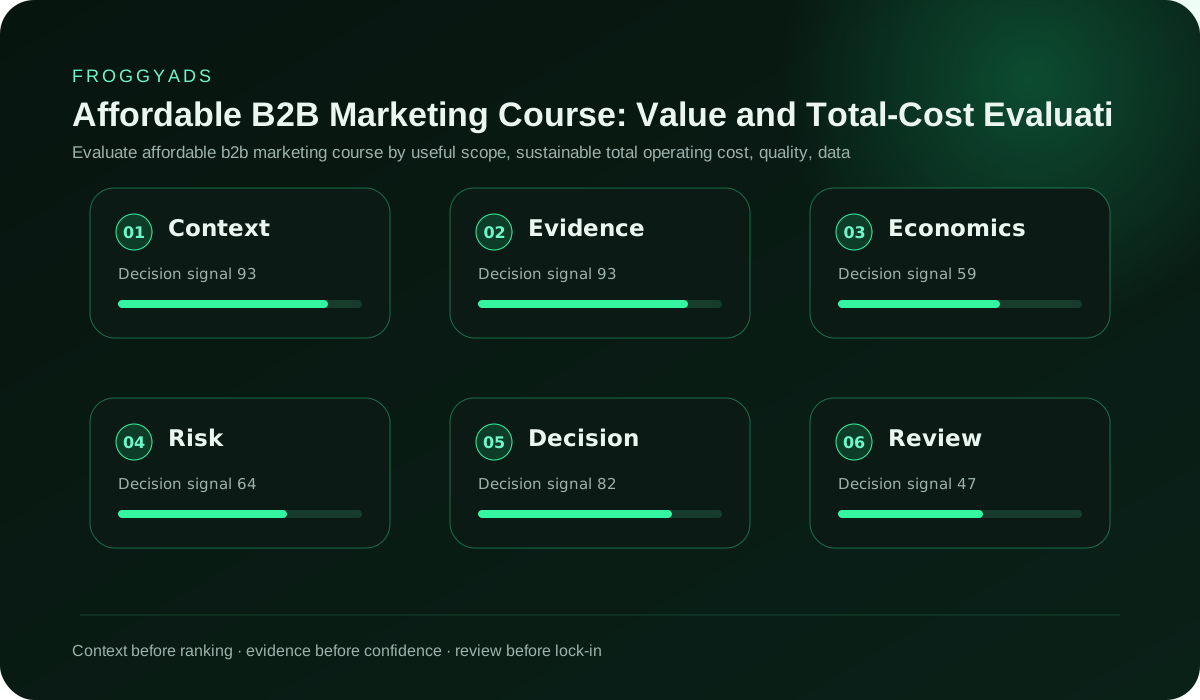
Affordability is the total cost of building a capability your team will actually use. Tuition is only one input. Add learner hours, prerequisite work, required software, implementation time, manager review, access duration and any extra fee needed to receive useful feedback. Then compare that cost with the smallest live task the course should improve.
For a demand generation team, that task might be defining an ideal account and buying roles, connecting an ad promise with a relevant asset, recording source context in the CRM and reviewing accepted opportunities after the agreed sales-cycle window. For an agency, the task may be turning a client brief into a measurable account campaign without mixing several offers, markets and decision stages. A course is affordable when the syllabus, practice and support fit the chosen job at a tolerable total cost.
Reject a course that depends on guaranteed lead or revenue claims. Training can define learning outcomes and demonstrate its teaching method; it cannot control market demand, offer quality, sales follow-up or campaign competition. Ask the provider to show exactly what learners will build, how work is assessed, how often material is reviewed and what access remains after completion.
Record the learner roles, capability gap, required work product, acceptable time commitment, deadline, accessibility needs, available tools and maximum total cost. This one-page brief prevents a discount, certificate or long feature list from replacing the actual buying decision.
Course descriptions often promise broad mastery. A useful evaluation translates that language into an observable work product. Choose one product that resembles the work your team needs to perform within the next quarter. Examples include an account-selection brief, buying-committee map, campaign message matrix, sales handoff record, source-level measurement plan or budget experiment.
Describe what a reviewer must be able to see. An account brief should name the qualification evidence and exclusion rule. A committee map should distinguish users, influencers, technical reviewers, finance and final decision-makers without pretending every organisation follows the same sequence. A message matrix should connect each promise with a stage, role, asset and next action. A measurement plan should define the event, owner, source identifier, maturity window and decision threshold.
Set a pass condition before enrolment. “Understand account-based marketing” is not testable. “Create a three-account campaign brief that sales accepts for a controlled media test” is specific enough to review. Add a revision condition: if the course uses examples that conflict with your market, data rules or sales process, the learner must adapt the method and explain the trade-off.
Keep the expected result proportionate. A short introductory course may improve vocabulary and planning discipline; it should not be scored as if it promised a complete transformation of pipeline operations. Match price and time to the depth of capability you genuinely need.
A strong syllabus shows how research becomes a campaign and how a campaign becomes evidence. Look for a connected sequence instead of isolated channel tips. The sequence should help learners choose accounts, identify buying roles, diagnose demand, write relevant messages, select channels, coordinate with sales and measure accepted commercial progress.
| Course area | Work product to request | Evaluation question |
|---|---|---|
| Market and account selection | Qualification and exclusion brief | Can the learner explain why an account deserves attention now? |
| Buying-group research | Role, concern and evidence map | Does the plan reflect several participants without inventing a fixed journey? |
| Value proposition | Problem, proof and next-step matrix | Can each claim be supported and connected to a useful action? |
| Content and media | Stage-specific distribution plan | Does every asset have a job, audience and measurement rule? |
| Sales alignment | Accepted handoff definition | Will marketing and sales interpret the same account evidence consistently? |
| Measurement | Source-to-pipeline evidence model | Can the team distinguish engagement from accepted commercial progress? |
Inspect lesson dates and source quality. Durable topics such as research discipline, offer clarity and experimental design may age slowly. Platform screens, privacy guidance, targeting options and measurement instructions need a visible review date and current primary sources. If the provider cannot separate stable principles from time-sensitive instructions, budget for additional verification.

Convert every shortlisted course to the same operating scenario. Use the number of learners, access term, feedback level, cohort dates and required modules your team actually needs. Do not compare an individual self-paced price with a coached team programme without accounting for the different support and time commitments.
| Cost layer | What belongs in the estimate | Evidence to retain |
|---|---|---|
| Access | Tuition, taxes, paid modules, renewal and certificate fees | Current dated price and included scope |
| Learner time | Lessons, assignments, group work and catch-up time | Expected hours by role and working schedule |
| Required tools | Software, data, templates or media needed for practice | Named prerequisites and trial limitations |
| Manager support | Briefing, work review, coaching and implementation help | Assigned owner and protected review time |
| Application | Adapting the method to CRM, content and sales processes | Contained live project and change log |
| Continuity | Download rights, updates, alumni access and replacement training | Access terms and exportable learner work |
Divide total cost by a useful denominator: learners who complete the relevant assignment, approved work products or capabilities demonstrated after the agreed period. This is a planning measure, not a promise of revenue. If the course is inexpensive only because managers must reconstruct missing context and feedback, that labour belongs in the comparison.
A biography alone does not show whether the course can teach your team. Ask how the instructor or content team selects sources, updates lessons, marks assignments and handles examples that do not fit the learner's market. Published experience can be relevant, but avoid treating follower counts, client logos or unsupported performance claims as proof of teaching quality.
Sample a complete lesson rather than a promotional excerpt. Check whether it states the decision, explains the reasoning, identifies limitations and gives the learner an opportunity to produce or critique work. A practical assignment should require choices under constraints. A vocabulary quiz may confirm recall; it does not prove that a learner can build an account campaign or resolve a measurement disagreement.
Clarify who provides feedback, the response time, the review depth and the number of submissions included. Automated comments may be sufficient for a basic exercise. A complex account plan usually needs a qualified reviewer who can identify unsupported assumptions, missing buying roles, weak evidence and measurement gaps. Decide which level is necessary before paying for a premium tier.
Request a rubric. Useful criteria include decision relevance, evidence quality, buying-group logic, message continuity, operational feasibility, measurement design and stated limitations. The rubric makes two courses easier to compare and gives managers a structure for reviewing live application later.

B2B purchases often involve several participants, different risk questions and uneven timing. A credible course should help learners research those differences without turning a buying committee into a rigid persona chart. Ask how the material distinguishes the person who uses a solution, the manager who owns the result, the technical reviewer, procurement, finance and the final decision authority.
The course should connect each role to a plausible information need and a verifiable next step. A technical reviewer may need implementation evidence. Finance may need cost and contract clarity. An operational user may need workflow detail. The learner should know when one asset can serve several roles and when a separate message or destination is justified.
Check how the programme treats anonymous engagement and account-level signals. Interest from one contact does not prove consensus, budget or purchase timing. Learners should record what the signal supports, what remains unknown and how sales can add context. This protects the team from turning every click into an opportunity claim.
Use a live but protected example. Remove personal or confidential information, state the account hypothesis, map the known roles and list the evidence needed before media or sales effort expands. That exercise reveals whether the course supports disciplined decisions or merely provides labels.
Completion rate, quiz scores and learner satisfaction describe the training experience. They do not show that the organisation can make a better campaign decision. Add a transfer plan that reviews a work product after the learner applies the method under normal constraints.
Choose a before-and-after comparison that does not require a guaranteed business outcome. You might compare whether campaign briefs now contain explicit account exclusions, whether sales handoffs include source and message context, whether content has a defined buying-role job, or whether media tests specify an accepted event and loss rule. These are observable operating improvements.
Where a live campaign follows, keep spend and downstream outcomes in the same decision record. Retain campaign and source IDs, creative version, destination, cohort date, cost, accepted lead definition and CRM disposition. Wait for the normal qualification window before judging the campaign. Paid delivery can create measurable visits; it cannot guarantee that sales will accept or close them.
FroggyAds can support the media portion of this lab through self-serve targeting, format, bid, budget and source decisions. Your CRM, analytics and sales process remain the evidence for qualified progress. Create your free FroggyAds account only after the learner has written the event, test boundary and stop rule.
The dates are a planning example and should be adjusted to the course and sales cycle. The important feature is the sequence: learn, produce, review, test and decide. Do not allow enrolment volume to become the success measure.

A course about account selection, message strategy or content distribution becomes more useful when the learner can test one explicit hypothesis. Begin with an eligible audience and destination, define the paid event and the downstream accepted event, and set a maximum loss. Keep the course lesson as the hypothesis; let campaign and CRM evidence decide whether it survives.
| Course lesson | Campaign translation | Evidence after launch |
|---|---|---|
| Ideal-account boundary | Separate market or audience cells that reflect the qualification rule | Cost and accepted-event rate by eligible cell |
| Buying-role message | Use distinct creative and destination continuity for the stated concern | Qualified progression by message, source and cohort |
| Content-stage job | Send traffic to the asset that answers the next decision | Meaningful action rather than pageview volume alone |
| Sales handoff | Preserve campaign, source and creative identifiers | Accepted or rejected disposition with reason |
| Learning loop | Change one bid, budget, audience or creative lever | Marginal outcome cost after the same maturity window |
We recommend a discovery campaign that is small enough to limit downside but large enough to test the route and event. Separate formats in reporting, keep source visibility and avoid broadening several targeting dimensions at once. If delivery works but accepted outcomes do not appear, inspect message, destination, sales qualification and conversion maturity before assigning a permanent label to the traffic.
Start the controlled lab with FroggyAds when tracking and ownership are ready. The platform gives you the media controls; the team must still validate offer fit and downstream value.
Use weighted scoring only after non-negotiable requirements are confirmed. A course that lacks accessible delivery, usable assignments or current evidence should not win because it is inexpensive. Set the weights before reviewing marketing pages so the team does not change criteria to favour a familiar provider.
| Dimension | Illustrative weight | Evidence |
|---|---|---|
| Curriculum fit | 25% | Modules mapped to the chosen work product |
| Practice quality | 20% | Realistic assignment, rubric and revision path |
| Evidence currency | 15% | Dated sources and visible update process |
| Feedback | 15% | Qualified reviewer, depth and response terms |
| Delivery access | 10% | Schedule, captions, readable materials and device support |
| Total economics | 10% | Tuition, time, tools and implementation on one denominator |
| Continuity | 5% | Downloadable work, access term and fallback |
Change the weights when the decision changes. A team repairing measurement may give more weight to attribution practice. A new demand generation team may prioritise account selection and sales alignment. Keep the score beside written disqualifiers and reviewer notes; the number should summarise evidence, not replace it.
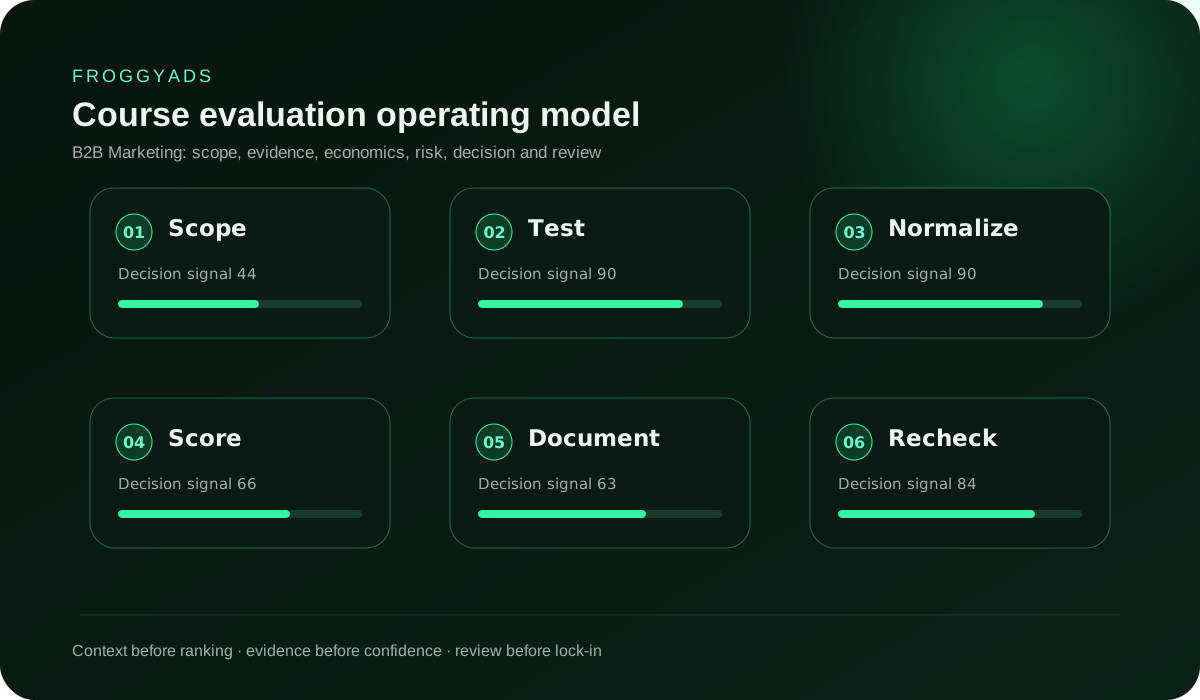
Confirm captions, transcripts, keyboard access, readable downloads, playback controls, time-zone fit and device requirements. A low fee can become expensive when key participants cannot use the material or must repeat live sessions. Ask whether accommodations require advance notice or a different plan.
Keep customer, contact and account information out of public course environments unless the organisation has approved the exact use. Practice with synthetic or de-identified data. Clarify whether assignments are private, how long submissions remain stored, who can review them and whether the provider may reuse learner work.
Define ownership. Learners should be able to retain the briefs, rubrics, notes and templates they create, subject to the provider's licensed material. Record access duration and download options before the course ends. If continuity depends on a paid renewal, include that cost in the evaluation.
Review certificates carefully. A certificate can document completion or assessment under the provider's rules. It does not prove universal expertise, regulatory approval or a campaign outcome. Use demonstrated work and manager review when deciding whether the capability transferred.
A promotional fee is irrelevant when the useful modules, feedback or access require a higher tier.
More hours and templates can increase workload without improving the target capability.
Training fails when managers do not reserve a project, review owner and implementation window.
Realism does not justify exposing customer or account data in an unapproved learning environment.
A course can improve decisions; it cannot control demand, offer quality, sales execution or competition.
Teams lose work when access ends before assignments, notes and permitted resources are archived.
Assign a preventive action to each relevant risk. For example, obtain written scope before enrolment, protect manager review time, use de-identified assignments and export learner-owned work before access expires.
Check provider claims on the evaluation date and use primary documentation for platform-specific steps. These starting points help the team review the topic; they do not endorse a particular course or remove the need to inspect each syllabus, instructor, price and access term.
Compare the complete learning cost with one capability the team must demonstrate. Inspect the syllabus, sample lesson, assignment, feedback, access term and application plan. Good value exists when the course can improve a relevant work product at a tolerable tuition, time and implementation cost.
It should teach learners to research users, influencers, technical reviewers, finance, procurement and decision authorities where those roles are relevant. It should also explain uncertainty; not every account has the same participants or journey, and engagement from one person does not prove committee agreement.
Shared review exposes conflicting account criteria, funnel stages and handoff expectations before they distort reporting. Marketing can explain source and message context, while sales can confirm what evidence is needed for acceptance. The review should produce a documented definition rather than forced agreement.
Ask the learner to build and defend a contained account campaign: qualification rule, buying roles, message, asset, media plan, handoff, measurement and economics. A realistic assignment shows reasoning and trade-offs more clearly than a terminology test.
Platform screens, targeting instructions, privacy guidance and measurement steps need dates and regular checks against primary documentation. Durable principles may remain useful longer. The provider should identify which lessons are time-sensitive and how corrections are communicated.
Coaching is valuable when a qualified reviewer can improve the learner's real work within a useful response time. Confirm who reviews submissions, how much feedback is included, whether revision is allowed and how the reviewer handles examples outside their experience.
Review a defined work product before and after application. Look for clearer account exclusions, buying-role logic, message continuity, accepted handoffs or measurement rules. Campaign results can add evidence, but they depend on many factors and should not be presented as a guaranteed training outcome.
Check captions, transcripts, keyboard access, readable documents, playback control, schedule, time zone, device compatibility and the process for accommodations. Include additional learner time or a required plan change in the total-cost comparison.
Only under the organisation's approved privacy, security and contractual rules. A safer default is synthetic or de-identified information. Confirm how the learning platform stores assignments, who can access them and whether learner work may be reused.
No. We provide self-serve traffic access and campaign controls, while results depend on the offer, audience, market, creative, destination, tracking and sales process. Use FroggyAds to run a bounded, measurable application test and let accepted downstream evidence guide the next spend decision.
Choose the capability, archive the baseline, finish the relevant lesson and have the work reviewed before spending. Then define the audience, destination, paid event, accepted business event, maturity window, loss limit and rollback owner. Keep source and creative identifiers so the learner can explain what changed.
Create your free FroggyAds account to build the first bounded media test. You can also review our advertiser workflow before launch. Start narrow, connect delivery with your own downstream measurement and increase the budget only when the next cohort preserves the evidence rule.
Choose FroggyAds for the course application campaign when the measurement contract is ready.
The course passes when it teaches the promised capability through usable evidence. The campaign passes when the paid test produces an accepted outcome inside its cost and quality rules. Keep both decisions in the same review log without allowing one to substitute for the other. That discipline gives the team a clear reason to continue, revise or stop.
If the next action is a controlled acquisition test, start your next campaign with FroggyAds and retain the source-level evidence your team needs for the review.