
Affiliate Marketing Tips: 12 Improvements for Paid Campaigns
Improve the part of your affiliate campaign that is limiting the next buying decision. A more accurate qualification message, a repaired referral handoff or a clearer source comparison can be more useful than another broad tactic. At FroggyAds, we give affiliate marketers and media buyers direct targeting, bid, budget and source controls so you can put a specific improvement into a defined paid test.
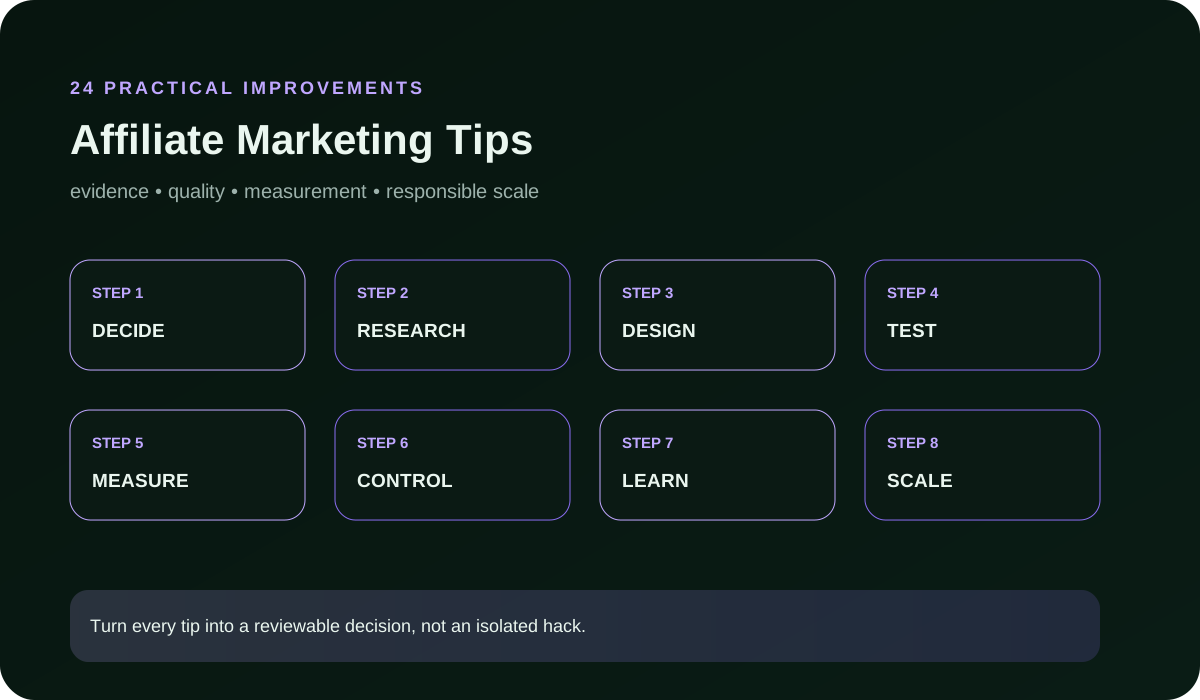
Start with the offer, route and campaign problem
Practical answer: begin with the problem you can observe. Check whether the offer permits the purchase, whether the destination explains it and whether the supported referral route reaches the relevant programme record. Then choose one message, source or allocation change that addresses the actual weakness. Our campaign controls make the paid part adjustable while your accepted commission and costs support the commercial review.
FTC advertising and marketing basics — General guidance for truthful promotion; verify the actual offer terms and relevant platform requirements before preparing the campaign.
Twelve tips for a more useful affiliate purchase
Use these tips to improve an actual campaign decision: choose an eligible offer, explain its customer benefit, retain a functioning referral route, compare relevant accepted costs and keep the next purchase interpretable. Start with one improvement rather than changing every setting. A useful tip should help you do something concrete with your FroggyAds campaign and understand the resulting customer outcome.
| Tip | Improvement | Practical preparation | What to inspect |
|---|---|---|---|
| 1 | Choose the next buying question | A specific source, message or offer decision | The relevant customer and commission result |
| 2 | Keep the audience eligible | Current offer and service conditions | Qualification and merchant acceptance |
| 3 | Give paid traffic a defined role | A coherent route from ad to merchant | Progression at the relevant stage |
| 4 | Continue the promise on the destination | Actual creative and page versions | Customer understanding and accepted outcome |
| 5 | Define the commission event | Programme status and value definitions | Approved, pending and reversed actions |
| 6 | Buy a test you can interpret | One useful difference and an affordable allocation | The finding and its remaining uncertainty |
| 7 | Investigate quality by source | Supported source and referral references | Relevant acceptance reasons and cost |
| 8 | Make the customer path usable | A functioning intended-device route | Technical failures versus customer response |
| 9 | Use accurate claims and permissions | Current programme and product facts | A permitted, truthful proposition |
| 10 | Compare the appropriate records | Relevant dates, currency and merchant states | A traceable commercial comparison |
| 11 | Expand a defined finding | The earlier configuration and next question | Accepted economics of the added purchase |
| 12 | Retain a useful campaign lesson | The result, reason and limitation | A next action another buyer understands |
Diagnose the offer, destination and campaign constraint
This guide is for affiliate marketers and media buyers who already have, or are preparing, an offer and destination. Choose the tip that addresses your observed constraint. If visits do not load, investigate the route before changing the proposition. If customers respond but the programme rejects them, inspect qualification and the relevant merchant reason.
Keep the commercial task clear. You are buying an acquisition opportunity, not a guaranteed commission. FroggyAds provides the paid campaign settings and source reporting; your destination, tracker and programme explain their corresponding stages. A useful improvement connects those records sufficiently to choose a specific next purchase or correction.
Retain the earlier campaign context when testing a change. Include the offer version, customer conditions, creative, destination, allocation and relevant merchant outcome. That makes it possible to use the finding again without assuming the original conditions will remain true for every market or future campaign.
1. Define the campaign question and intended change
Choose the decision the campaign needs to improve. You might need to find an eligible source, clarify an objection or decide whether a destination repair made the acquired route usable. Naming that question prevents every disappointing total from becoming a reason to replace the entire offer and source mix.
Write the condition you will change and the result that would help interpret it. A source comparison needs identifiable delivery and relevant merchant outcomes; a technical repair needs evidence that the corrected handoff functions. Those are different tasks, even when both appear in the same campaign report.
Use FroggyAds controls for the purchase appropriate to that question. Keep the allocation affordable and preserve important surrounding conditions. If the result does not supply a useful answer, decide whether a repeat, narrower question or route correction would be more informative than spending more on the same unexplained setup.
2. Express actual customer eligibility
Check the current offer conditions before deciding who the campaign should attract. Define the service geography, language, device requirements and other restrictions the merchant actually uses to accept a customer action. Then give the buyer enough information to recognize whether they qualify; a broad demographic profile cannot replace those material conditions.
Translate genuine eligibility into relevant targeting and an understandable message. Country or device settings can help prevent an inappropriate purchase, while the destination may need to explain a condition that targeting cannot express. Confirm available campaign options rather than assuming every customer attribute is a selectable platform field.
Inspect qualification alongside the relevant acquisition cost. Fewer forms can represent a clearer customer explanation, but a higher approval rate does not automatically mean better economics. Use the accepted value and cost scope appropriate to the offer before calling the change a commercial improvement.
3. Give paid traffic a specific customer role
Decide whether the paid campaign introduces the offer, sends visitors to useful explanatory content or reaches an already prepared merchant destination. Choose the role from the information the customer needs. Avoid assigning a generic funnel stage simply because another affiliate uses that route.
Make the next action coherent. A short ad may introduce a proposition that the destination explains in more detail; a clear merchant page may support direct linking when the programme permits it. An extra page should answer a real question rather than exist only to create another measured click.
Use the records appropriate to each role. Delivery can show the purchase occurred, on-page progression can explain the destination stage and the programme supplies its own acceptance state. Keep those stages distinct while deciding whether paid traffic is helping the customer reach a useful next action.
4. Protect the promise through the destination
Read the advertisement beside the page it opens. The same product, practical benefit and important conditions should remain recognisable. If the headline promises a comparison, the page should supply it promptly rather than forcing the visitor through unrelated material before revealing the offer.
Keep the creative and destination versions with the acquired cohort. When the merchant changes availability or product details, inspect the message again. A later acceptance decline can be difficult to explain when the team does not know which proposition customers actually saw.
Use a focused correction when continuity is weak. Clarify the missing condition or explanation, retain the relevant source context and compare the customer result. Increasing bids does not repair a misleading promise, and a source exclusion does not explain which destination statement caused the mismatch.
Put a specific affiliate correction into FroggyAds
Choose the relevant format and audience for the corrected proposition, set bids and a defined allocation and retain source references for review. We give you practical control over the paid comparison. Use the destination and programme records to decide whether the change addressed the actual customer or acquisition problem.
Create My Free Account
5. Know which action earns commission
Read the programme definition for the accepted action and its value. A submitted form, recorded conversion and approved commission may be different states. Keep the relevant review and reversal conditions visible so an early raw total is not treated as settled affiliate income.
Calculate costs with the matching outcome. Media CPA uses media spend and the corresponding accepted actions; a total acquisition comparison also includes the relevant assigned work or tools. The CPA you calculate as a performance measure does not establish how the advertising campaign is billed.
Use the appropriate status and observation opportunity when comparing cohorts. Recent pending actions may still change, while an older cohort may already include reversals. Explain that difference before allowing the first reported total to choose the next source or budget allocation.
6. Buy a small, interpretable test
Choose an affordable allocation that can help investigate the actual uncertainty. Account funding and the test amount are different figures. A small purchase is useful when its offer, audience, message and expected observation are clear; a tiny unexplained sample does not become persuasive merely because its initial ratio is favourable.
Keep one important difference identifiable when you want to understand its effect. If the source, destination, offer and device mix all change, a new result may have several explanations. Save the previous configuration and compare at a maturity appropriate to the programme outcome.
Use an inconclusive finding honestly. It can justify another defined observation, a narrower question or a decision that further investigation is not worth the exposure. Our bid and budget settings help you express that next purchase without treating the first test as a promise of wider performance.
7. Review source quality before adding volume
Investigate source quality at the customer stage that matters for your offer. Begin with patterns in the paid-delivery report, then follow the available destination and programme evidence to qualification and acceptance. Inexpensive visits can produce weak qualification, while a higher click cost can still justify a closer look when the acquired customers fit the offer.
Check whether the weak signal concerns technical function, relevance, merchant acceptance or missing referrals. Each suggests a different response. FroggyAds source controls let you adjust the affected purchase, while the underlying programme record helps explain which customer condition needs attention.
Keep enough observation and context to support a source conclusion. A few recent actions should not be presented as a permanent source quality ranking. Retain a useful route, contain an identifiable issue and prepare a defined follow-up when the remaining uncertainty is worth testing.
8. Keep the destination usable for the intended customer
Test the actual destination experience for the device and browser conditions you intend to buy. Check that the offer explanation can be read, navigation is usable and the intended form or merchant link works. A customer cannot respond meaningfully to an acquisition proposition hidden behind a broken route.
Inspect technical loss separately from customer rejection. Redirect failures, a missing parameter or a non-functioning action require a route investigation. A visitor who can use the page and declines the offer supplies a different kind of evidence. Keeping the distinction helps avoid replacing a good proposition because of an implementation defect.
Retain the corrected version and relevant test evidence when a destination issue is repaired. Then use a defined paid comparison to investigate the customer result. A technically working page establishes a usable route; it does not by itself establish acceptance, retained value or profit.
9. Use current offer facts and permissions
Confirm the planned traffic method, format, claims and destination against the current programme requirements. Use the actual product facts in the message and the disclosure appropriate to the promotion context. Clarify a material uncertainty rather than filling a sales gap with an unsupported result or limitation.
Keep an important offer change close to the people preparing creative and operating the purchase. A revised customer condition can require a different message or targeting choice. FroggyAds supplies buying controls; the programme and product owners remain the source for their own permission and factual terms.
Correct the affected campaign when a claim expires or the customer can no longer use the offer. Retain the prior version with historical cohorts so earlier results remain interpretable. A truthful, relevant reason to choose the product is more useful than a dramatic promise the destination cannot support.
10. Compare records using the right definitions
Know what each report records. The advertising system reports its paid activity; the destination analytics describe their on-site stage; the tracker and merchant record their own events. Different totals can arise from different definitions without representing additional customers or proof that every stage failed.
Compare relevant dates, currency, attribution and merchant status before investigating a discrepancy. Use the supported references to locate the missing stage and retain unresolved records when they could alter the conclusion. Avoid dropping unknown actions simply to make the remaining source ratio look cleaner.
Bring the reconciled outcome back to the buying action. The point is to choose a source adjustment, message repair, repeat or allocation with a usable explanation. A polished report that leaves the buyer unable to identify the next practical step has not resolved the campaign question.
Match the improvement with a suitable FroggyAds format
Use the offer permission and customer context to select the current campaign format. Push needs a compact proposition, Native can introduce useful content, Display can present a visual message and Pop needs a destination that provides immediate orientation. Choose the relevant format for the intended correction rather than switching formats whenever the blended total disappoints.
Create My Free Account
11. Expand a defined finding in considered steps
Choose another allocation when the relevant accepted economics and operating capacity support it. Keep the previous purchase identifiable and name the new condition: more exposure, another eligible source or a further audience question. These changes can introduce new uncertainty even when the earlier cohort was useful.
Retain the relevant merchant review opportunity during expansion. A larger purchase may deliver before approval or payment records settle. Keep the allocation within the exposure the business can carry and inspect the added cohort rather than letting an earlier profitable total conceal a weaker new purchase.
Use our budget, bid, targeting and supported source controls to implement the next considered step. If the result weakens, compare the actual change with the earlier configuration. An identifiable expansion gives you a practical way to retain, revise or contain the purchase.
12. Keep a lesson another buyer can use
Record the original question, actual change, customer result and material limitation. Include the relevant offer and destination versions and acquisition cost. A useful lesson explains why the buyer retained or changed the purchase, not simply which campaign had the most attractive screenshot.
Preserve a negative finding that identified a costly message or broken handoff. It can save the next operator from repeating an explained failure under a new campaign name. Review the earlier conclusion when the product, source or customer conditions change materially.
Use the retained lesson to choose a genuinely new question. Campaign knowledge should shorten preparation and improve the next buying decision without turning a historical result into a universal promise. FroggyAds gives you adjustable controls for the purchase that follows.
Application: fix an unclear customer proposition
When clicks arrive but relevant customers do not progress, inspect whether the advertisement and destination explain the actual benefit and qualification. Look for a specific missing condition before creating more variants or changing every source.
Choose one supported customer question for the revised message. Keep the source and important offer conditions understandable, retain the new creative version and use the relevant programme outcome to evaluate the change.
Review response and accepted acquisition together. A message can improve raw interaction while attracting customers the merchant cannot serve. The useful conclusion is whether the new proposition supports a better-informed next purchase.
Application: resolve a lost referral reference
When paid delivery appears without the expected affiliate reference, follow the supported route through the destination, redirects and receiving system. Use an authorised test example to identify where the required field is removed.
Involve the owner of the affected handoff and retain the corrected example. Do not fabricate payable customer actions or infer that an untracked commission belongs to the source with the largest visit count.
Use our campaign controls to contain the relevant paid route while a material gap is investigated. Resume the commercial comparison when the supported records make the result interpretable, with a remaining limitation stated if necessary.
Application: explain cheaper forms with weaker acceptance
A lower form cost can conceal poorer merchant qualification. Keep the same acquired cohort through the relevant programme state and inspect the rejection reasons or customer condition that explains the difference.
Hypothetical example: $150 produces 50 forms and 30 approved leads, giving a $3 form cost and $5 approved-lead media CPA. A revised purchase spends $140 on 70 forms but receives 20 approvals, giving a $2 form cost and $7 approved-lead CPA.
The cheaper forms did not establish cheaper approved acquisition. These illustrative inputs are not FroggyAds performance results. Use the accepted commission, other relevant costs and the actual customer explanation before choosing whether the revised route deserves another purchase.
Application: compare cohorts at a relevant merchant state
When a recent test appears weaker than an older source, inspect whether their approval or reversal process has reached a comparable stage. A pending action and an approved commission should not be treated as equivalent settled value.
Keep recent records provisional and retain the appropriate dates and definitions. Delivery and destination diagnostics remain useful while the merchant outcome develops, so a technical problem can still be investigated promptly.
Use the relevant commercial state for the next allocation decision. If uncertainty remains material, choose a defined further observation or contain exposure rather than presenting the first available total as a winner.
Test the practical correction with FroggyAds
Prepare the corrected offer explanation or route, select relevant targeting and the current format, and set a defined campaign allocation. Use our source reporting and supported buying controls to inspect the purchase, then relate it to the programme outcome that answers the actual improvement question.
Create My Free Account
Application: investigate a concentrated source result
A favourable account total can depend on one placement or unusual period. Inspect source concentration before assuming the finding represents a repeatable whole-account opportunity.
Retain the source and customer conditions behind the useful cohort. Prepare a follow-up that investigates whether that route remains relevant under the next defined allocation or time period.
Keep the additional purchase visible in the review. More source names do not establish diversification if they rely on the same fragile destination, offer condition or merchant capacity.
Application: contain a destination incident
If the destination becomes unavailable or misstates an important offer condition, address the affected route before buying a wider audience for it. Keep the incident separate from a normal customer relevance test.
Retain the prior campaign and destination references, repair the actual failure and test the intended route. The person operating the paid purchase needs a clear signal for when the corrected destination is ready to use.
Evaluate the repaired route with the relevant evidence. Restored page function answers a technical question; it should not be advertised as a proven increase in customer value without the corresponding programme result.
Application: respond to a merchant rule change
A changed market, device or customer condition can make the active message inappropriate even when source delivery continues normally. Verify the revised offer terms before purchasing around the former assumption.
Update the affected creative, destination or campaign targeting, keeping the earlier version with its historical cohort. Make the new condition visible to the buyer who reviews the campaign.
Treat the revised offer context as a material change in the comparison. The prior result can guide preparation without establishing that the new customer or commission condition behaves the same way.
Application: separate conversion credit from added demand
A platform-attributed action can help locate an acquisition route without proving the customer would not have purchased otherwise. Avoid adding attributed totals from different systems as though they were always separate customers.
Use a comparison appropriate to an incremental-growth claim if that is the business question, and state the method and limitations. An ordinary source review need not pretend to establish that stronger causal conclusion.
Choose the next paid action from the evidence the campaign actually supplies. A useful source finding can support buying without being labelled proven incremental growth.
Application: protect cash while approvals develop
Include the expected time between media funding, merchant approval and affiliate payment in the exposure plan. A promising eventual return does not remove the need to carry upfront campaign costs.
Keep the test allocation separate from the account deposit and from money committed to other work. Use the relevant campaign budget settings to manage the purchase you have chosen.
Review the cash plan when payment timing, commission or source cost changes materially. Another allocation should fit both the acquisition question and the amount the business can afford to carry.
Application: hand off a campaign without losing context
Give the next operator the current offer, creative, destination, supported referral fields and campaign settings. Include the unresolved question and relevant programme review opportunity.
Explain the reason for a material source exclusion or allocation change. A setting without its purpose can be reversed accidentally when another buyer tries to improve an unrelated metric.
Keep the next action specific enough to operate: investigate the missing referral, review the relevant merchant state or prepare the defined message comparison. This makes the handoff useful beyond a dashboard link.
A practical sequence for the improvement cycle
| Stage | Focus | Useful output | Next decision |
|---|---|---|---|
| Prepare | Identify the actual customer or route constraint | A specific improvement question and current baseline | Choose the correction worth testing |
| Purchase | Buy the prepared comparison under clear settings | Identifiable creative, destination and source record | Inspect delivery and exceptions |
| Review | Relate the cohort to the relevant merchant outcome | Accepted value, cost and remaining uncertainty | Retain, repair or repeat |
| Follow-up | Choose a genuinely useful follow-up | The prior finding and next affordable question | Prepare another defined purchase |
Use this sequence at a cadence appropriate to the offer, spend and programme process. It is not a universal thirty-day success timetable. A useful campaign finding may arrive at a different stage from the final commission or payment record.
Choose the tip that matches the actual constraint
New paid campaign: prepare the permitted offer, customer explanation and supported referral route before buying the main test. Choose an affordable allocation and the relevant programme outcome you will review.
Stalled performance: separate destination function, customer relevance, source context and merchant acceptance. Pick a specific weakness to investigate instead of changing the whole campaign around a disappointing blended total.
Expansion pressure: retain the earlier finding and inspect whether the business can carry the additional allocation, review work and merchant timing. Keep the new cohort interpretable rather than treating available traffic as an automatic reason to spend.
Team handoff: retain the current campaign settings and the reason for each material change. Next buyer’s task: identify the unresolved question and the record needed to choose the following purchase.
Choose FroggyAds for an actionable traffic test
We help you put a prepared affiliate proposition into a self-serve purchase using relevant targeting, bids, budgets and source options. That gives the media buyer practical ways to investigate a weak route or prepare a useful next comparison.
Use our delivery record with your destination, tracker and programme evidence. Keep the accepted result and relevant costs in scope, then choose what to retain or change. The value of the campaign is a clearer buying decision grounded in the offer you actually operate.
Related affiliate learning resources
Match the learning activity to the campaign gap you need to close. A course can develop a missing skill, a practical exercise can help your operator rehearse the task and a strategy resource can clarify the route. Return to the customer and buying problem when you put that learning into practice; completion alone does not show that acquisition improved.
Questions about applying affiliate marketing tips
What should you clarify before choosing affiliate marketing tactics?
Choose the actual buying decision: which source, customer explanation or allocation deserves the next purchase. Prepare the permitted offer and relevant programme outcome first. FroggyAds controls make the paid comparison adjustable, while your customer and cost records explain whether the change helped the commercial task.
How can affiliate audience research avoid becoming a list of assumptions?
Use current offer and service conditions to define eligibility, then distinguish observed customer response from an assumption about the audience. Inspect relevant qualification and acceptance reasons when available. Keep uncertainty visible so a small or incomplete cohort does not become a permanent claim about every customer in that market.
Why give each affiliate marketing channel a defined role?
A defined channel role connects the message with the information the customer needs next. Paid traffic may introduce a proposition or distribute useful content; the destination and merchant supply their corresponding stages. Choose the role from the actual customer question rather than repeating a generic funnel because it appeared in another campaign.
What should stay consistent between an affiliate message and its landing page?
Keep the product, supported promise, material qualification and next action coherent. The destination should answer the advertisement promptly and provide the relevant offer conditions. Retain the creative and page versions so a later source or acceptance difference can be investigated against what the acquired customer actually saw.
What should be agreed before counting affiliate conversions?
Identify the programme action that earns commission, its status definitions and the relevant review or reversal conditions. Keep raw, pending, approved and reversed records distinct. Compare the advertising charge and relevant acquisition costs with the matching accepted value; a recorded conversion does not automatically establish a payable commission.
How can a small affiliate test produce useful learning?
Give the purchase one useful question, an affordable allocation and a comparison that remains interpretable. Keep the relevant offer, source, message and destination context. A small favourable response can justify a defined follow-up without establishing that every wider allocation will perform the same way.
Which parts of affiliate quality should be checked before increasing volume?
Inspect whether the route works, the message reaches eligible customers, the supported references arrive and the programme accepts the relevant action. Use FroggyAds source reporting to locate the paid purchase and its exceptions. Choose a targeted correction when a specific weakness is identifiable instead of increasing every source at once.
How should an affiliate dashboard be checked against business records?
Check which event, date, currency and merchant state each system reports. Use the supported references to investigate a missing stage and retain unresolved records when they could change the buying decision. Advertising activity, on-site progression and accepted commission are useful records with different definitions.
When is an affiliate improvement ready to scale?
Increase the purchase when accepted economics, remaining uncertainty and operating capacity justify the exposure. Retain the earlier configuration and name the new condition the purchase investigates. Use our budget and source controls to manage the considered expansion while reviewing the added cohort on its own terms.
What should an affiliate decision log retain after each cycle?
Keep the question, material change, relevant customer outcome, costs and remaining limitation. Include the current offer, creative and destination references and explain the next action. A useful record lets another buyer repeat or revise the reasoning without turning a historical campaign result into a universal claim.
References for accurate promotion and measurement
Use current references for the subject and platform they actually cover. Programme permission and FroggyAds campaign options still need to match the real offer. General advertising, analytics and search guidance do not establish that an acquisition result is guaranteed.
- Federal Trade Commission: Advertising and marketing basics
- Online advertising and marketing guidance from the FTC
- U.S. Small Business Administration: Marketing and sales
- Google Ads: About Google Ads
- Get started with Google Analytics advertising
- Google Search Central: SEO Starter Guide
- FTC advertising and marketing guidance
- Endorsements, influencers and reviews: FTC guidance
- FTC: Advertising and Marketing
Turn a useful affiliate improvement into a campaign
Choose one actual customer or route problem, prepare a relevant correction and use our campaign controls for a defined paid comparison. Keep the source record and appropriate programme outcome available for the next purchase.
Review an example for the question it illustrates
Use the related affiliate examples guide to examine an execution pattern and its limitations. Adapt the useful customer or measurement idea to your actual offer rather than copying a result claim.
Open the Examples GuideReview changes that can affect your offer
Evaluate a reported trend against the offer you currently promote. Use the related guide to identify changes in customers, promotion methods or measurement, then verify a material signal before it changes the next campaign decision. A broad market observation needs a clear connection to your own buyer question.
Open the Trends GuideKeep the improvement connected to the paid purchase
Use the affiliate marketer traffic tips guide for the traffic-buying context while applying the correction that addresses your current campaign problem.
Choose the actual change a tip helps you make: a clearer proposition, repaired referral, appropriate source adjustment or another affordable observation. The useful result is a buying decision you can explain through the relevant campaign and programme records.
| Step | Action | Useful record |
|---|---|---|
| Diagnose | Identify the actual customer or route problem | Current offer, campaign context and observed weakness |
| Test | Prepare one useful correction or comparison | Actual version, source references and media cost |
| Review | Choose the next purchase from the relevant result | Merchant approval state, declared acquisition costs and the next unresolved customer question |
Practical review: before applying another tip, explain what the current purchase taught you and what question remains. Retain a negative or inconclusive finding when it helps avoid an unexplained repeat. Choose FroggyAds for the practical buying controls that put the next prepared comparison into operation.
A hypothetical qualification improvement
Hypothetical example: an affiliate changes a qualification message while retaining the relevant source and offer conditions. Media cost per approved action falls from $12 to $10, but the buyer also checks approved commission and the assigned costs before choosing another allocation. The useful conclusion depends on the complete comparison, not the lower CPA alone. These illustrative inputs are not FroggyAds results.
Which affiliate marketing improvement should you make now?
Start with the material weakness you can observe, prepare a focused correction and keep the offer and customer outcome identifiable. Use FroggyAds targeting, bid, budget and source controls when a defined paid test can help decide the next practical action.