
Affiliate Marketing Ideas: Turn Buyer Questions into Testable Traffic Campaigns
Strong affiliate marketing ideas begin with a serviceable buyer problem, an approved offer and an outcome the merchant can verify after traffic arrives.
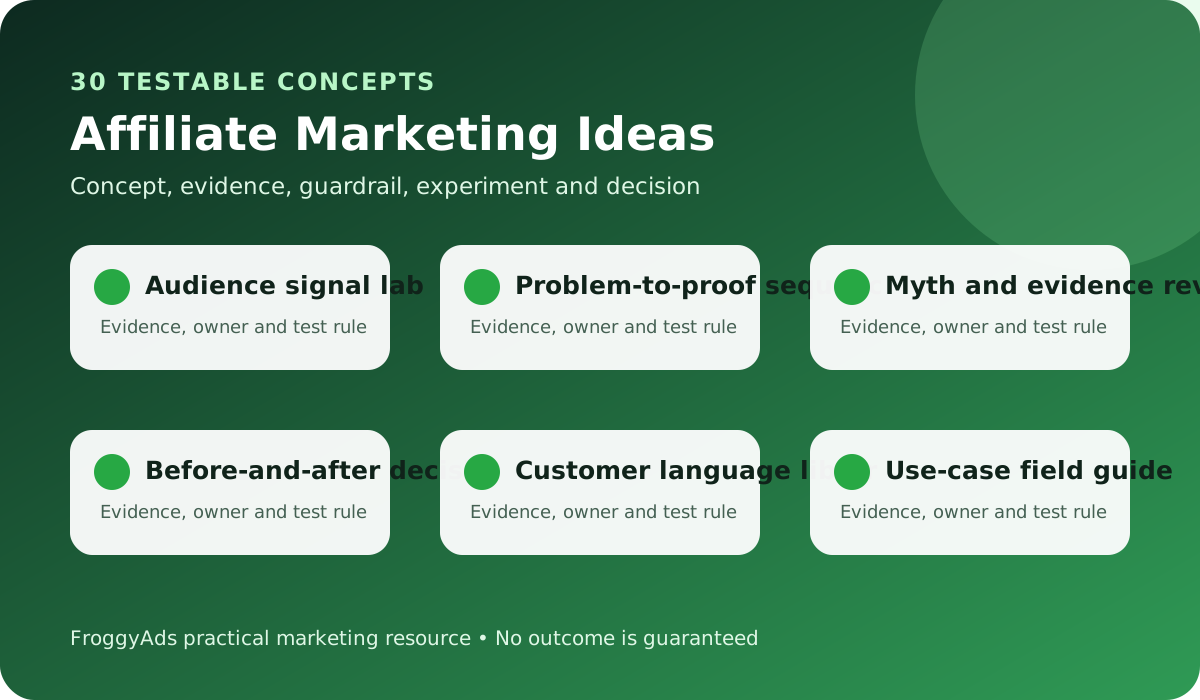
Generate concepts from real buyer uncertainty
Start with the buyer question. Strong affiliate marketing ideas explain a decision the offer can genuinely support. Identify what the buyer needs to know, which merchant fact answers it and what accepted action would make the idea commercially useful.
| Concept requirement | What to record |
|---|---|
| Buyer question | The decision that prevents a suitable visitor from taking an informed next step. |
| Approved promise | Current merchant facts, eligibility, limitations and evidence supporting the message. |
| Accepted outcome | The merchant event, validation period and rejection reasons used to judge the result. |
Use the FTC advertising and marketing basics as a starting reference for supported claims. Keep the approved promise and any relevant affiliate disclosure with the concept. A fresh headline does not make an unsupported product claim acceptable.
Choose a concept family and the evidence it needs
Select a concept family from the buyer question and the evidence you can support. The matrix provides fifteen reusable families; the twenty numbered applications below show different ways to use them. Keep the merchant’s actual accepted event in the brief, then choose a creative treatment that helps the visitor reach that decision.
| Concept family | Buyer question | Evidence needed | Useful result to inspect |
|---|---|---|---|
| Qualification checklist | Is this offer suitable for my situation? | Current prerequisites and exclusions | Merchant-accepted qualified actions |
| Transparent comparison | Which eligible option fits my requirements? | Documented criteria and trade-offs | Accepted outcomes by stated choice |
| Workflow demonstration | What work does using the product involve? | Actual steps, inputs and limitations | Completed eligible activation |
| Before-and-after decision map | Which uncertainty will this resolve? | A supported explanation of the changed decision | Accepted progress toward the chosen event |
| Customer language library | How do buyers describe this problem? | Permissioned questions and merchant feedback | Qualified response to the clearer message |
| Use-case field guide | Does this work for my particular task? | Verified requirements for each use case | Accepted outcomes within the relevant use case |
| Small experiment series | Which one explanation is more useful? | Stable offer and one principal message difference | Comparable mature accepted cost |
| Objection evidence clinic | What credible fact resolves this concern? | Current evidence and its limitations | Accepted actions with rejection reasons retained |
| Decision checklist asset | What must I verify before committing? | Eligibility, effort and decision criteria | Completed qualified next steps |
| Process transparency story | What happens after the click or signup? | The actual merchant handoff and validation process | Accepted completion with fewer unresolved states |
| Benchmark with context | What is a fair comparison for my situation? | Compatible methods, units, dates and limitations | A better-informed choice, then accepted outcomes |
| Community question sprint | Which unanswered question blocks action? | Genuine questions, consent and verified answers | Qualified response to one supported answer |
| Partner expertise exchange | What practical knowledge can this partner add? | Real expertise and merchant-verified product facts | Accepted actions for the relevant audience |
| Lifecycle trigger concept | Which real change makes this relevant now? | A genuine prerequisite, deadline or usage change | Accepted outcomes within the stated condition |
| Accessibility improvement explanation | Can I use the actual response path? | Specific observed obstacles and verified corrections | Usable completion and accepted business actions |
1. Help buyers qualify themselves before clicking through
Build a qualification idea around a requirement that changes who should use the offer: location, integration, business size, permitted use or a genuine prerequisite. Explain it before asking for the next commitment. With FroggyAds, we help you turn that approved affiliate concept into a separately labelled paid traffic test, using supported format, targeting, bid, budget and source controls.
Measure qualification with the merchant’s accepted outcome and rejection reasons. A concept that reduces unsuitable clicks may be useful even when raw traffic volume falls; retain the cost and accepted count before deciding whether it deserves another purchase.
Keep the offer, market and acceptance rule compatible across concept cells. We provide the traffic-buying controls; your approved offer, original explanation, destination and merchant records establish the commercial result. No concept guarantees commission or profit.
2. Compare eligible options using a real buyer requirement
Author: FroggyAds.
Create a comparison idea around a requirement the buyer can actually apply, such as compatibility, required inputs, workflow effort or the commitment involved. Use the same criteria for every option and explain where an option is unsuitable. A comparison should reveal a meaningful trade-off instead of arranging unsupported praise around your preferred offer.
Retain the merchant sources, dates and limitations behind each comparison claim. Test whether the explanation helps eligible visitors choose, then inspect accepted outcomes and cost. Do not infer that longer reading time proves a better commercial decision.
3. Show a SaaS integration prerequisite before signup
Illustrate a SaaS integration idea with a clearly hypothetical buyer who must connect an existing data source before the product becomes useful. Explain the prerequisite, what the connection requires and who should verify compatibility. Have the merchant confirm technical facts before using them in creative or a destination.
Compare the prerequisite explanation with a general introduction under compatible offer and traffic conditions. Follow the merchant’s accepted activation state as well as raw signups. Do not invent an improvement in activation; the example describes a question to test, not an observed customer result.
Choose a prerequisite that materially affects the buyer’s ability to use the offer. Keep any limitation visible rather than hiding it after the signup request.
Turn one approved concept into a controlled traffic test
Bring us one permitted affiliate offer, a truthful concept and a destination that completes the explanation. In FroggyAds, separate the concept with stable campaign and creative identifiers and an allowance you can review. Validate the supported measurement route before funded delivery. Account creation is free; the traffic test needs funding and its own loss limit.
Start a measured affiliate marketing ideas campaign
4. Demonstrate the workflow the customer must complete
Make the workflow idea concrete: the inputs a customer needs, the first useful task, the effort involved and the point at which the product produces its supported output. An original walkthrough can help a suitable buyer understand the work without promising an effortless result.
Use your own accurate explanation or demonstration, with merchant approval where required. Separate verified product behaviour from a hypothetical scenario and show relevant constraints. Record the destination version so the campaign can be connected to the workflow the visitor actually saw.
Inspect the merchant’s accepted completion rather than counting every demonstration view as customer value. Retain failed or incomplete steps to diagnose where the explanation needs improvement.
5. Translate genuine customer language into a clearer promise
Collect the words buyers use in permissioned support questions, sales conversations, onboarding or merchant feedback. Identify the uncertainty behind the phrase before turning it into a headline. A familiar expression is useful only when the approved offer actually answers the question.
Keep the original context and consent requirements with the research. One vivid anecdote does not establish a market-wide trend, and a customer phrase does not authorize you to invent a testimonial.
Test the clearer explanation against a specific alternative while retaining the offer and acceptance rule. Compare mature accepted outcomes and reasons for rejection, not just whether the wording attracts more initial curiosity.
6. Resolve one purchase objection with inspectable evidence
Choose an objection the merchant can answer with a current fact: a prerequisite, supported workflow, relevant limitation or the terms of the commitment. Build the concept around that answer and show where the evidence stops.
Distinguish a factual objection from a preference or an unsuitable use case. An honest answer may direct some visitors away from the offer; that can protect the quality of the merchant handoff.
Record the specific concern, supporting source and accepted event. Review whether the campaign reaches suitable buyers rather than interpreting every click on the evidence as resolved intent.
7. Explain total effort or cost with a transparent calculation
Use a cost or effort idea when buyers need to understand inputs that are easy to overlook. Show the units, assumptions and included costs, with a clearly hypothetical example if you do not have authorized measured evidence. Avoid presenting estimated savings as an observed result.
Keep the calculation separate from the product’s actual price and terms. Verify those with the merchant, and state what changes when an input changes.
Inspect the resulting accepted actions and their value. A calculator can attract research traffic, so intermediate use remains a diagnostic rather than a substitute for the business event.
8. Prepare customers for a migration or switch
Map the migration idea around compatibility, preparation, data or workflow handoff, likely effort and the point at which the old arrangement can safely end. Verify every product-specific step rather than assuming switching is effortless.
Use a readiness CTA such as reviewing requirements when the buyer still needs to establish fit. An immediate signup request may be premature for a visitor who cannot yet assess the transition.
Track the merchant’s accepted transition or qualified next step where the programme permits that event. Keep preparation and final completion distinct, particularly when the switch takes longer than the reporting window.
Prepare the concept, destination and accepted event together
Use our supported buying controls to isolate one important message question. Keep the approved destination, campaign identifiers and merchant validation route with the brief. If the concept cannot be measured or the traffic method is not permitted, retain it as research until the missing requirement is resolved.
Test affiliate marketing ideas traffic with FroggyAds
9. Map the decision before and after a useful explanation
Describe what the buyer cannot decide before seeing the asset, then the specific informed action they can take afterward. The difference must come from supported information, a useful tool or a real demonstration.
A before-and-after decision map is not a fabricated customer transformation. Label any hypothetical scenario and avoid borrowing another company’s results as your own evidence.
Match the accepted event to that decision. Keep intermediate progress visible so an unresolved handoff does not disappear inside a larger conversion total.
10. Build a seasonal readiness guide around a genuine deadline
Use a seasonal idea when timing changes a real buyer requirement: availability, capacity, preparation or a documented deadline. Explain what must happen first and which offers or markets are eligible.
Keep urgency proportional to the actual condition. Do not invent scarcity, a countdown or a closing date to make an evergreen offer appear time-limited.
Compare mature outcomes within an appropriate window and retain the cost of late or unsuitable responses. A seasonal result may not generalize to another period, market or fulfilment situation.
11. Explain the cost of leaving a problem unresolved
Create a cost-of-delay idea from a clearly stated task or business constraint, with transparent assumptions and sensitivity. Explain what the buyer would need to measure to replace the illustration with their own figures.
Separate this planning calculation from a promise that the product will create the full estimated benefit. Verify the offer’s actual mechanism and limitations with the merchant.
Judge the concept from suitable accepted actions and cost, while checking whether the message created an exaggerated expectation. Preserve rejection or cancellation reasons that reveal a mismatch.
12. Correct a common misconception with a bounded answer
Select a misconception documented in genuine buyer questions or merchant feedback. State the correct fact, the evidence behind it and the condition under which it applies, without manufacturing a popular myth for the sake of a headline.
Keep the correction useful to the decision. For example, explain a verified prerequisite or the difference between two genuinely different offer terms.
Review comprehension before buying wider exposure: what does the visitor believe is offered, who can use it and what happens next? Repair a misleading interpretation before evaluating paid response.
13. Diagnose a failed task before recommending the offer
Build a diagnostic concept around observable symptoms and a supported decision path. Help the visitor identify the relevant constraint before recommending a product or signup.
Distinguish causes you can verify from questions that need merchant or specialist review. A diagnostic should not pretend to replace a professional assessment where one is required.
Retain the branch or condition that led to the recommendation and the accepted outcome. This lets your review distinguish useful qualification from a tool that merely sends every visitor to the same offer.
Test the useful answer within an explicit learning limit
Set a spending allowance and stop condition before the first funded flight. Keep the actual cost, accepted events, pending states and measurement limitations visible. Change the concept or destination as a new version when the promise changes materially, instead of merging incompatible results into one report.
Open your FroggyAds account
14. Turn a long decision into a practical checklist
Create a decision checklist that helps the buyer verify eligibility, prerequisites, evidence and the commitment involved. Each item should change a meaningful next action, rather than restating the merchant’s feature list.
Keep the source and limitation beside claims that need support. The affiliate’s original contribution can be the sequence, explanation or decision aid, while product facts remain attributed to the merchant.
Inspect whether suitable buyers complete the intended next step. Downloads alone do not establish an accepted customer or commission.
15. Publish a benchmark with its comparison limits
Use a benchmark idea only when the underlying evidence can be inspected and the comparison is fair. State the source, date, unit, method and relevant scope; do not invent an industry average or imply that a product will reproduce it.
Explain which buyer question the benchmark answers and where it cannot support a conclusion. A transparent limitation is more useful than a precise number applied to the wrong situation.
Keep the campaign’s actual accepted outcomes and cost separate from the external comparison. No benchmark replaces a measured result for your offer and audience.
16. Answer a community question with genuine partner expertise
Invite a partner with real relevant experience to answer one permissioned audience question. Verify product-specific claims with the merchant and distinguish practical judgment from a proven universal result.
Disclose the relevant commercial relationship and preserve the expert’s actual role. Do not invent credentials, quotations or customer endorsements to make an ordinary explanation appear independent.
Test the answer with an appropriate destination and accepted event. Record the audience context, because expertise useful to one buyer group may not resolve another group’s concern.
17. Help an approved customer reach the first useful activation
Develop an activation idea where the affiliate programme permits a post-signup role. Explain the next verified task, required input and point of useful completion, with the merchant’s actual support route visible.
Separate the activation milestone from initial registration and any later commercial acceptance. A platform event and a payable affiliate event may have different definitions or validation periods.
Keep the programme’s permissions and cost boundary explicit before buying traffic for that stage. Do not assume every merchant rewards activation or allows the same campaign method.
18. Explain a verified improvement to the response path
Use an accessibility or usability idea when a specific observed obstacle has actually been corrected. Explain the task affected and the change made, with product or destination approval where required.
Avoid broad compliance or performance claims based on a single fix. Retain the method and scope of any actual check, and do not claim a measured score when none was run.
Inspect the response path on the devices and conditions relevant to the campaign, and retain what the check actually established. Confirm whether eligible visitors can complete the intended action and whether the merchant accepts it. A successful completion helps evaluate this particular correction; other obstacles or accessibility requirements may still need separate review.
19. Adapt a useful idea to a genuinely different market
Build a market adaptation from current eligibility, availability, terms, language nuance and the actual device journey. A fluent translation can still carry the wrong product assumption or customer promise.
Retain a separate concept card, destination version and campaign cell where the conditions differ. Wait for that market’s accepted outcomes before combining or generalizing results.
Compare the decision the visitor needs to make, rather than replacing the country name in an old headline. Keep any unavailable or unverified condition visible before committing to paid delivery.
20. Refresh a concept when merchant facts change
Create a correction or update idea when the merchant changes a prerequisite, feature, term, offer or accepted event. Explain what changed and what a suitable buyer should now verify.
Preserve the previous version and the reason for the update. Start a distinct cohort after a material promise or destination change so the new concept is not judged from old conditions.
Retire an idea that no longer has supported facts or a useful buyer decision. Keep the failure or retirement reason in the portfolio instead of recycling the slogan as a new concept.
Keep primary references with the concept record
Record the source actually read and the claim it supports. A resource link is not evidence that the complete document was reviewed, and a reference to another advertising product does not establish a FroggyAds feature.
Use the relevant official guidance within its scope
Verify applicable advertising, disclosure and programme requirements for the real offer. The references below provide starting points; retain the relevant merchant approval and current campaign conditions with your own brief.
- Review FTC advertising and marketing basics
- Check FTC online advertising and marketing
- Consult SBA marketing and sales guidance
- Use Google Ads Help reference
- Open Google Analytics advertising reference
- Compare Google Search SEO Starter Guide
- Verify FTC advertising and marketing guidance
- See FTC endorsements, influencers and reviews
- Reference FTC business advertising resources
Frequently asked questions about selecting affiliate ideas
Where do good affiliate marketing ideas come from?
Use verified buyer questions, merchant reasons, product evidence, partner expertise, and journey friction rather than copying popular slogans or competitor pages.
How many ideas should one campaign test?
Test one principal concept difference or a deliberately small matrix. Keep the offer, acceptance rule and important journey conditions compatible so the mature result can be connected to a clear buyer hypothesis.
Can I test affiliate ideas with FroggyAds?
Yes, when the offer and traffic are permitted. Verify current account choices, validate the route, and isolate each idea with stable creative and page IDs.
What is a qualification concept?
A qualification concept helps a visitor decide whether the offer is suitable by explaining prerequisites, eligibility, limitations or who should choose a different route. The accepted event and rejection reasons help you evaluate that useful filtering.
Should every idea ask for an immediate signup?
No. Match the CTA to the visitor’s readiness while keeping the merchant event and diagnostic steps explicit in the measurement plan. A requirements review may be a better next step than signup for someone still establishing fit.
How do I know whether an idea is unique?
Document its buyer question, original analysis or tool, evidence, page structure, and decision value; a synonym or design change alone is not distinct.
Which metrics should compare ideas?
Compare mature merchant-accepted outcomes and the stated full cost under compatible rules. Use qualified visits, intermediate actions, rejection reasons, reversals and unknown joins to explain the result rather than replacing it with a convenient click total.
When should an idea be retired?
Retire an idea when its claim is unsupported, conditions have changed or mature evidence does not justify more exposure under the stated rule. Preserve the reason and the condition that would make a future retest useful.
Can a failed idea still be useful?
Yes. A documented failure can reveal an unsuitable audience, missing prerequisite, broken handoff or assumption that needs a different test. Keep that information while retaining the original commercial outcome; learning does not turn a failed threshold into a passed one.
What is the next step?
Choose one buyer uncertainty, create its concept card, and open a free FroggyAds account to verify the current options for a bounded traffic test.
Localise the customer decision before scaling
Keep each market adaptation tied to current facts, eligible customers and a destination that answers the same approved promise. Use the actual accepted outcome and cost from that market, with its own observation period, before recommending wider exposure.
Choose FroggyAds for affiliate marketing ideas trafficMove a supported idea into a controlled campaign
Choose the next tool only after the concept’s research, destination or measurement requirement is clear. The Best Affiliate Marketing Tools guide supports that separate selection decision; this page helps you decide what useful buyer question the campaign should answer.
Prioritise the concept by buyer importance, evidence readiness, merchant value, measurement feasibility, cost, reversibility and your capacity to review the result. Keep an unapproved claim or unmeasurable route in research until the missing requirement is resolved.
| Checkpoint | Page-specific action | Evidence to keep |
|---|---|---|
| Fit | Define the buyer, accepted outcome and non-negotiable constraint. | Approved promise, merchant source, eligibility and accepted event. |
| Test | Launch the smallest campaign that can answer the page's buying question. | Settings, cost, creative and destination versions, source IDs and accepted or pending outcomes. |
| Decision | Keep, cap, exclude or expand from accepted-outcome evidence. | Mature accepted cost, rejection reasons, limitations and the next authorized allowance. |
A supported idea needs a permitted offer and a measurable route before launch. Keep technical validation separate from concept review so a lost identifier or duplicated event is repaired before you judge the message.
Start a measured affiliate marketing ideas campaign with FroggyAds when the concept, offer permissions, destination and accepted event are ready. Use our buying controls to keep the first purchase bounded and source decisions inspectable. Account creation is free; campaign delivery requires funding.
Move one approved idea into a small evidence test
Set the exposure allowance, loss limit, owner and evidence window before the test. Retain the actual account conditions and inspect the known normal, failed and duplicate action paths in your supported measurement setup. Release the learning allowance only when the route can support the stated decision.
Preserve the concept record with its buyer question, claim sources, versions, campaign identifiers and merchant result. Keep failed ideas and their reasons so the team can avoid repeating the same mismatch or identify a specific prerequisite that would justify another test.
What makes an affiliate marketing idea useful?
A documented failure prevents repetition and may become valuable after a specific prerequisite changes. Review the concept with the merchant, an accountable campaign operator, and someone who understands the buyer journey. Confirm the promise is supported, the page resolves it, the CTA matches readiness, the accepted event can be observed, and important conditions appear before the decision. Record disagreements instead of smoothing them into vague copy. Use a small qualitative check with representative questions rather than asking whether people 'like' the ad. Ask what they believe is offered, who it serves, what condition applies, what happens after the click, and what would stop them. Confusion found here can be repaired before paid delivery turns it into noisy behavioural data. Run route validation separately from concept validation. A concept cannot be judged while the wrong page loads, an ID disappears, an event duplicates, or the merchant status is unavailable. Hold the learning tranche until the technical route and campaign controls pass. Define what would make the idea useful even if the commercial threshold is missed: a verified qualification insight, a failed assumption, a page defect, or a clearer buyer question. This does not redefine failure as success; it records the information gained while keeping the release decision tied to the original accepted event. A market adaptation needs current eligibility, product availability, price or terms, claim support, language nuance, destination, device context, programme permission, validation, and customer expectations. Translating an existing creative while keeping foreign assumptions can produce a fluent message that is still wrong for the buyer and merchant. Create a separate concept card and campaign cell for each authorised market adaptation. Use local evidence and review, preserve the page version and identifiers, and wait for that market's mature cohort. Do not combine results simply because the headline idea shares a theme; the buyer condition and commercial route may differ materially. Bring FroggyAds an idea built around a real buyer question and measurable merchant decision. We give you campaign controls to test it cleanly, while your evidence and original contribution make the concept useful enough to deserve the visitor's attention.