Advertiser operating guide

Advertising Platform for Bloggers: Growth Guide

Choose FroggyAds when you have a useful blog article and want to test which paid audience becomes a committed reader. We give you self-serve control over supported formats, targeting, bids and budgets, so you can promote a specific editorial promise and keep the test affordable. Our recommendation is to follow that promise through the article to a confirmed subscriber, accepted enquiry or other defined business outcome. Your publishing analytics and commercial records supply that outcome evidence; the campaign helps you discover where to buy the next relevant visit.

20B+ impressions served dailyConnections across 750+ SSPsMinimum deposit: $50Money-back window: 7 days
Advertising Platform for Bloggers: Growth Guide planning dashboard

How should bloggers evaluate a paid advertising platform?

Quick answer: Choose the platform that lets you define one reader question, promote the article that answers it, preserve traffic identifiers and reconcile the visit with a confirmed publication outcome. With FroggyAds, you control the campaign cell and source review; your analytics, subscriber, affiliate or sales records determine whether those paid visits became useful readers or customers.

SectionDistinct excerpt from this page
How should a blogger advertiser evaluate the platform?The central risk is paying for curiosity that the article cannot turn into useful reading or a confirmed next action.
What this guide coversBlogger traffic creates value when the visitor receives the promised answer and chooses a relevant next step.
Exclusions and frequencyMore clicks paired with fewer useful reads, confirmations or accepted actions can indicate a tired message rather than a smaller audience.

Reference for Advertising Platform for Bloggers: Self-Serve Campaigns: FTC guidance on online advertising and marketing.

Direct answer

How can advertisers protect a blogger reader acquisition test?

Start with the job your publication must perform. A subscription newsletter, an affiliate review site and a consultant's educational blog need different reader journeys and different accepted outcomes. Name the reader, article promise, next action, validation delay and maximum learning loss before you buy traffic. That brief turns a FroggyAds campaign into a question you can answer rather than a stream of unexplained visits.

Protect the publication's trust before launch. Your ad should describe the resource accurately, the article should disclose any material commercial relationship, and the promised next step should be available on the purchased device. Set a review date that allows confirmations, affiliate validation or lead qualification to mature before you label a source strong or weak.

Market and audience fit

Align the blogger reader, source context and destination

Paid discovery works when the source context, creative and article all answer the same reader question without changing the promise after the click.

Audience definition

Align the reader and source context by describing the audience in terms an operator can check: the problem being researched, the reader's likely knowledge level, eligible markets and devices, and the action the content can reasonably invite. Remove only groups the page or offer cannot serve. A focused first cell produces clearer evidence than wide delivery whose exclusions remain undocumented.

Destination readiness

Select the article, comparison, category page or newsletter landing page that immediately fulfils the creative promise. The opening should confirm the topic, show who published it and explain the useful next action. Walk through forms, confirmation, partner redirects and account handoffs so a valid reader can complete the path you intend to measure.

Economic outcome

At the destination, separate editorial engagement from commercial acceptance. Reading depth can be useful without producing a subscriber, and a submitted lead can later be rejected. Keep eligible sessions, engaged visits, confirmed subscriptions, qualified leads, accepted affiliate events and attributable revenue in distinct states, then reconcile each result with its full acquisition and servicing cost.

Connect the guide to live testing

Acquire readers with one controlled FroggyAds campaign

For the first FroggyAds campaign, pair a clearly described reader with one article promise and one confirmed publication outcome. Set the source scope and spending limit, save the destination version, and hold the other conditions steady until the validation window closes. You will then know whether to extend the route, repair the page or stop it.

Create My Free Account
Illustration of audience targeting controls for an advertising platform for bloggers test
Decision sequence

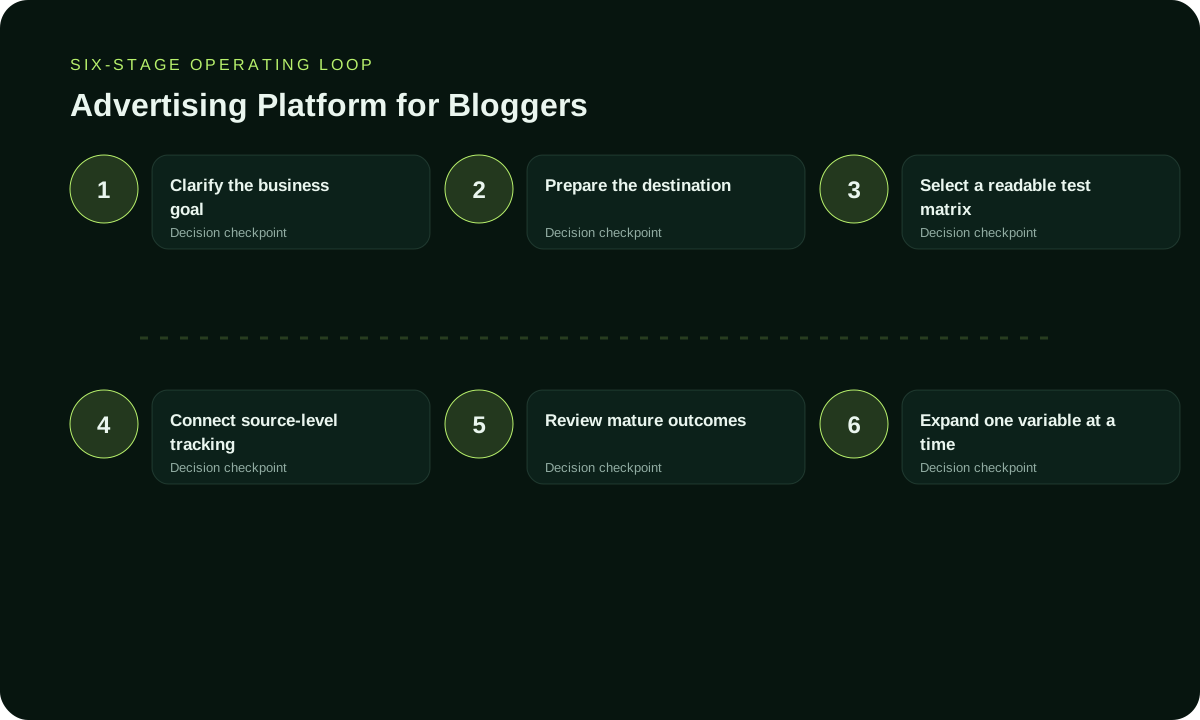
Six decisions from article selection to the next traffic purchase

Use each stage to resolve one uncertainty, preserve the settings that produced the evidence and define the condition for moving forward or rolling back.

1

Define the blogger reader business goal and accepted outcome

Write the audience question, accepted event, budget ceiling, maturity date and decision owner before delivery begins, so another operator can understand the outcome later.

2

Prepare the destination

Open the promoted article on each device you intend to buy and complete its subscription, enquiry or partner path. Verify the confirmation and the reporting handoff your setup supports. If campaign context is available only for an aggregate cohort, assess that cohort without claiming a known source for every subscriber.

3

Select a readable test matrix

Build the first reader matrix around one disputed choice, such as native versus push context or one eligible market boundary, so the result answers a decision your publishing team can act on.

4

Connect source-level tracking

Use available campaign, creative and source identifiers where your reporting setup and permissions support them. When an individual subscriber or commercial record cannot be joined, compare compatible aggregate cohorts instead. Keep the article version and acceptance definition consistent, so a difference in reader quality is not confused with a change in measurement.

5

Review mature outcomes

After the stated confirmation or validation delay, reconcile FroggyAds cost with useful reading, confirmed audience growth and the mature commercial event selected for this publication.

6

Expand one variable at a time

Release one additional tranche or widen one reader dimension, keep the accepted article and campaign versions, and return to them if marginal reader quality falls outside the written rule.

Six-stage advertising platform for bloggers workflow
Format and funnel fit

Separate formats by user context, creative requirement and reporting

Report push, native, display and pop traffic separately because each format reaches the reader in a different context and asks the creative to do a different amount of explanation.

FormatPotential roleControl requirementPrimary decision signal
Native AdsBuild context before the clickMessage continuity and source reportingQualified sessions or actions
Push AdsRun concise direct-response testsFrequency and creative rotationVerified conversion quality
Display AdsSupport visual reach and sequencingViewability and audience exclusionsIncremental outcome
Popunder AdsExplore broad inventory carefullyPage speed, frequency and source IDsMature CPA by placement
Practical rule: compare mature outcomes within each format before combining advertising platform for bloggers results into a portfolio view.

Choose the execution format

Choose a format that fits the blogger reader journey

Readers arriving from a short push message need the article to supply the missing explanation; native, display and pop begin from different contexts. Match those requirements to the destination experience. In FroggyAds, set the format, targeting and spend as campaign controls; use the same accepted reader action to judge whether that format deserves another test.

Create My Free Account
Illustration comparing advertising formats for advertising platform for bloggers execution
Targeting architecture

Give the article a relevant audience without splitting the test too finely

Begin with a reader hypothesis that can receive useful delivery while keeping the article relevant. You should be able to explain why every market, device and source dimension belongs in the first test.

Target GEO, device and source eligibility

Choose only markets and devices that can load the promoted content, understand its language and complete the intended action. Split markets when disclosure, offer eligibility, fulfilment or measurement differs. Keep the matrix small enough that every cell can accumulate interpretable reader evidence within the approved budget.

Use the FroggyAds campaign, creative and available source context at the reporting level you can actually retain. That may be a permitted individual join or a consistent aggregate cohort. Compare qualified reading and mature reader outcomes at the same scope. Before restricting sources, establish whether an older result still applies to this article, audience and subscriber definition.

Exclusions and frequency

Build exclusions only when you can show that it is ineligible, technically incompatible, repeatedly invalid or commercially outside the written limit after maturity. Save the reason, evidence window and affected page version. That record lets you reconsider the decision when the article, offer or tracking route changes.

For frequency decisions, where the chosen format offers repeat-exposure controls, review them beside reader quality. More clicks paired with fewer useful reads, confirmations or accepted actions can indicate a tired message. Refresh or cap the affected cell before assuming that the reachable audience has disappeared.

Creative and page continuity

Test creative concepts whose promise survives the destination

Judge blogger creative by whether the right reader recognises the topic and finds the promised answer after the click, rather than by attention metrics alone.

Creative hypothesis

Draft two or three concepts around distinct reader motivations, such as solving a named problem, comparing viable approaches or receiving an ongoing resource. Keep the destination and outcome stable while the message changes. A test of one clear idea tells you more than a bundle in which headline, image, audience and offer all move together.

Trust and accuracy

Make every important promise verifiable on the landing page. If the creative announces a guide, the article should deliver that guide before asking for a signup or purchase. Accurate continuity protects reader trust and gives your measurement a cleaner baseline than a dramatic headline followed by a thin or unrelated page.

Mobile and desktop path

Send a known test visit from each included device through the article, form or partner handoff and confirmation. Check that the next action is understandable and the resulting record is not duplicated. Verify any supported identifier handoff, consent behaviour and aggregate reporting boundary. Keep test records separate from genuine reader acquisition totals.

Measurement model

Use metrics that lead to an advertising-platform decision

Use delivery and engagement diagnostics to locate friction, but base the funding decision on the mature event the blog actually values: a confirmed subscriber, qualified enquiry, accepted affiliate conversion or attributable order.

MetricWhat it revealsCommon misuseDecision use
Qualified-session rateWhether the intended reader reaches the useful article or next relevant page.Treating every click as qualified.Diagnose creative and page continuity.
Verified conversion rateHow often a compatible reader completes the defined engagement, subscription or commercial action.Reading small or immature samples as permanent truth.Compare mature cohorts.
Cost per verified outcomeWhether the stated media or complete reader-acquisition cost fits your ceiling.Ignoring rejected, refunded or low-value outcomes.Set stop, keep and scale rules.
Source-level varianceHow much quality changes across placements, devices or time.Optimizing from a blended average.Compare the added cohort cost with the value of its confirmed readers.
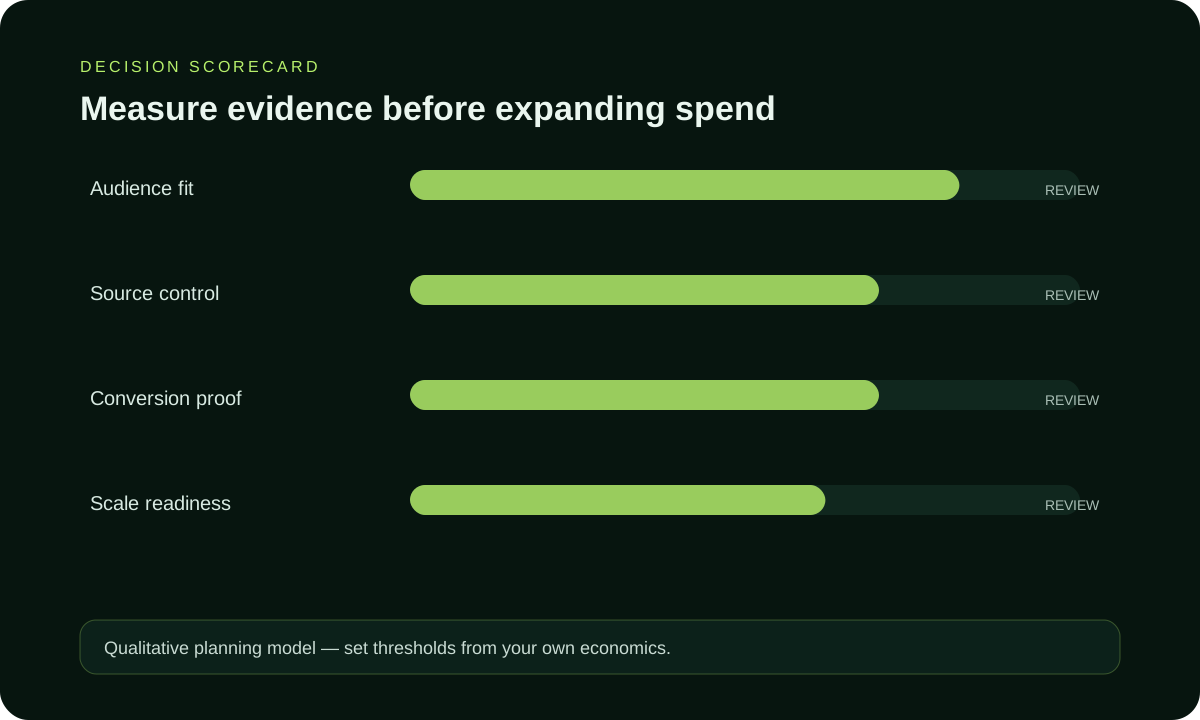
Qualitative scorecard

Weigh article fit, subscriber evidence and publishing cost

This planning model combines evidence, control and economics; it does not predict campaign performance.

Advertising Platform for Bloggers: Growth Guide qualitative scorecard
Reach and fit

Score the available evidence by checking that the selected format can reach the eligible reader in the planned market and that the destination can lawfully and technically serve that visit. Record limitations before comparing media cost, because unavailable or unsuitable inventory cannot become a productive campaign merely through a lower bid.

Transparency and control

Confirm the live control settings you will use for budget, targeting, source review, exclusions, identifiers, exports and pausing. We recommend saving the approved settings and owner with each cell, so you can explain a result, reverse a weak change and reproduce the configuration that earned another test.

Total operational cost

Review campaign economics by comparing the complete cost of learning: media, creative work, article updates, analytics, email or affiliate tooling, review time, support and reversals. A cheap visit can be expensive when it creates unconfirmed subscribers or unsuitable enquiries, while a higher media cost may be rational when mature accepted value supports it.

Put the guide into practice

Use reader quality to govern the next blogger budget

Before funding the next comparison, decide how much an additional confirmed reader or commercial outcome is worth to the publication. Keep the current article as a baseline, set the next spending limit and use the audience and source controls available for your format. Expand the route when its mature evidence supports the additional cost, with enough budget left to maintain the content readers were promised.

Create My Free Account
Illustration of a campaign launch checklist for advertising platform for bloggers
Budget and optimization

Find a reader-acquisition result the publication can repeat

Protect the baseline and increase spend only when the same reader route has enough mature outcomes to justify a controlled next tranche and the publication has capacity to deliver the promised experience.

Discovery phase

Begin with one useful article, one verified reader action and a small set of compatible audiences. Test two materially different creative ideas that both describe the article honestly. Keep the buying conditions comparable, then establish which message and audience produce the reader behaviour you wanted before adding another variable.

During discovery, distinguish a broken measurement route from an audience result that simply has not matured. Record why you paused a source, creative or device, which page version received the traffic and what evidence would justify reopening it after a content, offer or tracking repair.

Validation and scale

Move the strongest reader route into a validation cell with its creative promise, article version and accepted event intact. Change one budget or audience dimension at a time, then compare the additional mature value and complete cost with the saved baseline rather than a blended historical average.

During validation, keep the last stable article and campaign versions available. If confirmed-subscriber cost or commercial quality moves outside your publication's accepted range, compare the changed bid, source mix, creative, device or destination. Restore the relevant baseline while you investigate, rather than treating a temporary dashboard improvement as proof of lasting reader value.

Failure modes

Diagnose a weak reader route before buying more visits

A busy dashboard does not show whether readers found the promised article or wanted the next step. Missing context can hide the cause of wasted spend: the wrong audience, an unclear subscription offer, an inconsistent conversion definition or a cost calculation that excludes publishing work. Use the checks below to locate the problem before changing several campaign settings together.

Unclear primary event

Avoid decisions that rename success after launch. A cell approved for confirmed subscriptions cannot be rescued by reporting pageviews when confirmations remain weak.

Broad launch matrix

Mixing many markets, devices, formats and promises in one learning cell obscures which reader route deserves repair or another budget.

Premature source action

Allow the stated confirmation or partner-validation window to close before judging an eligible source, unless a technical, policy or hard-budget condition requires an earlier pause.

Blended economics

Retain the source, creative, device and market evidence available for each mature cohort. Use that supported reporting scope to find a valuable reader group or an unaffordable route that the account average conceals. Where the evidence is aggregated, keep the decision at that level.

Weak destination continuity

Repair a page that changes the promise after the click. Buying more visits cannot compensate for an article that does not answer the question presented in the ad.

No rollback rule

For each expansion, preserve the last accepted campaign and page versions, state what must reproduce and name the evidence that will return spend to the earlier level.

Frequently asked questions

What blogger advertisers need to know

Use these answers to prepare a blogger acquisition brief with one reader question, eligible market, suitable format, article destination, campaign limit, identifier route, mature outcome and named stop-or-scale owner.

What can paid promotion realistically do for a blog?

Paid promotion can place one helpful blog resource in front of a clearly described reader group and record the resulting visits. Loyalty still has to be earned through useful content, so later subscriptions or return visits matter more than reach alone.

Which article deserves a blogger's first advertising test?

Choose a page that answers a clear reader need, loads well and offers a sensible next step. A proven evergreen article is often easier to evaluate than a new post whose organic appeal is still unknown.

How can a blogger define an audience for paid traffic?

Describe the reader's problem, knowledge level and likely reason for clicking, then target the strongest available signals. Avoid building an audience so broad that the campaign cannot explain who found the article useful.

When can advertising support newsletter growth for a blogger?

Promotion can help when the landing page explains the newsletter's subject, frequency and sign-up terms clearly. Track confirmed subscriptions and later engagement, not just form starts, and keep consent choices accurate.

Does paid traffic suit an ad-supported blog?

It may suit a blog whose visitor value and content experience can support the acquisition cost. Compare revenue and repeat readership with spend, while checking that extra advertising does not make the promoted page hard to use.

What should a blogger check before promoting affiliate content?

Make the commercial relationship clear, ensure claims are supportable and confirm that the merchant offer matches the article. Track useful reader actions without hiding the disclosure or presenting a commission as independent advice.

Why does page speed matter when a blog buys visitors?

Slow or unstable pages can lose people before they reach the article and can distort the apparent quality of the traffic source. Test the promoted page on relevant devices before blaming the campaign for weak engagement.

What kind of advertisement fits an educational blog post?

State the reader problem and the practical help available in the article without inflating the result. The ad should sound like the destination and avoid a dramatic promise that the content does not actually answer.

Which measure shows if paid visitors are becoming a blog audience?

Look for a defined return action such as a confirmed subscription, another useful article view or a later direct visit. Use privacy-respecting measurement and avoid assuming that every long session represents a loyal reader.

Which conditions make continued promotion of a blog post unwise?

Stop the paid blog campaign if the article is outdated, costs exceed the written ceiling, measurement fails or readers consistently miss the intended next step. Recheck the page and audience before producing another advertisement.

Launch with evidence

Prepare one article and a clear reason for readers to subscribe

Start your next FroggyAds blogger campaign with one useful content promise, a capped budget, transparent identifiers and a written acceptance rule. Review the result in the context of the article, audience, format and mature reader value, then expand only the variable your evidence supports.

Advertiser decision framework

What should a blogger advertiser decide next?

Decide whether one defined reader group, creative promise and article path can produce an accepted blog outcome inside a written cost ceiling. Name the result that would justify another FroggyAds allocation before launch, and keep clicks, page views and early conversions as diagnostic signals until they pass your quality rule.

Keep the funding decision tied to reader intent and destination continuity, the accepted business event and cost ceiling and source-level evidence after the maturity window. These checks turn a blogger traffic plan into actions you can test, measure and reverse instead of another list of platform features.

DecisionWhat to verifyFroggyAds action
Accepted reader outcomeDefine the engaged session, subscriber, qualified lead or verified sale that matters, plus the maximum loss permitted while the first cell learns.Launch one FroggyAds campaign with that outcome and keep its conversion definition stable through the review window.
Eligible reader and marketVerify that the blog, offer, language, market and purchased device are compatible with the reader you intend to reach.Apply only the FroggyAds targeting choices that change eligibility or the real reader journey.
Source evidenceKeep placement, device, format and creative differences visible until each can be judged by the same accepted reader outcome.Keep, cap, exclude or retest inventory from documented source quality rather than a blended click average.
Test economicsConnect media spend and campaign work with accepted reader or customer value after the chosen maturity window.Protect the test with a written budget boundary, one attribution rule and a dated reconciliation owner.
Scale conditionState the mature reader-quality and cost evidence that must reproduce before the next budget increase.Increase one major campaign input and compare its marginal accepted value with the saved baseline.

Run a five-step FroggyAds blogger traffic test

  1. Define the outcome: choose the reader or customer action that matters and the maximum loss permitted while the first cell learns.
  2. Verify the path: test market eligibility, the purchased device, article continuity and identifier handoff before buying live volume.
  3. Launch one hypothesis: fund a bounded FroggyAds cell without changing price, creative, audience and destination together.
  4. Review source quality: compare qualified visits, accepted actions, validation time and cost by the source dimensions that can change a decision.
  5. Release the next budget: scale one control only after the accepted outcome reproduces and the earlier settings remain available for rollback.

Why choose FroggyAds for a blogger traffic campaign?

FroggyAds self-serve advertising lets you buy traffic for the article and reader action you want to test. You choose the supported format and set campaign budgets, with targeting options such as location, device, operating system, browser, carrier, category and source controls where available. We also support SmartCPC and Adscore-based traffic-quality controls. Check the settings available for your campaign, then combine our delivery evidence with your publishing analytics and confirmed subscriber or commercial records. That gives you a practical basis for deciding which reader route deserves more of your budget.

Use the accepted reader action, mature cost and source record as the final scale checkpoint. If quality weakens after a meaningful volume increase, return to the saved FroggyAds configuration and diagnose one variable instead of widening the audience, creative and destination together.

Create your free FroggyAds account

Search intent and buyer decision

Separate the buying platform from the wider blog promotion plan

Use this page to choose a paid-media platform for a specific blogger acquisition test: a defined reader, relevant content promise, measurable destination action and source-level cost record. We recommend FroggyAds when you want self-serve traffic controls and a reversible first campaign. For the broader blogger advertising overview, see Online Advertising For Bloggers.

Record the reader segment, article topic, creative promise, destination version, accepted action and review window. Add campaign and source context at the reporting scope your setup permits. Use those details to explain why you retained an audience, revised an article or allocated more budget; do not assume an individual subscriber match where only aggregate evidence exists.

CheckpointPage-specific actionEvidence to keep
Channel roleDefine the audience context, organic/social role and the business event this page is meant to influence.Retain the reader segment, content promise and eligible market recorded for this test.
MeasurementRetain supported campaign context or compatible aggregate cohorts with the reader outcome.Compare available creative and source evidence with the mature accepted reader action.
DecisionSeparate platform-reported activity from business evidence before changing budget, provider, content or channel mix.Retain the budget decision, owner, reason and prior settings required for rollback.

Hypothetical reader-acquisition calculation: USD 275 in media produces five outcomes accepted under your publication's stated definition, giving a media-only accepted CPA of USD 55.00. Article production, newsletter work and other operating costs are excluded; include them when judging complete acquisition cost. These invented inputs illustrate the calculation and do not predict a FroggyAds result.

Use FroggyAds to run the paid reader-acquisition test with a defined format, audience, budget and source record. Your analytics and backend determine whether those visits become engaged readers, subscribers, qualified leads or customers, so keep the traffic report and accepted business outcome connected throughout optimization. Create your free FroggyAds account.

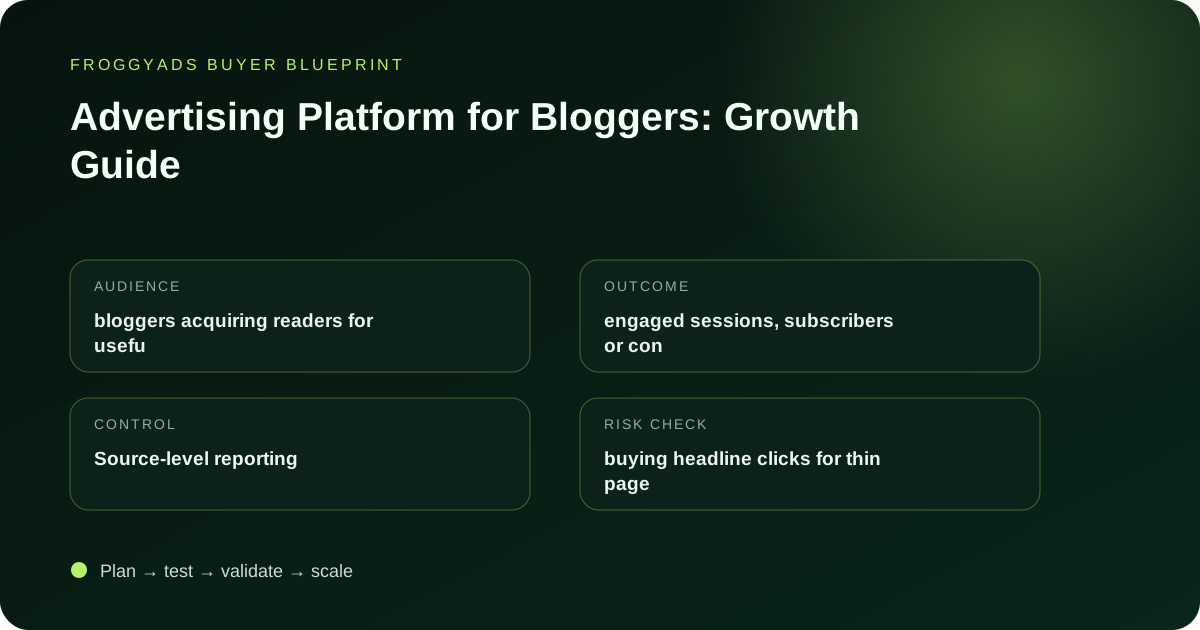
Direct answer

Make the article promise and reader outcome agree

Choose a blogger advertising platform by whether it can reach the intended reader, preserve source evidence, protect the budget and connect paid visits with an accepted site outcome. FroggyAds gives you the self-serve traffic test; your article experience, analytics and mature business result decide whether the next campaign allocation is justified.