Advertiser operating guide

Advertising Platform for App Developers: User Acquisition Guide

Choose an advertising platform by the users your app can serve, the acquisition evidence your team can preserve and the post-install actions that create product value. We help app developers and growth teams turn that decision into a controlled FroggyAds campaign with clear device, market, creative, source and budget boundaries.

20B+ daily impressions750+ SSP integrations$50 minimum deposit7-day Money-Back Guarantee
Advertising Platform for App Developers: UA Guide planning dashboard

What should app developers expect from a self-service advertising platform?

Direct answer: a useful self-service platform lets your team buy supported traffic, isolate an app-user hypothesis and connect media delivery with store visits, attributed installs and qualified in-app behaviour. The platform decision should reflect your release coverage, measurement design and customer economics. Use the related format guides when the next question is specifically about cheap, Push, Popunder or Native traffic.

SectionDistinct excerpt from this page
How should advertisers evaluate advertising platform for app developers?The first campaign should show whether one eligible audience and device path can progress from an ad interaction to an attributed install and a defined activation event. Keep the initial learning loss small enough that you can investigate a failed path instead of hiding it inside a larger launch.
What this guide coversAn app-growth record needs campaign, creative and source identifiers beside the store or deep-link route and the resulting product event. If a privacy or platform rule limits that connection, document what remains observable and avoid assigning certainty to an unattributed install.
Exclusions and frequencyWhen response rises but approved installs, onboarding completion or core-feature use weakens, inspect the creative promise, device compatibility, source mix and conversion delay before expanding reach. A cheaper click cannot compensate for a user who never reaches the app's intended value.

FTC guidance on online advertising and marketing informs the page's requirement for clear, supportable advertising claims. It does not document FroggyAds delivery or app-campaign results.

Direct answer

How should an app team evaluate an advertising-platform campaign test?

Evaluate the platform as an acquisition operating system rather than a source of raw installs. Confirm format availability, relevant GEO and device controls, practical bid and budget limits, source-level reporting and a measurement route your app team can reconcile. Then ask whether those controls can answer one user-acquisition question without changing the audience, artwork, destination and success event together.

The main failure is optimizing to the fastest countable install while ignoring device eligibility, duplicate activity, onboarding failure and post-install quality. Protect the test with accurate creative, a current store page or deep link, verified attribution fields and a cohort window long enough for the chosen product event to mature.

Market and audience fit

Design the app campaign guide around product value, eligibility, destination and commercial evidence

The campaign should answer a product-growth question such as whether Android users in one supported market can complete onboarding after seeing a benefit-led Push concept. The ad, delivery context, store listing and first session must describe the same value so the acquired cohort can be interpreted.

Audience definition

Define the reachable audience from the app's actual release coverage. Exclude unsupported operating systems, device versions, countries, languages and payment or account conditions. When eligibility differs by market, use separate campaign cells so a technical limitation is not misread as weak media quality.

Destination readiness

Prepare a destination that confirms the advertised feature, supported devices, privacy information and immediate next action. Test the store or deep-link route as both a new user and an installed user where relevant. A broken handoff, unavailable build or slow first screen invalidates the media comparison until corrected.

Economic outcome

Set the commercial ceiling from expected customer value and the proportion of installs likely to reach the chosen activation or revenue event. Include media cost, rejected events, measurement fees, creative work and review time. Treat the first model as a planning boundary and replace assumptions with observed cohort data.

Connect the guide to a live acquisition test

Connect the app-platform decision to a controlled FroggyAds campaign

Translate the product question into one FroggyAds campaign objective, one eligible market and device group, one destination route and one accepted event. Apply the relevant targeting, bid, budget and source controls, preserve the tracking keys, and schedule the first cohort review before delivery begins.

Create My Free Account
Illustration of audience targeting controls for an advertising platform for app developers test
Decision sequence

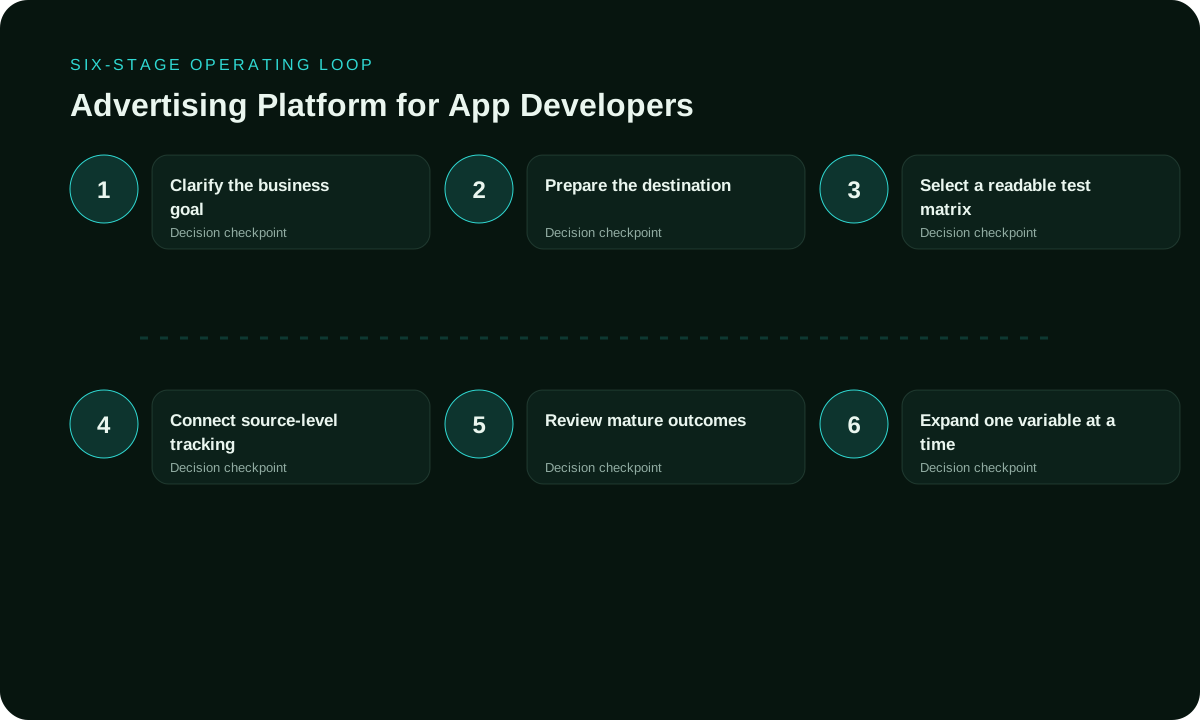
Use a six-stage app-acquisition operating loop

Each stage closes one uncertainty before the next one receives more spend, and every adjustment keeps a dated route back to the last stable configuration.

1

Clarify the business goal and product action

Name the product action that matters after installation, its attribution and maturity windows, its owner and the maximum loss allowed while learning. A campaign cannot optimize reliably when growth, product and finance teams use different definitions of an acquired user.

2

Prepare the destination

Verify the store listing or deep-link route on every eligible device path, then record loading, consent, attribution and first-session failures before traffic is admitted.

3

Select a readable test matrix

Separate market, operating system, device group and creative concept only when each cell can mature into a decision; keep the product proposition and accepted event stable.

4

Connect source-level tracking

Carry campaign, artwork, audience and actionable source identifiers into the app-measurement record while documenting any privacy or platform limit that weakens reconciliation.

5

Review mature outcomes

Wait for the stated attribution and product-event windows, reconcile duplicates and late decisions, and compare qualified app users rather than treating provisional installs as final value.

6

Expand one variable at a time

Increase a single bid, budget, audience or format boundary, preserve the smaller baseline and specify the evidence that will restore the former configuration.

Six-stage advertising platform for app developers workflow
Format and funnel fit

Give every ad format a defined role in app acquisition

Separate formats because the user's context, creative surface and expected response differ. Compare each format on its assigned job and final product event instead of forcing one click benchmark across every placement type.

FormatPotential roleControl requirementPrimary decision signal
Native AdsIntroduce an app benefit inside relevant publisher content without imitating editorial endorsement.Review headline-to-store continuity, source evidence and qualified reading-to-install sessions.Activation or core-feature completion from the Native cohort.
Push AdsPresent a concise, timely proposition that remains understandable outside the original browsing session.Review device fit, message freshness, creative variants and actionable source identifiers.Approved installs and downstream action after the Push cohort matures.
Display AdsBuild visual recognition for a clear app use case across suitable web inventory.Review rendering, message legibility, audience exclusions and post-click store continuity.Incremental qualified visits, installs or activated users under the stated comparison.
Popunder AdsTest broader reach only when the landing route loads quickly and makes the advertiser and action unmistakable.Review destination speed, device compatibility, source IDs and repeated exposure where data supports it.Mature cost per approved app outcome by source or placement group.
Practical rule: compare mature outcomes within each format before combining advertising platform for app developers results into a portfolio view.

Choose the execution format from the job it must perform

Choose a FroggyAds format that supports the app-platform hypothesis

Use the format roles above to decide whether Push, Native, Display or Popunder fits the amount of explanation, visual proof and destination readiness available. Keep each format in its own reporting cell. Our recommendation is to begin with the surface that can express the app's current value honestly, then add another format only for a distinct learning question.

Create My Free Account
Illustration comparing advertising formats for advertising platform for app developers execution
Targeting architecture

Start targeting broad enough to learn and narrow enough to stay eligible

App-acquisition targeting should describe a falsifiable audience hypothesis. Every filter needs a reason tied to release coverage, device experience, language, market eligibility or expected customer value.

Build an app targeting matrix from market and source evidence

Choose the GEOs, operating systems, device cases, languages and connection conditions that the current build can serve. Keep the matrix small enough for each cell to receive meaningful evidence. Separate markets whose store availability, consent path, pricing or onboarding differs.

Use available source identifiers to discover pockets of qualified app users. Avoid creating a tiny whitelist from stale or unrelated campaigns. A prior source result is useful only when the app version, destination, audience, conversion event and maturity rule are comparable.

Evidence-based exclusions and exposure review

Exclude combinations the app cannot support, sources with repeated invalid or rejected outcomes and mature cells that breach the accepted-cost boundary. Record the exclusion date, evidence and retest condition so temporary technical failures are not converted into permanent media rules.

Where the selected format and reporting expose repeat contact, review it beside activation and accepted-user quality. When individual frequency is unavailable, compare cohorts or time periods and state the limitation. Do not claim a frequency cap or a person-level conclusion the platform record cannot prove.

Creative and page continuity

Make each creative concept survive the store and first session

An app creative succeeds when the user finds the advertised benefit after arrival and can complete the next action on a supported device. Attention without that continuity produces activity, not useful acquisition evidence.

Creative hypothesis

Build two or three materially different concepts around real product use: a problem resolved, a workflow shortened or a feature demonstrated. Keep the offer and destination stable while one major concept changes, then label every version through the downstream record.

Trust and accuracy

Use claims the current app and store listing can substantiate. Avoid implying automatic earnings, guaranteed outcomes, unavailable features or compatibility that the build does not provide. Clear expectations improve the chance that an intentional install becomes a qualified user.

Mobile and desktop path

Test the path on every device group receiving material spend. Verify redirects, store availability, deep-link fallback, install or open behaviour, onboarding, consent choices and the conversion callback. Pause a cell whose technical failure prevents a fair media decision.

Measurement model

Use app-acquisition metrics that lead to a decision

Diagnostic signals explain where the journey changed. The agreed post-install business event determines whether the campaign deserves another allocation.

MetricWhat it revealsCommon misuseDecision use
Eligible store-arrival rateThe share of attributable visits that reach the correct listing or deep-linked app screen on a supported device.Counting redirects, unsupported devices or accidental sessions as qualified interest.Diagnose targeting, creative clarity and destination continuity.
Activation rate from attributed installsThe share of attributed installers who complete the defined onboarding or core-feature event after the chosen window.Promoting a cell while recent installs are still open or attribution is incomplete.Compare closed acquisition cohorts under one event definition.
Cost per advertiser-approved app userMedia cost divided by the installs that pass the product team's stated qualification and rejection rules.Ignoring duplicates, uninstall timing, refunded purchases or invalid product events.Apply trial, keep, constrain and expand thresholds to matured users.
Source and device varianceThe change in approved-user quality and cost across inventory sources, operating systems, device groups or cohort dates.Letting an account average hide an expensive source or a broken device path.Protect marginal economics when reach or budget changes.
Qualitative scorecard

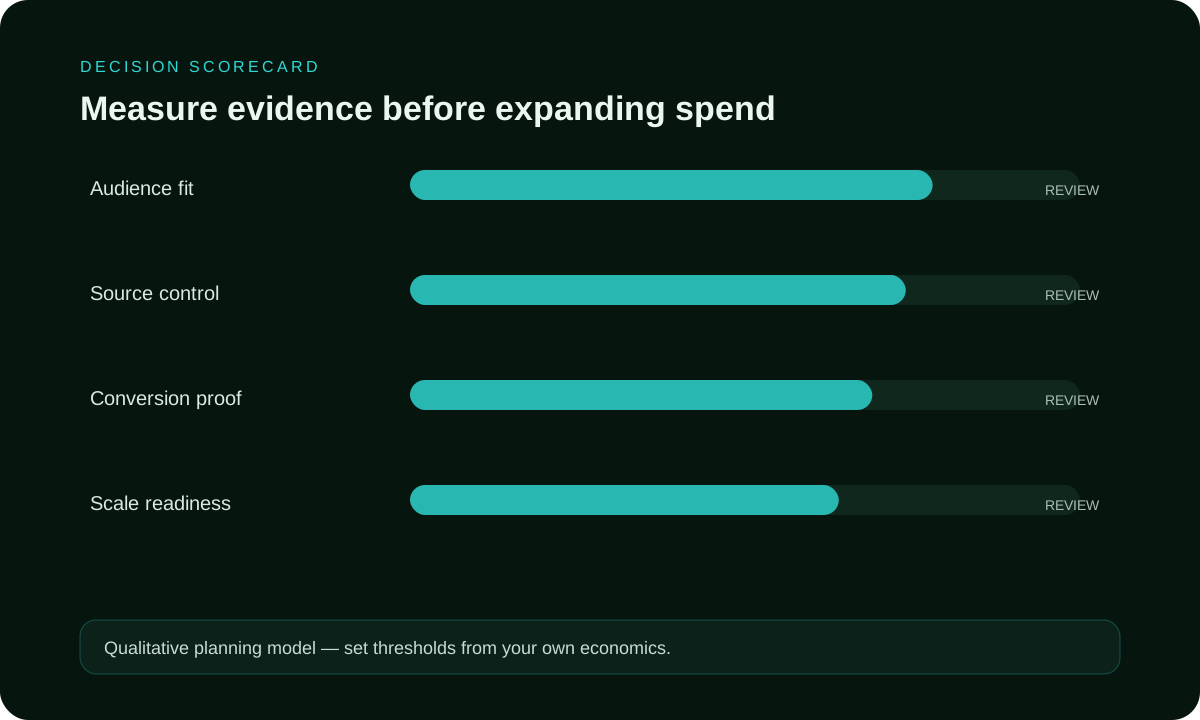
Score app fit, media controls and buying evidence together

Use this scorecard to organize evidence for a buying decision. It is a planning framework, not a forecast of FroggyAds delivery or app performance.

Advertising Platform for App Developers: UA Guide qualitative scorecard
Reach and fit

First verify that supported inventory can reach the app's eligible markets and devices. Then confirm that the listing, deep-link route, consent flow and first-session experience can serve that traffic. A media opportunity is irrelevant when the product path rejects the user.

Transparency and control

Look for controls your operators can act on: format choice, targeting, bid and budget boundaries, source reporting, exclusions and accessible campaign records. FroggyAds is valuable when those controls help your team isolate a weak cell and respond without rebuilding the whole acquisition plan.

Total operational cost

Compare the complete learning cost: creative production, measurement setup, app QA, review work, conversion delay and media spend. A lower front-end price can be more expensive when the resulting cohort needs manual repair or fails the agreed product event.

Put the app-platform scorecard into practice

Turn the app-platform decision into a bounded FroggyAds campaign

Use the completed scorecard to authorize one reversible test. Set its spend and loss ceiling, preserve a control, retain source and creative keys, and wait for the activation cohort to close. A documented weakness should trigger the planned response rather than a broader, harder-to-diagnose campaign.

Create My Free Account
Illustration of a campaign launch checklist for advertising platform for app developers
Budget and optimization

Move from discovery to a repeatable baseline before scale

Scale only after a closed cohort reproduces the accepted-user result and the campaign still behaves predictably when one buying lever changes.

Discovery phase for a new app audience

Discovery phase for app-audience failure diagnosis

Distinguish a technical failure from unproven traffic. A broken callback, unsupported build or wrong store route invalidates the cell until repaired. Low volume leaves the question open. Poor approved-user economics after a fair window supports a media action.

Validation and controlled scale

Validate a stable baseline before controlled scale

Keep the last stable audience, creative and buying configuration. If the new step increases disapproval, shifts delivery into weaker sources or crosses the loss rule, restore that baseline and record what changed. A rollback preserves learning and limits expensive guesswork.

Failure modes

Avoid decisions that destroy app-acquisition learning

Avoid campaign, team, source and scale decisions that destroy app learning

Unclear primary event

Changing the success event after launch makes earlier and later cohorts incomparable and lets a weak campaign appear improved through a new definition.

Broad launch matrix

Opening too many markets, operating systems, formats and concepts at once prevents your team from identifying which condition produced the outcome.

Premature source action

Removing a source before activation or purchase events mature can discard qualified inventory because recent installs were treated as final failures.

Blended economics

A blended average can conceal an incompatible device route, concentrated invalid activity or a source whose approved-user cost exceeds the account boundary.

Weak destination continuity

When the store page or first session contradicts the ad promise, installs measure curiosity while onboarding and product use reveal the acquisition mismatch.

No rollback rule

Every scale action needs the prior setting, review date and reversal trigger. Without them, a media buyer cannot separate inventory change from a genuine improvement.

Frequently asked questions

App advertising FAQs: event, link, attribution, creative, device, budget and privacy

Use these answers to build an acquisition brief with the app version, eligible users, selected format, markets, device scope, learning budget, measurement route, source actions and approved-user event. Keep product, growth and finance owners aligned on the same final definition.

Which in-app event should guide an acquisition campaign?

Choose an activation that represents real use, such as finishing setup, completing a core workflow or starting an eligible purchase. The event must be reliably measured and commercially meaningful. Keep the install as a diagnostic milestone when it does not yet prove product value.

When do app advertisements need deep links?

Use a deep link when the promised feature or content exists beyond the default first screen. Test installed, new-user and unsupported-device paths, plus the fallback destination. The link should never send a person to a state that cannot deliver the advertised action.

How can developers connect ad traffic with in-app outcomes?

Use approved attribution and campaign identifiers, then reconcile network records with store, backend or product analytics where permitted. Document the chosen attribution window, duplicate rule, privacy choices and known data gaps. Leave unattributed activity separate from source-level conclusions.

What separates a valuable app install from an empty one?

A valuable install reaches the product action defined before launch and remains eligible under the campaign rules. Review onboarding completion, feature use, retention or purchase quality by source and cohort. The exact event depends on the app's model and measurement reliability.

What should an app ad demonstrate before asking for a download?

Show the user problem, the relevant feature and the immediate next step without implying a result the product cannot guarantee. Match the current store listing and in-app experience. Distinct concepts should test different value propositions, not small wording changes around one generic message.

Can an app campaign run before every region and device is supported?

Target only markets, operating systems, versions and device cases where the app is available and functional. Separate combinations with different pricing, consent or onboarding. Eligibility is a product constraint first and a media filter second.

Why split app campaign results by operating system and device?

Separate device results when store behaviour, load time, technical stability, pricing or product use can differ. A blended report may blame the source for a compatibility fault or hide a promising audience behind one broken device route.

How should an app developer set an acquisition ceiling?

Start from customer value, margin and the expected share of installs that reach the qualified event. Set an affordable learning loss and update the model with closed cohorts. Do not present the planning budget as a universal recommendation or guaranteed acquisition cost.

Which privacy checks belong before app advertising starts?

Map the information collected by the app, network and measurement providers, together with platform, consent and policy requirements. Collect only what the approved purpose needs, protect identifiers appropriately and document any limitation that changes attribution confidence.

When should an app campaign optimize beyond installs?

Optimize toward a deeper event after its implementation is dependable and the campaign produces enough observations for a useful decision. Keep install and store-arrival metrics as diagnostics so the team can still locate technical or creative friction earlier in the journey.

Launch with evidence

Turn the app-platform plan into one controlled product objective

Start with one product objective, transparent tracking, actionable source evidence and a written keep-or-stop rule. Judge the result against eligible-device delivery and closed post-install cohorts, then change only the control that answers the next app-growth question.

Advertiser decision framework

What should the app advertiser decide next?

The next decision is whether one FroggyAds campaign cell can connect an eligible app audience with a truthful proposition and a closed activation cohort. That requires a defined event, a compatible route, enough source evidence for an action and an affordable downside while the test remains uncertain.

Use platform evaluation, product-decision design and the operating loop above as one chain. The matrix below converts that app-specific evidence into launch, validation and allocation actions. It does not create a second generic definition of an advertising platform.

DecisionWhat to verifyFroggyAds action
App acquisition objectiveName the post-install action, the window when it becomes final and the maximum loss permitted before the first audience question is answered.Launch one FroggyAds objective and keep its product-event definition fixed across the compared acquisition cohorts.
Eligible user and device scopeVerify store availability, operating system, version, market, language, consent path and the promised feature before opening a targeting cell.Apply only the FroggyAds filters that reflect real product eligibility or a documented audience hypothesis.
Attributable source evidencePreserve source, campaign and creative keys through the measurement route and keep technical failures apart from mature traffic-quality decisions.Retain, constrain, exclude or retest an actionable source from approved app-user evidence and a dated reason.
Acquisition economicsCombine media spend with creative, measurement and review costs, then relate the total to users who pass the agreed activation standard.Protect learning with day-level and total downside boundaries plus one stable attribution and acceptance window.
Controlled scale ruleWrite the exact approved-user, cost and source-composition evidence that earns one bid, budget or reach change.Compare the marginal closed cohort with the smaller baseline and reinstate the former control when its boundary is crossed.

A page-specific FroggyAds test sequence for app developers

  1. Define product value: choose the onboarding, core-feature, purchase or other qualified event that closes the acquisition decision, plus its learning-loss limit.
  2. Verify the app path: confirm release eligibility, store or deep-link behaviour, receiving-device experience, consent choices and attribution before buying material traffic.
  3. Launch one hypothesis: build a bounded FroggyAds cell for one audience question and avoid changing market, artwork, bid and destination in the same cycle.
  4. Adjudicate the cohort: compare store arrival, attributed install, qualified product action, rejection cause, timing and cost by actionable source and segment.
  5. Change one control: expand the strongest closed cell only after writing the resulting source-mix check and condition that restores its former boundary.

Why is FroggyAds relevant to a controlled app audience?

FroggyAds gives app-growth advertisers a self-service route to supported traffic formats with relevant targeting, bid, budget and source controls. You can separate markets, devices, creative concepts and inventory hypotheses, then connect the network evidence with your approved product event before making another allocation.

Use the controlled audience test as the final checkpoint. If the closed cohort cannot support an app-specific source or targeting action, keep the campaign limited and repair the product, creative or tracking uncertainty first. Our team recommends scale only after the same definition survives a deliberate validation cycle.

Create your free FroggyAds account

Search intent and buyer decision

How should an app buyer turn platform evidence into a campaign decision?

This page helps app developers evaluate an advertising platform through user eligibility, media controls, attribution continuity, source evidence and post-install economics. The related Online Advertising For App Developers page retains the broader channel-planning intent. Here, the final output is a platform-ready acquisition brief and a bounded first campaign.

The decision set is specific: an approved product event, eligible user and device scope, a measurable store or deep-link route, an interpretable source structure, affordable learning risk and a rule for the next allocation. Those elements connect FroggyAds controls with the app team's practical operating response.

CheckpointPage-specific actionEvidence to keep
FitConfirm the app version, audience eligibility, promised use case, receiving route and product event that make paid acquisition appropriate.Retain release coverage, destination QA, measurement limitations and the owner of the accepted-user definition.
TestOpen the smallest campaign cell that can compare one message-and-audience hypothesis through a complete app cohort.Retain creative version, targeting, bid, spend, campaign and source keys, cohort date and provisional outcome states.
DecisionRetain, constrain, remove, retest or expand a cell after its product events reach the agreed adjudication point.Retain approvals, rejection reasons, cost per qualified user, source distribution, next action and reversal trigger.

Illustrative calculation: suppose a closed acquisition cell records USD 300 in media spend and six app users who pass the predefined product event. Dividing USD 300 by six yields USD 50 per qualified user. Add measurement and creative costs when your business model requires them, and replace every input with observed data; this is not a FroggyAds result.

Choose FroggyAds when your app-growth question needs a controlled paid-media test with format, audience, budget and source decisions visible to the operator. We help you connect those controls with the post-install event your business accepts. Create your free FroggyAds account and launch one eligible acquisition hypothesis.

Direct answer

Choose a media platform around a validated in-app event

Start with an app user your current release can serve and an in-product event your team can validate. Then choose the media platform whose controls and source evidence let you test that journey without mixing incompatible markets, devices or messages. FroggyAds fits when you want self-service campaign execution and a clear route from traffic evidence to the next acquisition decision.