Ad network evaluation for media buyers

Advertising Network Japan

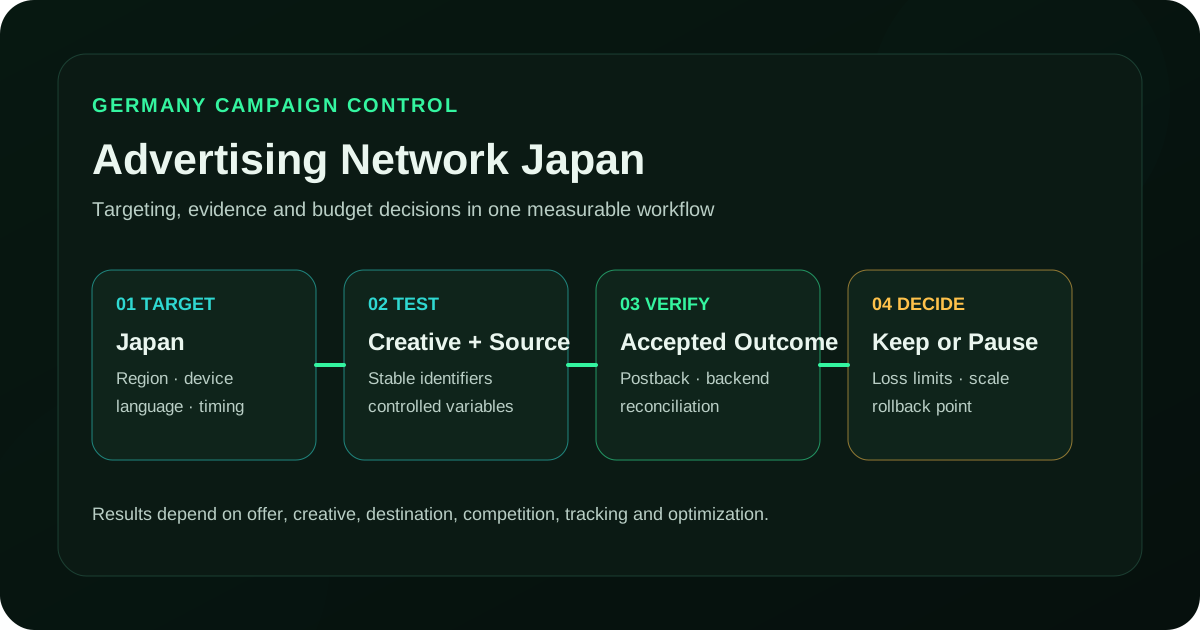
Evaluate advertising network japan by Japan inventory access, ad-format coverage, source reporting, targeting, budget controls, tracking, support and accepted campaign economics.

Self-serve control ·750+ SSP integrations ·20B+ daily impressions
advertising network japan planning visual
Precision before reach

A Japanese network brief should define the exact customer and commercial handoff

Specify the product, eligible location, responsible seller, availability and customer action before choosing Japanese inventory. A network can deliver the selected geography while the destination misstates stock, service or response. Keep local and cross-border routes separate when payment, delivery, returns or support differ. Each route needs its own reviewed page and owner.

Define maturity beyond a click or raw form. The responsible Japanese team should confirm that the request matches the offer, location and customer type, and can advance a documented action. Preserve invalid, duplicate, unsupported and information-only dispositions separately. Precision in the outcome is as important as precision in the creative.

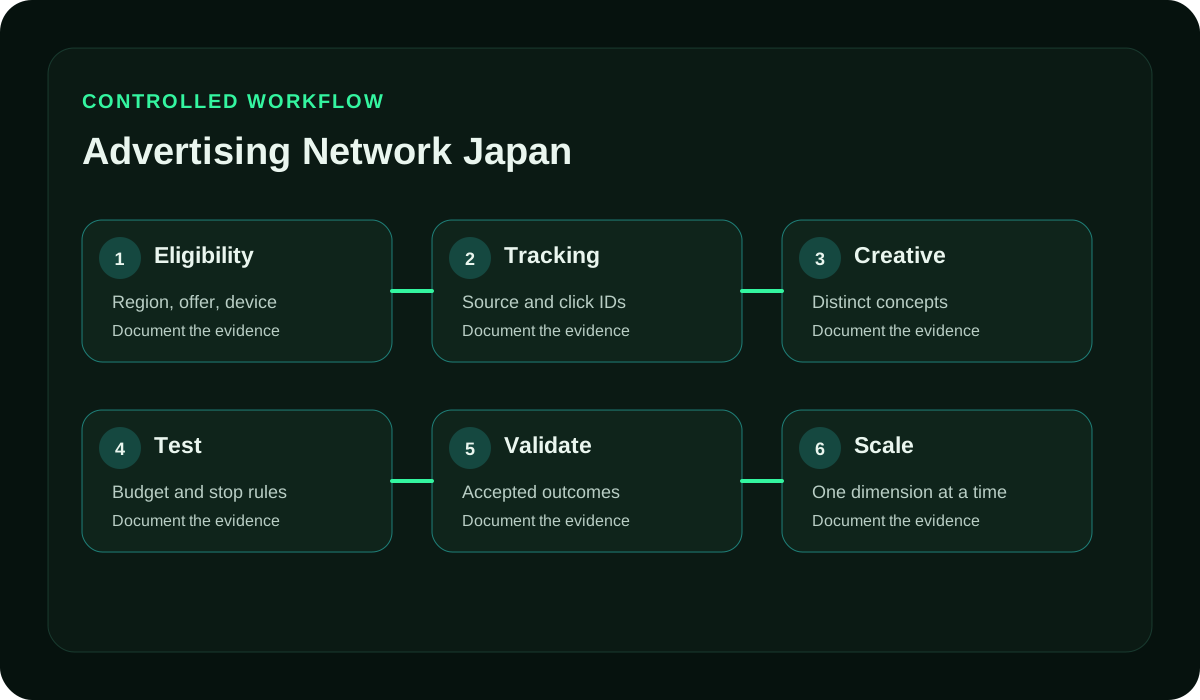
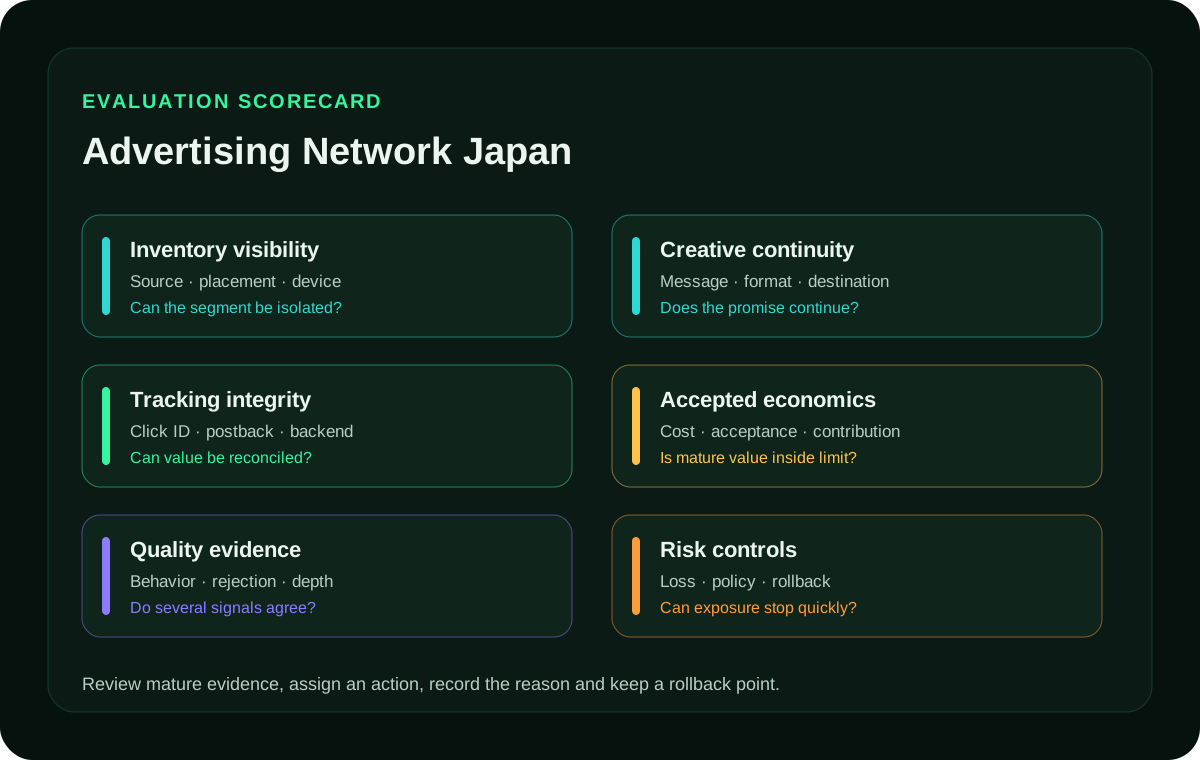
advertising network japan controlled workflow visualadvertising network japan evaluation scorecard visual
Native-language detail throughout the journey

Japanese review should cover typography, terminology and customer response

Review names, technical language, units, examples, fields, errors, confirmation and follow-up for the intended audience. Avoid a literal translation that remains understandable but feels disconnected from the product or commercial practice. Assign an owner who can judge both meaning and operational truth. Store the approved advertisement and destination as one versioned route.

Customer questions can expose missing context that a linguistic review did not catch. Repeated uncertainty about seller identity, delivery, specification or next steps should prompt clarification. Compare accepted customer progression, not only response volume. A restrained message that produces informed demand is more useful than an aggressive line that creates avoidable rejection.

Japan network readiness proof from local expression to accountable supply
Proof objectRequired detailDecision standardOwner
Commercial routeSeller, product, location, availability and responseThe stated offer can be completedJapan commercial lead
Japanese journeyJapanese message version, destination behaviour, validation, receipt state and assigned response queueMeaning remains precise after the clickLocal content reviewer
Placement samplePublisher or app, seller, device, format and timeThe environment can be inspected and challengedNetwork quality contact
Accepted outcomeMaturity, eligibility and controlled exclusionsThe responsible team can advance the customerMeasurement owner
Device and placement context

Inspect how Japanese web and app inventory presents the message

Sample environments from the formats and devices planned for delivery. For the Japanese sample, preserve the screen's user task, unit position, surrounding commercial load, declared seller and observation time. A network category cannot show whether the message appears beside relevant content or inside a confusing interaction. Review destination performance from the same device path.

Define an investigation route for unusual interaction or customer quality. Preserve source identifiers and later dispositions, then ask the network to trace the seller and available controls. The advertiser should separately test form and follow-up. Quarantine only the implicated Japanese publisher or application cell until its placement, destination and customer evidence reveal the failure owner.

Current data review is implementation-specific

Japanese authority sources support research, not automatic approval

Use the official source recorded in the ledger within its verified boundary. Qualified owners must determine how current requirements apply to the programme's purposes, parties, transfers, retention and customer rights. Map what the network, analytics, landing and customer systems actually receive. Keep the conclusion and reviewer with the implementation.

Return only the cohort evidence needed to compare partners. An accepted state, location, supply group and maturity may suffice. Detailed identity or customer conversation belongs in authorised systems. Review audience uploads, device identifiers or identity matching separately rather than treating every available feature as part of the Japanese pilot.

Japan pilot evidence organised around the decision each owner can make
Evidence streamQuestionAction when weakNot inferred
Japanese copy recordIs the public promise exact and current?Correct dependent routePublisher quality
Supply captureCan the placement and seller be traced?Quarantine or investigate cohortCustomer value
Customer dispositionCan the responsible team act?Repair eligibility or handoffUniversal market potential
Governance mapIs each data movement reviewed?Remove or reassess processingApproval from a platform feature
A small release protects quality

Wait for Japanese customer maturity before expanding inventory

Choose a serviceable route, reviewed language version, format and supply cohort. Fix the maximum allocation and response window. Preserve the platform configuration and customer acceptance rule. Observed cost remains specific to that auction and account; it should not become a published normal Japan CPM or guaranteed forecast.

Change one meaningful element for the next cohort. A new publisher class, device, geography or creative claim alters the evidence question. Keep earlier records and annotate stock, support or fulfilment events. When the operation cannot respond precisely, pause demand instead of allowing delay to distort the partner review.

Local support is part of network value

Approve Japanese partners that can explain exceptions in the needed language and time zone

Compare seller transparency, placement controls, Japanese support, device detail, reporting exports, suspicious-traffic handling and escalation. Verify the support route and account functions. Ask each candidate to trace one sampled placement and describe what it can change. A fast generic answer is less useful than a slower response with reproducible evidence.

Assign approved formats, geographies or supply groups with exclusions and replacement conditions. Several networks can operate when roles and overlap are explicit. If a partner cannot investigate or mature customer evidence fails, narrow the assignment. Do not translate the partner's sales assurance into a permanent endorsement.

Japanese meaning across the whole route

Inspect message precision, screen behaviour and accountable customer response together

A Japanese account demonstration should trace one placement from publisher environment through declared seller to the account report. Record the identifiers and available exclusion. A sales claim about premium inventory receives no operational credit unless the partner can reproduce this chain for the intended assignment.

Language QA should include a labelled synthetic enquiry that tests form behaviour, confirmation and handoff. Remove it from commercial totals. The exercise verifies that the Japanese promise reaches a team able to respond precisely rather than ending at a translated landing page.

Typography and line breaking should be checked on representative mobile screens without adding a new font or script. Existing semantic HTML should remain readable at the current layout. A content correction that depends on a heavy client-side component would conflict with the page-speed contract.

A local support rehearsal can use a benign source sample. Record which information the partner requests, whether it identifies the seller, and how it confirms the disposition. Response speed matters only alongside evidence quality and a closure that the advertiser can reproduce.

Attach Japan's funding and reporting conditions to the exact advertiser account and contract review date. Funding, refunds, credit and reporting access influence partner risk, but they do not define Japan's media prices. Auction observations remain tied to the exact inventory, device, format, settings and period used.

A product or availability change should trigger a narrow Japanese release. Identify dependent statements, creative and destination versions, then pause those routes until evidence is current. Do not rewrite unrelated content or add personalisation scripts to conceal an unmaintained product record.

Customer maturity may extend beyond media reporting. The responsible team should define when a request can be considered accepted and whether later reversal matters. Do not reward a source for fast submissions while ignoring a more precise route whose Japanese qualification takes longer.

Publisher renewal should capture current page or app context. A familiar property can change layout, placement or seller relationships. The original approval remains historical evidence and should not automatically cover a new integration or version.

Multiple partners can operate when their roles are disjoint. One may handle a particular publisher cohort while another supports an app environment or local service route. Record overlap and frequency limits rather than presenting summed platform reach as a unique audience.

A closing dossier should state unresolved questions. Missing device detail, unavailable placement identifiers or immature customer results remain NOT_VERIFIED. A bounded approval can coexist with unknowns, but those unknowns cannot be treated as positive evidence for expansion.

The renewal trigger should include a material support or export change. If the Japanese account loses the evidence needed to investigate, the former partner role may no longer be operable even when traffic continues. Pause or narrow before uncertainty accumulates.

A Japanese B2B route should preserve company eligibility and handoff ownership without asking the network to infer sensitive business attributes. The customer system can classify the request after submission and return a minimal accepted state. Media receives enough evidence to compare cohorts without copying the full company record.

Ecommerce delivery should retain stock, payment and fulfilment events beside the customer cohort. A source can appear weak when an advertised item becomes unavailable. Pause the product route and annotate the period before changing publisher allocation.

Network export retention must cover the chosen Japanese maturity window. If source dimensions expire sooner, arrange an authorised aggregate record or narrow the pilot. Do not extend tracking or retain unnecessary identity merely to solve a reporting mismatch.

After an account migration, verify one geographic exclusion and one approved placement route. Preserve screenshots or exports as supporting evidence, but rely on the actual control state rather than visual similarity. A migrated setting should not inherit approval without confirmation.

The closing decision separates unsuitable supply, operational failure and missing evidence. These states may all block expansion, yet they require different owners. A single low confidence score would hide whether the next action belongs to the network, advertiser or reviewer.

An approved Japanese network route should include a correction contact reachable by editorial, media and customer operations. When a product fact or seller path changes, the issue can be paused and assigned without circulating customer details. The roster records the evidence needed to reopen the route, not merely a request to optimise it.

Direct operating answers

Questions for a Japan placement-quality review

What should a Japan network brief establish first?

Define the exact offer, eligible customer and location, responsible seller, reviewed Japanese journey and mature accepted action.

Why is Japanese review more than translation?

Typography, terminology, fields, confirmation and follow-up must preserve precise meaning and operational truth.

What belongs in a Japanese placement sample?

Publisher or app context, seller route, placement position, format, device, location scope, timestamp and destination behaviour.

How should unusual interaction be investigated?

Join source identifiers with device evidence and later customer dispositions, then separate network, page and response causes.

Do official sources approve the implementation?

No. They support bounded review; qualified owners must assess the actual programme and current obligations.

What is an accepted Japanese network outcome?

A relevant request that the responsible team can verify and advance after the agreed response window.

Can a pilot establish a normal Japan CPM?

No. The observation belongs to specific settings, inventory, competition and time.

When should Japanese delivery pause?

Pause for inaccurate offer, broken language journey, unexplained supply, technical failure or repeated mature customer rejection.

Does local network support matter?

Yes. The advertiser needs an escalation route capable of understanding and resolving the actual placement or account issue.

What can FroggyAds substantiate?

The FroggyAds account export can substantiate settings and attributed delivery for the Japanese test route. The advertiser owns Japanese accuracy, eligibility, governance and fulfilled value.

Source boundary

Japan citations inform a narrow review and leave commercial proof with the advertiser

The ledger preserves whether the Japanese authority page was directly accessible; that research status makes no finding about the programme. The ads.txt reference helps interpret representation of the sampled Japanese publisher. Google's help page applies to Google's geographic feature. The Japan dossier relies on FroggyAds only for its own settings and attributed-delivery export; language and customer results are evidenced elsewhere. Japanese wording, service eligibility, customer acceptance and realised value require separate current evidence.