Japan product and customer readiness

Choose an Ad Network for a Working Japanese Customer Journey

By FroggyAds. Updated 21 October 2026. Choose FroggyAds for a Japan campaign built around an accurate Japanese offer and a customer route your business can complete. Use our available campaign and source controls for the media test, then verify product use, delivery or qualified enquiries in your own records.

Choose the uncertainty worth buying: specification clarity, price continuity, address completion, payment, fulfilment, lead response, onboarding or retention. One cell should resolve one meaningful question.

Japan route dossierStatistical boundaryJapanese specification
ad network in japan planning visual
Product and operations

Prepare the Japanese product and operating brief

Confirm stock, supplier, delivery, sales, product and Japanese-language support capacity before release. A customer route cannot produce accepted value when the organisation cannot complete the stated commitment. Use FroggyAds when live Japan availability and eligible formats fit the dossier. We provide campaign configuration and delivery evidence; the advertiser's customer systems approve value.

Statistical context

Use census and household data as background

Japan’s Statistics Bureau publishes population and household evidence through its 2025 census and the Survey of Household Economy. These sources use different units: a census population is not a count of online shoppers, and a two-or-more-person household shopping measure is not an individual purchase-intent estimate. Neither source establishes our inventory, campaign reach or the number of customers who can use your product.

Use the official evidence to ask practical questions about location, product category and the digital journey. Preserve the publication year and the unit behind any figure you use. Then check current FroggyAds availability and your own customer route. The census basic population-and-household tabulation released in September 2026 is distinct from the earlier preliminary counts; keep the release you actually consulted identifiable.

The Japanese route should preserve product name, model, size, material, compatibility, included items, service scope, eligibility and action. A persuasive headline cannot repair an ambiguous specification. Check the same specification when comparing Tokyo-area and regional customer journeys.

Language and currency

Keep Japanese wording and yen terms consistent

Use a reviewer who understands the product and Japanese commercial meaning. Check navigation, labels, validation, confirmation, help and support as part of the same version. When the English source changes, do not silently leave the Japanese page behind. Open a dated specification revision and associate resulting orders or leads with the exact content seen.

Treat a recurring pre-purchase question as route evidence. If customers repeatedly ask what is included or supported, clarify the relevant stage before excluding traffic. Record the approved yen amount or calculation basis with material tax display, shipping, plan duration, renewal, cancellation, return, refund and eligibility conditions. The buyer should understand the commitment before payment.

Start a new commercial record when price, promotion, bundle, stock or service condition changes. Pooling unlike offers makes source economics impossible to reproduce. If media spend is held in another currency, retain original value, conversion method, date and JPY decision value. Hypothetical calculations cannot establish FroggyAds rates, minimums or forecast performance.

Service area

Match the service area to real delivery and response

Confirm the order or subscription receipt shows the expected amount, product and next step. A technical purchase event without a usable customer state is not final acceptance. Map which locations receive the advertised product or service under ordinary conditions, with delivery time, appointment access, stock, response ownership and support. Do not use a national label to hide a narrower route.

Tokyo metropolitan concentration can justify a planning question but not a performance prediction. Use verified campaign geography and the business's real service boundary.

Separate regional cells when carrier route, inventory, appointment, language support or fulfilment timing changes materially. The purpose is to protect the customer promise, not assign value to residents. Open the next area only after the responsible owner confirms capacity, maximum exposure and the evidence that will trigger a pause. Apply the same service boundary when evaluating an app or subscription offer.

Address completion

Check Japanese address completion before the next budget step

Test name, address, postal, prefecture, building, contact, character handling, validation, correction and confirmation on supported production devices. Record the stage where an eligible customer cannot proceed. Keep invalid input, technical rejection, unsupported location, duplicate order and customer abandonment separate. A form design problem belongs to the route.

A Japan campaign deserves another budget step when the Japanese specification, JPY offer, order or onboarding route and customer operation create retained value—not because a census count or household shopping statistic appears large.

Keep only the data needed to diagnose the form

Avoid copying full customer data into a media workbook. Use approved identifiers, stage and reason sufficient for diagnosis under the advertiser's process. When a field or error is repaired, preserve the former version and begin a clean cohort. More traffic before the fix would only measure the same obstacle again.

Create My Free Account
Illustration of audience targeting controls for an ad network in japan test
Fulfilment

Follow orders through fulfilment and retention

Track selection, cart, checkout, authorisation, order creation, stock confirmation, dispatch, delivery, customer issue, cancellation, return and retained order. Finance and operations should agree on the mature event. Classify unavailable item, address issue, delayed dispatch, failed attempt, wrong product, damage, unmet specification and return independently. These reasons show who owns the next action.

Order economics

Compare paid-order cost with retained-order cost

Suppose a hypothetical JPY 18,000,000 test records 240 paid orders and 150 correctly delivered, retained orders. Cost per paid order is JPY 75,000; cost per accepted order is JPY 120,000. This is arithmetic only.

Product activity

Define useful product activity beyond the first payment

Allow the declared return or review window to close and post reversals to the original cohort. Early payment cost remains diagnostic, not the final allocation metric. For software and apps, choose the product action or approved account state that represents genuine progress. Install, signup, verification, first session, useful action and retained use answer different questions.

Separate outcomes

Keep onboarding, lead and response outcomes distinct

Keep product build, plan, Japanese route, campaign and stage timestamps. Remove internal tests and duplicates consistently and preserve rejection or cancellation reasons. Repair onboarding when it owns the loss. A source verdict is premature when the production journey fails for eligible customers.

Allocate after the chosen event matures. Initial registrations can guide product diagnosis, while useful activation or retained subscription directs spend. State what the form creates, who qualifies, where service is available and when a Japanese-language response should occur. Track validation, assignment, first attempt, reached contact, qualification and owner acceptance.

Separate invalid detail, duplicate, unsupported area, ineligible need, unreachable person, prospect decline and late internal response. The queue should not be mistaken for traffic quality.

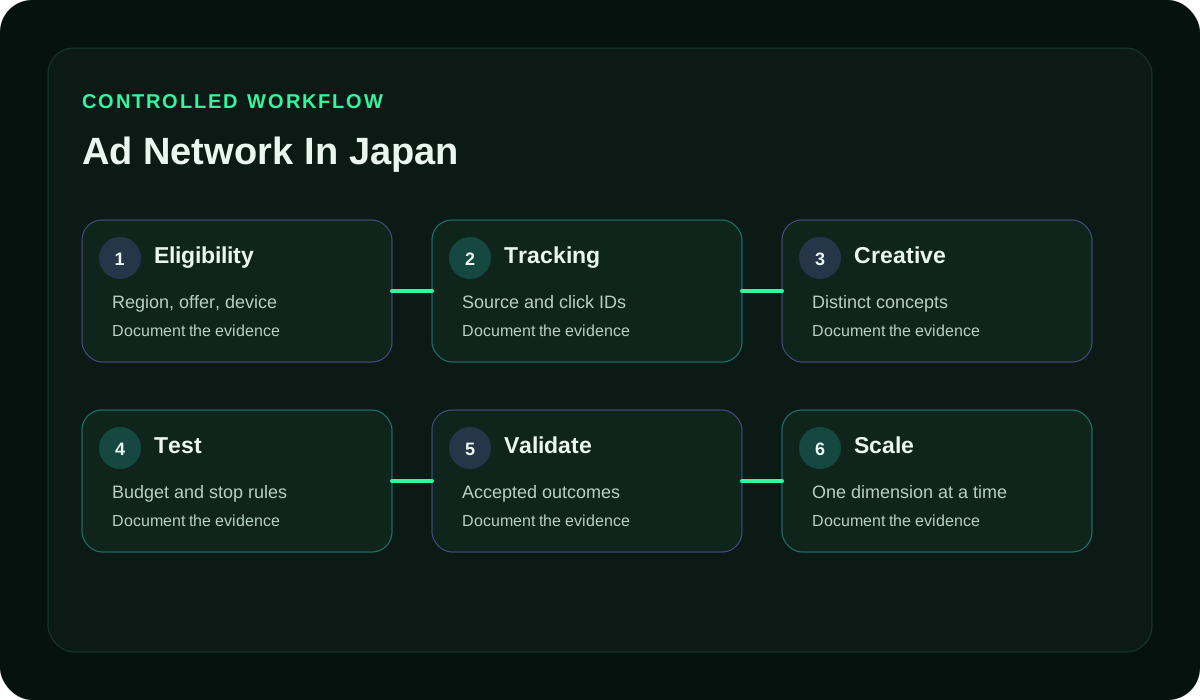
ad network in japan controlled workflow visual

Protect the response promise

Control demand within Japanese response capacity

Match the campaign allocation and available scheduling controls with your receiving team’s capacity. Monitor the response queue in your own process and pause affected delivery when the promised reply cannot be supplied. For B2B services, keep the buying role, verified need, agreed next action and accepted opportunity distinct. A meeting request does not by itself establish an approved project or funded contract.

Create My Free Account
Illustration comparing advertising formats for ad network in japan execution
Format selection

Select a format that can explain the specification

A concise placement can introduce a familiar problem, a visual unit can display a product state, and a context-rich format can explain a complex specification. Confirm current options inside the FroggyAds account. Write the one thing an eligible Japanese customer should understand after the creative. Do not hide price basis, compatibility, service area or approval conditions to inflate clicks.

Campaign versions

Keep creative and destination versions comparable

Version creative with its Japanese destination and acceptance rule. If any changes, open a new comparison window and record the reason. Attention and progression diagnose communication. Retained orders, accepted enquiries or useful activations decide whether the placement earns more budget.

Source review record

Make source decisions from a Japanese route record

Retain campaign, format, available source or placement, creative, Japanese version, geographic cell, spend, delivery, meaningful action, accepted event, reason and maturity date. Choose keep, cap, repair, exclude or retest. Fix specification, JPY discontinuity, address, fulfilment, response or onboarding before a source verdict.

Exclusion and retesting

Decide when a source needs exclusion or another test

Exclude only when the route works and a mature cell repeatedly fails the approved accepted-cost rule. Record what material change could justify another test.

Customer questions

Read customer questions by offer version and region

Inspect concentration by source, region, product and customer type. A strong average may rely on one narrow route that needs a contingency. Review customer contacts by product version, JPY offer, address, payment, delivery, specification, cancellation and support topic. Keep unnecessary personal information outside the media file.

Use verified questions to improve the offer

Treat repeated questions as a repair hypothesis

A question does not automatically invalidate the outcome. Preserve the answer and final status. Repetition may identify a statement the route should present earlier. Do not generalise a few cases into a claim about Japanese buyers. Require a documented pattern connected to the tested version and treat it as a repair hypothesis.

Create My Free Account
Illustration of a campaign launch checklist for ad network in japan
Review decision

Close the review with a reproducible decision

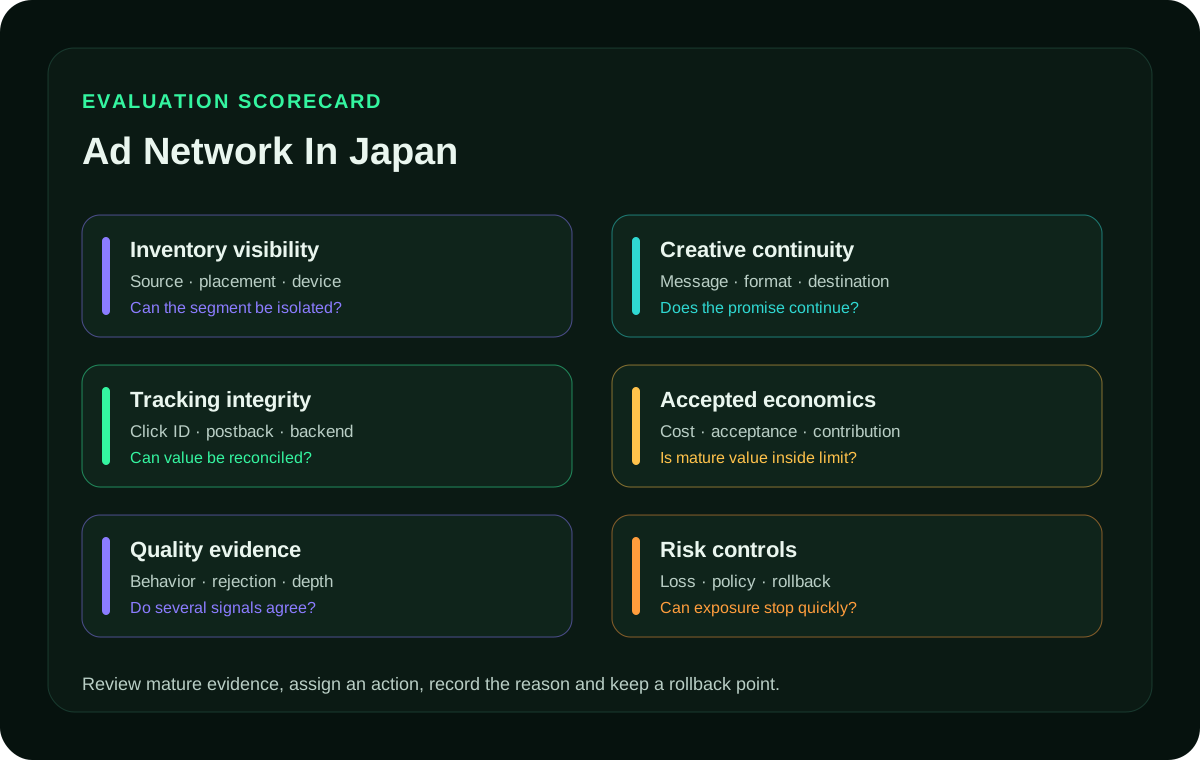
Assign clarify, repair, train, cap, stop or monitor, with owner, date and reversal rule. Compare the repaired cohort with the preserved predecessor. Confirm customer, Japanese specification, JPY offer, service area, production order or product path, mature denominator, source disposition and spare capacity. Attach exact versions.

ad network in japan evaluation scorecard visual
Remaining uncertainty

State uncertainty before releasing more spend

State remaining uncertainty, maximum exposure, review time and stop condition. Census and household statistics cannot authorise media growth; accepted customer evidence must.

Controlled expansion

Expand one product or geographic boundary at a time

Increase one meaningful dimension at a time so the next release remains explainable. Avoid changing region, format, offer and product route together. Create your FroggyAds account when the Japanese route and reason codes are ready. Start one bounded cell and grow where mature fulfilment or product value supports the next step.

Product usability

Check packaging, instructions and product usability

Record whether packaging, included documentation, setup instructions and required accessories support the Japanese product promise. A correctly delivered parcel can still fail when the customer cannot use what arrived. Keep missing item, unclear instruction, compatibility question, setup failure and product defect as separate reasons. These states point to merchandising, content, support or supplier ownership.

Support outcomes

Review final outcomes before treating support as failure

Use recurring questions to decide whether the destination should explain setup or included items sooner. Preserve the old version and test one controlled clarification. Do not count ordinary support contact as automatic rejection. Follow the final outcome through successful use, return or other mature state before changing the media verdict.

Evidence boundaries

Separate context, campaign records and accepted value

EvidenceAnswersDoes not answer
Official statisticsPopulation and surveyed household context.Available FroggyAds supply or purchase intent.
Campaign configurationThe selected format, audience, bid and spending settings.A guarantee that visitors become customers.
Japanese product routeThe specification, yen terms and supported customer journey.Correct receipt or retained value before review.
AttributionA supported match between campaign references and a business event.The value of unmatched or duplicate outcomes.
Mature customer valueRetained orders, accepted enquiries or approved product activity.The economics of every future customer cohort.
Operating capacityThe workload the responsible team can handle.Unlimited demand or automatic operational readiness.
Subscription review

Follow subscriptions through useful product use

Plan and terms

Record the Japanese plan and cancellation terms

Map plan selection, payment, account approval, onboarding, useful action, cancellation request, refund and retained subscription. Choose the state the product owner recognises as real value. Preserve the Japanese plan wording and JPY conditions seen. When renewal, trial or cancellation meaning changes, begin a new version instead of pooling different customer commitments.

Cancellation reasons

Diagnose why a subscription ends

Keep product friction, unmet expectation, price concern, technical failure and customer change as distinct cancellation reasons. Each reason has a different corrective owner.

Review window

Wait for the agreed subscription review

Allocate after the declared review window. Initial payment remains useful diagnostic evidence but cannot hide a route that fails before useful product adoption. Group customer contacts by product version, specification, JPY amount, address, delivery, setup, cancellation and service topic. Keep only the stage and evidence needed for acquisition review.

Frequently asked questions

Questions about Japan traffic campaigns

How should Tokyo compare with regional Japan delivery?

Separate Tokyo-area and regional groups when service terms, delivery capacity or the product journey differ. Confirm the geographic controls and reporting detail available for your campaign. Compare the same accepted event after the same review period; population concentration alone does not establish a better media source or a suitable customer.

What proves Japanese campaign wording is ready?

Have a fluent reviewer follow the Japanese advertisement, specification, price conditions, destination and response path. Ask what the customer expects to receive and which commitment the next step creates. Keep the approved version with the campaign so a later product or plan change cannot silently alter the meaning of the comparison.

Which mobile and desktop journey checks come first?

Test the actual product or enquiry route on supported screens. Include Japanese character input, address correction, payment or verification and the final business record where relevant. A successful desktop checkout does not prove a phone route works, and a page loading correctly does not establish successful order acceptance.

How should app inventory differ from web reporting?

Keep the supplied environment, format, creative and source identifiers visible. App events and web orders may have different attribution limits or review periods. Do not invent a named publisher or exact placement when the report supplies only a source ID. Confirm the available detail before committing to a placement-level comparison.

What frequency evidence helps control auction spend?

Define the event, identifier and period used to count repeated exposure, then compare it with accepted outcomes. A campaign average can conceal different exposure distributions. Verify which frequency controls the selected setup actually offers; use a supported campaign adjustment when the observed repetition no longer justifies its cost. This does not assume a universal person-level or per-source cap.

Which outcome tracking record should be audited?

Trace a known test click through the supported campaign, creative and source references to the business event. Verify duplicates, delayed confirmations and the reporting window. Keep unmatched orders or leads separate from attributed value until they can be reconciled; a convenient assignment would make the source comparison misleading.

Can placement quality be inferred from engagement alone?

No. Engagement can show attention while leaving eligibility, technical validity and customer acceptance unresolved. Inspect the working destination, relevant device evidence and mature business records together. An ordinary customer choosing not to buy is different from an invalid event, and both require a different response from a broken form.

Why does message continuity matter on the destination?

Visitors need the same product, payable amount, material conditions and next step that the advertisement prepared them to expect. Check compatibility, included items and service boundaries before payment. That continuity lets you investigate source differences without concealing a changed Japanese offer or an unusable customer route.

What makes a Japanese test financially controlled?

Choose one serviceable audience, a reviewed offer, a working destination and an affordable campaign allocation. Test the supported measurement route and assign someone to inspect spend and customer exceptions. Use the available controls with active review; an account deposit or low starting bid does not define a complete Japan test budget.

Which segment deserves a careful volume increase?

Consider a further test when comparable cohorts produce accepted value within your cost limit and normal operating capacity. Keep the added source, area or format identifiable and examine its marginal results. A strong earlier average is useful context, but it does not guarantee the next visitors will have the same economics.

Related Japan resources

Read the Japan guide for your next buying question

Continue with the Japan resource that answers your next buying question. Compare network options, prepare a suitable Push introduction or investigate traffic sources while keeping the Japanese specification, yen offer and accepted customer event consistent across the comparison.

Measure accepted campaign value

Use customer questions to improve the Japanese route

A repeated question can reveal missing information, yet frequency alone does not prove every customer was confused. Review the answer and mature outcome before proposing a change. Assign the repair to creative, destination, confirmation, packaging, onboarding or support and change one owner-controlled element. Document the hypothesis and the date the new cohort starts.

Offer evidence and the next purchase

Build the record for your next Japan buying decision

Close the review with keep, clarify, train, cap, stop or retest. The support loop should create a reversible decision, not a broad claim about Japanese consumers. Create a decision file containing campaign route, customer-facing JPY amount, accepted date, return or cancellation state and the approved value measure. Avoid unnecessary personal data.

Choose the finance measure: State whether finance uses retained order, net revenue, contribution basis, accepted lead or product activation. Keep the definition stable across regions and versions.

Keep reversals with the original cohort: Post valid reversals back to the original cohort and show pending outcomes. Moving them into a later reporting period can overstate the earlier media cell. Approve the next campaign release only when the mature value and remaining uncertainty are visible. Finance evidence supports a controlled test; it cannot guarantee future performance.

Preserve the product specification: For electronics, equipment, software or specialist products, list the compatibility facts a suitable customer needs before purchase: supported model or environment, included item, required accessory, service condition and version date. The advertiser should verify these claims against its own product record rather than infer them from category demand. Keep the exact specification set with the creative and destination version. If a model, connector, plan, package or support boundary changes, open a new record and prevent older ads from sending customers to a conflicting page. A clean version chain protects both the buyer and later campaign analysis.

Track specification outcomes: Track compatibility question, wrong-model order, missing accessory, setup issue, defect, successful use, exchange and retained outcome separately. A completed payment can still reveal a specification failure after delivery, so the media verdict should wait for the maturity point chosen by commerce and support. Use recurring, verified questions to improve the relevant specification block; avoid turning a few cases into a claim about Japanese shoppers. FroggyAds can bring controlled paid traffic to the tested route, while product and customer records determine whether the promise created accepted value.

Keep specialist services accountable: For consultations, installation, education or local services, document the serviceable area, eligible request, available appointment type, normal response window and specialist owner. A dense Tokyo-area opportunity and a broader national service promise are different operating questions and should not be blended automatically. Follow validation, assignment, first attempt, reached customer, qualification, appointment offered, attendance, completion and owner acceptance. Keep no capacity, unsupported location, specialist mismatch, customer decline, no-show and late internal response as separate reasons.

Match service demand to capacity: Schedule or cap the cell around the receiving team's real calendar. More enquiries during a closed or full service window measure queue pressure, not the value of the Japanese customer route. Reopen only after the service owner records headroom and a dated stop condition.

Test address and service groups consistently: Compare regions or schedules using the same accepted stage and review window. The decision should explain which constraint changed and why the next release is reversible, rather than relying on a country average or an early form-cost advantage. Run the production journey with authorised test records that reflect the address states the business supports. Check postcode handling, prefecture and locality fields, building details, character input, validation feedback and the confirmation summary. The goal is to verify the advertiser's form and fulfilment handoff, not to claim that one format covers every Japanese address convention.

Record the first address failure: Record where abandonment or error occurs without collecting more personal data than the operating process needs. Separate an unsupported location from a field-format rejection, an unclear instruction and a technical failure. Each outcome belongs to a different owner and should produce a different repair. Keep the destination and fulfilment rules versioned together. If a field or validation rule changes, restart the observation window for that route; an improvement cannot be attributed cleanly when old and new forms share one cohort.

Verify the fulfilment handoff: Before reallocating budget, confirm that correctly completed addresses reach the order system and that exceptions enter a staffed queue. More paid traffic will magnify a broken validation rule. A bounded FroggyAds release makes the production check measurable while limiting customer exposure. Write which event triggers order confirmation, dispatch information, appointment details or service instructions, and which team owns exceptions. The public destination should state any material timing or customer action known before purchase; notification cannot repair a promise that was unclear at the decision point.

Track delivery communication: Follow packed, dispatched, carrier or service handoff, scheduled window, attempted completion, customer receipt and final acceptance. Preserve the reason when the business changes a window, the customer requests another time, the address fails or the item returns. Measure contacts caused by missing or contradictory notices by the exact offer and fulfilment version. A repeated question can justify a clearer confirmation message, yet ordinary status enquiries should not automatically disqualify an otherwise retained customer.

Approve notification capacity: Release another media cell only when the fulfilment owner can support its expected notifications and exception workload. The accepted outcome remains a completed, retained transaction or another owner-approved event, not the sending of an automated message.

Review stageHow to use itEvidence to retain
Order acceptanceAssess correct receipt and retention after the declared review window.Order status, applicable specification and known cancellation or return reasons.
Service capacityAssess qualified enquiries receiving the promised response.Responsible team, response status and available appointment or support capacity.
Next campaign testApprove one change with an allocation, owner and review point.Previous settings, accepted-event rule and the condition that would trigger a pause.

A hypothetical equipment-enquiry workflow in Japan

Hypothetical workflow: An equipment supplier prepares a Japanese compatibility sheet and invites an eligible business to request a consultation. The form identifies the use case and requested next step; it does not imply that a quotation, integration or contract has been approved. The sales team checks the organisation, technical fit, service area and agreed follow-up under one qualification rule. Requests still being reviewed remain pending. This illustrates an operating method, not FroggyAds customer results.

Use FroggyAds for the media part of that review

Choose FroggyAds when you want to control the format, audience, bids, budget and available sources for a defined Japanese offer. Your team’s product and sales records show whether those visitors can use it. Keep an unsupported requirement, a duplicate request and a missed internal reply as different findings, then make the buying adjustment the evidence supports. Create your free FroggyAds account.

Research and practical references: Japan’s Statistics Bureau provides the census and Survey of Household Economy context used above. Population, households and advertising delivery remain different measures. shopify.com gives general paid-advertising background; support.google.com describes Google’s own Display targeting. These references do not verify a FroggyAds integration, local inventory quantity or campaign result. Check the actual Japan setup in your account.

Direct answer

Start with one Japanese offer the business can deliver

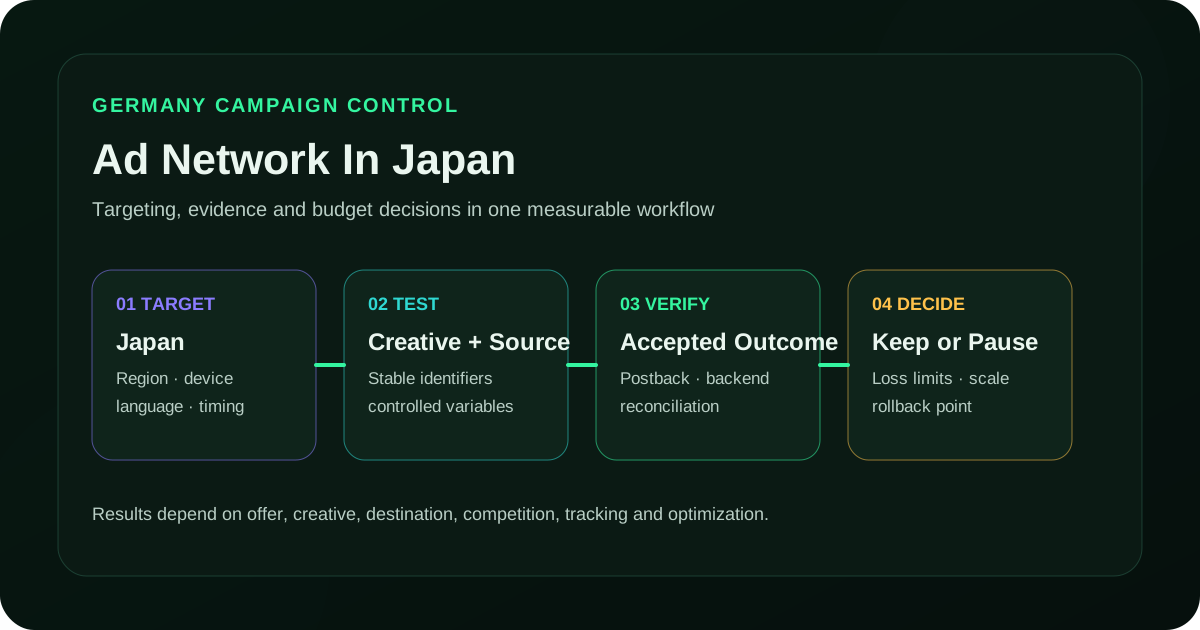
Bring a clear specification, consistent yen terms and a working order or enquiry route to FroggyAds. We recommend starting with the available campaign options that fit your operating capacity. Set the first allocation, then use verified fulfilment, product activity or accepted enquiries to decide what the next purchase should change.