Advertise Products Online: Improve Campaign Performance & Control
Advertising products online begins before an ad is purchased. The product record, stock state, price, delivery promise, evidence for claims and landing experience must agree. Channel selection follows that preparation. A product campaign is useful when a buyer can move from a specific promise to a specific item, understand the terms and complete the intended action without discovering a contradiction.
Make the product record campaign-ready
Create one authoritative record for the item name, variant, availability, price, destination, imagery and approved claims. Decide which system owns each field and how quickly a change reaches the landing page and advertising feed. A campaign should never require an operator to guess whether a product fact is still current.
Connect the guide to live testing
Connect Advertise Products Online to a controlled audience test
Use the choices established in “Make the product record campaign-ready” to define one audience, budget and source set in FroggyAds. Keep the surrounding offer and measurement rule stable so the test adds evidence to advertise products online instead of mixing several changes at once.
Treat missing or conflicting fields as launch blockers rather than creative inconveniences. If an item is unavailable, the route should not continue promoting a purchase that cannot be fulfilled. If a variant has a different condition or delivery window, its advertisement and destination need to preserve that distinction.
Write a promise the destination can keep
The advertisement can emphasize one buyer-relevant reason to inspect the product, but the landing page must substantiate that reason. Keep the wording concrete, show the item immediately and place material terms where a visitor can encounter them before committing. Avoid converting a category-wide statement into a guarantee about every product.
The FTC advertising basics explain that US advertising claims should be truthful, non-deceptive and supported by evidence. Use that principle as a claim-review boundary. The business must still determine which rules apply to its product and market; a campaign page cannot replace product, legal or regulatory review.
Match the channel to shopping behaviour
Search-led discovery fits a buyer who can describe the item or need. Visual discovery can introduce an unfamiliar design, use or collection. Publisher and audience placements can reach people in a relevant context. The choice depends on how the product becomes understandable, not on a universal ranking of advertising platforms.
Write the expected buyer state beside every channel: actively comparing, exploring a theme, returning to a known product or responding to a time-bound merchandising event. That note determines creative, destination and measurement. It also reveals when the same asset is being asked to perform incompatible roles.
Protect price and availability consistency
A visible mismatch between advertisement and store creates both trust and measurement problems. Check currency, variant pricing, discount conditions, stock status, delivery geography and the moment an offer ends. Assign an owner to pause or update promotion when the source record changes.
Do not hide unavoidable uncertainty. If fulfilment timing depends on destination or inventory, make that dependency clear before checkout. The campaign can still attract interest, but the decision should be based on the actual purchasing conditions rather than a simplified message that the store cannot reliably honour.
Design evidence around the buying question
Product photography, specifications, demonstrations, compatibility notes, comparison information and customer feedback answer different questions. Select the evidence the intended buyer needs at that stage. A decorative image may attract attention while still failing to show scale, material, fit or operation.
Reviews and endorsements require special care because readers may treat them as independent evidence. The FTC endorsements resources describe responsibilities around endorsements, influencers and reviews in the United States. Record the source and any material relationship, and do not reuse a statement outside the context in which it was actually made.
Measure the route, not only the click
Define meaningful checkpoints from product impression to destination view, item interaction, cart action, checkout and confirmed order. Diagnose the first material loss rather than optimizing a blended rate. A click that reaches the wrong variant is not equivalent to a visitor who finds an in-stock item and understands the terms.
Choose the execution format
Choose a paid-media format that supports Advertise Products Online
Use the criteria around “Measure the route, not only the click” to decide whether push, native, display or pop fits the message and destination. Set format, targeting and spend as campaign controls in FroggyAds while the advertise products online decision remains the standard for judging the result.
Preserve cancellation, refund and fulfilment information when it changes the commercial interpretation of a sale. The advertising system may report an event before the store has confirmed its value. Keep provisional and confirmed outcomes separate so campaign decisions do not reward demand the operation cannot complete.
Plan creative refresh from product events
A refresh should follow a reason: a new variant, a seasonal use, a changed buyer objection, improved evidence or a measured decline in response. Maintain the claim boundary while changing presentation. New wording does not authorize a stronger promise than the product record supports.
Build a small asset register showing product, audience question, format, destination, approval state and retirement condition. That register prevents an old price, image or promise from remaining active after the store has moved on. It also makes creative testing interpretable because the differences are recorded.
Run a launch reconciliation
Before activation, compare the advertisement, feed, destination, cart and confirmation route as one journey. Test representative devices and variants, check parameters and verify that the outcome arrives in the measurement system. Record the evidence rather than relying on a remembered spot check.
After launch, reconcile delivery with the product ledger. Investigate traffic to unavailable items, unexpected geography, claim-related support contacts and return reasons. These signals can require merchandising or destination changes before more media is purchased. The campaign is part of the store operation, not a separate source of clicks.
Decision records
A variant identifier remains consistent from the promoted creative through the landing destination and order record.
Offer language contains the qualifying condition in the same buyer journey, not in an unrelated policy page.
Stock changes have a named campaign response and a maximum tolerated delay before the promotion is paused.
The selected image answers a product question instead of merely repeating the catalogue thumbnail.
Currency, taxes, shipping eligibility and delivery limits are reviewed for the geography receiving the advertisement.
Every approved claim points to product evidence and records the person who accepted its campaign use.
The destination opens on the promised item or collection without forcing the visitor to repeat the search.
Tracking distinguishes a product view, cart action, checkout start, completed order and later business confirmation.
Return and cancellation signals remain connected to the campaign cohort when commercial value is assessed.
A creative retirement condition is defined before assets become stale or contradict the live product record.
Channel exclusions are documented when the format, audience state or measurement route does not fit the item.
The post-launch review assigns store, creative, media and analytics issues to different accountable owners.
Operational commentary
For the Advertise Products Online decision, record how this control changes the next test or review. These notes turn the page-specific controls into inspectable operating records. They describe a review method, not a forecast or a claim that any advertising result is guaranteed.
Review note 1
A variant identifier remains consistent from the promoted creative through the landing destination and order record. Connect this control to the authoritative product record and name the store role that maintains it. The merchandising reviewer checks the live item, advertised presentation and checkout path together, then documents any difference before media resumes. A campaign operator should never resolve a product contradiction by inventing new copy outside the approved evidence boundary.
Put the guide into practice
Turn Advertise Products Online into a bounded campaign test
With “Review note 1” documented, launch only the next reversible test. Set a spending limit, preserve the baseline and use source-level and audience controls so the next step depends on qualified outcomes for advertise products online, not activity volume.
Offer language contains the qualifying condition in the same buyer journey, not in an unrelated policy page. Inspect the condition from the buyer's route rather than from the campaign interface alone. Save the creative version, variant, geography and destination state that produced the observation. The product owner decides whether the item record changes; the media owner changes delivery only after that decision has propagated through the feed and landing experience.
Review note 3
Stock changes have a named campaign response and a maximum tolerated delay before the promotion is paused. Use the checkpoint to distinguish attraction from purchasability. A click may show that the message was noticed, while stock, variant, price or delivery evidence determines whether the promised item can be ordered. Record the first inconsistent state and fix its source before interpreting additional traffic as a creative problem.
Review note 4
The selected image answers a product question instead of merely repeating the catalogue thumbnail. Keep claim review and performance review separate but connected. The store retains the substantiation and material conditions for the product statement, while the campaign log retains where and when it was shown. Weak response can justify a new presentation; it does not authorize a stronger claim than the evidence supports.
Review note 5
Currency, taxes, shipping eligibility and delivery limits are reviewed for the geography receiving the advertisement. Reconcile the event with later store status before assigning commercial value. Preserve the initial order, cancellation, return and fulfilment outcome as related records rather than replacing one total with another. This lets the product team understand both buyer interest and operational completion without rewarding a campaign merely for creating fragile transactions.
Review note 6
Every approved claim points to product evidence and records the person who accepted its campaign use. End the review with a specific merchandising action, an owner and a retirement condition for obsolete material. The next asset or destination should change one documented buyer question at a time. Retaining the previous version and observation window makes the comparison useful even when demand, stock or promotion conditions later move.
Review note 7
The destination opens on the promised item or collection without forcing the visitor to repeat the search. Connect this control to the authoritative product record and name the store role that maintains it. The merchandising reviewer checks the live item, advertised presentation and checkout path together, then documents any difference before media resumes. A campaign operator should never resolve a product contradiction by inventing new copy outside the approved evidence boundary.
Review note 8
Tracking distinguishes a product view, cart action, checkout start, completed order and later business confirmation. Inspect the condition from the buyer's route rather than from the campaign interface alone. Save the creative version, variant, geography and destination state that produced the observation. The product owner decides whether the item record changes; the media owner changes delivery only after that decision has propagated through the feed and landing experience.
Review note 9
Return and cancellation signals remain connected to the campaign cohort when commercial value is assessed. Use the checkpoint to distinguish attraction from purchasability. A click may show that the message was noticed, while stock, variant, price or delivery evidence determines whether the promised item can be ordered. Record the first inconsistent state and fix its source before interpreting additional traffic as a creative problem.
Review note 10
A creative retirement condition is defined before assets become stale or contradict the live product record. Keep claim review and performance review separate but connected. The store retains the substantiation and material conditions for the product statement, while the campaign log retains where and when it was shown. Weak response can justify a new presentation; it does not authorize a stronger claim than the evidence supports.
Review note 11
Channel exclusions are documented when the format, audience state or measurement route does not fit the item. Reconcile the event with later store status before assigning commercial value. Preserve the initial order, cancellation, return and fulfilment outcome as related records rather than replacing one total with another. This lets the product team understand both buyer interest and operational completion without rewarding a campaign merely for creating fragile transactions.
Review note 12
The post-launch review assigns store, creative, media and analytics issues to different accountable owners. End the review with a specific merchandising action, an owner and a retirement condition for obsolete material. The next asset or destination should change one documented buyer question at a time. Retaining the previous version and observation window makes the comparison useful even when demand, stock or promotion conditions later move.
Sources and preserved resources
The following links preserve the page's established navigation and provide dated owner or primary-source references for the factual boundaries used in this guide. A source describes its own rules or vocabulary; it does not guarantee campaign results. For Advertise Products Online, apply this rule to the page-specific audience, market, format or buying decision described here.
FTC advertising principles require truthful, non-deceptive and evidence-supported claims in United States advertising.
Product merchandising connects item availability, offer presentation, buyer evidence and the checkout route.
Questions and answers
Where should a business advertise its products?
Active product searches suit routes that answer existing demand, whereas discovery campaigns introduce products to target groups not yet looking. The buying point, product category and expected choice time should guide the mix instead of imitating a generic channel plan.
Why does accurate product data matter before online advertising starts?
Current titles, prices, images, stock status and variants keep the advertising consistent with the item a shopper can order. Errors create wasted clicks, disapprovals and doubt, especially when catalog data update more slowly than the store.
How can product margin set a reasonable online advertising bid ceiling?
The calculation begins with contribution profit after fulfilment, fees and planned returns. A target acquisition expense can then protect profit, whereas separate limits for different offers prevent a high-profit item from subsidising weak economics elsewhere.
What should happen to product campaigns when stock levels change quickly?
Advertising and inventory data need a dependable refresh route, with scarce or unavailable items retired before buyers arrive. A fallback product is valuable only when its offer and economics genuinely fit the original shopper intent.
Which landing-page details help product ads convert qualified shoppers?
Qualified shoppers need the landing page to confirm the listed product, price, delivery conditions, returns information and a clear purchase path. Firm visual continuity between creative and landing page confirms for visitors that they found the offer they selected.
How should returns change product-ad reporting?
Treat approved orders as provisional until cancellations and returns have matured. Link those later events to the original product, offer and advertising source, then use net revenue or contribution rather than gross order volume for the commercial decision.
Which advertising test suits a recently launched online product?
A limited audience, stable offer page and capped budget build a readable first test. Initial data should distinguish weak content interest from checkout or pricing resistance before the business changes multiple parts of the offer at once.
How should seasonality change an online product advertising plan?
Demand, competition and delivery deadlines can shift together during seasonal periods. Budgets and creative timings should follow the buying calendar, while post-season benchmarks account for changed prices and buyer urgency rather than treating each month as equivalent.
Which product or tracking mismatches should pause an online campaign?
The campaign should stop when pricing, stock, delivery promises or analytics no longer match the live store. Continued visits under those conditions buy misleading information and disappoint shoppers, so the route requires correction before spending resumes.
After a catalogue pilot, how should an online retailer choose products for added media spend?
Increase advertising for products with stable stock, acceptable margin, and consistent approved sales after a mature review. Keep new product groups in separate records, raise one budget boundary at a time, and stop if the added spend weakens marginal profit or service capacity.
Advertiser decision framework
Advertise Products Online: Improve Campaign Performance & Control: what should the advertiser decide next?
For Advertise Products Online: Improve Campaign Performance & Control, the commercial task is to turn advertise products online into one measurable campaign decision. Use On this page to define the audience or problem, use Make the product record campaign-ready to constrain the test, and decide in advance which accepted result would justify more FroggyAds spend.
On this Advertise Products Online: Improve Campaign Performance & Control page, the decision should remain tied to the existing evidence around On this page, Make the product record campaign-ready and Connect Advertise Products Online to a controlled audience test. Those sections give advertise products online its specific context; the table below turns that context into campaign actions rather than adding another generic definition.
Decision
What to verify
FroggyAds action
Advertise Products Online: Improve Campaign Performance & Control objective
Use On this page to define the accepted business event and the maximum learning loss for advertise products online.
Launch one FroggyAds campaign objective for Advertise Products Online: Improve Campaign Performance & Control and keep the conversion definition stable.
Advertise Products Online: Improve Campaign Performance & Control audience
Use Make the product record campaign-ready to verify market, device, language and offer eligibility for advertise products online.
Apply only the FroggyAds targeting controls that change the real Advertise Products Online: Improve Campaign Performance & Control customer journey.
Advertise Products Online: Improve Campaign Performance & Control source evidence
Use Connect Advertise Products Online to a controlled audience test to keep source-level differences visible instead of relying on one blended advertise products online average.
Keep, cap, exclude or retest Advertise Products Online: Improve Campaign Performance & Control inventory from documented source evidence.
Advertise Products Online: Improve Campaign Performance & Control economics
Use Write a promise the destination can keep to connect media spend with accepted conversions and downstream value for advertise products online.
Protect the Advertise Products Online: Improve Campaign Performance & Control test with a written budget boundary and a consistent attribution window.
Advertise Products Online: Improve Campaign Performance & Control scale rule
Use Match the channel to shopping behaviour to define the exact evidence that earns the next budget increase for advertise products online.
Scale Advertise Products Online: Improve Campaign Performance & Control one major control at a time and compare marginal performance with the prior baseline.
A page-specific FroggyAds test sequence for Advertise Products Online: Improve Campaign Performance & Control
Advertise Products Online: Improve Campaign Performance & Control outcome: define the accepted event for advertise products online and the maximum loss permitted while the first test is learning.
Advertise Products Online: Improve Campaign Performance & Control path: verify market eligibility, device experience, landing-page continuity and tracking against On this page before buying more traffic.
Advertise Products Online: Improve Campaign Performance & Control hypothesis: launch one bounded FroggyAds test tied to Make the product record campaign-ready; do not change bid, creative, audience and destination together.
Advertise Products Online: Improve Campaign Performance & Control source review: compare qualified activity, accepted conversions, timing and cost by the source or segment dimensions relevant to Connect Advertise Products Online to a controlled audience test.
Advertise Products Online: Improve Campaign Performance & Control scaling: use Write a promise the destination can keep and Match the channel to shopping behaviour to define what must reproduce before the next budget increase.
Why FroggyAds is relevant to Advertise Products Online: Improve Campaign Performance & Control
For Advertise Products Online: Improve Campaign Performance & Control, FroggyAds gives advertisers a self-serve DSP and ad-network workflow for buying supported traffic with campaign-level budgets and targeting. Depending on format and campaign context, available controls can include country, city, device, operating system, browser, carrier, category, source, ID and IP options. SmartCPC and Adscore-supported traffic-quality controls can support the advertise products online optimization process, while the advertiser's tracker, analytics and backend acceptance remain the final evidence for commercial quality.
Use Match the channel to shopping behaviour as the final checkpoint for Advertise Products Online: Improve Campaign Performance & Control. If the accepted result does not reproduce after the next meaningful volume step, return to the last stable configuration instead of widening several controls at once.
Advertise Products Online: Improve Campaign Performance & Control: the buyer task this URL owns
Advertise Products Online: Improve Campaign Performance & Control is for performance-focused advertisers who need to make a measurable paid-acquisition decision. Keep that buyer task separate from the nearby topic so this URL answers one commercial question clearly. The nearest related FroggyAds page is How To Advertise Online Cheap; this URL keeps ownership of the distinct task to make a measurable paid-acquisition decision.
Keep audience targeting, conversion tracking, source quality, campaign objective in the Advertise Products Online: Improve Campaign Performance & Control evidence record because they can change how this media test is configured, measured or scaled.
Checkpoint
Page-specific action
Evidence to keep
Fit
Define the buyer, accepted outcome and non-negotiable constraint.
Retain evidence specific to Advertise Products Online: Improve Campaign Performance & Control and its accepted outcome.
Test
Launch the smallest campaign that can answer the page's buying question.
Retain evidence specific to Advertise Products Online: Improve Campaign Performance & Control and its accepted outcome.
Decision
Keep, cap, exclude or expand from accepted-outcome evidence.
Retain evidence specific to Advertise Products Online: Improve Campaign Performance & Control and its accepted outcome.
Hypothetical calculation: if a controlled campaign for advertise products online: improve campaign performance & control spends USD 275 and produces 5 accepted conversions, accepted CPA is USD 275 / 5 = USD 55.0. Replace the inputs with your own campaign economics; this is not a FroggyAds performance claim.
Use FroggyAds as the execution layer for Advertise Products Online: Improve Campaign Performance & Control: keep the offer and conversion definition stable, apply the needed media controls and let advertiser-side accepted value decide whether more spend is justified. Create your free FroggyAds account.
Direct answer
Advertise Products Online: Improve Campaign Performance & Control — what matters first
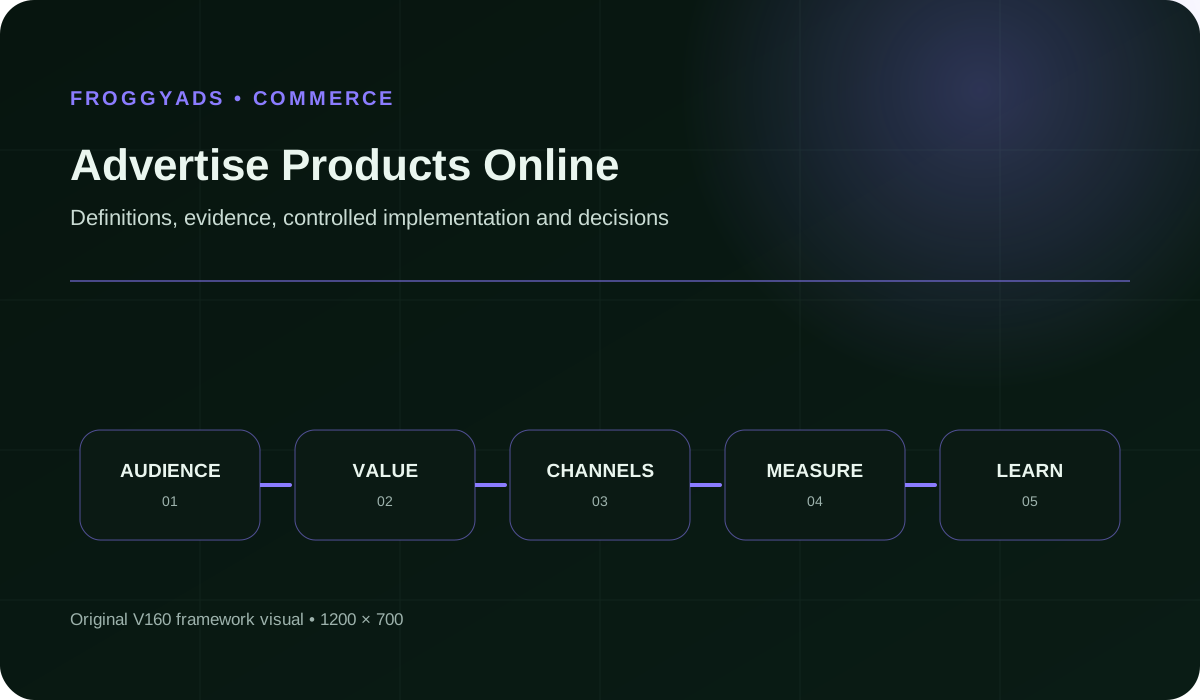
Advertise Products Online: Improve Campaign Performance & Control is most useful when it helps a buyer decide whether this option fits the buyer's acquisition workflow. Define the accepted outcome first, then use targeting, budget and source-level evidence to decide what deserves more spend.



Operational commentary
For the Advertise Products Online decision, record how this control changes the next test or review. These notes turn the page-specific controls into inspectable operating records. They describe a review method, not a forecast or a claim that any advertising result is guaranteed.
Review note 1
A variant identifier remains consistent from the promoted creative through the landing destination and order record. Connect this control to the authoritative product record and name the store role that maintains it. The merchandising reviewer checks the live item, advertised presentation and checkout path together, then documents any difference before media resumes. A campaign operator should never resolve a product contradiction by inventing new copy outside the approved evidence boundary.
Put the guide into practice
Turn Advertise Products Online into a bounded campaign test
With “Review note 1” documented, launch only the next reversible test. Set a spending limit, preserve the baseline and use source-level and audience controls so the next step depends on qualified outcomes for advertise products online, not activity volume.
Create My Free AccountReview note 2
Offer language contains the qualifying condition in the same buyer journey, not in an unrelated policy page. Inspect the condition from the buyer's route rather than from the campaign interface alone. Save the creative version, variant, geography and destination state that produced the observation. The product owner decides whether the item record changes; the media owner changes delivery only after that decision has propagated through the feed and landing experience.
Review note 3
Stock changes have a named campaign response and a maximum tolerated delay before the promotion is paused. Use the checkpoint to distinguish attraction from purchasability. A click may show that the message was noticed, while stock, variant, price or delivery evidence determines whether the promised item can be ordered. Record the first inconsistent state and fix its source before interpreting additional traffic as a creative problem.
Review note 4
The selected image answers a product question instead of merely repeating the catalogue thumbnail. Keep claim review and performance review separate but connected. The store retains the substantiation and material conditions for the product statement, while the campaign log retains where and when it was shown. Weak response can justify a new presentation; it does not authorize a stronger claim than the evidence supports.
Review note 5
Currency, taxes, shipping eligibility and delivery limits are reviewed for the geography receiving the advertisement. Reconcile the event with later store status before assigning commercial value. Preserve the initial order, cancellation, return and fulfilment outcome as related records rather than replacing one total with another. This lets the product team understand both buyer interest and operational completion without rewarding a campaign merely for creating fragile transactions.
Review note 6
Every approved claim points to product evidence and records the person who accepted its campaign use. End the review with a specific merchandising action, an owner and a retirement condition for obsolete material. The next asset or destination should change one documented buyer question at a time. Retaining the previous version and observation window makes the comparison useful even when demand, stock or promotion conditions later move.
Review note 7
The destination opens on the promised item or collection without forcing the visitor to repeat the search. Connect this control to the authoritative product record and name the store role that maintains it. The merchandising reviewer checks the live item, advertised presentation and checkout path together, then documents any difference before media resumes. A campaign operator should never resolve a product contradiction by inventing new copy outside the approved evidence boundary.
Review note 8
Tracking distinguishes a product view, cart action, checkout start, completed order and later business confirmation. Inspect the condition from the buyer's route rather than from the campaign interface alone. Save the creative version, variant, geography and destination state that produced the observation. The product owner decides whether the item record changes; the media owner changes delivery only after that decision has propagated through the feed and landing experience.
Review note 9
Return and cancellation signals remain connected to the campaign cohort when commercial value is assessed. Use the checkpoint to distinguish attraction from purchasability. A click may show that the message was noticed, while stock, variant, price or delivery evidence determines whether the promised item can be ordered. Record the first inconsistent state and fix its source before interpreting additional traffic as a creative problem.
Review note 10
A creative retirement condition is defined before assets become stale or contradict the live product record. Keep claim review and performance review separate but connected. The store retains the substantiation and material conditions for the product statement, while the campaign log retains where and when it was shown. Weak response can justify a new presentation; it does not authorize a stronger claim than the evidence supports.
Review note 11
Channel exclusions are documented when the format, audience state or measurement route does not fit the item. Reconcile the event with later store status before assigning commercial value. Preserve the initial order, cancellation, return and fulfilment outcome as related records rather than replacing one total with another. This lets the product team understand both buyer interest and operational completion without rewarding a campaign merely for creating fragile transactions.
Review note 12
The post-launch review assigns store, creative, media and analytics issues to different accountable owners. End the review with a specific merchandising action, an owner and a retirement condition for obsolete material. The next asset or destination should change one documented buyer question at a time. Retaining the previous version and observation window makes the comparison useful even when demand, stock or promotion conditions later move.