Search intent and buyer decisionPush Traffic Tier 2: the decision this URL owns
Treat Push Traffic Tier 2 as an operating decision, not a definition page. A performance advertiser should use it to plan the market-specific test and measurement rules, with the same accepted outcome preserved from setup through review. This is the second-tier decision path, so its evidence should remain separate from adjacent tier URLs.
URL boundary for Push Traffic Tier 2: This URL owns Push Traffic Tier 2; Tier 3 Push Ads is the nearest neighboring topic and should keep its separate task. Use this page only for the decision implied by Push Traffic Tier 2. Keep this second-tier path separate from the neighboring tier pages when you record evidence and make the next spend decision.
Decision inputs for Push Traffic Tier 2: audience targeting, source evidence, conversion tracking, accepted business value; preserve a distinct second-tier evidence trail rather than pooling it with another tier. Keep these inputs tied to accepted conversion or business-value event and the page-specific job: plan the market-specific test and measurement rules.
Market test design for Push Traffic Tier 2 (second-tier): Treat the market as an independent acquisition cohort: isolate the offer, destination and conversion definition before comparing it with another GEO. Record audience targeting beside the destination, source and device mix; this prevents a market conclusion from being inferred from blended delivery.
Market evidence and next action for Push Traffic Tier 2 (second-tier): Use source evidence to connect traffic delivery to accepted conversion or business-value event, including the rejection or reversal signals that can change the apparent economics. If the mature result is inside the written limit, expand one controlled dimension; otherwise keep, cap or exclude the responsible source segment.
Push Traffic Tier 2 in three decisions is an evidence checkpoint for Push Traffic Tier 2. To answer “What does tier two mean when evaluating push traffic?”, keep audience targeting in the same campaign record and use it to plan the market-specific test and measurement rules.
A practical evaluation framework is the action checkpoint for Push Traffic Tier 2. Before acting on “How is permission provenance checked for tier-two push inventory?”, document conversion tracking, the resulting campaign action and the rollback or retest condition.
What push traffic tier 2 means is the measurement checkpoint for this URL. Resolve “Which local signals guide selection among tier-two push markets?” while retaining source evidence, accepted business value, spend and cohort age so the result can be reconciled with accepted conversion or business-value event.
| Page checkpoint | How to use it | Evidence to retain |
|---|
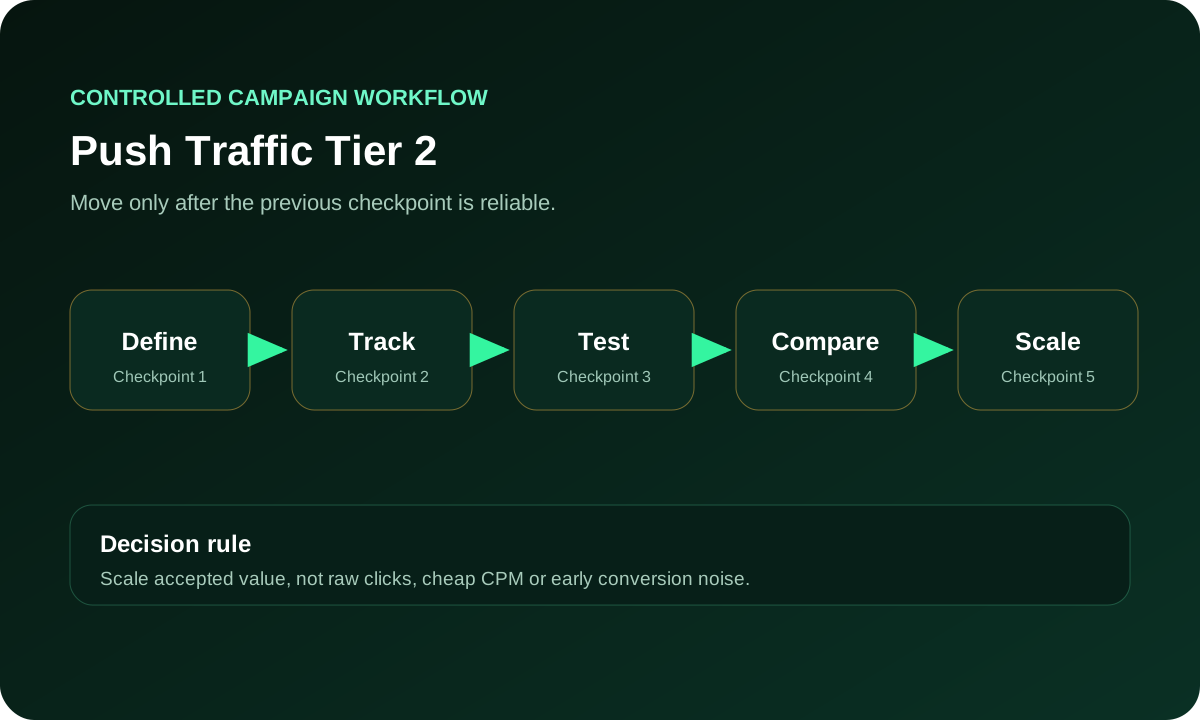
| Push Traffic Tier 2 in three decisions | Use Push Traffic Tier 2 in three decisions to establish the first evidence boundary for Push Traffic Tier 2; then record which part of campaign objective, targeting, source evidence, conversion tracking and economics it changes. | Keep audience targeting, source/campaign ID and the accepted-event definition together. |
| What push traffic tier 2 means | Use What push traffic tier 2 means as the second checkpoint and reconcile it with accepted conversion or business-value event before changing budget or source allocation. | Retain source evidence, spend, timestamp/cohort age and accepted/rejected outcomes. |
| A practical evaluation framework | Use A practical evaluation framework as the final checkpoint: if it does not change the evidence for accepted conversion or business-value event, keep the test narrow rather than scaling. | Document conversion tracking, the decision taken and the rollback or retest condition. |
Transparent Push Traffic Tier 2 decision example
Hypothetical example: For Push Traffic Tier 2, a hypothetical controlled cell that spends USD 280 and records 3 accepted conversion or business-value event after the same maturity window has an accepted cost of USD 93.33 per outcome. Replace the figures, outcome and review window with your own economics; this is not a FroggyAds performance claim. Use the calculation as a second-tier measurement template only; do not transfer its inputs to another tier.
Why use FroggyAds here?
Choose FroggyAds for the media-buying part of Push Traffic Tier 2 when you need controllable traffic and source evidence; keep the commercial decision anchored to accepted conversion or business-value event, not delivery volume alone. Keep the FroggyAds campaign record tied to this second-tier test rather than merging its conclusions with another tier. Create your free FroggyAds account.
Research basis for Push Traffic Tier 2: This URL helps performance-focused advertisers plan the market-specific test and measurement rules. It is mapped to the general ads research cluster. Our current review used shopify.com and support.google.com to check terminology, buyer questions and decision coverage relevant to Push Traffic Tier 2. These external sources are research inputs, not evidence of FroggyAds campaign performance. This research note supports the distinct second-tier decision path for this URL.