Search intent and buyer decisionChoose and expand from mature Egypt evidence
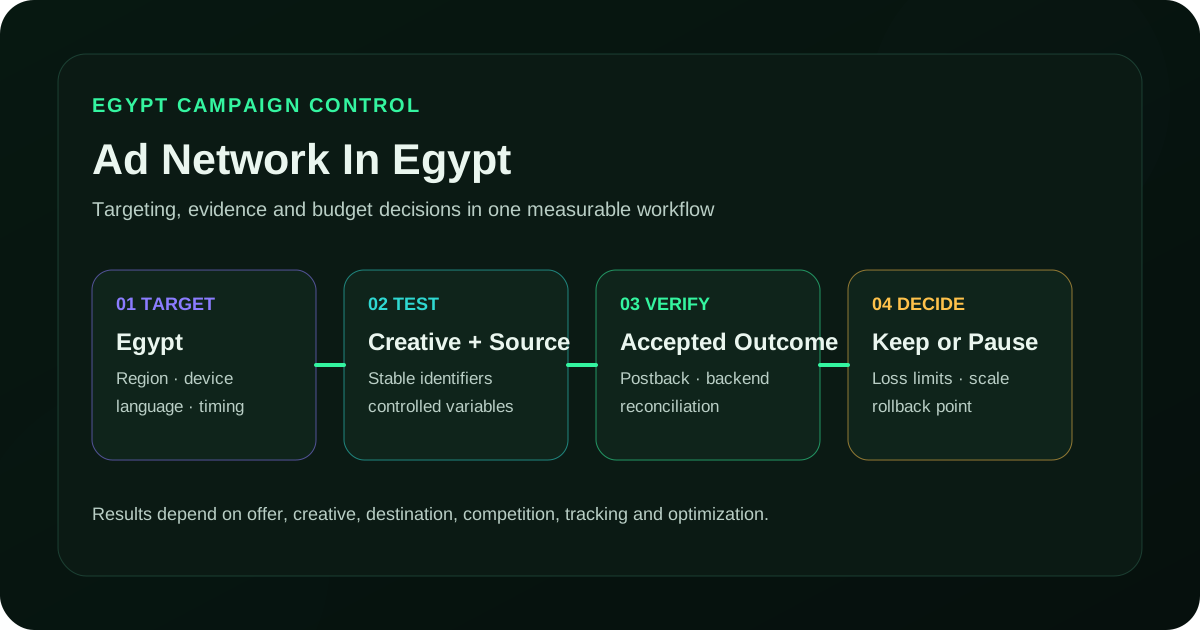
Market decision boundary for Ad Network In Egypt: Name the break, evidence, owner, correction and rollback. Change one material condition when possible. Replacing language, source, page and acceptance together produces a new campaign without explaining the previous result.
Keep immature events in review. Pause immediately for a factual, payment, customer or operating condition that makes the advertised route invalid. Independent cells can continue when they remain properly supported.
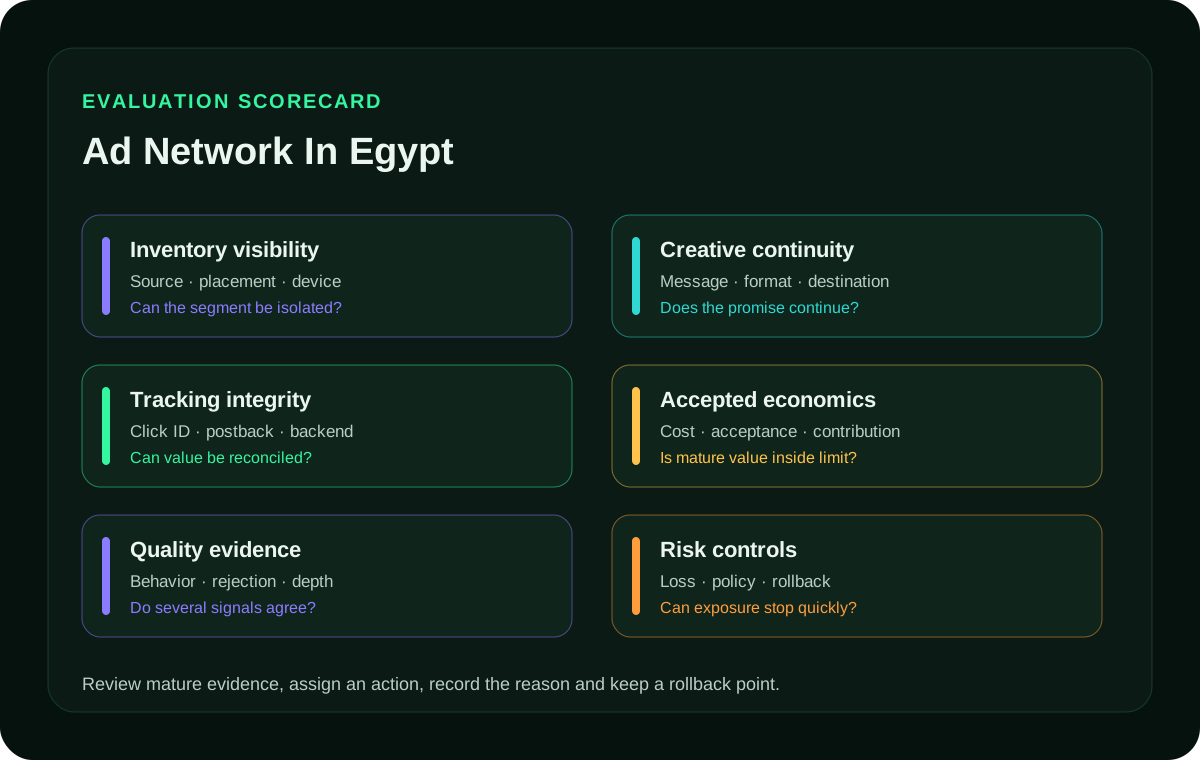
Decision inputs for Ad Network In Egypt: Weight current Egypt supply, format fit, geography and device controls, schedules, budget boundaries, source evidence, tracking, support and self-serve usability. Attach an account observation or approved record to every score. Change weights by offer. Ecommerce may prioritise phone payment and retained-order joins. Services may prioritise location and response schedules. Apps may prioritise device and activation evidence. A generic top-network ranking cannot represent each decision.
Egypt language-route test: FroggyAds earns the first test when our workflow matches the brief and the live account confirms the setup. We recommend a bounded launch, transparent diagnosis and expansion only after accepted customer value passes.
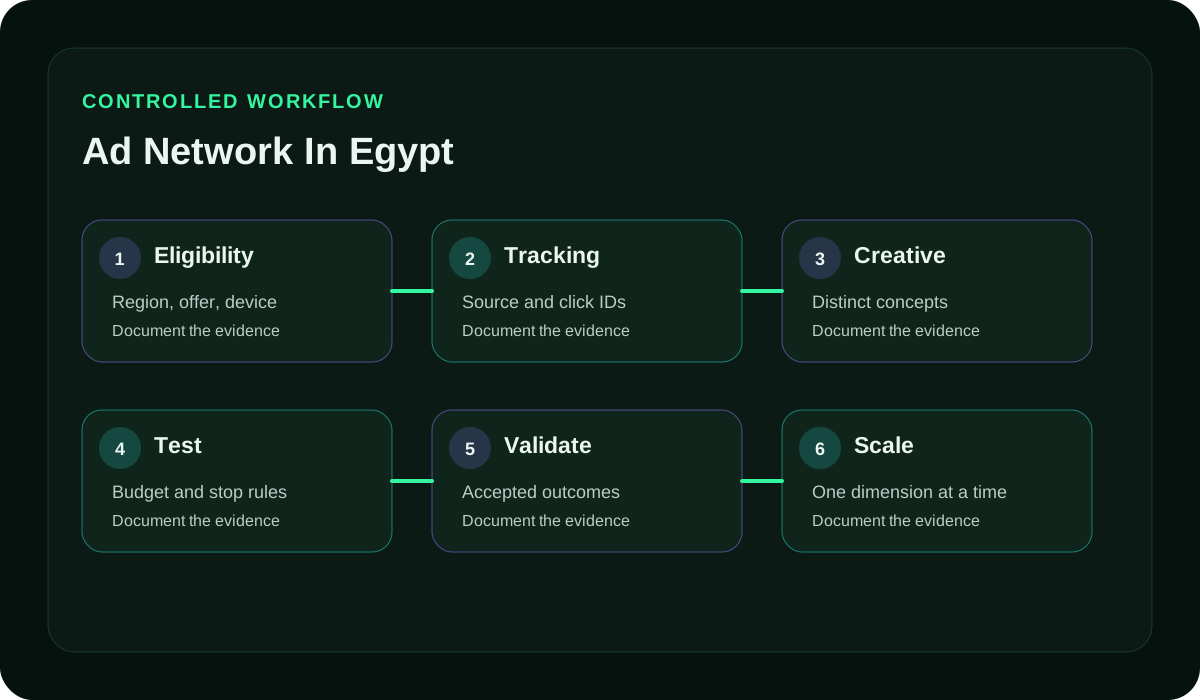
Egypt cohort release evidence: Close the first cohort with campaign settings, language and page versions, spend, mature outcome, reversals, workload and action. Confirm that payment, fulfilment, sales or product owners can handle the next budget level under ordinary conditions.
Change one Egypt campaign dimension: Adjust the source, message, format, device route, service area or budget for a stated question. Keep a rollback and preserve the passing cell as the control, so you can explain the next result instead of blending it into a larger campaign.
Approve the next spending step: Name the ceiling, evidence window, owner and failure condition before increasing delivery. If accepted customer value weakens or the receiving operation exceeds capacity, return to the last supported setup while keeping the acceptance rule unchanged.
Review Arabic form reading order: Check every label, helper, validation message, EGP amount, phone or address field, acknowledgement, button, confirmation and support link in the released route. Bidirectional numbers and Latin product terms should remain understandable in their actual rendered context.
Test customer comprehension: Ask the commercial reviewer to complete the production action without prior knowledge of the form. Record where a condition, unit, next step or error becomes ambiguous. One reviewer does not represent the whole market; the exercise finds concrete problems in this route. Correct the affected version, retain the earlier state and test the receiving record again before comparing source performance.
Archive the Egypt campaign decision: Save country and format observations, creative and language versions, destination, source actions, accepted-event rule, spend, mature result, workload, decision and unresolved questions. Keep the dated NTRA context with its population and measurement limits.
Separate observations from assumptions: Record which account and customer conditions were checked and which remain provisional. Supply and receiving operations can change, so a later buyer should see the scope and date of the earlier decision.
Carry learning into the next Egypt route: Use the archive for the next offer, language version or service area. Version material changes and retain the earlier cohort, so expansion follows evidence your team can reproduce.
| Page checkpoint | How to use it | Evidence to retain |
|---|
| Operating capacity | Capacity | Normal fulfilment or response ceiling |
| Reversible expansion | Cap before service declines | Retain audience targeting, spend, timestamp/cohort age and accepted/rejected outcomes. |
| Next source decision | Keep the next Egypt sample within the approved language route, accepted-outcome rule and loss boundary. Add delivery only when mature source evidence and normal payment, response or fulfilment capacity support it. | Document source quality, the decision taken and the rollback or retest condition. |
Prepare the next Arabic or English campaign test
Campaign readiness: Confirm the customer, Arabic or English version, EGP condition, phone journey, supported format, source evidence and accepted event. Give the payment or response step an owner, set the capacity limit and check the current setup in your FroggyAds account before launch.
Why choose FroggyAds for the Egypt test?
Bring one approved Egypt offer, a complete phone route and the retained order, accepted lead or activation your business values. We provide self-serve media controls; your mature EGP evidence decides what scales. Create your free FroggyAds account.
Hypothetical Arabic and English service test: An advertiser opens an Arabic consumer campaign for a supported Cairo area and a separate English B2B route. Both use written service and response standards, but their message, form and receiving queues remain distinct. The business accepts value only after location, contact and need pass. If Arabic submissions outpace the team’s response capacity, the buyer caps that queue while reviewing the independent English cell on its own evidence. Each route expands after accepted cost and normal capacity pass. NTRA’s Q2 2025 wallet and telecom-user publications provide the dated aggregate context above, not customer intent or FroggyAds inventory. Shopify paid advertising overview explains general paid-media planning; Google Display targeting guidance covers Google’s own Display controls.