
What is Banner Advertising
Banner advertising is the paid-media practice of delivering visual ads inside eligible website or app placements. The advertiser combines a banner asset, audience settings, inventory conditions, bid or budget controls, and a destination. Tracking then connects delivery and clicks with later campaign events. The practical value comes from managing those parts as one system. A banner campaign should answer a commercial question instead of merely collecting impressions. Record that question in the launch brief so every later adjustment can be judged against the same purpose.
What does this page explain about What is Banner Advertising: Create, Test & Improve Ad Performance?
Quick answer: Treat buyer hypothesis as a separate control inside banner media strategy. Start with one testable buyer hypothesis: name the audience, the problem they recognize, the banner promise and the action the landing page must earn. Preserve a reproducible comparison when you write the hypothesis before selecting inventory or bids. Avoid a wider conclusion, since an unwritten assumption is difficult to test or reject. FroggyAds gives your team a self-serve route for running the following bounded test.
Scenario planning gives banner advertising a financial boundary before launch. Model conservative, expected, and stress conditions as hypothetical cases, state every input, and avoid presenting any case as a forecast. Keep the chosen budget ceiling and stop rule beside the campaign record. List the impression or click assumption, response assumption, accepted-event rule, and maturity period behind each case. Replace those inputs with observed campaign data as it becomes available. The purposeis to expose uncertainty and choose a bounded learning test, not to manufacture a promised return. Date every scenario and name its owner. Reopen the budget decision when the offer, destination, audience, or validation rule changes.
What Banner Advertising means
Build the operating definition around the advertiser campaign call behind publisher source review. Inventory origin should remain attached to every delivery and outcome row. Publisher source review compares delivery, engagement, accepted conversions, and rejection patterns by inventory origin. Make the campaign state auditable: keep, cap, exclude, or retest from documented observed data. The unit-economics limit is that a blended campaign average can hide opposing publisher source observations. Use the observed data gap to select whether traffic, ad asset, offer, or destination changes next.
Understand How Banner Ads Are Delivered
Attribution rules determine how a banner interaction is connected with a later qualified action. Choose the window, identifiers, and acceptance rule before comparing sources, then keep them stable through the test. Different attribution settings can create an apparent performance gap even when buyer behaviour has not changed.
Define what What is Banner Advertising means for the campaign
Read the campaign boundary through ad asset matrix. A defensible buying rule is that a ad asset matrix separates message angle, visual concept, headline, action, and destination. Before the campaign call, label each combination with a stable version identifier. This protects the finding because minor punctuation changes rarely answer a meaningful campaign question. Assess one controlled revision after both cells reach the same maturity window.
Evaluate Supply Beyond a Volume Claim
Make campaign objective visible in the record for the inventory evaluation. The concrete standard is that the campaign objective names the business action that banner advertising should support. For the next review, connect the objective with one accepted event and one campaign call date. Keep expectations realistic: delivery volume cannot define success on its own. Our publisher source-aware workflow helps your team assign the next campaign action.
Define Eligibility Before Buying Reach
Change one major campaign control at a time when eligibility or performance needs investigation. Keep the source, audience, creative, destination, bid, or budget stable except for the variable under review. Mature accepted-outcome evidence can then support a clear continue, revise, or stop decision.
Connect the guide to live testing
Connect What is Banner Advertising to a controlled audience test
Structure the review of banner media strategy around frequency control. Use this planning principle: frequency observed data shows how response changes as eligible people encounter the message again. The account owner should separate first-contact and repeated-exposure behaviour. Remember that ad asset fatigue and weak visitor group fit require different corrections.
Create My Free Account
Build Creative Assets for the Real Placement
For this allocation, ad asset production depends on validated event. The precise rule is that a validated event is the lead. The review also covers each signup, sale, or qualified action that passes the advertiser's written rule. Document the campaign call when you preserve accepted and rejected totals with their reasons. The guardrail remains necessary because a raw event count may overstate commercial value. Increase budget cap only when marginal accepted value remains inside the business limit.
Protect Readability Across Devices and Placements
Use cross-device readability to define visitor group eligibility. Visitor group eligibility defines who can use the offer and complete the intended action. For the operating record, exclude unsupported markets, devices, languages, and policy conditions before launch. Keep one limit explicit: broader reach can increase waste without improving qualification. We use FroggyAds controls and inventory findings to support the next disciplined media campaign call.
Landing-page continuity for What is Banner Advertising
For ad asset-to-destination continuity, start with dated action record. The strategic principle is that a dated action record connects the observed data, campaign call, owner, and next review requirement. Your media plan should capture the campaign state before each material change. This matters because undocumented optimization cannot be reproduced or audited. Review mature accepted conversions before changing another buying variable.
Create a Reliable Impression-to-Outcome Chain
Treat review cadence as a separate control inside the measurement chain. In operation, a review cadence prevents teams from reacting to one hour or one isolated conversion. Preserve a reproducible comparison when you schedule checks around delivery, maturity, and business reporting windows. Avoid a wider conclusion, since continuous changes destroy the stable comparison needed for learning.
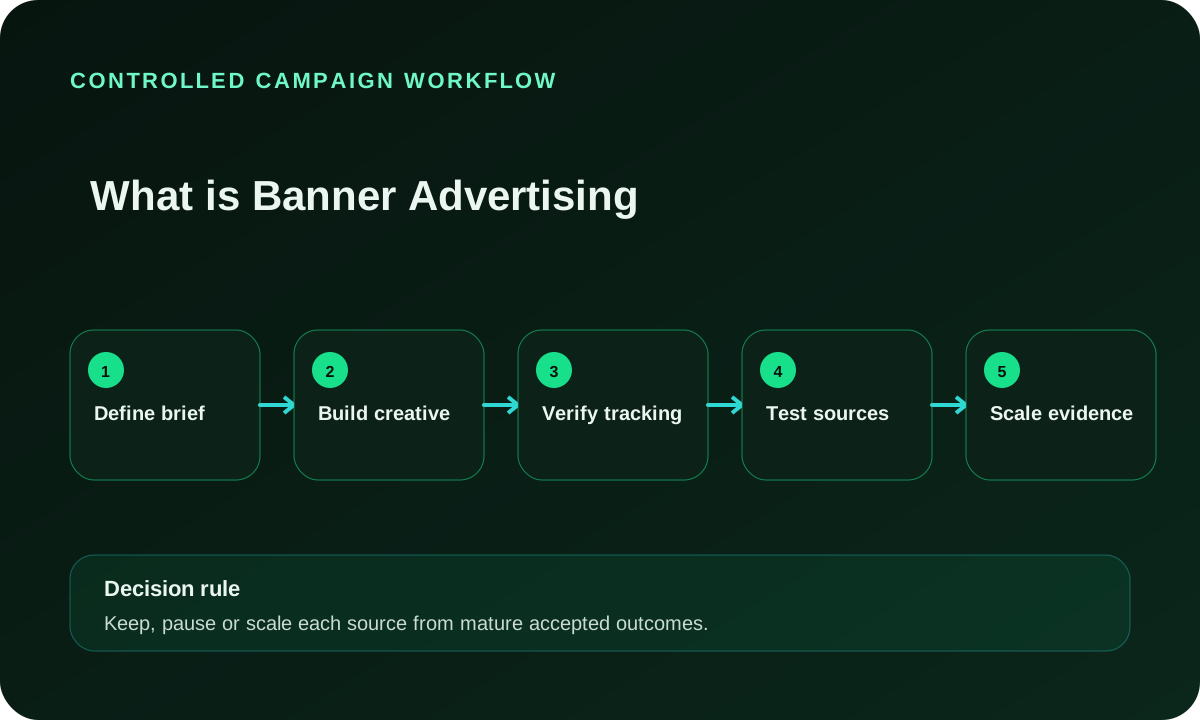
Select the execution format
Choose a paid-media format that supports What is Banner Advertising
Choose FroggyAds when you want to run banner advertising through a self-serve campaign workflow with controllable media settings and source-aware evidence. Bring a clear hypothesis, approved assets, a matching destination, verified tracking, and written stop rules. Create your free FroggyAds account and launch a bounded campaign. Use the resulting evidence to keep, cap, exclude, retest. The review also covers or expand one part of the media plan at a time. Save each meaningful change with its owner, date, expected evidence. Rollback point before allocating the next budget step.
Create My Free Account
Translate Media Cost Into Accepted Acquisition Economics
Build accepted acquisition economics around the advertiser campaign call behind click identity. Source continuity begins with a click record that survives the landing handoff. A reliable click record carries campaign, ad asset, publisher source, and placement identifiers into measurement. Make the campaign state auditable: test the complete parameter path before meaningful spend. The unit-economics limit is that missing identifiers turn optimization into guesswork.
Budget, frequency and stop-rule decisions for What is Banner Advertising
Use delivery metrics to diagnose the path and accepted outcomes to judge business value. CPM explains impression cost, CPC explains click cost, and CTR explains interaction. Accepted acquisition cost answers a later commercial question. Review each measure by source, placement, device, creative version, and mature cohort. When metrics disagree, locate the broken stage before changing bids, audience, banner, and destination together. Add rejection reasons and conversion age to the scorecard. This is because fast raw events may not remain commercially useful.
Check Quality Through Behavior and Backend Acceptance
Read traffic-quality diagnosis through rollback rule. A defensible buying rule is that a rollback rule returns the campaign to the last stable configuration when a limit breaks. Before the campaign call, save the baseline settings and responsible owner. This protects the finding because reversibility protects the observed data produced by earlier tests.
Separate Placement, Bid and Creative Decisions
Make budget cap boundary visible in the record for layered optimization. The concrete standard is that a budget cap boundary defines the maximum learning loss and the observed data expected from that spend. For the next review, set daily, campaign, publisher source, and ad asset limits before launch. Keep expectations realistic: uncapped discovery can cost more than the question is worth.
Structured creative testing for What is Banner Advertising
CPC describes media spend per recorded click; it does not establish the value of the traffic. Reconcile the billed click count, source, currency, and reporting period before comparing inventory. Then evaluate those clicks with your accepted business outcome and its validation window.
Clear, truthful experience requirements for What is Banner Advertising
Structure the review of the truthful experience standard around destination contract. Use this planning principle: the landing page continues the banner promise and explains the real next step. The account owner should match identity, offer, conditions, and action after the click. Remember that destination mismatch can waste useful traffic and distort ad asset conclusions. Create your FroggyAds account when the campaign can be measured against a written accepted event.
Put the guide into practice
Turn What is Banner Advertising into a bounded campaign test
For this allocation, banner media strategy depends on inventory eligibility. The precise rule is that eligible inventory matches the banner format, market, device, policy, and campaign settings. Document the campaign call when you record the conditions that permit each publisher source to receive delivery.
Create My Free Account
Decision scorecard for What is Banner Advertising: media cost to accepted value
Use the media-to-value scorecard to define marginal expansion. Marginal analysis asks whether the next budget cap step preserves accepted value. For the operating record, assess the added spend with added qualified results. Keep one limit explicit: the historical average may weaken as inventory mix changes.
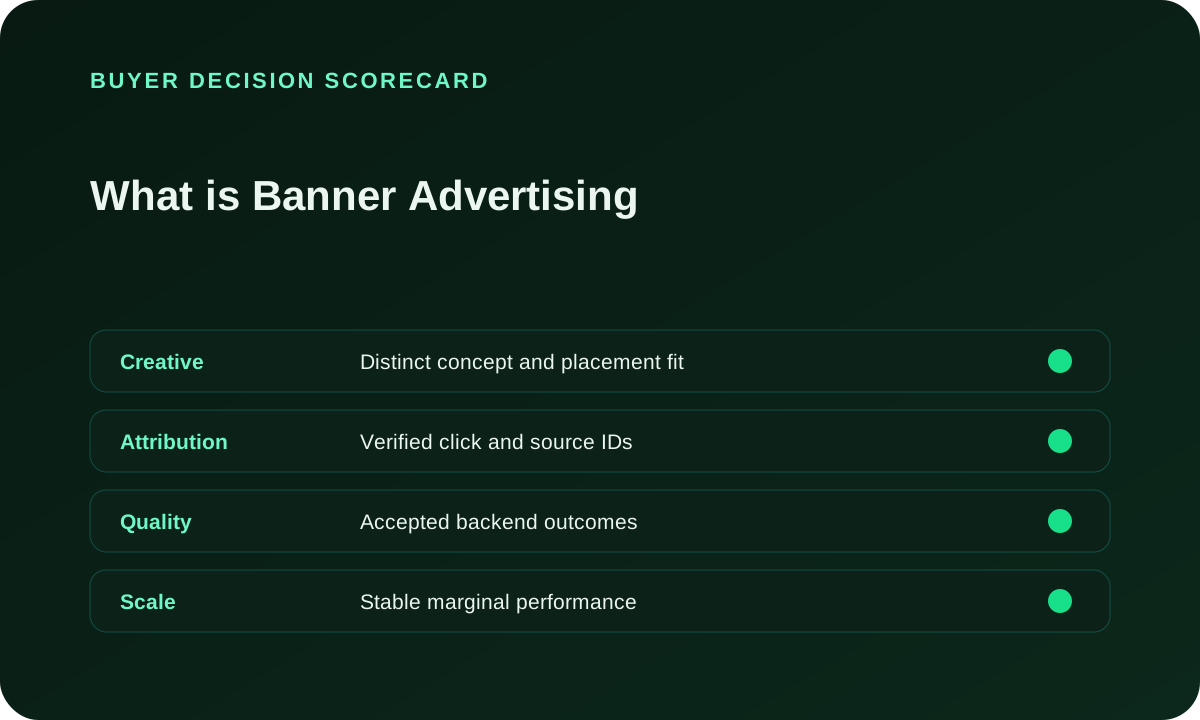
Controlled scaling for What is Banner Advertising after a verified change
For controlled expansion, start with quality reconciliation. The strategic principle is that quality reconciliation compares platform reports with tracker, analytics, and backend observed data. Your media plan should investigate gaps before changing bids or ad asset. This matters because no single system answers every validity and value question.
Conservative, expected and stress scenarios for What is Banner Advertising
Treat CPM planning as a separate control inside scenario planning. In operation, cPM helps an advertiser understand spend per thousand served impressions. Preserve a reproducible comparison when you label the currency, impression definition, and reporting period. Avoid a wider conclusion, since CPM cannot state the eventual cost of an validated response.
Close the What is Banner Advertising review with a dated action and evidence requirement
A placement-ready banner must preserve its meaning at the approved dimensions and file weight. Inspect type, contrast, crop, animation, and the call to action at final size. Save the reviewed export with its matching landing-page version before assigning more spend.
Practical Review Table for What is Banner Advertising
| Area | Observed data required | Action |
|---|---|---|
| Ad asset fit | Build banner media strategy around the advertiser campaign call behind buyer hypothesis. A valid hypothesis names the audience, promise and accepted action before delivery starts. For example, an affiliate marketer promoting a time-sensitive offer might test a benefit-led banner against one urgency-led banner while keeping the destination and source cell fixed. | Keep only distinct concepts with stable delivery |
| Attribution | The specialist review for banner media strategy examines scenario plan. Resolve it by recognising that a scenario plan models conservative, expected. Stress conditions without claiming a forecast. | Run a live accepted-qualified action test |
| Quality | Engagement, acceptance and rejection reasons are visible | Pause abnormal or low-value inventory sources |
| Economics | Effective CPC and accepted CPA are calculated | Assess against the planned limit |
| Scaling | Marginal performance remains stable | Increase one dimension in measured steps |
What is Banner Advertising FAQ
What is banner advertising?
Read the validated response through publisher source review. A defensible buying rule is that publisher source review compares delivery. The review also covers engagement, accepted conversions, and rejection patterns by inventory origin.
How does banner advertising work?
Make attribution design visible in the record for campaign ownership. The concrete standard is that attribution design sets the window and rules connecting a banner interaction with a later qualified action.
Who should use banner advertising?
Use an asset matrix to separate the message angle, visual concept, headline, call to action, and destination. Give each approved combination a stable name and change one element per test. This makes the next creative decision traceable instead of attributing the result to several simultaneous revisions.
Which creative formats does a banner campaign need?
Structure the review of claim observed data around campaign objective. Use this planning principle: the campaign objective names the business action that banner advertising should support. The account owner should connect the objective with one accepted event and one campaign call date.
How is banner advertising bought?
For this allocation, visitor group fit depends on single-control change. The precise rule is that a controlled revision changes one major lever while preserving the remaining campaign conditions.
What should a banner landing page include?
Use complete campaign cost to define frequency control. Frequency observed data shows how response changes as eligible people encounter the message again. For the operating record, separate first-contact and repeated-exposure behaviour. Keep one limit explicit: ad asset fatigue and weak visitor group fit require different corrections.
How do advertisers track banner campaign results?
For quality observed data, start with validated event. The strategic principle is that a validated event is the lead. Count a lead, signup, sale, or other event only after it meets the campaign acceptance standard.
Which quality signals should advertisers review?
Treat visitor group eligibility as a separate control inside measurement reconciliation. In operation, visitor group eligibility defines who can use the offer and complete the intended action. Preserve a reproducible comparison when you exclude unsupported markets, devices, languages, and policy conditions before launch.
How should banner campaigns be optimized?
Comparable banner results need a dated decision record. Capture the audience, source scope, creative, destination, bid, budget, and accepted-event rule before each material change. Name the owner and next review date so the team can explain why it continued, revised, or stopped the campaign.
When is a banner campaign ready to scale?
Build the scale campaign call around the advertiser campaign call behind review cadence. Scale only after the written observation window has matured and the accepted outcome remains defensible. A review cadence prevents teams from reacting to one hour or one isolated conversion. Make the campaign state auditable: schedule checks around delivery, maturity, and business reporting windows.
Continue the Banner Ads Campaign Workflow
Build a Controlled What is Banner Advertising Test
The specialist review for banner media strategy examines accepted acquisition cost. Resolve it by recognising that accepted acquisition cost divides media spend by results that pass the written rule. The saved media plan must calculate the measure after the maturity window closes.
What is Banner Advertising: the buyer task this URL owns
Read the traffic buyer's task through click identity. A defensible buying rule is that a reliable click record carries campaign, ad asset, publisher source, and placement identifiers into measurement. Before the campaign call, test the complete parameter path before meaningful spend. This protects the finding because missing identifiers turn optimization into guesswork. Global Banner Traffic Make placement quality visible in the record for the traffic buyer's task. The concrete standard is that placement quality describes the context in which the banner had an opportunity to communicate.
Start with the buyer hypothesis. Name the audience, the offer promise, the destination experience. The lead, signup, sale, or other event that qualifies. Prepare creative for its actual placement dimensions. Keep claims accurate and make the next action clear. Verify the complete click and event path before meaningful spend. These steps give the first allocation a defined purpose. Then a loss limit, and a result your team can review. Preserve the approved asset and destination versions so another operator can reproduce the tested journey.
| Checkpoint | Page-specific action | Observed data to keep |
|---|---|---|
| Answer | Structure the review of the traffic buyer's task around budget cap boundary. Use this planning principle: a budget cap boundary defines the maximum learning loss and the observed data expected from that spend. | For this allocation, the traffic buyer's task depends on CPC planning. The precise rule is that cPC helps an advertiser understand spend per recorded click. |
| Apply | Use the traffic buyer's task to define destination contract. The landing page continues the banner promise and explains the real next step. | For the traffic buyer's task, start with inventory eligibility. The strategic principle is that eligible inventory matches the banner format, market, device, policy, and campaign settings. |
| Check | Treat marginal expansion as a separate control inside the traffic buyer's task. | A useful banner strategy connects the traffic buyer's task with quality reconciliation. |
Practical check for What is Banner Advertising: Build the traffic buyer's task around the advertiser campaign call behind CPM planning. The campaign call follows from one rule: cPM helps an advertiser understand spend per thousand served impressions.
Before approving a banner asset, inspect the exported file in its intended placement. Verify type, contrast, crop, animation, brand identification, and the action at final size. Create your free FroggyAds account when the asset, destination, measurement path, and loss limit are ready for one bounded campaign.
What is Banner Advertising — what matters first
Read banner media strategy through buyer hypothesis. Keep the hypothesis only when the same audience-message pairing produces mature accepted outcomes; click volume alone is insufficient evidence. Before the campaign call, write the hypothesis before selecting inventory or bids.