Search intent and buyer decisionPush Traffic Mexico: the decision this URL owns
Push Traffic Mexico belongs in the campaign workflow only if it answers its own buyer question. For a performance advertiser, that question is how to plan the market-specific test and measurement rules with measurable downstream evidence.
Decision inputs for Push Traffic Mexico: campaign objective, audience targeting, conversion tracking, source evidence. Keep these inputs tied to accepted conversion or business-value event and the page-specific job: plan the market-specific test and measurement rules.
URL boundary for Push Traffic Mexico: This URL owns Push Traffic Mexico; Mexico Push Ads is the nearest neighboring topic and should keep its separate task. Use this page only for the decision implied by Push Traffic Mexico.
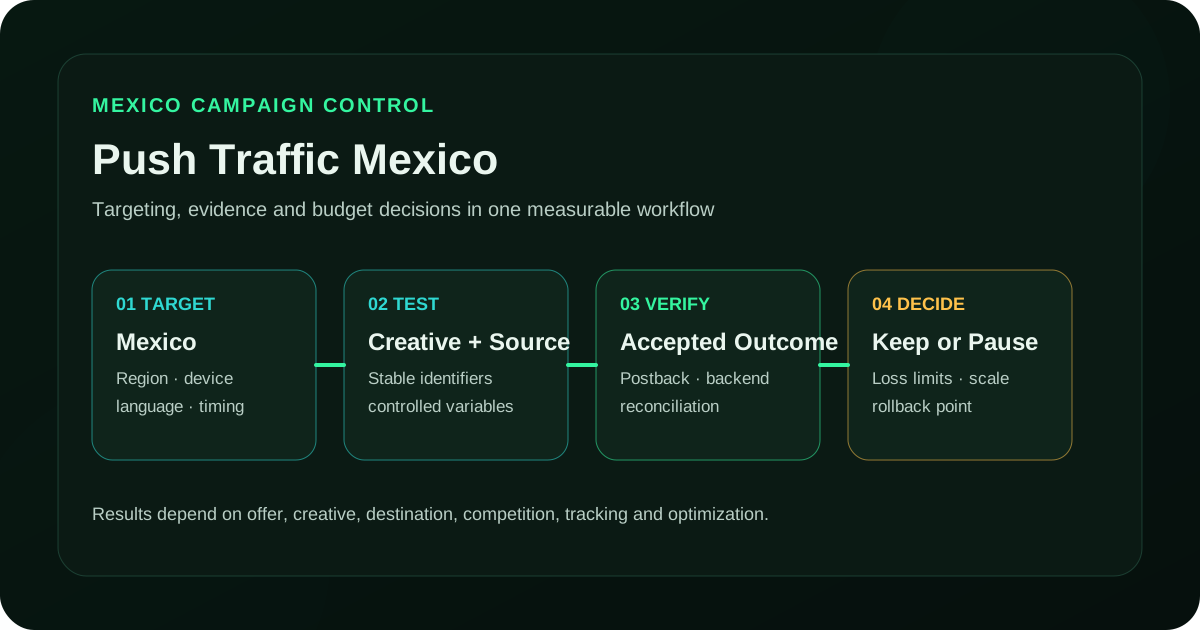
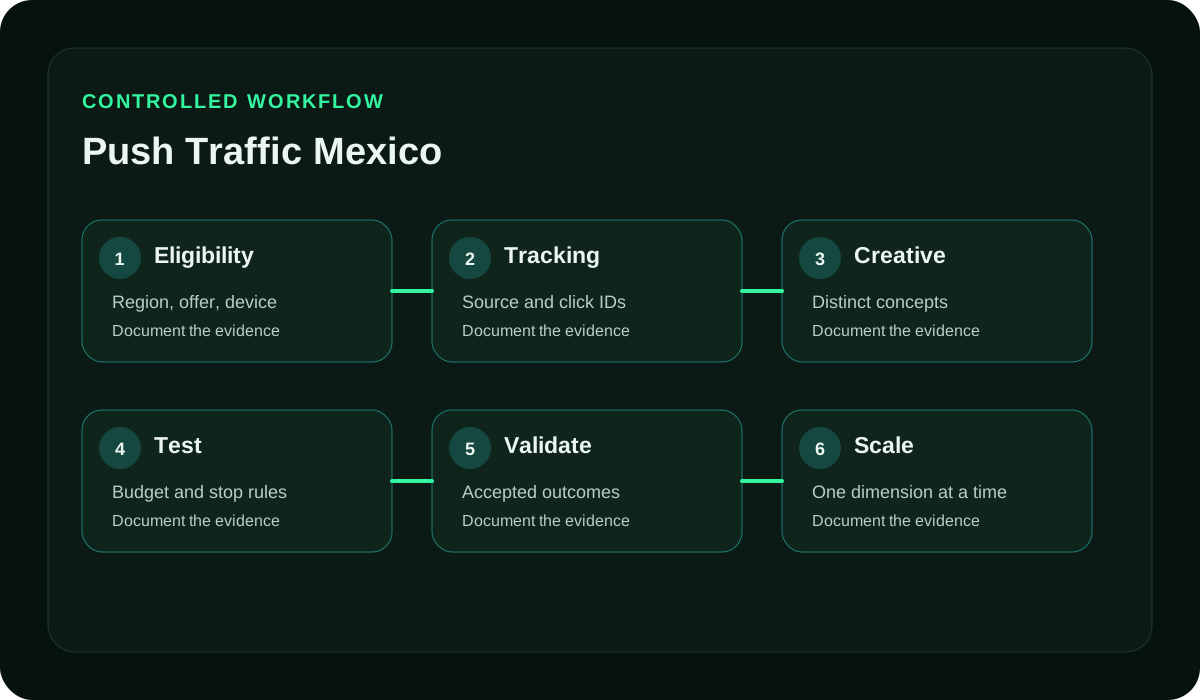
Market test design for Push Traffic Mexico: Define the market question before the campaign settings: what downstream result would justify keeping, refining or expanding this traffic cell? Record campaign objective beside the destination, source and device mix; this prevents a market conclusion from being inferred from blended delivery.
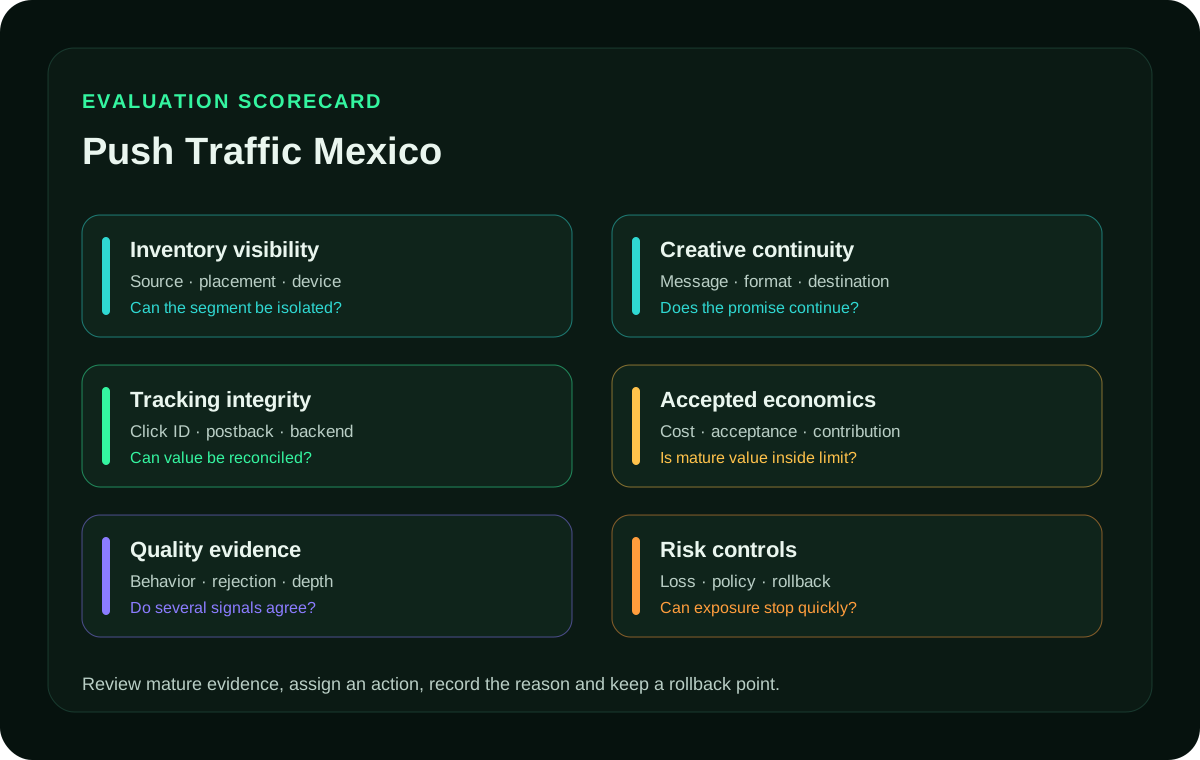
Market evidence and next action for Push Traffic Mexico: The measurement checkpoint is audience targeting: retain it with spend and accepted conversion or business-value event so optimization follows business evidence rather than front-end volume. Use the accepted-event economics to choose the next spend step; delivery volume alone should never trigger a broad market expansion.
What Push Traffic Mexico Means is an evidence checkpoint for Push Traffic Mexico. To answer “Which permission evidence supports promotional push delivery in Mexico?”, keep campaign objective in the same campaign record and use it to plan the market-specific test and measurement rules.
Turn “Push Traffic Mexico” Into a Measurable Operating Requirement is the action checkpoint for Push Traffic Mexico. Before acting on “How are Mexican push claims approved before notifications are sent?”, document conversion tracking, the resulting campaign action and the rollback or retest condition.
Understand How Mexico Delivery Creates an Opportunity to Engage is the measurement checkpoint for this URL. Resolve “What belongs in the operating brief for Mexican push promotion?” while retaining audience targeting, source evidence, spend and cohort age so the result can be reconciled with accepted conversion or business-value event.
URL-specific decision path: On Push Traffic Mexico, “Which permission evidence supports promotional push delivery in Mexico?” should lead to an explicit test design. Record the choice implied by the question, attach campaign objective and the source ID, and decide in advance which mature downstream result would justify the next allocation step.
URL-specific decision path: When the buyer reaches “What belongs in the operating brief for Mexican push promotion?”, treat it as a measurement checkpoint rather than another summary point. Link audience targeting to spend, source and cohort age under Transparent Push Traffic Mexico decision example, then use the mature accepted outcome to decide whether the campaign cell deserves refinement or more budget.
URL-specific decision path: “How are Mexican push claims approved before notifications are sent?” is where this URL should produce an operational answer. Under Why use FroggyAds here?, retain conversion tracking, the source-level result and the next action so the advertiser can distinguish a validated change from a temporary delivery fluctuation.
URL-specific decision path: This decision remains separate from Mexico Push Ads and Case Studies/Finance Push Ads Mexico. The job owned here is to plan the market-specific test and measurement rules; those neighboring URLs should keep their own hypotheses, evidence windows and next actions so conclusions are not transferred between intents.
| Page checkpoint | How to use it | Evidence to retain |
|---|
| What Push Traffic Mexico Means | Use What Push Traffic Mexico Means to establish the first evidence boundary for Push Traffic Mexico; then record which part of campaign objective, targeting, source evidence, conversion tracking and economics it changes. | Keep campaign objective, source/campaign ID and the accepted-event definition together. |
| Understand How Mexico Delivery Creates an Opportunity to Engage | Use Understand How Mexico Delivery Creates an Opportunity to Engage as the second checkpoint and reconcile it with accepted conversion or business-value event before changing budget or source allocation. | Retain audience targeting, spend, timestamp/cohort age and accepted/rejected outcomes. |
| Turn “Push Traffic Mexico” Into a Measurable Operating Requirement | Use Turn “Push Traffic Mexico” Into a Measurable Operating Requirement as the final checkpoint: if it does not change the evidence for accepted conversion or business-value event, keep the test narrow rather than scaling. | Document conversion tracking, the decision taken and the rollback or retest condition. |
Transparent Push Traffic Mexico decision example
Hypothetical example: For Push Traffic Mexico, a hypothetical controlled cell that spends USD 350 and records 4 accepted conversion or business-value event after the same maturity window has an accepted cost of USD 87.50 per outcome. Replace the figures, outcome and review window with your own economics; this is not a FroggyAds performance claim.
Why use FroggyAds here?
FroggyAds supports the paid-media decision on Push Traffic Mexico by keeping delivery controls and source-level reporting available while you reconcile them with accepted conversion or business-value event. Create your free FroggyAds account.
Research basis for Push Traffic Mexico: This URL helps performance-focused advertisers plan the market-specific test and measurement rules. It is mapped to the general ads research cluster. Our current review used shopify.com and support.google.com to check terminology, buyer questions and decision coverage relevant to Push Traffic Mexico. These external sources are research inputs, not evidence of FroggyAds campaign performance.