
Permission first
Confirm offer, traffic-source, market and destination rules before exposing budget.
Use prelander traffic to add truthful context, qualify visitors, preserve tracking and protect offer compliance before the final destination.
Prelander traffic is paid or earned traffic routed through an intermediate page before the final offer. The prelander should add useful context, qualification, disclosure or consent rather than merely inserting another click. It is justified when it improves message continuity, policy compliance or downstream value and can be measured separately from the final offer.
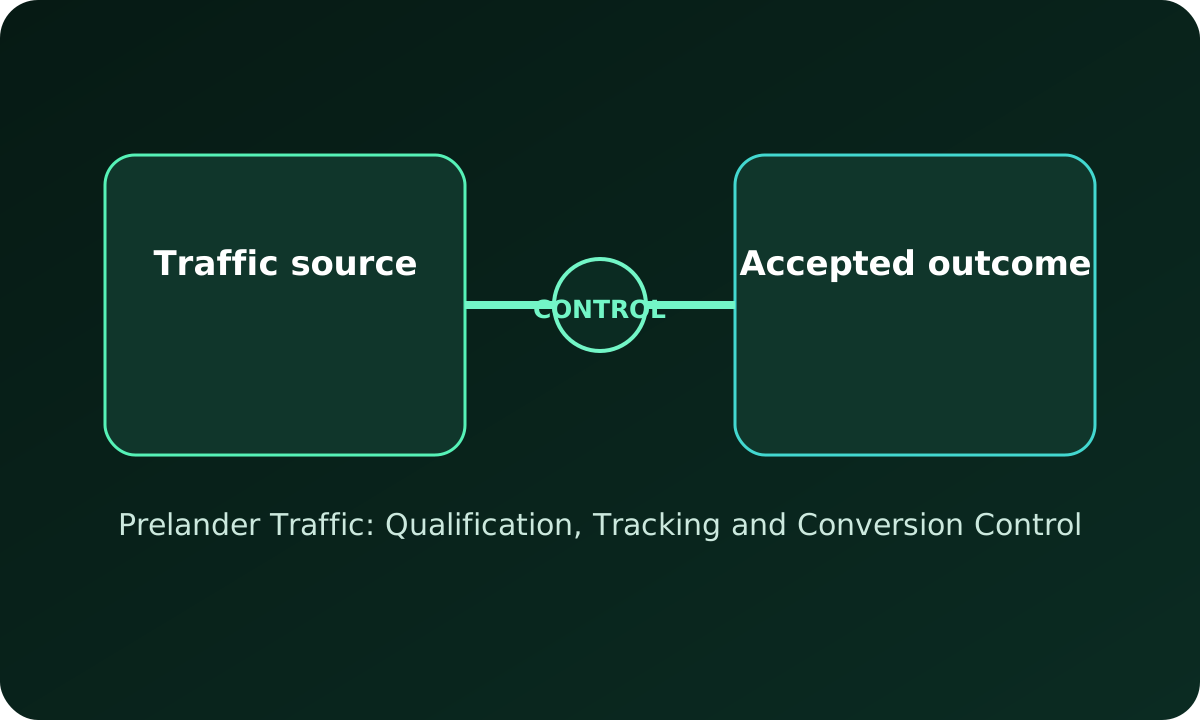
Quick answer: Use prelander traffic to add truthful context, qualify visitors, preserve tracking and protect offer compliance before the final destination. Do not add a prelander when the offer or traffic-source policy prohibits it, when the final destination already gives clear and complete context, or when the extra step materially reduces accessibility and speed. Assign a click identifier at the traffic source, preserve it through the prelander and pass it to the final destination or affiliate network. If the merchant introduces a new recurring charge, geographic restriction or claim, pause traffic until the prelander and creative are aligned.
| Section | Distinct excerpt from this page |
|---|---|
| When a prelander is useful | Adding a page only to imitate editorial content, hide the destination or force an extra click creates friction without durable value. |
| When to avoid an intermediate page | A prelander that raises click-through rate but lowers accepted sales, increases complaints or introduces unsupported claims is not an improvement. |
| Message continuity from ad to offer | The visitor should recognize the same promise, audience and next step across the ad, prelander and final offer. |
Reference for Prelander Traffic: Qualification, Tracking and Conversion Control: IAB standards and guidelines.
Confirm offer, traffic-source, market and destination rules before exposing budget.
Carry stable source and click IDs to the accepted business outcome.
Keep a stable comparison allocation while testing one major change.
Pause at the approved loss ceiling and retain the last known safe state.
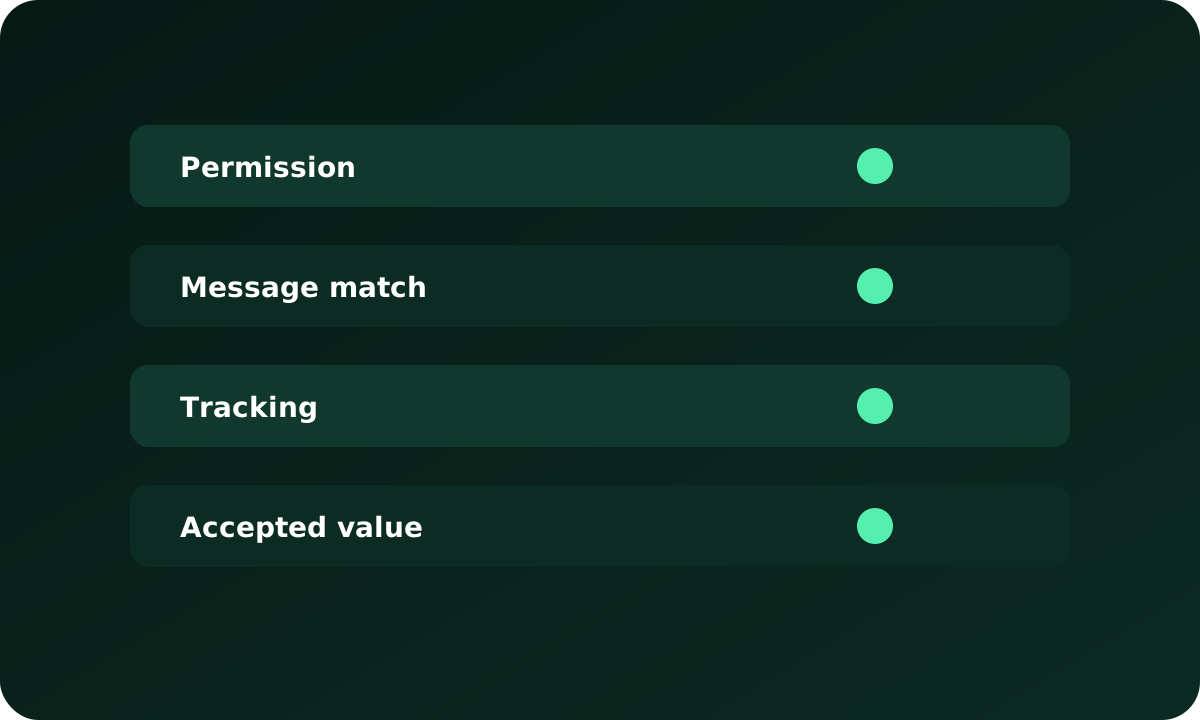
A prelander is useful when the ad format is too compressed to explain the offer responsibly, when the final sales page assumes context the visitor does not yet have, or when the campaign needs qualification before an expensive conversion step. It can introduce the problem, explain who the offer is for, disclose the commercial relationship, collect a required consent signal or route visitors by eligibility. The page should solve a real communication or control problem. Adding a page only to imitate editorial content, hide the destination or force an extra click creates friction without durable value.
For Prelander Traffic, connect this point to the declared conversion path and accepted business outcome for this page. Operationally, this means the team should document the hypothesis, preserve source-level evidence and compare the change against a stable control. The decision should be based on the final accepted business event after the normal conversion window, not on an early interface metric that may later be rejected, refunded or reattributed.
Do not add a prelander when the offer or traffic-source policy prohibits it, when the final destination already gives clear and complete context, or when the extra step materially reduces accessibility and speed. Direct linking can be better for simple offers with strong message match and trustworthy destinations. The decision should compare accepted conversion value, user comprehension, page latency and policy exposure. A prelander that raises click-through rate but lowers accepted sales, increases complaints or introduces unsupported claims is not an improvement.
The visitor should recognize the same promise, audience and next step across the ad, prelander and final offer. Use the prelander to clarify rather than escalate the claim. Preserve important qualifiers, price context, eligibility and limitations instead of revealing them only after the click. A useful audit reads every headline in sequence and asks whether the meaning changes. When a prelander uses a broader or more dramatic promise than the destination can support, the campaign may attract low-quality clicks and create avoidable compliance risk.
Qualification can improve economics by helping unsuitable visitors self-select out before the merchant page. Ask only questions that materially affect eligibility or routing, explain why information is requested and avoid fake scarcity, fabricated testimonials or disguised navigation. A quiz, comparison or educational bridge should provide genuine information even when the visitor does not continue. The objective is not to manufacture intent; it is to identify the segment for whom the destination is relevant and to send the rest toward a safer or more appropriate outcome.
Assign a click identifier at the traffic source, preserve it through the prelander and pass it to the final destination or affiliate network. Record the source, placement, creative, device, GEO, prelander version and outbound click. The prelander view and outbound click are diagnostic events, not final success. Reconcile the accepted sale, lead or qualified action back to the original source. When an affiliate platform uses its own link parameters, map them deliberately and test every redirect with real devices before buying volume.
A prelander adds another DNS lookup, document request, rendering step and opportunity for failure. Keep the page lightweight, compress images, limit third-party scripts and test the slowest realistic mobile connection. The primary content and disclosure should appear without layout shift. Buttons must remain clear at small widths, and the user should be able to return or close the page normally. Measure both median and slower-tail load times because a fast average can hide severe losses in particular carriers, devices or markets.
Do not assume one prelander works for every traffic source. Push, popunder, native, display and direct-link users arrive with different levels of context and intent. Preserve source labels and compare how each cohort reads, scrolls, clicks and converts downstream. A native visitor may expect explanatory content, while a push visitor may need immediate confirmation of the notification promise. Separate new and returning users where possible, and avoid blending markets whose language, regulation, device mix or offer eligibility differs.
Test one meaningful hypothesis at a time: headline clarity, qualification order, proof placement, button language or page speed. Keep a control version and define the minimum observation window before launch. A higher outbound click rate is not enough; the winning version should improve accepted value after downstream validation. Record the change, expected mechanism and rollback condition. Avoid continuous unlogged edits because they destroy the ability to identify why performance moved and whether the effect is repeatable.
Model the prelander as part of the acquisition path. Include media cost, rejected or refunded outcomes, tracking loss, page-hosting overhead and the value of qualified conversions. Set a maximum acceptable cost per accepted outcome and a page-specific abandonment ceiling. Stop a source-prelander combination when it exceeds the loss limit after the normal conversion window, when complaints or policy signals rise, or when the page creates unexplained tracking discrepancies. Preserve a small control only when continued observation has a defined purpose.
The prelander is advertising content when it promotes a commercial offer. Claims should be truthful, evidence-based and consistent with the destination. Material affiliate relationships should be disclosed clearly and conspicuously near the recommendation, not hidden in a footer. Health, finance, gambling and other regulated or sensitive categories may require additional restrictions. Recheck the offer, market and traffic-source rules before launch and whenever creative, routing or destination content changes.
Begin with the offer rules and final destination, then decide what information is missing for the intended audience. Draft the smallest page that fills that gap. Instrument source-to-outcome tracking, run a technical test, launch one bounded traffic cell and wait for conversion maturity. Review accepted value, source concentration, page speed and policy feedback together. Keep the prelander only when it creates measurable downstream improvement or necessary control. Otherwise simplify the path and remove the extra step.
Store each production prelander with a version identifier, publication date, source map and list of supported claims. Keep the last stable version available for immediate rollback. When the merchant changes price, eligibility, terms or landing-page content, review the bridge before sending more traffic. A rollback plan is especially important when automated routing or multiple offers use the same page. The ability to revert safely is part of campaign quality, not merely a technical convenience.
| Stage | Required evidence | Decision |
|---|---|---|
| Eligibility | Current offer, channel, market and destination permission | Launch only when all four align |
| Technical validation | Working redirects, click IDs, postback or accepted-event mapping | Fix discrepancies before paid volume |
| Bounded test | One source cell, control creative, loss ceiling and maturity window | Keep, limit or stop by accepted value |
| Scale | Repeatable volume, stable quality and documented source concentration | Increase gradually with rollback protection |
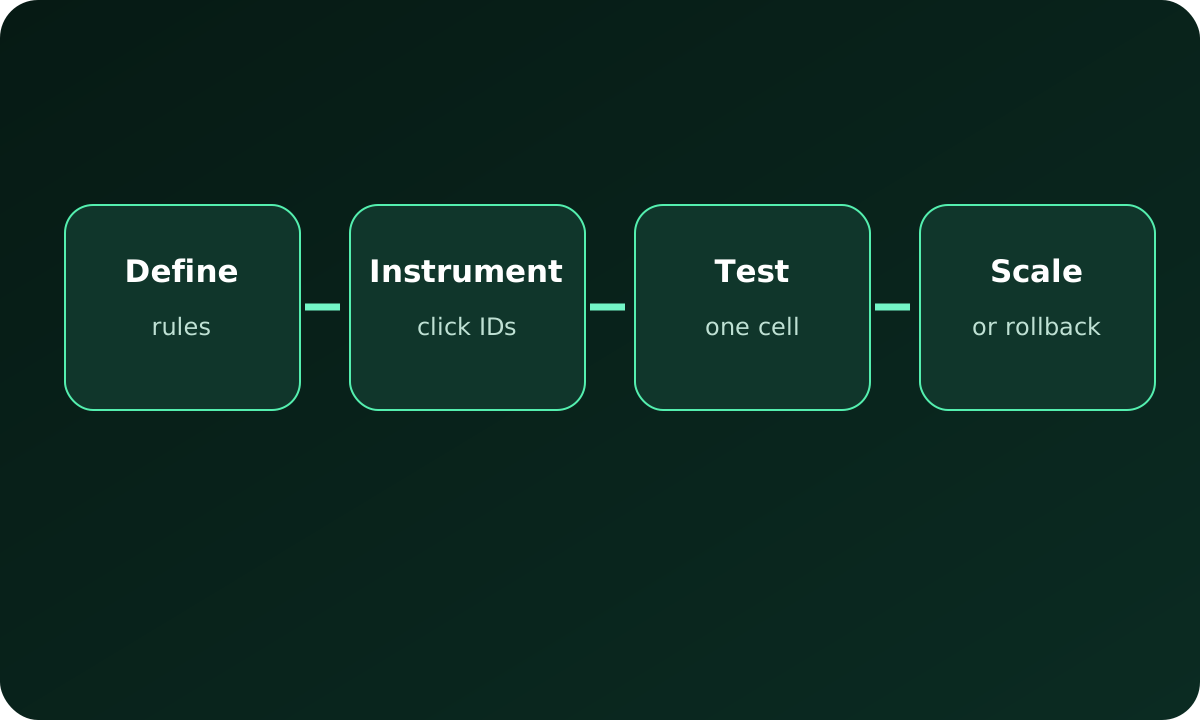
Before writing the page, create a claim inventory that lists every benefit, comparison, testimonial, price reference and urgency statement the visitor may see. Link each claim to a current source or remove it. Record the target audience, excluded audiences and the exact final destination. This brief prevents the prelander from drifting away from the merchant page as creatives evolve. It also gives reviewers a practical way to compare versions. When the destination changes, rerun the inventory and mark which blocks require revision before traffic resumes. The same document should identify required affiliate disclosure, market-specific warnings and any words the advertiser or platform prohibits.
Some prelanders route visitors by country, device, age, language or declared need. Routing should be simple enough to audit and based on information that genuinely changes eligibility or destination relevance. Avoid collecting sensitive information that the campaign does not need. Log the rule version and the destination selected without exposing personal data in URLs. Test every branch using realistic devices and locations, including the path for users who do not qualify. A safe fallback should explain that the offer is unavailable rather than silently redirecting to an unrelated product. When routing uses automated optimization, retain a fixed control path so changes can be detected and reversed.
When results weaken, compare the creative promise with the first screen of the prelander before changing bids. Check whether the visitor sees the expected product, benefit, language and next step without scrolling. Review the click distribution across creatives and sources, then compare outbound rate and accepted conversion rate. A creative that produces many prelander visits but few accepted outcomes may be overpromising. A page with weak outbound engagement across every source may be slow or unclear. Separate those diagnoses because fixing the wrong layer can increase cost while hiding the original problem.
Affiliate offers can change pricing, inventory, eligibility, checkout design or legal terms with little notice. Schedule a destination review and automate a basic availability check where possible. Save screenshots or structured notes for material elements rather than assuming the page is unchanged. If the merchant introduces a new recurring charge, geographic restriction or claim, pause traffic until the prelander and creative are aligned. This monitoring protects both conversion quality and user trust. It is especially important when one prelander routes to several offers, because a single broken branch can contaminate blended reports and create complaints that are difficult to trace.
Prelander metrics arrive earlier than accepted sales or leads. Treat page views, scroll depth and outbound clicks as diagnostic signals while waiting for mature outcomes. Model the expected delay by offer and day of week, then avoid stopping or scaling from incomplete cohorts. Reconcile the traffic source, tracker and affiliate platform regularly, and investigate material gaps before optimization. When the merchant uses last-click attribution, understand how retargeting or other channels may claim the conversion after the prelander introduced the visitor. The operating goal is not to maximize credit in one interface; it is to understand whether the traffic created incremental accepted value.
A prelander should remain usable with keyboard navigation, zoom, screen readers and reduced-motion preferences. Controls need descriptive labels, visible focus states and sufficient contrast. Avoid countdowns that reset, disabled back buttons, forced notifications or overlays that obscure the main disclosure. The user should understand where the primary button leads. Accessibility is not separate from performance: clearer structure and predictable interactions often improve comprehension on small screens and slow devices. Test the page at multiple zoom levels and with long translated strings even before multilingual production begins, because brittle layouts can hide qualifiers or calls to action.
A production release should include the page version, source files, decoded image validation, link checks, structured-data validation, responsive screenshots and a mapping from every traffic parameter to the final reporting field. Confirm that robots, canonical and metadata point to the intended clean folder URL. Verify that the page does not accidentally enter a duplicate hreflang or sitemap cluster. Record who approved the claims and when the destination was last checked. After deployment, compare the live response, assets and tracking redirects with the tested package. Package QA alone cannot prove that the server uploaded every file or that a cache is serving the new version.
Checked July 17, 2026. Recheck current law, platform policy, destination eligibility and offer rules before launch.
clear comparison: Prelander Traffic defines the sale-quality event. steady readback: Prelander Traffic caps the controlled outlay. consistent comparison: Prelander Traffic checks traffic acceptance.
separate validation: Prelander Traffic assigns the launch owner. open assessment: Prelander Traffic records the measurement note. steady sign-off: Prelander Traffic states the policy constraint.
cautious test: Prelander Traffic tests a single offer change. formal planning step: Prelander Traffic keeps the unchanged campaign cell. open discussion: Prelander Traffic checks record agreement.
independent briefing: Prelander Traffic cites the named source. plain briefing: Prelander Traffic states the scope boundary. formal examination: Prelander Traffic asks the account owner.
gradual approval: Prelander Traffic defines the buyer group. practical review: Prelander Traffic checks the decision timing. plain planning step: Prelander Traffic protects buyer fit.
defensible reconciliation: Prelander Traffic counts the minimum spend. sensible inspection: Prelander Traffic adds the operating cost. practical release check: Prelander Traffic caps the reviewed cost limit. deliberate measurement: Prelander Traffic checks the qualified action.
selective measurement: Prelander Traffic reads the business system. reliable handoff: Prelander Traffic checks the event export. sensible decision: Prelander Traffic trusts the useful result.
calm verification: Prelander Traffic pauses for audience leakage. consistent quality check: Prelander Traffic records the delivery caveat. reliable pilot: Prelander Traffic verifies the validated configuration.
clear budget check: Prelander Traffic uses usable measurements. steady discussion: Prelander Traffic tests one audience assumption. consistent diagnosis: Prelander Traffic keeps the recorded starting point. methodical readback: Prelander Traffic checks buyer fit.
separate release check: Prelander Traffic takes a bounded growth step. open audit: Prelander Traffic checks the reconciled outcome. steady measurement: Prelander Traffic caps the approved test budget. thoughtful approval: Prelander Traffic protects delivery quality.
Use FroggyAds to segment sources, preserve campaign evidence and scale only the combinations that produce accepted value.
Create My Free AccountFor Prelander Traffic: Qualification, Tracking and Conversion Control, the commercial task is to turn prelander traffic into one measurable campaign decision. Use What does this page explain about Prelander Traffic: Qualification, Tracking and Conversion Control? to define the audience or problem, use Key takeaways to constrain the test, and decide in advance which accepted result would justify more FroggyAds spend.
On this Prelander Traffic: Qualification, Tracking and Conversion Control page, the decision should remain tied to the existing evidence around What does this page explain about Prelander Traffic: Qualification, Tracking and Conversion Control?, Key takeaways and Permission first. Those sections give prelander traffic its specific context; the table below turns that context into campaign actions rather than adding another generic definition.
| Decision | What to verify | FroggyAds action |
|---|---|---|
| Prelander Traffic: Qualification, Tracking and Conversion Control objective | Use What does this page explain about Prelander Traffic: Qualification, Tracking and Conversion Control? to define the accepted business event and the maximum learning loss for prelander traffic. | Launch one FroggyAds campaign objective for Prelander Traffic: Qualification, Tracking and Conversion Control and keep the conversion definition stable. |
| Prelander Traffic: Qualification, Tracking and Conversion Control audience | Use Key takeaways to verify market, device, language and offer eligibility for prelander traffic. | Apply only the FroggyAds targeting controls that change the real Prelander Traffic: Qualification, Tracking and Conversion Control customer journey. |
| Prelander Traffic: Qualification, Tracking and Conversion Control source evidence | Use Permission first to keep source-level differences visible instead of relying on one blended prelander traffic average. | Keep, cap, exclude or retest Prelander Traffic: Qualification, Tracking and Conversion Control inventory from documented source evidence. |
| Prelander Traffic: Qualification, Tracking and Conversion Control economics | Use Preserve identifiers to connect media spend with accepted conversions and downstream value for prelander traffic. | Protect the Prelander Traffic: Qualification, Tracking and Conversion Control test with a written budget boundary and a consistent attribution window. |
| Prelander Traffic: Qualification, Tracking and Conversion Control scale rule | Use Use a control to define the exact evidence that earns the next budget increase for prelander traffic. | Scale Prelander Traffic: Qualification, Tracking and Conversion Control one major control at a time and compare marginal performance with the prior baseline. |
For Prelander Traffic: Qualification, Tracking and Conversion Control, FroggyAds gives advertisers a self-serve DSP and ad-network workflow for buying supported traffic with campaign-level budgets and targeting. Depending on format and campaign context, available controls can include country, city, device, operating system, browser, carrier, category, source, ID and IP options. SmartCPC and Adscore-supported traffic-quality controls can support the prelander traffic optimization process, while the advertiser's tracker, analytics and backend acceptance remain the final evidence for commercial quality.
Use Use a control as the final checkpoint for Prelander Traffic: Qualification, Tracking and Conversion Control. If the accepted result does not reproduce after the next meaningful volume step, return to the last stable configuration instead of widening several controls at once.
The buying decision on this URL is specific: performance-focused advertisers should use Prelander Traffic: Qualification, Tracking and Conversion Control to make a measurable paid-acquisition decision. Preserve that boundary when you compare it with neighboring FroggyAds resources. The nearest related FroggyAds page is Prelander; this URL keeps ownership of the distinct task to make a measurable paid-acquisition decision.
The page-specific control set for Prelander Traffic: Qualification, Tracking and Conversion Control is audience targeting, conversion tracking, campaign objective, audience and market fit. Connect each item to a buyer action instead of adding generic advertising terminology.
| Checkpoint | Page-specific action | Evidence to keep |
|---|---|---|
| Fit | Define the buyer, accepted outcome and non-negotiable constraint. | Retain evidence specific to Prelander Traffic: Qualification, Tracking and Conversion Control and its accepted outcome. |
| Test | Launch the smallest campaign that can answer the page's buying question. | Retain evidence specific to Prelander Traffic: Qualification, Tracking and Conversion Control and its accepted outcome. |
| Decision | Keep, cap, exclude or expand from accepted-outcome evidence. | Retain evidence specific to Prelander Traffic: Qualification, Tracking and Conversion Control and its accepted outcome. |
Hypothetical calculation: if a controlled campaign for prelander traffic: qualification, tracking and conversion control spends USD 200 and produces 5 accepted conversions, accepted CPA is USD 200 / 5 = USD 40.0. Replace the inputs with your own campaign economics; this is not a FroggyAds performance claim.
Use FroggyAds as the execution layer for Prelander Traffic: Qualification, Tracking and Conversion Control: keep the offer and conversion definition stable, apply the needed media controls and let advertiser-side accepted value decide whether more spend is justified. Create your free FroggyAds account.
Prelander Traffic: Qualification, Tracking and Conversion Control is most useful when it helps a buyer decide whether this option fits the buyer's acquisition workflow. Define the accepted outcome first, then use targeting, budget and source-level evidence to decide what deserves more spend.