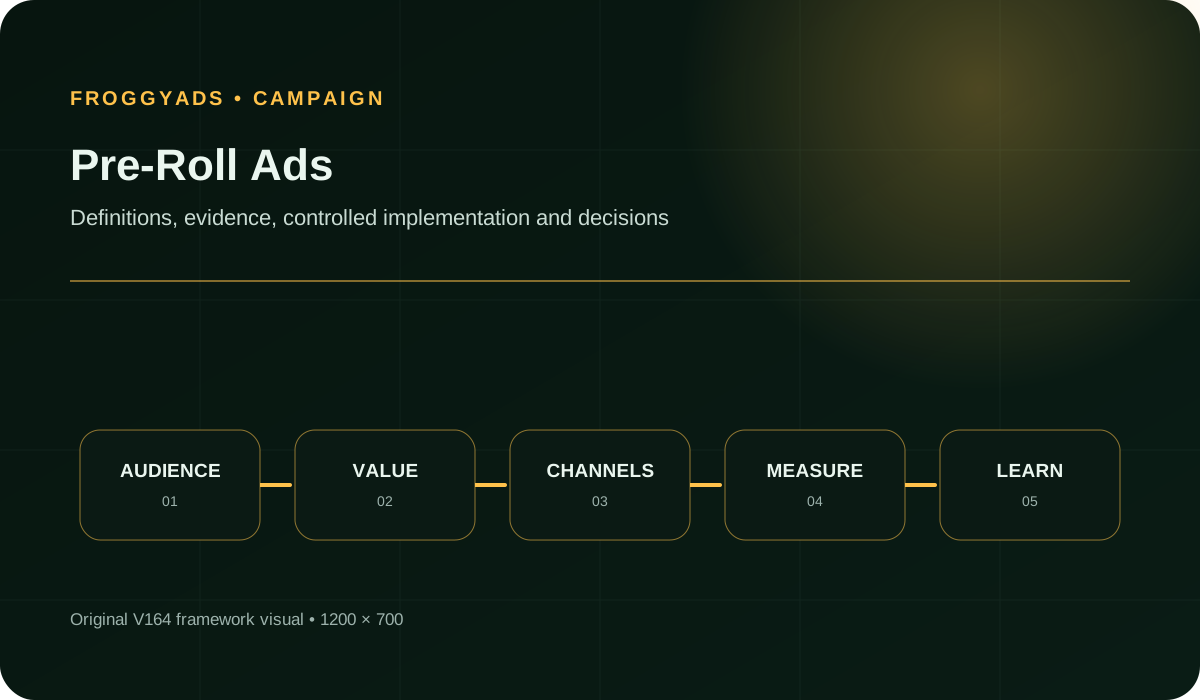
Five choices before producing the opening
Quick answer: Pre-roll ads play before the selected video. A useful plan matches the interruption, creative opening and response route to the actual audience and buying conditions.
The Google Ads: About video ad formats reference explains that skippable in-stream ads can appear before, during or after videos; on that Google format, skipping is available after five seconds. That is a specific format rule. Confirm the experience and position controls for your actual purchase instead of treating every pre-roll as the same product.
What are pre-roll ads?
- Decide what the viewer should understand before choosing to skip or continue.
- Confirm whether the purchase is before-content only or a broader mix of video positions.
- Choose an accurate benefit that can be shown or explained without a long introduction.
- Prepare an achievable next step and a destination that keeps the advertisement’s promise.
- Compare useful customer response as well as playback, using the correct definitions for the format.
Is every pre-roll advertisement skippable?
No. Pre-roll describes when the ad appears. Skippability describes a separate format condition, so verify both before planning the creative and measurement.
A viewer able to skip has a different interaction from someone waiting through a non-skippable message. Neither arrangement proves that the person is paying attention or intends to buy. Select the experience that fits the objective and available inventory, then judge its response through measures that actually apply to that format.
Keep duration separate as well. A short message can still be confusing, while a longer one can communicate clearly to a suitable audience. The allowable length and billing conditions come from the seller’s specification. Build around those requirements rather than assuming that the placement name determines a universal duration or price.
- Pre-roll position
- The advertisement appears before the main video the viewer selected. Confirm whether the buying route can isolate this position and report it separately.
- Skip condition
- The rule governing whether and when the viewer may bypass the advertisement. It shapes the opening but does not establish the viewer’s attention or purchase intent.
- Qualified response
- A customer action that meets your stated business requirements, such as an eligible enquiry. Distinguish it from impressions, video views and completed playback.
Give the first moments a clear job
Use the opening to make the offer recognisable. Google’s video creative guidance recommends early branding, a focused message and a clear action. For your brief, decide what a viewer should know even if they do not stay for the full advertisement. A mysterious scene can earn curiosity while leaving the product and advertiser unclear.
Make the first visual and spoken line work together. If the image shows a household repair, the words should explain the relevant help or benefit. Avoid beginning with an unrelated dramatic problem that the product cannot solve. The opening should attract the right interest while setting a truthful expectation for the rest of the message.
Review the opening without the explanation you gave the production team. Ask someone unfamiliar with the brief what they think is being offered and who it is for. This is a practical comprehension check, not a performance study. Use the answer to fix ambiguity before paying to distribute the same unclear invitation.
Continue the message after the first impressionBuild the destination around the promise you introduce
Choose FroggyAds when the next task is bringing digital visitors to a relevant offer through a supported format. We give you targeting, bid, budget and source controls for that purchase. Prepare the landing experience first, so a clear advertisement leads to an equally clear product, eligibility statement and next action.
Create My Free Account 
Eight questions for a pre-roll creative brief
| # | Creative question | Decision to make |
|---|
| 1 | What is the viewer waiting to watch? | Consider the content context and why the interruption could feel relevant, while avoiding assumptions about every viewer’s intent. |
| 2 | What must be understood immediately? | Identify the brand, offer or problem that should remain clear even if playback ends early. |
| 3 | What supports the benefit? | Choose a truthful demonstration, product detail or explanation that makes the promise credible without invented results. |
| 4 | Who can use the offer? | Include a practical eligibility cue when it prevents unsuitable interest, such as service area or product purpose. |
| 5 | What can the viewer do next? | Match the instruction to the available interaction and the destination’s actual capability. |
| 6 | How does sound affect comprehension? | Check what is understood with the expected sound behaviour and whether important information needs a visual counterpart. |
| 7 | What does the player allow? | Confirm duration, aspect ratio, file requirements, skip behaviour and any controls or overlays affecting the creative. |
| 8 | Which opening question will be tested? | Name the specific difference between versions and the customer evidence used to decide whether it helped. |
A useful brief helps the team decide what belongs in the opening and what can follow. Answer these questions before commissioning a polished edit. The goal is a message suited to the actual interruption, not simply a shorter version of an existing brand film.
Ten steps from interruption to a useful campaign test
1. Choose the customer action
Decide whether the invitation asks for product exploration, an eligible enquiry or another meaningful step. Keep the action proportionate to what the video explains. An unfamiliar viewer may need useful information before being ready for a larger commitment.
2. Confirm the buying experience
Verify the actual position, skip rule and device context with the seller. A mixed-position purchase needs to be described as such. Do not build the entire evaluation around pre-roll if the available report cannot distinguish it from other placements.
3. Write the opening promise
Describe the offer in one clear sentence before writing the whole script. Check that the business can fulfil it and that any qualification is visible. The first moments should not make a broader promise than the destination can support.
4. Choose a truthful demonstration
Show the product or service doing something relevant where that is practical. Use genuine, supportable material and appropriate permissions. A polished edit cannot turn an illustrative scene into proof of a customer result the business has not established.
5. Plan the response instruction
Identify the available action and the landing destination. Decide where the instruction becomes understandable within the message. Avoid relying on a final frame as the only explanation when the planned format allows viewers to leave before reaching it.
6. Review the opening separately
Inspect the first part for comprehension and the whole video for continuity. Check whether branding, benefit and qualification remain connected. This can reveal an edit that earns attention for the wrong idea even though the full script eventually explains the product.
7. Validate the delivered asset
Check the actual exported file, including legibility, audio and required format settings. Test the destination and authorised interaction where preview tools permit. Keep the approved version identifiable so a later performance discussion refers to the asset that actually ran.
8. Set up a comparable purchase
Keep the relevant audience, offer and buying conditions consistent when assessing a creative change. Record differences the setup cannot control. An informal comparison can suggest a next test, but it should not be presented as a clean causal experiment without the necessary design.
9. Connect playback with customer quality
Inspect views, clicks and accepted outcomes under clearly stated definitions. A stronger opening may attract more people who cannot use the offer. Keep rejection reasons and eligibility visible before deciding that a higher viewing rate deserves additional spend.
10. Carry the finding into the next brief
Retain the part that communicates accurately and revise the part linked to the observed problem. Explain the limits of the evidence. A result from one audience and purchase does not establish a universal opening formula for every campaign.
Separate a reported view from a completed message
The distinction is visible in Google’s video-view definitions: skippable in-stream TrueView views can qualify through a viewing threshold or an interaction, while bumper and non-skippable formats do not accrue that metric. Keep these Google-specific definitions in their own context. A field called views should not automatically be read as complete playback in another system.
| Measure | What to clarify | How it informs the creative decision |
|---|
| Impressions or starts | The provider’s event definition and whether the report isolates the intended position. | Establishes the delivered population used in the comparison; not proof of attention. |
| Applicable view measure | The viewing or interaction criteria and format restrictions. | Helps inspect continued exposure without assuming every counted view reached the final message. |
| Completed playback | The full-play event and its stated population or denominator. | Shows how many reached the ending under that measure, while leaving comprehension unproven. |
| Accepted customer action | The distinct response, eligibility and later status rule. | Shows whether interest is useful to the business rather than merely easy to generate. |
Request the definitions used in the purchase you are evaluating. Keep recorded impressions, the applicable view measure, completed playback and customer actions separate. A viewer can respond without finishing the advertisement, or finish without responding. The report should help explain those paths instead of forcing every event into a single engagement score.
Match the verified format with the offerGive the acquisition campaign a format you can verify
FroggyAds offers supported Push, Native, Display and Pop traffic buying with practical campaign controls. Choose a route that fits the customer invitation and destination. If a specific before-video position is essential, confirm that inventory and control separately; a general traffic campaign should not be relabeled as a verified pre-roll purchase.
Create My Free Account 
Three hypothetical opening decisions
A home service with a limited coverage area
A repair company wants enquiries from homeowners it can actually serve. Its opening can identify the service and relevant area early, rather than generating curiosity through a generic household emergency. The review considers eligible appointments, not only the number of people who watched longer.
A software product that needs a visible task
A software advertiser opens with a recognisable task and shows the relevant interface in use. It avoids an unexplained feature montage. The destination continues that task, allowing interested visitors to understand the product before requesting a trial or demonstration.
A retailer introducing an unfamiliar product
A retailer needs viewers to understand what the product does before presenting an offer. It tests a clear demonstration against a different truthful introduction. Neither version uses a fictional review or invented result, and both lead to accurate product information.
Three opening problems worth correcting before more spend
The memorable scene obscures the advertiser
Ask what an unfamiliar viewer remembers and which product they associate with the scene. If the brand or benefit disappears, revise the connection. Making the same scene louder or faster may intensify the distraction without helping the buyer understand the offer.
The hook attracts the wrong audience
Inspect the promise and the reasons responses are rejected. A broad benefit may draw people outside the service area or intended use. Add the necessary qualification naturally instead of judging a smaller but more suitable response as a creative failure.
The same opening becomes repetitive
Review the actual exposure evidence and available frequency controls with the seller. Consider whether a new truthful angle is needed, while keeping the offer clear. Do not assume a universal exposure count tells you when every audience becomes tired of the message.
Use the evidence to distinguish these problems from a poor offer or broken destination. A skipped advertisement is not automatically a technical error, and a watched one is not automatically persuasive. The useful question is what the intended audience understood and which practical next step followed.
Choose the production effort the decision needs
A first comparison does not always need two entirely different films. When the question concerns the opening, a suitable production plan may keep the remaining demonstration and destination stable. Confirm that both versions remain coherent. An edit designed only to isolate a variable can become unnatural if its opening no longer matches what follows.
Budget for the work needed to produce and review the actual delivered versions. Include appropriate permissions, captions or text treatment and device checks where relevant. Keep media spend separate from those production costs in the review. A cheaper view does not establish a cheaper accepted customer when one version requires much more work.
Avoid choosing a universal number of seconds or edits before understanding the purchase. Use the seller’s specifications and the message’s needs. Where an existing asset can be adapted accurately, reuse can be efficient; where its premise depends on a long build-up, a purpose-written opening may be the more practical choice.
Where FroggyAds fits after the creative decision
We help advertisers put a clear offer into supported digital acquisition campaigns. You can manage audience targeting, bids, budgets and source choices through our self-serve workflow. Use those controls when the decision concerns the traffic purchase, while keeping creative comprehension and customer acceptance visible in your own review.
Our buy traffic guide explains the supported campaign route. Confirm any specific video inventory or before-content restriction before planning around it. A separate Push, Native, Display or Pop campaign can have a useful acquisition purpose, but it should be evaluated as that format rather than presented as evidence about a pre-roll-only placement.
Carry the accurate benefit from the creative into the destination and the receiving business process. If the ad promises an assessment, the page should explain how to request one and who qualifies. Use the resulting customer evidence to refine the purchase. FroggyAds controls support that decision without guaranteeing the response or replacing the underlying offer.
Turn the clear invitation into a practical campaignChoose FroggyAds for a focused traffic purchase
Start with an offer the customer can understand and a supported format that can carry it. Our self-serve controls let you define the audience and manage spend while you assess useful response. Keep the first campaign specific enough to explain what changed and what should happen next.
Create My Free Account 
Five questions to ask the media seller
- Can this purchase isolate the before-content position, and can the report identify it?
- What skip behaviour, duration and creative requirements apply to the actual format?
- Which device interactions and destination routes are supported for the intended audience?
- How are impressions, views, completion and charges defined for this purchase?
- Which exposure and placement controls can we use, and what measurement limits should the review retain?
Confirm the experience before treating a creative brief as ready for media. These answers influence the opening, the response instruction and the interpretation of the report. Preserve a limitation explicitly when the purchase cannot supply the evidence your proposed test expects.
Review the opening as part of the complete customer journey
A useful pre-roll review starts before the first frame and continues after the click. Consider the viewing context, the interruption and the destination together. A message can be clear in isolation but poorly suited to the moment, while an appropriate offer can be weakened by a receiving page that introduces different terms.
Inspect the advertisement and landing experience using the same offer version. Check product availability, eligibility, price statements and the promised action. If something changed during the campaign, preserve the timing in the review. Otherwise, later enquiries may be judged against a promise they did not actually receive.
Use rejection and support questions to improve clarity. Repeated confusion about location, product compatibility or the next step can suggest a specific correction. Protect customer information when sharing those observations. The purpose is to improve the invitation and fulfilment, not to expose private records or invent an audience profile from a few examples.
Pre-roll advertising questions
What does pre-roll mean in video advertising?
It describes an advertisement placed before the main video selected by the viewer. It does not by itself specify duration, skip behaviour, billing or targeting. Confirm those details for the actual format and seller before using the placement name to plan a campaign.
How quickly should the advertisement introduce the brand?
Make the brand and relevant offer understandable early enough for the actual viewing experience. The precise execution depends on the creative and format. Test comprehension before launch, and avoid assuming that a longer mystery opening will connect the remembered scene with the advertiser.
Are non-skippable pre-roll ads automatically more effective?
No. A format without a skip option creates different playback conditions, but it does not prove attention, understanding or customer intent. Compare useful outcomes under appropriate definitions and the campaign objective. Do not rank effectiveness solely by the proportion reaching the end.
Should every pre-roll be five seconds long?
No. The five-second skip point belongs to particular skippable formats, including the Google in-stream example discussed here. It is not a universal required ad length. Use the actual seller specification and a message suited to the permitted experience.
What should I put before the skip point?
Give the intended viewer a clear reason to recognise the offer and consider it. Show or explain the relevant benefit truthfully and identify the brand. Avoid a confusing teaser whose meaning only becomes clear after most of the planned message has played.
Does a counted view mean the whole ad played?
Not necessarily. Providers and formats define views differently, and some criteria include interaction before full playback. Keep the named view measure separate from completed playback. Read the current definition for the actual purchase before comparing reports or calculating a rate.
Can I compare two openings by view rate alone?
View rate can inform a playback question, but it does not establish the best commercial invitation. Compare equivalent conditions and inspect accepted customer actions. An opening with fewer counted views may still attract more suitable responses; small samples and uncontrolled differences limit the conclusion.
How can I reduce irrelevant enquiries from video?
Inspect the opening promise, visible eligibility and the landing page. Add a clear qualification when it helps the right audience recognise the offer. Then review the actual reasons enquiries are unsuitable instead of assuming that every increase in form submissions represents better acquisition.
Can I assume FroggyAds offers pre-roll-only inventory?
No specific placement capability is established by this guide. We provide supported self-serve traffic buying and campaign controls. Confirm the required format and position before committing to that role, and use a verified traffic route when it fits the acquisition task.
What should decide the next campaign purchase?
Use the campaign objective, actual expense, meaningful customer response and the limits of the comparison. Retain a clear, accurate message and refine the part linked to an observed problem. Treat the result as evidence for the next decision rather than a guarantee of future performance.
References for creative and video measurement
The retained references describe provider formats, specifications, measurement and accessible experiences. Use the nearby current sources for the stated Google format, creative and metric points. Other referenced documents have their own scopes; they do not establish a FroggyAds integration or prove that an individual campaign will perform well.
Eight findings from an opening and response review
Review what the message communicated and what customers could do with it. These findings lead to different changes. Keep the question narrow enough to investigate, and avoid replacing every part of the campaign because one headline measure moved.
Viewers remember the scene but not the offer
Inspect whether the product and brand are part of the opening’s meaning or appear only as an unrelated ending. Strengthen the connection with the actual benefit. Do not assume more dramatic footage will solve a recognition problem.
The first line promises too much
Compare the spoken promise with the product and destination. Narrow it to what the business can support, including necessary qualifications. A less sweeping opening can attract better-fit customers while avoiding disappointment later in the journey.
People respond before the final explanation
Check whether early responders receive enough accurate information to take the intended step. Move a necessary qualification or instruction earlier when appropriate. Do not treat their incomplete playback as failure if they make a useful, informed response.
More views produce more rejected enquiries
Review the eligibility mismatch and the reason the opening attracts those people. Keep the rejected count visible beside total response. Revise the promise or qualification before spending more to distribute the same unsuitable invitation.
A new opening changes several other elements
Record differences in duration, offer, audience or destination as well as the opening. The result may still be informative, but it cannot isolate one cause cleanly. Plan the next comparison around the specific uncertainty that matters to the purchase.
A high completion rate has little commercial follow-through
Inspect the objective, response mechanism and destination before declaring success or failure. Playback and purchase are separate behaviours. A campaign designed for direct response needs evidence beyond the fact that the video reached its final frame.
Repeated exposure seems to weaken response
Ask what the available exposure data can actually show and review supported controls. Consider a different relevant angle or a narrower purchase where justified. Avoid presenting a universal frequency threshold when the campaign has not established one.
The opening works only in one device context
Check legibility, sound and interaction differences before broadening the conclusion. Adapt the creative where the experience requires it. Keep the original useful version and evaluate the adaptation on its own evidence instead of assuming the same response will transfer unchanged.
Make your next traffic campaign easier to understand and manage
Choose FroggyAds for supported digital acquisition with direct control over the purchase. Bring a relevant invitation, a working destination and a clear accepted outcome. Our campaign settings help you refine the traffic decision while you retain the customer evidence that explains whether the offer deserves further investment.
Create My Free AccountMake the next creative question specificTurn the creative review into a specific next test
Start with the exact asset and the conditions in which it ran. Confirm the position, format, duration and audience before comparing versions. Keep any measurement definition changes visible. An apparent improvement can reflect a different counted event rather than a more useful opening or a better offer.
Read the customer evidence alongside the playback report. Explain why responses qualified or failed to qualify, and whether the destination kept the advertised promise. Those details can reveal a correction that a view-rate chart cannot. Protect personal information when sharing examples with the creative team.
| Finding | Next creative or buying question | Evidence to compare |
|---|
| Offer misunderstood | Would a clearer opening explain the product and intended customer? | Unprompted comprehension and later reasons for unsuitable responses. |
| Weak brand connection | Does the scene attach the benefit to the advertiser? | What an unfamiliar reviewer remembers, followed by campaign evidence where available. |
| Unclear instruction | Can the viewer understand and complete the intended next step? | Actual interaction and destination checks, then distinct usable responses. |
| Unsuitable traffic | Does the offered audience match the service and destination? | Relevant targeting settings and accepted versus rejected customer actions. |
| Promising comparison | Does the useful result hold under a further comparable purchase? | Current expense, consistent definitions and customer outcomes with uncertainty retained. |
Five actions before approving the next version
- Confirm the exact asset, position and measurement definitions.
- Check what the opening communicates without a verbal explanation.
- Review the destination and reasons customer responses qualify or fail.
- Choose one useful question for the next creative or buying change.
- Keep the new purchase bounded while observing the result.
Keep campaign controls connected to the right evidence
Then write one clear next question. It might concern a more explicit service cue, a better product demonstration or a different response instruction. Retain the accurate parts of the message. A test brief should explain why the proposed change could improve the customer journey, without pretending the result is already known.
For a supported FroggyAds campaign, use targeting, bid, budget and source controls to manage the digital purchase. Keep the creative question and the buying question distinguishable. If both change, preserve that fact in the review instead of crediting the whole result to a new first frame.
Use a verified format and a clear invitation when you are ready to buy the next traffic. Create your free FroggyAds account
Compare the opening with the customer outcomeA hypothetical comparison where the higher view rate is not the purchase winner
Assume two invented opening variants run under the same stated format and view definition, each with 20,000 measured impressions. Variant A records 8,000 qualifying views and variant B records 6,000. Their view rates are 40% and 30%. The figures illustrate interpretation; they are not performance benchmarks or a reported FroggyAds test.
Now assume A produces twenty distinct accepted enquiries and B produces thirty under the same eligibility and review rule. Each costs USD 600 in media and USD 200 in creative work, for USD 800 total. A’s total accepted-enquiry cost is USD 800 ÷ 20 = USD 40. B’s is USD 800 ÷ 30, approximately USD 26.67.
The media-only figures are USD 30 and USD 20 respectively. Showing both cost bases prevents production expense from disappearing. If the commercial purpose is eligible enquiries, B is the more promising next purchase in this invented comparison despite its lower view rate. That does not establish a statistically reliable difference or guarantee the same result at greater spend.
| Hypothetical version | Playback result | Accepted-enquiry expense |
|---|
| Opening A | 8,000 qualifying views ÷ 20,000 impressions = 40%. | USD 600 media + USD 200 creative = USD 800; divided by 20 accepted enquiries gives USD 40. |
| Opening B | 6,000 qualifying views ÷ 20,000 impressions = 30%. | The same USD 800 total divided by 30 accepted enquiries gives approximately USD 26.67. |
| Interpretation | A higher view rate is a playback finding under the stated definition. | B has the lower observed accepted-enquiry cost in these invented groups; comparability and uncertainty still require review. |
Calculate the customer cost on the same basis
Before acting, check whether duration, audience, offer and destination were genuinely comparable. Consider whether the accepted enquiries have equivalent value and whether later status changes remain likely. If those conditions are uncertain, use the result to design a further test rather than claiming the opening caused the difference.
Decide what the comparison can support
Keep the customer outcome and the creative question together in the next brief. Use FroggyAds for a supported traffic purchase when that is the acquisition route you can verify and manage. Create your free FroggyAds account
Make the interruption understandableWhat should a pre-roll advertisement achieve first?
Make the offer and advertiser understandable within the actual viewing experience. Then judge useful response and expense, keeping skip behaviour and view definitions in context.
Turn Pre-Roll Ads: Video Placement, Creative and Measurement into a controlled FroggyAds decision
Pre-roll advertising has only a short window to establish relevance before the main content begins. Match the opening promise to the audience and response path, and measure any companion FroggyAds traffic campaign as its own acquisition source.
Use a dated decision log for creative, audience and offer changes so a later improvement can be traced to a real campaign action.
When your pre-roll ads: video placement, creative and measurement brief is ready, create your free FroggyAds account and turn the plan into a measured campaign test.