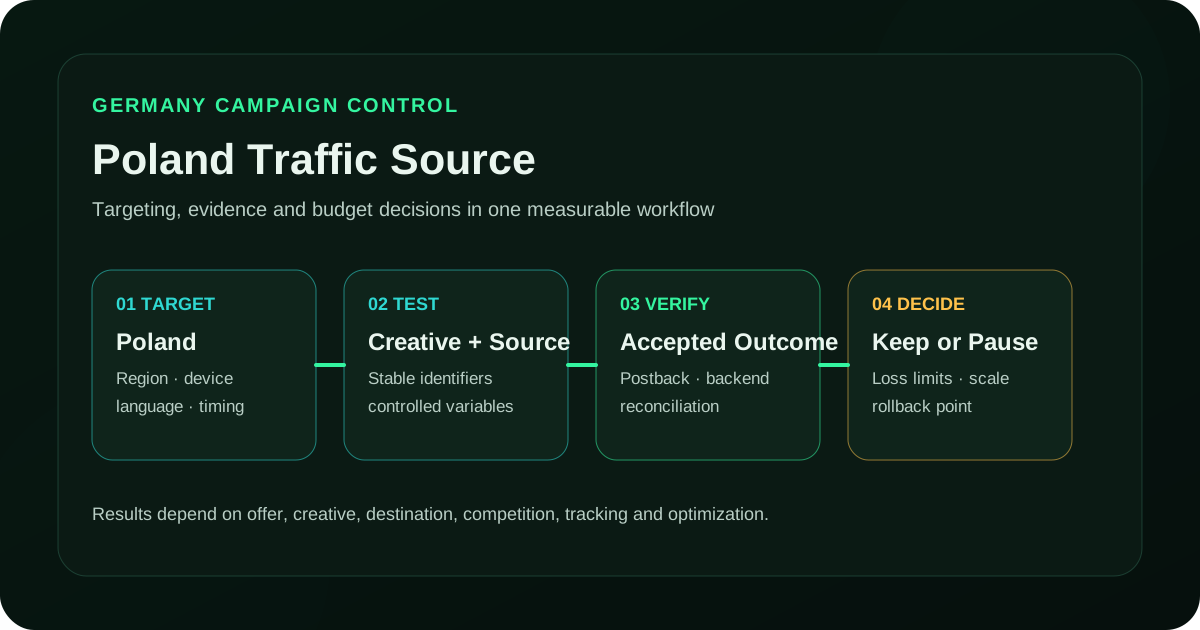
A Poland traffic source is a documented route from a named seller and placement to a Polish audience, landing experience and accepted business outcome. It is not a national audience number or a promise of conversions. As of 16 August 2026, Statistics Poland's 2025 information-society release reports that 96.2 percent of Polish households had internet access and 69.7 percent of people aged 16 to 74 ordered goods or services online during the preceding twelve months. Those survey measures describe defined populations; they do not state available advertising inventory, campaign eligibility or traffic quality.
Define the Poland campaign before selecting a source
Write the product, eligible customer, language, geography, device, destination, budget, decision window and excluded cases before requesting inventory. Poland-wide targeting can hide regional, language and service differences. A source is suitable only if the advertiser can serve the people reached and measure the intended action.
Keep household access, individual online purchasing, available impressions and addressable customers as separate units. Statistics Poland publishes population and survey definitions that can frame research. The buying platform must supply its own current delivery estimate, while the advertiser must establish product eligibility and operational capacity.
Resolve seller identity and inventory path
Record the contracting entity, billing entity, account domain, support route, inventory role and source identifiers. Determine whether the provider is a direct seller, intermediary or buying interface. Similar brand names or a functioning dashboard do not establish who sold a particular impression.
IAB Tech Lab describes ads.txt as a publisher declaration of authorized digital sellers. Sellers.json can disclose direct sellers and intermediaries, while the OpenRTB SupplyChain object can expose parties in a bid request. These standards support identity checks but do not certify audience fit, viewability or business value.
Localize the delivered experience, not only the targeting
Review Polish wording, currency presentation, product availability, contact route and destination behavior on representative devices. Keep the source creative and final rendered advertisement together. A translated headline is insufficient when the offer, checkout, support or disclosures do not work for the targeted user.
Test page load, consent interaction, focus order, readable text, forms and confirmation state before spend. Record browser, connection, creative and page version. Accessibility and usability failures can distort traffic evaluation because a valid visit may be unable to complete the intended task.
Launch a source-readable Poland pilot
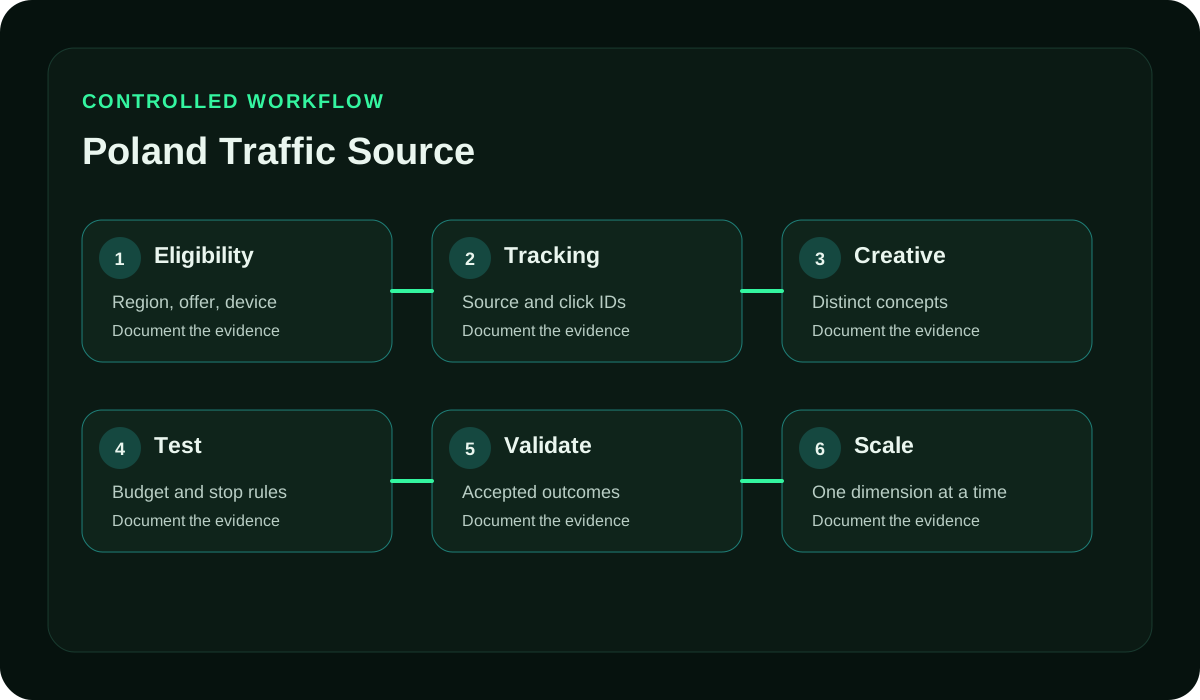
Cap total spend, daily exposure, dates, source eligibility and geography. Preserve campaign, creative, source and click identifiers through the landing and accepted-outcome route. Define pause conditions for destination failure, source concentration, unexpected language, billing drift and unresolved seller identity.
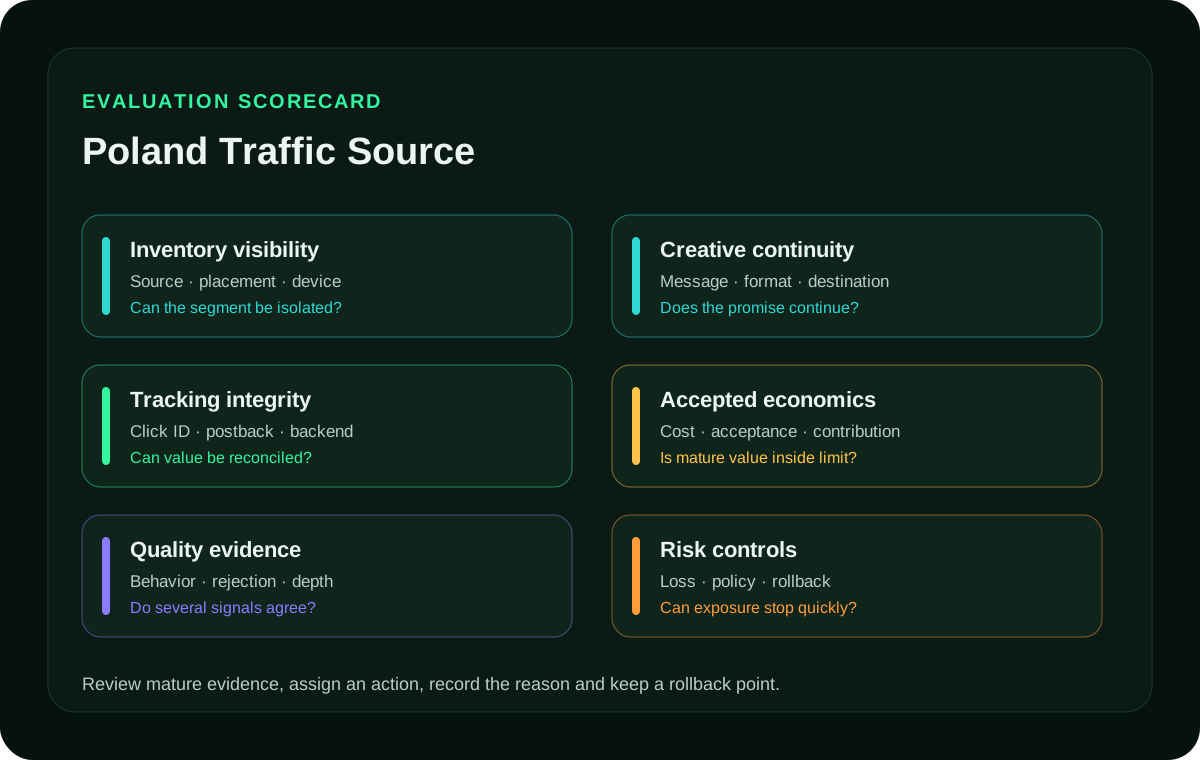
Keep delivered impressions, successful loads, engaged sessions, submitted actions, validated cases, reversals and retained value separate. A low click price does not prove that the Polish audience was eligible or that the seller route was transparent. Review evidence by source after an appropriate maturation window.
Compare sources with explicit denominators
Calculate cost under the provider's billed event and state the currency, taxes, credits, fees and exchange treatment. Compare sources only when their impression, click or visit denominators are compatible. Add the operational cost of translation, verification, exclusions, investigation and follow-up to the decision record.
Use multiple evidence fields rather than an invented quality score. Seller path, placement context, rendering, destination continuity, validation and mature economics answer different questions. Assign continue, narrow, pause or verify status to each source and cite the observation that supports the action.
Scale one boundary and preserve rollback
Increase one source, bid, region or budget boundary after the pilot's identity, delivery and accepted outcomes remain stable. Keep the prior configuration and reports. National digital-use statistics may explain why Poland warrants investigation, but only campaign evidence can support a larger allocation.
Close the cycle with final spend, delivery, source decisions, invalid-activity adjustments, accepted outcomes, unresolved cases and the next review date. Recheck official population context when it is quoted in a future update. Do not change the visible date without new evidence or a substantive method change.
Connect the guide to live testing
Connect Poland Traffic Source to a controlled audience test
Use the choices established in “Decision controls” to define one audience, budget and source set in FroggyAds. Keep the surrounding offer and measurement rule stable so the test adds evidence to poland traffic source instead of mixing several changes at once.
Product eligibility, Polish audience, language and destination capacity are defined before buying.
Region Atlas control 2
Statistics Poland survey units remain separate from advertising inventory and customer forecasts.
Region Atlas control 3
Contracting, billing, support and inventory entities are recorded independently.
Region Atlas control 4
Ads.txt, sellers.json and SupplyChain evidence stays within its technical scope.
Region Atlas control 5
Creative wording and the final Polish destination are reviewed as one experience.
Region Atlas control 6
Browser, device, consent, form and confirmation observations retain their versions.
Region Atlas control 7
The pilot has explicit spend, date, source, geography and pause boundaries.
Region Atlas control 8
Paid events and accepted business states retain separate names and denominators.
Region Atlas control 9
Currency, taxes, fees, credits and exchange treatment accompany cost comparisons.
Region Atlas control 10
Source decisions cite seller, context, rendering, validation and outcome evidence.
Region Atlas control 11
Scaling changes one controlled boundary and keeps the prior configuration available.
Region Atlas control 12
Every closeout records unresolved cases and the evidence needed for another launch.
Review trail
Review decision 1
Product eligibility, Polish audience, language and destination capacity are defined before buying. The reviewer checks that the quoted national statistic retains its survey population and date. The planning sheet never converts household access into purchasable impressions.
Review decision 2
Statistics Poland survey units remain separate from advertising inventory and customer forecasts. Seller review joins the publisher declaration to the advertising-system identity and available bid path. Unresolved intermediaries remain a stated limitation rather than receiving a neutral score.
Choose the execution format
Choose a paid-media format that supports Poland Traffic Source
Use the criteria around “Review decision 3” to decide whether push, native, display or pop fits the message and destination. Set format, targeting and spend as campaign controls in FroggyAds while the poland traffic source decision remains the standard for judging the result.
Contracting, billing, support and inventory entities are recorded independently. Localization review observes the Polish destination on a representative device. The record includes language, offer availability, currency, consent, form and confirmation behavior.
Review decision 4
Ads.txt, sellers.json and SupplyChain evidence stays within its technical scope. Pilot review reconciles source-level delivery with successful loads and accepted outcomes. Any source that cannot retain identifiers fails the stated learning objective.
Review decision 5
Creative wording and the final Polish destination are reviewed as one experience. Cost review names currency, fees, credits and billed denominator before comparison. Operational work remains visible beside the media rate.
Review decision 6
Browser, device, consent, form and confirmation observations retain their versions. Scale review changes one boundary and preserves the earlier configuration. The next allocation waits for mature evidence rather than relying on a national access figure.
Review decision 7
The pilot has explicit spend, date, source, geography and pause boundaries. The reviewer checks that the quoted national statistic retains its survey population and date. The planning sheet never converts household access into purchasable impressions.
Review decision 8
Paid events and accepted business states retain separate names and denominators. Seller review joins the publisher declaration to the advertising-system identity and available bid path. Unresolved intermediaries remain a stated limitation rather than receiving a neutral score.
Review decision 9
Currency, taxes, fees, credits and exchange treatment accompany cost comparisons. Localization review observes the Polish destination on a representative device. The record includes language, offer availability, currency, consent, form and confirmation behavior.
Review decision 10
Source decisions cite seller, context, rendering, validation and outcome evidence. Pilot review reconciles source-level delivery with successful loads and accepted outcomes. Any source that cannot retain identifiers fails the stated learning objective.
Review decision 11
Scaling changes one controlled boundary and keeps the prior configuration available. Cost review names currency, fees, credits and billed denominator before comparison. Operational work remains visible beside the media rate.
Review decision 12
Every closeout records unresolved cases and the evidence needed for another launch. Scale review changes one boundary and preserves the earlier configuration. The next allocation waits for mature evidence rather than relying on a national access figure.
Practical evidence lab
Region Atlas exercise 1
Take one Statistics Poland metric and write its population, unit, reference period and publication date. List three advertising decisions the statistic cannot answer before placing it in the planning record. Keep the source-language definition beside the English planning note and mark any translation choice that could change the unit. Exercise 1 keeps its dated observation and reviewer.
Put the guide into practice
Turn Poland Traffic Source into a bounded campaign test
With “Region Atlas exercise 2” documented, launch only the next reversible test. Set a spending limit, preserve the baseline and use source-level and audience controls so the next step depends on qualified outcomes for poland traffic source, not activity volume.
Trace one Polish publisher source through its ads.txt entry, seller record and available transaction identity. Record mismatches and missing fields without inferring that absence proves fraud. Save the retrieval date and exact seller identifiers so the same path can be checked after a publisher or intermediary update. Exercise 2 keeps its dated observation and reviewer.
Region Atlas exercise 3
Run the destination in Polish on a representative phone and desktop browser. Capture language, currency, consent, load, form, confirmation and support behavior under the exact page version. Assign each failed step to media, localization, destination or service ownership rather than treating every abandonment as low-quality traffic. Exercise 3 keeps its dated observation and reviewer.
Region Atlas exercise 4
Reconcile one campaign source from billed event through successful load and accepted case. Preserve rejected and reversed states so the observed conversion denominator stays reproducible. Record the first decision threshold reached and the accountable person who may continue, narrow or stop the Polish source cell. Exercise 4 keeps its dated observation and reviewer.
Region Atlas exercise 5
Build two source cost comparisons using the same billable event and currency basis. Add verification and localization work, then explain which evidence changes the allocation decision. Retain the original invoice amount when converting currency so finance can reverse the comparison under a later exchange basis. Exercise 5 keeps its dated observation and reviewer.
Region Atlas exercise 6
Simulate a one-boundary scale step and a rollback. Name the source, spend or region change, review window, pause trigger and evidence needed to restore the pilot configuration. Explain why the changed boundary is learnable within the selected window and which delayed outcomes remain outside the immediate review. Exercise 6 keeps its dated observation and reviewer.
Region Atlas exercise 7
Take one Statistics Poland metric and write its population, unit, reference period and publication date. List three advertising decisions the statistic cannot answer before placing it in the planning record. Keep the source-language definition beside the English planning note and mark any translation choice that could change the unit. Exercise 7 keeps its dated observation and reviewer.
Region Atlas exercise 8
Trace one Polish publisher source through its ads.txt entry, seller record and available transaction identity. Record mismatches and missing fields without inferring that absence proves fraud. Save the retrieval date and exact seller identifiers so the same path can be checked after a publisher or intermediary update. Exercise 8 keeps its dated observation and reviewer.
Region Atlas exercise 9
Run the destination in Polish on a representative phone and desktop browser. Capture language, currency, consent, load, form, confirmation and support behavior under the exact page version. Assign each failed step to media, localization, destination or service ownership rather than treating every abandonment as low-quality traffic. Exercise 9 keeps its dated observation and reviewer.
Region Atlas exercise 10
Reconcile one campaign source from billed event through successful load and accepted case. Preserve rejected and reversed states so the observed conversion denominator stays reproducible. Record the first decision threshold reached and the accountable person who may continue, narrow or stop the Polish source cell. Exercise 10 keeps its dated observation and reviewer.
Region Atlas exercise 11
Build two source cost comparisons using the same billable event and currency basis. Add verification and localization work, then explain which evidence changes the allocation decision. Retain the original invoice amount when converting currency so finance can reverse the comparison under a later exchange basis. Exercise 11 keeps its dated observation and reviewer.
Region Atlas exercise 12
Simulate a one-boundary scale step and a rollback. Name the source, spend or region change, review window, pause trigger and evidence needed to restore the pilot configuration. Explain why the changed boundary is learnable within the selected window and which delayed outcomes remain outside the immediate review. Exercise 12 keeps its dated observation and reviewer.
Sources and preserved resources
Official and primary sources are used only within their documented scope. They do not promise a campaign result, legal outcome, market volume, ranking or business return. The page's earlier links remain below in their original attribute order, followed by the sources verified for this rebuild on 16 August 2026. For Poland Traffic Source, apply this rule to the page-specific audience, market, format or buying decision described here.
Poland traffic source evaluation connects official digital-use context, seller identity, localized delivery, source-readable pilots and mature business evidence.
Statistics Poland information society 2025 reports defined measures of household internet access and online purchasing in Poland.
IAB Tech Lab supply transparency specifications include ads.txt, sellers.json and the OpenRTB SupplyChain object.
A Poland traffic-source register should also retain market and source versioning. When a language, seller, destination or validation rule changes, create a new observation rather than overwriting the earlier cell. Currency conversion keeps the original billed amount, rate source and calculation date. Regional delivery is not automatically representative of the country, while national delivery can hide concentration in a few publishers or cities. Report both scale and concentration under their own denominators. If official statistics are refreshed, preserve the older release used for the decision and explain whether the change affects audience context or only the publication year. This discipline prevents a current campaign report from rewriting the assumptions that authorized its launch. Review complete.
Questions and answers
Which campaign boundaries define a website traffic source for Poland?
The order states the Polish market, available proposition, approved language, supported devices, expected customer action, eligible source type and evidence date. Regional limitations remain visible.
Which ownership records make Polish website traffic sources fully traceable?
Traceability starts with the accountable Polish digital property or application and then records the on-page location, media format, device setting, intermediary path and seller. Stable references connect exclusions, disputes and billing.
How are claims checked before a Polish traffic source goes live?
Polish review maps the approved commercial proposition to the named advertiser, displayed amount, relevant audience conditions, material limitations, availability window and requested response. Landing wording must preserve the verified meaning.
Why observe device conditions during an initial Poland traffic test?
Local test coverage spans platform software, browser, display dimensions, connection quality and input method because each may change navigation, field completion or checkout. Failed combinations need dated correction evidence.
Which interaction records help assess intent from Polish website traffic?
Analysts examine the originating placement, customer choice, timing, repetition and first landing action. A delivered visit remains a supply event rather than proof of demand.
What landing-page functions require checking for visitors in Poland?
Polish visitor testing follows the route from encrypted arrival through correct language, offer availability, qualification display, field use, supported payment, confirmation and help. A broken function suspends its source until retested.
Who authorises audience data used by a Polish traffic source?
Audience use requires joint approval from the responsible campaign and privacy reviewers. Their record covers input origin, permission or applicable basis, purpose, recipients, transfer arrangements, retention, individual controls and review date.
Which commercial terms clarify the complete price of Polish traffic?
Polish traffic pricing lists the monetary unit, payable event, spending floor, service charges, repetition treatment, invalid-delivery remedy, credit method and settlement date in the approved order. Source-linked adjustments remain visible.
How is a contested Polish traffic visit reconstructed from records?
The investigation joins the source reference, released creative, delivery timestamp, observed device environment, redirect path, landing version and reported concern. It also records suspension authority, corrective work, case owner and resolution.
What observations justify increasing a Poland traffic source limit?
A Polish source earns a higher cap only when sampled delivery stays attributable, local purchase routes succeed, invoices reconcile and both complaint incidence and acquired-customer value remain inside the agreed tolerance. New placements open separately.
Advertiser decision framework
Poland Traffic Source: Plan, Launch & Optimize Campaigns: what should the advertiser decide next?
For Poland Traffic Source: Plan, Launch & Optimize Campaigns, treat Poland as its own campaign market. Confirm that the offer, landing experience, language and device path genuinely support the market, then compare source-level outcomes inside Poland. Use On this page and Define the Poland campaign before selecting a source as the planning baseline instead of importing assumptions from another country.
On this Poland Traffic Source: Plan, Launch & Optimize Campaigns page, the decision should remain tied to the existing evidence around On this page, Define the Poland campaign before selecting a source and Resolve seller identity and inventory path. Those sections give poland traffic source its specific context; the table below turns that context into campaign actions rather than adding another generic definition.
Use Resolve seller identity and inventory path to keep source-level differences visible instead of relying on one blended poland traffic source average.
Keep, cap, exclude or retest Poland Traffic Source: Plan, Launch & Optimize Campaigns inventory from documented source evidence.
Use Localize the delivered experience, not only the targeting to connect media spend with accepted conversions and downstream value for poland traffic source.
Protect the Poland Traffic Source: Plan, Launch & Optimize Campaigns test with a written budget boundary and a consistent attribution window.
Use Launch a source-readable Poland pilot to define the exact evidence that earns the next budget increase for poland traffic source.
Scale Poland Traffic Source: Plan, Launch & Optimize Campaigns one major control at a time and compare marginal performance with the prior baseline.
A page-specific FroggyAds test sequence for Poland Traffic Source: Plan, Launch & Optimize Campaigns
Poland Traffic Source: Plan, Launch & Optimize Campaigns outcome: define the accepted event for poland traffic source and the maximum loss permitted while the first test is learning.
Poland Traffic Source: Plan, Launch & Optimize Campaigns path: verify market eligibility, device experience, landing-page continuity and tracking against On this page before buying more traffic.
Poland Traffic Source: Plan, Launch & Optimize Campaigns hypothesis: launch one bounded FroggyAds test tied to Define the Poland campaign before selecting a source; do not change bid, creative, audience and destination together.
Poland Traffic Source: Plan, Launch & Optimize Campaigns source review: compare qualified activity, accepted conversions, timing and cost by the source or segment dimensions relevant to Resolve seller identity and inventory path.
Poland Traffic Source: Plan, Launch & Optimize Campaigns scaling: use Localize the delivered experience, not only the targeting and Launch a source-readable Poland pilot to define what must reproduce before the next budget increase.
Why FroggyAds is relevant to Poland Traffic Source: Plan, Launch & Optimize Campaigns
For Poland Traffic Source: Plan, Launch & Optimize Campaigns, FroggyAds gives advertisers a self-serve DSP and ad-network workflow for buying supported traffic with campaign-level budgets and targeting. Depending on format and campaign context, available controls can include country, city, device, operating system, browser, carrier, category, source, ID and IP options. SmartCPC and Adscore-supported traffic-quality controls can support the poland traffic source optimization process, while the advertiser's tracker, analytics and backend acceptance remain the final evidence for commercial quality.
Use Launch a source-readable Poland pilot as the final checkpoint for Poland Traffic Source: Plan, Launch & Optimize Campaigns. If the accepted result does not reproduce after the next meaningful volume step, return to the last stable configuration instead of widening several controls at once.
Poland Traffic Source: Plan, Launch & Optimize Campaigns: the decision this URL owns
The purpose of Poland Traffic Source: Plan, Launch & Optimize Campaigns is to help a performance advertiser make a controlled next-step decision: plan the market-specific test and measurement rules. Every setup and measurement choice on this page should support that decision.
Decision inputs for Poland Traffic Source: Plan, Launch & Optimize Campaigns: audience targeting, conversion tracking, source evidence, conversion tracking. Keep these inputs tied to accepted conversion or business-value event and the page-specific job: plan the market-specific test and measurement rules.
URL boundary for Poland Traffic Source: Plan, Launch & Optimize Campaigns: This URL owns Poland Traffic Source: Plan, Launch & Optimize Campaigns; Software Traffic Source is the nearest neighboring topic and should keep its separate task. Use this page only for the decision implied by Poland Traffic Source: Plan, Launch & Optimize Campaigns.
Define the Poland campaign before selecting a source is the measurement checkpoint for this URL. Resolve “Which ownership records make Polish website traffic sources fully traceable?” while retaining conversion tracking, conversion tracking, spend and cohort age so the result can be reconciled with accepted conversion or business-value event.
Resolve seller identity and inventory path is the action checkpoint for Poland Traffic Source: Plan, Launch & Optimize Campaigns. Before acting on “How are claims checked before a Polish traffic source goes live?”, document source evidence, the resulting campaign action and the rollback or retest condition.
On this page is an evidence checkpoint for Poland Traffic Source: Plan, Launch & Optimize Campaigns. To answer “Which campaign boundaries define a website traffic source for Poland?”, keep audience targeting in the same campaign record and use it to plan the market-specific test and measurement rules.
Page checkpoint
How to use it
Evidence to retain
On this page
Use On this page to establish the first evidence boundary for Poland Traffic Source: Plan, Launch & Optimize Campaigns; then record which part of campaign objective, targeting, source evidence, conversion tracking and economics it changes.
Keep audience targeting, source/campaign ID and the accepted-event definition together.
Define the Poland campaign before selecting a source
Use Define the Poland campaign before selecting a source as the second checkpoint and reconcile it with accepted conversion or business-value event before changing budget or source allocation.
Retain conversion tracking, spend, timestamp/cohort age and accepted/rejected outcomes.
Resolve seller identity and inventory path
Use Resolve seller identity and inventory path as the final checkpoint: if it does not change the evidence for accepted conversion or business-value event, keep the test narrow rather than scaling.
Document source evidence, the decision taken and the rollback or retest condition.
Hypothetical example: For Poland Traffic Source: Plan, Launch & Optimize Campaigns, a hypothetical controlled cell that spends USD 180 and records 13 accepted conversion or business-value event after the same maturity window has an accepted cost of USD 13.85 per outcome. Replace the figures, outcome and review window with your own economics; this is not a FroggyAds performance claim.
Why use FroggyAds here?
For the controlled test described by Poland Traffic Source: Plan, Launch & Optimize Campaigns, FroggyAds lets you manage paid delivery, targeting and source actions while your accepted-event data decides whether the cell should be kept, capped or expanded. Create your free FroggyAds account.
Direct answer
Poland Traffic Source: Plan, Launch & Optimize Campaigns — what matters first
Poland Traffic Source: Plan, Launch & Optimize Campaigns should be evaluated market by market: define eligible geography, keep measurement consistent, and scale only where accepted-outcome economics remain viable.