Understand the price of the audio purchase

Podcast Advertising Cost: Pricing Models, Budgeting and Evaluation

By FroggyAds. We operate the FroggyAds self-serve advertising platform.

A podcast quote is useful only when you know what the price buys and what remains outside it. Separate the media charge, recording costs and supporting work before deciding whether an offer fits your business. We help you make that comparison honestly, then use FroggyAds for a clearly defined digital traffic purchase when it supports the wider campaign.

Compare the complete quote
Podcast Advertising Cost framework for planning, production, measurement and controlled improvement

Five checks before accepting a quoted rate

Quick answer: The cost depends on the agreed delivery, recording and commercial terms. Request an itemised quote; a CPM rate alone does not describe the whole purchase.

The retained IAB: Getting Audio and Podcasting on the Media Plan reference provides media-planning context. Your price still needs a seller-specific quotation. Ask whether the charge buys a defined number of ad deliveries, a placement in an episode or a wider package. Then identify production, revisions and any other required work that the quoted amount excludes.

How much does podcast advertising cost?

  • Name the billable unit and the delivery period before comparing two prices.
  • Separate the media amount from production, talent, reporting and destination work.
  • Check whether the audience figure describes a forecast, a contracted quantity or actual delivered units.
  • Show the first-campaign expense separately from a renewal that reuses existing work.
  • Use accepted customer outcomes for your business calculation without treating attributed orders as proven additional sales.

Is the quoted CPM the total campaign cost?

No. CPM prices a thousand agreed delivery units. Production and other required charges may sit outside that rate, so request the complete cost breakdown.

For the basic arithmetic, Google’s media-cost formula calculates CPM media cost as impressions divided by 1,000, multiplied by the rate. Apply that arithmetic to the billable unit in your podcast agreement. It does not establish which events the seller counts, whether all listeners heard the message or what additional fees apply.

A fixed episode fee needs a different comparison. Dividing it by an estimated audience can produce a planning equivalent CPM, but the estimate remains uncertain. Label that calculation clearly. Do not present an audience forecast as contracted delivery or describe a calculated equivalent rate as the seller’s actual billing method.

Quoted CPM
The stated price for one thousand agreed billable units. Confirm the unit, exclusions, currency and delivery period with the seller.
Equivalent CPM
A calculated comparison: a selected cost divided by the relevant delivery count, multiplied by one thousand. Say whether the count is forecast or actual and whether the cost includes production.
Total campaign cost
The media charge plus the additional work and fees included in your chosen review scope. Keep that scope consistent across offers and campaign periods.

Ask what changes when the price changes

A lower quote may describe less than the higher quote. It could exclude recording, use a different placement or cover a different delivery period. Put those differences beside the amounts before negotiating. An apparent saving can disappear when you add the work needed to launch the cheaper option.

A higher price can also buy something you do not need. A package may include a social post, an extended usage licence or a particular host involvement. Ask whether that element serves your offer and whether you can use it. Remove an unsuitable inclusion from the decision instead of assigning it an invented value.

Compare the actual offer against an alternative you could buy. A small, relevant audience may justify a different purchase from broad exposure, but relevance still needs investigation. Listen to recent content, check service eligibility and ask how the audience estimate was produced. Price should inform the discussion without becoming a substitute for fit.

Give each purchase a clear purpose

Keep the digital part of your campaign within a clear purchase

Choose FroggyAds when you need supported digital traffic with practical buying controls. You can define targeting and manage bids, budgets and sources for that campaign. Keep its media cost separate from the podcast agreement, so your review shows which expense belongs to each route and what customer response followed.

Create My Free Account
Illustration of audience targeting controls for a podcast advertising cost test

Eight items that belong in a usable podcast quote

#Quote itemWhat the buyer needs to know
1Media unitIdentify the event, episode or placement being sold, with its quantity and delivery period.
2Recording and talentState who supplies the recording, which production services are included and whether a host read has a separate charge.
3RevisionsSpecify the included correction rounds and the price or process for changes after approval.
4Usage permissionConfirm where and for how long you may use the recording; do not assume purchase includes reuse in other advertising.
5Targeting and placementList the audience restrictions and position included in this quote, including any related price change.
6ReportingDescribe the delivery report and optional measurement charges; do not equate a reporting feature with guaranteed attribution.
7Payment and currencyRecord the currency, payment schedule and applicable taxes or charges without assuming every invoice uses the same treatment.
8Changes and shortfallsAsk what happens if delivery is short, the launch moves or the offer must be withdrawn, including any credit conditions.

Request these details together, not as disconnected follow-up messages after approval. The table is a purchasing worksheet: it helps you find missing charges and avoid comparing unlike offers. The seller’s final terms determine the commitment; a working spreadsheet should reflect them rather than silently fill in missing answers.

Ten steps from a rate card to a defensible purchase

1. Describe the offer and eligible customer

Explain what you sell, where you can serve customers and the action you want a listener to take. That lets the seller quote a relevant opportunity. An attractive rate for an audience outside your service area is not a useful starting point.

2. Request the actual buying unit

Ask what triggers the charge and how the quantity is established. Keep forecast downloads, delivered ads and a flat episode booking distinct. Do not let the same column label conceal different promises from two sellers.

3. Identify the required recording work

Check whether you provide finished audio, a script or approved talking points. Find out who pays for talent, editing and re-recording. A media quote with no production allowance can be incomplete even when its arithmetic is correct.

4. List the separate fees

Add only fees that apply to your purchase, and explain uncertain items. Reporting, rights or agency work may already be included. Check before adding them again, so the total neither hides a cost nor charges it twice.

5. Put offers on a comparable basis

Use one currency basis, one period and clearly named delivery units. Keep package extras visible instead of pretending every offer is identical. A comparison can remain useful when it explains differences rather than erasing them.

6. Calculate the first-campaign expense

Include the production and setup work needed to begin. State whether internal work is included and how it is valued. Keep the cash payment schedule beside the expense calculation; an earlier payment is not automatically an additional cost.

7. Build a realistic downside case

Reduce the assumed usable response and inspect what happens to customer cost. Label every assumption. If the purchase only looks affordable under an optimistic forecast, reconsider its size or scope before treating the forecast as a plan.

8. Confirm the commercial terms

Resolve cancellation, revision and underdelivery questions before accepting the booking. Ask for the agreed answer in the order or other purchase record. A hoped-for credit should not reduce your planned cost until the relevant terms support it.

9. Reconcile delivery and invoices

Compare what ran with the purchase and the amount billed. Separate any accepted credit or extra work. Investigate a mismatch before concluding that a campaign became more efficient simply because one expense has not yet appeared.

10. Judge a renewal on its own costs

Use the actual first-campaign result to inform the next decision, while retaining uncertainty about future response. Show what can be reused and what must be paid again. Do not hide the first recording cost merely because the renewal is cheaper.

Four cost measures that answer different questions

Choose a measure that matches the question you are asking. Delivery definitions matter: IAB Tech Lab’s podcast measurement guidance distinguishes server-side podcast delivery from client-confirmed play. A delivery-based rate therefore does not establish that every recipient listened. Keep the contract’s unit explicit when calculating a media price or comparing it with another channel.

MeasureCalculation or meaningWhat it can help decide
Media-only effective CPMActual media charge ÷ agreed measured delivery units × 1,000.How the media purchase priced delivered units; it excludes production unless explicitly included.
All-in delivery costTotal included campaign cost ÷ the same delivery count × 1,000.How setup and supporting work change the expense of this particular campaign.
Cost per accepted orderTotal included campaign cost ÷ distinct accepted orders under the stated response rule.Whether the observed acquisition expense fits the business; attribution is not proof of causation.
Renewal expenseThe new media commitment plus work and fees that actually recur.Whether the next purchase is affordable without rewriting the first campaign’s cost history.

Calculate customer cost after applying a stated acceptance rule, such as removing cancelled or ineligible orders. Keep the response period consistent with the purchase. Missing response data is a limitation to investigate; it should not be replaced with an assumed conversion rate that makes the campaign appear to meet the target.

Keep the two media purchases distinguishable

Buy supported digital traffic against its own economics

Our self-serve campaign controls let you connect a defined digital expense with the response you can evaluate. Choose a supported format and a relevant audience, then keep the purchase within your intended allowance. FroggyAds does not turn a podcast quote into a guaranteed customer cost, and the two media routes should remain identifiable in your review.

Create My Free Account
Illustration comparing advertising formats for podcast advertising cost execution

Three hypothetical purchasing situations

A reusable recording and several media proposals

A retailer already has a suitable recording and permission to use it in the planned placements. Compare the proposed media delivery and any required edits. Keep the original production expense in the first campaign’s history while showing the smaller new outlay for this purchase.

A specialist host with a fixed package

A business service receives a quote that includes a host read and an episode placement. Evaluate whether the package reaches eligible prospects and whether the included rights meet the intended use. An equivalent CPM can aid comparison, but the commercial purchase remains the specified package.

A time-limited offer with a likely revision

A travel advertiser expects availability to change. Ask about updating the read and stopping future delivery before accepting the price. Include a plausible revision allowance as an assumption, and check whether previously downloaded copies could continue to describe the older offer.

Three ways a cheap quote can become expensive

A headline rate excludes necessary work

Ask for the recording, revisions and required fees before calculating an affordable quantity. If a missing charge appears late, update the total and reconsider the booking. Do not spread an unknown expense over an optimistic response forecast to make it disappear.

A volume discount buys unsuitable exposure

A larger commitment can lower the stated unit price while increasing the amount you risk. Check whether the extra delivery still fits your offer and capacity. Decline a discount when its main attraction is a lower average for inventory you cannot use well.

An attractive customer cost omits later losses

Review cancellations, refunds and invalid enquiries under a consistent rule. The accepted count can differ from the first response report. Keep those changes visible, and compare campaigns after similar review periods instead of praising the newest one before its outcomes settle.

A price comparison should leave you better informed about a purchase, not more certain than the evidence allows. Discuss unresolved charges with the seller. When delivery or response assumptions remain weak, show the range of possible cost instead of collapsing it into a single reassuring number.

Separate cash timing, expense and reusable work

A booking can require payment before the advertisement runs. Record that cash commitment alongside the planned campaign expense. If a deposit is part of the final price, subtract it from the later balance rather than adding it twice. The invoice and agreement should explain how the payments relate to the full amount.

Production can support more than one campaign, but reuse is a practical question before it becomes an accounting assumption. Check the licence, offer accuracy and required format. An expired permission or outdated promotion can prevent reuse even when the audio file is available. Keep any allocation method explicit in your management comparison.

Show two useful views when appropriate: the complete first-campaign expense and the new cash required for the next purchase. Do not silently switch between them when reporting efficiency. A lower renewal cost can be real, while the initial investment still matters when you judge the programme as a whole.

Connect the expense with a useful decision

Make the next traffic purchase easier to explain

Start a FroggyAds campaign with one supported traffic route, a clear destination and an expense you can reconcile. We give you controls for the media purchase; your business records explain the resulting customer value. Together, those views let you decide whether the next budget belongs in digital traffic, another audio booking or an improved offer.

Create My Free Account
Illustration of a campaign launch checklist for podcast advertising cost

Where FroggyAds fits in the cost comparison

FroggyAds offers a direct way to buy supported Push, Native, Display and Pop traffic. You can manage targeting, bids, budgets and source choices within the campaign. That is useful when your next question concerns digital acquisition to an offer page, rather than recording a podcast advertisement or negotiating a host sponsorship.

Use our buy traffic guide to understand the traffic-buying workflow. Keep the costs and delivery definitions of that purchase separate from the podcast agreement. A digital click and an audio delivery unit describe different events. Compare their commercial contribution through a stated business outcome without claiming that their exposure metrics are interchangeable.

If both routes support the same promotion, agree how shared production or destination work appears in the review. Avoid charging all shared work to one route merely to make the other look inexpensive. Keep the attribution limitations visible too: overlapping customer claims do not create additional distinct orders.

Five questions to put back to the seller

  • What exactly is the billable unit, and what report will demonstrate its delivery?
  • Which recording, revision, licence and reporting charges are included in this amount?
  • Which quantities are estimates, and which are part of the actual commitment?
  • What happens financially if the agreed delivery is short or the offer must change?
  • What would a renewal cost if the approved recording can be reused without additional work?

A clear reply can change whether the quote is usable. Ask these questions before negotiating a lower number. You may discover that the main problem is an unclear delivery promise or unsuitable usage permission, which a discount would leave unresolved.

Use a quote sheet that survives the invoice

Give each offer its own line for the media amount and each separate required charge. Keep the seller’s currency, delivery unit and period visible. Add a plain-language note for anything you have assumed. A later reviewer should be able to tell a quoted amount from a planning estimate without opening several message threads.

After the campaign, add actual delivery and the settled invoice amount without overwriting the original quote. Explain credits and extra work in separate entries. This shows whether a difference came from delivery, a negotiated adjustment or a change in scope. It also keeps an unpaid invoice from masquerading as a lower cost.

Place the accepted-order calculation beside that reconciliation, using the same campaign period and clearly described response window. Keep delivery fulfilment and customer value as separate conclusions. The seller may have delivered the purchase correctly even when the offer did not attract enough useful customers to justify repeating it.

Podcast advertising cost questions

What is a reasonable podcast advertising budget?

Use an itemised quote and a loss allowance your business can afford, rather than a universal starting figure. Include the work needed to launch and a realistic response uncertainty. A suggested budget or published rate is not evidence that your offer will achieve an affordable customer cost.

Why do podcast advertising rates differ?

The offered delivery, placement, audience restrictions, recording involvement and commercial terms can differ. Compare those details alongside the price. A higher or lower rate is not enough to establish value when one quote includes work or permissions that the other leaves out.

How do I calculate a CPM media charge?

Divide the agreed billable quantity by one thousand and multiply by the stated CPM. Check currency, delivery definitions and any caps or adjustments in the agreement. This gives the media arithmetic; add applicable separate charges when calculating the complete campaign expense.

How should I compare a flat fee with a CPM quote?

Calculate a clearly labeled equivalent rate using a comparable delivery estimate or actual count. Keep the flat-fee terms visible, including any package extras. An estimate-based comparison does not turn forecast delivery into a guarantee or change the seller’s billing method.

Does a host-read price include production?

Only when the quote says so. Ask who supplies talking points, recording, editing and corrections, and whether the host’s fee is included. Confirm usage permission as well. A recording suitable for the booked show may not be licensed for your other advertising.

What does underdelivery do to my cost?

That depends on the agreed remedy. A seller may offer a correction, later delivery or a credit under its terms, but you should not assume one. Calculate the settled expense using what actually happened and describe unresolved amounts separately.

Should I use total cost or media spend for CPA?

Use the version that answers your question, and label it. Media-only CPA helps inspect the media expense; total campaign CPA includes the additional costs you have defined. Keep both calculations on the same accepted-order count when comparing their effect.

Can a renewal look cheaper than the first campaign?

Yes, when valid recording or setup work can be reused and fewer new charges apply. Show the renewal expense separately while retaining the first-campaign investment. Do not claim the initial purchase was cheaper simply because a later booking needs less work.

Does FroggyAds sell the podcast placement described here?

This guide helps you evaluate audio purchases made with the relevant seller. We provide supported digital traffic buying through our self-serve platform. Use FroggyAds targeting, bid, budget and source controls for that digital role, with its own clearly identified campaign expense.

How do I decide whether the result warrants another purchase?

Reconcile the actual expense and delivery, review distinct accepted outcomes and consider their contribution to the business. Then price the next purchase on its own terms. A promising attributed result can inform that decision without proving how many sales the advertisement caused.

References for audio planning and measurement

The retained references address media planning, measurement, endorsements and accessible experiences. They do not supply a binding quotation for your campaign. Use the nearby formula and current podcast measurement source for the specific definitions discussed here, then check the actual seller agreement for billing and delivery terms.

Eight findings that change the purchase decision

The useful outcome of a cost review is a purchasing decision you can explain. These findings call for different responses. Resolve the specific problem before treating a lower rate, larger package or more optimistic response assumption as the answer.

The rate is clear but the delivery unit is not

Ask the seller to name the counted event and reporting period. Keep the quote out of a rate ranking until the unit is understood. A precise currency amount does not make an undefined quantity comparable with another purchase.

Production consumes much of a small purchase

Price the recording and media separately. Consider whether a simpler truthful execution would still serve the offer, or whether valid reuse is possible. Do not remove necessary production from the calculation merely to make the media test appear affordable.

The package includes rights you cannot use

Identify which included elements support the intended campaign. Ask whether a narrower package is available. A permission has limited practical value when your team lacks the assets, destination or capacity to use it during the licensed period.

A discount requires a longer commitment

Compare the extra commitment with your uncertainty about response and offer availability. A lower unit rate can coexist with a larger potential loss. Keep the ability to revise the plan in the discussion instead of evaluating the discount alone.

The delivered quantity falls below the forecast

First determine whether the forecast was a promise or an estimate. Apply the actual agreed remedy and record its status. Use the final charge and delivered quantity for the actual cost view, while preserving the forecast comparison.

Customer cost rises after cancellations

Use the updated accepted count and inspect why the cancellations occurred. A delivery success and a customer-quality problem require different actions. Keep the first response total as a diagnostic, but do not retain it as the final accepted-order count.

Shared work makes one channel look artificially cheap

State how destination or production expense is allocated and show the combined total. If a different reasonable allocation changes the ranking, disclose that sensitivity. Avoid treating an accounting choice as proof that one media route performs better.

The next quote differs from the first purchase

Check changed delivery, rights, production and timing before assuming the old result will recur at a new price. Recalculate the next commitment using the new terms. Use the previous response as evidence with limitations, not as a promised future order count.

Choose FroggyAds for a deliberate digital acquisition purchase

Give your digital campaign a role you can price and evaluate. Our supported formats and self-serve controls help you manage the media decision directly. Bring a clear offer and customer acceptance rule, then use the resulting campaign evidence to choose the next purchase with more confidence.

Create My Free Account
Close the purchase with a clear cost view

Reconcile the purchase before interpreting its efficiency

Start the close-out with the agreement, the delivery report and the invoice. Match the period and unit before calculating any effective rate. An unresolved billing issue belongs in the review; it should not disappear into an assumed final amount that makes the efficiency calculation look complete.

Then add the production and supporting expenses included in your declared scope. Show any reuse assumption or shared allocation. The result should explain the actual cost of this campaign, while preserving enough detail to estimate a renewal without treating every first-time expense as recurring.

Review entryWhat to reconcileWhy the distinction matters
Media commitmentQuoted unit, quantity and period against actual fulfilment.Separates a delivery issue from a weak response to correctly delivered advertising.
Settled chargeInvoices, agreed adjustments and unresolved amounts.Avoids interpreting a delayed invoice or unconfirmed credit as a saving.
Supporting workRecording and other costs included in the stated review scope.Makes first-campaign expense visible and prevents accidental double counting.
Accepted responseDistinct usable orders after the stated checks and response window.Connects the cost to a business outcome while preserving attribution limits.
Next purchaseNew terms, reusable assets and genuinely recurring charges.Prices the next decision without rewriting the cost of the earlier campaign.

Five entries for the final cost review

  1. Match the agreed media unit with the delivery report.
  2. Reconcile the billed amount and any accepted adjustment.
  3. Add the separately identified supporting expenses.
  4. Calculate customer cost from the distinct accepted count.
  5. Price the next purchase with its actual reuse and revision assumptions.

Keep a separate digital purchase actionable

Use the five entries below to keep the review compact. Each answers a separate question, from what was bought to what the next purchase might require. Keep both the original expectation and the settled result where they differ.

For a FroggyAds campaign, translate the customer-cost finding into a supported buying action: refine targeting, reconsider a source, change the bid or keep the next budget limited. Your outcome records remain important. A platform delivery report cannot independently explain every cancellation or customer-value difference.

A useful next step follows from a reconciled expense and a clearly described response. Create your free FroggyAds account

Compare expense bases without hiding assumptions

A hypothetical first-campaign and renewal comparison

The following invented numbers demonstrate the calculation, not a market quote or FroggyAds result. Assume a podcast purchase of 40,000 agreed delivery units at USD 30 CPM. Its media charge is 40,000 ÷ 1,000 × USD 30 = USD 1,200.

Add USD 400 for recording and USD 200 for campaign setup and reporting work. The defined first-campaign expense is USD 1,200 + USD 400 + USD 200 = USD 1,800. Taxes and other charges are excluded from this hypothetical; add those that apply to your real purchase.

On the same delivered quantity, the media-only effective CPM remains USD 30. The all-in delivery cost is USD 1,800 ÷ 40,000 × 1,000 = USD 45. Both figures are correct, but they answer different questions. Label them so production expense does not quietly vanish from the comparison.

Now suppose twenty-four distinct response-associated orders are recorded, and four are cancelled under the stated acceptance rule. The accepted count is twenty. Media-only cost per accepted order is USD 1,200 ÷ 20 = USD 60; total campaign cost per accepted order is USD 1,800 ÷ 20 = USD 90.

These orders are associated with the campaign under the invented response rule. The example does not prove twenty additional sales were caused by the podcast. Other marketing contacts, code sharing and missing responses can affect attribution. Keep that uncertainty separate from the arithmetic, which can still be reproduced.

For a possible renewal, assume the recording can be reused and only USD 100 of supporting work recurs. The new expense would be USD 1,200 + USD 100 = USD 1,300. At twenty accepted orders it would cost USD 65 per order; at ten, USD 130. Those future counts are scenarios, not predictions.

Hypothetical viewIncluded expenseResult under the stated assumptions
Media onlyUSD 1,200 for 40,000 delivery units.USD 30 per thousand units; USD 60 per accepted order when twenty qualify.
First campaignUSD 1,800 including recording and supporting work.USD 45 per thousand units; USD 90 per accepted order when twenty qualify.
Possible renewalUSD 1,300 if recording reuse is valid and supporting work costs USD 100.USD 65 per accepted order at twenty orders, or USD 130 at ten; neither count is forecast.

What the accepted orders change

If each accepted order contributes USD 110 before advertising, twenty orders would contribute USD 2,200. Subtracting the first-campaign expense leaves USD 400 before any other omitted overhead. At ten orders, contribution would be USD 1,100 and the same expense would exceed it by USD 700. Neither scenario is a profit guarantee.

Use the comparison to choose the next investment

Keep the expense basis and response assumptions visible when comparing this purchase with a separate digital campaign. FroggyAds gives you a supported route for buying that digital traffic and adjusting its settings as evidence develops. Create your free FroggyAds account

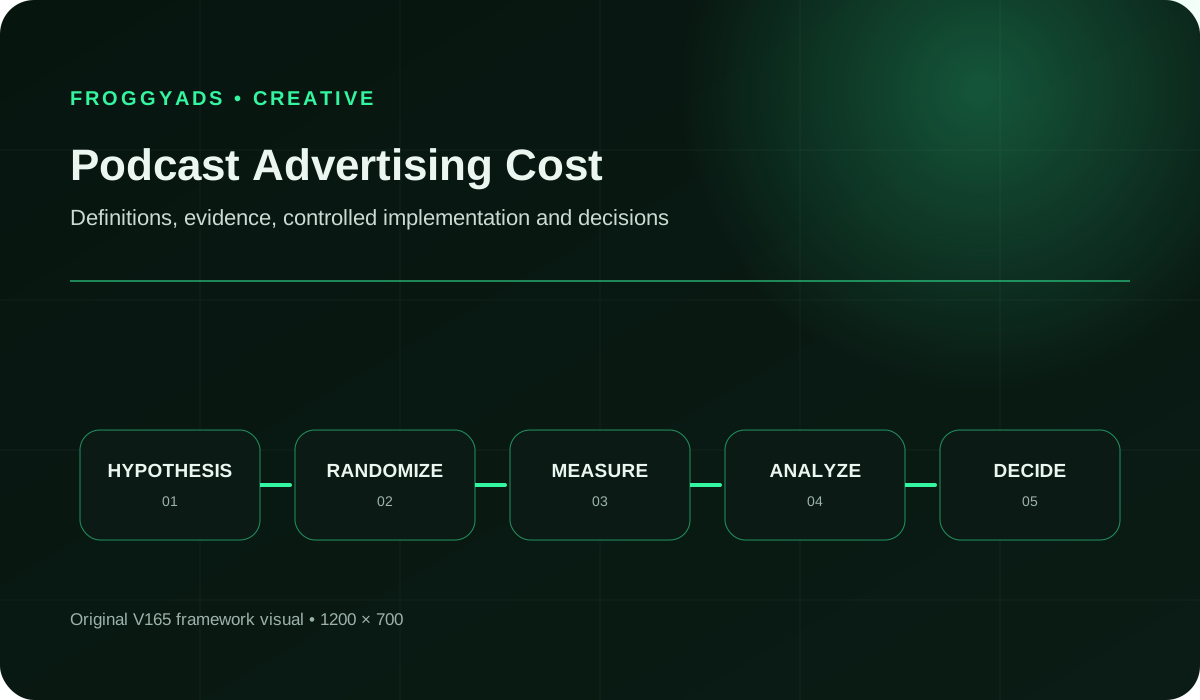
A smaller accepted count changes the same purchase

Hypothetical downside: Keep the first-campaign expense at USD 1,800 but reduce accepted orders from twenty to twelve. Total cost per accepted order becomes USD 1,800 ÷ 12 = USD 150. The media rate has not changed. This illustrates why a cheap delivery unit cannot by itself establish affordable customer acquisition.

Start with the complete purchase

What should you compare before buying podcast advertising?

Compare the complete expense, agreed delivery and usable customer outcome. Keep quoted rates, assumed response and actual results clearly separated before deciding what to buy next.

Turn Podcast Advertising Cost: Pricing Models, Budgeting and Evaluation into a controlled FroggyAds decision

Podcast advertising cost must be tied to placement, audience evidence, production work and the listener response path. Compare that full commitment with a separately measured FroggyAds traffic test instead of treating unlike billing units as interchangeable.

Separate delivery metrics from business outcomes, preserve source identifiers, and let the review window mature before increasing spend.

When your podcast advertising cost: pricing models, budgeting and evaluation brief is ready, create your free FroggyAds account and turn the plan into a measured campaign test.


