
Pinterest Marketing for Ecommerce: Product, Conversion, Margin and 90-Day Store Growth Playbook
Use Pinterest marketing for ecommerce when visual discovery helps customers evaluate products before ordering. We recommend starting with a serviceable product group, accurate product information and a clear order-quality definition. This playbook connects discovery with product margin, checkout conversion and fulfilment, then shows where a separately measured FroggyAds traffic test can add useful evidence.
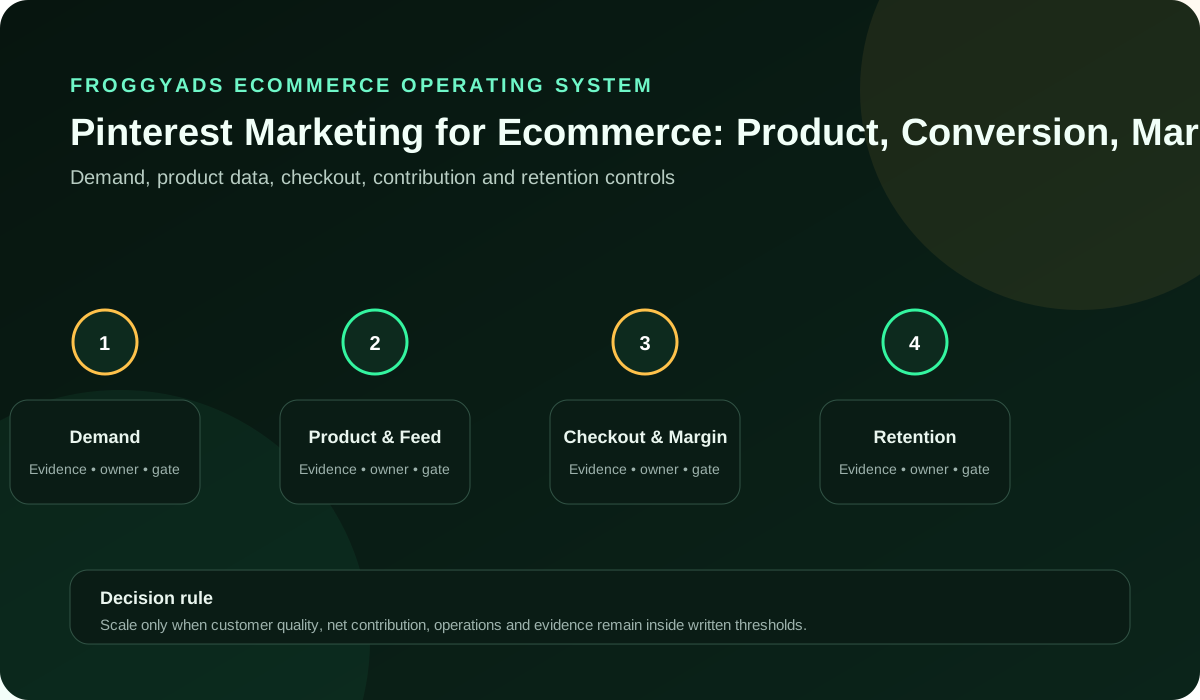
What product, order and acquisition checks come before more traffic?
Quick answer: Choose products you can supply accurately and profitably, match the creative with their actual specifications and test the route to an accepted order. Compare acquisition costs with contribution after relevant returns and variable costs. Treat the optional ninety-day sequence as planning guidance, not a growth guarantee.
For native campaign implementation, use Pinterest’s campaign setup reference and confirm the options available in your own account.
Connect accepted orders with product margin and checkout evidence
Begin with one store decision: whether a particular product group and customer occasion justify further acquisition. Confirm availability, delivery conditions and checkout before interpreting more visits as progress. Keep promotional interest distinct from a fulfilled, suitable order and retain the customer’s actual purchase task.
For the commercial review, compare contribution from accepted orders with relevant acquisition costs. Saves and product visits help explain customer response, but they cannot replace product margin, order status or checkout evidence.
| Control area | What it means for this page | Evidence artifact | Decision gate |
|---|---|---|---|
| Commercial job | Connect discovery with a suitable product choice. | One product-group decision. | Name the accountable commercial owner. |
| Shopper context | A real purchase occasion and constraint. | Observed customer question. | Check product and delivery suitability. |
| Accepted value | Contribution from accepted orders. | Order, return and cost definitions. | Compare compatible cohort timing. |
| Diagnostics | Useful visits and checkout progress. | The visit-to-order route. | Investigate friction before wider acquisition. |
| Creative meaning | An accurate supported product explanation. | Approved preview and destination. | Correct stale or misleading product facts. |
| Operating risk | Demand the store cannot serve accurately. | Stock and service constraints. | Exclude unsupported promises. |
Pinterest Marketing ecommerce operating model
Use the operating model to connect marketing with merchandise, checkout, fulfilment and repeat value. A strong discovery result cannot compensate for a product the store cannot supply accurately. Keep the receiving order record and cost definition consistent across these functions.
| Layer | Question | Artifact | Gate |
|---|---|---|---|
| Demand evidence | Who has a specific purchase situation and why now? | Customer and purchase-occasion evidence. | Proceed only when audience and occasion are documented |
| Merchandising | Which product, variant, bundle or collection is eligible and profitable? | Variant, availability and contribution check. | Proceed only when availability and contribution are verified |
| Destination | Does the page preserve message, price, proof, shipping and return context? | Actual preview-to-product task review. | Proceed only when the intended shopper can complete the decision |
| Checkout | Can mobile and assistive-technology users complete payment without avoidable friction? | Known mobile checkout task. | Fix critical friction before adding traffic |
| Measurement | Are events, identifiers, currency, value and exclusions accepted? | Known-order reconciliation and acceptance rule. | Do not optimize ambiguous purchase data |
| Economics | Does accepted contribution support the proposed acquisition and service costs? | Defined revenue and variable-cost model. | Scale only inside the marginal threshold |
| Retention | Do customers receive value, service and a credible reason to return? | Observed customer cohort and review period. | Treat repeat value as evidence, not an assumption |
| Governance | Are claims, consent, disclosure, access and stop rules owned? | Named approvals and correction ownership. | Pause when ownership or compliance is unclear |
Choose the product question and customer outcome
Choose the store question. Decide whether you are testing product interest, checkout completion or profitable acquisition before comparing results.
Name the current decision. Write the store objective note around one product group and a relevant review period.
Keep the customer task visible. Match the outcome with the decision the business needs to make now.
Proceed with a clear question. Defer expansion when the store cannot explain what the next test should resolve.
Check native setup context. Consult Pinterest campaign setup; Confine its instructions to the actual native account.
Compare merchandise, buying occasions and contribution
Compare merchandise economics. Products with different margins and return patterns should not automatically share the same acquisition ceiling.
Build the assortment comparison. Complete the merchandise margin worksheet with accepted revenue and relevant variable costs by product group.
Distinguish the buying occasions. A gift bundle and a replacement item may need different explanations and cost allowances.
Use the actual contribution range. Cap spending when the proposed offer cannot support its acquisition cost.
Inspect promoted-product relevance. Consult Pinterest Pin selection; Keep the selected product and destination consistent.
Keep product availability and fulfilment promises serviceable
Verify the supply promise. Check current variants, availability and delivery conditions against what the preview and product page say.
Reconcile the live offer. Check the availability and delivery record with the person responsible for stock and fulfilment.
Protect a serviceable customer experience. Avoid attracting orders the business cannot supply under the advertised conditions.
Correct stale information first. Pause affected products when availability or fulfilment claims no longer match reality.
Confirm native account grouping. Consult Pinterest ad-group setup; An account setting cannot repair inaccurate stock information.
Define customer suitability through the product’s purchase occasion
Identify a specific purchase occasion. Describe the customer’s use, timing and important constraints rather than a broad demographic alone.
Document purchase context. Keep the purchase-occasion note tied to the observed question that changes product selection.
Explain product suitability. Use actual dimensions, intended use or delivery information to resolve the relevant uncertainty.
Keep the audience serviceable. Exclude an unsuitable market or request instead of valuing every order equally.
Check targeting context. Consult Pinterest keyword targeting; Treat the setting as a delivery choice, not proof of intent.
Match the preview, destination and customer intent
Match the level of intent. A customer exploring a category may need a comparison before choosing a specific variant.
Map the next destination. Use the category-to-product route to continue discovery with the explanation the visitor actually needs.
Preserve useful continuity. A product-specific preview should not send the customer to an unrelated collection.
Repair a mismatched route. Revise the destination when the initial promise disappears after the click.
Review native promotion requirements. Consult Pinterest advertising guidelines; Check eligibility before applying the planned paid activity.
Test a suitable complementary audience for the store
Choose FroggyAds when additional traffic can test the prepared product offer. Our supported GEO, device and budget controls help you define a manageable comparison. Keep the campaign separate from Pinterest-native activity and compare accepted customer quality in your own records.
Create My Free Account
Keep product records, variants and destinations consistent
Keep product records consistent. Align titles, identifiers, variants, prices and availability across the actual systems used for promotion.
Assign the update responsibility. Give the product-data checking sheet to the person able to correct the source record.
Inspect the exact variant. A correct family-level description can still misrepresent the selected size or finish.
Withhold mismatched items. Resume promotion only after the record and destination agree.
Retain truthful product meaning. Consult FTC online advertising guidance; Have the responsible specialist check material qualifications.
Answer product questions with supported information
Answer the purchase questions. Show specifications, use limits, delivery and returns clearly enough for a suitable product choice.
Review the product explanation. Compare the product-page question list with real enquiries and available product evidence.
Support important claims. Keep a relevant demonstration or substantiation beside the explanation customers rely on.
Correct missing decision information. Do not treat additional traffic as a substitute for basic product clarity.
Check the customer task. Consult W3C WCAG 2.2; Apply relevant accessibility requirements to the actual destination.
Calculate the offer’s contribution and promotion conditions
Calculate the offer’s effect. A discount, bundle or shipping incentive changes contribution as well as the attractiveness of the message.
Model the actual promotion. Complete the offer economics sheet using eligibility, reduced revenue and other incurred costs.
Keep important conditions understandable. The preview and destination should agree on what the customer can receive.
Protect the margin boundary. Revise an incentive that attracts volume the store cannot fulfil profitably.
Review promotion context. Consult FTC advertising and marketing; Use appropriate specialist advice for the particular claim.
Connect the product message, preview and destination
Build a product-specific message. Connect one customer question with an accurate demonstration and a useful next explanation.
Prepare the creative comparison. Write the product message brief from approved facts, relevant visual rights and the destination version.
Make qualifications readable. An attractive scene should not hide dimensions, included items or important limitations.
Choose clarity over volume. Repeat production only when the message still answers a real customer question.
Keep measurement terms explicit. Consult Google Analytics measurement reference; Interpret its recorded activity within that product’s scope.
Choose the channel role and supporting customer signals
Give Pinterest a defined job. Decide whether the planned activity supports discovery, comparison or a purchase-related next step.
Describe the expected route. Use the channel-role note to explain the relevant touchpoint without assuming it completes the entire sale.
Keep supporting signals useful. Saves may explain planning interest while orders answer a different commercial question.
Review the chosen role. Do not discard useful discovery or declare profitable acquisition from the wrong metric.
Use search guidance appropriately. Consult Google SEO starter guide; It does not establish paid-media buying conditions.
Build the minimum credible destination for Pinterest Marketing
Choose a credible destination. Route the preview to a page that preserves the product, offer and intended customer task.
Test the important next step. Complete the destination acceptance check using current facts and representative devices.
Retain the material offer details. Price, variant and availability should remain understandable through the buying route.
Repair blocking friction. Pause the affected route when visitors cannot complete or understand the task.
Keep budget references scoped. Consult Google Ads budgeting reference; Apply another product’s rules only to that product.
Match the complementary format with the actual product offer
Our supported FroggyAds formats give you another way to present an accurate product explanation. Choose a preview that continues to current specifications, availability and checkout. Retain the source identity and important offer conditions when comparing the resulting order quality.
Create My Free Account
Install the ecommerce measurement contract for Pinterest Marketing
Define accepted order evidence. Record the event, currency, identifier and business condition used to count a suitable order.
Trace a known transaction. Link the campaign identity with the actual receiving status in the order measurement note.
Separate credit from acceptance. An attributed notification can still concern a duplicate, cancelled or unsuitable transaction.
Investigate disagreement. Repair event or status uncertainty before drawing a stronger commercial conclusion.
Recognize external platform context. Consult LinkedIn marketing learning resources; Its examples do not establish Pinterest implementation options.
Reconcile orders, cancellations, returns and refunds for Pinterest Marketing
Reconcile order changes. Review cancellations, refunds, returns and duplicate messages over the defined observation period.
Use the receiving status. Update the order reconciliation record to retain accepted value without counting one transaction twice.
Keep cohort timing consistent. Early paid orders and later completed returns belong in a comparable review.
Revise overstated value. Do not preserve a favourable acquisition conclusion after the underlying orders change.
Check the native reporting setting. Consult Pinterest campaign setup; Retain the period and relevant attribution context.
Set CAC, contribution and payback thresholds for Pinterest Marketing
Set the acquisition allowance. Compare customer acquisition cost with contribution and the actual cash timing the business can support.
State the cost assumptions. Set out the relevant fulfilment, payment and returns treatment in the contribution and payback model.
Treat repeat value cautiously. Use observed cohort evidence rather than assuming every new customer buys again.
Limit the next spend step. A larger revenue total cannot override an unsupported contribution or payback assumption.
Inspect the promoted offer. Consult Pinterest Pin selection; Keep the product conditions alongside the economics.
Separate new and returning customer decisions for Pinterest Marketing
Separate customer status. Distinguish a first accepted customer from a returning buyer using an understandable business rule.
Define the eligible cohort. Separate new and returning customers in the new-and-returning customer note before comparing acquisition and retention activity.
Recognize different purchase histories. A repeat order may reflect prior customer relationships as well as the latest touchpoint.
Avoid inflated acquisition credit. Reclassify returning purchases before using them to support a new-customer claim.
Review native grouping context. Consult Pinterest ad-group setup; Preserve the actual audience and campaign identities.
Launch a bounded acquisition experiment for Pinterest Marketing
Choose one experiment question. Test a meaningful message or destination change without altering every important condition simultaneously.
Write the comparison. Give the bounded acquisition brief a spending limit and the finding needed for a decision.
Retain concurrent changes. Stock, price and seasonal differences can affect the customer response.
Accept uncertainty when necessary. An inconclusive result can justify a narrower comparison rather than immediate expansion.
Check native targeting meaning. Consult Pinterest keyword targeting; Do not treat targeting labels as accepted customer evidence.
Improve mobile, checkout and accessibility for Pinterest Marketing
Try the mobile purchase route. Inspect navigation, product selection, form completion and payment on representative devices with responsible owners.
Keep the actual findings. Record information and interaction barriers in the checkout task review with the people responsible for correction.
Make essential details accessible. Customers should not depend on a decorative image to understand a material condition.
Repair a blocked task. A delivery comparison is unreliable when the destination cannot serve the intended visitor.
Review relevant advertising rules. Consult Pinterest advertising guidelines; Policy checks complement the destination’s actual usability review.
Recover browse and cart intent responsibly for Pinterest Marketing
Use appropriate recovery messages. Distinguish a consented reminder from a service communication and retain the relevant permission context.
Document the receiving route. Use the browse-and-cart recovery note to identify eligibility, exclusions and the responsible owner.
Keep the reminder relevant. Do not continue promoting an unavailable item or hide an important offer condition.
Review incremental value cautiously. Some returning shoppers would have ordered without the reminder.
Keep the offer truthful. Consult FTC online advertising guidance; Obtain specialist guidance for the actual messaging use.
Use a bounded complementary traffic comparison
Start your next campaign with FroggyAds after checking the store’s receiving route and spending limit. Our bid, budget and source controls support a specific acquisition question. Compare accepted orders and contribution before widening the product group or traffic allocation.
Create My Free Account
Build post-purchase and retention operations for Pinterest Marketing
Support the purchase after checkout. Keep delivery, product-use information and customer help connected with what the store promised.
Name the receiving team. Assign the questions, corrections and appropriate follow-up in the post-purchase service map to responsible operators.
Measure continued value separately. Repeat purchase needs a defined customer cohort and a sensible observation period.
Protect the customer experience. Resolve repeated fulfilment or product-use problems before increasing demand.
Check destination continuity. Consult Pinterest campaign setup; The native acquisition context remains separate from service delivery.
Localize price, shipping, tax and market context for Pinterest Marketing
Localize the complete offer. Check currency, delivery availability, language and support conditions for the actual market.
Compare the market facts. Check the market eligibility record with the people responsible for pricing and service.
Account for seasonal timing. Planning interest and purchase availability may peak at different times.
Keep the promise serviceable. Exclude a market when the current destination cannot explain or fulfil its offer.
Inspect the relevant creative. Consult Pinterest Pin selection; The preview should reflect actual market conditions.
Manage marketplaces, partners and channel conflicts for Pinterest Marketing
Clarify partner responsibilities. Agree which party maintains product data, pricing context, account access and customer records.
Record partner boundaries. State fees, reporting definitions and correction ownership in the partner operating note.
Avoid conflicting promises. Partner and store destinations should explain important differences in the offer.
Resolve material uncertainty. Do not expand through a partner whose receiving or data responsibilities remain unclear.
Check the account relationship. Consult Pinterest ad-group setup; Confirm who operates the relevant native campaign.
Apply claims, endorsement, privacy and consent controls for Pinterest Marketing
Review claims and data use. Verify product substantiation, visual rights, relevant disclosures and intended use of customer information.
Keep approval traceable. Link the claims and permission record with the responsible specialist and the released version.
Use only appropriate information. Collect or share what the actual task requires under the applicable conditions.
Pause unresolved material issues. Additional distribution should not precede the necessary claim or permission correction.
Confirm targeting context separately. Consult Pinterest keyword targeting; A delivery option does not authorize a data practice.
Test incrementality and holdout logic for Pinterest Marketing
Test what the channel added. An attributed order and an incremental order are different claims about the customer’s path.
Choose a feasible comparison. Define the question, limitations and measurement owner in the incrementality question note.
Preserve the conditions. Geography, timing and audience differences can complicate interpretation.
Use proportionate conclusions. When a credible comparison is unavailable, retain the uncertainty instead of asserting causation.
Check native eligibility. Consult Pinterest advertising guidelines; Current policy scope is independent of causal evidence.
Review source, placement and customer quality for Pinterest Marketing
Inspect quality by source. Review accepted orders, customer suitability and returns where source identities remain reliable.
Compare the actual cohorts. Conduct the source quality review using compatible timing and order-status definitions.
Retain small-sample limitations. One expensive or cancelled order can distort an early source comparison.
Change allocation with a reason. Use supported FroggyAds source controls for its own campaign when the evidence supports that decision.
Retain truthful reporting context. Consult FTC online advertising guidance; Do not turn a bounded observation into an unsupported performance claim.
Run the 30-day foundation cycle for Pinterest Marketing
Prepare before broadening acquisition. Use an optional foundation phase for product truth, destination, measurement and the first comparison.
Schedule the prerequisites. Organize the thirty-day foundation plan around actual owner availability rather than a universal deadline.
Keep unfinished work visible. A missing receiving check can matter more than publishing another product image.
Advance when ready. The end of thirty days does not establish sufficient evidence or profitable demand.
Confirm native setup dependencies. Consult Pinterest campaign setup; Use the actual account and product conditions.
Run the 60-day optimization cycle for Pinterest Marketing
Improve the observed bottleneck. An optional second phase can examine the strongest supported obstacle in the product-to-order route.
Choose one improvement. Write the sixty-day optimization note around an observed customer obstacle while preserving a comparable starting version.
Connect the change with customer evidence. Use actual questions, checkout findings or return reasons to justify it.
Review what changed. Do not attribute every later order difference to one improvement without considering other conditions.
Inspect the released Pin. Consult Pinterest Pin selection; Check whether the product explanation still matches the destination.
Set the 90-day scale gate for Pinterest Marketing
Decide whether expansion is justified. Review accepted contribution, customer suitability, stock and service capacity before committing a larger scope.
State the next bounded step. Record the proposed scope, uncertainty and receiving owner in the ninety-day scale decision.
Keep new conditions separate. Another product group or market can introduce a different margin and return pattern.
Expand proportionately. Ninety days is an illustrative review point, not evidence that the next increase must succeed.
Check the real account scope. Consult Pinterest ad-group setup; Confirm that the planned native action is actually available.
Pinterest Marketing for ecommerce decision scorecard
Use the ten scorecard dimensions to find unresolved store conditions before expanding. A numerical total cannot make stale product information or an unusable checkout acceptable. Treat missing evidence separately and assign the correction to the person who can make it.
| # | Dimension | What good evidence shows | Page-specific artifact | Score |
|---|---|---|---|---|
| 1 | Customer and occasion evidence | The shopper situation, trigger and eligibility are documented | Customer question and occasion | 0: customer occasion unknown; 1: assumed; 2: documented with relevant customer evidence. |
| 2 | Product and inventory truth | Products, variants, price, availability and fulfillment are current | Current variant and availability check | 0: product facts missing; 1: partly checked; 2: current price, stock and delivery verified. |
| 3 | Message and proof quality | Claims, demonstrations, reviews and comparisons are substantiated | Approved claim and released preview | 0: claims unsupported; 1: proof incomplete; 2: approved claims match the released creative. |
| 4 | Destination continuity | The landing experience preserves audience, product, offer and next step | Tested product-to-checkout route | 0: destination unusable; 1: route partly tested; 2: product-to-checkout tasks completed successfully. |
| 5 | Measurement integrity | Events, values, identifiers, order status and exclusions reconcile | Known transaction reconciliation | 0: orders cannot reconcile; 1: identifiers partly match; 2: known transactions reconcile with accepted status. |
| 6 | Contribution economics | Media, discounts, payment, fulfillment, returns and service are included | Defined contribution calculation | 0: cost boundary missing; 1: some variable costs excluded; 2: contribution uses the documented full boundary. |
| 7 | Customer quality | New, repeat, refunded, cancelled and low-quality orders are separated | Accepted new-customer cohort | 0: order quality unknown; 1: statuses mixed; 2: accepted new-customer orders are separately identifiable. |
| 8 | Operational capacity | Inventory, service, support and fulfillment can absorb the expected scope | Stock and fulfilment capacity note | 0: capacity unconfirmed; 1: constraints unresolved; 2: stock and receiving owners accept the proposed scope. |
| 9 | Compliance and accessibility | Consent, disclosure, claims, privacy and accessibility are reviewed | Relevant specialist approvals | 0: required reviews absent; 1: issues remain open; 2: relevant claims, consent and accessibility checks completed. |
| 10 | Scale discipline | Continue, revise, pause and scale rules are written before the review | Written next spending decision. | 0: spending rule absent; 1: decision owner unclear; 2: owner and evidence thresholds define the next allocation. |
Measure Pinterest Marketing ecommerce economics without gross-revenue bias
These planning definitions keep gross sales separate from accepted value and acquisition cost. Choose explicit cost categories and order-status rules with your finance and operations owners. Avoid counting the same promotion cost twice: a reduced selling price already affects revenue, while another incurred cost may belong separately in contribution.
| Measure | Planning definition | Control note |
|---|---|---|
| Accepted net revenue | Accepted order revenue after the defined cancellations, refunds and returns | Use transaction and item identifiers and an observation window |
| Contribution before marketing | Accepted net revenue minus the relevant product, payment, fulfilment and variable service costs | Do not subtract a price discount twice; disclose included costs. |
| Contribution after marketing | Contribution before marketing minus media and variable marketing cost | Use the stated marketing cost boundary for the comparison. |
| New-customer CAC | Relevant new-customer acquisition costs divided by accepted new customers | State whether the calculation is media-only or complete acquisition cost. |
| Repeat purchase rate | Eligible customers with a subsequent accepted order divided by eligible customers | Use a defined cohort and time window |
| Return-adjusted ROAS | Accepted net revenue divided by eligible media cost | Diagnostic only; not a substitute for contribution |
| Marginal scale check | Change in accepted contribution divided by change in eligible spend | Use the same defined cost basis and compatible observation period. |
Use FroggyAds for a bounded Pinterest Marketing ecommerce practice test
Choose FroggyAds when ecommerce advertisers need a separately identifiable traffic comparison for a prepared product offer. Our format, audience, bid, budget and source controls let you define the test and investigate which traffic produces suitable accepted orders. Keep Pinterest-native buying under its own campaign identity and compare acquisition cost with your store’s contribution and receiving evidence before the next allocation.
Start with one useful comparison and a spending limit you can support. Investigate sources through accepted orders, suitability and contribution rather than visit cost alone. Our controls help you manage the media test while your team maintains accurate product facts, checkout and fulfilment.
Related Pinterest Marketing ecommerce resources
Choose the related resource for the remaining store, customer or implementation question after defining this acquisition decision.
- Strategy: Pinterest Marketing Complete Guide
- Startup planning: Pinterest Marketing for Startups
- Small-business operations: Pinterest Marketing for Small Business
- Beginner preparation: Pinterest Marketing for Beginners
- Changing customer patterns: Pinterest Marketing Trends
- Practical improvements: Pinterest Marketing Tips
- Broader learning: FroggyAds Learning Center
- Store acquisition: Ecommerce Marketing Guide
Official and primary sources
Use each reference for its actual implementation, advertising, measurement or accessibility context. Platform documentation explains capabilities under stated conditions; it does not establish profitable demand for your products. Confirm current account options and obtain appropriate specialist review before applying advice beyond your team’s competence.
- Campaign setup in Pinterest
- Promoted Pin selection
- Ad-group setup for native Pinterest campaigns
- Keyword targeting in Pinterest
- Advertising guidelines for Pinterest
- FTC online advertising guidance
- W3C WCAG 2.2 accessibility requirements
- Truthful advertising and marketing: FTC context
- Measurement definitions in Google Analytics
- Search implementation: Google SEO starter guide
- Budgeting in Google Ads
- LinkedIn marketing learning resources
Pinterest Marketing for ecommerce FAQs
When is Pinterest marketing relevant for an ecommerce store?
Pinterest can fit products that shoppers research, compare, plan or save before purchase. The campaign brief connects that browsing behaviour to a specific catalogue and commercial objective before media is selected.
How can ecommerce teams define a useful Pinterest audience?
Customer research, search behaviour, catalogue demand, seasonal context and observed purchase patterns support a testable audience idea. Interest labels alone do not establish that a person intends to buy.
Which Pinterest creative details support a confident ecommerce purchase decision?
Clear product context, accurate images, readable qualifications, price continuity and a relevant destination help shoppers evaluate an offer. Each claim remains tied to current catalogue evidence.
What catalogue checks belong before any Pinterest shopping promotion begins?
Product records verify title, image, availability, variant, price, destination and update timing. Items with stale or mismatched information stay out of promotion until the catalogue and page agree.
How should Pinterest traffic connect with an ecommerce landing page?
The destination continues the saved or promoted promise, shows material conditions and works on representative devices. Payment, confirmation, cancellation and customer help remain available throughout the route.
Who reviews customer information used across active Pinterest ecommerce campaigns?
Marketing and privacy owners document provenance, applicable permission, intended use, access limits, retention and customer controls before identifiers enter audience creation, personalisation or performance reporting.
Which outcomes matter beyond Pinterest clicks and product saves?
The measurement plan separates qualified visits, accepted orders, cancellations, refunds, fulfilled sales and retained customers. Its attribution window reflects the store's documented research and purchase cycle.
How is full Pinterest ecommerce customer acquisition cost calculated?
Calculate media-only accepted acquisition cost from media spend and accepted new customers. For complete CAC, add relevant creative, tools, catalogue and operating acquisition costs. Review product, fulfilment, refunds and support costs separately where they belong in contribution, avoiding duplicate deductions.
Why does seasonality affect the timing of Pinterest ecommerce testing?
Planning behaviour, product availability and purchase timing can change around events or seasons. Reports preserve the test dates and catalogue conditions instead of treating one period as universal.
Which Pinterest pilot results support a larger ecommerce budget?
Growth follows relevant discovery, reliable product pages, fulfilled orders and retained value inside the approved acquisition range. New audiences, formats and catalogue groups keep separate spending limits.
Turn the Pinterest Marketing plan into one measurable store decision
Choose a specific product group, customer occasion and accepted order definition before the next traffic comparison. Confirm the actual contribution range and ability to serve demand. If a known product or checkout defect remains, correct that obstacle before interpreting wider promotion.
Keep the acquisition decision connected to the store
This playbook connects the product promise with checkout, accepted orders and contribution. Use the Ecommerce Marketing Software guide when choosing tools for the operating job; software selection is a separate decision from whether this product offer deserves more acquisition spend.
Keep customer acquisition cost, product margin and AOV, checkout conversion and remarketing in the same commercial context. A larger average order value may still produce weaker contribution after discounts, fulfilment or returns. Review the relevant cohort and actual costs before using a surface improvement to justify expansion.
| Store decision | Practical next step | Retain |
|---|---|---|
| Product route | Check product truth through checkout and accepted order. | Variant, destination and receiving status. |
| Contribution | Compare relevant acquisition costs with accepted contribution. | Revenue, variable costs and return timing. |
| Expansion | Approve a serviceable next product or source scope. | Customer quality, stock and support capacity. |
Hypothetical calculation: five accepted orders from USD 275 of media produce a media-only accepted CPA of USD 55. If each order contributes USD 48 before marketing, those orders contribute USD 240 before the USD 275 media cost: a USD 35 shortfall before any additional marketing costs. Gross order revenue alone would conceal that difference. These inputs illustrate a planning method, not expected results.
Our supported campaign controls give you a practical way to test a prepared store offer with separately identifiable sources and costs. Choose a useful comparison and review accepted customer quality. Create your free FroggyAds account.
Choose the next useful store improvement
Resolve the condition most likely to change the acquisition decision: product truth, customer fit, checkout, accepted contribution or service capacity. Choose FroggyAds when complementary traffic can answer the next question, and retain the receiving evidence before committing more spend.