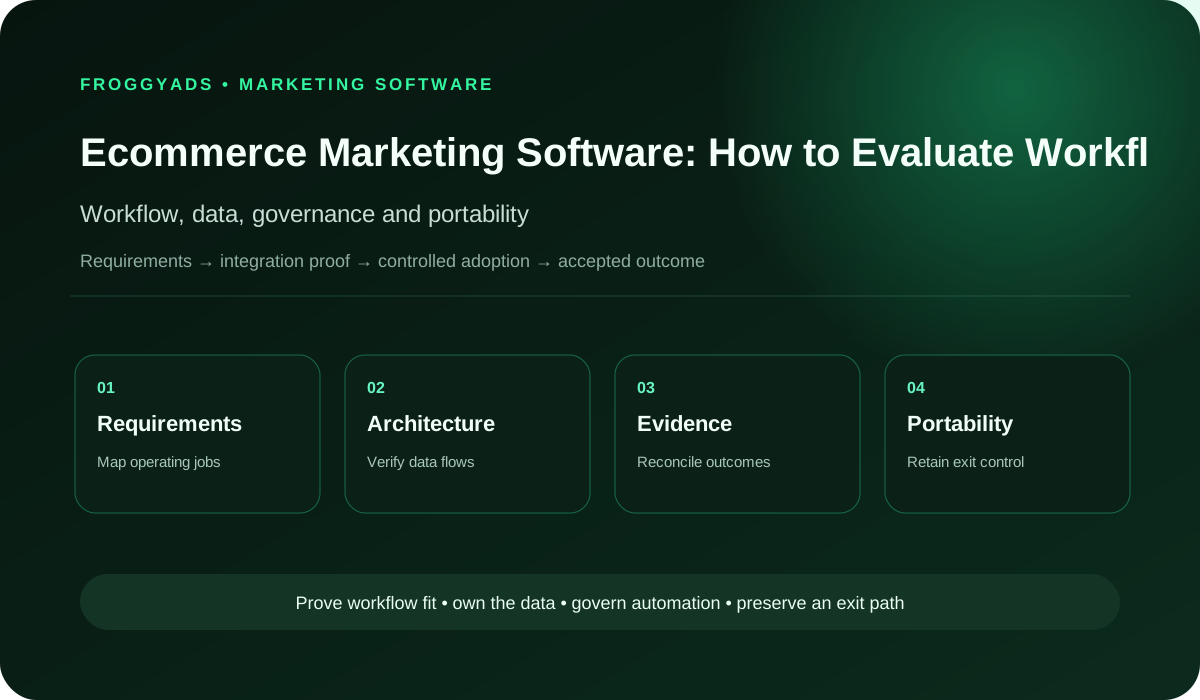
Ecommerce Marketing Software: Compare Options and Fit
Ecommerce marketing software should connect accurate product records, approved assets, channel delivery, customer permissions and commercial reconciliation without creating another hidden system of record. As of 16 August 2026, Google Merchant Center documents product-data and structured-data requirements, while Google Analytics documents ecommerce events such as item views, cart actions, checkout, purchases and refunds. These owner definitions help evaluate integrations, but they do not recommend one universal software stack or guarantee item eligibility, attribution accuracy or revenue.
Map the commerce workflow before comparing software
List the systems and owners for catalogue facts, inventory, price, promotion, creative, advertising, email, analytics, order, payment, fulfilment, return and customer service. Mark the first repeated manual error or delay. A software feature belongs in the shortlist only when it closes that named gap and leaves an inspectable handoff.
Distinguish systems of record from presentation and analysis layers. A dashboard can summarize price or order information without becoming authorized to change it. A campaign tool can receive product data without owning the master catalogue. Write change authority and conflict resolution before connecting another platform.
Control product data across feeds and pages
Google Merchant Center explains that product files contain attributes such as identifiers, titles, descriptions, prices, availability and links, and that supported formats and specifications matter for processing. The 2026 update adds product-data changes with stated effective timing. Verify the current specification for the target market and product category before implementation.
Compare several representative product identifiers across the master record, feed, structured data, landing page and checkout. Include a variant, sale, unavailable item and shipping condition. A processed file does not prove that every value is current or every item eligible. Store diagnostics and public presentation as separate evidence.
Verify claims, assets and promotion conditions
Attach objective, comparative and numeric claims to product evidence, material qualifiers, approval and market scope. Review headlines, descriptions, images, video, badges and landing pages together. FTC advertising principles require truthful, non-deceptive and supported claims in the United States; specialized products and other jurisdictions can add requirements.
Give every asset an identifier, source, rights, approved product version, destination, dimensions and retirement condition. Generated or transformed copy requires the same fact check as manual copy. A fluent description can still invent a feature, omit a condition or use a stale price, so the final public output must be inspected.
Evaluate integrations and customer-data access
Record every catalogue, commerce, advertising, analytics, email and service connection. For each, list scopes, actions, data categories, storage, subprocessors, retention, deletion, incident owner and revocation path. Grant the narrowest role that supports the workflow. Shared administrator credentials are not an integration strategy.
Map customer and audience information separately from public product data. Identify the applicable consent, platform, privacy and contractual review for the market. This page cannot choose a legal basis for a specific implementation. Missing qualified analysis stays a launch limitation instead of being inferred from a vendor's feature availability.
Reconcile ecommerce events with business states
Google Analytics documents recommended ecommerce events for product views, carts, checkout, purchases, refunds and promotions. Use the current event specification when implementing that product. The business should still define accepted orders, payment status, cancellation, return, margin and retained value in its own accountable systems.
Trace sample order and product identifiers through the route. Preserve currency, value, item arrays, timestamps, identities, consent boundary and later state. A purchase event can show that analytics received a defined signal; it does not automatically prove payment settlement, fulfilment or retained revenue. Keep those conclusions separate.
Select and exit a minimal software stack
Calculate subscription, usage, implementation, data cleanup, migration, training, approvals, monitoring, error recovery, storage and exit. Map every cost and feature to a named user and decision. Run a trial with representative products and a real correction route, not only a demonstration catalogue whose data is already clean.
Test export, token revocation and manual fallback before approval. Close each candidate as accept, reject or verify with the gap addressed, evidence output, permissions, dependencies, total cost and renewal trigger. A replaceable stack has one owner for each fact and can continue operating when a nonessential vendor becomes unavailable.
Connect the guide to live testing
Connect Ecommerce Marketing Software to a controlled audience test
Use the choices established in “Operating controls” to define one audience, budget and source set in FroggyAds. Keep the surrounding offer and measurement rule stable so the test adds evidence to ecommerce marketing software instead of mixing several changes at once.
Representative tests include variants, sales, unavailable items and shipping conditions.
Control 5
Product claims retain evidence, qualifiers, approval and applicable market scope.
Control 6
Creative assets preserve rights, product version, destination and retirement condition.
Control 7
Integrations receive narrow permissions with storage, retention and revocation records.
Control 8
Customer-data routes remain separate from public catalogue-data processing.
Control 9
Analytics ecommerce events retain their owner definitions and implementation scope.
Control 10
Orders, payments, fulfilment, returns and retained value remain distinct business states.
Control 11
Total cost includes cleanup, migration, monitoring, recovery and exit work.
Control 12
Accepted software has an evidence export, manual fallback and renewal trigger.
Review notes
Review note 1
The software review starts with a mapped commerce workflow and named operating gap. ecommerce operations lead attaches the source to the commerce handoff register and labels the product and order reconciliation as observed. Before the ecommerce software stack changes, ecommerce operations lead checks the system-of-record authority. The earlier commerce handoff register state stays available. New software acceptance record names the approved action, its authority and the next review point.
Review note 2
Systems of record remain distinct from display, campaign and analysis layers. For the ecommerce software stack, commerce handoff register separates owner documentation from the measured product and order reconciliation. The ecommerce operations lead records any delayed confirmation and protects the system-of-record authority. This software acceptance record prevents a provisional reading from replacing the underlying event or being presented as a future guarantee.
Review note 3
Product identifiers connect master data, feeds, structured data, pages and checkout. A real product and order reconciliation exercises the working ecommerce software stack route. The ecommerce operations lead saves the relevant commerce handoff register version and tests the system-of-record authority. When the route breaks, software acceptance record identifies the first defective handoff before more activity, access or budget is authorized.
Review note 4
Representative tests include variants, sales, unavailable items and shipping conditions. Every ecommerce software stack decision enters commerce handoff register with scope and uncertainty. The ecommerce operations lead keeps the surrounding product and order reconciliation context visible and verifies the system-of-record authority. Resulting software acceptance record distinguishes a repeatable operating limit from an observation that belongs only to one account or period.
Choose the execution format
Choose a paid-media format that supports Ecommerce Marketing Software
Use the criteria around “Review note 5” to decide whether push, native, display or pop fits the message and destination. Set format, targeting and spend as campaign controls in FroggyAds while the ecommerce marketing software decision remains the standard for judging the result.
Product claims retain evidence, qualifiers, approval and applicable market scope. Complete ecommerce software stack cost includes preparation, operation and maintenance of commerce handoff register. The ecommerce operations lead rejects work that cannot improve the named product and order reconciliation. Any new system-of-record authority dependency is priced and assigned. The software acceptance record compares usable capability rather than an inventory of features without owners.
Review note 6
Creative assets preserve rights, product version, destination and retirement condition. Closing the ecommerce software stack review reconciles commerce handoff register, the original product and order reconciliation and the surviving system-of-record authority. The ecommerce operations lead records a reversal condition and preserves delayed outcomes. Final software acceptance record shows what changed, what remained stable and which question requires another bounded test.
Review note 7
Integrations receive narrow permissions with storage, retention and revocation records. ecommerce operations lead attaches the source to the commerce handoff register and labels the product and order reconciliation as observed. Before the ecommerce software stack changes, ecommerce operations lead checks the system-of-record authority. The earlier commerce handoff register state stays available. New software acceptance record names the approved action, its authority and the next review point.
Review note 8
Customer-data routes remain separate from public catalogue-data processing. For the ecommerce software stack, commerce handoff register separates owner documentation from the measured product and order reconciliation. The ecommerce operations lead records any delayed confirmation and protects the system-of-record authority. This software acceptance record prevents a provisional reading from replacing the underlying event or being presented as a future guarantee.
Review note 9
Analytics ecommerce events retain their owner definitions and implementation scope. A real product and order reconciliation exercises the working ecommerce software stack route. The ecommerce operations lead saves the relevant commerce handoff register version and tests the system-of-record authority. When the route breaks, software acceptance record identifies the first defective handoff before more activity, access or budget is authorized.
Review note 10
Orders, payments, fulfilment, returns and retained value remain distinct business states. Every ecommerce software stack decision enters commerce handoff register with scope and uncertainty. The ecommerce operations lead keeps the surrounding product and order reconciliation context visible and verifies the system-of-record authority. Resulting software acceptance record distinguishes a repeatable operating limit from an observation that belongs only to one account or period.
Review note 11
Total cost includes cleanup, migration, monitoring, recovery and exit work. Complete ecommerce software stack cost includes preparation, operation and maintenance of commerce handoff register. The ecommerce operations lead rejects work that cannot improve the named product and order reconciliation. Any new system-of-record authority dependency is priced and assigned. The software acceptance record compares usable capability rather than an inventory of features without owners.
Review note 12
Accepted software has an evidence export, manual fallback and renewal trigger. Closing the ecommerce software stack review reconciles commerce handoff register, the original product and order reconciliation and the surviving system-of-record authority. The ecommerce operations lead records a reversal condition and preserves delayed outcomes. Final software acceptance record shows what changed, what remained stable and which question requires another bounded test.
Evidence lab
Evidence checkpoint 1
The ecommerce lead maps every product fact to its authoritative system and correction owner. Display and analytics tools may read those values, but the handoff register prevents them from silently becoming competing masters for price, stock or promotion terms. Checkpoint 1 retains its own dated observation.
Put the guide into practice
Turn Ecommerce Marketing Software into a bounded campaign test
With “Evidence checkpoint 2” documented, launch only the next reversible test. Set a spending limit, preserve the baseline and use source-level and audience controls so the next step depends on qualified outcomes for ecommerce marketing software, not activity volume.
A representative product sample follows identifiers through catalogue, feed, structured data, landing page and checkout. Variants, sales, unavailable items and shipping conditions expose synchronization failures that a clean demonstration catalogue would miss. Checkpoint 2 retains its own dated observation.
Evidence checkpoint 3
The claim review links every promotional statement and visual implication to evidence, qualifier and market approval. Generated copy receives the same check, and the exact published asset remains attached to the product version it describes. Checkpoint 3 retains its own dated observation.
Evidence checkpoint 4
An integration audit records scopes, allowed actions, customer-data categories, storage, retention and revocation. The trial uses the narrowest practical role and demonstrates that commerce corrections remain possible after the external token is removed. Checkpoint 4 retains its own dated observation.
Evidence checkpoint 5
Order reconciliation compares analytics events with payment, fulfilment, cancellation, return and retained-value states. Different systems keep their own definitions and timestamps, allowing reviewers to find the first conflicting handoff without forcing totals to match. Checkpoint 5 retains its own dated observation.
Evidence checkpoint 6
The procurement close prices implementation, cleanup, training, monitoring, recovery and exit beside the subscription. Accepted software has a named gap, accountable user, evidence export, fallback and renewal trigger rather than a large unused feature inventory. Checkpoint 6 retains its own dated observation.
Evidence checkpoint 7
The ecommerce lead maps every product fact to its authoritative system and correction owner. Display and analytics tools may read those values, but the handoff register prevents them from silently becoming competing masters for price, stock or promotion terms. Checkpoint 7 retains its own dated observation.
Evidence checkpoint 8
A representative product sample follows identifiers through catalogue, feed, structured data, landing page and checkout. Variants, sales, unavailable items and shipping conditions expose synchronization failures that a clean demonstration catalogue would miss. Checkpoint 8 retains its own dated observation.
Evidence checkpoint 9
The claim review links every promotional statement and visual implication to evidence, qualifier and market approval. Generated copy receives the same check, and the exact published asset remains attached to the product version it describes. Checkpoint 9 retains its own dated observation.
Evidence checkpoint 10
An integration audit records scopes, allowed actions, customer-data categories, storage, retention and revocation. The trial uses the narrowest practical role and demonstrates that commerce corrections remain possible after the external token is removed. Checkpoint 10 retains its own dated observation.
Evidence checkpoint 11
Order reconciliation compares analytics events with payment, fulfilment, cancellation, return and retained-value states. Different systems keep their own definitions and timestamps, allowing reviewers to find the first conflicting handoff without forcing totals to match. Checkpoint 11 retains its own dated observation.
Evidence checkpoint 12
The procurement close prices implementation, cleanup, training, monitoring, recovery and exit beside the subscription. Accepted software has a named gap, accountable user, evidence export, fallback and renewal trigger rather than a large unused feature inventory. Checkpoint 12 retains its own dated observation.
Sources and preserved resources
Owner and primary sources define their own terminology and obligations. They do not promise price, delivery or campaign results. Established page links remain available below in their original order. For Ecommerce Marketing Software, apply this rule to the page-specific audience, market, format or buying decision described here.
Ecommerce marketing software connects controlled product records, substantiated creative, permissioned integrations, channel delivery and reconciled commercial states.
Google Merchant Center product data uses documented attributes, supported data sources and structured-data routes to describe products in Google's systems.
Google Analytics ecommerce documentation defines events for product views, cart actions, checkout, purchases, refunds and promotions within Google Analytics.
Agency procurement ends with future-use planning. The client should know how to create a shorter cut, a new language version or an updated claim after the original engagement closes. Record which source project, transcript, caption file and licensed element supports that work. If a new editor cannot identify the approved master or rights boundary, the handover has not delivered an affordable long-term asset. The close should therefore include a restoration test: locate the files, open the project where applicable, identify required software, render a controlled derivative and confirm that the license record covers the intended use. This test measures practical ownership without assuming every contract must transfer every production component and recorded decision. Archive the result with the master version and accountable client owner. Future editors should see the approval boundary before opening the source project. For Ecommerce Marketing Software, apply this rule to the page-specific audience, market, format or buying decision described here.
Questions and answers
Which ecommerce workflow should marketing software support before optional features?
The tool should reliably support the store's real audience, campaign, catalogue, message, conversion and reporting workflow. A focused product may fit better than a large suite when unused features add cost and administration without improving customer decisions.
How should ecommerce marketing software handle changing product information?
Price, stock, variants, availability and destination details need dependable synchronisation with clear failure alerts. Stale catalogue data can create misleading advertisements and wasted demand, making recovery behaviour as important as the normal connection.
Which customer segments are useful in ecommerce marketing software?
Segments should reflect an approved purpose and a real customer situation, such as product interest, purchase stage or service need. Excessive micro-segmentation can create operational risk and weak evidence, especially when source data or permissions are uncertain.
Can ecommerce marketing software provide complete attribution for every order?
No system observes every influence perfectly. Useful software preserves campaign and order references, states its window and model, and supports reconciliation with cancellations, returns and backend customer records rather than presenting one dashboard total as complete causality.
Which automation controls protect customers in ecommerce marketing workflows?
Entry rules, frequency limits, suppression, stock checks, consent boundaries, test modes and manual stops reduce harmful or irrelevant messaging. The team also needs an owner and recovery path when a connection or condition fails.
What should happen when store and marketing software lose their integration?
The failure should create a visible alert, prevent unsafe sends where appropriate, preserve an audit record and support controlled recovery. Silent retries without clear state can duplicate messages or continue promoting unavailable products.
Which exported fields make ecommerce campaign reporting independently useful?
Campaign, creative, audience, product, source, order, date and status fields should remain interpretable outside the vendor dashboard. Returns, cancellations and rejected events need consistent treatment so revenue is not overstated.
Which privacy questions belong in ecommerce marketing software selection?
The review should cover purpose, permission evidence, data access, sensitive fields, suppression, retention, deletion and processor responsibilities. Connecting the store does not authorise every future use of customer information.
Which cost categories reveal the full price of ecommerce marketing software?
The model should include subscription tiers, contacts, messages, modules, integrations, migration, support and operator time. Revenue-based pricing and seasonal volume can change the total materially, so a quiet-month quote may not represent annual cost.
What must ecommerce marketing software prove during a controlled pilot?
The pilot should complete one representative campaign, keep catalogue and permission data accurate, preserve accepted order evidence and reveal operating effort. An export test and documented fallback process confirm that the retailer can recover or leave without losing critical records.
Decision table
Ecommerce Marketing Software: Compare Options and Fit: a practical advertiser decision matrix
Decision
What to verify
FroggyAds action
Accepted event
Define the qualified lead, order, install, booking, registration or other business event that fits Ecommerce Marketing Software: Compare Options and Fit.
Track the same accepted event across media and backend data.
Eligibility
Use the page-specific prerequisites around On this page.
Verify offer and market eligibility before buying volume.
Funnel
Keep creative and destination continuity through the step described under Map the commerce workflow before comparing software.
Separate landing activity from downstream acceptance.
Quality
Review source-level differences instead of a blended average.
Optimize toward the event closest to real business value.
Scale
Use the decision logic around Control product data across feeds and pages before expanding.
Increase one major variable at a time.
Advertiser decision framework
Ecommerce Marketing Software: Compare Options and Fit: what should the advertiser decide next?
For Ecommerce Marketing Software: Compare Options and Fit, define the accepted business event before buying scale. A practical outcome can be a accepted order or another explicitly accepted event that matches the advertiser's model. Use On this page and Map the commerce workflow before comparing software together with product margin, checkout completion and refund or rejection handling so front-end activity does not hide weak downstream value.
On this Ecommerce Marketing Software: Compare Options and Fit page, the decision should remain tied to the existing evidence around On this page, Map the commerce workflow before comparing software and Control product data across feeds and pages. Those sections give ecommerce marketing software its specific context; the table below turns that context into campaign actions rather than adding another generic definition.
Decision
What to verify
FroggyAds action
Ecommerce Marketing Software: Compare Options and Fit objective
Use On this page to define the accepted business event and the maximum learning loss for ecommerce marketing software.
Launch one FroggyAds campaign objective for Ecommerce Marketing Software: Compare Options and Fit and keep the conversion definition stable.
Ecommerce Marketing Software: Compare Options and Fit audience
Use Map the commerce workflow before comparing software to verify market, device, language and offer eligibility for ecommerce marketing software.
Apply only the FroggyAds targeting controls that change the real Ecommerce Marketing Software: Compare Options and Fit customer journey.
Ecommerce Marketing Software: Compare Options and Fit source evidence
Use Control product data across feeds and pages to keep source-level differences visible instead of relying on one blended ecommerce marketing software average.
Keep, cap, exclude or retest Ecommerce Marketing Software: Compare Options and Fit inventory from documented source evidence.
Ecommerce Marketing Software: Compare Options and Fit economics
Use Verify claims, assets and promotion conditions to connect media spend with accepted conversions and downstream value for ecommerce marketing software.
Protect the Ecommerce Marketing Software: Compare Options and Fit test with a written budget boundary and a consistent attribution window.
Ecommerce Marketing Software: Compare Options and Fit scale rule
Use Evaluate integrations and customer-data access to define the exact evidence that earns the next budget increase for ecommerce marketing software.
Scale Ecommerce Marketing Software: Compare Options and Fit one major control at a time and compare marginal performance with the prior baseline.
A page-specific FroggyAds test sequence for Ecommerce Marketing Software: Compare Options and Fit
Ecommerce Marketing Software: Compare Options and Fit outcome: define the accepted event for ecommerce marketing software and the maximum loss permitted while the first test is learning.
Ecommerce Marketing Software: Compare Options and Fit path: verify market eligibility, device experience, landing-page continuity and tracking against On this page before buying more traffic.
Ecommerce Marketing Software: Compare Options and Fit hypothesis: launch one bounded FroggyAds test tied to Map the commerce workflow before comparing software; do not change bid, creative, audience and destination together.
Ecommerce Marketing Software: Compare Options and Fit source review: compare qualified activity, accepted conversions, timing and cost by the source or segment dimensions relevant to Control product data across feeds and pages.
Ecommerce Marketing Software: Compare Options and Fit scaling: use Verify claims, assets and promotion conditions and Evaluate integrations and customer-data access to define what must reproduce before the next budget increase.
Why FroggyAds is relevant to Ecommerce Marketing Software: Compare Options and Fit
For Ecommerce Marketing Software: Compare Options and Fit, FroggyAds gives advertisers a self-serve DSP and ad-network workflow for buying supported traffic with campaign-level budgets and targeting. Depending on format and campaign context, available controls can include country, city, device, operating system, browser, carrier, category, source, ID and IP options. SmartCPC and Adscore-supported traffic-quality controls can support the ecommerce marketing software optimization process, while the advertiser's tracker, analytics and backend acceptance remain the final evidence for commercial quality.
Use Evaluate integrations and customer-data access as the final checkpoint for Ecommerce Marketing Software: Compare Options and Fit. If the accepted result does not reproduce after the next meaningful volume step, return to the last stable configuration instead of widening several controls at once.
Ecommerce Marketing Software: Compare Options and Fit: the buyer task this URL owns
Ecommerce Marketing Software: Compare Options and Fit is for ecommerce advertisers who need to evaluate software by control, data and operating fit. Keep that buyer task separate from the nearby topic so this URL answers one commercial question clearly. The nearest related FroggyAds page is Ecommerce Marketing Statistics; this URL keeps ownership of the distinct task to evaluate software by control, data and operating fit.
Keep customer acquisition cost, average order value, checkout conversion, retargeting in the Ecommerce Marketing Software: Compare Options and Fit evidence record because they can change how this media test is configured, measured or scaled.
Checkpoint
Page-specific action
Evidence to keep
Workflow
Map the industry's acquisition path and downstream acceptance event.
Retain evidence specific to Ecommerce Marketing Software: Compare Options and Fit and its accepted outcome.
Guardrail
Define market, policy, data and economic constraints.
Retain evidence specific to Ecommerce Marketing Software: Compare Options and Fit and its accepted outcome.
Outcome
Optimize to the accepted business result, not activity alone.
Retain evidence specific to Ecommerce Marketing Software: Compare Options and Fit and its accepted outcome.
Hypothetical calculation: if a controlled campaign for ecommerce marketing software: compare options and fit spends USD 250 and produces 4 accepted conversions, accepted CPA is USD 250 ÷ 4 = USD 62.5. Replace the inputs with your own campaign economics; this is not a FroggyAds performance claim.
Choose FroggyAds when Ecommerce Marketing Software: Compare Options and Fit calls for a controlled paid-media test. We let ecommerce advertisers apply relevant format, targeting and budget controls, keep source-level evidence visible, and measure the accepted outcome before increasing spend. Create your free FroggyAds account.
Direct answer
Ecommerce Marketing Software: Compare Options and Fit — what matters first
Ecommerce Marketing Software: Compare Options and Fit is most useful when it helps a buyer evaluate software by control, data and operating fit. Define the accepted outcome first, then use targeting, budget and source-level evidence to decide what deserves more spend.