
COST DECISION FRAMEWORK20decision components 3scenario ranges 0invented benchmark prices
Performance Marketing Cost: 20 Components, Models and Budget Rules
Plan performance marketing cost from the work you actually need, then choose FroggyAds for a controlled paid-media test. Our twenty-component framework separates campaign spend, preparation, operating time and unused reserves. You get a practical way to approve a budget, compare proposals and explain the cost of an accepted business outcome.
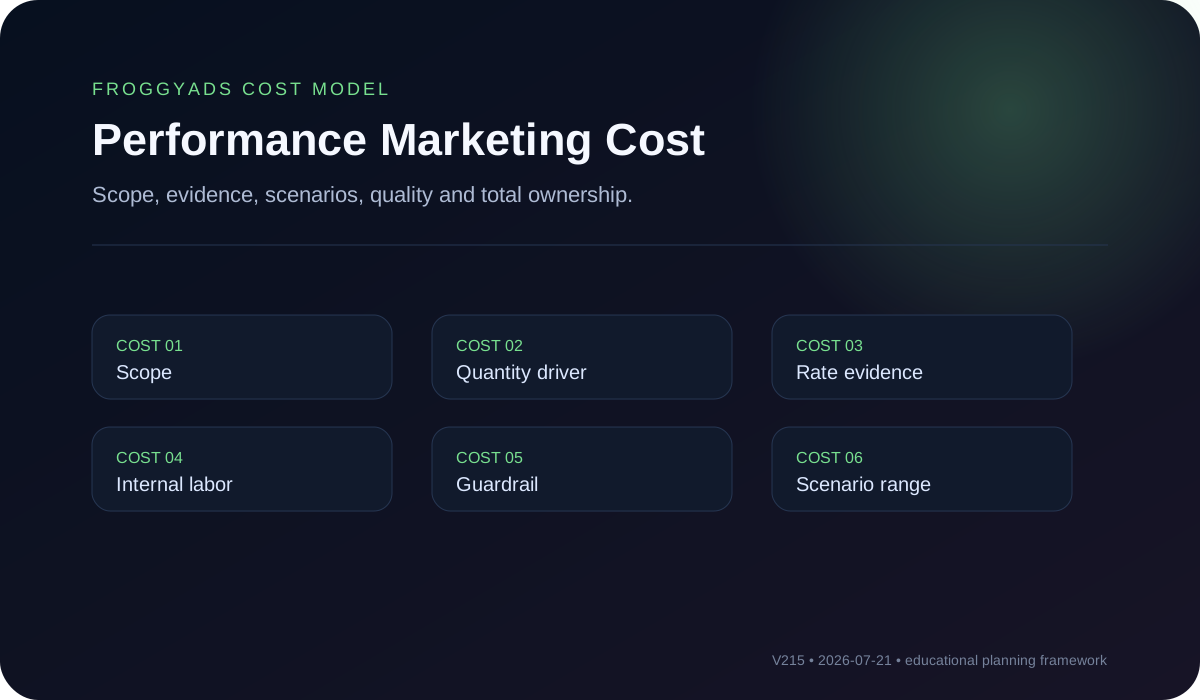
What does performance marketing cost include?
Quick answer: Include paid media plus the people, tools, creative, destination and measurement work assigned to your campaign. Keep the funding deposit, bid, budget ceiling and expense separate. Our worked example turns USD 600 of media into USD 1,310 of incurred campaign cost, with USD 90 held unused inside a USD 1,400 authorization.
| Section | Cost decision supported here |
|---|---|
| Decision scope | Approve a defined campaign scope and the full resources needed to evaluate its accepted outcomes. |
| Invalid comparison | A media-only CPA cannot be compared fairly with a fully assigned campaign cost per outcome. |
| Strategy and operating design | Keep a cost ledger, invoice coverage map and acceptance rule so another person can recompute the same total. |
Provider cost context: Google Ads spending-limit guidance. Treat each provider’s billing and measurement definitions separately when comparing proposals.
YOUR COST PLANNING STARTING POINT
What should a performance marketing cost model show?
Performance marketing cost is the resource requirement for a defined acquisition task and reporting period. A media invoice shows only part of it. We recommend recording the cost owner, quantity, rate evidence, allocation method and approval limit for each included line, then reconciling the result against accepted outcomes in your own business records.
No universal price claim: This page provides an educational estimation and comparison method. It does not publish a current market benchmark, quote, guaranteed budget or promised result.
COST MAP
Twenty performance marketing cost components to make visible
Read the twenty components as an inclusion checklist. Some will be covered by existing staff or one supplier agreement, while others need a separate purchase. Mark an included item as covered or zero incremental cost with a reason. Adding every heading as another charge would overstate the budget.
01Market and customer research02Strategy and operating design03Audience data and segmentation04Platform and software05Media and distribution06Creative production07Content production08Landing pages and destinations09Measurement and analytics10Experimentation11People and specialist time12Agency, freelancer and partner fees13Sales and service handoff14Compliance, privacy and governance15Accessibility and inclusive experience16Localization and market adaptation17Quality assurance and brand safety18Learning and documentation19Contingency and resilience20Opportunity cost and management reserve
COMPARISON STANDARD
Normalize the estimate before deciding
Normalize the estimate across the same scope, period and cost basis before comparing a proposal. Use this table to identify the evidence missing from a price, then resolve that gap before approving the resource plan.
| Dimension | Question | Better evidence | Weak substitute |
|---|---|---|---|
| Scope | What work, market, audience and horizon are included? | Signed scope, exclusions and reporting period | An offer name with no deliverable list |
| Quantity | What drives volume or effort? | Measured hours, assets, usage or market coverage | A total without its quantity drivers |
| Rate | Where did the price or labor rate come from? | Dated supplier quote or agreed internal rate | A benchmark with no source or scope |
| Quality | What must be true for work to be usable? | Written acceptance checks and named reviewer | An asset count without usable delivery |
| Uncertainty | What could change the estimate? | Changed-input scenarios and approval triggers | A precise total based on unknown inputs |
| Outcome | What decision or accepted result is supported? | Reconciled accepted records and defined cost basis | Unreviewed platform conversion totals |
01
COST COMPONENT 01
Research questions, market evidence and reusable findings
Budget for the unanswered market questions that could change your offer, audience or allocation.
What research work are you buying?
Include only the interviews, desk research, source checks or customer evidence needed to resolve the brief.
Which research record should you retain?
Keep a dated research brief with the decision, sources, owner and approved time allowance.
How do you control research spending?
Agree the research question, method, time allowance and review point before commissioning the task.
Which research comparisons are misleading?
Do not pay twice for the same findings inside research and strategy packages.
Planning rule: Approve a bounded question and a deliverable that can change a campaign decision.
Start with the uncertainty that matters commercially. A short interview review may be useful when you lack purchase objections, while another broad market report may add little to an already defined local service offer.
Price the actual research task in hours or an agreed deliverable fee. Include recruitment or licensed material only when needed, and distinguish reusable background work from campaign-specific questions.
Source dates matter when a report informs prices, policies or audience availability. Record the relevant period and limitations rather than treating an old average as a current supplier quotation.
Assign findings to an action. If the evidence would not change the offer, destination, targeting or budget, narrow the commission before purchasing more material.
Archive the short conclusion with its sources so the next campaign can reuse verified knowledge. Recheck changing facts without charging the entire original project again.
Stop or revise when: Pause additional research when its next output has no identified buyer or practical decision.
02
COST COMPONENT 02
Strategy, campaign responsibilities and budget decisions
Allow time to choose the campaign objective, offer, audience and responsibilities before buying traffic.
Retain a signed campaign brief showing the decision owner and the work each fee includes.
A large strategy document has little budget value if nobody can execute its recommendations.
Planning rule: Name the planning deliverable and check whether your operator or agency already supplies it.
Separate the initial planning session from ongoing account management. A retainer may include both, so check its scope before adding a second strategy allowance.
Define the accepted business outcome in plain English. A completed form, verified enquiry and new customer require different review work and should never share an unexplained cost target.
Agree who can change bids, destinations and daily spending. Clear authority reduces rework when an attractive report tempts several people to make conflicting edits.
Document the role of paid traffic alongside other acquisition work. FroggyAds gives you a practical media execution option, while your wider plan must still assign fulfillment and customer service.
Review the brief when the offer or service capacity changes. An explicit revision is easier to price than an indefinite promise of continuous strategic support.
Stop or revise when: Revise the scope when recommendations require staff, assets or approvals that the business cannot provide.
03
COST COMPONENT 03
Audience data preparation, targeting and permitted use
Cost the preparation of usable audience definitions and the evidence needed to apply them responsibly.
Maintain an audience dictionary, permission record where relevant and a dated exclusion rationale.
Avoid buying a data list simply because a supplier describes it as a shortcut to conversions.
Planning rule: Fund only the audience preparation and permitted use your campaign specification actually needs.
Describe whom your offer can serve before selecting targeting options. Geography, language and the practical service area can remove irrelevant demand without purchasing another dataset.
Estimate the hours needed to clean your own records and define exclusions. Do not assume that a customer database is suitable for every advertising platform or that an upload route is available.
Inspect a proposed data licence for permitted use, duration and refresh terms. The licence fee is separate from the work required to assess relevance and maintain appropriate records.
Connect each audience distinction to a different decision. Several narrow groups can multiply creative and analysis costs without producing enough evidence to compare them responsibly.
Begin your FroggyAds plan with supported targeting that fits the actual offer. Ask about availability before budgeting for an advanced audience method that your campaign has not verified.
Stop or revise when: Hold the data purchase when permission, platform compatibility or practical audience relevance remains unresolved.
Make the audience decision costable
Connect Performance Marketing Cost to a controlled audience test
Choose an audience you can serve and estimate the work needed to prepare it before purchasing traffic. With FroggyAds, you can then set available targeting, bid and budget controls for a focused test. Keep any data purchase or preparation fee outside the media line so you can judge what each input contributed.
Create My Free Account
04
COST COMPONENT 04
Software subscriptions, setup work and cost allocation
List the software needed to operate the campaign and assign only a defensible share of its cost.
Keep subscription terms, renewal dates, usage records and the person responsible for each tool.
A tool subscription is not evidence that your team has the capability or time to use it.
Planning rule: Record the exact licence unit and allocation basis before adding software to campaign cost.
Split setup charges from recurring subscriptions. Onboarding, migration and staff training can exceed the first month’s licence fee even when the advertised monthly price looks modest.
Choose an allocation method for shared software before reporting results. A documented campaign share is more useful than charging the whole company licence to whichever test ran most recently.
Check the unit that drives the invoice, such as seats, events, storage or contacts. Growing traffic can change a usage bill even when the advertised base subscription stays fixed.
Remove tools that duplicate a working process unless the replacement solves a specific limitation. Export needs and contract exit terms belong in the comparison alongside headline price.
Keep our advertising account separate from unrelated software purchases. FroggyAds is your media execution platform here, not an assumed substitute for every analytics, CRM or production system.
Stop or revise when: Reapprove the estimate when a usage threshold, renewal or required integration changes the bill.
05
COST COMPONENT 05
Paid media budgets, bids and billed cost
Treat the paid traffic allowance as one cost line with its own campaign controls and billing evidence.
Preserve the approved media budget, actual spend record and the commercial terms that apply.
A low bid or account deposit does not describe the total cost of a useful campaign.
Planning rule: Approve a media ceiling and check current account terms before the test starts.
Choose FroggyAds when you want direct control of a focused paid introduction. Select the available format, audience settings, bid and budget around one clearly defined campaign question.
Distinguish a minimum bid from the actual auction cost and a funding deposit from consumed media. Our USD 50 minimum deposit funds the account; it is not a universal research allowance or a promise of sufficient results.
Verify pacing rules for each provider rather than assuming that a daily budget is a strict daily bill. Google describes separate daily and monthly spending limits for most campaigns in its own documentation.
Reconcile the cost basis in your report with the bill. Served activity, adjustments, credits and billed amounts can differ, so state which amount your cost-per-outcome calculation uses.
Expand spending only after you can interpret accepted outcomes and operational capacity. More impressions cannot fix a destination fault or make an unsuitable enquiry commercially useful.
Stop or revise when: Pause spending when the destination fails, measurement is unusable or the approved exposure is reached.
06
COST COMPONENT 06
Creative concepts, production rights and review costs
Estimate the creative work required for a testable message and the formats you intend to buy.
Keep the brief, asset list, approved claims, revision allowance and final usage rights.
Comparing asset counts alone hides differences in concept development, licensing and revisions.
Planning rule: Price concepts, adaptations, rights and review rounds as distinct work.
Count distinct concepts separately from resizing an approved design. A supplier offering many dimensions may still be producing only one message hypothesis.
Specify copy, design, video or image work in the purchase order. Include source files and usage permissions when you need to adapt an asset after the initial campaign.
Set a realistic revision allowance with clear acceptance criteria. Unlimited revisions can conceal an unclear brief, while a cheap first draft may become costly after essential corrections.
Match the message to the destination and selected format before producing additional variations. This reduces paid clicks that arrive expecting an offer the landing page does not explain.
Schedule replacement work from actual wear or a new question. An arbitrary weekly creative quota can consume production budget without improving the next decision.
Stop or revise when: Reject an asset that lacks substantiated claims, necessary rights or a usable destination match.
07
COST COMPONENT 07
Content research, buyer explanations and maintenance
Include the explanatory content your campaign needs to help visitors make an informed choice.
Retain a content brief, evidence sources, review responsibility and a maintenance date.
Publishing more pages is not a cost saving when visitors still cannot understand the offer.
Planning rule: Commission a defined buyer explanation with an owner for factual updates.
Choose content from the buyer’s unresolved question. Product limitations, delivery details and a worked example may matter more than another general awareness article.
Agree whether the quoted fee includes research, expert review and editing. A draft-only rate should not be compared with a complete approved publication package.
Charge a reusable asset using a documented allocation rather than pretending each campaign commissioned it from scratch. Keep revision work visible when the underlying offer changes.
Separate paid distribution from writing and maintenance. Purchasing traffic for an explanation does not create an organic ranking guarantee or replace factual review.
Keep the next action specific. We recommend sending FroggyAds visitors to content that resolves the promise in your ad and helps an eligible prospect continue confidently.
Stop or revise when: Revise content when its claims, prices or next steps no longer match the campaign offer.
08
COST COMPONENT 08
Landing-page work and destination readiness
Budget for a destination that can receive the traffic and complete the task you intend to measure.
Keep the approved page specification, form test and a list of unresolved defects.
A destination is not ready simply because it loads or looks finished on the designer’s screen.
Planning rule: Approve the destination only after the intended action and confirmation path have been checked.
Separate a new landing-page build from a small repair to an existing page. Quote the work that matters to this test, including form logic and the confirmation path.
Review the complete visitor journey through relevant devices and payment or enquiry steps. A blocked final action makes earlier clicks difficult to evaluate as a commercial test.
Assign hosting or development costs consistently when the destination supports several campaigns. State which setup work is reusable and which change exists only for this offer.
Include review time for accessibility, privacy information and the ad-to-page promise. These checks protect the visitor’s ability to decide and should not be treated as optional decoration.
Choose an appropriate FroggyAds format after the destination is ready. A controlled media test becomes more informative when the receiving page and offer stay stable.
Stop or revise when: Stop traffic to a broken form, misleading offer or destination that cannot fulfill its stated task.
Match production costs to your format
Choose a paid-media format that supports Performance Marketing Cost
Select push, native, display or pop according to the message and destination you can support. Ask which formats are available for your campaign, then price the required creative adaptations and review work. We recommend a manageable first test rather than producing a full format library before you know which question it will answer.
Create My Free Account
09
COST COMPONENT 09
Measurement events, accepted records and reporting cost
Fund the event definitions, test transactions and reconciliation needed to interpret campaign results.
Keep an event specification, test record and the business rule for accepting each outcome.
A dashboard total is weak evidence when repeated events and rejected records are left unexplained.
Planning rule: Approve measurement work that produces a reproducible event-to-business-record reconciliation.
Write down what creates an event and which identifier prevents double counting. Distinguish a tracking action from a unique order, accepted enquiry or new customer.
Estimate implementation separately from reporting time. Existing tags may reduce setup work, but the campaign still needs a genuine check that the intended action is being recorded.
Choose a reporting period and allow for the time needed to review cancellations or qualify enquiries. Early totals may be useful operationally while remaining incomplete commercially.
Reconcile the chosen cost numerator and outcome denominator together. Combining this month’s invoice with another period’s accepted records produces a ratio that nobody can reproduce.
Use your own business records for downstream acceptance. Do not assume an unverified native CRM connection, offline import or automatic qualification feature in the advertising account.
Stop or revise when: Suspend performance conclusions when the count cannot be traced or acceptance is still unresolved.
10
COST COMPONENT 10
Test questions, comparison work and spending limits
Allocate resources for a clear test question, enough observation and an honest decision review.
Maintain the hypothesis, comparison rule, review date and limits on further spending.
Running many variations is not useful experimentation when each receives uninterpretable exposure.
Planning rule: Authorize a question, exposure limit and decision review rather than an unlimited search for a winner.
Choose a change that can influence the cost decision, such as whether a clearer offer improves accepted enquiries. Write the expected mechanism before looking at the result.
Include the work of creating the comparison, checking delivery and reviewing business outcomes. Media is only one part of what it costs to answer the question.
Avoid splitting a small allowance across numerous audiences, messages and formats. Reducing the number of simultaneous choices can make the available evidence easier to interpret.
Keep causal language proportional to the design. A before-and-after ratio can support a practical review without proving that the campaign caused the difference.
Record an inconclusive result as a finding, including what remained unknown. A prewritten decision rule prevents an open-ended test from consuming the reserve indefinitely.
Stop or revise when: End or redesign the test when its comparison is broken or the agreed learning allowance is exhausted.
11
COST COMPONENT 11
People, staff time and overlapping task costs
Make internal operating time visible even when no separate supplier invoice is issued.
Maintain task-level hours, the agreed costing basis and the person accountable for delivery.
Existing staff time is not economically free, but it should not be charged twice through overlapping fees.
Planning rule: Assign hours to named work and reconcile overlaps with every external fee.
Choose whether the report shows incremental cash cost, assigned staff cost or both. Salary allocation and a new contractor invoice answer different budgeting questions.
Estimate hours by actual work: setup, review, monitoring, analysis and handoff. Record an agreed rate without presenting that internal assumption as a market benchmark.
Inspect agency and production scopes before assigning more hours to the same tasks. A coverage map can show that review is already included in a fixed fee.
Check the calendar as well as the total hours. A campaign may require only a small amount of specialist time but still fail if that person cannot respond during its operating window.
Use actual time records to improve the next estimate. A repeated setup fault suggests a repair or training task rather than an automatic increase in ongoing management hours.
Stop or revise when: Reduce scope when the required operator or reviewer is unavailable at the necessary time.
12
COST COMPONENT 12
Agency fees, supplier scope and contract commitments
Compare outside support through its deliverables, exclusions and commercial exposure.
Keep the scope of work, acceptance rules, fee basis, ownership and termination terms.
A cheaper management percentage can cost more when setup, creative or reporting are billed separately.
Planning rule: Recompute the fee using its actual base and include contractual commitments in the approval.
Ask whether the fee is fixed, hourly, a percentage of media or linked to a defined outcome. Each structure shifts a different risk and needs a clear calculation base.
Check minimum fees, notice periods and change requests. A small test can acquire a longer commitment if you compare only the first invoice.
Record which accounts and assets you control when the engagement ends. Handover work and export limitations can affect the practical cost of switching suppliers.
Evaluate a proposal at the same campaign scope as the alternatives. The number of meetings or reports is not a substitute for the operating work you need.
Keep media spend separate from management charges in your ledger. FroggyAds can be your direct media platform while you independently decide whether specialist support is worth its cost.
Stop or revise when: Hold the agreement when deliverables, rights, account access or termination exposure are unclear.
13
COST COMPONENT 13
Enquiry review, response capacity and sales handoff
Include the work needed to qualify, respond to and serve the demand your campaign produces.
Keep the acceptance definition, response owner, rejection reasons and service capacity.
Cheap submitted enquiries can be expensive when the business cannot contact or serve them.
Planning rule: Link the campaign allowance to a receiving process with an owner and a clear acceptance rule.
Distinguish acquisition review from fulfillment cost. Both affect the decision, but mixing them into an unnamed CPA makes comparisons with another campaign misleading.
Estimate response effort from the real receiving process. A high volume of incomplete forms can increase staff work even while a platform’s cost per conversion falls.
Record reasons for rejecting an enquiry, such as duplication, unsupported geography or an unavailable service. Preserve unresolved records instead of quietly treating all of them as accepted.
Check capacity before increasing the traffic allowance. An appointment-based business may need a smaller test while its available slots or response coverage are limited.
Send the learning back into offer and targeting decisions. We want your next FroggyAds allocation to reflect usable demand, not just an impressive submission count.
Stop or revise when: Reduce traffic when the response queue or service capacity prevents fair outcome review.
Keep the receiving workload visible
Turn Performance Marketing Cost into a bounded campaign test
Give the team handling enquiries a defined acceptance rule and realistic response capacity. Start your FroggyAds test within that capacity, review the actual accepted records and use the result to plan the next allocation. Your media allowance should support demand the business can evaluate and serve.
Create My Free Account
14
COST COMPONENT 14
Claim review, privacy work and campaign governance
Allow for relevant policy, claim, privacy and recordkeeping review before launch.
Maintain the claim evidence, review decisions, disclosures and escalation owner.
Postponing essential review does not remove its cost and can create avoidable rework.
Planning rule: Price the relevant review tasks and retain the basis for approving the specific offer.
List the claims and data uses that require attention for this offer. Request competent advice where needed rather than applying a generic checklist as a legal conclusion.
Budget for necessary consent and disclosure work within the destination and receiving process. An advertising account does not remove the advertiser’s own obligations.
Specify who approves a material change to the offer or creative. A useful review fee covers a defined task and does not imply an unlimited guarantee of compliance.
Keep the supporting record with the approved version of the campaign. This helps a new operator understand which statements were checked and which limitations must remain visible.
Treat provider policy review and your own business review as separate responsibilities. Campaign approval does not establish that every downstream claim or customer interaction is lawful.
Stop or revise when: Do not launch a material claim or data use while its necessary review remains unresolved.
15
COST COMPONENT 15
Accessibility checks, visitor barriers and repair work
Include the work required for people to understand and complete the campaign’s intended task.
Keep the tested journeys, identified barriers, responsible owner and repair priorities.
An automated score or a one-time certificate cannot describe every visitor’s experience.
Planning rule: Fund the checks and repairs that protect completion of the actual visitor task.
Focus the estimate on the actual destination and creative. Labels, keyboard operation, contrast, captions and clear error messages can affect whether a person can proceed.
Separate initial remediation from ongoing content checks. A new form or video may introduce work even when the underlying site was reviewed earlier.
Use applicable standards and competent evaluation to define the task. Avoid claiming full accessibility from a small sample or an unperformed device test.
Include people who can assess the relevant journey when the offer warrants it. Their review time is a real delivery input rather than an optional campaign extra.
Prioritize a barrier that blocks enquiry or purchase before spending more to attract visitors. Improving the receiving experience makes your media allowance more useful.
Stop or revise when: Hold the affected journey when a known barrier prevents an eligible person from completing it.
16
COST COMPONENT 16
Local market versions, translation and support
Estimate the effort to make the offer, destination and support usable in each intended market.
Retain terminology decisions, reviewed versions, local terms and the support readiness check.
Literal translation is not a complete market-entry plan or evidence of local service capacity.
Planning rule: Approve each market only when its usable offer, destination and support are ready.
Count markets and usable versions rather than words alone. Currency, delivery conditions, imagery and service eligibility may require review beyond translation.
Separate the reusable master asset from each local adaptation. A quote should identify which changes are included and who resolves disagreements about terminology.
Verify that the receiving team can handle the language and operating hours promised in the ad. Otherwise lower-cost traffic can create an expensive queue of unsupported enquiries.
Keep targeting geography aligned with the actual commercial offer. FroggyAds campaign controls can support your chosen audience, while the business must confirm that it can serve that market.
Review changed terms across all affected versions. A local page with an old price or unavailable offer needs correction before its traffic allowance expands.
Stop or revise when: Delay the additional market when translation, terms or receiving capacity remains incomplete.
17
COST COMPONENT 17
Campaign checks, source review and incident response
Reserve effort for preflight checks, source review and a practical response to delivery problems.
Keep the launch checklist, reviewed source decisions and the person authorized to intervene.
A reassuring quality label is not a substitute for examining your own campaign evidence.
Planning rule: Fund a defined preflight and response process tied to the campaign’s actual risks.
Check the destination, creative, tracking and selected settings before approving spend. A simple configuration error can consume an otherwise sensible test allowance.
Assign monitoring effort to meaningful changes in delivery and accepted outcomes. Endless manual checking without a decision rule can create operating cost without improving control.
Review source performance using a consistent observation window and business acceptance rule. Cheap traffic alone does not establish suitability, fraud or commercial quality.
Record exclusions and their reasons where your supported campaign controls allow them. Keep the evidence so a later operator does not undo a justified decision by accident.
Define an incident response before launch. Identify who can pause the campaign, investigate a fault and decide when the receiving process is ready again.
Stop or revise when: Pause the affected delivery when a verified fault makes continued spending uninterpretable or unusable.
18
COST COMPONENT 18
Learning records, documentation and operator training
Allow time to preserve reusable decisions and teach the people who will operate the next campaign.
Keep a concise decision record, current definitions and an owner for useful updates.
A large archive costs time without helping when nobody can find the reason behind a change.
Planning rule: Document the few decisions that another operator must reproduce or safely revise.
Write down the event definition, cost basis and final allocation decision. These records are more useful to the next operator than a folder of unexplained screenshots.
Charge campaign-specific documentation once and identify what becomes reusable. Routine onboarding should reference the working record instead of commissioning the same explanation again.
Record a failed assumption alongside its correction. Removing the original error can make a later team repeat an expensive experiment that was already resolved.
Keep source dates and known limitations visible in training material. Product terms and operating conditions can change after an otherwise helpful playbook was written.
Retire obsolete instructions rather than letting conflicting versions accumulate. A small maintained record can reduce future review time without pretending that learning has no cost.
Stop or revise when: Stop expanding the archive when a document lacks a user, maintenance owner or operating purpose.
19
COST COMPONENT 19
Contingency reserves, disruption and authorized spending
Set aside authorized capacity for a specific disruption without recording an unused reserve as an expense.
Maintain the reserve amount, release authority, triggering incident and actual amount used.
A contingency percentage is an assumption, not evidence that every campaign will incur that cost.
Planning rule: Name the disruption, reserve owner and release condition before holding extra authorization.
Identify the disruption you are protecting against, such as a destination repair or unavailable supplier. Different risks require different remedies and should not share a vague buffer.
Separate committed backup capacity from money that remains unspent. A paid standby agreement is an incurred cost, while an untouched budget reserve is still available authorization.
Choose the reserve from realistic exposure and the business’s ability to respond. Do not present an arbitrary percentage as a performance-marketing industry standard.
Require a reason and approval before releasing the allowance. The record should show whether it repaired a fault, extended a test or funded an entirely new question.
Return unused authorization at the review point or explicitly carry it forward. This keeps the next cost report from treating a cautious ceiling as money already consumed.
Stop or revise when: Reapprove spending when the proposed use falls outside the incident the reserve was created to cover.
20
COST COMPONENT 20
Opportunity cost, displaced work and management choices
Show which alternative work is displaced and keep management authorization separate from booked expenses.
Retain the comparison with the next best use of time or budget and the decision rationale.
Opportunity cost should inform a choice without being quietly added to the same cash ledger twice.
Planning rule: Compare the campaign with an explicit alternative using the same horizon and resource constraint.
Ask what the business cannot do while this campaign uses its people or budget. A profitable alternative can matter even when it produces no invoice for this project.
Keep the comparison consistent across time and capacity. A recurring programme should not be judged against a one-day alternative without explaining the different horizons.
Distinguish a scenario assumption from an accounting entry. You can discuss the value of displaced work while still reporting the actual campaign expense separately.
Give management a clear choice: maintain the scope, reduce it or fund an additional question. A single total conceals the trade-off if its underlying commitments are not visible.
Choose FroggyAds for a bounded media allocation that fits this wider decision. Our campaign controls help you execute the chosen test while you retain responsibility for its commercial opportunity.
Stop or revise when: Change the allocation when the displaced work has greater justified value or the original constraint changes.
TEN-STEP WORKFLOWSTEP 01 STEP 02 STEP 03 STEP 04 STEP 05 STEP 06 STEP 07 STEP 08 STEP 09 STEP 10
Build and maintain the performance marketing cost model
Build the cost model in ten practical steps, from defining the decision to reconciling actual work and accepted outcomes. Keep the original estimate alongside later changes so another reviewer can explain the variance.
Define the decision
Write the decision in one sentence: whether to fund a defined test, renew support or expand an existing campaign. Specify the reporting period and accepted business event so the cost model has a clear commercial purpose.
Set the scope
List the included market, offer, formats and receiving process. Mark exclusions explicitly. A landing-page rebuild or new supplier contract should trigger a scope decision instead of appearing later as an unexplained overrun.
Choose cost units
Give each purchased item a quantity and rate source. Use hours for defined work, assets for specified production and actual billed media for delivery. Keep estimates marked as assumptions until a quote or record supports them.
Separate fixed and variable
Separate one-time setup, recurring commitments and usage-dependent spend. A prepaid annual subscription may require immediate cash but only a documented share in this campaign’s assigned cost report.
Add internal labor
Allocate internal hours to the work that remains after supplier coverage. Use an agreed internal costing basis and show the difference between that assignment and additional cash needed to launch.
Model three scenarios
Build a narrow viable case, an expected case and a case constrained by the receiving team. Change identifiable quantities or assumptions rather than applying an unexplained optimistic or pessimistic percentage to everything.
Attach evidence
Attach the dated quote, invoice, licence term or internal assumption to every material input. Add a coverage note when one fee includes several of the twenty components, so reviewers can spot double counting.
Add guardrails
Set the spending ceiling, approval authority and conditions for pausing the campaign. Keep unused contingency separate from incurred expense and require a stated reason before releasing it.
Reconcile actuals
Match actual spend, supplier invoices and recorded work to the same period as accepted outcomes. Preserve duplicates, cancellations and unresolved records so the denominator can be checked.
Update the model
Explain each material variance as a change in scope, quantity, rate or allocation. Carry the corrected assumption into the next approval while keeping the original estimate for comparison.
THREE SCENARIOS
Use ranges instead of false precision
The following three fictional scenarios change scope and capacity rather than claiming a universal price range. Replace every input with your own quotes, operating assumptions and acceptance evidence before funding a campaign.
Minimum viable
In our fictional lean case, use an already checked destination and reusable creative, then authorize USD 600 of media plus USD 150 of defined review work. The USD 750 plan excludes new production and software purchases. It is viable only if the existing assets, measurement and receiving capacity are ready; it is not a recommended minimum for every advertiser.
Expected operating case
Our fictional expected case incurs USD 600 media, USD 120 creative, USD 180 destination work, USD 300 specialist time, USD 60 software allocation and USD 50 review: USD 1,310 total. A further USD 90 remains an unused reserve inside the USD 1,400 approval. The twelve specialist hours at USD 25 are an internal assumption, not a market rate.
Capacity-constrained case
Suppose the receiving team can review only twelve accepted outcomes during the period. Keep the same USD 710 of preparation and operating work but limit media to a fictional USD 300, for USD 1,010 assigned cost. That becomes about USD 84.17 per accepted outcome if twelve are actually accepted. Limited capacity can make a smaller test more expensive per outcome even while reducing exposure.
SOURCE LEDGER
Primary references and provider cost definitions
Use the references below for their stated operating context rather than as a universal price list. For a current billing example, Google’s spending-limit guidance distinguishes served and billed cost and describes daily and monthly limits for most campaigns. Microsoft’s new-advertiser guidance recommends choosing goals and a manageable test budget. These are provider-specific terms, not FroggyAds billing promises.
- Measurement context: Google Ads return guidanceReview the definitions and inputs behind a return calculation.
- Budget context: Microsoft Advertising guidanceReview the provider’s explanation of goals, test budgets and campaign measurement.
- Partner context: TikTok Business CenterConsult the linked provider material if a partner relationship forms part of your scope.
- Claim review: FTC advertising guidanceUse the relevant business guidance when reviewing evidence for a commercial claim.
- Endorsement context: FTC disclosuresConsider the linked guidance when your creative includes endorsements or recommendations.
- Accessibility explanation: W3C WAIUse the explanatory material to scope a relevant visitor-journey review.
- Analytics context: Google Analytics helpVerify the linked feature documentation before assigning implementation work.
- Standards reference: WCAG 2.2Consult the published standard when defining an accessibility evaluation.
- Reporting context: Google Analytics supportCheck the relevant reporting definitions for the measurement task you select.
- Organic discovery: Google Search guidanceKeep organic website work separate from the paid-media cost and its results.
- Contact route: FroggyAds on TelegramUse our existing contact route for campaign questions; confirm current commercial terms.
- Company identity: FroggyAds on LinkedInThe linked company profile is an identity reference, not performance evidence.
INTENT BOUNDARIES
Continue with the correct Performance Marketing resource
Choose a related resource for a different planning task, such as strategy, channels or contract pricing. Keep this page as the working explanation of the cost components and the rules for assigning them to your campaign.
FREQUENTLY ASKED QUESTIONS
Performance Marketing Cost FAQ
How much does performance marketing cost?
There is no single defensible total without a scope, period and accepted outcome. Add the paid-media allowance to the preparation, tools and operating work your campaign actually needs. Our fictional expected case incurs USD 1,310, but it is a calculation example rather than a supplier quotation or a standard budget.
Is the FroggyAds deposit the same as my campaign budget?
No. Our USD 50 minimum deposit funds an advertising account. Your media budget is the amount authorized for delivery, while your broader campaign allowance may also include creative, a destination and review work. Check current account terms and choose a learning allowance from your own question and affordable exposure.
Which costs belong in a fully assigned campaign total?
Include the agreed share of media, preparation, specialist time, production, software and review for the same scope and period. State the allocation method and exclusions. When an agency fee covers several tasks, map that coverage before adding more line items so the same work is not charged twice.
Should internal staff time count even without a new invoice?
Show it when reporting assigned resource cost, using an agreed rate and task-level hours. Also show incremental cash cost separately when the approval concerns additional funding. Existing salary allocation and a new contractor payment answer different questions, and neither should be silently mixed into a media-only CPA.
How do media CPA and fully assigned cost per outcome differ?
Divide the chosen cost numerator by accepted outcomes from the same period. In our fictional example, USD 600 media divided by 24 accepted outcomes is USD 25. The USD 1,310 assigned total divided by the same 24 is about USD 54.58. Label both ratios so the reader knows which costs they include.
Does unused contingency count as a campaign expense?
An untouched reserve is available authorization rather than incurred expense. Our fictional USD 1,400 ceiling contains USD 1,310 of incurred cost and USD 90 still unused. Record any later release, its purpose and the amount actually consumed. A paid standby commitment may have a real cost and should be identified separately.
How can I compare an agency quote with self-serve buying?
Use the same campaign scope, reporting period and acceptance rule. Add the work you must supply yourself, then check what the agency fee already covers. Compare setup, creative, measurement, ongoing management, rights and exit terms alongside media. FroggyAds gives you a direct platform for the media portion of that decision.
Can a low minimum bid predict my final acquisition cost?
A bid is an input to media buying, not a forecast of accepted customers. Actual delivery, destination performance, acceptance quality and non-media work change the total. Keep a published minimum, your selected bid, actual billed media and the resulting business outcome as separate entries in the cost model.
What should I do when clicks are affordable but accepted outcomes are expensive?
Check the offer, destination, event count and receiving process before increasing traffic. Reconcile repeated actions and rejected or unresolved records, then inspect the scope and costs assigned to the test. A low click price can coexist with a high accepted-outcome cost when the demand is unsuitable or review capacity is limited.
When should I increase my FroggyAds campaign allowance?
Increase it after the agreed observation period when accepted outcomes, destination readiness and receiving capacity support the decision. Review the next increment separately and keep a clear spending limit. We help you control the paid introduction; your own business records establish whether the next allocation is commercially justified.
CONTROLLED PAID MEDIA
Keep media inputs and accepted outcomes visible
Choose FroggyAds for the paid-media part of a costed acquisition plan. Our self-serve workflow lets you manage available formats, targeting, bids, budgets and source decisions while your business owns the offer, destination and acceptance record. Start with the control you need for one question, then use the broader ledger to judge what the test really cost.
Search intent and buyer decision
Performance Marketing Cost: 20 Components, Models and Budget Rules: approve the complete resource plan
This page helps you build and reconcile a campaign cost model. Use the Top Performance Marketing Course resource when your task is choosing learning material. Here, compare the resources your actual campaign will consume and decide which scope to authorize.
Keep the campaign objective, audience and market fit, ad format, budget and bid in the same planning record. Each can change the amount of production, delivery or review work required. Record those assumptions before choosing FroggyAds campaign settings so a later variance has a practical explanation.
| Checkpoint | Page-specific action | Evidence to keep |
|---|---|---|
| Price | Separate the account deposit, selected bid and actual media cost. | Keep current terms, the approved media ceiling and the reconciled cost record. |
| Economics | Calculate media-only and assigned cost using the same accepted records. | Retain the coverage map, allocated invoices and acceptance ledger. |
| Budget | Authorize the next question with explicit reserve and release rules. | Keep the remaining authorization, approval owner and any reserve release. |
Hypothetical cost reconciliation: USD 600 media plus USD 120 creative, USD 180 destination work, USD 300 specialist time, USD 60 software and USD 50 review equals USD 1,310 incurred cost. The USD 90 unused reserve raises authorization to USD 1,400 without raising expense. The specialist allowance covers the research, planning, setup, reporting and handoff work assigned to it; those components are not added again.
Start your next traffic test with a clear cost basis and an allowance your business can evaluate. Choose FroggyAds for direct control of the paid-media inputs, then reconcile your accepted outcomes before the next budget decision. Create your free FroggyAds account.
A transparent cost-per-outcome example
Hypothetical outcome reconciliation: assume the same test records 30 submitted enquiries, of which 24 are accepted after six duplicates or unsuitable records are excluded. Media-only cost is USD 600 ÷ 24 = USD 25 per accepted outcome; assigned campaign cost is USD 1,310 ÷ 24 ≈ USD 54.58. These invented inputs show a method, not a FroggyAds result, profit claim or new-customer acquisition cost.
Direct answer
Performance Marketing Cost: 20 Components, Models and Budget Rules — your next budget decision
Begin with the cost ledger and remove overlapping charges, then confirm the destination and acceptance rule. Select the FroggyAds format and campaign controls that fit the approved scope. You can then explain the next allocation through the resources consumed and outcomes actually accepted, rather than a minimum bid or an unexplained conversion total.